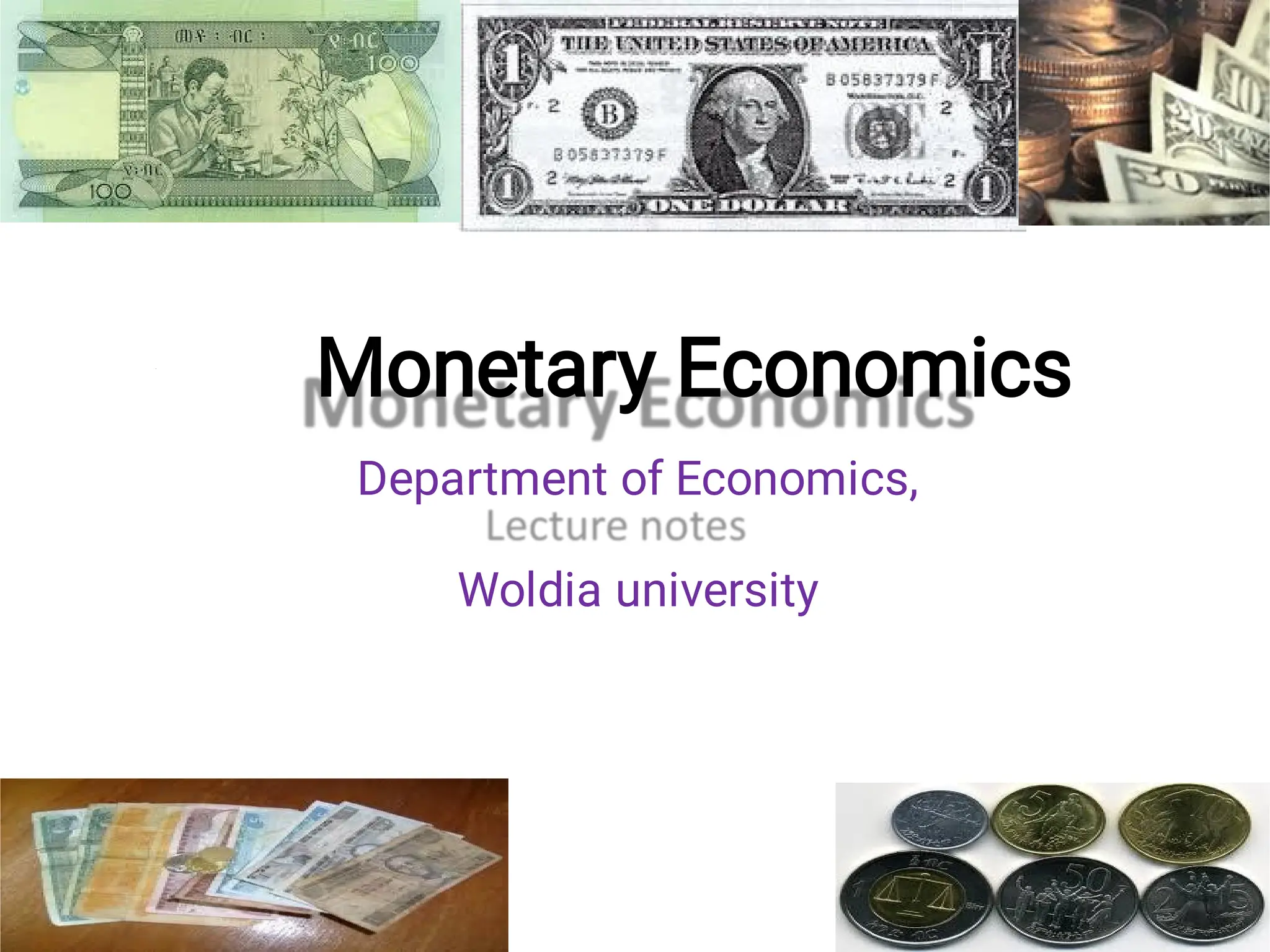
Monetary Economics
Department of Economics,
Woldia university
Chapter 2
•
.
What is Financial system? 






A system that allows the exchange of funds
between lenders, investors, and borrowers
It operates at national, global, and firm-specific
level
It allows funds to be allocated, invested, or
moved between economic sectors
They enable individuals and companies to share
the associated risk
Components of financial system:
financial intermediaries and financial markets
Why study Financial Markets and

Institutions?
They are the cornerstones of the overall
financial system in which financial managers
operate
Individuals use for investing
Corporations and gov.ts use both for
financing
•
•
•
Financial markets (bond and stock markets) and
financial intermediaries(such as banks, insurance
companies ,pension funds)have the basic
function of getting people together by moving
funds from those who have a surplus of funds to
those who have a shortage of funds.
More realistically ,when a local government needs
to build a road or a school it may need more
funds than it gets from its different revenue
sources.
Well – functioning financial markets and financial
intermediaries are crucial to economic health.
•
•
To study the effects of financial markets and
financial intermediaries on the economy, we
need to acquire an understanding of their
general structure and operation .
In this chapter ,we learn about the major
financial intermediaries and the instruments that
are traded in financial markets as well as how
these markets are regulated.
Functions and Structures of Financial
Markets
•
Function of Financial Markets:
Financial markets perform the essential economic
function of channeling funds from households ,
f i
rms ,and governments that have saved surplus
funds by spending less than their income to those
that have a shortage of funds because they wish to
spend more than income.
•
•
•
This function is shown in Figure 1 below.
Those who have saved and are lending funds,
the lender-savers, are at the left, and those who
must borrow funds to finance their spending, the
borrower-spenders, are at the right .
The principal lender –savers are households, but
business enterprises and the government, as
well as foreigners sometimes also find
themselves with excess funds and so lend them
out.
•
•
The most important borrower –spenders are
business and the government, but households
and foreigners also borrow to finance their
purchases of cars, furniture, and houses.
………….
The arrows show that funds flow from lender-
savers to borrower-spenders via two routes.
•
•
In direct finance , borrowers borrow funds
directly from lenders in financial markets by
selling them securities(also called financial
instruments),which are claims on the borrower’s
future income or assets.
Securities are assets for the person who buys
them but liabilities(debts) for the individual or
firm that sells (issues)them. Ex. Bond(debt
security): promises to make payments
periodically for a specified period of time ,stock :
a security that entitles the owner to a share of
the company’s profits and assets.
•
•
•
Why is this channeling of funds from savers to
spenders so important to the economy?
The answer is that to transfer funds from a person
who has no investment opportunities to one whose
promoting investment but lacks the finance
In the absence of the financial markets, the two
might never get together. You would both be stuck
with the status quo, and both of you would be
worse off.
Financial markets are thus essential to promoting
economic efficiency
•
•
•
The existence of financial markets is beneficial
even if someone borrows for a purpose other than
increasing production in a business.
Financial markets are critical for producing an
efficient allocation of capital ,(wealth,either
financial or physical ,that is employed to produce
more wealth), which contributes to higher
production and efficiency for the overall economy.
When financial market breaks down during
financial crisis ,severe economic hardship results,
which can even lead to dangerous political
instability.
•
-
Structures of Financial Markets
The following descriptions of several categorizations
of financial markets illustrate essential features of
these markets.
1. Debt and Equity Markets:
A firm or an individual can obtain funds in a financial
market in two ways.
i. By issuing debt instrument: such as bonds or a
mortgage, which is a contractual agreement by the
borrower to pay the holder of the instrument fixed
dollar amounts at regular intervals until the maturity
date,when a final payments is made.
-
-
Types
Types: Short-Term (maturity  1 year)
Long-Term (maturity  10 year)
Intermediate term (maturity in-between)
ii. By issuing equities
Such as common stock ,which are claims to share
in the net income (income after expenses and taxes)
and the assets of a business.
Equities often make periodic payments (dividends)
to their holders and are considered long term
securites because they have no maturity date.
•
•
In addition, owning stock means that you own a
portion of the firm and thus have the right to vote
on issues important to the firm and to elect its
directors.
The main disadvantage of owning a
corporation’s equities rather than its debt is that
an equity holder is a residual claimant; that is,
the corporation must pay all its debt holders
before it pays its equity holders.
•
•
The advantage of holding equities is that equity
holders benefit directly from any increases in the
corporation’s profitability or asset value because
equities confer ownership rights on the equity
holders.
Debt holders do not share in this benefit because
their dollar payments are fixed.
2. Primary and Secondary Markets:
A primary market is a financial market in which
new issues of a security, such as a bond or a stock,
are sold to initial buyers by the corporation or
government agency borrowing funds.
•
o
The primary market for securities are not well
known to the public because the selling of
securities to initial buyers often takes place
behind closed doors.
E.g. Securities sold by a corporation to investment
bank.
A secondary Market is a financial market in
which securities that have been previously
issued can be resold.
E.g. NYSE
This market serve as an important functions:
They make it easier and quiker to sell these
financial instruments to raise cash(i.e.,to make it
more liquid.)
•
o
4. Money and capital market:
Another way of distinguishing between markets
is on the basis of the maturity of the securities
traded in each market.
The money market is a financial market in which
only short-term debt instruments(generally those
with original maturity of less than one year) are
traded;
o
•
•
The capital market is the market in which longer-
term debt(generally those with original maturity
of one year or greater) and equity instruments
are traded.
Money market securities are usually more widely
traded than longer-term securities and so tend to
be more liquid.
In addition ,short-term securities have smaller
fluctuations in prices than long-term securities,
making them safer investments.
•
•
As a result corporations and banks actively use
the money market to earn interest on surplus
funds.
Capital market securities ,such as stocks and
long-term bonds ,are often held by financial
intermediaries such as insurance companies and
pension funds, which have little uncertainity
about the amount of funds they will have
available in the future.
Money Market Instruments
•
•
-
-
-
-
Because of their short terms to maturity ,the debt
instruments traded in the money market undergo
the least price fluctuations and so are the least
risky investments.
The principal money market instruments are
Treasury bill
Negotiable bank Certificate of deposit
Commercial paper
Repurchase Agreements

•
•
•
Treasury Bills:
Are shot term debt instruments and are the most
liquid of all the money market instruments because
they are the most actively traded.
They are also the safest of all money market
instruments because there is almost no possibility
of default, a situation in which the party issuing the
debt instruments is unable to make interest
payments or pay off the amount owed when the
instrument matures.
the government is always able to meet its debt
obligations because it can raise taxes or issue
currency (paper money and coins)to pay off its
debts.

•
•
Treasury bills are held mainly by banks ,although
small amounts are held by households,
corporations, and other financial intermediaries.
Negotiable Bank certificate of deposit:
Is a debt instrument sold by a bank directly to
depositors that pays interest of a given amount
and at maturity pays back the original purchase
price.
Are an extremely important source of funds for
commercial banks, from corporations, money
market mutual funds, charitable institutions, and
government agencies.

•
•
Commercial Paper:
Is a short-term debt instrument issued by large
banks and well-known corporations, such as GM
and Microsoft.
Is a form of direct finance and the loan has no
collateral.

•
Repurchase Agreements
Are effectively short-term loans (usually with a
maturity of less than two weeks) for which
Treasury bills serve as collateral, an asset that
the lender receives if the borrower does not pay
back the loan.
Capital Market Instruments:
•
•
•
-
-
-
-
-
-
They are debt and equity instruments with
maturities of greater than one year.
They have far wider price fluctuations than money
market instruments and are considered to be fairly
risky investments.
The principal capital market instruments are :
Stocks
Mortgages
Corporate Bonds
Government securities
Government Agency securities
State and local Government Bonds

•

•
Stocks:
Are equity claims on the net income and assets of a
corporation.
Mortgages:
Are loans in households or firms to purchase housing ,
land ,or other real structures , where the structure or land
itself serves as collateral for the loans.

•
•
Corporate Bonds:
Are long-term bonds issued by corporations with very
strong credit ratings.
The principal buyers of corporate bonds are life
insurance companies; pension funds and households are
other large holders.

•

•
Government securities:
Are long term debt instruments issued by the
government to finance the deficits of the federal
government.
Government Agency Securities:
Are long term bonds issued by various government
agencies

•
State and Local Government Bonds:
Also called municipal bonds, and are long term debt
instruments issued by state and local governments to
finance expenditures on schools,roads, and other large
programs.
Financial Intermediaries
An institution that is entitled legally to collect
funds from lenders/depositors and distributes
these funds to borrowers is called a financial
intermediary (go between).
BANKS AND NON-BANK FINANCIAL INSTITUTIONS
(INTERMEDIARIES)

•
•
•
A. Banks: Banks take in their depositors’ money and
lend it to borrowers-they thus function as financial
intermediaries.
With the interest they earn on their loans, banks are
able to pay interest to the depositors’, cover their
own operating costs, and earn a profit, all the while
maintaining the ability of the original depositors’
spend the funds when they desire to do so.
One of the key characteristics of banks is that they
offer customers the opportunity to open checking
accounts, thus creating checkable deposits.
•
•
•
•
B. Other Financial intermediaries (Non-Bank
financial institutions)
Banks aren’t the only financial intermediaries in
the economy.
A host of institutions act to amass fund from
one group and make them available to others.
Insurance companies, for example, use some of
the premiums paid by their customers to lend to
firms for investment.
Mutual fund institutions make money available
to firms and other institutions by purchasing their
stocks or bonds.
Brokerage firms also offer interest earning
saving accounts and make loans. All these
institutions act as non-bank financial
intermediaries.
Therefore, the most important functions of
financial intermediaries are:
1. Financial intermediaries reduce adverse
selection and moral hazard problems, enabling
them to make profits. Because of their
expertise in screening and monitoring, they
minimize their losses, earning a higher return on
lending and paying higher yields to savers.
2. They reduce the cost of transaction (deposit, lending,
and borrowing transaction).
Primarily, this implies that individuals or firms can
deposit their assets (currency or checks) safely in
financial intermediaries than keeping at home or in their
pocket where the probability of being lost or theft is
higher.
Second, individuals or firms can obtain short or long
term loans easily from financial intermediaries than
looking for usurers.
These two together imply that financial intermediaries
bring net savers (lenders) and investors (borrowers)
together by channeling funds from one to the other
.
3. They serve as maturity transformation.
Lenders-individuals or f i
rms who buy securities
usually prefer to hold (lend for) short-term
maturity and capital certain assets and
depositors save their money in short-term and
capital certain (the interest rate) saving accounts.
On the other hand, borrowers prefer loan on long-
term maturity assets for investment and getting
return that have long gestation period. Financial
intermediaries such as banks, insurance
c om panies, and m utual fund ( pension
contribution ) institutions have large number of
depositors, but the proportion of withdrawal is
small.
Therefore, having large number of depositors as
compared to those who withdraw their deposits
(sometimes known as the law of the large
number) enable these financial intermediaries to
satisfy or transform the interest of depositors
and borrowers on maturity at the same time.
4. They facilitate the payment system, particularly
banks.
measurement

Interest rates are among the most closely
watched variables in the economy
Interest rates affect the economic decisions
businesses and households
The concept of present value (or present discounted
value)
Generalizing, we can see that at the end of n years, your
$100 would turn into:
$100(1 + i) n
$100 today.
PV = FV /(1 + i
The process is discounting the future
Yield To Maturity as a Measure of

Interest Rate

Yield to maturity: the interest rate that
equates the present value of payments
received from a debt instrument with its value
today is commonly used as a measure if i.
The yield to maturity is the most
measure of interest rates; this is economists mean
when they use
interest rate.
In terms of the timing of their payments,
there are four basic types of credit market
instruments
A simple loan

which must be repaid to the lender at the
maturity date along with an additional payment for
the interest.
Example: For the one-year loan you made
today’s value is $100, and the payments
in one year’s time would be 110.
The yield to maturity i
$100=110/(1+i)
i=10%
Fixed-Payment Loan

•
which is also called a fully amortized, repaid by
making the same payment every period (such as a month),
consisting of part of the principal and interest for a set
number of years.
For example, if you borrowed $1,000, a fixed-
payment loan might require you to pay $126
every year for 25 years. Then what is the yield to maturity?
i=12%
Coupon Bond

Is a credit mkt instrument that pays the owner of the
bond a fixed interest payment (coupon payment) every year until
the maturity date, when a specified final amount (face value or
par value) is repaid.
E.g. A coupon bond with $1,000 face value, for example, might
pay you a coupon payment of $100 per year for ten years, and at
the maturity date repay you the face value amount of $1,000.
To calculate the yield to maturity
equate today’s value of the bond
value.
i=10%
Discount Bond

also called a zero-coupon bond, is bought at a
price below its face value (at a discount), and the face
value is repaid at the maturity date. It does not make any
interest payments; it just pays off the face value.
E.g. a discount bond with a face value of $1,000
might be bought for $900; in a year’s time the
owner would be repaid the face value of 1000 dollar . Then
Calculate the yield to maturity.
i=11.1%
NB: the yield to maturity is negatively related price
Nominal Vs Real interest rate

What we have calculated so far is nominal
Interest rate?
The real interest rate equals the nominal
interest rate minus the expected inflation
rate.
monetary ch 2.pdf from woldia university

  • 1.
    Monetary Economics Department ofEconomics, Woldia university
  • 2.
  • 3.
    What is Financialsystem?       A system that allows the exchange of funds between lenders, investors, and borrowers It operates at national, global, and firm-specific level It allows funds to be allocated, invested, or moved between economic sectors They enable individuals and companies to share the associated risk Components of financial system: financial intermediaries and financial markets
  • 4.
    Why study FinancialMarkets and Institutions? They are the cornerstones of the overall financial system in which financial managers operate Individuals use for investing Corporations and gov.ts use both for financing
  • 5.
    • • • Financial markets (bondand stock markets) and financial intermediaries(such as banks, insurance companies ,pension funds)have the basic function of getting people together by moving funds from those who have a surplus of funds to those who have a shortage of funds. More realistically ,when a local government needs to build a road or a school it may need more funds than it gets from its different revenue sources. Well – functioning financial markets and financial intermediaries are crucial to economic health.
  • 6.
    • • To study theeffects of financial markets and financial intermediaries on the economy, we need to acquire an understanding of their general structure and operation . In this chapter ,we learn about the major financial intermediaries and the instruments that are traded in financial markets as well as how these markets are regulated.
  • 7.
    Functions and Structuresof Financial Markets • Function of Financial Markets: Financial markets perform the essential economic function of channeling funds from households , f i rms ,and governments that have saved surplus funds by spending less than their income to those that have a shortage of funds because they wish to spend more than income.
  • 8.
    • • • This function isshown in Figure 1 below. Those who have saved and are lending funds, the lender-savers, are at the left, and those who must borrow funds to finance their spending, the borrower-spenders, are at the right . The principal lender –savers are households, but business enterprises and the government, as well as foreigners sometimes also find themselves with excess funds and so lend them out.
  • 9.
    • • The most importantborrower –spenders are business and the government, but households and foreigners also borrow to finance their purchases of cars, furniture, and houses. …………. The arrows show that funds flow from lender- savers to borrower-spenders via two routes.
  • 11.
    • • In direct finance, borrowers borrow funds directly from lenders in financial markets by selling them securities(also called financial instruments),which are claims on the borrower’s future income or assets. Securities are assets for the person who buys them but liabilities(debts) for the individual or firm that sells (issues)them. Ex. Bond(debt security): promises to make payments periodically for a specified period of time ,stock : a security that entitles the owner to a share of the company’s profits and assets.
  • 12.
    • • • Why is thischanneling of funds from savers to spenders so important to the economy? The answer is that to transfer funds from a person who has no investment opportunities to one whose promoting investment but lacks the finance In the absence of the financial markets, the two might never get together. You would both be stuck with the status quo, and both of you would be worse off. Financial markets are thus essential to promoting economic efficiency
  • 13.
    • • • The existence offinancial markets is beneficial even if someone borrows for a purpose other than increasing production in a business. Financial markets are critical for producing an efficient allocation of capital ,(wealth,either financial or physical ,that is employed to produce more wealth), which contributes to higher production and efficiency for the overall economy. When financial market breaks down during financial crisis ,severe economic hardship results, which can even lead to dangerous political instability.
  • 14.
    • - Structures of FinancialMarkets The following descriptions of several categorizations of financial markets illustrate essential features of these markets. 1. Debt and Equity Markets: A firm or an individual can obtain funds in a financial market in two ways. i. By issuing debt instrument: such as bonds or a mortgage, which is a contractual agreement by the borrower to pay the holder of the instrument fixed dollar amounts at regular intervals until the maturity date,when a final payments is made.
  • 15.
    - - Types Types: Short-Term (maturity 1 year) Long-Term (maturity 10 year) Intermediate term (maturity in-between) ii. By issuing equities Such as common stock ,which are claims to share in the net income (income after expenses and taxes) and the assets of a business. Equities often make periodic payments (dividends) to their holders and are considered long term securites because they have no maturity date.
  • 16.
    • • In addition, owningstock means that you own a portion of the firm and thus have the right to vote on issues important to the firm and to elect its directors. The main disadvantage of owning a corporation’s equities rather than its debt is that an equity holder is a residual claimant; that is, the corporation must pay all its debt holders before it pays its equity holders.
  • 17.
    • • The advantage ofholding equities is that equity holders benefit directly from any increases in the corporation’s profitability or asset value because equities confer ownership rights on the equity holders. Debt holders do not share in this benefit because their dollar payments are fixed. 2. Primary and Secondary Markets: A primary market is a financial market in which new issues of a security, such as a bond or a stock, are sold to initial buyers by the corporation or government agency borrowing funds.
  • 18.
    • o The primary marketfor securities are not well known to the public because the selling of securities to initial buyers often takes place behind closed doors. E.g. Securities sold by a corporation to investment bank. A secondary Market is a financial market in which securities that have been previously issued can be resold. E.g. NYSE This market serve as an important functions: They make it easier and quiker to sell these financial instruments to raise cash(i.e.,to make it more liquid.)
  • 19.
    • o 4. Money andcapital market: Another way of distinguishing between markets is on the basis of the maturity of the securities traded in each market. The money market is a financial market in which only short-term debt instruments(generally those with original maturity of less than one year) are traded;
  • 20.
    o • • The capital marketis the market in which longer- term debt(generally those with original maturity of one year or greater) and equity instruments are traded. Money market securities are usually more widely traded than longer-term securities and so tend to be more liquid. In addition ,short-term securities have smaller fluctuations in prices than long-term securities, making them safer investments.
  • 21.
    • • As a resultcorporations and banks actively use the money market to earn interest on surplus funds. Capital market securities ,such as stocks and long-term bonds ,are often held by financial intermediaries such as insurance companies and pension funds, which have little uncertainity about the amount of funds they will have available in the future.
  • 22.
    Money Market Instruments • • - - - - Becauseof their short terms to maturity ,the debt instruments traded in the money market undergo the least price fluctuations and so are the least risky investments. The principal money market instruments are Treasury bill Negotiable bank Certificate of deposit Commercial paper Repurchase Agreements
  • 23.
     • • • Treasury Bills: Are shotterm debt instruments and are the most liquid of all the money market instruments because they are the most actively traded. They are also the safest of all money market instruments because there is almost no possibility of default, a situation in which the party issuing the debt instruments is unable to make interest payments or pay off the amount owed when the instrument matures. the government is always able to meet its debt obligations because it can raise taxes or issue currency (paper money and coins)to pay off its debts.
  • 24.
     • • Treasury bills areheld mainly by banks ,although small amounts are held by households, corporations, and other financial intermediaries. Negotiable Bank certificate of deposit: Is a debt instrument sold by a bank directly to depositors that pays interest of a given amount and at maturity pays back the original purchase price. Are an extremely important source of funds for commercial banks, from corporations, money market mutual funds, charitable institutions, and government agencies.
  • 25.
     • • Commercial Paper: Is ashort-term debt instrument issued by large banks and well-known corporations, such as GM and Microsoft. Is a form of direct finance and the loan has no collateral.
  • 26.
     • Repurchase Agreements Are effectivelyshort-term loans (usually with a maturity of less than two weeks) for which Treasury bills serve as collateral, an asset that the lender receives if the borrower does not pay back the loan.
  • 27.
    Capital Market Instruments: • • • - - - - - - Theyare debt and equity instruments with maturities of greater than one year. They have far wider price fluctuations than money market instruments and are considered to be fairly risky investments. The principal capital market instruments are : Stocks Mortgages Corporate Bonds Government securities Government Agency securities State and local Government Bonds
  • 28.
     •  • Stocks: Are equity claimson the net income and assets of a corporation. Mortgages: Are loans in households or firms to purchase housing , land ,or other real structures , where the structure or land itself serves as collateral for the loans.
  • 29.
     • • Corporate Bonds: Are long-termbonds issued by corporations with very strong credit ratings. The principal buyers of corporate bonds are life insurance companies; pension funds and households are other large holders.
  • 30.
     •  • Government securities: Are longterm debt instruments issued by the government to finance the deficits of the federal government. Government Agency Securities: Are long term bonds issued by various government agencies
  • 31.
     • State and LocalGovernment Bonds: Also called municipal bonds, and are long term debt instruments issued by state and local governments to finance expenditures on schools,roads, and other large programs.
  • 32.
    Financial Intermediaries An institutionthat is entitled legally to collect funds from lenders/depositors and distributes these funds to borrowers is called a financial intermediary (go between).
  • 33.
    BANKS AND NON-BANKFINANCIAL INSTITUTIONS (INTERMEDIARIES) • • • A. Banks: Banks take in their depositors’ money and lend it to borrowers-they thus function as financial intermediaries. With the interest they earn on their loans, banks are able to pay interest to the depositors’, cover their own operating costs, and earn a profit, all the while maintaining the ability of the original depositors’ spend the funds when they desire to do so. One of the key characteristics of banks is that they offer customers the opportunity to open checking accounts, thus creating checkable deposits.
  • 34.
    • • • • B. Other Financialintermediaries (Non-Bank financial institutions) Banks aren’t the only financial intermediaries in the economy. A host of institutions act to amass fund from one group and make them available to others. Insurance companies, for example, use some of the premiums paid by their customers to lend to firms for investment. Mutual fund institutions make money available to firms and other institutions by purchasing their stocks or bonds. Brokerage firms also offer interest earning saving accounts and make loans. All these institutions act as non-bank financial intermediaries.
  • 35.
    Therefore, the mostimportant functions of financial intermediaries are: 1. Financial intermediaries reduce adverse selection and moral hazard problems, enabling them to make profits. Because of their expertise in screening and monitoring, they minimize their losses, earning a higher return on lending and paying higher yields to savers.
  • 36.
    2. They reducethe cost of transaction (deposit, lending, and borrowing transaction). Primarily, this implies that individuals or firms can deposit their assets (currency or checks) safely in financial intermediaries than keeping at home or in their pocket where the probability of being lost or theft is higher. Second, individuals or firms can obtain short or long term loans easily from financial intermediaries than looking for usurers. These two together imply that financial intermediaries bring net savers (lenders) and investors (borrowers) together by channeling funds from one to the other
  • 37.
    . 3. They serveas maturity transformation. Lenders-individuals or f i rms who buy securities usually prefer to hold (lend for) short-term maturity and capital certain assets and depositors save their money in short-term and capital certain (the interest rate) saving accounts. On the other hand, borrowers prefer loan on long- term maturity assets for investment and getting return that have long gestation period. Financial intermediaries such as banks, insurance c om panies, and m utual fund ( pension contribution ) institutions have large number of depositors, but the proportion of withdrawal is small.
  • 38.
    Therefore, having largenumber of depositors as compared to those who withdraw their deposits (sometimes known as the law of the large number) enable these financial intermediaries to satisfy or transform the interest of depositors and borrowers on maturity at the same time. 4. They facilitate the payment system, particularly banks.
  • 39.
    measurement Interest rates areamong the most closely watched variables in the economy Interest rates affect the economic decisions businesses and households The concept of present value (or present discounted value) Generalizing, we can see that at the end of n years, your $100 would turn into: $100(1 + i) n $100 today. PV = FV /(1 + i The process is discounting the future
  • 40.
    Yield To Maturityas a Measure of Interest Rate Yield to maturity: the interest rate that equates the present value of payments received from a debt instrument with its value today is commonly used as a measure if i. The yield to maturity is the most measure of interest rates; this is economists mean when they use interest rate. In terms of the timing of their payments, there are four basic types of credit market instruments
  • 41.
    A simple loan whichmust be repaid to the lender at the maturity date along with an additional payment for the interest. Example: For the one-year loan you made today’s value is $100, and the payments in one year’s time would be 110. The yield to maturity i $100=110/(1+i) i=10%
  • 42.
    Fixed-Payment Loan • which isalso called a fully amortized, repaid by making the same payment every period (such as a month), consisting of part of the principal and interest for a set number of years. For example, if you borrowed $1,000, a fixed- payment loan might require you to pay $126 every year for 25 years. Then what is the yield to maturity? i=12%
  • 43.
    Coupon Bond Is acredit mkt instrument that pays the owner of the bond a fixed interest payment (coupon payment) every year until the maturity date, when a specified final amount (face value or par value) is repaid. E.g. A coupon bond with $1,000 face value, for example, might pay you a coupon payment of $100 per year for ten years, and at the maturity date repay you the face value amount of $1,000. To calculate the yield to maturity equate today’s value of the bond value. i=10%
  • 44.
    Discount Bond also calleda zero-coupon bond, is bought at a price below its face value (at a discount), and the face value is repaid at the maturity date. It does not make any interest payments; it just pays off the face value. E.g. a discount bond with a face value of $1,000 might be bought for $900; in a year’s time the owner would be repaid the face value of 1000 dollar . Then Calculate the yield to maturity. i=11.1% NB: the yield to maturity is negatively related price
  • 45.
    Nominal Vs Realinterest rate What we have calculated so far is nominal Interest rate? The real interest rate equals the nominal interest rate minus the expected inflation rate.