Chapter 10 
Getting Financing 
or Funding 
Bruce R. Barringer 
R. Duane Ireland 
©2010 Prentice Hall 10-1
Chapter Objectives 
1 of 2 
1. Explain why most entrepreneurial ventures need to 
raise money during their early life. 
2. Identify the three sources of personal financing 
available to entrepreneurs. 
3. Provide examples of how entrepreneurs bootstrap to 
raise money or cut costs. 
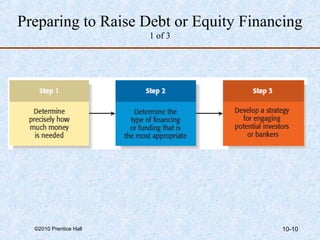
4. Identify the three steps involved in properly 
preparing to raise debt or equity financing. 
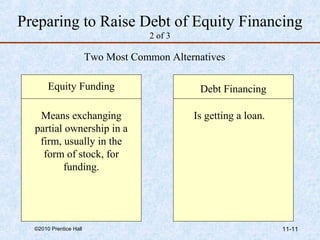
5. Discuss the difference between equity funding and 
debt financing. 
©2010 Prentice Hall 10-2
Chapter Objectives 
2 of 2 
6. Explain the role of an elevator speech in attracting 
financing for an entrepreneurial venture. 
7. Describe the difference between a business angel 
and a venture capitalist. 
8. Explain why an initial public offering (IPO) is an 
important milestone in an entrepreneurial venture. 
9. Discuss the SBA Guaranteed Loan Program. 
10. Explain the advantages of leasing for an 
entrepreneurial venture. 
©2010 Prentice Hall 10-3
The Importance of Getting Financing or 
Funding 
• The Nature of the Funding and Financing Process 
– Few people deal with the process of raising investment 
capital until they need to raise capital for their own firm. 
• As a result, many entrepreneurs go about the task of raising capital 
haphazardly because they lack experience in this area. 
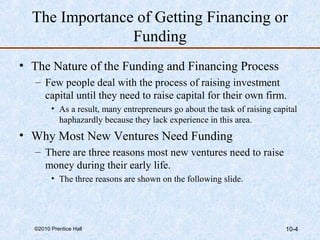
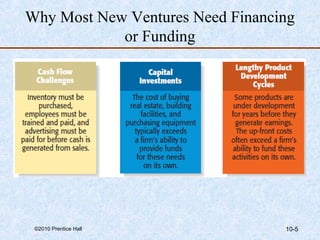
• Why Most New Ventures Need Funding 
– There are three reasons most new ventures need to raise 
money during their early life. 
• The three reasons are shown on the following slide. 
©2010 Prentice Hall 10-4
Why Most New Ventures Need Financing 
or Funding 
©2010 Prentice Hall 10-5
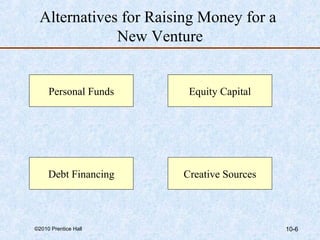
Alternatives for Raising Money for a 
New Venture 
Personal Funds Equity Capital 
Debt Financing Creative Sources 
©2010 Prentice Hall 10-6
Sources of Personal Financing 
1 of 2 
• Personal Funds 
– The vast majority of founders contribute personal funds, 
along with sweat equity, to their ventures. 
• Sweat equity represents the value of the time and effort that a 
founder puts into a new venture. 
• Friends and Family 
– Friends and family are the second source of funds for many 
new ventures. 
©2010 Prentice Hall 10-7
Sources of Personal Financing 
2 of 2 
• Bootstrapping 
– A third source of seed money for a new venture is referred 
to as bootstrapping. 
– Bootstrapping is finding ways to avoid the need for external 
financing or funding through creativity, ingenuity, 
thriftiness, cost-cutting, or any means necessary. 
– Many entrepreneurs bootstrap out of necessity. 
©2010 Prentice Hall 10-8
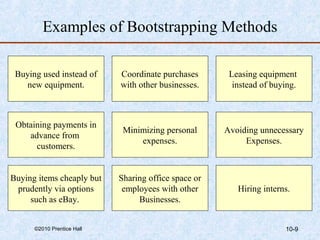
Examples of Bootstrapping Methods 
Buying used instead of 
new equipment. 
Coordinate purchases 
with other businesses. 
Leasing equipment 
instead of buying. 
Obtaining payments in 
advance from 
customers. 
Minimizing personal 
expenses. 
Avoiding unnecessary 
Expenses. 
Buying items cheaply but 
prudently via options 
such as eBay. 
Sharing office space or 
employees with other 
Businesses. 
Hiring interns. 
©2010 Prentice Hall 10-9
Preparing to Raise Debt or Equity Financing 
1 of 3 
©2010 Prentice Hall 10-10
Preparing to Raise Debt of Equity Financing 
2 of 3 
Two Most Common Alternatives 
Equity Funding Debt Financing 
Means exchanging 
partial ownership in a 
firm, usually in the 
form of stock, for 
funding. 
Is getting a loan. 
©2010 Prentice Hall 11-11
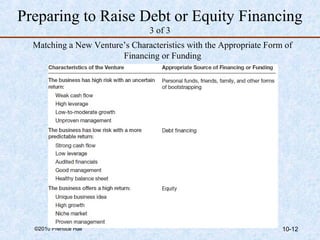
Preparing to Raise Debt or Equity Financing 
3 of 3 
Matching a New Venture’s Characteristics with the Appropriate Form of 
Financing or Funding 
©2010 Prentice Hall 10-12
Preparing An Elevator Speech 
1 of 2 
Purpose 
• An elevator speech is a brief, 
carefully constructed statement 
that outlines the merits of a 
business opportunity. 
• There are many occasions when a 
carefully constructed elevator 
speech might come in handy. 
• Most elevator speeches are 45 
seconds to 2 minutes long. 
Elevator 
Speech 
©2010 Prentice Hall 10-13
Preparing an Elevator Speech 
2 of 2 
Step 1 
Step 2 
Step 3 
Step 4 
Total 
20 seconds 
20 seconds 
10 seconds 
10 seconds 
60 seconds 
Describe the opportunity or problem 
that needs to be solved. 
Describe how your product meets the 
opportunity or solves the problem. 
Describe your qualifications. 
Describe your market. 
©2010 Prentice Hall 10-14
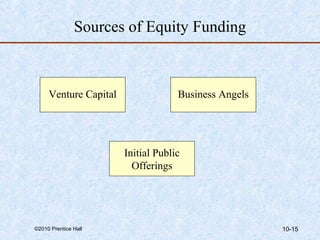
Sources of Equity Funding 
Venture Capital Business Angels 
Initial Public 
Offerings 
©2010 Prentice Hall 10-15
Business Angels 
1 of 2 
• Business Angels 
– Are individuals who invest their personal capital directly in 
start-ups. 
– The prototypical business angel is about 50 years old, has 
high income and wealth, is well educated, has succeeded as 
an entrepreneur, and is interested in the startup process. 
– The number of angel investors in the U.S. has increased 
dramatically over the past decade. 
©2010 Prentice Hall 10-16
Business Angels 
2 of 2 
• Business Angels (continued) 
– Business angels are valuable because of their willingness to 
make relatively small investments. 
• These investors generally invest between $10,000 and 
$500,000 in a single company. 
• Are looking for companies that have the potential to 
grow between 30% to 40% per year. 
– Business angels are difficult to find. 
©2010 Prentice Hall 10-17
Venture Capital 
1 of 3 
• Venture Capital 
– Is money that is invested by venture-capital firms in start-ups 
and small businesses with exceptional growth 
potential. 
– There are about 650 venture-capital firms in the U.S. that 
provide funding to about 2,600 firms per year. 
• Venture-capital firms are limited partnerships of money managers 
who raise money in “funds” to invest in start-ups and growing 
firms. 
• The funds, or pool of money, are raised from wealthy individuals, 
pension plans, university endowments, foreign investors, and 
similar sources. 
• A typical fund is $75 million to $200 million and invests in 20 to 
30 companies over a three- to five-year period. 
©2010 Prentice Hall 10-18
Venture Capital 
2 of 3 
• Venture Capital (continued) 
– Venture capital firms fund very few entrepreneurial firms 
in comparison to business angels. 
• Many entrepreneurs get discouraged when they are repeatedly 
rejected for venture capital funding, even though they may have an 
excellent business plan. 
• Venture capitalists are looking for the “home run” and so reject the 
majority of the proposals they consider. 
• Still, for the firms that qualify, venture capital is a viable 
alternative for equity funding. 
©2010 Prentice Hall 10-19
Venture Capital 
3 of 3 
• Venture Capital (continued) 
– An important part of obtaining venture-capital funding is 
going through the due diligence process: 
– Venture capitalists invest money in start-ups in “stages,” 
meaning that not all the money that is invested is disbursed 
at the same time. 
– Some venture capitalists also specialize in certain “stages” 
of funding. 
©2010 Prentice Hall 10-20
Initial Public Offering 
1 of 3 
• Initial Public Offering 
– An initial public offering (IPO) is a company’s first sale of 
stock to the public. When a company goes public, its stock 
is traded on one of the major stock exchanges. 
– Most entrepreneurial firms that go public trade on the 
NASDAQ, which is weighted heavily toward technology, 
biotech, and small-company stocks. 
– An IPO is an important milestone for a firm. Typically, a 
firm is not able to go public until it has demonstrated that it 
is viable and has a bright future. 
©2010 Prentice Hall 10-21
Initial Public Offering 
2 of 3 
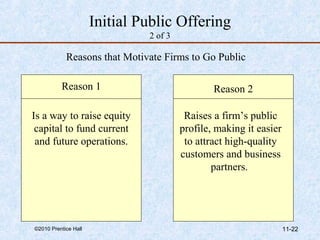
Reasons that Motivate Firms to Go Public 
Reason 1 Reason 2 
Is a way to raise equity 
capital to fund current 
and future operations. 
Raises a firm’s public 
profile, making it easier 
to attract high-quality 
customers and business 
partners. 
©2010 Prentice Hall 11-22
Initial Public Offering 
3 of 3 
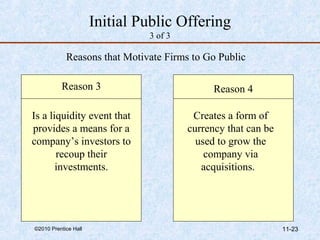
Reasons that Motivate Firms to Go Public 
Reason 3 Reason 4 
Is a liquidity event that 
provides a means for a 
company’s investors to 
recoup their 
investments. 
Creates a form of 
currency that can be 
used to grow the 
company via 
acquisitions. 
©2010 Prentice Hall 11-23
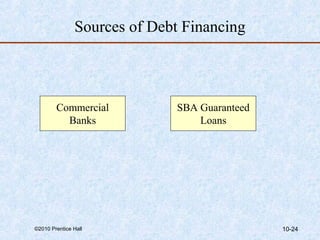
Sources of Debt Financing 
Commercial 
Banks 
SBA Guaranteed 
Loans 
©2010 Prentice Hall 10-24
Commercial Banks 
• Banks 
– Historically, commercial banks have not been viewed as a 
practical sources of financing for start-up firms. 
– This sentiment is not a knock against banks; it is just that 
banks are risk adverse, and financing start-ups is a risky 
business. 
• Banks are interested in firms that have a strong cash flow, low 
leverage, audited financials, good management, and a healthy 
balance sheet. 
©2010 Prentice Hall 10-25
Other Sources of Debt Financing 
• Friends and Family 
• Credit Cards 
– Should be used sparingly. 
• Peer-to-Peer Lending Networks 
– Examples include Propser.com and Zopa.com. 
• Organizations that Lend Money to Specific Groups 
– An example is Count Me In, an organization that provides 
loans of $500 to $10,000 to women starting or growing a 
business. 
©2010 Prentice Hall 10-26
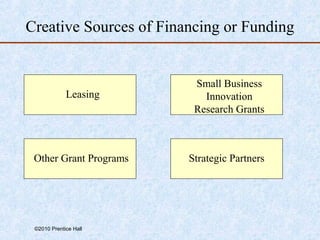
Creative Sources of Financing or Funding 
©2010 Prentice Hall 
Small Business 
Innovation 
Research Grants 
10-27 
Leasing 
Other Grant Programs Strategic Partners
All rights reserved. No part of this publication may be reproduced, 
stored in a retrieval system, or transmitted, in any form or by any 
means, electronic, mechanical, photocopying, recording, or otherwise, 
without the prior written permission of the publisher. Printed in the 
©2010 Prentice Hall 
United States of America. 
Copyright ©2010 Pearson Education, Inc. 
publishing as Prentice Hall

Entrepreneurship 01

  • 1.
    Chapter 10 GettingFinancing or Funding Bruce R. Barringer R. Duane Ireland ©2010 Prentice Hall 10-1
  • 2.
    Chapter Objectives 1of 2 1. Explain why most entrepreneurial ventures need to raise money during their early life. 2. Identify the three sources of personal financing available to entrepreneurs. 3. Provide examples of how entrepreneurs bootstrap to raise money or cut costs. 4. Identify the three steps involved in properly preparing to raise debt or equity financing. 5. Discuss the difference between equity funding and debt financing. ©2010 Prentice Hall 10-2
  • 3.
    Chapter Objectives 2of 2 6. Explain the role of an elevator speech in attracting financing for an entrepreneurial venture. 7. Describe the difference between a business angel and a venture capitalist. 8. Explain why an initial public offering (IPO) is an important milestone in an entrepreneurial venture. 9. Discuss the SBA Guaranteed Loan Program. 10. Explain the advantages of leasing for an entrepreneurial venture. ©2010 Prentice Hall 10-3
  • 4.
    The Importance ofGetting Financing or Funding • The Nature of the Funding and Financing Process – Few people deal with the process of raising investment capital until they need to raise capital for their own firm. • As a result, many entrepreneurs go about the task of raising capital haphazardly because they lack experience in this area. • Why Most New Ventures Need Funding – There are three reasons most new ventures need to raise money during their early life. • The three reasons are shown on the following slide. ©2010 Prentice Hall 10-4
  • 5.
    Why Most NewVentures Need Financing or Funding ©2010 Prentice Hall 10-5
  • 6.
    Alternatives for RaisingMoney for a New Venture Personal Funds Equity Capital Debt Financing Creative Sources ©2010 Prentice Hall 10-6
  • 7.
    Sources of PersonalFinancing 1 of 2 • Personal Funds – The vast majority of founders contribute personal funds, along with sweat equity, to their ventures. • Sweat equity represents the value of the time and effort that a founder puts into a new venture. • Friends and Family – Friends and family are the second source of funds for many new ventures. ©2010 Prentice Hall 10-7
  • 8.
    Sources of PersonalFinancing 2 of 2 • Bootstrapping – A third source of seed money for a new venture is referred to as bootstrapping. – Bootstrapping is finding ways to avoid the need for external financing or funding through creativity, ingenuity, thriftiness, cost-cutting, or any means necessary. – Many entrepreneurs bootstrap out of necessity. ©2010 Prentice Hall 10-8
  • 9.
    Examples of BootstrappingMethods Buying used instead of new equipment. Coordinate purchases with other businesses. Leasing equipment instead of buying. Obtaining payments in advance from customers. Minimizing personal expenses. Avoiding unnecessary Expenses. Buying items cheaply but prudently via options such as eBay. Sharing office space or employees with other Businesses. Hiring interns. ©2010 Prentice Hall 10-9
  • 10.
    Preparing to RaiseDebt or Equity Financing 1 of 3 ©2010 Prentice Hall 10-10
  • 11.
    Preparing to RaiseDebt of Equity Financing 2 of 3 Two Most Common Alternatives Equity Funding Debt Financing Means exchanging partial ownership in a firm, usually in the form of stock, for funding. Is getting a loan. ©2010 Prentice Hall 11-11
  • 12.
    Preparing to RaiseDebt or Equity Financing 3 of 3 Matching a New Venture’s Characteristics with the Appropriate Form of Financing or Funding ©2010 Prentice Hall 10-12
  • 13.
    Preparing An ElevatorSpeech 1 of 2 Purpose • An elevator speech is a brief, carefully constructed statement that outlines the merits of a business opportunity. • There are many occasions when a carefully constructed elevator speech might come in handy. • Most elevator speeches are 45 seconds to 2 minutes long. Elevator Speech ©2010 Prentice Hall 10-13
  • 14.
    Preparing an ElevatorSpeech 2 of 2 Step 1 Step 2 Step 3 Step 4 Total 20 seconds 20 seconds 10 seconds 10 seconds 60 seconds Describe the opportunity or problem that needs to be solved. Describe how your product meets the opportunity or solves the problem. Describe your qualifications. Describe your market. ©2010 Prentice Hall 10-14
  • 15.
    Sources of EquityFunding Venture Capital Business Angels Initial Public Offerings ©2010 Prentice Hall 10-15
  • 16.
    Business Angels 1of 2 • Business Angels – Are individuals who invest their personal capital directly in start-ups. – The prototypical business angel is about 50 years old, has high income and wealth, is well educated, has succeeded as an entrepreneur, and is interested in the startup process. – The number of angel investors in the U.S. has increased dramatically over the past decade. ©2010 Prentice Hall 10-16
  • 17.
    Business Angels 2of 2 • Business Angels (continued) – Business angels are valuable because of their willingness to make relatively small investments. • These investors generally invest between $10,000 and $500,000 in a single company. • Are looking for companies that have the potential to grow between 30% to 40% per year. – Business angels are difficult to find. ©2010 Prentice Hall 10-17
  • 18.
    Venture Capital 1of 3 • Venture Capital – Is money that is invested by venture-capital firms in start-ups and small businesses with exceptional growth potential. – There are about 650 venture-capital firms in the U.S. that provide funding to about 2,600 firms per year. • Venture-capital firms are limited partnerships of money managers who raise money in “funds” to invest in start-ups and growing firms. • The funds, or pool of money, are raised from wealthy individuals, pension plans, university endowments, foreign investors, and similar sources. • A typical fund is $75 million to $200 million and invests in 20 to 30 companies over a three- to five-year period. ©2010 Prentice Hall 10-18
  • 19.
    Venture Capital 2of 3 • Venture Capital (continued) – Venture capital firms fund very few entrepreneurial firms in comparison to business angels. • Many entrepreneurs get discouraged when they are repeatedly rejected for venture capital funding, even though they may have an excellent business plan. • Venture capitalists are looking for the “home run” and so reject the majority of the proposals they consider. • Still, for the firms that qualify, venture capital is a viable alternative for equity funding. ©2010 Prentice Hall 10-19
  • 20.
    Venture Capital 3of 3 • Venture Capital (continued) – An important part of obtaining venture-capital funding is going through the due diligence process: – Venture capitalists invest money in start-ups in “stages,” meaning that not all the money that is invested is disbursed at the same time. – Some venture capitalists also specialize in certain “stages” of funding. ©2010 Prentice Hall 10-20
  • 21.
    Initial Public Offering 1 of 3 • Initial Public Offering – An initial public offering (IPO) is a company’s first sale of stock to the public. When a company goes public, its stock is traded on one of the major stock exchanges. – Most entrepreneurial firms that go public trade on the NASDAQ, which is weighted heavily toward technology, biotech, and small-company stocks. – An IPO is an important milestone for a firm. Typically, a firm is not able to go public until it has demonstrated that it is viable and has a bright future. ©2010 Prentice Hall 10-21
  • 22.
    Initial Public Offering 2 of 3 Reasons that Motivate Firms to Go Public Reason 1 Reason 2 Is a way to raise equity capital to fund current and future operations. Raises a firm’s public profile, making it easier to attract high-quality customers and business partners. ©2010 Prentice Hall 11-22
  • 23.
    Initial Public Offering 3 of 3 Reasons that Motivate Firms to Go Public Reason 3 Reason 4 Is a liquidity event that provides a means for a company’s investors to recoup their investments. Creates a form of currency that can be used to grow the company via acquisitions. ©2010 Prentice Hall 11-23
  • 24.
    Sources of DebtFinancing Commercial Banks SBA Guaranteed Loans ©2010 Prentice Hall 10-24
  • 25.
    Commercial Banks •Banks – Historically, commercial banks have not been viewed as a practical sources of financing for start-up firms. – This sentiment is not a knock against banks; it is just that banks are risk adverse, and financing start-ups is a risky business. • Banks are interested in firms that have a strong cash flow, low leverage, audited financials, good management, and a healthy balance sheet. ©2010 Prentice Hall 10-25
  • 26.
    Other Sources ofDebt Financing • Friends and Family • Credit Cards – Should be used sparingly. • Peer-to-Peer Lending Networks – Examples include Propser.com and Zopa.com. • Organizations that Lend Money to Specific Groups – An example is Count Me In, an organization that provides loans of $500 to $10,000 to women starting or growing a business. ©2010 Prentice Hall 10-26
  • 27.
    Creative Sources ofFinancing or Funding ©2010 Prentice Hall Small Business Innovation Research Grants 10-27 Leasing Other Grant Programs Strategic Partners
  • 28.
    All rights reserved.No part of this publication may be reproduced, stored in a retrieval system, or transmitted, in any form or by any means, electronic, mechanical, photocopying, recording, or otherwise, without the prior written permission of the publisher. Printed in the ©2010 Prentice Hall United States of America. Copyright ©2010 Pearson Education, Inc. publishing as Prentice Hall