DATA PROCESSING 
Data processing Þ any operation applied to data in order to 
achieve a specific task: producing new data or reproducing the 
existing data in an organised manner. 
common data processing - operations imposed by the fact that 
data must be stored on magnetic support and extracted from it 
main data processing - operations that really process 
data in order to satisfy user needs
Common data processing 
Data storing 
•collect data from user 
•validate data (check data for errors and ask the user to correct the 
mistakes he made) 
•encode data 
•organise data (group data on logical criteria, add identification 
information for later retrieval and group data to meet external device 
requirements - data clustering) 
•write data on magnetic support
Common data processing 
Data retrieving 
•access data on magnetic support (using identification 
information added when data is organised ) 
•read data from external support and store it in 
internal memory 
•decode data 
•communicate data to the end user - write data on 
output devices
Main data processing 
in the process of data retrieving at the moment when 
data are in the internal memory before communicating data to the end 
user 
at the access moment, considering the process of looking for 
a precise data in a large collection on magnetic support 
a complex activity - it doesn't process user data but auxiliary data that 
refer to identification and organisation – 
data querying.
Main data processing 
Main data processing produce new data needed by 
the end user on the basis of data stored in the 
computer. 
Þ the result of computations, of reordering, grouping or 
summarising performed on existing data. 
Þ complex operations that involve a lot of elementary 
operations: 
arithmetic operations: +, -, *, /, ­ 
logical operations: È, Ç, not 
comparison operations: <, >, =, £, ³, ¹ 
strings operations (concatenate, split, merge, select)
PROGRAMMING 
LANGUAGES 
A program is a sequence of instructions telling the 
computer what to do on data in order to achieve a 
specific task. 
An instruction is a command specifying the operation to be 
done and the data that is involved in. 
Physical instructions (machine code) are directly 
performed by the computer. 
Logical instructions - user-oriented and form the first 
programming language – the assembly language.
PROGRAMMING 
LANGUAGES 
the data description - must specify the name, the type and 
the size for memory variables and file name and record’s 
structure (field name, type, size) for data stored on external 
magnetic support. 
the set of instructions designed to process data according 
to an algorithm that express in logical form the user intention. 
The algorithm presents the decomposition of the task in 
activities, sub-activities up to operations that can be performed 
by a single instruction
PROGRAMMING 
LANGUAGES 
A set of programs written to solve a business 
problem form an application system. 
Programming languages: 
I generation: machine language 
II generation: assembler languages 
III generation : high-level instructions– procedural 
(Cobol, Fortran, C , Pascal) 
IV generation : declarative programs (SQL,QBE) 
V generation : symbolic processing ( Prolog)
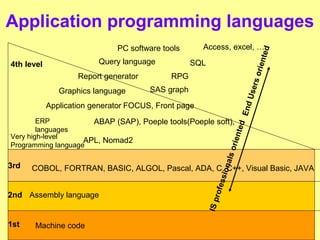
Application programming languages 
PC software tools 
RPG 
SAS graph 
Access, excel, … 
SQL 
Report generator 
Graphics language 
FOCUS, Front page 
Application generator 
APL, Nomad2 
4th level 
ERP 
languages 
COBOL, FORTRAN, BASIC, ALGOL, Pascal, ADA, C, C++, Visual Basic, JAVA 
Assembly language 
Machine code 
ABAP (SAP), Poeple tools(Poeple soft), 
Very high-level 
Programming language 
Query language 
3rd 
2nd 
1st 
End Users oriented IS professionals oriented
Historically, 
1st GL was (and still is) a machine language based on 
binary code. 
2nd GL is assembly language (or assembler). 
3rd GL are procedural language close enough to human language by using 
some english 
common words. So, it is a « high level » programming language. 
As object oriented language, there are : 
C++ is an object oriented version of C. 
Java is also object oriented, but is very friendly to develop particular tasks 
called « applets » for Web sites. They can be downloaded from a network, 
can run on any computer and operating system.
4th GL is a less procedural or at the limit nonprocedural programming 
language which can be employed directly by end users or by less skilled 
programmers to develop applications more rapidly than conventional 
language. 
There are different levels of 4th GL from no technical assistance for end 
users to productivity enhancement of professional programmers. 
5th GL is already used by some companies. It visuals programming 
products for developing applications in Java, for example. 
Visual programming allows to easily envision object-oriented programming 
class hierarchies and drag icons to assemble program components
Data base approach 
generalised programs - no more data dependent 
half built programs that solve the common part of data 
processing (data retrieval, sorting, grouping, summarising) and 
enable the user to specify his particular computations or 
layouts. 
Þ declarative languages - tell the computer what to 
do not how to do . 
ßn 
onprocedural, they are used to express the user 
requests for data in a standardised manner.
Levels of data processing 
elementary level - the simplest operations performed on the 
smallest pieces of data: memory variables (or fields from files). 
At this level data processing relays on machine oriented 
operations (operations that are directly performed by the 
logical and arithmetical unit of the computer). 
record level - mainly input - output operations (write, read, 
delete, update) performed on physical records - operations 
related directly to common data processing
Levels of data processing 
file level - user oriented operations performed on the 
whole data collection in order to satisfy user requests. 
These operations are the basis of main data processing, 
performed in user benefit (data reordering, grouping, selecting, 
merging, summarising, etc.). 
Processing data at file level is influenced only by the way the 
files are organised (independent or related)
FILE ORIENTED DATA 
PROCESSING 
Used mainly in relational data models and closely related with it 
(relational data processing). 
Data are stored in files record by record; data storage is 
record oriented. 
Data are retrieved as a whole; data retrieving is file 
oriented. 
File oriented data processing is done by elementary operations 
similar to set operations called relational operators.
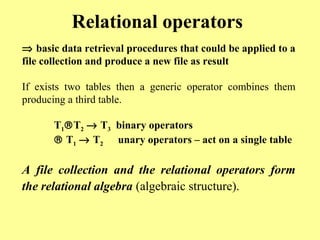
Relational operators 
Þ basic data retrieval procedures that could be applied to a 
file collection and produce a new file as result 
If exists two tables then a generic operator combines them 
producing a third table. 
T1âT2 ® T3 binary operators 
â T1 ® T2 unary operators – act on a single table 
A file collection and the relational operators form 
the relational algebra (algebraic structure).

Databases

  • 1.
    DATA PROCESSING Dataprocessing Þ any operation applied to data in order to achieve a specific task: producing new data or reproducing the existing data in an organised manner. common data processing - operations imposed by the fact that data must be stored on magnetic support and extracted from it main data processing - operations that really process data in order to satisfy user needs
  • 2.
    Common data processing Data storing •collect data from user •validate data (check data for errors and ask the user to correct the mistakes he made) •encode data •organise data (group data on logical criteria, add identification information for later retrieval and group data to meet external device requirements - data clustering) •write data on magnetic support
  • 3.
    Common data processing Data retrieving •access data on magnetic support (using identification information added when data is organised ) •read data from external support and store it in internal memory •decode data •communicate data to the end user - write data on output devices
  • 4.
    Main data processing in the process of data retrieving at the moment when data are in the internal memory before communicating data to the end user at the access moment, considering the process of looking for a precise data in a large collection on magnetic support a complex activity - it doesn't process user data but auxiliary data that refer to identification and organisation – data querying.
  • 5.
    Main data processing Main data processing produce new data needed by the end user on the basis of data stored in the computer. Þ the result of computations, of reordering, grouping or summarising performed on existing data. Þ complex operations that involve a lot of elementary operations: arithmetic operations: +, -, *, /, ­ logical operations: È, Ç, not comparison operations: <, >, =, £, ³, ¹ strings operations (concatenate, split, merge, select)
  • 6.
    PROGRAMMING LANGUAGES Aprogram is a sequence of instructions telling the computer what to do on data in order to achieve a specific task. An instruction is a command specifying the operation to be done and the data that is involved in. Physical instructions (machine code) are directly performed by the computer. Logical instructions - user-oriented and form the first programming language – the assembly language.
  • 7.
    PROGRAMMING LANGUAGES thedata description - must specify the name, the type and the size for memory variables and file name and record’s structure (field name, type, size) for data stored on external magnetic support. the set of instructions designed to process data according to an algorithm that express in logical form the user intention. The algorithm presents the decomposition of the task in activities, sub-activities up to operations that can be performed by a single instruction
  • 8.
    PROGRAMMING LANGUAGES Aset of programs written to solve a business problem form an application system. Programming languages: I generation: machine language II generation: assembler languages III generation : high-level instructions– procedural (Cobol, Fortran, C , Pascal) IV generation : declarative programs (SQL,QBE) V generation : symbolic processing ( Prolog)
  • 9.
    Application programming languages PC software tools RPG SAS graph Access, excel, … SQL Report generator Graphics language FOCUS, Front page Application generator APL, Nomad2 4th level ERP languages COBOL, FORTRAN, BASIC, ALGOL, Pascal, ADA, C, C++, Visual Basic, JAVA Assembly language Machine code ABAP (SAP), Poeple tools(Poeple soft), Very high-level Programming language Query language 3rd 2nd 1st End Users oriented IS professionals oriented
  • 10.
    Historically, 1st GLwas (and still is) a machine language based on binary code. 2nd GL is assembly language (or assembler). 3rd GL are procedural language close enough to human language by using some english common words. So, it is a « high level » programming language. As object oriented language, there are : C++ is an object oriented version of C. Java is also object oriented, but is very friendly to develop particular tasks called « applets » for Web sites. They can be downloaded from a network, can run on any computer and operating system.
  • 11.
    4th GL isa less procedural or at the limit nonprocedural programming language which can be employed directly by end users or by less skilled programmers to develop applications more rapidly than conventional language. There are different levels of 4th GL from no technical assistance for end users to productivity enhancement of professional programmers. 5th GL is already used by some companies. It visuals programming products for developing applications in Java, for example. Visual programming allows to easily envision object-oriented programming class hierarchies and drag icons to assemble program components
  • 12.
    Data base approach generalised programs - no more data dependent half built programs that solve the common part of data processing (data retrieval, sorting, grouping, summarising) and enable the user to specify his particular computations or layouts. Þ declarative languages - tell the computer what to do not how to do . ßn onprocedural, they are used to express the user requests for data in a standardised manner.
  • 13.
    Levels of dataprocessing elementary level - the simplest operations performed on the smallest pieces of data: memory variables (or fields from files). At this level data processing relays on machine oriented operations (operations that are directly performed by the logical and arithmetical unit of the computer). record level - mainly input - output operations (write, read, delete, update) performed on physical records - operations related directly to common data processing
  • 14.
    Levels of dataprocessing file level - user oriented operations performed on the whole data collection in order to satisfy user requests. These operations are the basis of main data processing, performed in user benefit (data reordering, grouping, selecting, merging, summarising, etc.). Processing data at file level is influenced only by the way the files are organised (independent or related)
  • 15.
    FILE ORIENTED DATA PROCESSING Used mainly in relational data models and closely related with it (relational data processing). Data are stored in files record by record; data storage is record oriented. Data are retrieved as a whole; data retrieving is file oriented. File oriented data processing is done by elementary operations similar to set operations called relational operators.
  • 16.
    Relational operators Þbasic data retrieval procedures that could be applied to a file collection and produce a new file as result If exists two tables then a generic operator combines them producing a third table. T1âT2 ® T3 binary operators â T1 ® T2 unary operators – act on a single table A file collection and the relational operators form the relational algebra (algebraic structure).

Editor's Notes

  • #11 &amp;lt;number&amp;gt; 1st GL is the level of instructions and data that the processor is actually given to work on. 2nd GL or Assembler converts each language statement into machine language There are several 3rd GL depending on the field they are used : FORTRAN for scientific applications COBOL for business applications C, used primarily for PC ’s, is a powerful language as it allows tight control and efficiency of execution.
  • #12 &amp;lt;number&amp;gt;