Publishing in the
Digital Humanities
Rafia Mirza
rmirza@smu.edu
Humanities Research Librarian
Pam Pagels
ppagels@smu.edu
Music andTheatre Librarian
Overview for today
• Traditional publishing in your field
• Or specific digital humanities (DH) journals
• Or nontraditional publishing
• How to find a match
What is publishing to you?
• So, what is it to you?
• Goals
• Audience
• Discoverability
• Intellectual property and copyright
What is Digital Humanities to you?
• Constraints? Requirements?
• How does that affect scholarship
• Formats and multiple outputs?
• How does collaboration affect authorship?
• Recommended Resources:
• How did they make that?
• How DidThey MakeThat?TheVideo!
What is Digital Humanities publishing to you?
• Many scholars who develop digital humanities projects also create more
traditional forms of scholarship (e.g. papers) based on their project.While some
projects yield discoveries that are suitable for publication in a journal specific to
your field, digital humanities journals provide a place to publish work that
addresses broader issues such as methodology, technical approach, and/or
project development and evaluation. – Digital Humanities at Berkeley
Collaboration
• Who is collaborating?
• Content of the project itself
• Technical infrastructure and expertise
• Administrative
• Others
• Note: different disciplines care
about different things.
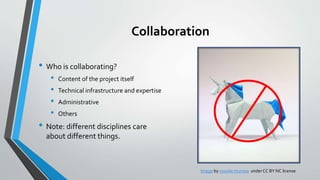
Image by yosuke muroya underCC BY NC license
Publishing Goals
Image by Sean MacEntee under CC BY license
Goal:Traditional Publications/Journals
• How do you find the right journal for you?
• What are your major disciplinary databases?
• Does that database have journal information?
•UpcomingWorkshop: Searching for Author Impact
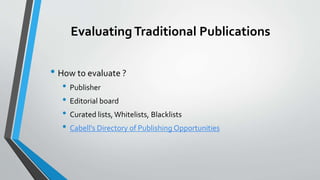
EvaluatingTraditional Publications
• How to evaluate ?
• Publisher
• Editorial board
• Curated lists, Whitelists, Blacklists
• Cabell's Directory of Publishing Opportunities
Evaluating Publications, cont.
• Authors’ rights
•Preprints
•Derivative use
•SHERPA/RoMEO - Publisher copyright policies & self-archiving
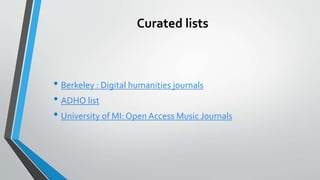
Curated lists
• Berkeley : Digital humanities journals
• ADHO list
• University of MI: Open Access Music Journals
Additional Resources
• Copyright
• www.smu.edu/copyright
• Academic Publishing
• http://guides.smu.edu/academicpublishing
Please take this this survey!
•https://tinyurl.com/smulibraryworkshops
Upcoming workshops
•Getting Ready to Publish
•KnowYour Author's Rights
•Searching for Author Impact

Publishing in the digital humanities

  • 1.
    Publishing in the DigitalHumanities Rafia Mirza rmirza@smu.edu Humanities Research Librarian Pam Pagels ppagels@smu.edu Music andTheatre Librarian
  • 2.
    Overview for today •Traditional publishing in your field • Or specific digital humanities (DH) journals • Or nontraditional publishing • How to find a match
  • 3.
    What is publishingto you? • So, what is it to you? • Goals • Audience • Discoverability • Intellectual property and copyright
  • 4.
    What is DigitalHumanities to you? • Constraints? Requirements? • How does that affect scholarship • Formats and multiple outputs? • How does collaboration affect authorship? • Recommended Resources: • How did they make that? • How DidThey MakeThat?TheVideo!
  • 5.
    What is DigitalHumanities publishing to you? • Many scholars who develop digital humanities projects also create more traditional forms of scholarship (e.g. papers) based on their project.While some projects yield discoveries that are suitable for publication in a journal specific to your field, digital humanities journals provide a place to publish work that addresses broader issues such as methodology, technical approach, and/or project development and evaluation. – Digital Humanities at Berkeley
  • 6.
    Collaboration • Who iscollaborating? • Content of the project itself • Technical infrastructure and expertise • Administrative • Others • Note: different disciplines care about different things. Image by yosuke muroya underCC BY NC license
  • 7.
    Publishing Goals Image bySean MacEntee under CC BY license
  • 8.
    Goal:Traditional Publications/Journals • Howdo you find the right journal for you? • What are your major disciplinary databases? • Does that database have journal information? •UpcomingWorkshop: Searching for Author Impact
  • 9.
    EvaluatingTraditional Publications • Howto evaluate ? • Publisher • Editorial board • Curated lists, Whitelists, Blacklists • Cabell's Directory of Publishing Opportunities
  • 10.
    Evaluating Publications, cont. •Authors’ rights •Preprints •Derivative use •SHERPA/RoMEO - Publisher copyright policies & self-archiving
  • 11.
    Curated lists • Berkeley: Digital humanities journals • ADHO list • University of MI: Open Access Music Journals
  • 12.
    Additional Resources • Copyright •www.smu.edu/copyright • Academic Publishing • http://guides.smu.edu/academicpublishing
  • 13.
    Please take thisthis survey! •https://tinyurl.com/smulibraryworkshops Upcoming workshops •Getting Ready to Publish •KnowYour Author's Rights •Searching for Author Impact

Editor's Notes

  • #3 Rafia Here’s what we’ll be covering today: diff ways of publishing including non-trad. --trad in your field vs. specific DH journals --plus non-trad How to find publications/outlets that are a good fit with your product/output/project.
  • #4 Rafia 3-4 responses, Tenure requirements, but DH publishing often additive can be article or blog   Share   b. For what audience? Academic, commercial, specialist,  c. Things to consider  1. Preparing the text; authorship/joint authorship; proofing; house style  Discoverability: paywalls/ oa Pam-Intellectual property and copyright 2. Copyright (your own); permissions for others’ copyrighted content  See OUP for example: https://academic.oup.com/journals/pages/access_purchase/rights_and_permissions   . Fees? (OA green, excess pages, color) 
  • #5 Rafia What is DH to you? Ask audience, limit to 3 or 4 responses. How do constraints and specific requirements of DH affect scholarship and output? Format: Publishing an app or code ?   How does that go in your portfolio?  Establish Quick Definitions of: DH & publishing for purposes of workshop   (do not spend too much time on copyright, as that is separate workshop: mention)   Unless unicorn , need partner   USUALLY Collaborative process? But if you need to be single author, or do not care about being author, just code or sharing    maybe multiple publications (website, code, paper, monograph)   (Also talk about infrastructure in addition to content/thesis: long term planning : workshops on project planning in the FUTURE)  
  • #6 Rafia What is DH to you? Ask audience, limit to 3 or 4 responses. How do constraints and specific requirements of DH affect scholarship and output? Format: Publishing an app or code ?   How does that go in your portfolio?  Establish Quick Definitions of: DH & publishing for purposes of workshop   (do not spend too much time on copyright, as that is separate workshop: mention)   Unless unicorn , need partner   USUALLY Collaborative process? But if you need to be single author, or do not care about being author, just code or sharing    maybe multiple publications (website, code, paper, monograph)   (Also talk about infrastructure in addition to content/thesis: long term planning : workshops on project planning in the FUTURE)  
  • #7 Pam Are you a unicorn who can magically run an entire DH project? Answer: No. You are not a unicorn. You probably will be involved in collaboration. Collaboration—lots of ways- Content creation—you, your colleagues (departmental colleagues; interdisciplinary colleagues; outside of campus, ets) Technical infrastructure/expertise—servers; website design; programing/coding; digital asset management and long term planning Administrative—across academic divisions; finance, marketing; Others—IRB office; intellectual property/copyright expertise; partner institutions joint authorship and copyright. Rafia: Different disciplines care about different things –examples:   USUALLY Collaborative process? But if you need to be single author, or do not care about being author, just code or sharing maybe multiple publications (website, code, paper, monograph)  
  • #8 Rafia Publishing goal:  Computer scientist : maybe github enough   Discuss what are your goals?   What Criteria for selecting a publication? 
  • #9 Rafia Focus on identifying traditional publications/Journals  that feature DH:  Journal in your field that feature DH   Field and subfield Go to major disciplinary databases and find which journals indexed heavily feature DH  If you are lucky, like MLA has periodical directory. Historical Abstracts does not, so need to go to Journal Home page.
  • #10 Rafia – lead into mla Whitelists and blacklist Use Michigan site https://www.lib.umich.edu/music-library/open-access-music-journals because Libraries are awesome (ties into Berkeley later) Tools and strategies a. Assessing legit vs. predatory journals-- Ulrichsweb.com, DOAJ, oaspa.org, Declan Butler’s checklist (http://www.nature.com/news/investigating-journals-the-dark-side-of-publishing-1.12666  ), Sherpa RoMEO  b. How to evaluate impact factor-PLOS and SPARC (ALM)  c. Cabell's Directory of Publishing Opportunities (Educational set)  
  • #11 Pam f. Authors rights—agreements and licensing (what to look for before signing)  g. Open Access http://research.library.gsu.edu/c.php?g=115588&p=754380 
  • #12 Focus on identifying traditional publications/Journals that feature DH:  DH journals  How to identify   Mostly OA, as ethos of DH  http://digitalhumanities.berkeley.edu/resources/digital-humanities-journals  
  • #13 As group , pull up main page of journal Bring up a journal http://www.ams-net.org/ojs/index.php/jmhp/about/editorialTeam https://www.lib.umich.edu/music-library/open-access-music-journals