Introduction to
Omeka.net
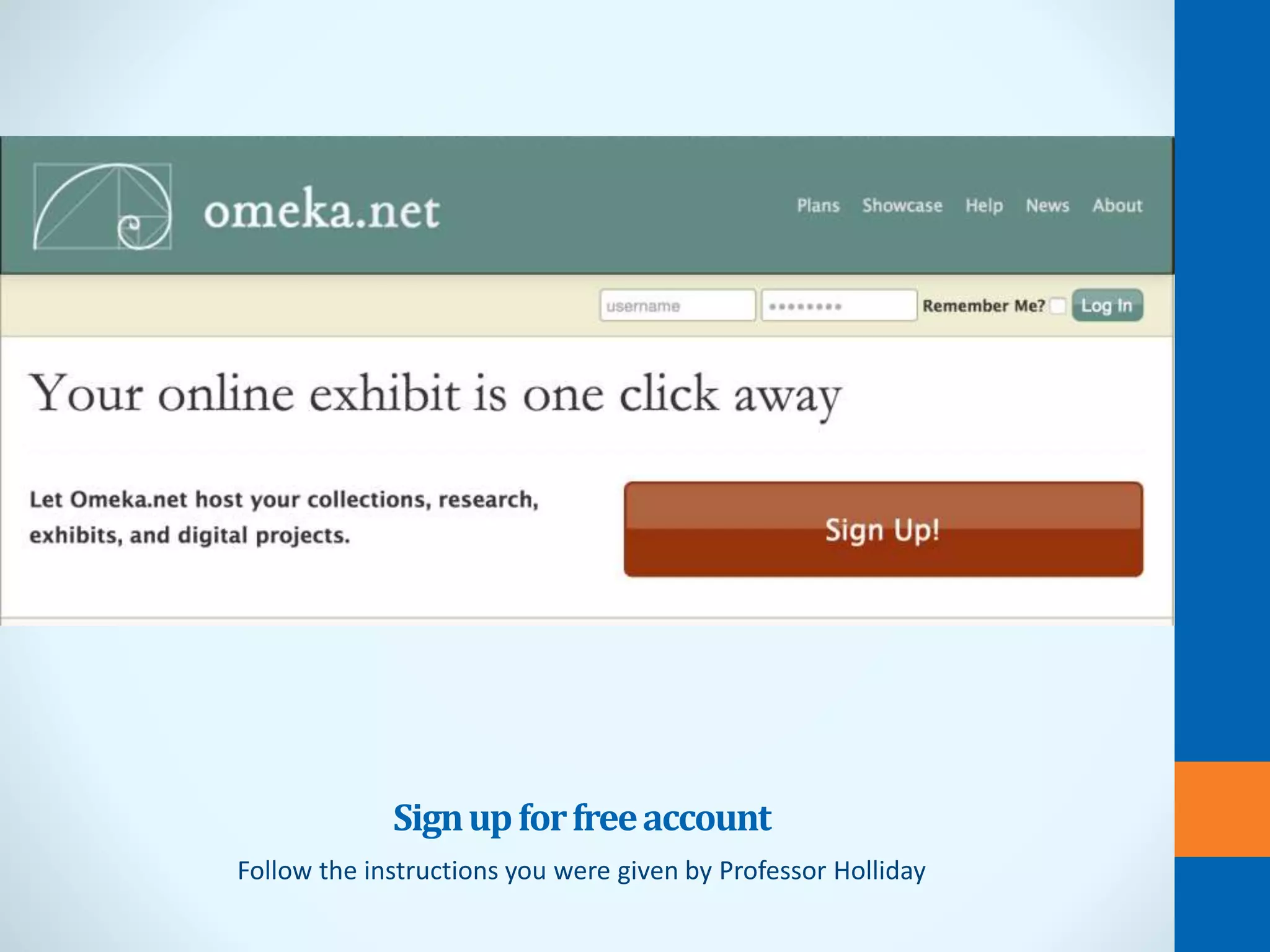
Signupforfreeaccount
Follow the instructions you were given by Professor Holliday
What is Omeka?
• The Roy Rosenzweig Center for History and New Media
began building Omeka in 2006; they wanted to abstract
the technologies they were using repeatedly to build
historical websites, all of which required setting up a
searchable database that was integrated with an online
exhibit.- Amanda French
• The free, open source, downloadable version of Omeka is
available at omeka.org.
• We are using hosted version of Omeka which is available at
omeka.net
• Storage for the free account is capped at 500 MB
• Pay attention to you image size, avoid tifs
Why use Omeka?
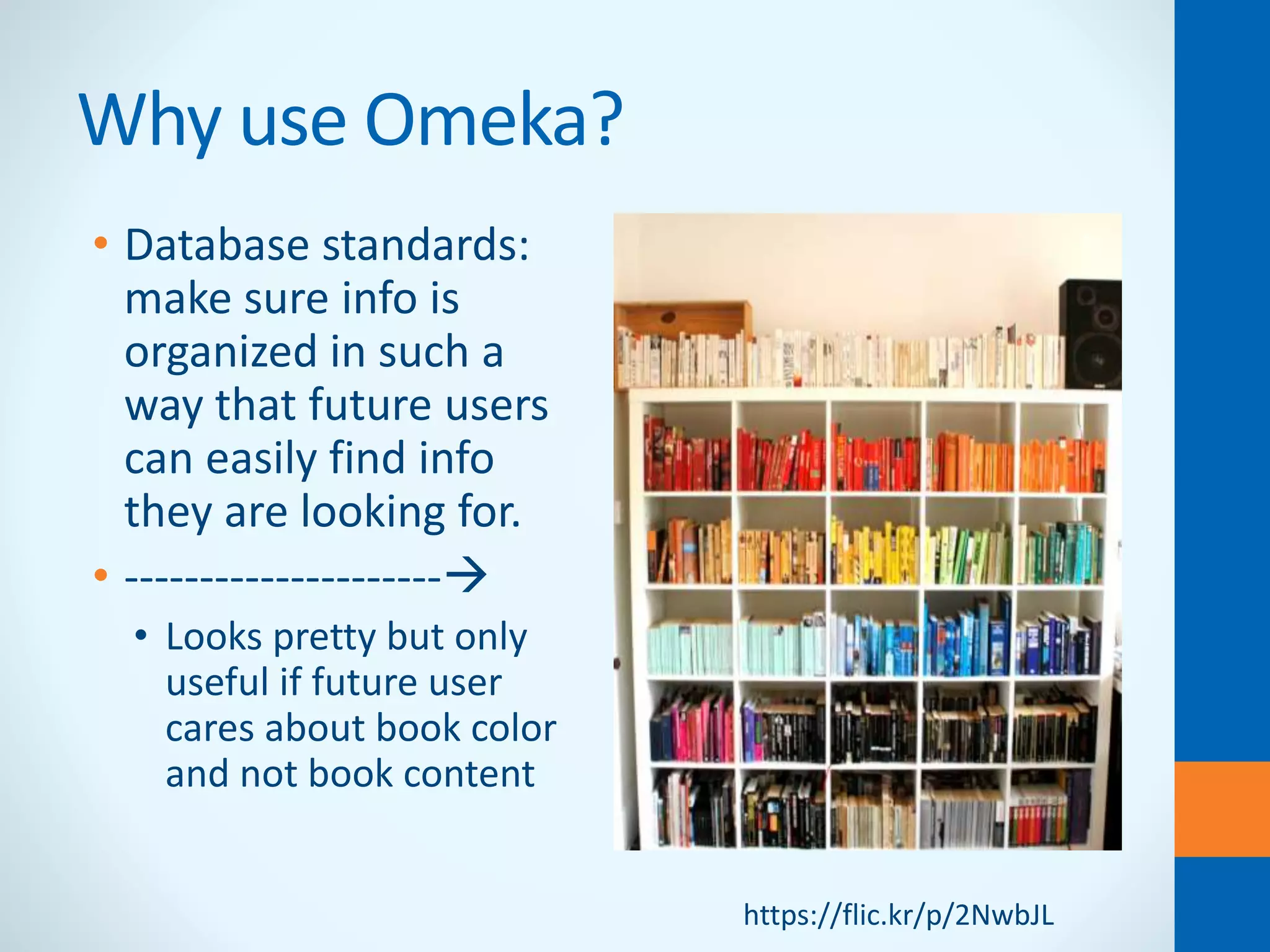
• Database standards:
make sure info is
organized in such a
way that future users
can easily find info
they are looking for.
• ---------------------
• Looks pretty but only
useful if future user
cares about book color
and not book content
https://flic.kr/p/2NwbJL
What is Omeka?
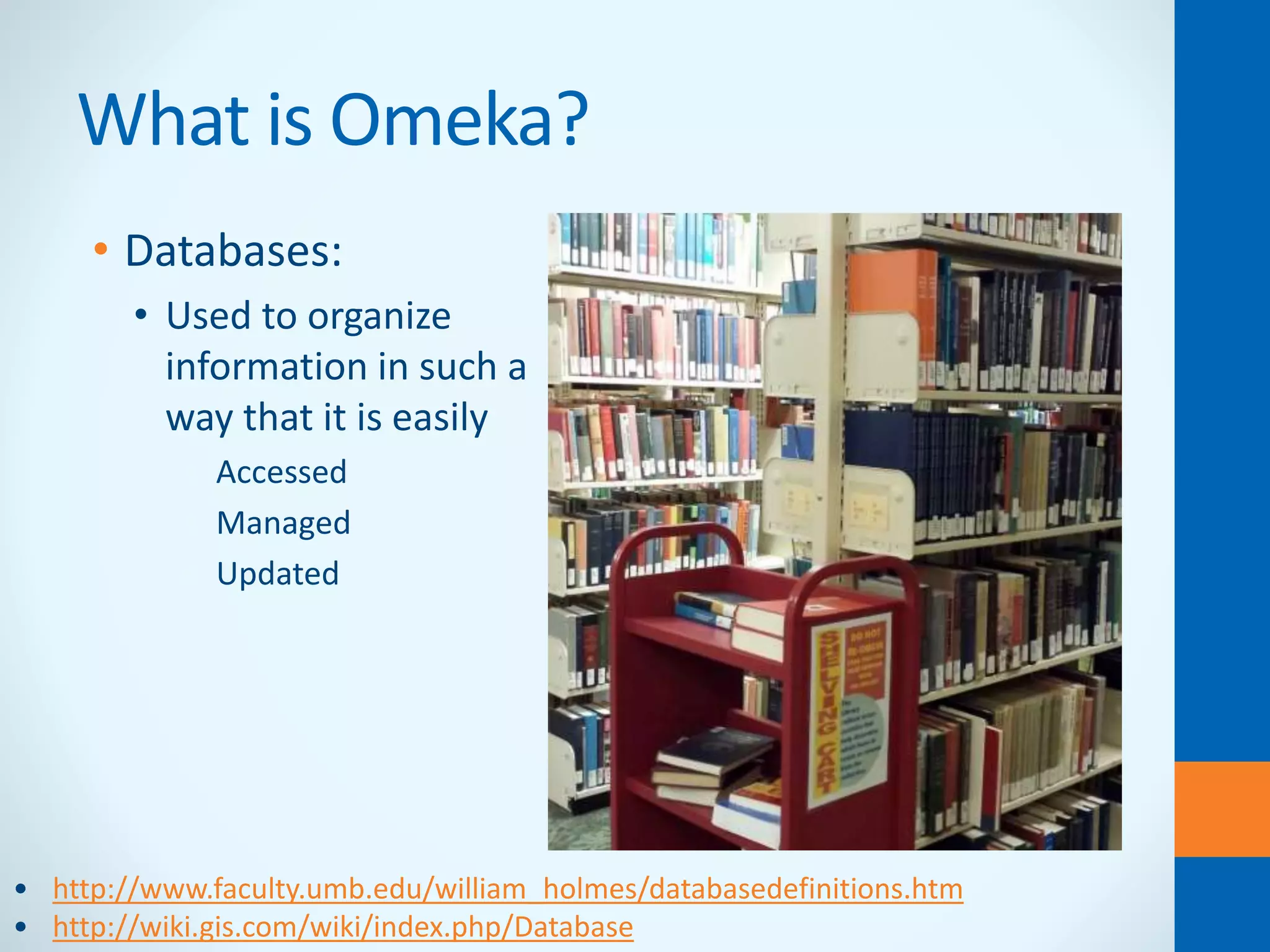
• Databases:
• Used to organize
information in such a
way that it is easily
• Accessed
• Managed
• Updated
• http://www.faculty.umb.edu/william_holmes/databasedefinitions.htm
• http://wiki.gis.com/wiki/index.php/Database
What is Dublin Core?
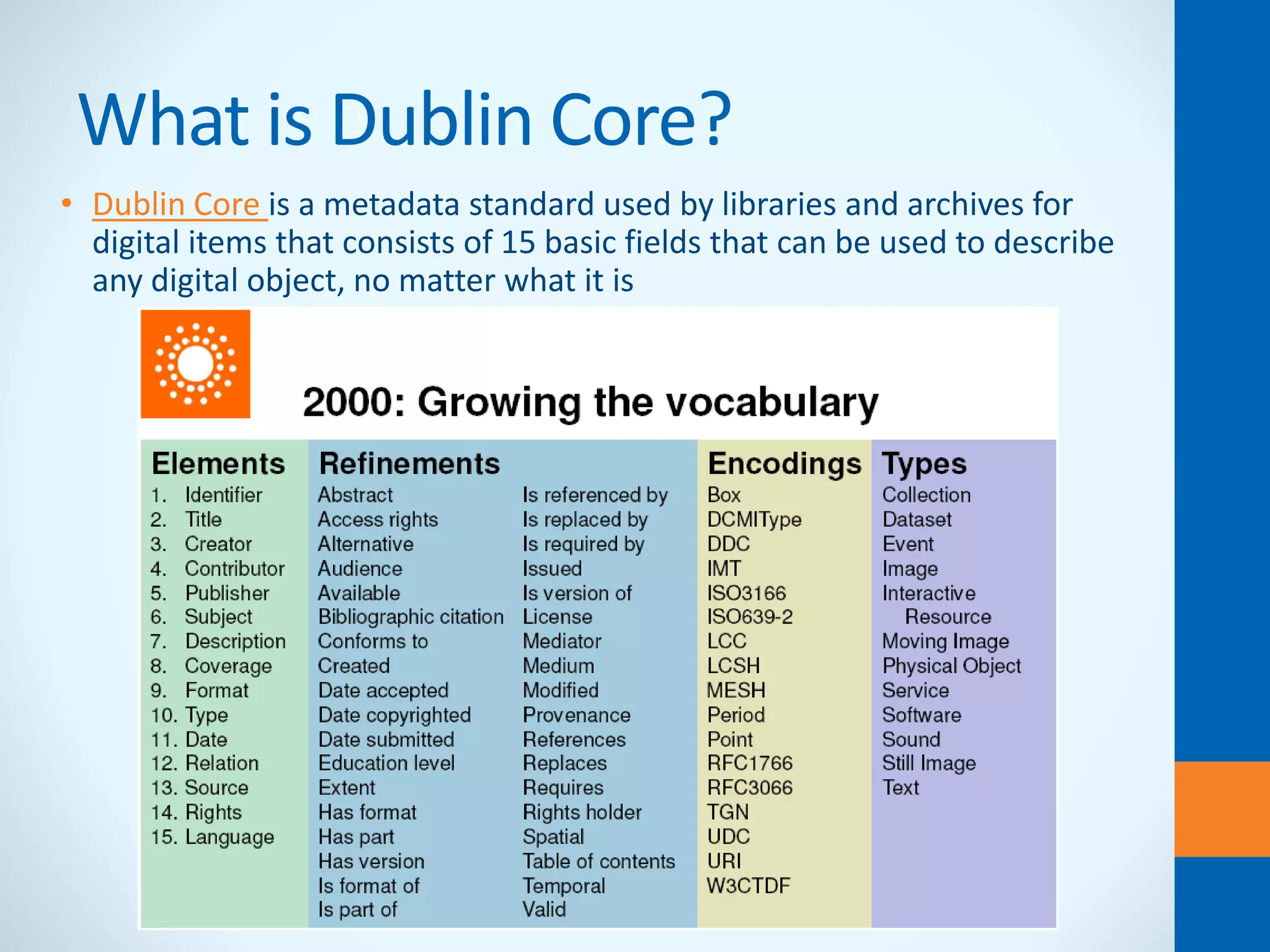
• Dublin Core is a metadata standard used by libraries and archives for
digital items that consists of 15 basic fields that can be used to describe
any digital object, no matter what it is
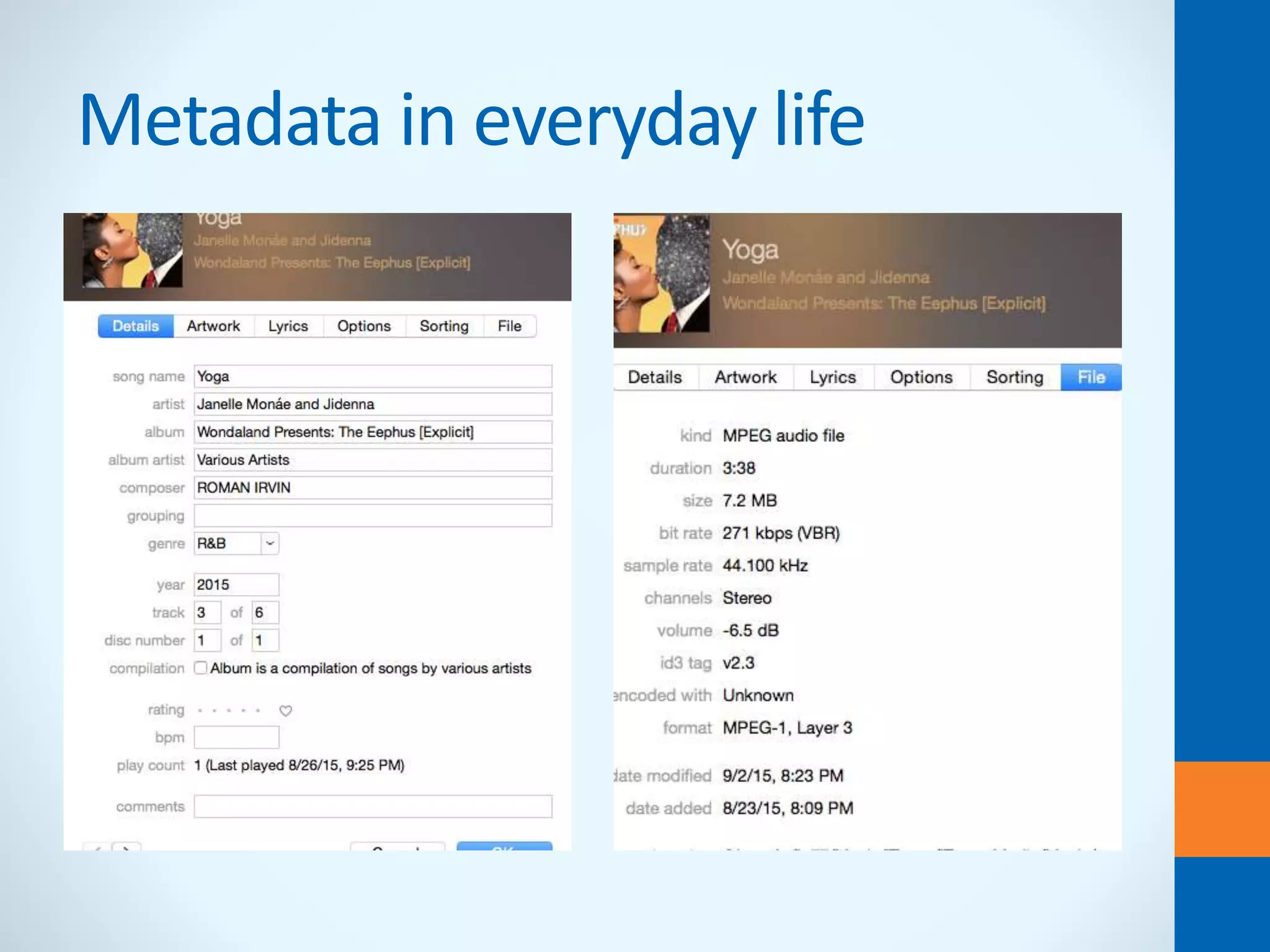
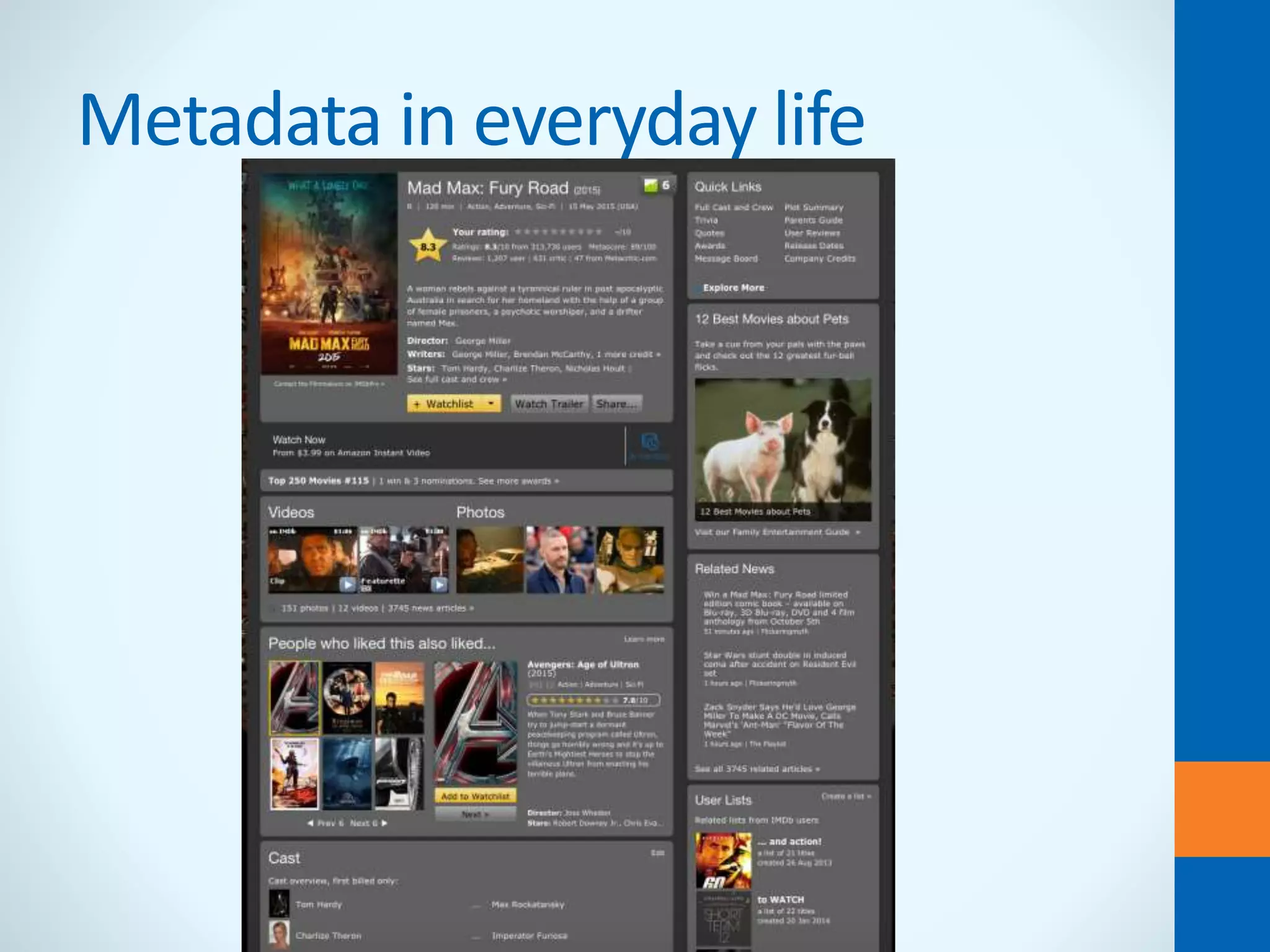
Metadata in everyday life
This work is licensed under a Creative Commons Attribution-
NonCommercial-ShareAlike 4.0 International License.
QUESTIONS?

Introduction to Omeka

  • 2.
  • 3.
    Signupforfreeaccount Follow the instructionsyou were given by Professor Holliday
  • 4.
    What is Omeka? •The Roy Rosenzweig Center for History and New Media began building Omeka in 2006; they wanted to abstract the technologies they were using repeatedly to build historical websites, all of which required setting up a searchable database that was integrated with an online exhibit.- Amanda French • The free, open source, downloadable version of Omeka is available at omeka.org. • We are using hosted version of Omeka which is available at omeka.net • Storage for the free account is capped at 500 MB • Pay attention to you image size, avoid tifs
  • 5.
    Why use Omeka? •Database standards: make sure info is organized in such a way that future users can easily find info they are looking for. • --------------------- • Looks pretty but only useful if future user cares about book color and not book content https://flic.kr/p/2NwbJL
  • 6.
    What is Omeka? •Databases: • Used to organize information in such a way that it is easily • Accessed • Managed • Updated • http://www.faculty.umb.edu/william_holmes/databasedefinitions.htm • http://wiki.gis.com/wiki/index.php/Database
  • 7.
    What is DublinCore? • Dublin Core is a metadata standard used by libraries and archives for digital items that consists of 15 basic fields that can be used to describe any digital object, no matter what it is
  • 8.
  • 9.
  • 10.
    This work islicensed under a Creative Commons Attribution- NonCommercial-ShareAlike 4.0 International License. QUESTIONS?

Editor's Notes

  • #2 Opening Slide
  • #4 Preparation Go to omeka.net and click the big “Sign up!” button. Sign up for the free Basic plan. When you submit the form, you will be emailed an activation link and a username and password. If you don’t get the email, check your spam folder. Feel free to explore Omeka on your own while I take you through it.
  • #5 Introduction – What is Omeka? (10 minutes) Omeka is a simple, free web publishing system built by and for scholars that is used by hundreds of archives, historical societies, libraries, museums, and individual researchers and teachers to create searchable online databases and scholarly online interpretations of their digital collections. If you have a digital collection of primary sources that you want to publish online in a scholarly way, you’ll want to consider Omeka. “Omeka” (pronounced oh-MEH-ka) is a Swahili word meaning “to display or lay out wares” – swahili_english.enacademic.com/11461/omeka The Roy Rosenzweig Center for History and New Media began building Omeka in 2006; they wanted to abstract the technologies they were using repeatedly to build historical websites, all of which required setting up a searchable database that was integrated with an online exhibit.
  • #7 Introduction – What is Omeka? (10 minutes) Omeka is a simple, free web publishing system built by and for scholars that is used by hundreds of archives, historical societies, libraries, museums, and individual researchers and teachers to create searchable online databases and scholarly online interpretations of their digital collections. If you have a digital collection of primary sources that you want to publish online in a scholarly way, you’ll want to consider Omeka. “Omeka” (pronounced oh-MEH-ka) is a Swahili word meaning “to display or lay out wares” – swahili_english.enacademic.com/11461/omeka The Roy Rosenzweig Center for History and New Media began building Omeka in 2006; they wanted to abstract the technologies they were using repeatedly to build historical websites, all of which required setting up a searchable database that was integrated with an online exhibit. http://www.dlib.org/dlib/march10/kucsma/03kucsma.html
  • #8 Introduction – What is Omeka? (10 minutes) Omeka is a simple, free web publishing system built by and for scholars that is used by hundreds of archives, historical societies, libraries, museums, and individual researchers and teachers to create searchable online databases and scholarly online interpretations of their digital collections. If you have a digital collection of primary sources that you want to publish online in a scholarly way, you’ll want to consider Omeka. “Omeka” (pronounced oh-MEH-ka) is a Swahili word meaning “to display or lay out wares” – swahili_english.enacademic.com/11461/omeka The Roy Rosenzweig Center for History and New Media began building Omeka in 2006; they wanted to abstract the technologies they were using repeatedly to build historical websites, all of which required setting up a searchable database that was integrated with an online exhibit. http://www.dlib.org/dlib/march10/kucsma/03kucsma.html