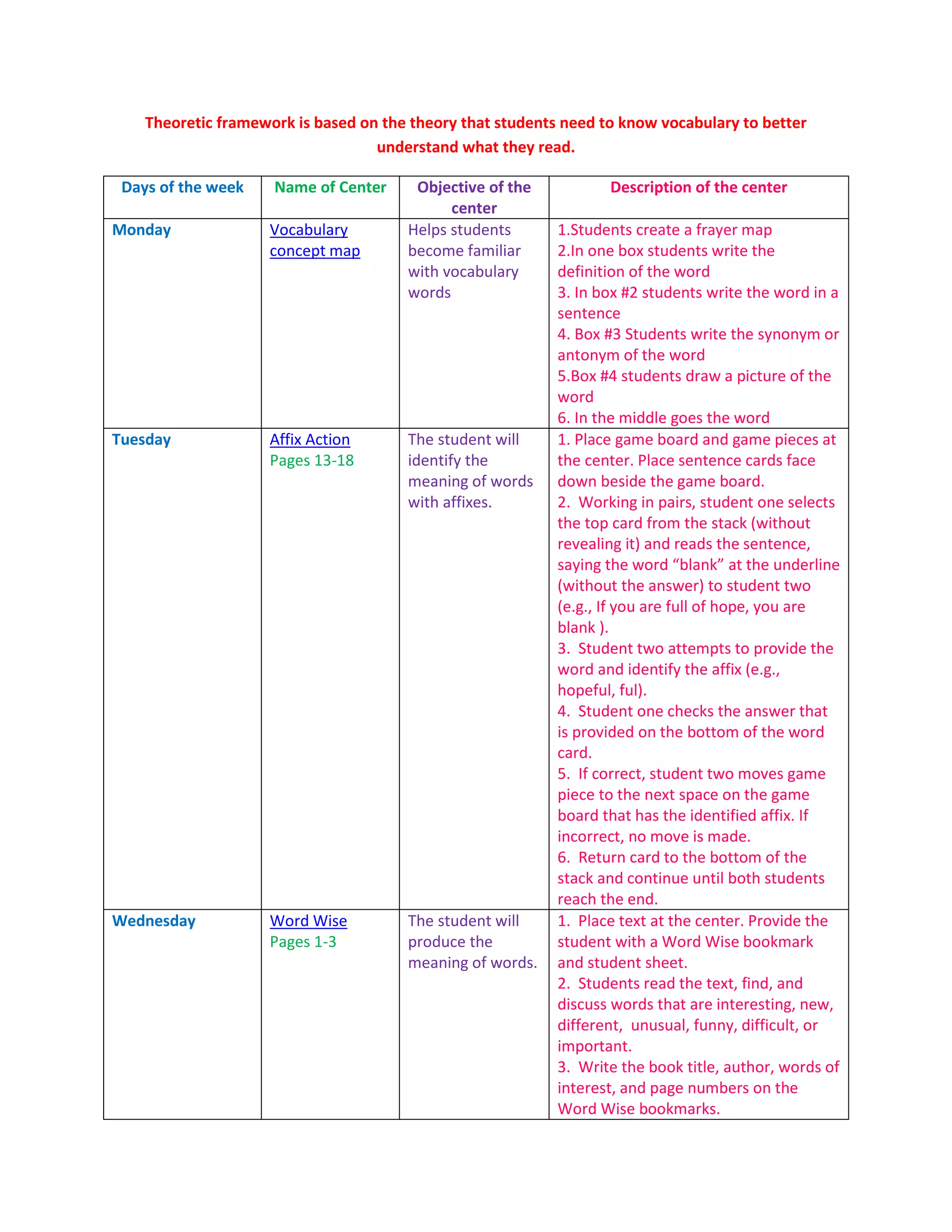
Theoretic framework is based on the theory that students need to know vocabulary to better
                                   understand what they read.

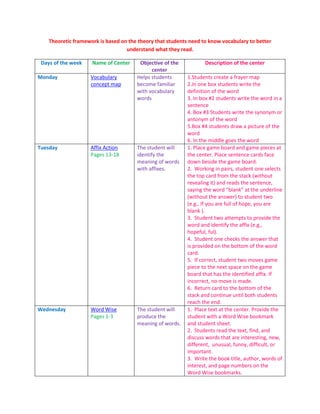
 Days of the week    Name of Center     Objective of the           Description of the center
                                             center
Monday              Vocabulary         Helps students       1.Students create a frayer map
                    concept map        become familiar      2.In one box students write the
                                       with vocabulary      definition of the word
                                       words                3. In box #2 students write the word in a
                                                            sentence
                                                            4. Box #3 Students write the synonym or
                                                            antonym of the word
                                                            5.Box #4 students draw a picture of the
                                                            word
                                                            6. In the middle goes the word
Tuesday             Affix Action       The student will     1. Place game board and game pieces at
                    Pages 13-18        identify the         the center. Place sentence cards face
                                       meaning of words     down beside the game board.
                                       with affixes.        2. Working in pairs, student one selects
                                                            the top card from the stack (without
                                                            revealing it) and reads the sentence,
                                                            saying the word “blank” at the underline
                                                            (without the answer) to student two
                                                            (e.g., If you are full of hope, you are
                                                            blank ).
                                                            3. Student two attempts to provide the
                                                            word and identify the affix (e.g.,
                                                            hopeful, ful).
                                                            4. Student one checks the answer that
                                                            is provided on the bottom of the word
                                                            card.
                                                            5. If correct, student two moves game
                                                            piece to the next space on the game
                                                            board that has the identified affix. If
                                                            incorrect, no move is made.
                                                            6. Return card to the bottom of the
                                                            stack and continue until both students
                                                            reach the end.
Wednesday           Word Wise          The student will     1. Place text at the center. Provide the
                    Pages 1-3          produce the          student with a Word Wise bookmark
                                       meaning of words.    and student sheet.
                                                            2. Students read the text, find, and
                                                            discuss words that are interesting, new,
                                                            different, unusual, funny, difficult, or
                                                            important.
                                                            3. Write the book title, author, words of
                                                            interest, and page numbers on the
                                                            Word Wise bookmarks.
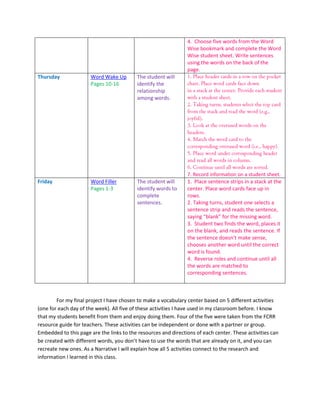
4. Choose five words from the Word
                                                                Wise bookmark and complete the Word
                                                                Wise student sheet. Write sentences
                                                                using the words on the back of the
                                                                page.
Thursday              Word Wake Up        The student will
                      Pages 10-16         identify the
                                          relationship
                                          among words.


                                                                7. Record information on a student sheet.
Friday                Word Filler         The student will      1. Place sentence strips in a stack at the
                      Pages 1-3           identify words to     center. Place word cards face up in
                                          complete              rows.
                                          sentences.            2. Taking turns, student one selects a
                                                                sentence strip and reads the sentence,
                                                                saying “blank” for the missing word.
                                                                3. Student two finds the word, places it
                                                                on the blank, and reads the sentence. If
                                                                the sentence doesn’t make sense,
                                                                chooses another word until the correct
                                                                word is found.
                                                                4. Reverse roles and continue until all
                                                                the words are matched to
                                                                corresponding sentences.


        For my final project I have chosen to make a vocabulary center based on 5 different activities
(one for each day of the week). All five of these activities I have used in my classroom before. I know
that my students benefit from them and enjoy doing them. Four of the five were taken from the FCRR
resource guide for teachers. These activities can be independent or done with a partner or group.
Embedded to this page are the links to the resources and directions of each center. These activities can
be created with different words, you don’t have to use the words that are already on it, and you can
recreate new ones. As a Narrative I will explain how all 5 activities connect to the research and
information I learned in this class.
Centers are important for children in every grade to practice what they learned during

the lesson. Vocabulary is one of those important subjects that get over looked. But it is

important for students to know and learn vocabulary. According to Davis there’s a connection

between vocabulary knowledge and the readers ability to understand what they read (Davis,

1944, 1968). Students that are learning vocabulary words are more likely to understand what

they are reading.


        Vocabulary can be learned in many ways, one strategy is having the students practice in

a center. The following five strategies have been used in my third grade classroom before. My

test scores have shown that my strategies have helped extensively and my students all enjoy

doing these. The first one is a vocabulary concept map. Students are to complete a graphic

organizer, which includes the word, a definition made by the student, a sentence using the

word, the words synonym or antonym and finally a picture. Using this model students are

making connections to the vocabulary words, instead of just learning them they are putting

them into context. It also fits under the Guideline #2 of teaching vocabulary effectively which

states: students become word learners independently, because it scaffolds to different

learners.


       The second strategy Affix Action, in this game students are looking for the vocab word

and its affix. It is a fun board game in which students are learning bound morphemes (prefixes

and suffixes). According to Blachowicz and Fisher book Teaching Vocabulary in all Classrooms,

teaching morphology helps students learn the meaning of words (p.125). The game also helps
students learn how prefixes work. Bilingual students benefit from this game when common

affixes in both English and Spanish are used (p.128).


       Word Wise involves learning the meaning of vocabulary words while reading. The

students get to read the words in an expository or narrative text and then they define the word

using the context clues. Knowing the words previously to them reading the passage helps the

students develop background knowledge and could make predictions before reading. This is

also the first time they get to see their vocab words in a story. Learning new vocabulary is like

the process of strategic reading, they go hand in hand (Blachowicz & Fisher p.49), which is why

this center is beneficial to students.


       The fourth center is Word Wake-up; this center involves students making connections

with similar words. This center is great for English Language Learners; it develops word

consciousness between words. This also can be used in many different ways. Cognates which

are similar words in a different language can be used in the sorting so that students can easily

make connections with their vocabulary words.


       The last center is Word Filler; this center lets students use everything they learned

throughout the week. The objective is to insert the vocabulary words correctly in the right

sentences. This is a great activity because the teacher can create these for any words. Also

different types of sentences can be used, so that the words may use different affixes.


       All these centers have strategies which support vocabulary and reading learning.

Students of all levels may benefit from them, including ELL students who may struggle with

vocabulary. They are also great because students enjoy doing them. All the students in my
classroom looked forward to centers because they knew that it wasn’t just reading and

answering questions. I never used the same 5 centers weekly; I changed them when I could to

keep the students engaged. In this class I enjoyed learning about all the research that supports

a lot of the things that I do in my classroom and these centers are examples of them.

Final project

  • 1.
    Theoretic framework isbased on the theory that students need to know vocabulary to better understand what they read. Days of the week Name of Center Objective of the Description of the center center Monday Vocabulary Helps students 1.Students create a frayer map concept map become familiar 2.In one box students write the with vocabulary definition of the word words 3. In box #2 students write the word in a sentence 4. Box #3 Students write the synonym or antonym of the word 5.Box #4 students draw a picture of the word 6. In the middle goes the word Tuesday Affix Action The student will 1. Place game board and game pieces at Pages 13-18 identify the the center. Place sentence cards face meaning of words down beside the game board. with affixes. 2. Working in pairs, student one selects the top card from the stack (without revealing it) and reads the sentence, saying the word “blank” at the underline (without the answer) to student two (e.g., If you are full of hope, you are blank ). 3. Student two attempts to provide the word and identify the affix (e.g., hopeful, ful). 4. Student one checks the answer that is provided on the bottom of the word card. 5. If correct, student two moves game piece to the next space on the game board that has the identified affix. If incorrect, no move is made. 6. Return card to the bottom of the stack and continue until both students reach the end. Wednesday Word Wise The student will 1. Place text at the center. Provide the Pages 1-3 produce the student with a Word Wise bookmark meaning of words. and student sheet. 2. Students read the text, find, and discuss words that are interesting, new, different, unusual, funny, difficult, or important. 3. Write the book title, author, words of interest, and page numbers on the Word Wise bookmarks.
  • 2.
    4. Choose fivewords from the Word Wise bookmark and complete the Word Wise student sheet. Write sentences using the words on the back of the page. Thursday Word Wake Up The student will Pages 10-16 identify the relationship among words. 7. Record information on a student sheet. Friday Word Filler The student will 1. Place sentence strips in a stack at the Pages 1-3 identify words to center. Place word cards face up in complete rows. sentences. 2. Taking turns, student one selects a sentence strip and reads the sentence, saying “blank” for the missing word. 3. Student two finds the word, places it on the blank, and reads the sentence. If the sentence doesn’t make sense, chooses another word until the correct word is found. 4. Reverse roles and continue until all the words are matched to corresponding sentences. For my final project I have chosen to make a vocabulary center based on 5 different activities (one for each day of the week). All five of these activities I have used in my classroom before. I know that my students benefit from them and enjoy doing them. Four of the five were taken from the FCRR resource guide for teachers. These activities can be independent or done with a partner or group. Embedded to this page are the links to the resources and directions of each center. These activities can be created with different words, you don’t have to use the words that are already on it, and you can recreate new ones. As a Narrative I will explain how all 5 activities connect to the research and information I learned in this class.
  • 3.
    Centers are importantfor children in every grade to practice what they learned during the lesson. Vocabulary is one of those important subjects that get over looked. But it is important for students to know and learn vocabulary. According to Davis there’s a connection between vocabulary knowledge and the readers ability to understand what they read (Davis, 1944, 1968). Students that are learning vocabulary words are more likely to understand what they are reading. Vocabulary can be learned in many ways, one strategy is having the students practice in a center. The following five strategies have been used in my third grade classroom before. My test scores have shown that my strategies have helped extensively and my students all enjoy doing these. The first one is a vocabulary concept map. Students are to complete a graphic organizer, which includes the word, a definition made by the student, a sentence using the word, the words synonym or antonym and finally a picture. Using this model students are making connections to the vocabulary words, instead of just learning them they are putting them into context. It also fits under the Guideline #2 of teaching vocabulary effectively which states: students become word learners independently, because it scaffolds to different learners. The second strategy Affix Action, in this game students are looking for the vocab word and its affix. It is a fun board game in which students are learning bound morphemes (prefixes and suffixes). According to Blachowicz and Fisher book Teaching Vocabulary in all Classrooms, teaching morphology helps students learn the meaning of words (p.125). The game also helps
  • 4.
    students learn howprefixes work. Bilingual students benefit from this game when common affixes in both English and Spanish are used (p.128). Word Wise involves learning the meaning of vocabulary words while reading. The students get to read the words in an expository or narrative text and then they define the word using the context clues. Knowing the words previously to them reading the passage helps the students develop background knowledge and could make predictions before reading. This is also the first time they get to see their vocab words in a story. Learning new vocabulary is like the process of strategic reading, they go hand in hand (Blachowicz & Fisher p.49), which is why this center is beneficial to students. The fourth center is Word Wake-up; this center involves students making connections with similar words. This center is great for English Language Learners; it develops word consciousness between words. This also can be used in many different ways. Cognates which are similar words in a different language can be used in the sorting so that students can easily make connections with their vocabulary words. The last center is Word Filler; this center lets students use everything they learned throughout the week. The objective is to insert the vocabulary words correctly in the right sentences. This is a great activity because the teacher can create these for any words. Also different types of sentences can be used, so that the words may use different affixes. All these centers have strategies which support vocabulary and reading learning. Students of all levels may benefit from them, including ELL students who may struggle with vocabulary. They are also great because students enjoy doing them. All the students in my
  • 5.
    classroom looked forwardto centers because they knew that it wasn’t just reading and answering questions. I never used the same 5 centers weekly; I changed them when I could to keep the students engaged. In this class I enjoyed learning about all the research that supports a lot of the things that I do in my classroom and these centers are examples of them.