Lesson 1
LO: I can identify the ear as /er/sound
and words
Using the Cambridge Global
English Workbook 2 quickly work
on page11 No 1.
Write and colour what you see.
2
Value of the
Month:
positive thinking
3
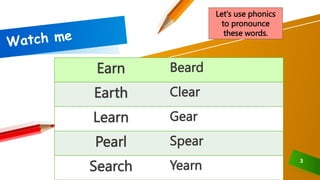
Earn Beard
Earth Clear
Learn Gear
Pearl Spear
Search Yearn
Let's use phonics
to pronounce
these words.
4
Watch the video to further explain
1. Earn - If I want something I have to earn it.
2. Earth- The is our planet and we have to take good care of it.
3. Learn – We go to school to learn new things and improve our
knowledge.
4. Peal - Pearl fishing is a major part of the history of Qatar.
5. Search - I lost my cat so we all went on a search for it. 5
Watch me
6
6. Beard -The man at the mall had a very long
beard.
7. Clear - After I washed the glass, it was
crystal clear.
8. Gear – My mother bought me swimming
gear.
9. Spear – Hunters used to use a spear to catch
animals.
10. Yearn – I yearn to be a pilot when I grow
up.
7
Play the jungle animal game where
students have to rearrange the
letters to form the word. Work in
pairs to rearrange the letters to
form the words on the smart
board.
https://www.spellingtraining.com/games/friends/friends.ht
ml?&ytqj&ytqlr&mytqj&hytqm&vytqdr&cytqj&nytqw&dmytq
&aytq&vhytq
Students will play the practice
game where they will listen to
the word and then write it in
their copybook. (or whiteboard)
Teacher's discretion
https://www.spellingtraining.com/ets.html
?&ytqj&ytqlr&mytqj&hytqm&vytqdr&cytqj
&nytqw&dmytq&aytq&vhytq 8
9
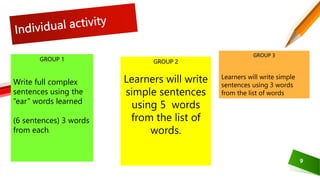
GROUP 1
Write full complex
sentences using the
“ear” words learned
(6 sentences) 3 words
from each.
GROUP 2
Learners will write
simple sentences
using 5 words
from the list of
words.
GROUP 3
Learners will write simple
sentences using 3 words
from the list of words
Recap on the words we
have learned today by
asking students to tell you
what the words are and
how to spell them. Use
the video below to
practice pronunciation.
https://youtu.be/4JSwmP6
1nXo
10
Lesson 2
LO: I can read and understand rhyming
poems.
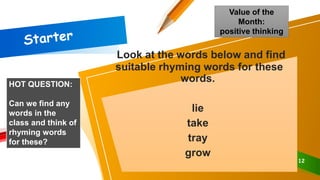
Look at the words below and find
suitable rhyming words for these
words.
lie
take
tray
grow
12
Value of the
Month:
positive thinking
HOT QUESTION:
Can we find any
words in the
class and think of
rhyming words
for these?
13
Lets look at the
following
poem.
Lets read this
poem together
and identify the
rhyming
words.
14
Learners will look for words
that rhyme in the poem &
repeat the rhyming words
with its sound.
15
TEACHER WILL DEMONSTRATE
HOW TO WRITE ALPHABETS ON
COPYBOOK LINES
Learners will work with their
partner to think of
Which words rhyme with:
How
Pen
16
GROUP 1
Learners will
read the poem
given to them
and answer the
questions on
that poem in
their copy books
GROUP 2
Learners will read the
poem and answer the
questions given to them
on that poem with
teacher’s guidance.
GROUP 3
Learners will read the
poem and answer the
questions given to them
on that poem with
teacher’s assistance.
Recap rhyming words
from the lesson.Have
students say a few
rhyming words they can
remember from the
lesson.
17
Lesson 3
LO: I can write my own rhyming
poem.
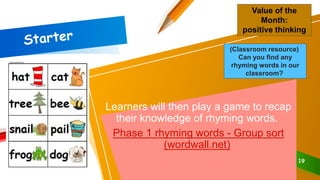
Learners will then play a game to recap
their knowledge of rhyming words.
Phase 1 rhyming words - Group sort
(wordwall.net)
19
Value of the
Month:
positive thinking
(Classroom resource)
Can you find any
rhyming words in our
classroom?
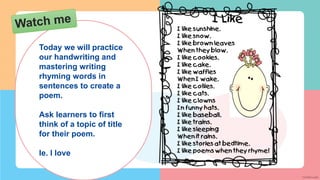
Today we will practice
our handwriting and
mastering writing
rhyming words in
sentences to create a
poem.
Ask learners to first
think of a topic of title
for their poem.
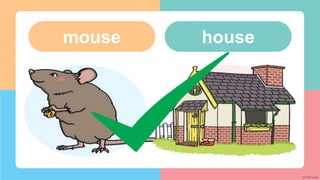
Ie. I love
Ball - Mall
Nose – Rose
Mouse – House
.
Some rhyming
words.
Can you think
of more?
22
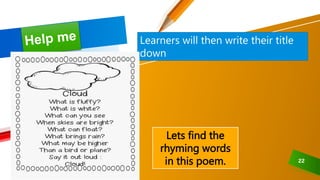
Lets find the
rhyming words
in this poem.
Learners will then write their title
down
Learners will write down various rhyming words that
they can use in their poem.
house
mouse
snail
whale
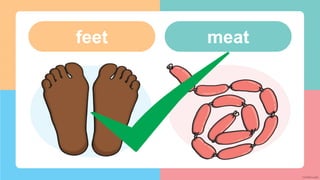
meat
feet
see
pea
sail
nail
29
GROUP 1
learners will use their
title and the 4/6
rhyming words they
wrote down to help
them write a 6 line
short poem. Activity
done independently
GROUP 2
learners will use their
title and the 2/4 rhyming
words they wrote down
to help them write a 4
line short poem with
teachers help.
GROUP 3
learners will use their
title and the rhyming
words they wrote down
to help them write a 2
line short poem with
teachers help.
ACTIVITY TO BE DONE ON WORKSHEET
PAPER
Learners to read their poem out
to the class.
30
Lesson 4
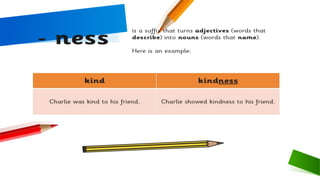
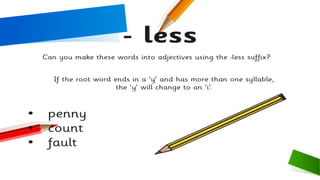
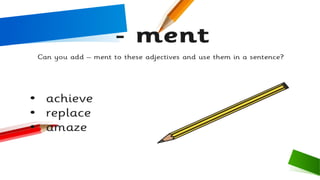
LO: I can identify the suffix ‘less’
‘ment’.
Value of the
Month:
positive thinking
Lesson will start by teacher asking
the class to break this word down.
SPEECHLESS
What other word can you get from
this word
Teacher will explain root words
Value of the
Month:
positive thinking
45
GROUP 1
Write sentences with
the words below and
underline the suffix in
the sentences.
Enjoyment
Appointment
Argument
Hopeless
Pointless
harmless
GROUP 2
Write sentences with
the words below and
underline the suffix in
the sentences.
Teacher to assist.
Enjoyment
Appointment
Hopeless
pointless
GROUP 3
Write sentences with
the words below and
underline the suffix in
the sentences.
Teacher to assist.
Enjoyment
Hopeless
Pointless
Learners will think and
suggest of other words
that have roots and
suffixes.
Lesson 7
LO: I can identify future tense.
Students will watch a
future Tenses video introduce
them to the lesson
https://youtu.be/DXaWRy6oiss
48
Value of the
Month:
positive thinking
HOT QUESTION
What is an
example of a
word in the past
tense
(Classroom resource)
Can you find any future
tense words in the
classroom?
49
Tell the students that today we are going
to be learning about Tenses with focus on
future tense .
Future tense tells us something that
will be done in the future or later
Future tense often has the phrases
“will” “going to” “wont be” after the
subject.
Future tense
50
Look at these words, the teacher will give you some
examples of sentnces, can you create your own sentences
in the future tense using these words?
What do
you
notice?
51
To play this game, simply show the
video in class. There are ten rounds.
Each round shows students a future
simple tense sentence with a word
missing. The students will then see
an image hidden behind some
colored shapes. As the shapes
disappear, students must try to guess
what the word is to complete the
future tense sentence.
https://youtu.be/Mg1NOCnb8zo
Have the students play the online
activity to see how
future tense verbs are used.
https://www.tinytap.com/activities/g3
nhi/play/j13-future-tense
52
53
GROUP 1
learners will complete
page 114-115 in their
English Global copy
books
GROUP 2
learners will complete
activity 2 and 3 on
page 115 by filling in
the missing words
and circling the right
form of future tense.
GROUP 3
learners will circle the
correct form that
represents future
tense ( page 115
number 2)
Recap on the lesson Play a game
on the Games and activity to learn
English linking to Regular Past
Tenses Students will come in pair
to the smartboard and match the
words read to the picture. This will
encourage their listening skills. Its
called the time click madness
where you need to beat the timing
of the clock.
https://www.mes-
games.com/past1.php
54
Lesson 8
LO: I write letters “p” and “q”
correctly and form sentences.
Ask the learners to look around the
classroom and find words that start with
the letters P and Q big or small and then
write these words down on a piece of
paper.
56
Value of the
Month:
positive thinking
ADD A FOOTER 57
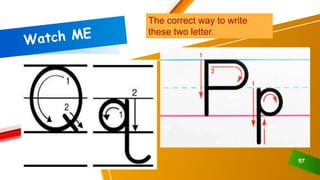
The correct way to write
these two letter.
ADD A FOOTER 58
59
Learners are to write
these to alphabets ( big
and small letters) down
in their books as neatly
as they can.
60
Learners are to now
think of 4 words that
start with P and 4 words
that start with q and
then write these words
down.
61
GROUP 1
Students will write
the letters “p” and “q”
words of their choice
in the writing
copybook and make
as many sentences
they can following the
Sky letters, Root
letters, and Grass
letter formation.
No help from the
teacher.
GROUP 2
Students will write the
letters “p” and
“q” and find words of
their choice in the
writing copybook and
make at least 5
sentences they can
following the Sky
letters, Root letters,
and Grass letter
formation – little or no
help from the
teacher.
GROUP 3
Students will write the
letters “p” and “q”
words of their choice
in the writing
copybook and make
atleast 2 sentences
they can following the
Sky letters, Root
letters, and Grass
letter formation.
Words will be given.
With maximum help
from the teacher.
62
Recap the Grass , Sky and root letter activity at the
beginning of the lesson to enhance the students
understanding of the writing pattern.

English term2-week 3..pptx

  • 1.
    Lesson 1 LO: Ican identify the ear as /er/sound and words
  • 2.
    Using the CambridgeGlobal English Workbook 2 quickly work on page11 No 1. Write and colour what you see. 2 Value of the Month: positive thinking
  • 3.
    3 Earn Beard Earth Clear LearnGear Pearl Spear Search Yearn Let's use phonics to pronounce these words.
  • 4.
    4 Watch the videoto further explain
  • 5.
    1. Earn -If I want something I have to earn it. 2. Earth- The is our planet and we have to take good care of it. 3. Learn – We go to school to learn new things and improve our knowledge. 4. Peal - Pearl fishing is a major part of the history of Qatar. 5. Search - I lost my cat so we all went on a search for it. 5 Watch me
  • 6.
    6 6. Beard -Theman at the mall had a very long beard. 7. Clear - After I washed the glass, it was crystal clear. 8. Gear – My mother bought me swimming gear. 9. Spear – Hunters used to use a spear to catch animals. 10. Yearn – I yearn to be a pilot when I grow up.
  • 7.
    7 Play the jungleanimal game where students have to rearrange the letters to form the word. Work in pairs to rearrange the letters to form the words on the smart board. https://www.spellingtraining.com/games/friends/friends.ht ml?&ytqj&ytqlr&mytqj&hytqm&vytqdr&cytqj&nytqw&dmytq &aytq&vhytq
  • 8.
    Students will playthe practice game where they will listen to the word and then write it in their copybook. (or whiteboard) Teacher's discretion https://www.spellingtraining.com/ets.html ?&ytqj&ytqlr&mytqj&hytqm&vytqdr&cytqj &nytqw&dmytq&aytq&vhytq 8
  • 9.
    9 GROUP 1 Write fullcomplex sentences using the “ear” words learned (6 sentences) 3 words from each. GROUP 2 Learners will write simple sentences using 5 words from the list of words. GROUP 3 Learners will write simple sentences using 3 words from the list of words
  • 10.
    Recap on thewords we have learned today by asking students to tell you what the words are and how to spell them. Use the video below to practice pronunciation. https://youtu.be/4JSwmP6 1nXo 10
  • 11.
    Lesson 2 LO: Ican read and understand rhyming poems.
  • 12.
    Look at thewords below and find suitable rhyming words for these words. lie take tray grow 12 Value of the Month: positive thinking HOT QUESTION: Can we find any words in the class and think of rhyming words for these?
  • 13.
    13 Lets look atthe following poem. Lets read this poem together and identify the rhyming words.
  • 14.
    14 Learners will lookfor words that rhyme in the poem & repeat the rhyming words with its sound.
  • 15.
    15 TEACHER WILL DEMONSTRATE HOWTO WRITE ALPHABETS ON COPYBOOK LINES Learners will work with their partner to think of Which words rhyme with: How Pen
  • 16.
    16 GROUP 1 Learners will readthe poem given to them and answer the questions on that poem in their copy books GROUP 2 Learners will read the poem and answer the questions given to them on that poem with teacher’s guidance. GROUP 3 Learners will read the poem and answer the questions given to them on that poem with teacher’s assistance.
  • 17.
    Recap rhyming words fromthe lesson.Have students say a few rhyming words they can remember from the lesson. 17
  • 18.
    Lesson 3 LO: Ican write my own rhyming poem.
  • 19.
    Learners will thenplay a game to recap their knowledge of rhyming words. Phase 1 rhyming words - Group sort (wordwall.net) 19 Value of the Month: positive thinking (Classroom resource) Can you find any rhyming words in our classroom?
  • 20.
    Today we willpractice our handwriting and mastering writing rhyming words in sentences to create a poem. Ask learners to first think of a topic of title for their poem. Ie. I love
  • 21.
    Ball - Mall Nose– Rose Mouse – House . Some rhyming words. Can you think of more?
  • 22.
    22 Lets find the rhymingwords in this poem. Learners will then write their title down
  • 23.
    Learners will writedown various rhyming words that they can use in their poem.
  • 24.
  • 25.
  • 26.
  • 27.
  • 28.
  • 29.
    29 GROUP 1 learners willuse their title and the 4/6 rhyming words they wrote down to help them write a 6 line short poem. Activity done independently GROUP 2 learners will use their title and the 2/4 rhyming words they wrote down to help them write a 4 line short poem with teachers help. GROUP 3 learners will use their title and the rhyming words they wrote down to help them write a 2 line short poem with teachers help. ACTIVITY TO BE DONE ON WORKSHEET PAPER
  • 30.
    Learners to readtheir poem out to the class. 30
  • 31.
    Lesson 4 LO: Ican identify the suffix ‘less’ ‘ment’.
  • 32.
    Value of the Month: positivethinking Lesson will start by teacher asking the class to break this word down. SPEECHLESS What other word can you get from this word Teacher will explain root words
  • 33.
  • 45.
    45 GROUP 1 Write sentenceswith the words below and underline the suffix in the sentences. Enjoyment Appointment Argument Hopeless Pointless harmless GROUP 2 Write sentences with the words below and underline the suffix in the sentences. Teacher to assist. Enjoyment Appointment Hopeless pointless GROUP 3 Write sentences with the words below and underline the suffix in the sentences. Teacher to assist. Enjoyment Hopeless Pointless
  • 46.
    Learners will thinkand suggest of other words that have roots and suffixes.
  • 47.
    Lesson 7 LO: Ican identify future tense.
  • 48.
    Students will watcha future Tenses video introduce them to the lesson https://youtu.be/DXaWRy6oiss 48 Value of the Month: positive thinking HOT QUESTION What is an example of a word in the past tense (Classroom resource) Can you find any future tense words in the classroom?
  • 49.
    49 Tell the studentsthat today we are going to be learning about Tenses with focus on future tense . Future tense tells us something that will be done in the future or later Future tense often has the phrases “will” “going to” “wont be” after the subject. Future tense
  • 50.
    50 Look at thesewords, the teacher will give you some examples of sentnces, can you create your own sentences in the future tense using these words? What do you notice?
  • 51.
    51 To play thisgame, simply show the video in class. There are ten rounds. Each round shows students a future simple tense sentence with a word missing. The students will then see an image hidden behind some colored shapes. As the shapes disappear, students must try to guess what the word is to complete the future tense sentence. https://youtu.be/Mg1NOCnb8zo
  • 52.
    Have the studentsplay the online activity to see how future tense verbs are used. https://www.tinytap.com/activities/g3 nhi/play/j13-future-tense 52
  • 53.
    53 GROUP 1 learners willcomplete page 114-115 in their English Global copy books GROUP 2 learners will complete activity 2 and 3 on page 115 by filling in the missing words and circling the right form of future tense. GROUP 3 learners will circle the correct form that represents future tense ( page 115 number 2)
  • 54.
    Recap on thelesson Play a game on the Games and activity to learn English linking to Regular Past Tenses Students will come in pair to the smartboard and match the words read to the picture. This will encourage their listening skills. Its called the time click madness where you need to beat the timing of the clock. https://www.mes- games.com/past1.php 54
  • 55.
    Lesson 8 LO: Iwrite letters “p” and “q” correctly and form sentences.
  • 56.
    Ask the learnersto look around the classroom and find words that start with the letters P and Q big or small and then write these words down on a piece of paper. 56 Value of the Month: positive thinking
  • 57.
    ADD A FOOTER57 The correct way to write these two letter.
  • 58.
  • 59.
    59 Learners are towrite these to alphabets ( big and small letters) down in their books as neatly as they can.
  • 60.
    60 Learners are tonow think of 4 words that start with P and 4 words that start with q and then write these words down.
  • 61.
    61 GROUP 1 Students willwrite the letters “p” and “q” words of their choice in the writing copybook and make as many sentences they can following the Sky letters, Root letters, and Grass letter formation. No help from the teacher. GROUP 2 Students will write the letters “p” and “q” and find words of their choice in the writing copybook and make at least 5 sentences they can following the Sky letters, Root letters, and Grass letter formation – little or no help from the teacher. GROUP 3 Students will write the letters “p” and “q” words of their choice in the writing copybook and make atleast 2 sentences they can following the Sky letters, Root letters, and Grass letter formation. Words will be given. With maximum help from the teacher.
  • 62.
    62 Recap the Grass, Sky and root letter activity at the beginning of the lesson to enhance the students understanding of the writing pattern.