WEEK THEME / UNIT CONTENT STANDARD LEARNING STANDARD FOCUS WORDS REMARKS
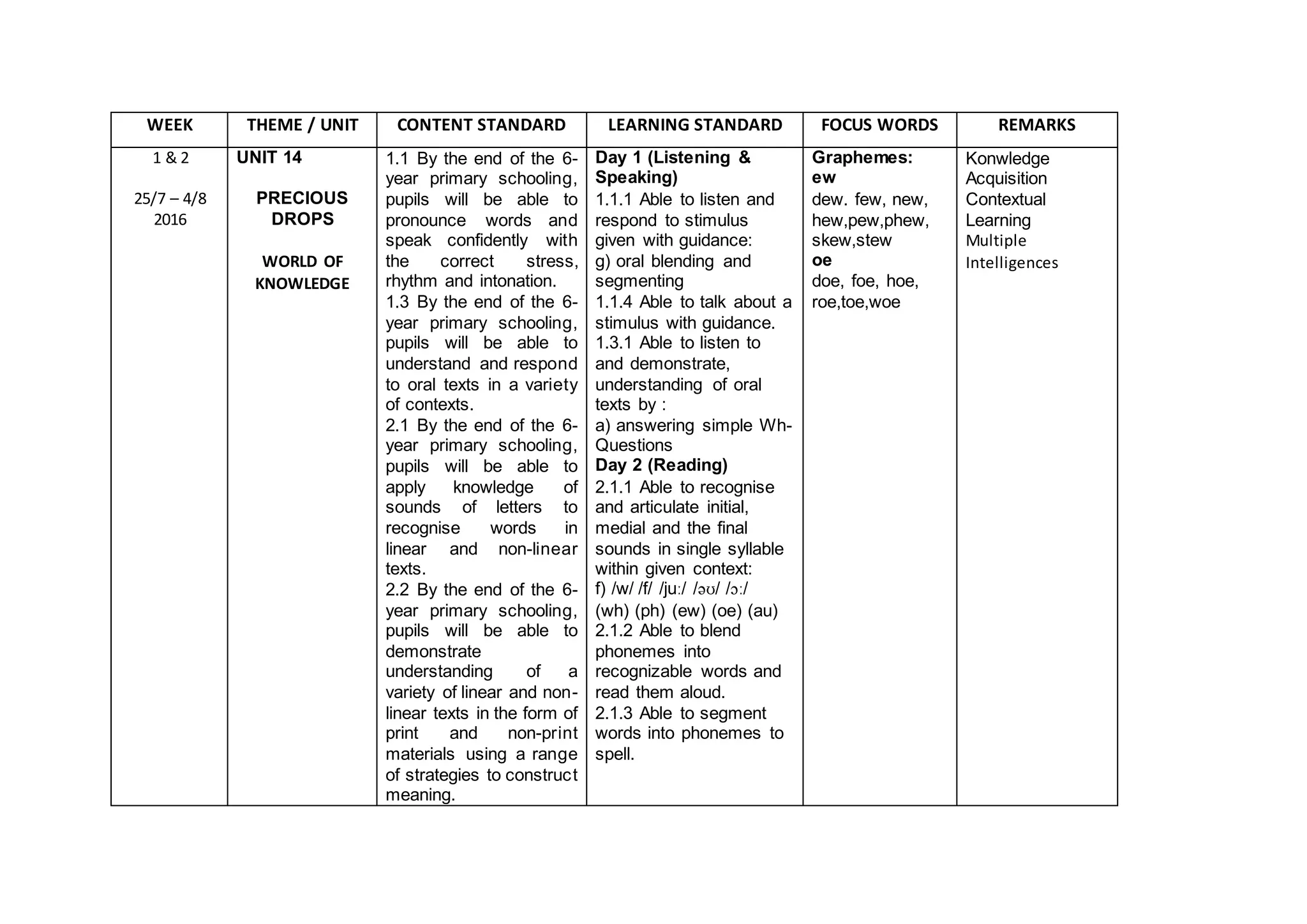
1 & 2
25/7 – 4/8
2016
UNIT 14
PRECIOUS
DROPS
WORLD OF
KNOWLEDGE
1.1 By the end of the 6-
year primary schooling,
pupils will be able to
pronounce words and
speak confidently with
the correct stress,
rhythm and intonation.
1.3 By the end of the 6-
year primary schooling,
pupils will be able to
understand and respond
to oral texts in a variety
of contexts.
2.1 By the end of the 6-
year primary schooling,
pupils will be able to
apply knowledge of
sounds of letters to
recognise words in
linear and non-linear
texts.
2.2 By the end of the 6-
year primary schooling,
pupils will be able to
demonstrate
understanding of a
variety of linear and non-
linear texts in the form of
print and non-print
materials using a range
of strategies to construct
meaning.
Day 1 (Listening &
Speaking)
1.1.1 Able to listen and
respond to stimulus
given with guidance:
g) oral blending and
segmenting
1.1.4 Able to talk about a
stimulus with guidance.
1.3.1 Able to listen to
and demonstrate,
understanding of oral
texts by :
a) answering simple Wh-
Questions
Day 2 (Reading)
2.1.1 Able to recognise
and articulate initial,
medial and the final
sounds in single syllable
within given context:
f) /w/ /f/ /juː/ /əʊ/ /ɔː/
(wh) (ph) (ew) (oe) (au)
2.1.2 Able to blend
phonemes into
recognizable words and
read them aloud.
2.1.3 Able to segment
words into phonemes to
spell.
Graphemes:
ew
dew. few, new,
hew,pew,phew,
skew,stew
oe
doe, foe, hoe,
roe,toe,woe
Konwledge
Acquisition
Contextual
Learning
Multiple
Intelligences
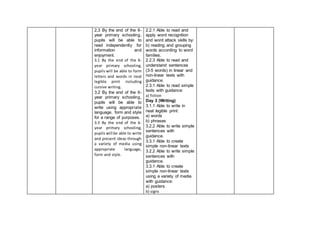
2.3 By the end of the 6-
year primary schooling,
pupils will be able to
read independently for
information and
enjoyment.
3.1 By the end of the 6-
year primary schooling,
pupils will be able to form
letters and words in neat
legible print including
cursive writing.
3.2 By the end of the 6-
year primary schooling,
pupils will be able to
write using appropriate
language, form and style
for a range of purposes.
3.3 By the end of the 6-
year primary schooling,
pupils will be able to write
and present ideas through
a variety of media using
appropriate language,
form and style.
2.2.1 Able to read and
apply word recognition
and word attack skills by:
b) reading and grouping
words according to word
families.
2.2.3 Able to read and
understand sentences
(3-5 words) in linear and
non-linear texts with
guidance.
2.3.1 Able to read simple
texts with guidance:
a) fiction
Day 3 (Writing)
3.1.1 Able to write in
neat legible print:
a) words
b) phrases
3.2.2 Able to write simple
sentences with
guidance.
3.3.1 Able to create
simple non-linear texts
3.2.2 Able to write simple
sentences with
guidance.
3.3.1 Able to create
simple non-linear texts
using a variety of media
with guidance:
a) posters
b) signs
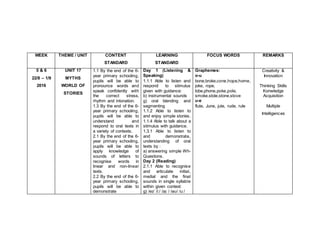
WEEK THEME / UNIT CONTENT STANDARD LEARNING STANDARD FOCUS WORDS REMARKS
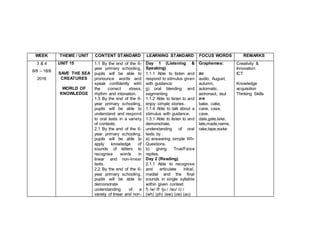
3 & 4
8/8 – 18/8
2016
UNIT 15
SAVE THE SEA
CREATURES
WORLD OF
KNOWLEDGE
1.1 By the end of the 6-
year primary schooling,
pupils will be able to
pronounce words and
speak confidently with
the correct stress,
rhythm and intonation.
1.3 By the end of the 6-
year primary schooling,
pupils will be able to
understand and respond
to oral texts in a variety
of contexts.
2.1 By the end of the 6-
year primary schooling,
pupils will be able to
apply knowledge of
sounds of letters to
recognise words in
linear and non-linear
texts.
2.2 By the end of the 6-
year primary schooling,
pupils will be able to
demonstrate
understanding of a
variety of linear and non-
Day 1 (Listening &
Speaking)
1.1.1 Able to listen and
respond to stimulus given
with guidance:
g) oral blending and
segmenting
1.1.2 Able to listen to and
enjoy simple stories.
1.1.4 Able to talk about a
stimulus with guidance.
1.3.1 Able to listen to and
demonstrate,
understanding of oral
texts by :
a) answering simple Wh-
Questions.
b) giving True/False
replies.
Day 2 (Reading)
2.1.1 Able to recognise
and articulate initial,
medial and the final
sounds in single syllable
within given context:
f) /w/ /f/ /juː/ /əʊ/ /ɔː/
(wh) (ph) (ew) (oe) (au)
Graphemes:
au
audio, August,
autumn,
automatic,
astronaut, taut
a-e
bake, cake,
cane, case,
cave,
date,gate,lake,
late,made,name,
rake,tape,wake
Creativity &
Innovation
ICT
Knowledge
acquisition
Thinking Skills
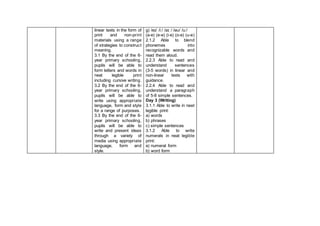
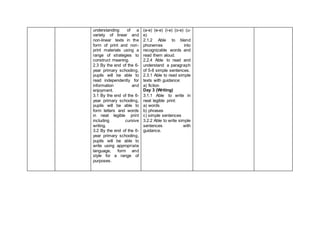
linear texts in the form of
print and non-print
materials using a range
of strategies to construct
meaning.
3.1 By the end of the 6-
year primary schooling,
pupils will be able to
form letters and words in
neat legible print
including cursive writing.
3.2 By the end of the 6-
year primary schooling,
pupils will be able to
write using appropriate
language, form and style
for a range of purposes.
3.3 By the end of the 6-
year primary schooling,
pupils will be able to
write and present ideas
through a variety of
media using appropriate
language, form and
style.
g) /eɪ/ /iː/ /aɪ / /əʊ/ /uː/
(a-e) (e-e) (i-e) (o-e) (u-e)
2.1.2 Able to blend
phonemes into
recognizable words and
read them aloud.
2.2.3 Able to read and
understand sentences
(3-5 words) in linear and
non-linear texts with
guidance.
2.2.4 Able to read and
understand a paragraph
of 5-8 simple sentences.
Day 3 (Writing)
3.1.1 Able to write in neat
legible print:
a) words
b) phrases
c) simple sentences
3.1.2 Able to write
numerals in neat legible
print:
a) numeral form
b) word form
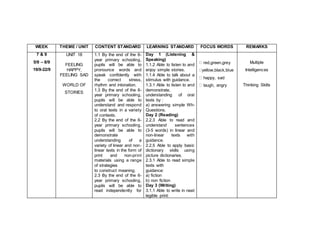
WEEK THEME / UNIT CONTENT
STANDARD
LEARNING
STANDARD
FOCUS WORDS REMARKS
5 & 6
22/8 – 1/9
2016
UNIT 17
MYTHS
WORLD OF
STORIES
1.1 By the end of the 6-
year primary schooling,
pupils will be able to
pronounce words and
speak confidently with
the correct stress,
rhythm and intonation.
1.3 By the end of the 6-
year primary schooling,
pupils will be able to
understand and
respond to oral texts in
a variety of contexts.
2.1 By the end of the 6-
year primary schooling,
pupils will be able to
apply knowledge of
sounds of letters to
recognise words in
linear and non-linear
texts.
2.2 By the end of the 6-
year primary schooling,
pupils will be able to
demonstrate
Day 1 (Listening &
Speaking)
1.1.1 Able to listen and
respond to stimulus
given with guidance:
b) instrumental sounds
g) oral blending and
segmenting
1.1.2 Able to listen to
and enjoy simple stories.
1.1.4 Able to talk about a
stimulus with guidance.
1.3.1 Able to listen to
and demonstrate,
understanding of oral
texts by :
a) answering simple Wh-
Questions.
Day 2 (Reading)
2.1.1 Able to recognise
and articulate initial,
medial and the final
sounds in single syllable
within given context:
g) /eɪ/ /iː/ /aɪ / /əʊ/ /uː/
Graphemes:
o-u
bone,broke,cone,hope,home,
joke, rope,
lobe,phone,poke,pole,
smoke,stole,stone,stove
u-e
flute, June, jute, rude, rule
Creativity &
Innovation
Thinking Skills
Konwledge
Acquisition
Multiple
Intelligences
understanding of a
variety of linear and
non-linear texts in the
form of print and non-
print materials using a
range of strategies to
construct meaning.
2.3 By the end of the 6-
year primary schooling,
pupils will be able to
read independently for
information and
enjoyment.
3.1 By the end of the 6-
year primary schooling,
pupils will be able to
form letters and words
in neat legible print
including cursive
writing.
3.2 By the end of the 6-
year primary schooling,
pupils will be able to
write using appropriate
language, form and
style for a range of
purposes.
(a-e) (e-e) (i-e) (o-e) (u-
e)
2.1.2 Able to blend
phonemes into
recognizable words and
read them aloud.
2.2.4 Able to read and
understand a paragraph
of 5-8 simple sentences.
2.3.1 Able to read simple
texts with guidance:
a) fiction
Day 3 (Writing)
3.1.1 Able to write in
neat legible print:
a) words
b) phrases
c) simple sentences
3.2.2 Able to write simple
sentences with
guidance.
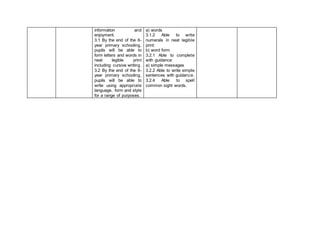
WEEK THEME / UNIT CONTENT STANDARD LEARNING STANDARD FOCUS WORDS REMARKS
7 & 9
5/9 – 8/9
19/9-22/9
UNIT 18
FEELING
HAPPY,
FEELING SAD
WORLD OF
STORIES
1.1 By the end of the 6-
year primary schooling,
pupils will be able to
pronounce words and
speak confidently with
the correct stress,
rhythm and intonation.
1.3 By the end of the 6-
year primary schooling,
pupils will be able to
understand and respond
to oral texts in a variety
of contexts.
2.2 By the end of the 6-
year primary schooling,
pupils will be able to
demonstrate
understanding of a
variety of linear and non-
linear texts in the form of
print and non-print
materials using a range
of strategies
to construct meaning.
2.3 By the end of the 6-
year primary schooling,
pupils will be able to
read independently for
Day 1 (Listening &
Speaking)
1.1.2 Able to listen to and
enjoy simple stories.
1.1.4 Able to talk about a
stimulus with guidance.
1.3.1 Able to listen to and
demonstrate,
understanding of oral
texts by :
a) answering simple Wh-
Questions.
Day 2 (Reading)
2.2.3 Able to read and
understand sentences
(3-5 words) in linear and
non-linear texts with
guidance.
2.2.5 Able to apply basic
dictionary skills using
picture dictionaries.
2.3.1 Able to read simple
texts with
guidance:
a) fiction
b) non fiction
Day 3 (Writing)
3.1.1 Able to write in neat
legible print:
red,green,grey
yellow,black,blue
happy, sad
laugh, angry
Multiple
Intelligences
Thinking Skills
information and
enjoyment.
3.1 By the end of the 6-
year primary schooling,
pupils will be able to
form letters and words in
neat legible print
including cursive writing.
3.2 By the end of the 6-
year primary schooling,
pupils will be able to
write using appropriate
language, form and style
for a range of purposes.
a) words
3.1.2 Able to write
numerals in neat legible
print:
b) word form
3.2.1 Able to complete
with guidance:
a) simple messages
3.2.2 Able to write simple
sentences with guidance.
3.2.4 Able to spell
common sight words.
WEEK THEME / UNIT CONTENT STANDARD LEARNING STANDARD FOCUS WORDS REMARKS
10 & 11
26/9 – 6/9
2016
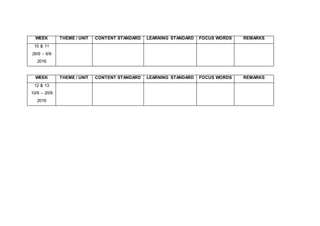
WEEK THEME / UNIT CONTENT STANDARD LEARNING STANDARD FOCUS WORDS REMARKS
12 & 13
10/9 – 20/9
2016

Eng sow 2

  • 1.
    WEEK THEME /UNIT CONTENT STANDARD LEARNING STANDARD FOCUS WORDS REMARKS 1 & 2 25/7 – 4/8 2016 UNIT 14 PRECIOUS DROPS WORLD OF KNOWLEDGE 1.1 By the end of the 6- year primary schooling, pupils will be able to pronounce words and speak confidently with the correct stress, rhythm and intonation. 1.3 By the end of the 6- year primary schooling, pupils will be able to understand and respond to oral texts in a variety of contexts. 2.1 By the end of the 6- year primary schooling, pupils will be able to apply knowledge of sounds of letters to recognise words in linear and non-linear texts. 2.2 By the end of the 6- year primary schooling, pupils will be able to demonstrate understanding of a variety of linear and non- linear texts in the form of print and non-print materials using a range of strategies to construct meaning. Day 1 (Listening & Speaking) 1.1.1 Able to listen and respond to stimulus given with guidance: g) oral blending and segmenting 1.1.4 Able to talk about a stimulus with guidance. 1.3.1 Able to listen to and demonstrate, understanding of oral texts by : a) answering simple Wh- Questions Day 2 (Reading) 2.1.1 Able to recognise and articulate initial, medial and the final sounds in single syllable within given context: f) /w/ /f/ /juː/ /əʊ/ /ɔː/ (wh) (ph) (ew) (oe) (au) 2.1.2 Able to blend phonemes into recognizable words and read them aloud. 2.1.3 Able to segment words into phonemes to spell. Graphemes: ew dew. few, new, hew,pew,phew, skew,stew oe doe, foe, hoe, roe,toe,woe Konwledge Acquisition Contextual Learning Multiple Intelligences
  • 2.
    2.3 By theend of the 6- year primary schooling, pupils will be able to read independently for information and enjoyment. 3.1 By the end of the 6- year primary schooling, pupils will be able to form letters and words in neat legible print including cursive writing. 3.2 By the end of the 6- year primary schooling, pupils will be able to write using appropriate language, form and style for a range of purposes. 3.3 By the end of the 6- year primary schooling, pupils will be able to write and present ideas through a variety of media using appropriate language, form and style. 2.2.1 Able to read and apply word recognition and word attack skills by: b) reading and grouping words according to word families. 2.2.3 Able to read and understand sentences (3-5 words) in linear and non-linear texts with guidance. 2.3.1 Able to read simple texts with guidance: a) fiction Day 3 (Writing) 3.1.1 Able to write in neat legible print: a) words b) phrases 3.2.2 Able to write simple sentences with guidance. 3.3.1 Able to create simple non-linear texts 3.2.2 Able to write simple sentences with guidance. 3.3.1 Able to create simple non-linear texts using a variety of media with guidance: a) posters b) signs
  • 3.
    WEEK THEME /UNIT CONTENT STANDARD LEARNING STANDARD FOCUS WORDS REMARKS 3 & 4 8/8 – 18/8 2016 UNIT 15 SAVE THE SEA CREATURES WORLD OF KNOWLEDGE 1.1 By the end of the 6- year primary schooling, pupils will be able to pronounce words and speak confidently with the correct stress, rhythm and intonation. 1.3 By the end of the 6- year primary schooling, pupils will be able to understand and respond to oral texts in a variety of contexts. 2.1 By the end of the 6- year primary schooling, pupils will be able to apply knowledge of sounds of letters to recognise words in linear and non-linear texts. 2.2 By the end of the 6- year primary schooling, pupils will be able to demonstrate understanding of a variety of linear and non- Day 1 (Listening & Speaking) 1.1.1 Able to listen and respond to stimulus given with guidance: g) oral blending and segmenting 1.1.2 Able to listen to and enjoy simple stories. 1.1.4 Able to talk about a stimulus with guidance. 1.3.1 Able to listen to and demonstrate, understanding of oral texts by : a) answering simple Wh- Questions. b) giving True/False replies. Day 2 (Reading) 2.1.1 Able to recognise and articulate initial, medial and the final sounds in single syllable within given context: f) /w/ /f/ /juː/ /əʊ/ /ɔː/ (wh) (ph) (ew) (oe) (au) Graphemes: au audio, August, autumn, automatic, astronaut, taut a-e bake, cake, cane, case, cave, date,gate,lake, late,made,name, rake,tape,wake Creativity & Innovation ICT Knowledge acquisition Thinking Skills
  • 4.
    linear texts inthe form of print and non-print materials using a range of strategies to construct meaning. 3.1 By the end of the 6- year primary schooling, pupils will be able to form letters and words in neat legible print including cursive writing. 3.2 By the end of the 6- year primary schooling, pupils will be able to write using appropriate language, form and style for a range of purposes. 3.3 By the end of the 6- year primary schooling, pupils will be able to write and present ideas through a variety of media using appropriate language, form and style. g) /eɪ/ /iː/ /aɪ / /əʊ/ /uː/ (a-e) (e-e) (i-e) (o-e) (u-e) 2.1.2 Able to blend phonemes into recognizable words and read them aloud. 2.2.3 Able to read and understand sentences (3-5 words) in linear and non-linear texts with guidance. 2.2.4 Able to read and understand a paragraph of 5-8 simple sentences. Day 3 (Writing) 3.1.1 Able to write in neat legible print: a) words b) phrases c) simple sentences 3.1.2 Able to write numerals in neat legible print: a) numeral form b) word form
  • 5.
    WEEK THEME /UNIT CONTENT STANDARD LEARNING STANDARD FOCUS WORDS REMARKS 5 & 6 22/8 – 1/9 2016 UNIT 17 MYTHS WORLD OF STORIES 1.1 By the end of the 6- year primary schooling, pupils will be able to pronounce words and speak confidently with the correct stress, rhythm and intonation. 1.3 By the end of the 6- year primary schooling, pupils will be able to understand and respond to oral texts in a variety of contexts. 2.1 By the end of the 6- year primary schooling, pupils will be able to apply knowledge of sounds of letters to recognise words in linear and non-linear texts. 2.2 By the end of the 6- year primary schooling, pupils will be able to demonstrate Day 1 (Listening & Speaking) 1.1.1 Able to listen and respond to stimulus given with guidance: b) instrumental sounds g) oral blending and segmenting 1.1.2 Able to listen to and enjoy simple stories. 1.1.4 Able to talk about a stimulus with guidance. 1.3.1 Able to listen to and demonstrate, understanding of oral texts by : a) answering simple Wh- Questions. Day 2 (Reading) 2.1.1 Able to recognise and articulate initial, medial and the final sounds in single syllable within given context: g) /eɪ/ /iː/ /aɪ / /əʊ/ /uː/ Graphemes: o-u bone,broke,cone,hope,home, joke, rope, lobe,phone,poke,pole, smoke,stole,stone,stove u-e flute, June, jute, rude, rule Creativity & Innovation Thinking Skills Konwledge Acquisition Multiple Intelligences
  • 6.
    understanding of a varietyof linear and non-linear texts in the form of print and non- print materials using a range of strategies to construct meaning. 2.3 By the end of the 6- year primary schooling, pupils will be able to read independently for information and enjoyment. 3.1 By the end of the 6- year primary schooling, pupils will be able to form letters and words in neat legible print including cursive writing. 3.2 By the end of the 6- year primary schooling, pupils will be able to write using appropriate language, form and style for a range of purposes. (a-e) (e-e) (i-e) (o-e) (u- e) 2.1.2 Able to blend phonemes into recognizable words and read them aloud. 2.2.4 Able to read and understand a paragraph of 5-8 simple sentences. 2.3.1 Able to read simple texts with guidance: a) fiction Day 3 (Writing) 3.1.1 Able to write in neat legible print: a) words b) phrases c) simple sentences 3.2.2 Able to write simple sentences with guidance.
  • 7.
    WEEK THEME /UNIT CONTENT STANDARD LEARNING STANDARD FOCUS WORDS REMARKS 7 & 9 5/9 – 8/9 19/9-22/9 UNIT 18 FEELING HAPPY, FEELING SAD WORLD OF STORIES 1.1 By the end of the 6- year primary schooling, pupils will be able to pronounce words and speak confidently with the correct stress, rhythm and intonation. 1.3 By the end of the 6- year primary schooling, pupils will be able to understand and respond to oral texts in a variety of contexts. 2.2 By the end of the 6- year primary schooling, pupils will be able to demonstrate understanding of a variety of linear and non- linear texts in the form of print and non-print materials using a range of strategies to construct meaning. 2.3 By the end of the 6- year primary schooling, pupils will be able to read independently for Day 1 (Listening & Speaking) 1.1.2 Able to listen to and enjoy simple stories. 1.1.4 Able to talk about a stimulus with guidance. 1.3.1 Able to listen to and demonstrate, understanding of oral texts by : a) answering simple Wh- Questions. Day 2 (Reading) 2.2.3 Able to read and understand sentences (3-5 words) in linear and non-linear texts with guidance. 2.2.5 Able to apply basic dictionary skills using picture dictionaries. 2.3.1 Able to read simple texts with guidance: a) fiction b) non fiction Day 3 (Writing) 3.1.1 Able to write in neat legible print: red,green,grey yellow,black,blue happy, sad laugh, angry Multiple Intelligences Thinking Skills
  • 8.
    information and enjoyment. 3.1 Bythe end of the 6- year primary schooling, pupils will be able to form letters and words in neat legible print including cursive writing. 3.2 By the end of the 6- year primary schooling, pupils will be able to write using appropriate language, form and style for a range of purposes. a) words 3.1.2 Able to write numerals in neat legible print: b) word form 3.2.1 Able to complete with guidance: a) simple messages 3.2.2 Able to write simple sentences with guidance. 3.2.4 Able to spell common sight words.
  • 9.
    WEEK THEME /UNIT CONTENT STANDARD LEARNING STANDARD FOCUS WORDS REMARKS 10 & 11 26/9 – 6/9 2016 WEEK THEME / UNIT CONTENT STANDARD LEARNING STANDARD FOCUS WORDS REMARKS 12 & 13 10/9 – 20/9 2016