WORD WALK:
A New Vocabulary Strategy for
Young Children


      Katrin L. Blamey, Ph.D.   Katherine A. Beauchat, Ed.D.
      DeSales University        York College of Pennsylvania
Introductions
    Katie Beauchat, Ed.D.          Katie Blamey, Ph.D.
    Assistant Professor            Assistant Professor
    York College of Pennsylvania   DeSales University
A Powerful Context
Shared Storybook Reading
• Shared storybook reading is a broad term, including all instances
  when an adult reads to a child or children, pausing to engage
  children in discussion about the text.
               Dooley, 2010; Holdaway, 1979

• Discussion includes items both inside and outside the text
                                               Snow, 2002; Whitehurst & Lonigan, 1998
• Shown to be a powerful tool for building children’s short- and long-
  term reading development
                                      Beauchat, Blamey, & Phillipakos, 2012; Wells, 1985
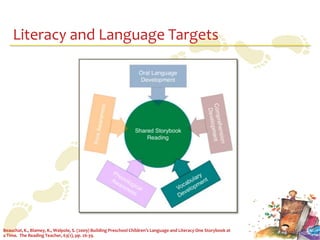
Literacy and Language Targets


Beauchat, K., Blamey, K., Walpole, S. (2009) Building Preschool Children’s Language and Literacy One Storybook at
a Time. The Reading Teacher, 63(1), pp. 26-39.
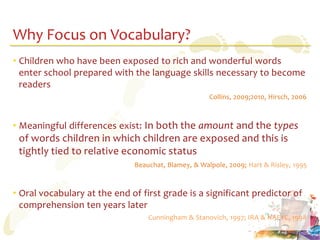
Why Focus on Vocabulary?
• Children who have been exposed to rich and wonderful words
  enter school prepared with the language skills necessary to become
  readers
                                                     Collins, 2009;2010, Hirsch, 2006


• Meaningful differences exist: In both the amount and the types
 of words children in which children are exposed and this is
 tightly tied to relative economic status
                              Beauchat, Blamey, & Walpole, 2009; Hart & Risley, 1995


• Oral vocabulary at the end of first grade is a significant predictor of
  comprehension ten years later
                                  Cunningham & Stanovich, 1997; IRA & NAEYC, 1998
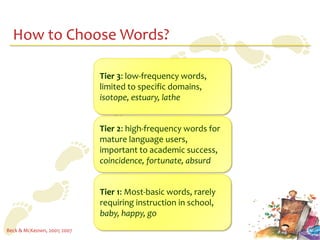
How to Choose Words?

                             Tier 3: low-frequency words,
                             limited to specific domains,
                             isotope, estuary, lathe


                             Tier 2: high-frequency words for
                             mature language users,
                             important to academic success,
                             coincidence, fortunate, absurd


                             Tier 1: Most-basic words, rarely
                             requiring instruction in school,
                             baby, happy, go
Beck & McKeown, 2001; 2007
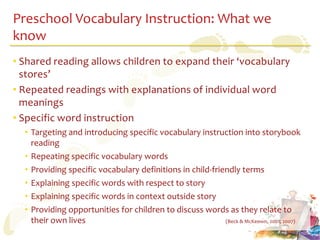
Preschool Vocabulary Instruction: What we
know
• Shared reading allows children to expand their ‘vocabulary
  stores’
• Repeated readings with explanations of individual word
  meanings
• Specific word instruction
  • Targeting and introducing specific vocabulary instruction into storybook
    reading
  • Repeating specific vocabulary words
  • Providing specific vocabulary definitions in child-friendly terms
  • Explaining specific words with respect to story
  • Explaining specific words in context outside story
  • Providing opportunities for children to discuss words as they relate to
    their own lives                                        (Beck & McKeown, 2001; 2007)
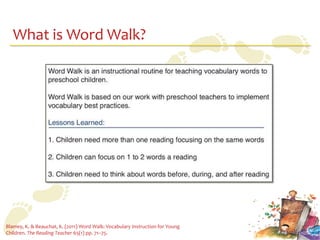
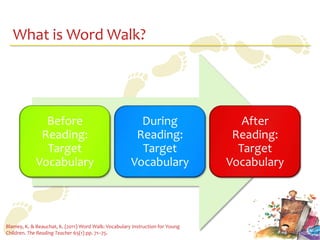
What is Word Walk?


Blamey, K. & Beauchat, K. (2011) Word Walk: Vocabulary Instruction for Young
Children. The Reading Teacher 65(1) pp. 71–75.
What is Word Walk?


               Before                                   During                    After
              Reading:                                 Reading:                 Reading:
               Target                                   Target                   Target
             Vocabulary                               Vocabulary               Vocabulary


Blamey, K. & Beauchat, K. (2011) Word Walk: Vocabulary Instruction for Young
Children. The Reading Teacher 65(1) pp. 71–75.
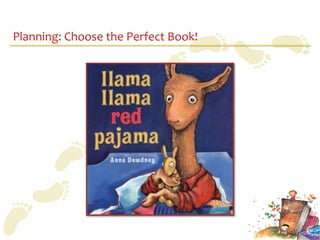
Planning: Choose the Perfect Book!
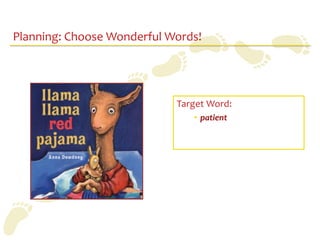
Planning: Choose Wonderful Words!


                            Target Word:
                               • patient
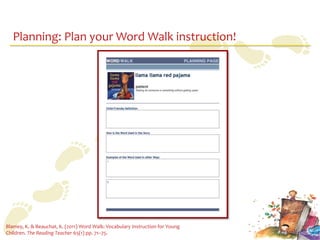
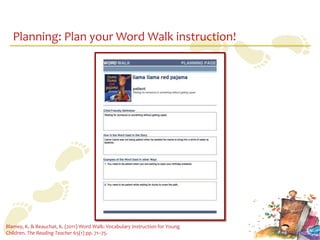
Planning: Plan your Word Walk instruction!


Blamey, K. & Beauchat, K. (2011) Word Walk: Vocabulary Instruction for Young
Children. The Reading Teacher 65(1) pp. 71–75.
Planning: Plan your Word Walk instruction!


Blamey, K. & Beauchat, K. (2011) Word Walk: Vocabulary Instruction for Young
Children. The Reading Teacher 65(1) pp. 71–75.
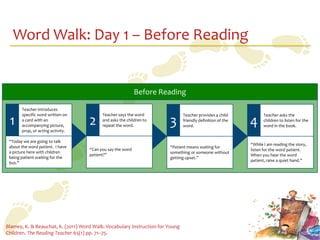
Word Walk: Day 1 – Before Reading


                                                            Before Reading

       Teacher introduces
       specific word written on           Teacher says the word                Teacher provides a child-          Teacher asks the
 1     a card with an
       accompanying picture,        2     and asks the children to
                                          repeat the word.             3       friendly definition of the
                                                                               word.                        4     children to listen for the
                                                                                                                  word in the book.
       prop, or acting activity.

 “Today we are going to talk
                                                                                                            “While I am reading the story,
 about the word patient. I have                                        “Patient means waiting for
                                    “Can you say the word                                                   listen for the word patient.
 a picture here with children                                          something or someone without
                                    patient?”                                                               When you hear the word
 being patient waiting for the                                         getting upset.”
                                                                                                            patient, raise a quiet hand.”
 bus.”


Blamey, K. & Beauchat, K. (2011) Word Walk: Vocabulary Instruction for Young
Children. The Reading Teacher 65(1) pp. 71–75.
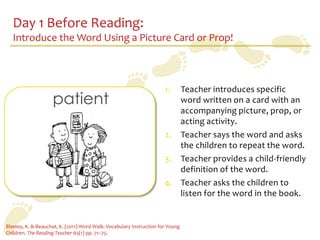
Day 1 Before Reading:
   Introduce the Word Using a Picture Card or Prop!


                                                                     1. Teacher introduces specific
                    patient                                             word written on a card with an
                                                                        accompanying picture, prop, or
                                                                        acting activity.
                                                                     2. Teacher says the word and asks
                                                                        the children to repeat the word.
                                                                     3. Teacher provides a child-friendly
                                                                        definition of the word.
                                                                     4. Teacher asks the children to
                                                                        listen for the word in the book.


Blamey, K. & Beauchat, K. (2011) Word Walk: Vocabulary Instruction for Young
Children. The Reading Teacher 65(1) pp. 71–75.
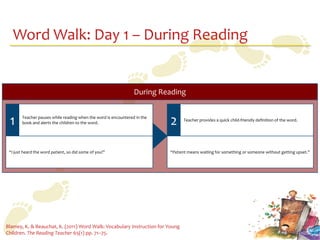
Word Walk: Day 1 – During Reading


                                                                 During Reading


 1      Teacher pauses while reading when the word is encountered in the
        book and alerts the children to the word.                          2     Teacher provides a quick child-friendly definition of the word.


 “I just heard the word patient, so did some of you!”                      “Patient means waiting for something or someone without getting upset.”


Blamey, K. & Beauchat, K. (2011) Word Walk: Vocabulary Instruction for Young
Children. The Reading Teacher 65(1) pp. 71–75.
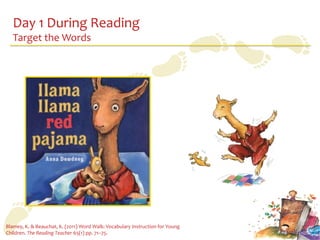
Day 1 During Reading
   Target the Words


Blamey, K. & Beauchat, K. (2011) Word Walk: Vocabulary Instruction for Young
Children. The Reading Teacher 65(1) pp. 71–75.
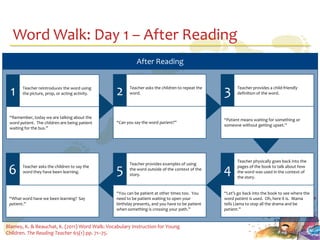
Word Walk: Day 1 – After Reading
                                                          After Reading


 1     Teacher reintroduces the word using
       the picture, prop, or acting activity.   2     Teacher asks the children to repeat the
                                                      word.                                     3     Teacher provides a child-friendly
                                                                                                      definition of the word.


 “Remember, today we are talking about the
                                                                                                “Patient means waiting for something or
 word patient. The children are being patient   “Can you say the word patient?”
                                                                                                someone without getting upset.”
 waiting for the bus.”


                                                                                                      Teacher physically goes back into the
                                                      Teacher provides examples of using
 6     Teacher asks the children to say the
       word they have been learning.            5     the word outside of the context of the
                                                      story.                                    4     pages of the book to talk about how
                                                                                                      the word was used in the context of
                                                                                                      the story.


                                                “You can be patient at other times too. You     “Let’s go back into the book to see where the
 “What word have we been learning? Say          need to be patient waiting to open your         word patient is used. Oh, here it is. Mama
 patient.”                                      birthday presents, and you have to be patient   tells Llama to stop all the drama and be
                                                when something is crossing your path.”          patient.”


Blamey, K. & Beauchat, K. (2011) Word Walk: Vocabulary Instruction for Young
Children. The Reading Teacher 65(1) pp. 71–75.
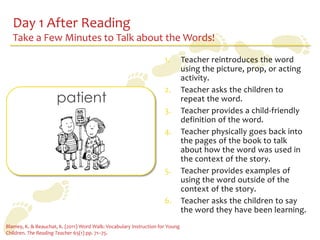
Day 1 After Reading
   Take a Few Minutes to Talk about the Words!
                                                                     1.        Teacher reintroduces the word
                                                                               using the picture, prop, or acting
                                                                               activity.
                                                                     2.        Teacher asks the children to
                      patient                                                  repeat the word.
                                                                     3.        Teacher provides a child-friendly
                                                                               definition of the word.
                                                                     4.        Teacher physically goes back into
                                                                               the pages of the book to talk
                                                                               about how the word was used in
                                                                               the context of the story.
                                                                     5.        Teacher provides examples of
                                                                               using the word outside of the
                                                                               context of the story.
                                                                     6.        Teacher asks the children to say
                                                                               the word they have been learning.
Blamey, K. & Beauchat, K. (2011) Word Walk: Vocabulary Instruction for Young
Children. The Reading Teacher 65(1) pp. 71–75.
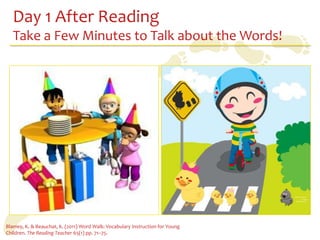
Day 1 After Reading
   Take a Few Minutes to Talk about the Words!


Blamey, K. & Beauchat, K. (2011) Word Walk: Vocabulary Instruction for Young
Children. The Reading Teacher 65(1) pp. 71–75.
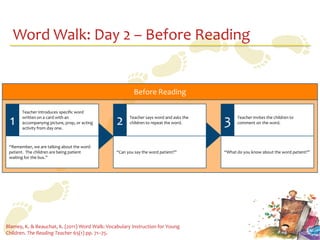
Word Walk: Day 2 – Before Reading


                                                        Before Reading

       Teacher introduces specific word

 1     written on a card with an
       accompanying picture, prop, or acting
       activity from day one.
                                                2     Teacher says word and asks the
                                                      children to repeat the word.     3     Teacher invites the children to
                                                                                             comment on the word.


 “Remember, we are talking about the word
 patient. The children are being patient        “Can you say the word patient?”        “What do you know about the word patient?”
 waiting for the bus.”


Blamey, K. & Beauchat, K. (2011) Word Walk: Vocabulary Instruction for Young
Children. The Reading Teacher 65(1) pp. 71–75.
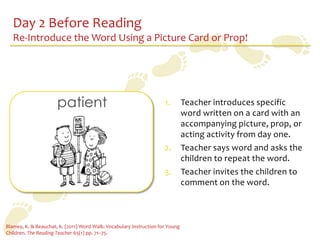
Day 2 Before Reading
   Re-Introduce the Word Using a Picture Card or Prop!


                      patient                                        1.        Teacher introduces specific
                                                                               word written on a card with an
                                                                               accompanying picture, prop, or
                                                                               acting activity from day one.
                                                                     2.        Teacher says word and asks the
                                                                               children to repeat the word.
                                                                     3.        Teacher invites the children to
                                                                               comment on the word.


Blamey, K. & Beauchat, K. (2011) Word Walk: Vocabulary Instruction for Young
Children. The Reading Teacher 65(1) pp. 71–75.
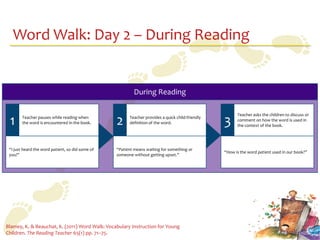
Word Walk: Day 2 – During Reading


                                                          During Reading

                                                                                                        Teacher asks the children to discuss or
 1      Teacher pauses while reading when
        the word is encountered in the book.      2     Teacher provides a quick child-friendly
                                                        definition of the word.                   3     comment on how the word is used in
                                                                                                        the context of the book.


 “I just heard the word patient, so did some of   “Patient means waiting for something or
                                                                                                  “How is the word patient used in our book?”
 you!”                                            someone without getting upset.”


Blamey, K. & Beauchat, K. (2011) Word Walk: Vocabulary Instruction for Young
Children. The Reading Teacher 65(1) pp. 71–75.
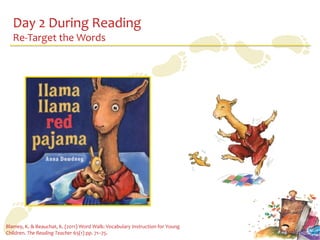
Day 2 During Reading
   Re-Target the Words


Blamey, K. & Beauchat, K. (2011) Word Walk: Vocabulary Instruction for Young
Children. The Reading Teacher 65(1) pp. 71–75.
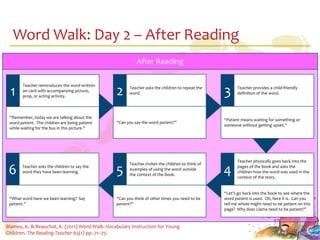
Word Walk: Day 2 – After Reading
                                                          After Reading

       Teacher reintroduces the word written
 1     on card with accompanying picture,
       prop, or acting activity.
                                                2     Teacher asks the children to repeat the
                                                      word.                                      3      Teacher provides a child-friendly
                                                                                                        definition of the word.


 “Remember, today we are talking about the
                                                                                                 “Patient means waiting for something or
 word patient. The children are being patient   “Can you say the word patient?”
                                                                                                 someone without getting upset.”
 while waiting for the bus in this picture.”


                                                                                                        Teacher physically goes back into the
                                                      Teacher invites the children to think of
 6     Teacher asks the children to say the
       word they have been learning.            5     examples of using the word outside
                                                      the context of the book.                   4      pages of the book and asks the
                                                                                                        children how the word was used in the
                                                                                                        context of the story.


                                                                                                 “Let’s go back into the book to see where the
 “What word have we been learning? Say          “Can you think of other times you need to be     word patient is used. Oh, here it is. Can you
 patient.”                                      patient?”                                        tell me whole might need to be patient on this
                                                                                                 page? Why does Llama need to be patient?”


Blamey, K. & Beauchat, K. (2011) Word Walk: Vocabulary Instruction for Young
Children. The Reading Teacher 65(1) pp. 71–75.
Day 2 After Reading
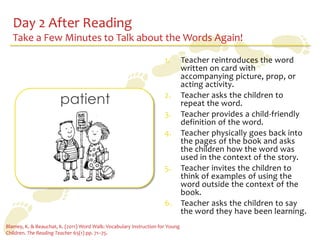
   Take a Few Minutes to Talk about the Words Again!

                                                                     1.        Teacher reintroduces the word
                                                                               written on card with
                                                                               accompanying picture, prop, or
                                                                               acting activity.

                       patient                                       2.        Teacher asks the children to
                                                                               repeat the word.
                                                                     3.        Teacher provides a child-friendly
                                                                               definition of the word.
                                                                     4.        Teacher physically goes back into
                                                                               the pages of the book and asks
                                                                               the children how the word was
                                                                               used in the context of the story.
                                                                     5.        Teacher invites the children to
                                                                               think of examples of using the
                                                                               word outside the context of the
                                                                               book.
                                                                     6.        Teacher asks the children to say
                                                                               the word they have been learning.
Blamey, K. & Beauchat, K. (2011) Word Walk: Vocabulary Instruction for Young
Children. The Reading Teacher 65(1) pp. 71–75.
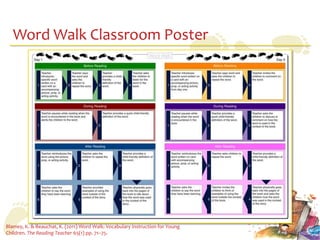
Word Walk Classroom Poster


Blamey, K. & Beauchat, K. (2011) Word Walk: Vocabulary Instruction for Young
Children. The Reading Teacher 65(1) pp. 71–75.
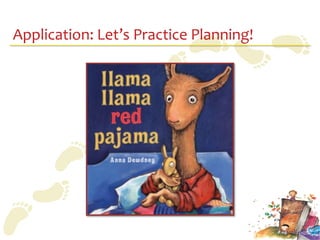
Application: Let’s Practice Planning!

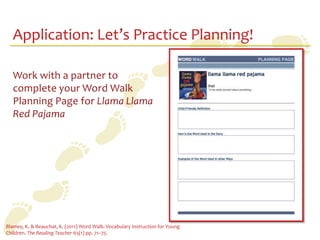
   Work with a partner to
   complete your Word Walk
   Planning Page for Llama Llama
   Red Pajama


Blamey, K. & Beauchat, K. (2011) Word Walk: Vocabulary Instruction for Young
Children. The Reading Teacher 65(1) pp. 71–75.
Let’s Share our Planning Page!
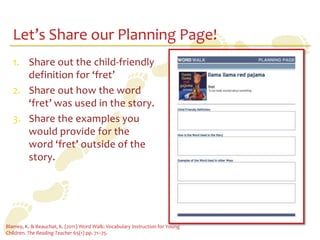
   1. Share out the child-friendly
      definition for ‘fret’
   2. Share out how the word
      ‘fret’ was used in the story.
   3. Share the examples you
      would provide for the
      word ‘fret’ outside of the
      story.


Blamey, K. & Beauchat, K. (2011) Word Walk: Vocabulary Instruction for Young
Children. The Reading Teacher 65(1) pp. 71–75.
Let’s Share

   Child-Friendly Definition


     To be really worried about something


Blamey, K. & Beauchat, K. (2011) Word Walk: Vocabulary Instruction for Young
Children. The Reading Teacher 65(1) pp. 71–75.
Let’s Share

   How is the Word Used in the Story?

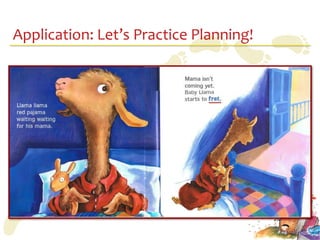
     Llama llama was FRETTING when he thinks Mama Llama is gone and has left him
     alone in bed in the dark.


Blamey, K. & Beauchat, K. (2011) Word Walk: Vocabulary Instruction for Young
Children. The Reading Teacher 65(1) pp. 71–75.
Let’s Share

   Examples of the Word Used in Other Ways

      I might FRET when I have to get my house cleaned and Thanksgiving dinner made
      for a houseful of guests.


      You might FRET about moving to a new school and meeting new friends.


Blamey, K. & Beauchat, K. (2011) Word Walk: Vocabulary Instruction for Young
Children. The Reading Teacher 65(1) pp. 71–75.
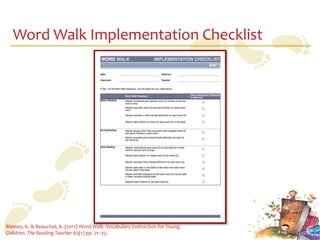
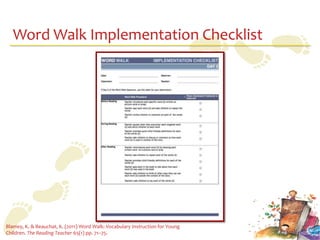
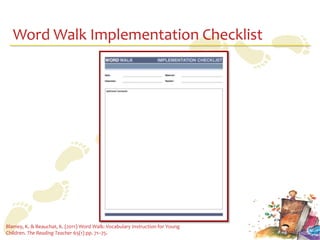
Word Walk Implementation Checklist


Blamey, K. & Beauchat, K. (2011) Word Walk: Vocabulary Instruction for Young
Children. The Reading Teacher 65(1) pp. 71–75.
Word Walk Implementation Checklist


Blamey, K. & Beauchat, K. (2011) Word Walk: Vocabulary Instruction for Young
Children. The Reading Teacher 65(1) pp. 71–75.
Word Walk Implementation Checklist


Blamey, K. & Beauchat, K. (2011) Word Walk: Vocabulary Instruction for Young
Children. The Reading Teacher 65(1) pp. 71–75.
Word Walk Video Share
Reviewing your Word Walk implementation checklist, identify
one strength of the lesson, one aspect of Word Walk to work
towards next time!
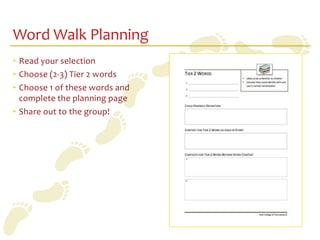
Word Walk Planning
• Read your selection
• Choose (2-3) Tier 2 words
• Choose 1 of these words and
  complete the planning page
• Share out to the group!
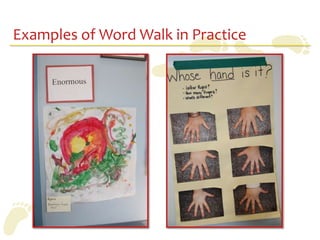
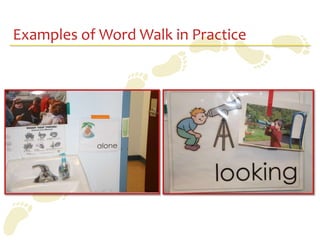
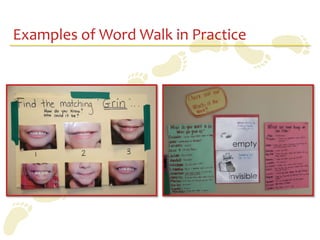
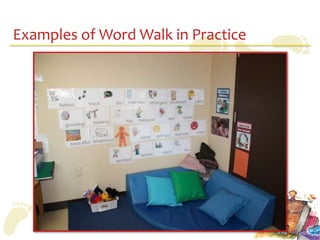
Examples of Word Walk in Practice
Word Walk Extensions
Children need multiple exposures for the words to live
in their permanent vocabulary stores!

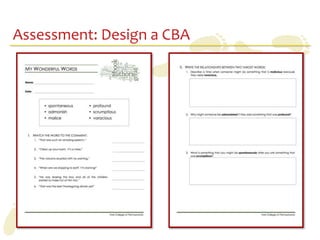
 •   Spontaneous
 •   Admonish
 •   Malice
 •   Profound
 •   Scrumptious
 •   Voracious
1. Ask “Why?”
Admonish
• To admonish someone means to caution or scold him or her in a
  mild way. If students are talking too loudly in the cafeteria, they
  could admonished for their behavior.
• If I say something that someone might be admonished for, say
  “You’ll get admonished.” If not, don’t say anything. Ask “why?”
 •   forgetting to take out the trash
 •   helping a new student find her locker
 •   practicing your yodeling early in the morning
 •   finding a lost key
• What’s the word that means “advised to change what you’re
  doing”?
2. Match word to a comment!
Ask students to name the vocabulary word that goes with each of
these comments:

 •   “That was so mean!”
 •   “Ooh, deep, man, really deep.”
 •   “The principal was angry when we came in late.”
 •   “What just happened?”
 •   “That was absolutely delicious.”
 •   I’m so hungry I could eat a horse!”
3. Create relationships!
• Admonish/malice
     Would you admonish someone for something that showed malice?
• Admonish/spontaneous
     Why would someone be admonished for doing something that was
     spontaneous?
• Spontaneous/malicious
     Would something spontaneous be malicious?
• Voracious/scrumptious
     Why would someone who was voracious not eat something that looked
     scrumptious?
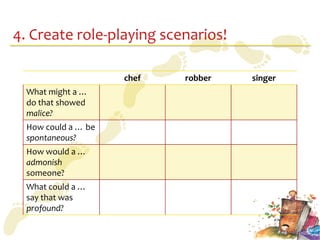
4. Create role-playing scenarios!

                     chef   robber   singer
  What might a …
  do that showed
  malice?
  How could a … be
  spontaneous?
  How would a …
  admonish
  someone?
  What could a …
  say that was
  profound?
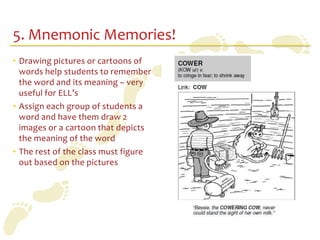
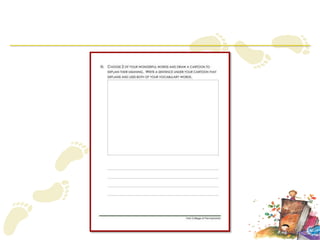
5. Mnemonic Memories!
• Drawing pictures or cartoons of
  words help students to remember
  the word and its meaning – very
  useful for ELL’s
• Assign each group of students a
  word and have them draw 2
  images or a cartoon that depicts
  the meaning of the word
• The rest of the class must figure
  out based on the pictures
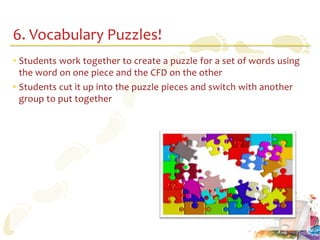
6. Vocabulary Puzzles!
• Students work together to create a puzzle for a set of words using
  the word on one piece and the CFD on the other
• Students cut it up into the puzzle pieces and switch with another
  group to put together
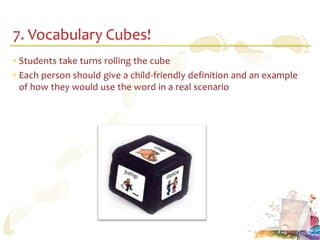
7. Vocabulary Cubes!
• Students take turns rolling the cube
• Each person should give a child-friendly definition and an example
  of how they would use the word in a real scenario
8. Word Freeze!
• Every student gets a card with a word that they have been studying
• Teacher plays song clips and students walk around the room until
  music stops
• Find a partner and tell them the CFD and a real-world scenario, the
  other partner then has to give another scenario or example of how
  the word can be used
9. Vo-back-u-lary!
• Students get in group or whole group and review words
• One student has a word taped to their back (they do not know
  which one) and the group must give them clues to help the student
  name the word.
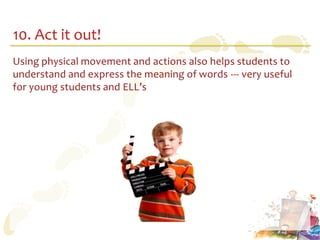
10. Act it out!
Using physical movement and actions also helps students to
understand and express the meaning of words --- very useful
for young students and ELL’s
Assessment: Design a CBA
Word Walk Preliminary Research Findings
• On measures of receptive vocabulary knowledge, children in the
  intervention group made gains in the percentage of words they
  knew from pre-test to monthly CBM tests

• On measures of expressive vocabulary knowledge, children in the
  intervention group made even greater gains in the percentage of
  words they knew from pre-test to monthly CBM tests

• We are in the process of collecting post-study data in order to make
  the intervention and control group comparisons
DISCUSSION & QUESTIONS
Contact Information

   Dr. Katherine A. Beauchat      Dr. Katrin L. Blamey
   Assistant Professor
                                  Assistant Professor
   Department of Education
                                  De Sales University
   York College of Pennsylvania
                                  120 Dooling Hall
   LS113
                                  Center Valley, PA 18034
   York, PA 17403
                                  katrin.blamey@desales.edu
   kbeauch1@ycp.edu
THANK YOU!

Word Walk

  • 1.
    WORD WALK: A NewVocabulary Strategy for Young Children Katrin L. Blamey, Ph.D. Katherine A. Beauchat, Ed.D. DeSales University York College of Pennsylvania
  • 2.
    Introductions Katie Beauchat, Ed.D. Katie Blamey, Ph.D. Assistant Professor Assistant Professor York College of Pennsylvania DeSales University
  • 3.
    A Powerful Context SharedStorybook Reading • Shared storybook reading is a broad term, including all instances when an adult reads to a child or children, pausing to engage children in discussion about the text. Dooley, 2010; Holdaway, 1979 • Discussion includes items both inside and outside the text Snow, 2002; Whitehurst & Lonigan, 1998 • Shown to be a powerful tool for building children’s short- and long- term reading development Beauchat, Blamey, & Phillipakos, 2012; Wells, 1985
  • 4.
    Literacy and LanguageTargets Beauchat, K., Blamey, K., Walpole, S. (2009) Building Preschool Children’s Language and Literacy One Storybook at a Time. The Reading Teacher, 63(1), pp. 26-39.
  • 5.
    Why Focus onVocabulary? • Children who have been exposed to rich and wonderful words enter school prepared with the language skills necessary to become readers Collins, 2009;2010, Hirsch, 2006 • Meaningful differences exist: In both the amount and the types of words children in which children are exposed and this is tightly tied to relative economic status Beauchat, Blamey, & Walpole, 2009; Hart & Risley, 1995 • Oral vocabulary at the end of first grade is a significant predictor of comprehension ten years later Cunningham & Stanovich, 1997; IRA & NAEYC, 1998
  • 6.
    How to ChooseWords? Tier 3: low-frequency words, limited to specific domains, isotope, estuary, lathe Tier 2: high-frequency words for mature language users, important to academic success, coincidence, fortunate, absurd Tier 1: Most-basic words, rarely requiring instruction in school, baby, happy, go Beck & McKeown, 2001; 2007
  • 7.
    Preschool Vocabulary Instruction:What we know • Shared reading allows children to expand their ‘vocabulary stores’ • Repeated readings with explanations of individual word meanings • Specific word instruction • Targeting and introducing specific vocabulary instruction into storybook reading • Repeating specific vocabulary words • Providing specific vocabulary definitions in child-friendly terms • Explaining specific words with respect to story • Explaining specific words in context outside story • Providing opportunities for children to discuss words as they relate to their own lives (Beck & McKeown, 2001; 2007)
  • 8.
    What is WordWalk? Blamey, K. & Beauchat, K. (2011) Word Walk: Vocabulary Instruction for Young Children. The Reading Teacher 65(1) pp. 71–75.
  • 9.
    What is WordWalk? Before During After Reading: Reading: Reading: Target Target Target Vocabulary Vocabulary Vocabulary Blamey, K. & Beauchat, K. (2011) Word Walk: Vocabulary Instruction for Young Children. The Reading Teacher 65(1) pp. 71–75.
  • 10.
    Planning: Choose thePerfect Book!
  • 11.
    Planning: Choose WonderfulWords! Target Word: • patient
  • 12.
    Planning: Plan yourWord Walk instruction! Blamey, K. & Beauchat, K. (2011) Word Walk: Vocabulary Instruction for Young Children. The Reading Teacher 65(1) pp. 71–75.
  • 13.
    Planning: Plan yourWord Walk instruction! Blamey, K. & Beauchat, K. (2011) Word Walk: Vocabulary Instruction for Young Children. The Reading Teacher 65(1) pp. 71–75.
  • 14.
    Word Walk: Day1 – Before Reading Before Reading Teacher introduces specific word written on Teacher says the word Teacher provides a child- Teacher asks the 1 a card with an accompanying picture, 2 and asks the children to repeat the word. 3 friendly definition of the word. 4 children to listen for the word in the book. prop, or acting activity. “Today we are going to talk “While I am reading the story, about the word patient. I have “Patient means waiting for “Can you say the word listen for the word patient. a picture here with children something or someone without patient?” When you hear the word being patient waiting for the getting upset.” patient, raise a quiet hand.” bus.” Blamey, K. & Beauchat, K. (2011) Word Walk: Vocabulary Instruction for Young Children. The Reading Teacher 65(1) pp. 71–75.
  • 15.
    Day 1 BeforeReading: Introduce the Word Using a Picture Card or Prop! 1. Teacher introduces specific patient word written on a card with an accompanying picture, prop, or acting activity. 2. Teacher says the word and asks the children to repeat the word. 3. Teacher provides a child-friendly definition of the word. 4. Teacher asks the children to listen for the word in the book. Blamey, K. & Beauchat, K. (2011) Word Walk: Vocabulary Instruction for Young Children. The Reading Teacher 65(1) pp. 71–75.
  • 16.
    Word Walk: Day1 – During Reading During Reading 1 Teacher pauses while reading when the word is encountered in the book and alerts the children to the word. 2 Teacher provides a quick child-friendly definition of the word. “I just heard the word patient, so did some of you!” “Patient means waiting for something or someone without getting upset.” Blamey, K. & Beauchat, K. (2011) Word Walk: Vocabulary Instruction for Young Children. The Reading Teacher 65(1) pp. 71–75.
  • 17.
    Day 1 DuringReading Target the Words Blamey, K. & Beauchat, K. (2011) Word Walk: Vocabulary Instruction for Young Children. The Reading Teacher 65(1) pp. 71–75.
  • 18.
    Word Walk: Day1 – After Reading After Reading 1 Teacher reintroduces the word using the picture, prop, or acting activity. 2 Teacher asks the children to repeat the word. 3 Teacher provides a child-friendly definition of the word. “Remember, today we are talking about the “Patient means waiting for something or word patient. The children are being patient “Can you say the word patient?” someone without getting upset.” waiting for the bus.” Teacher physically goes back into the Teacher provides examples of using 6 Teacher asks the children to say the word they have been learning. 5 the word outside of the context of the story. 4 pages of the book to talk about how the word was used in the context of the story. “You can be patient at other times too. You “Let’s go back into the book to see where the “What word have we been learning? Say need to be patient waiting to open your word patient is used. Oh, here it is. Mama patient.” birthday presents, and you have to be patient tells Llama to stop all the drama and be when something is crossing your path.” patient.” Blamey, K. & Beauchat, K. (2011) Word Walk: Vocabulary Instruction for Young Children. The Reading Teacher 65(1) pp. 71–75.
  • 19.
    Day 1 AfterReading Take a Few Minutes to Talk about the Words! 1. Teacher reintroduces the word using the picture, prop, or acting activity. 2. Teacher asks the children to patient repeat the word. 3. Teacher provides a child-friendly definition of the word. 4. Teacher physically goes back into the pages of the book to talk about how the word was used in the context of the story. 5. Teacher provides examples of using the word outside of the context of the story. 6. Teacher asks the children to say the word they have been learning. Blamey, K. & Beauchat, K. (2011) Word Walk: Vocabulary Instruction for Young Children. The Reading Teacher 65(1) pp. 71–75.
  • 20.
    Day 1 AfterReading Take a Few Minutes to Talk about the Words! Blamey, K. & Beauchat, K. (2011) Word Walk: Vocabulary Instruction for Young Children. The Reading Teacher 65(1) pp. 71–75.
  • 21.
    Word Walk: Day2 – Before Reading Before Reading Teacher introduces specific word 1 written on a card with an accompanying picture, prop, or acting activity from day one. 2 Teacher says word and asks the children to repeat the word. 3 Teacher invites the children to comment on the word. “Remember, we are talking about the word patient. The children are being patient “Can you say the word patient?” “What do you know about the word patient?” waiting for the bus.” Blamey, K. & Beauchat, K. (2011) Word Walk: Vocabulary Instruction for Young Children. The Reading Teacher 65(1) pp. 71–75.
  • 22.
    Day 2 BeforeReading Re-Introduce the Word Using a Picture Card or Prop! patient 1. Teacher introduces specific word written on a card with an accompanying picture, prop, or acting activity from day one. 2. Teacher says word and asks the children to repeat the word. 3. Teacher invites the children to comment on the word. Blamey, K. & Beauchat, K. (2011) Word Walk: Vocabulary Instruction for Young Children. The Reading Teacher 65(1) pp. 71–75.
  • 23.
    Word Walk: Day2 – During Reading During Reading Teacher asks the children to discuss or 1 Teacher pauses while reading when the word is encountered in the book. 2 Teacher provides a quick child-friendly definition of the word. 3 comment on how the word is used in the context of the book. “I just heard the word patient, so did some of “Patient means waiting for something or “How is the word patient used in our book?” you!” someone without getting upset.” Blamey, K. & Beauchat, K. (2011) Word Walk: Vocabulary Instruction for Young Children. The Reading Teacher 65(1) pp. 71–75.
  • 24.
    Day 2 DuringReading Re-Target the Words Blamey, K. & Beauchat, K. (2011) Word Walk: Vocabulary Instruction for Young Children. The Reading Teacher 65(1) pp. 71–75.
  • 25.
    Word Walk: Day2 – After Reading After Reading Teacher reintroduces the word written 1 on card with accompanying picture, prop, or acting activity. 2 Teacher asks the children to repeat the word. 3 Teacher provides a child-friendly definition of the word. “Remember, today we are talking about the “Patient means waiting for something or word patient. The children are being patient “Can you say the word patient?” someone without getting upset.” while waiting for the bus in this picture.” Teacher physically goes back into the Teacher invites the children to think of 6 Teacher asks the children to say the word they have been learning. 5 examples of using the word outside the context of the book. 4 pages of the book and asks the children how the word was used in the context of the story. “Let’s go back into the book to see where the “What word have we been learning? Say “Can you think of other times you need to be word patient is used. Oh, here it is. Can you patient.” patient?” tell me whole might need to be patient on this page? Why does Llama need to be patient?” Blamey, K. & Beauchat, K. (2011) Word Walk: Vocabulary Instruction for Young Children. The Reading Teacher 65(1) pp. 71–75.
  • 26.
    Day 2 AfterReading Take a Few Minutes to Talk about the Words Again! 1. Teacher reintroduces the word written on card with accompanying picture, prop, or acting activity. patient 2. Teacher asks the children to repeat the word. 3. Teacher provides a child-friendly definition of the word. 4. Teacher physically goes back into the pages of the book and asks the children how the word was used in the context of the story. 5. Teacher invites the children to think of examples of using the word outside the context of the book. 6. Teacher asks the children to say the word they have been learning. Blamey, K. & Beauchat, K. (2011) Word Walk: Vocabulary Instruction for Young Children. The Reading Teacher 65(1) pp. 71–75.
  • 27.
    Word Walk ClassroomPoster Blamey, K. & Beauchat, K. (2011) Word Walk: Vocabulary Instruction for Young Children. The Reading Teacher 65(1) pp. 71–75.
  • 28.
  • 29.
  • 30.
    Application: Let’s PracticePlanning! Work with a partner to complete your Word Walk Planning Page for Llama Llama Red Pajama Blamey, K. & Beauchat, K. (2011) Word Walk: Vocabulary Instruction for Young Children. The Reading Teacher 65(1) pp. 71–75.
  • 31.
    Let’s Share ourPlanning Page! 1. Share out the child-friendly definition for ‘fret’ 2. Share out how the word ‘fret’ was used in the story. 3. Share the examples you would provide for the word ‘fret’ outside of the story. Blamey, K. & Beauchat, K. (2011) Word Walk: Vocabulary Instruction for Young Children. The Reading Teacher 65(1) pp. 71–75.
  • 32.
    Let’s Share Child-Friendly Definition To be really worried about something Blamey, K. & Beauchat, K. (2011) Word Walk: Vocabulary Instruction for Young Children. The Reading Teacher 65(1) pp. 71–75.
  • 33.
    Let’s Share How is the Word Used in the Story? Llama llama was FRETTING when he thinks Mama Llama is gone and has left him alone in bed in the dark. Blamey, K. & Beauchat, K. (2011) Word Walk: Vocabulary Instruction for Young Children. The Reading Teacher 65(1) pp. 71–75.
  • 34.
    Let’s Share Examples of the Word Used in Other Ways I might FRET when I have to get my house cleaned and Thanksgiving dinner made for a houseful of guests. You might FRET about moving to a new school and meeting new friends. Blamey, K. & Beauchat, K. (2011) Word Walk: Vocabulary Instruction for Young Children. The Reading Teacher 65(1) pp. 71–75.
  • 35.
    Word Walk ImplementationChecklist Blamey, K. & Beauchat, K. (2011) Word Walk: Vocabulary Instruction for Young Children. The Reading Teacher 65(1) pp. 71–75.
  • 36.
    Word Walk ImplementationChecklist Blamey, K. & Beauchat, K. (2011) Word Walk: Vocabulary Instruction for Young Children. The Reading Teacher 65(1) pp. 71–75.
  • 37.
    Word Walk ImplementationChecklist Blamey, K. & Beauchat, K. (2011) Word Walk: Vocabulary Instruction for Young Children. The Reading Teacher 65(1) pp. 71–75.
  • 38.
    Word Walk VideoShare Reviewing your Word Walk implementation checklist, identify one strength of the lesson, one aspect of Word Walk to work towards next time!
  • 39.
    Word Walk Planning •Read your selection • Choose (2-3) Tier 2 words • Choose 1 of these words and complete the planning page • Share out to the group!
  • 40.
    Examples of WordWalk in Practice
  • 41.
    Examples of WordWalk in Practice
  • 42.
    Examples of WordWalk in Practice
  • 43.
    Examples of WordWalk in Practice
  • 44.
    Word Walk Extensions Childrenneed multiple exposures for the words to live in their permanent vocabulary stores! • Spontaneous • Admonish • Malice • Profound • Scrumptious • Voracious
  • 45.
    1. Ask “Why?” Admonish •To admonish someone means to caution or scold him or her in a mild way. If students are talking too loudly in the cafeteria, they could admonished for their behavior. • If I say something that someone might be admonished for, say “You’ll get admonished.” If not, don’t say anything. Ask “why?” • forgetting to take out the trash • helping a new student find her locker • practicing your yodeling early in the morning • finding a lost key • What’s the word that means “advised to change what you’re doing”?
  • 46.
    2. Match wordto a comment! Ask students to name the vocabulary word that goes with each of these comments: • “That was so mean!” • “Ooh, deep, man, really deep.” • “The principal was angry when we came in late.” • “What just happened?” • “That was absolutely delicious.” • I’m so hungry I could eat a horse!”
  • 47.
    3. Create relationships! •Admonish/malice Would you admonish someone for something that showed malice? • Admonish/spontaneous Why would someone be admonished for doing something that was spontaneous? • Spontaneous/malicious Would something spontaneous be malicious? • Voracious/scrumptious Why would someone who was voracious not eat something that looked scrumptious?
  • 48.
    4. Create role-playingscenarios! chef robber singer What might a … do that showed malice? How could a … be spontaneous? How would a … admonish someone? What could a … say that was profound?
  • 49.
    5. Mnemonic Memories! •Drawing pictures or cartoons of words help students to remember the word and its meaning – very useful for ELL’s • Assign each group of students a word and have them draw 2 images or a cartoon that depicts the meaning of the word • The rest of the class must figure out based on the pictures
  • 50.
    6. Vocabulary Puzzles! •Students work together to create a puzzle for a set of words using the word on one piece and the CFD on the other • Students cut it up into the puzzle pieces and switch with another group to put together
  • 51.
    7. Vocabulary Cubes! •Students take turns rolling the cube • Each person should give a child-friendly definition and an example of how they would use the word in a real scenario
  • 52.
    8. Word Freeze! •Every student gets a card with a word that they have been studying • Teacher plays song clips and students walk around the room until music stops • Find a partner and tell them the CFD and a real-world scenario, the other partner then has to give another scenario or example of how the word can be used
  • 53.
    9. Vo-back-u-lary! • Studentsget in group or whole group and review words • One student has a word taped to their back (they do not know which one) and the group must give them clues to help the student name the word.
  • 54.
    10. Act itout! Using physical movement and actions also helps students to understand and express the meaning of words --- very useful for young students and ELL’s
  • 55.
  • 57.
    Word Walk PreliminaryResearch Findings • On measures of receptive vocabulary knowledge, children in the intervention group made gains in the percentage of words they knew from pre-test to monthly CBM tests • On measures of expressive vocabulary knowledge, children in the intervention group made even greater gains in the percentage of words they knew from pre-test to monthly CBM tests • We are in the process of collecting post-study data in order to make the intervention and control group comparisons
  • 58.
  • 59.
    Contact Information Dr. Katherine A. Beauchat Dr. Katrin L. Blamey Assistant Professor Assistant Professor Department of Education De Sales University York College of Pennsylvania 120 Dooling Hall LS113 Center Valley, PA 18034 York, PA 17403 katrin.blamey@desales.edu kbeauch1@ycp.edu
  • 60.

Editor's Notes

  • #3 *Reverse these
  • #5 Put our RT 2009 article cite here (building….one storybook at a time)
  • #7 Add Tier word slide here from Text Talk ppt. Put text talk cite here on bottom of slide. Beck & McKeown, 2001; 2007
  • #9 Start putting our cite here on the bottom of all slides --- Word Walk 2011
  • #29 Replace with Llama Llama cover again here
  • #30 Put page where it says the word FRET and underline FRET
  • #31 Replace with planning page with target word FRET --- When you are worried about something.
  • #32 Change this to planning page with FRET again
  • #33 CFD: to be really worried about something
  • #34 Llama llama was FRETTING when he thinks Mama Llama is gone and has left him alone in bed in the dark.
  • #35 I might FRET when I have to get my house cleaned and dinner made for a houseful of guests for Thanksgiving dinner.You might FRET about moving to a new school and meeting new friends.
  • #60 Reverse and add PhD and EdD for our names