Drug treatment of Uncontrolled
epilepsy
Dr Surendra Khosya
Consultant Neurologist
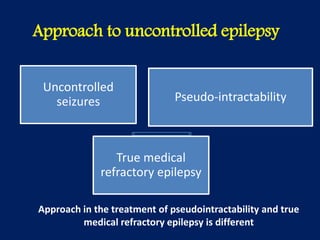
Uncontrolled
seizures Pseudo-intractability
True medical
refractory epilepsy
Approach to uncontrolled epilepsy
Approach in the treatment of pseudointractability and true
medical refractory epilepsy is different
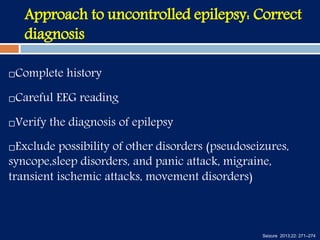
Approach to uncontrolled epilepsy: Correct
diagnosis
Complete history
Careful EEG reading
Verify the diagnosis of epilepsy
Exclude possibility of other disorders (pseudoseizures,
syncope,sleep disorders, and panic attack, migraine,
transient ischemic attacks, movement disorders)
Seizure 2013;22: 271–274
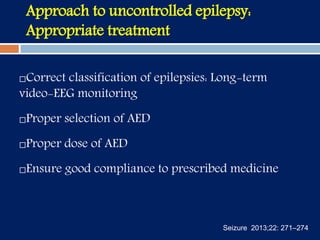
Approach to uncontrolled epilepsy:
Appropriate treatment
Correct classification of epilepsies: Long-term
video-EEG monitoring
Proper selection of AED
Proper dose of AED
Ensure good compliance to prescribed medicine
Seizure 2013;22: 271–274
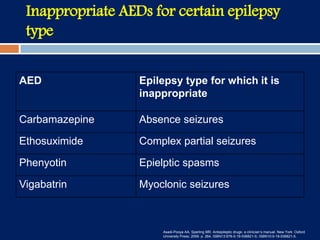
Inappropriate AEDs for certain epilepsy
type
AED Epilepsy type for which it is
inappropriate
Carbamazepine Absence seizures
Ethosuximide Complex partial seizures
Phenyotin Epielptic spasms
Vigabatrin Myoclonic seizures
Asadi-Pooya AA, Sperling MR. Antiepileptic drugs: a clinician’s manual. New York: Oxford
University Press; 2009. p. 264, ISBN13:978-0-19-536821-5; ISBN10:0-19-536821-5.
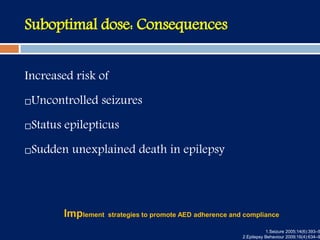
Suboptimal dose: Consequences
Increased risk of
Uncontrolled seizures
Status epilepticus
Sudden unexplained death in epilepsy
Implement strategies to promote AED adherence and compliance
1.Seizure 2005;14(6):393–5
2.Epilepsy Behaviour 2009;16(4):634–9
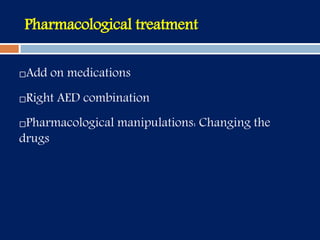
Pharmacological treatment
Add on medications
Right AED combination
Pharmacological manipulations: Changing the
drugs
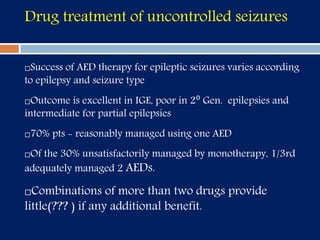
Drug treatment of uncontrolled seizures
Success of AED therapy for epileptic seizures varies according
to epilepsy and seizure type
Outcome is excellent in IGE, poor in 2⁰ Gen. epilepsies and
intermediate for partial epilepsies
70% pts - reasonably managed using one AED
Of the 30% unsatisfactorily managed by monotherapy, 1/3rd
adequately managed 2 AEDs.
Combinations of more than two drugs provide
little(??? ) if any additional benefit.
Treatment options
Clobazam
Lacosamide
Oxcarbazepine
Levetiracetam
Topiramate
Lamotrigine
Zonisamide
perampanel
Gabapentin
Tiagabine
Choosing the Next Antiepileptic Drug
: What Matters?
Rational polytherapy
Mechanism of drug action
Drug Interactions during combination therapy
The Valproate Lamotrigine Combination therapy &
Other combination therapies
Polytherapy in special groups
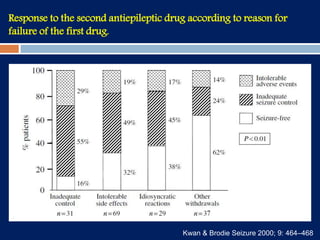
Response to the second antiepileptic drug according to reason for
failure of the first drug.
Kwan & Brodie Seizure 2000; 9: 464–468
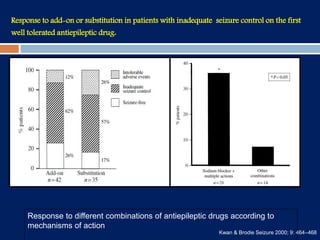
Response to add-on or substitution in patients with inadequate seizure control on the first
well tolerated antiepileptic drug.
Kwan & Brodie Seizure 2000; 9: 464–468
Response to different combinations of antiepileptic drugs according to
mechanisms of action
Response to different combinations of antiepileptic drugs according
to mechanisms of action
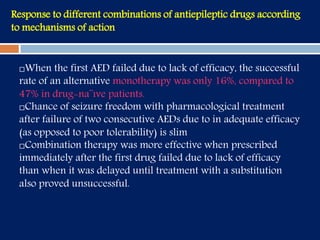
When the first AED failed due to lack of efficacy, the successful
rate of an alternative monotherapy was only 16%, compared to
47% in drug-na¨ıve patients.
Chance of seizure freedom with pharmacological treatment
after failure of two consecutive AEDs due to in adequate efficacy
(as opposed to poor tolerability) is slim
Combination therapy was more effective when prescribed
immediately after the first drug failed due to lack of efficacy
than when it was delayed until treatment with a substitution
also proved unsuccessful.
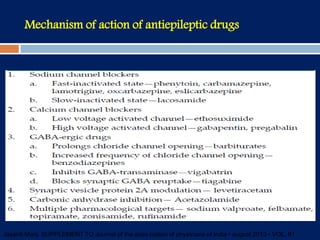
Mechanism of action of antiepileptic drugs
Jayanti Mani. SUPPLEMENT TO Journal of the asso ciation of physicians of india • august 2013 • VOL. 61
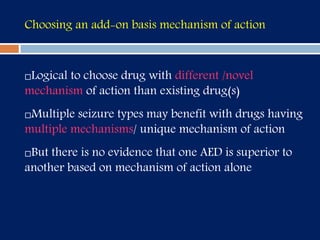
Choosing an add-on basis mechanism of action
Logical to choose drug with different /novel
mechanism of action than existing drug(s)
Multiple seizure types may benefit with drugs having
multiple mechanisms/ unique mechanism of action
But there is no evidence that one AED is superior to
another based on mechanism of action alone
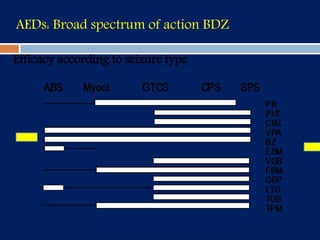
AEDs: Broad spectrum of action BDZ
Efficacy according to seizure type
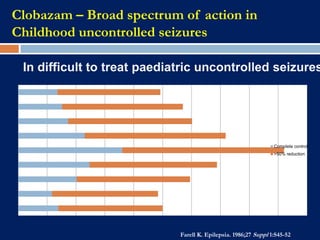
Clobazam – Broad spectrum of action in
Childhood uncontrolled seizures
Complete control
>50% reduction
In difficult to treat paediatric uncontrolled seizures
Farell K. Epilepsia. 1986;27 Suppl 1:S45-52
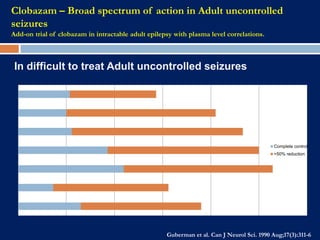
Clobazam – Broad spectrum of action in Adult uncontrolled
seizures
Add-on trial of clobazam in intractable adult epilepsy with plasma level correlations.
Complete control
>50% reduction
In difficult to treat Adult uncontrolled seizures
Guberman et al. Can J Neurol Sci. 1990 Aug;17(3):311-6
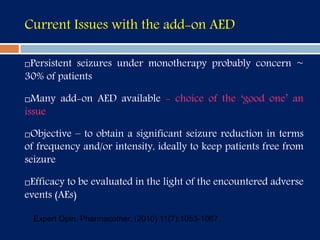
Current Issues with the add-on AED
Persistent seizures under monotherapy probably concern ~
30% of patients
Many add-on AED available - choice of the ‘good one’ an
issue
Objective – to obtain a significant seizure reduction in terms
of frequency and/or intensity, ideally to keep patients free from
seizure
Efficacy to be evaluated in the light of the encountered adverse
events (AEs)
Expert Opin. Pharmacother. (2010) 11(7):1053-1067
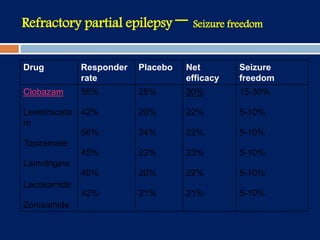
Refractory partial epilepsy – Seizure freedom
Drug Responder
rate
Placebo Net
efficacy
Seizure
freedom
Clobazam
Levetiraceta
m
Topiramate
Lamotrigine
Lacosamide
Zonisamide
55%
42%
56%
45%
40%
42%
25%
20%
34%
22%
20%
21%
30%
22%
22%
23%
22%
21%
15-30%
5-10%
5-10%
5-10%
5-10%
5-10%
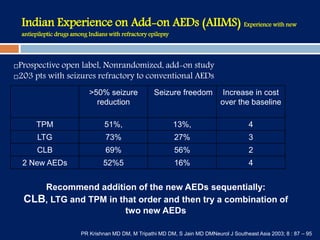
Indian Experience on Add-on AEDs (AIIMS) Experience with new
antiepileptic drugs among Indians with refractory epilepsy
Prospective open label, Nonrandomized, add-on study
203 pts with seizures refractory to conventional AEDs
PR Krishnan MD DM, M Tripathi MD DM, S Jain MD DMNeurol J Southeast Asia 2003; 8 : 87 – 95
>50% seizure
reduction
Seizure freedom Increase in cost
over the baseline

TPM 51%, 13%, 4
LTG 73% 27% 3
CLB 69% 56% 2
2 New AEDs 52%5 16% 4
Recommend addition of the new AEDs sequentially:
CLB, LTG and TPM in that order and then try a combination of
two new AEDs
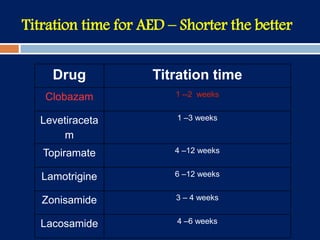
Titration time for AED – Shorter the better
Drug Titration time
Clobazam 1 --2 weeks
Levetiraceta
m
1 –3 weeks
Topiramate 4 –12 weeks
Lamotrigine 6 –12 weeks
Zonisamide 3 – 4 weeks
Lacosamide 4 –6 weeks
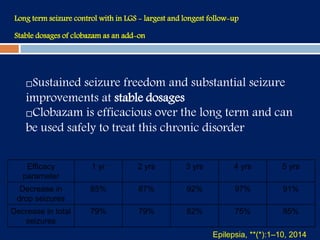
Sustained seizure freedom and substantial seizure
improvements at stable dosages
Clobazam is efficacious over the long term and can
be used safely to treat this chronic disorder
Efficacy
parameter
1 yr 2 yrs 3 yrs 4 yrs 5 yrs
Decrease in
drop seizures
85% 87% 92% 97% 91%
Decrease in total
seizures
79% 79% 82% 75% 85%
Epilepsia, **(*):1–10, 2014
Long term seizure control with in LGS - largest and longest follow-up
Stable dosages of clobazam as an add-on
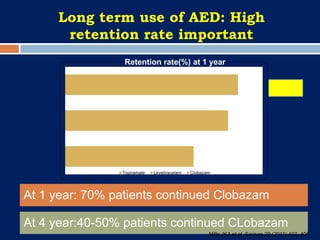
At 1 year: 70% patients continued Clobazam
At 4 year:40-50% patients continued CLobazam
Long term use of AED: High
retention rate important
Topiramate Levetiracetam Clobazam
Mills JKA et al. Seizure 20 (2011) 402–405
Retention rate(%) at 1 year
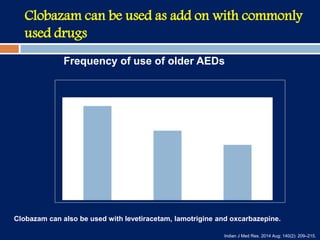
Clobazam can be used as add on with commonly
used drugs
Frequency of use of older AEDs
Indian J Med Res. 2014 Aug; 140(2): 209–215.
Clobazam can also be used with levetiracetam, lamotrigine and oxcarbazepine.
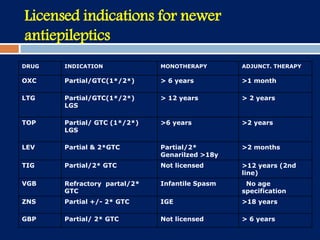
Licensed indications for newer
antiepileptics
DRUG INDICATION MONOTHERAPY ADJUNCT. THERAPY
OXC Partial/GTC(1*/2*) > 6 years >1 month
LTG Partial/GTC(1*/2*)
LGS
> 12 years > 2 years
TOP Partial/ GTC (1*/2*)
LGS
>6 years >2 years
LEV Partial & 2*GTC Partial/2*
Genarilzed >18y
>2 months
TIG Partial/2* GTC Not licensed >12 years (2nd
line)
VGB Refractory partal/2*
GTC
Infantile Spasm No age
specification
ZNS Partial +/- 2* GTC IGE >18 years
GBP Partial/ 2* GTC Not licensed > 6 years
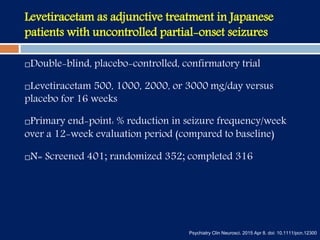
Levetiracetam as adjunctive treatment in Japanese
patients with uncontrolled partial-onset seizures
Double-blind, placebo-controlled, confirmatory trial
Levetiracetam 500, 1000, 2000, or 3000 mg/day versus
placebo for 16 weeks
Primary end-point: % reduction in seizure frequency/week
over a 12-week evaluation period (compared to baseline)
N= Screened 401; randomized 352; completed 316
Psychiatry Clin Neurosci. 2015 Apr 8. doi: 10.1111/pcn.12300
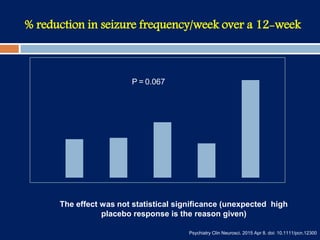
% reduction in seizure frequency/week over a 12-week
Psychiatry Clin Neurosci. 2015 Apr 8. doi: 10.1111/pcn.12300
P = 0.067
The effect was not statistical significance (unexpected high
placebo response is the reason given)
Levetiracetam associated psychosis
Levetiracetam even at dose of 500 mg per day
reported to have
Visual hallucinations
Mood swings
Suspicious behavior
Indian J Pharmacol. 2014 Sep-Oct;46(5):560-1
Newer AEDs
Lacosamide: Effective add-on for children with
refractory partial epilepsy and is well tolerated1
Brivaracetam: As add on associated with significant
reductions in seizure frequency compared to
placebo2
Retigabine: Add-on retigabine for focal- epilepsy
appears to be cost-effective3
1.Pediatr Neurol. 2014 Oct;51(4):509-
2.Epilepsia. 2014 Jan;55(1):57
3.Acta Neurol Scand. 2013 Jun;127(6):419-2
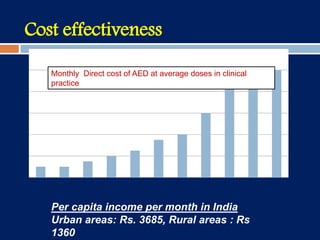
Cost effectiveness
AED
Per capita income per month in India
Urban areas: Rs. 3685, Rural areas : Rs
1360
Monthly Direct cost of AED at average doses in clinical
practice
For AED: Switching between originator and generic drugs may actually be
unethical, raise the cost of treatment, with additional clinic visits and laboratory
tests
While the active pharmaceutical ingredient (API) does not differ between
originator and generic medicines, other (inactive) ingredients, known as
excipients, may be different and a number of pharmaceutical excipients are
known to have side effects or contraindications
Evidence has been published that differences in excipients between originator
medications and their generic counterparts can cause problems
Generic substitution in epilepsy: Evidence
for concerns
While bioequivalence may have been proven, as required by regulatory guidelines,
given the differences in other ingredients it is incumbent on prescribing physicians to
remain vigilant to the potential risks, and exercise caution in the substitution of
generic
Dunne et al. BMC Pharmacology and Toxicology 2013, 14:1
AAN Position Statement on generic
substitution (2006)
Small variations in concentrations of AEDs can cause toxic
effects and/or seizures when taken by patients with epilepsy
AAN opposes generic substitution of AEDs
without the attending physician’s approval and claims:
Full autonomy by physician regarding prescription
Access to all anticonvulsants
No point-of-sale switching
Informed consent before switching
Possible different policies for AEDs in seizure disorders vs other uses
Liow K. Neurology 2007;68;1249-1250
High Switchback Rates to Branded Compounds Compulsory
Generic Switching of Antiepileptic Drugs
1,354 patients (403 monotherapy, 951 polytherapy) were prescribed generic
Switchback rates for AEDs were substantially higher than for non-AEDs (1.5–
2.9%).
Significant increases in AED doses were observed after generic substitution
Switchback rates of AEDs were ∼20% for Clobazam
Poor acceptance of switching AEDs to generic compounds.
Increased toxicity and/or loss of seizure control associated with generic AED use.
Data source: public-payer database from Ontario, Canada,
Epilepsia, 48(3):464–469, 2007
Summary
Uncontrolled epilepsy is a common problem in
epilepsy care
Uncontrolled epilepsy is not always drug resistant
epilepsy
Approach for the management of uncontrolled
epilepsy and drug resistant epilepsy are different
Clobazam is an effective add on for generalized as
well as focal epilepsies because of its broad spectrum
of action
Thank you

Final ppt epilepsy

  • 1.
    Drug treatment ofUncontrolled epilepsy Dr Surendra Khosya Consultant Neurologist
  • 2.
    Uncontrolled seizures Pseudo-intractability True medical refractoryepilepsy Approach to uncontrolled epilepsy Approach in the treatment of pseudointractability and true medical refractory epilepsy is different
  • 3.
    Approach to uncontrolledepilepsy: Correct diagnosis Complete history Careful EEG reading Verify the diagnosis of epilepsy Exclude possibility of other disorders (pseudoseizures, syncope,sleep disorders, and panic attack, migraine, transient ischemic attacks, movement disorders) Seizure 2013;22: 271–274
  • 4.
    Approach to uncontrolledepilepsy: Appropriate treatment Correct classification of epilepsies: Long-term video-EEG monitoring Proper selection of AED Proper dose of AED Ensure good compliance to prescribed medicine Seizure 2013;22: 271–274
  • 5.
    Inappropriate AEDs forcertain epilepsy type AED Epilepsy type for which it is inappropriate Carbamazepine Absence seizures Ethosuximide Complex partial seizures Phenyotin Epielptic spasms Vigabatrin Myoclonic seizures Asadi-Pooya AA, Sperling MR. Antiepileptic drugs: a clinician’s manual. New York: Oxford University Press; 2009. p. 264, ISBN13:978-0-19-536821-5; ISBN10:0-19-536821-5.
  • 6.
    Suboptimal dose: Consequences Increasedrisk of Uncontrolled seizures Status epilepticus Sudden unexplained death in epilepsy Implement strategies to promote AED adherence and compliance 1.Seizure 2005;14(6):393–5 2.Epilepsy Behaviour 2009;16(4):634–9
  • 7.
    Pharmacological treatment Add onmedications Right AED combination Pharmacological manipulations: Changing the drugs
  • 8.
    Drug treatment ofuncontrolled seizures Success of AED therapy for epileptic seizures varies according to epilepsy and seizure type Outcome is excellent in IGE, poor in 2⁰ Gen. epilepsies and intermediate for partial epilepsies 70% pts - reasonably managed using one AED Of the 30% unsatisfactorily managed by monotherapy, 1/3rd adequately managed 2 AEDs. Combinations of more than two drugs provide little(??? ) if any additional benefit.
  • 9.
  • 10.
    Choosing the NextAntiepileptic Drug : What Matters? Rational polytherapy Mechanism of drug action Drug Interactions during combination therapy The Valproate Lamotrigine Combination therapy & Other combination therapies Polytherapy in special groups
  • 11.
    Response to thesecond antiepileptic drug according to reason for failure of the first drug. Kwan & Brodie Seizure 2000; 9: 464–468
  • 12.
    Response to add-onor substitution in patients with inadequate seizure control on the first well tolerated antiepileptic drug. Kwan & Brodie Seizure 2000; 9: 464–468 Response to different combinations of antiepileptic drugs according to mechanisms of action
  • 13.
    Response to differentcombinations of antiepileptic drugs according to mechanisms of action When the first AED failed due to lack of efficacy, the successful rate of an alternative monotherapy was only 16%, compared to 47% in drug-na¨ıve patients. Chance of seizure freedom with pharmacological treatment after failure of two consecutive AEDs due to in adequate efficacy (as opposed to poor tolerability) is slim Combination therapy was more effective when prescribed immediately after the first drug failed due to lack of efficacy than when it was delayed until treatment with a substitution also proved unsuccessful.
  • 14.
    Mechanism of actionof antiepileptic drugs Jayanti Mani. SUPPLEMENT TO Journal of the asso ciation of physicians of india • august 2013 • VOL. 61
  • 15.
    Choosing an add-onbasis mechanism of action Logical to choose drug with different /novel mechanism of action than existing drug(s) Multiple seizure types may benefit with drugs having multiple mechanisms/ unique mechanism of action But there is no evidence that one AED is superior to another based on mechanism of action alone
  • 16.
    AEDs: Broad spectrumof action BDZ Efficacy according to seizure type
  • 17.
    Clobazam – Broadspectrum of action in Childhood uncontrolled seizures Complete control >50% reduction In difficult to treat paediatric uncontrolled seizures Farell K. Epilepsia. 1986;27 Suppl 1:S45-52
  • 18.
    Clobazam – Broadspectrum of action in Adult uncontrolled seizures Add-on trial of clobazam in intractable adult epilepsy with plasma level correlations. Complete control >50% reduction In difficult to treat Adult uncontrolled seizures Guberman et al. Can J Neurol Sci. 1990 Aug;17(3):311-6
  • 19.
    Current Issues withthe add-on AED Persistent seizures under monotherapy probably concern ~ 30% of patients Many add-on AED available - choice of the ‘good one’ an issue Objective – to obtain a significant seizure reduction in terms of frequency and/or intensity, ideally to keep patients free from seizure Efficacy to be evaluated in the light of the encountered adverse events (AEs) Expert Opin. Pharmacother. (2010) 11(7):1053-1067
  • 20.
    Refractory partial epilepsy– Seizure freedom Drug Responder rate Placebo Net efficacy Seizure freedom Clobazam Levetiraceta m Topiramate Lamotrigine Lacosamide Zonisamide 55% 42% 56% 45% 40% 42% 25% 20% 34% 22% 20% 21% 30% 22% 22% 23% 22% 21% 15-30% 5-10% 5-10% 5-10% 5-10% 5-10%
  • 21.
    Indian Experience onAdd-on AEDs (AIIMS) Experience with new antiepileptic drugs among Indians with refractory epilepsy Prospective open label, Nonrandomized, add-on study 203 pts with seizures refractory to conventional AEDs PR Krishnan MD DM, M Tripathi MD DM, S Jain MD DMNeurol J Southeast Asia 2003; 8 : 87 – 95 >50% seizure reduction Seizure freedom Increase in cost over the baseline TPM 51%, 13%, 4 LTG 73% 27% 3 CLB 69% 56% 2 2 New AEDs 52%5 16% 4 Recommend addition of the new AEDs sequentially: CLB, LTG and TPM in that order and then try a combination of two new AEDs
  • 22.
    Titration time forAED – Shorter the better Drug Titration time Clobazam 1 --2 weeks Levetiraceta m 1 –3 weeks Topiramate 4 –12 weeks Lamotrigine 6 –12 weeks Zonisamide 3 – 4 weeks Lacosamide 4 –6 weeks
  • 23.
    Sustained seizure freedomand substantial seizure improvements at stable dosages Clobazam is efficacious over the long term and can be used safely to treat this chronic disorder Efficacy parameter 1 yr 2 yrs 3 yrs 4 yrs 5 yrs Decrease in drop seizures 85% 87% 92% 97% 91% Decrease in total seizures 79% 79% 82% 75% 85% Epilepsia, **(*):1–10, 2014 Long term seizure control with in LGS - largest and longest follow-up Stable dosages of clobazam as an add-on
  • 24.
    At 1 year:70% patients continued Clobazam At 4 year:40-50% patients continued CLobazam Long term use of AED: High retention rate important Topiramate Levetiracetam Clobazam Mills JKA et al. Seizure 20 (2011) 402–405 Retention rate(%) at 1 year
  • 25.
    Clobazam can beused as add on with commonly used drugs Frequency of use of older AEDs Indian J Med Res. 2014 Aug; 140(2): 209–215. Clobazam can also be used with levetiracetam, lamotrigine and oxcarbazepine.
  • 26.
    Licensed indications fornewer antiepileptics DRUG INDICATION MONOTHERAPY ADJUNCT. THERAPY OXC Partial/GTC(1*/2*) > 6 years >1 month LTG Partial/GTC(1*/2*) LGS > 12 years > 2 years TOP Partial/ GTC (1*/2*) LGS >6 years >2 years LEV Partial & 2*GTC Partial/2* Genarilzed >18y >2 months TIG Partial/2* GTC Not licensed >12 years (2nd line) VGB Refractory partal/2* GTC Infantile Spasm No age specification ZNS Partial +/- 2* GTC IGE >18 years GBP Partial/ 2* GTC Not licensed > 6 years
  • 27.
    Levetiracetam as adjunctivetreatment in Japanese patients with uncontrolled partial-onset seizures Double-blind, placebo-controlled, confirmatory trial Levetiracetam 500, 1000, 2000, or 3000 mg/day versus placebo for 16 weeks Primary end-point: % reduction in seizure frequency/week over a 12-week evaluation period (compared to baseline) N= Screened 401; randomized 352; completed 316 Psychiatry Clin Neurosci. 2015 Apr 8. doi: 10.1111/pcn.12300
  • 28.
    % reduction inseizure frequency/week over a 12-week Psychiatry Clin Neurosci. 2015 Apr 8. doi: 10.1111/pcn.12300 P = 0.067 The effect was not statistical significance (unexpected high placebo response is the reason given)
  • 29.
    Levetiracetam associated psychosis Levetiracetameven at dose of 500 mg per day reported to have Visual hallucinations Mood swings Suspicious behavior Indian J Pharmacol. 2014 Sep-Oct;46(5):560-1
  • 30.
    Newer AEDs Lacosamide: Effectiveadd-on for children with refractory partial epilepsy and is well tolerated1 Brivaracetam: As add on associated with significant reductions in seizure frequency compared to placebo2 Retigabine: Add-on retigabine for focal- epilepsy appears to be cost-effective3 1.Pediatr Neurol. 2014 Oct;51(4):509- 2.Epilepsia. 2014 Jan;55(1):57 3.Acta Neurol Scand. 2013 Jun;127(6):419-2
  • 31.
    Cost effectiveness AED Per capitaincome per month in India Urban areas: Rs. 3685, Rural areas : Rs 1360 Monthly Direct cost of AED at average doses in clinical practice
  • 32.
    For AED: Switchingbetween originator and generic drugs may actually be unethical, raise the cost of treatment, with additional clinic visits and laboratory tests While the active pharmaceutical ingredient (API) does not differ between originator and generic medicines, other (inactive) ingredients, known as excipients, may be different and a number of pharmaceutical excipients are known to have side effects or contraindications Evidence has been published that differences in excipients between originator medications and their generic counterparts can cause problems Generic substitution in epilepsy: Evidence for concerns While bioequivalence may have been proven, as required by regulatory guidelines, given the differences in other ingredients it is incumbent on prescribing physicians to remain vigilant to the potential risks, and exercise caution in the substitution of generic Dunne et al. BMC Pharmacology and Toxicology 2013, 14:1
  • 33.
    AAN Position Statementon generic substitution (2006) Small variations in concentrations of AEDs can cause toxic effects and/or seizures when taken by patients with epilepsy AAN opposes generic substitution of AEDs without the attending physician’s approval and claims: Full autonomy by physician regarding prescription Access to all anticonvulsants No point-of-sale switching Informed consent before switching Possible different policies for AEDs in seizure disorders vs other uses Liow K. Neurology 2007;68;1249-1250
  • 34.
    High Switchback Ratesto Branded Compounds Compulsory Generic Switching of Antiepileptic Drugs 1,354 patients (403 monotherapy, 951 polytherapy) were prescribed generic Switchback rates for AEDs were substantially higher than for non-AEDs (1.5– 2.9%). Significant increases in AED doses were observed after generic substitution Switchback rates of AEDs were ∼20% for Clobazam Poor acceptance of switching AEDs to generic compounds. Increased toxicity and/or loss of seizure control associated with generic AED use. Data source: public-payer database from Ontario, Canada, Epilepsia, 48(3):464–469, 2007
  • 35.
    Summary Uncontrolled epilepsy isa common problem in epilepsy care Uncontrolled epilepsy is not always drug resistant epilepsy Approach for the management of uncontrolled epilepsy and drug resistant epilepsy are different Clobazam is an effective add on for generalized as well as focal epilepsies because of its broad spectrum of action
  • 36.

Editor's Notes