NETS OF SOLID FIGURES:
UNFOLDING 3D SHAPES
LEARNING COMPETENCIES
● Identify the nets of different
solid figures.
● Construct nets of different
solid figures.
What are Nets?
● A net is a 2D pattern
that can be folded to
create a 3D shape
● It's like "unfolding" a 3D
object and laying it flat
● Nets show all the faces
of a solid figure
● Can you think of any
real-life examples where
you've seen nets?
Why Learn About Nets?
● Helps understand the structure of 3D
shapes
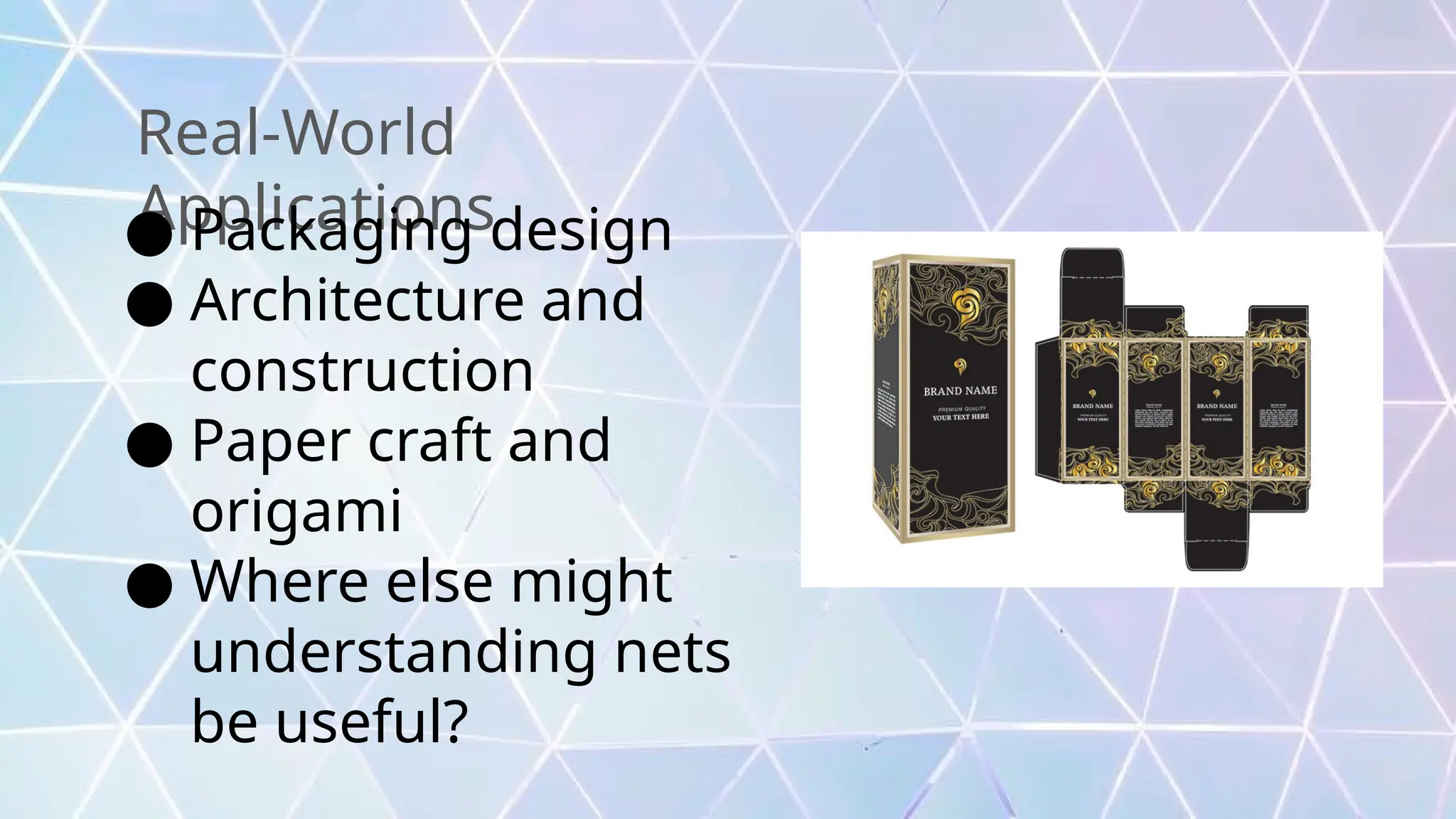
● Useful in packaging design and
engineering
● Improves spatial reasoning skills
● How do you think nets might be used
in everyday life?
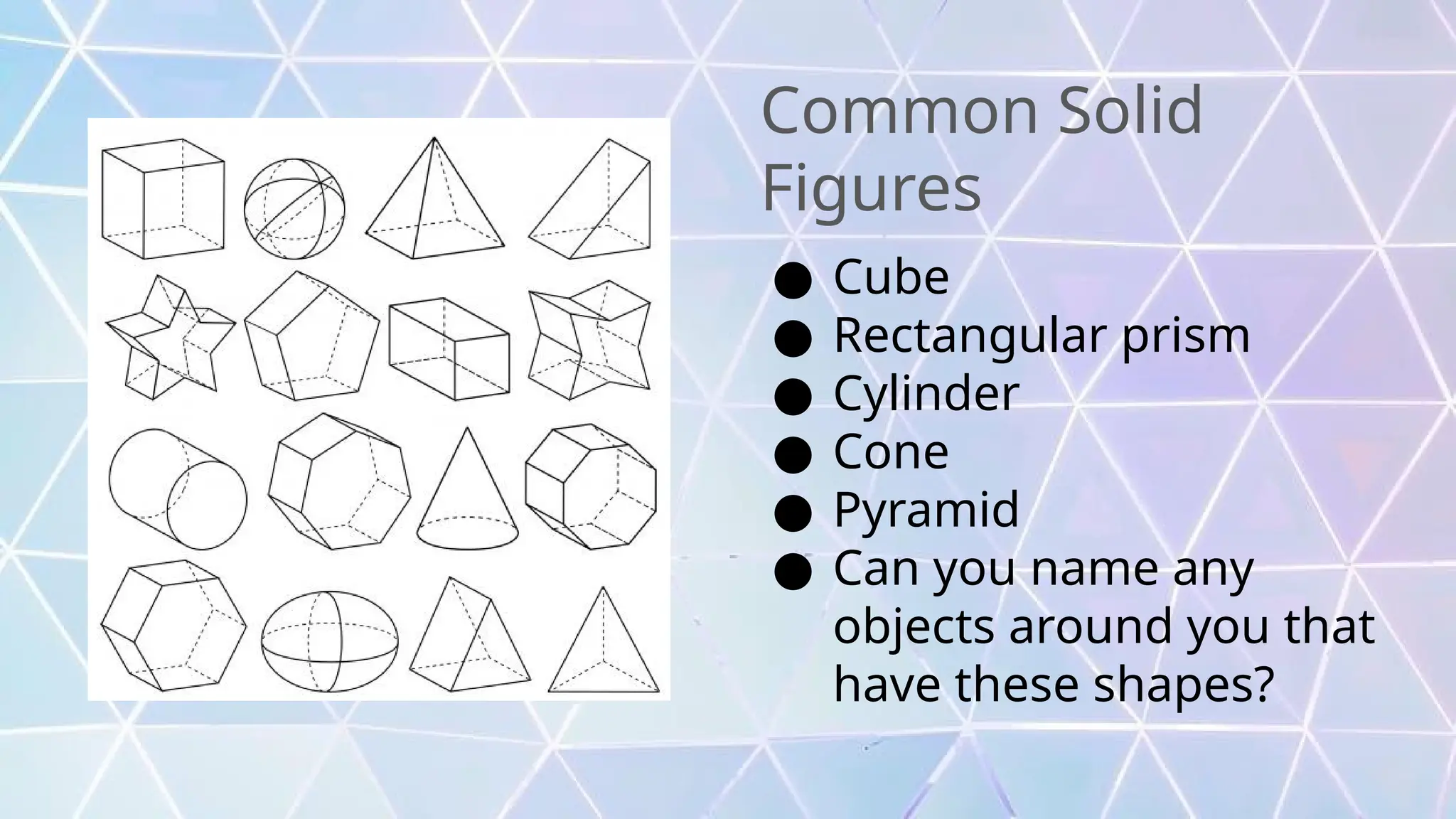
Common Solid
Figures
● Cube
● Rectangular prism
● Cylinder
● Cone
● Pyramid
● Can you name any
objects around you that
have these shapes?
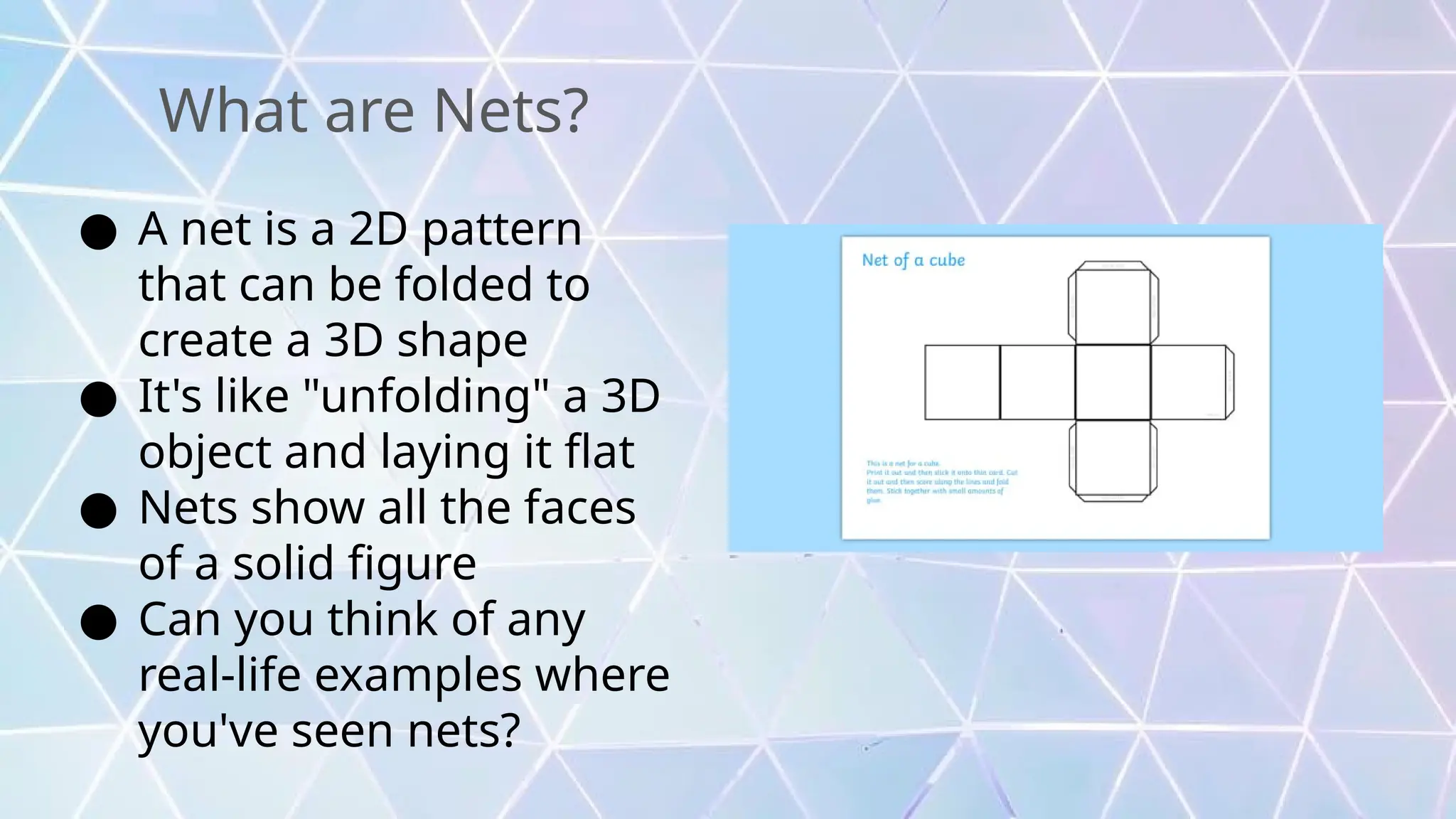
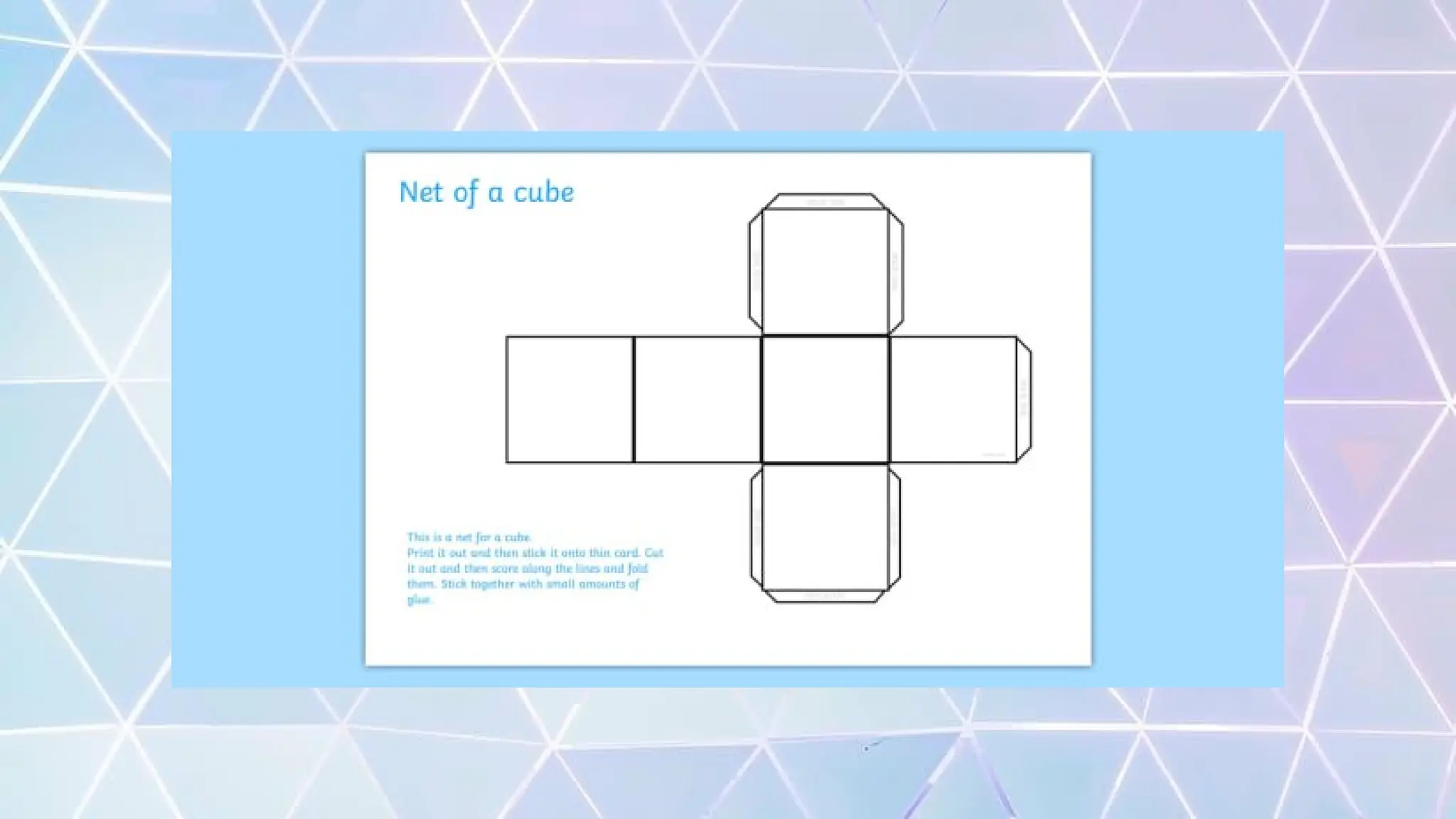
Net of a Cube
● A cube has 6 square faces
● Its net shows all 6 squares
connected
● There are 11 different nets for a
cube
● Try drawing a net of a cube on
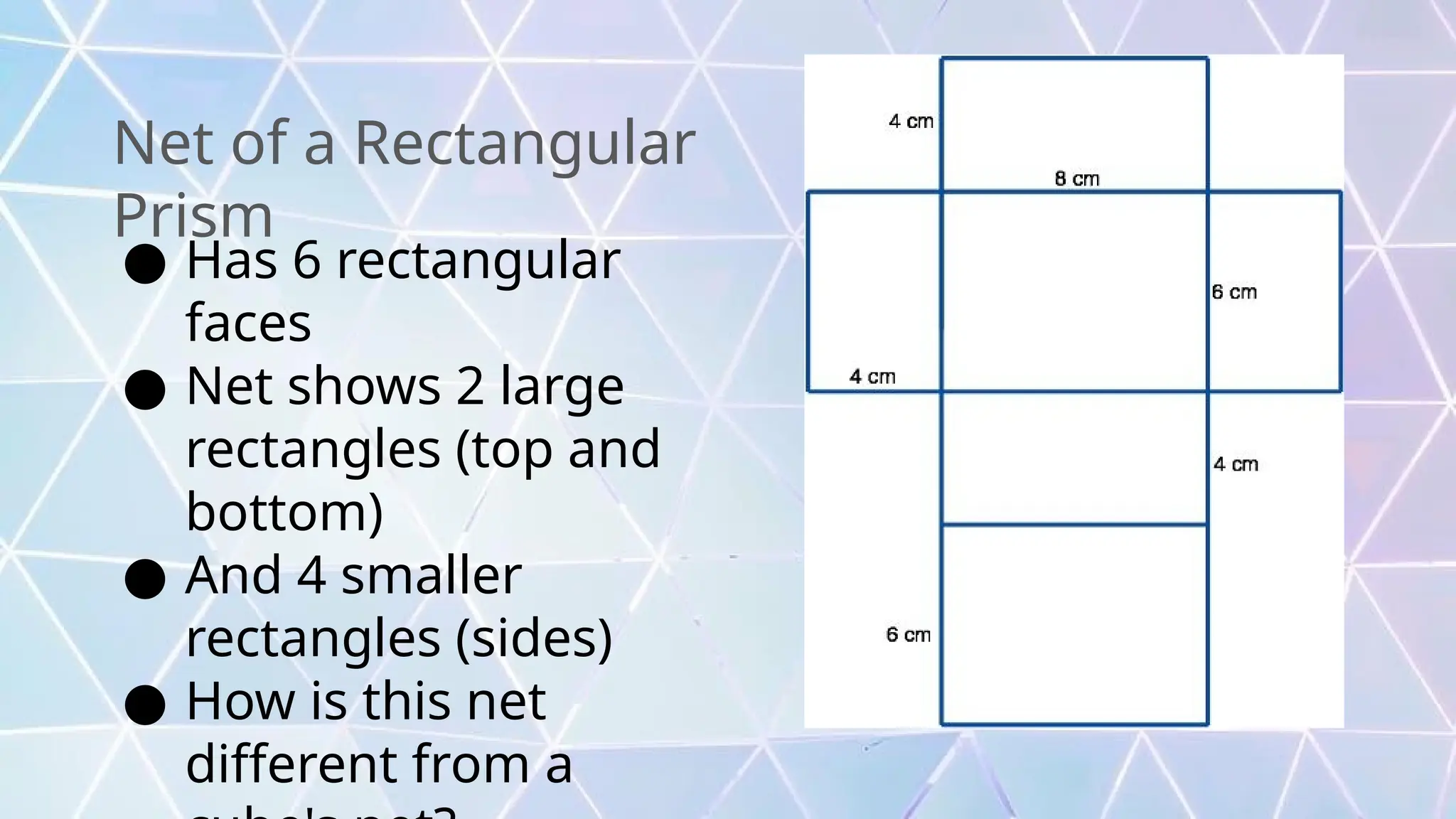
Net of a Rectangular
Prism
● Has 6 rectangular
faces
● Net shows 2 large
rectangles (top and
bottom)
● And 4 smaller
rectangles (sides)
● How is this net
different from a
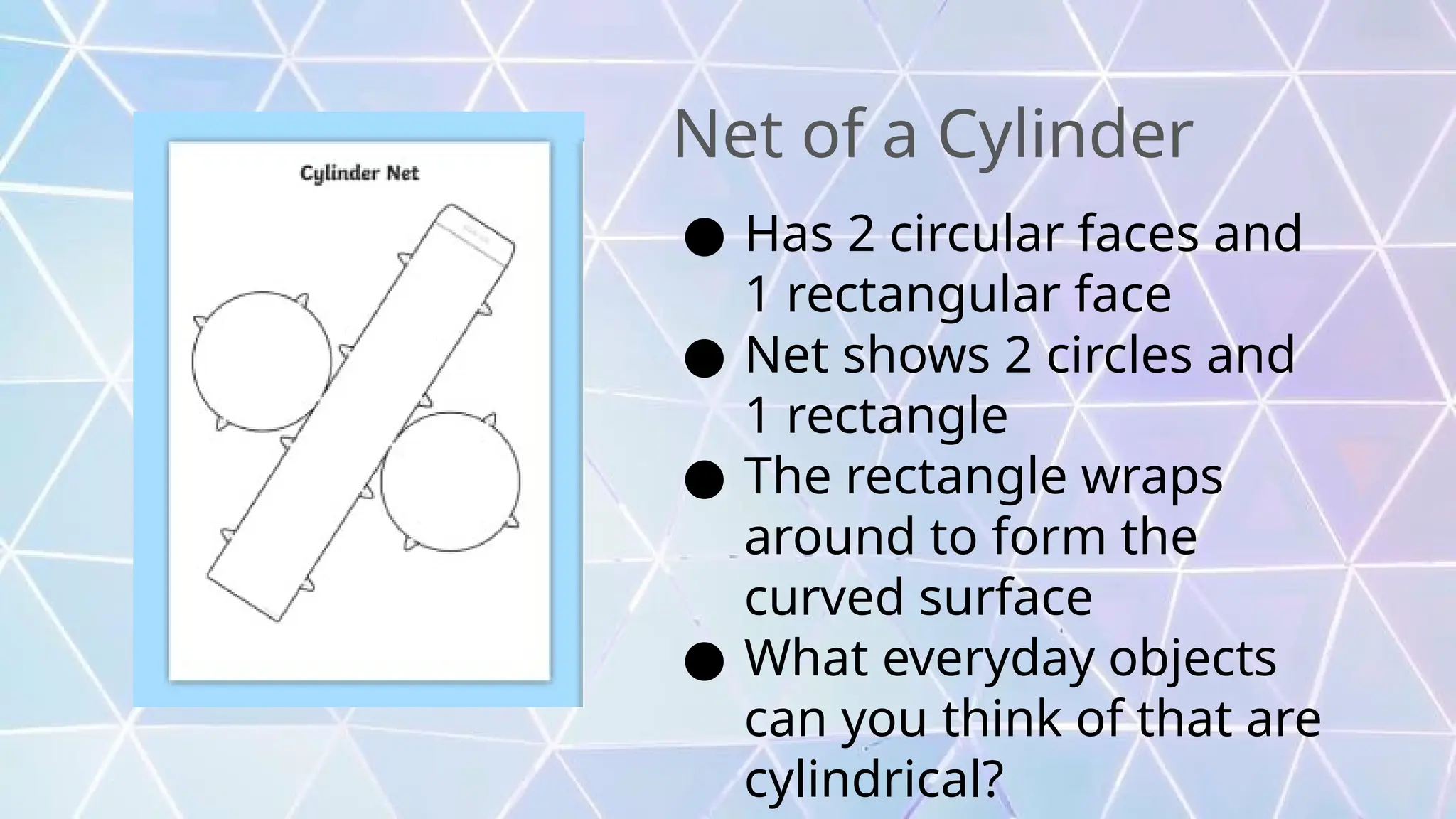
Net of a Cylinder
● Has 2 circular faces and
1 rectangular face
● Net shows 2 circles and
1 rectangle
● The rectangle wraps
around to form the
curved surface
● What everyday objects
can you think of that are
cylindrical?
Net of a Cone
● Has 1 circular face and 1 sector
(part of a circle)
● The sector forms the curved surface
when folded
● The size of the sector determines
the cone's height
● Can you imagine how this net folds
into a cone?
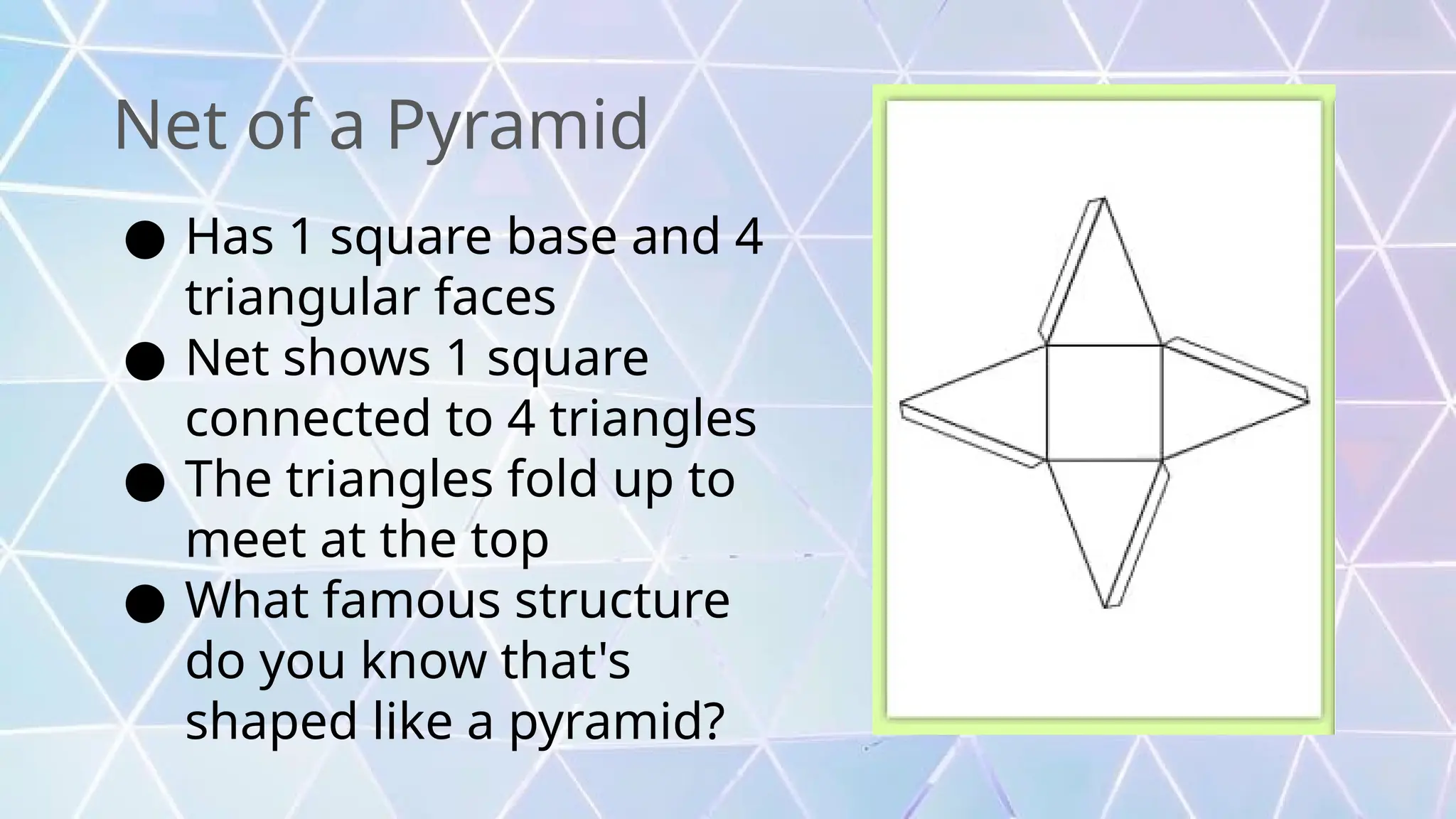
Net of a Pyramid
● Has 1 square base and 4
triangular faces
● Net shows 1 square
connected to 4 triangles
● The triangles fold up to
meet at the top
● What famous structure
do you know that's
shaped like a pyramid?
Identifying Nets
● Look at the shape and number of
faces
● Check if the faces can connect
properly
● Imagine folding the net in your
mind
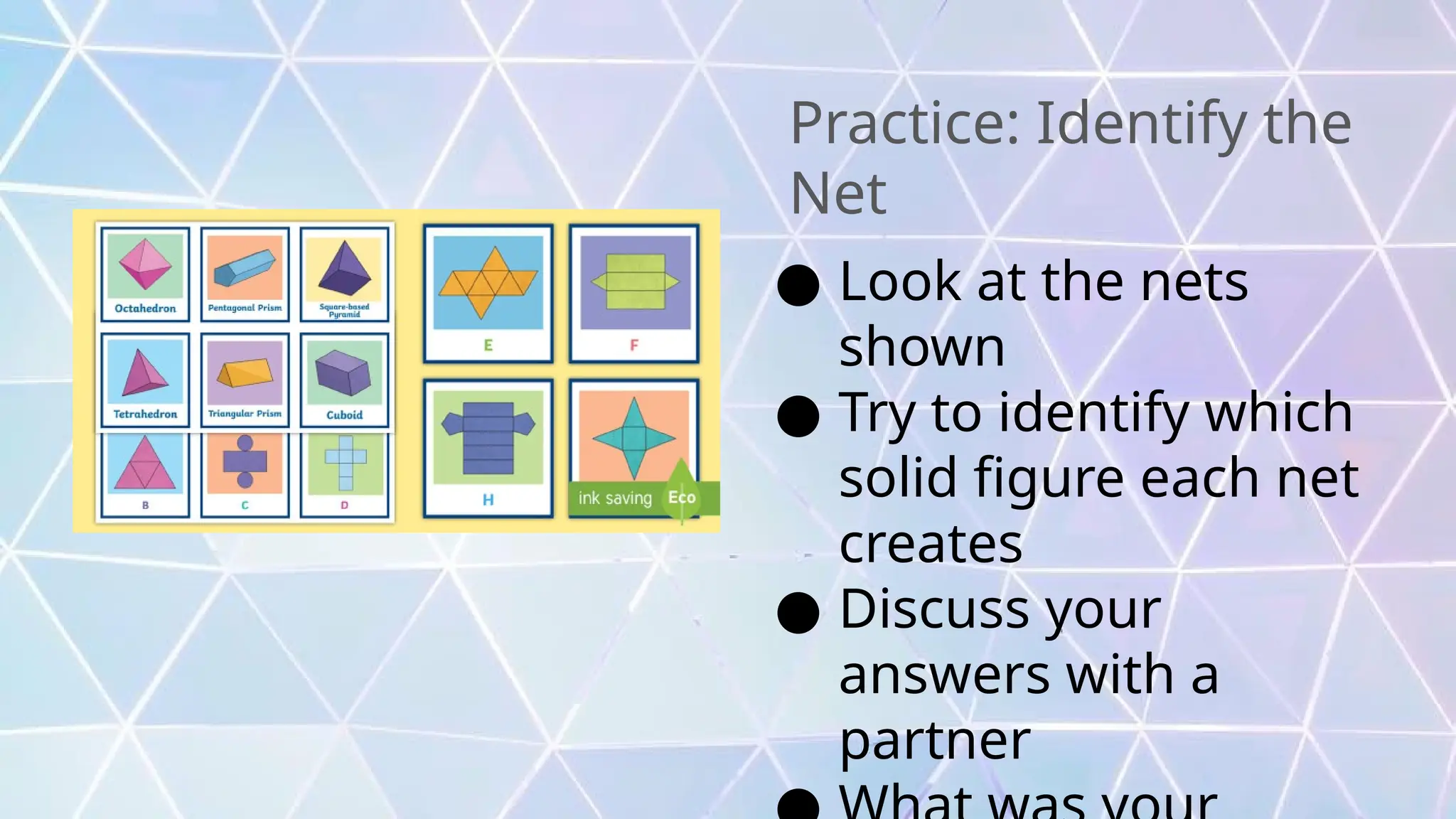
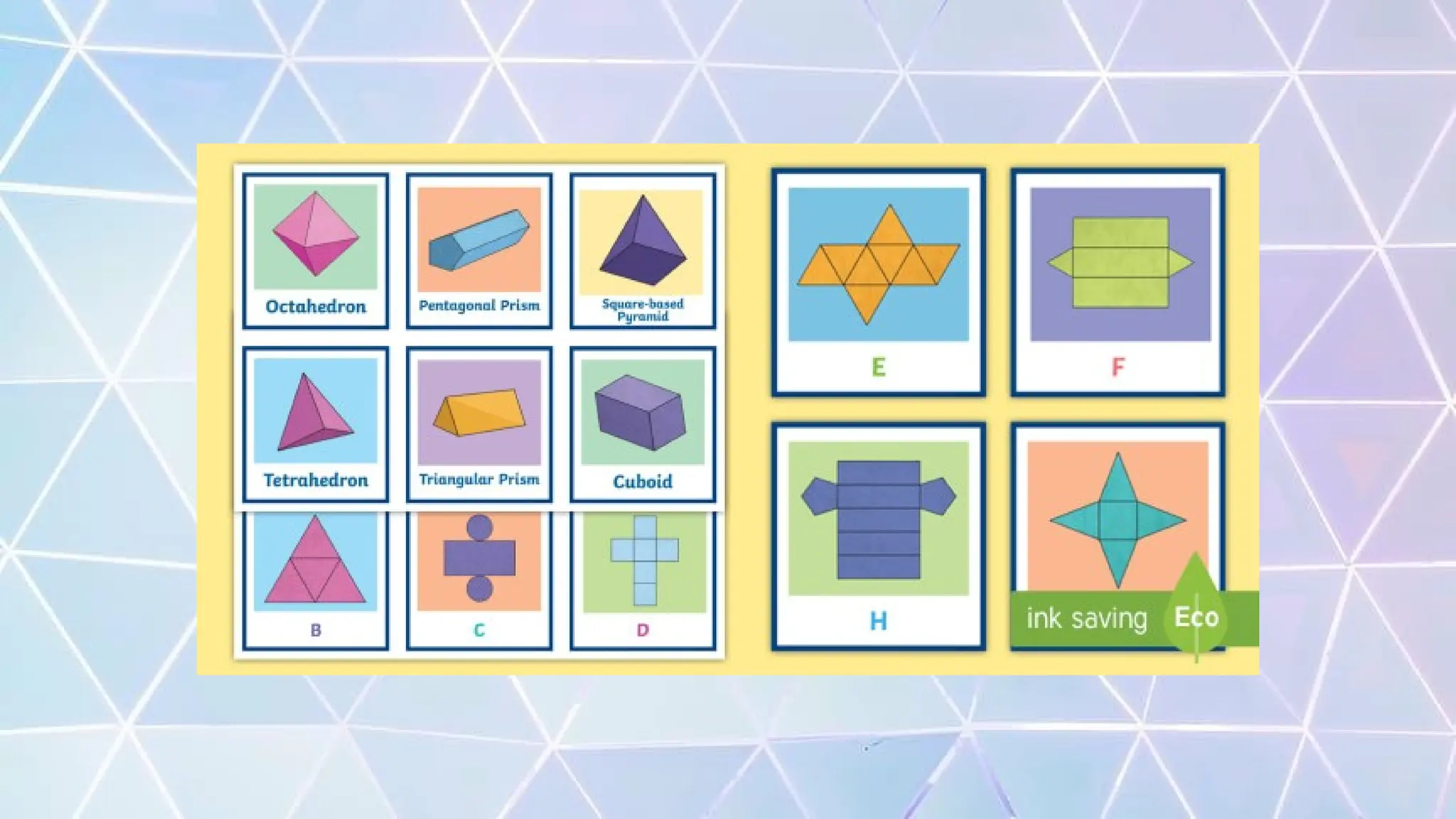
Practice: Identify the
Net
● Look at the nets
shown
● Try to identify which
solid figure each net
creates
● Discuss your
answers with a
partner
Constructing Nets: Materials
● Paper or cardstock
● Scissors
● Ruler
● Pencil
● What other materials might be
useful for making nets?
Steps to Construct a Net
● Choose a solid figure
● Identify its faces and their shapes
● Draw the faces connected to each
other
● Cut out the net
● Fold along the lines to check if it forms
the shape
● What might be challenging about
Tips for Drawing Nets
● Start with the base shape
● Add other faces one by one
● Make sure faces are connected
correctly
● Double-check measurements
● What strategy would you use to
draw a net?
Common Mistakes to Avoid
● Forgetting a face
● Incorrect face sizes or shapes
● Faces not connected properly
● Can you think of any other
potential mistakes?
Real-World
Applications
● Packaging design
● Architecture and
construction
● Paper craft and
origami
● Where else might
understanding nets
be useful?
Review: Key Points
● Nets are 2D patterns that fold
into 3D shapes
● Each solid figure has its own
unique net(s)
● Nets show all faces of a solid
figure
● Understanding nets helps in

GRADE 6 NETS OF SOLID FIGURES, DEFINITION, AND REAL-LIFE EXAMPLES

  • 1.
    NETS OF SOLIDFIGURES: UNFOLDING 3D SHAPES
  • 2.
    LEARNING COMPETENCIES ● Identifythe nets of different solid figures. ● Construct nets of different solid figures.
  • 3.
    What are Nets? ●A net is a 2D pattern that can be folded to create a 3D shape ● It's like "unfolding" a 3D object and laying it flat ● Nets show all the faces of a solid figure ● Can you think of any real-life examples where you've seen nets?
  • 5.
    Why Learn AboutNets? ● Helps understand the structure of 3D shapes ● Useful in packaging design and engineering ● Improves spatial reasoning skills ● How do you think nets might be used in everyday life?
  • 6.
    Common Solid Figures ● Cube ●Rectangular prism ● Cylinder ● Cone ● Pyramid ● Can you name any objects around you that have these shapes?
  • 7.
    Net of aCube ● A cube has 6 square faces ● Its net shows all 6 squares connected ● There are 11 different nets for a cube ● Try drawing a net of a cube on
  • 8.
    Net of aRectangular Prism ● Has 6 rectangular faces ● Net shows 2 large rectangles (top and bottom) ● And 4 smaller rectangles (sides) ● How is this net different from a
  • 9.
    Net of aCylinder ● Has 2 circular faces and 1 rectangular face ● Net shows 2 circles and 1 rectangle ● The rectangle wraps around to form the curved surface ● What everyday objects can you think of that are cylindrical?
  • 10.
    Net of aCone ● Has 1 circular face and 1 sector (part of a circle) ● The sector forms the curved surface when folded ● The size of the sector determines the cone's height ● Can you imagine how this net folds into a cone?
  • 11.
    Net of aPyramid ● Has 1 square base and 4 triangular faces ● Net shows 1 square connected to 4 triangles ● The triangles fold up to meet at the top ● What famous structure do you know that's shaped like a pyramid?
  • 12.
    Identifying Nets ● Lookat the shape and number of faces ● Check if the faces can connect properly ● Imagine folding the net in your mind
  • 13.
    Practice: Identify the Net ●Look at the nets shown ● Try to identify which solid figure each net creates ● Discuss your answers with a partner
  • 15.
    Constructing Nets: Materials ●Paper or cardstock ● Scissors ● Ruler ● Pencil ● What other materials might be useful for making nets?
  • 16.
    Steps to Constructa Net ● Choose a solid figure ● Identify its faces and their shapes ● Draw the faces connected to each other ● Cut out the net ● Fold along the lines to check if it forms the shape ● What might be challenging about
  • 17.
    Tips for DrawingNets ● Start with the base shape ● Add other faces one by one ● Make sure faces are connected correctly ● Double-check measurements ● What strategy would you use to draw a net?
  • 18.
    Common Mistakes toAvoid ● Forgetting a face ● Incorrect face sizes or shapes ● Faces not connected properly ● Can you think of any other potential mistakes?
  • 19.
    Real-World Applications ● Packaging design ●Architecture and construction ● Paper craft and origami ● Where else might understanding nets be useful?
  • 20.
    Review: Key Points ●Nets are 2D patterns that fold into 3D shapes ● Each solid figure has its own unique net(s) ● Nets show all faces of a solid figure ● Understanding nets helps in

Editor's Notes

  • #1 Created from: https://docs.google.com/presentation/d/1DMK2bssGrKnoVUCTwBFY0nl_mVfGs_gYGZ8bSzSWCcI/edit#slide=id.p