Business Environment: Social
Project By Part time MMS Batch 2013-16 Simsree
Presented to- Varun Sharma
Prepared & Presented by
Miss. Ankita
Sriwardhankar-
PM1325
Miss . Manisha Bhatia-
PF1304
Miss .Shreya Kunder-
PM1314
Mr. . Someshwar
Verma-PM1330
Mr. . Jatin Shah-PM1323
Highlights
Social Factors affecting Business Environment.
Business and Unions
Organizational Behavior
Culture
Education
CSR
Social Change
Social Preference
Social Factors Affecting Business
Environment.
• The social environment of a business can be integral to its success
or failure.
• Employees are often influenced by the context in which they work
and this can have implications for productivity. Employees who
take the necessary strides to create a positive and harmonious
social environment in the work place can set themselves up for
future success.
• The social environment of a business can also have an impact on
the type and number of customers it attracts.
• Customers choose which business to patronize based on various
factors, and social environment can be the deciding factor for
some.
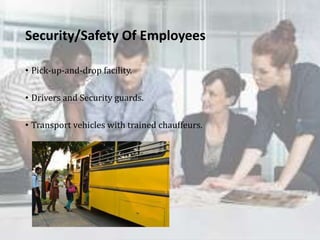
Security/Safety Of Employees
• Pick-up-and-drop facility.
• Drivers and Security guards.
• Transport vehicles with trained chauffeurs.
• Sexual harassing conduct causes devastating physical and
psychological injuries to a large percentage of women in
workplaces around the world. Harassment directed against
women in the workplace by their supervisors, fellow employees,
or third parties interferes with the integration of women in the
workforce, reinforce the subordination of women to men in
society, violates women’s dignity and creates a health and safety
hazard at work. States are obligated under the international law to
take effective steps to protect women from violence and to hold
harassers and/or their employers accountable for sexual
harassment in the workplace.
Prevention Mechanisms, policies and
strategies at Workplace
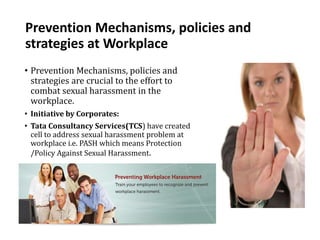
• Prevention Mechanisms, policies and
strategies are crucial to the effort to
combat sexual harassment in the
workplace.
• Initiative by Corporates:
• Tata Consultancy Services(TCS) have created
cell to address sexual harassment problem at
workplace i.e. PASH which means Protection
/Policy Against Sexual Harassment.
Caste Discrimination
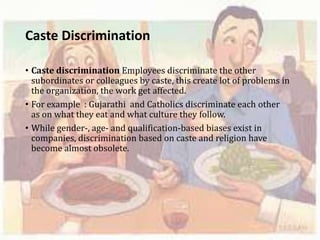
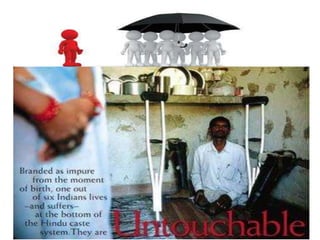
• Caste discrimination Employees discriminate the other
subordinates or colleagues by caste, this create lot of problems in
the organization, the work get affected.
• For example : Gujarathi and Catholics discriminate each other
as on what they eat and what culture they follow.
• While gender-, age- and qualification-based biases exist in
companies, discrimination based on caste and religion have
become almost obsolete.
Business People
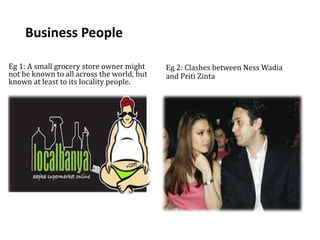
Eg 1: A small grocery store owner might
not be known to all across the world, but
known at least to its locality people.
Eg 2: Clashes between Ness Wadia
and Priti Zinta
Union within Organizations
WRMS – Western Railway Mazdoor Sangh
• Monthly meet
• Organized and settled
• Equality amongst the members
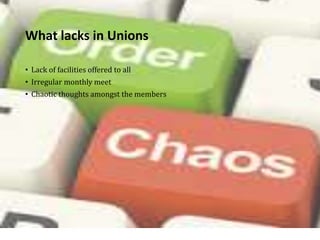
What lacks in Unions
• Lack of facilities offered to all
• Irregular monthly meet
• Chaotic thoughts amongst the members
Organizational Behavior
• Organizational Behavior = how the employees working in
an organization behave + how their behavior affects
overall functioning of an organization
Personality
Learning
Values
Attitude & Interest
Team Building
Conflict
Motivation
Learning
• Learning:-one can just bring a hungry person towards food, but it is
only on the person to put it into his mouth
• Utkarsh
• Six Sigma
• Green Belt
Team Building
• Team Building:- can become very time consuming and expensive, but is
extremely important for success of the organization
“Get Set Go”
“Maitree”
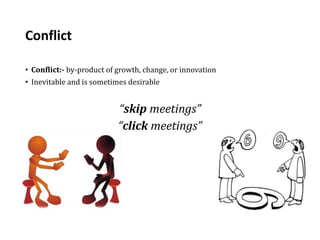
Conflict
• Conflict:- by-product of growth, change, or innovation
• Inevitable and is sometimes desirable
“skip meetings”
“click meetings”
Personality
• Personality:- a key factor influencing individual behavior in
organizations
“Personality Contest”
“Lets TALK”
Motivation
• Motivation :- anything that makes a person “to move” to attain desires,
wants, needs, goals
R&R (Rewards and Recognition)
TCS Star Awards
Gem Points
Incentives
Bonuses
Promotions
Compensations
Values , Attitude & Interest
• Values:- basic convictions
• Attitude:- affect toward an object
• Interests:- something that holds our attention
“TATA Code Of Conduct”
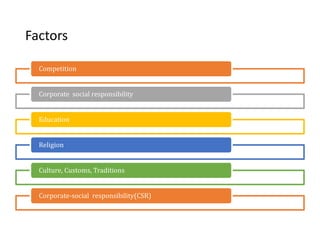
Factors
Competition
Corporate social responsibility
Education
Religion
Culture, Customs, Traditions
Corporate-social responsibility(CSR)
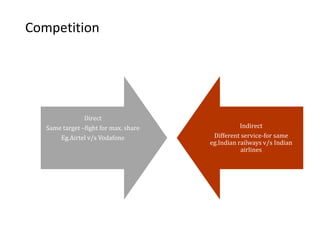
Competition
Direct
Same target –fight for max. share
Eg.Airtel v/s Vodafone
Indirect
Different service-for same
eg.Indian railways v/s Indian
airlines
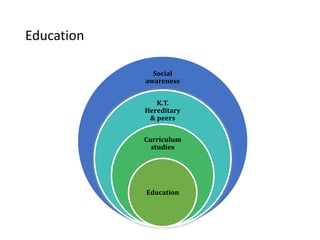
Education
Social
awareness
K.T.
Hereditary
& peers
Curriculum
studies
Education
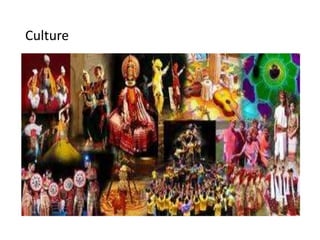
Culture
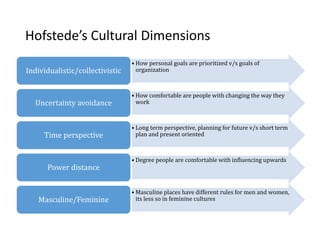
Hofstede’s Cultural Dimensions
• How personal goals are prioritized v/s goals of
organizationIndividualistic/collectivistic
• How comfortable are people with changing the way they
workUncertainty avoidance
• Long term perspective, planning for future v/s short term
plan and present orientedTime perspective
• Degree people are comfortable with influencing upwards
Power distance
• Masculine places have different rules for men and women,
its less so in feminine culturesMasculine/Feminine
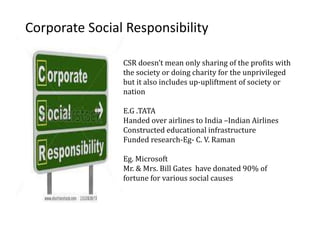
Corporate Social Responsibility
CSR doesn’t mean only sharing of the profits with
the society or doing charity for the unprivileged
but it also includes up-upliftment of society or
nation
E.G .TATA
Handed over airlines to India –Indian Airlines
Constructed educational infrastructure
Funded research-Eg- C. V. Raman
Eg. Microsoft
Mr. & Mrs. Bill Gates have donated 90% of
fortune for various social causes
Social change & Social
Preference
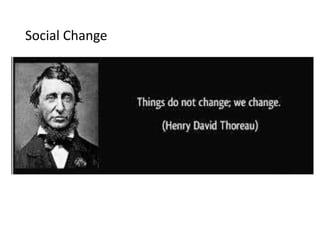
Social Change
What is “Social Change”?
• Social change is a combination of small-small revolutionary ideas, thoughts,
processes, mindsets which alter or transform over a period of time
• Social change is defined as the changes people make to their behaviour that,
when taken collectively, benefit society.
• Social change
• Occur slowly, as the result of a cultural shift
• Quickly, as the result of a natural disaster
• Change in public policy.
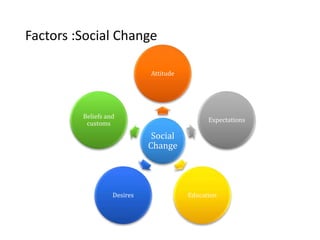
Factors :Social Change
Social
Change
Attitude
Expectations
EducationDesires
Beliefs and
customs
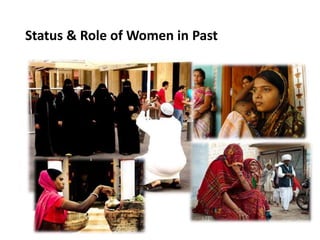
Status & Role of Women in Past
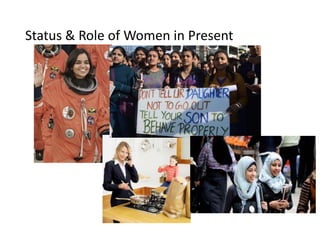
Status & Role of Women in Present
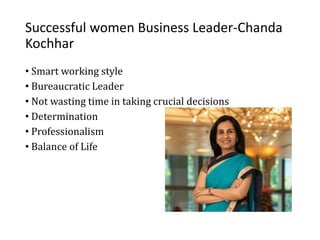
Successful women Business Leader-Chanda
Kochhar
• Smart working style
• Bureaucratic Leader
• Not wasting time in taking crucial decisions
• Determination
• Professionalism
• Balance of Life
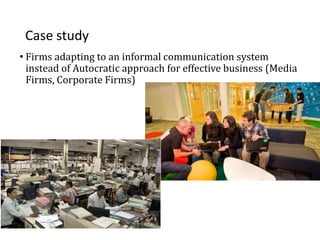
Case study
• Firms adapting to an informal communication system
instead of Autocratic approach for effective business (Media
Firms, Corporate Firms)
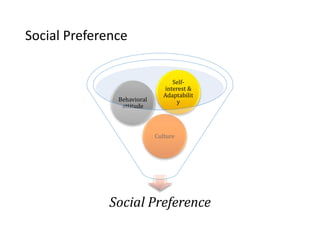
Social Preference
Social Preference
Culture
Behavioral
attitude
Self-
interest &
Adaptabilit
y
Case Study-Domino’s Pizza
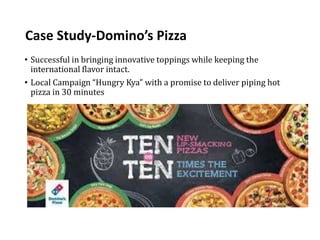
• Successful in bringing innovative toppings while keeping the
international flavor intact.
• Local Campaign “Hungry Kya” with a promise to deliver piping hot
pizza in 30 minutes
Reference
1)Presentation Technique-”The Mind
Map Book”-TONY & BARRY BUZAN
2)Videos-www.youtube.com
3)Content-Business Environment
Assignment SIMSREE.
4)Images-google.com
Final Business environment presentation-Social

Final Business environment presentation-Social

  • 1.
    Business Environment: Social ProjectBy Part time MMS Batch 2013-16 Simsree Presented to- Varun Sharma
  • 2.
    Prepared & Presentedby Miss. Ankita Sriwardhankar- PM1325 Miss . Manisha Bhatia- PF1304 Miss .Shreya Kunder- PM1314 Mr. . Someshwar Verma-PM1330 Mr. . Jatin Shah-PM1323
  • 3.
    Highlights Social Factors affectingBusiness Environment. Business and Unions Organizational Behavior Culture Education CSR Social Change Social Preference
  • 4.
    Social Factors AffectingBusiness Environment. • The social environment of a business can be integral to its success or failure. • Employees are often influenced by the context in which they work and this can have implications for productivity. Employees who take the necessary strides to create a positive and harmonious social environment in the work place can set themselves up for future success. • The social environment of a business can also have an impact on the type and number of customers it attracts. • Customers choose which business to patronize based on various factors, and social environment can be the deciding factor for some.
  • 5.
    Security/Safety Of Employees •Pick-up-and-drop facility. • Drivers and Security guards. • Transport vehicles with trained chauffeurs.
  • 6.
    • Sexual harassingconduct causes devastating physical and psychological injuries to a large percentage of women in workplaces around the world. Harassment directed against women in the workplace by their supervisors, fellow employees, or third parties interferes with the integration of women in the workforce, reinforce the subordination of women to men in society, violates women’s dignity and creates a health and safety hazard at work. States are obligated under the international law to take effective steps to protect women from violence and to hold harassers and/or their employers accountable for sexual harassment in the workplace.
  • 7.
    Prevention Mechanisms, policiesand strategies at Workplace • Prevention Mechanisms, policies and strategies are crucial to the effort to combat sexual harassment in the workplace. • Initiative by Corporates: • Tata Consultancy Services(TCS) have created cell to address sexual harassment problem at workplace i.e. PASH which means Protection /Policy Against Sexual Harassment.
  • 8.
    Caste Discrimination • Castediscrimination Employees discriminate the other subordinates or colleagues by caste, this create lot of problems in the organization, the work get affected. • For example : Gujarathi and Catholics discriminate each other as on what they eat and what culture they follow. • While gender-, age- and qualification-based biases exist in companies, discrimination based on caste and religion have become almost obsolete.
  • 10.
    Business People Eg 1:A small grocery store owner might not be known to all across the world, but known at least to its locality people. Eg 2: Clashes between Ness Wadia and Priti Zinta
  • 11.
    Union within Organizations WRMS– Western Railway Mazdoor Sangh • Monthly meet • Organized and settled • Equality amongst the members
  • 12.
    What lacks inUnions • Lack of facilities offered to all • Irregular monthly meet • Chaotic thoughts amongst the members
  • 13.
    Organizational Behavior • OrganizationalBehavior = how the employees working in an organization behave + how their behavior affects overall functioning of an organization Personality Learning Values Attitude & Interest Team Building Conflict Motivation
  • 14.
    Learning • Learning:-one canjust bring a hungry person towards food, but it is only on the person to put it into his mouth • Utkarsh • Six Sigma • Green Belt
  • 15.
    Team Building • TeamBuilding:- can become very time consuming and expensive, but is extremely important for success of the organization “Get Set Go” “Maitree”
  • 16.
    Conflict • Conflict:- by-productof growth, change, or innovation • Inevitable and is sometimes desirable “skip meetings” “click meetings”
  • 17.
    Personality • Personality:- akey factor influencing individual behavior in organizations “Personality Contest” “Lets TALK”
  • 18.
    Motivation • Motivation :-anything that makes a person “to move” to attain desires, wants, needs, goals R&R (Rewards and Recognition) TCS Star Awards Gem Points Incentives Bonuses Promotions Compensations
  • 19.
    Values , Attitude& Interest • Values:- basic convictions • Attitude:- affect toward an object • Interests:- something that holds our attention “TATA Code Of Conduct”
  • 20.
    Factors Competition Corporate social responsibility Education Religion Culture,Customs, Traditions Corporate-social responsibility(CSR)
  • 21.
    Competition Direct Same target –fightfor max. share Eg.Airtel v/s Vodafone Indirect Different service-for same eg.Indian railways v/s Indian airlines
  • 22.
  • 23.
  • 24.
    Hofstede’s Cultural Dimensions •How personal goals are prioritized v/s goals of organizationIndividualistic/collectivistic • How comfortable are people with changing the way they workUncertainty avoidance • Long term perspective, planning for future v/s short term plan and present orientedTime perspective • Degree people are comfortable with influencing upwards Power distance • Masculine places have different rules for men and women, its less so in feminine culturesMasculine/Feminine
  • 25.
    Corporate Social Responsibility CSRdoesn’t mean only sharing of the profits with the society or doing charity for the unprivileged but it also includes up-upliftment of society or nation E.G .TATA Handed over airlines to India –Indian Airlines Constructed educational infrastructure Funded research-Eg- C. V. Raman Eg. Microsoft Mr. & Mrs. Bill Gates have donated 90% of fortune for various social causes
  • 26.
    Social change &Social Preference
  • 27.
  • 28.
    What is “SocialChange”? • Social change is a combination of small-small revolutionary ideas, thoughts, processes, mindsets which alter or transform over a period of time • Social change is defined as the changes people make to their behaviour that, when taken collectively, benefit society. • Social change • Occur slowly, as the result of a cultural shift • Quickly, as the result of a natural disaster • Change in public policy.
  • 29.
  • 30.
    Status & Roleof Women in Past
  • 31.
    Status & Roleof Women in Present
  • 32.
    Successful women BusinessLeader-Chanda Kochhar • Smart working style • Bureaucratic Leader • Not wasting time in taking crucial decisions • Determination • Professionalism • Balance of Life
  • 33.
    Case study • Firmsadapting to an informal communication system instead of Autocratic approach for effective business (Media Firms, Corporate Firms)
  • 34.
  • 35.
    Case Study-Domino’s Pizza •Successful in bringing innovative toppings while keeping the international flavor intact. • Local Campaign “Hungry Kya” with a promise to deliver piping hot pizza in 30 minutes
  • 36.
    Reference 1)Presentation Technique-”The Mind MapBook”-TONY & BARRY BUZAN 2)Videos-www.youtube.com 3)Content-Business Environment Assignment SIMSREE. 4)Images-google.com

Editor's Notes

  • #35 Social preference is a result of behavioural attitude, self interest, adaptability to change and culture