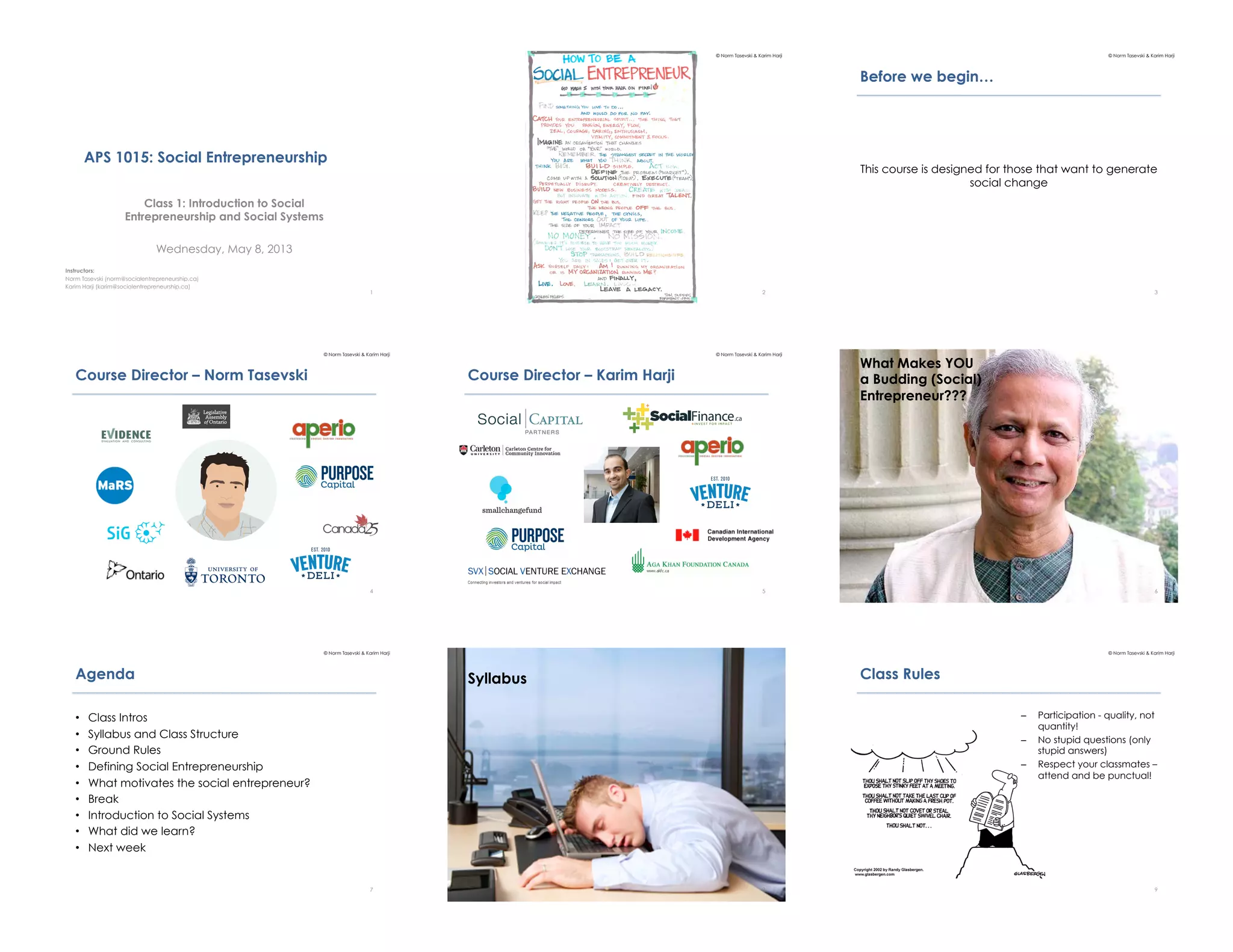
APS 1015: Social Entrepreneurship
Class 1: Introduction to Social
Entrepreneurship and Social Systems
Wednesday, May 8, 2013
1
Instructors:
Norm Tasevski (norm@socialentrepreneurship.ca)
Karim Harji (karim@socialentrepreneurship.ca)
© Norm Tasevski & Karim Harji
2
© Norm Tasevski & Karim Harji
Before we begin…
This course is designed for those that want to generate
social change
3
© Norm Tasevski & Karim Harji
Course Director – Norm Tasevski
4
© Norm Tasevski & Karim Harji
Course Director – Karim Harji
5
© Norm Tasevski & Karim Harji
What Makes YOU
a Budding (Social)
Entrepreneur???
6
© Norm Tasevski & Karim Harji
Agenda
•  Class Intros
•  Syllabus and Class Structure
•  Ground Rules
•  Defining Social Entrepreneurship
•  What motivates the social entrepreneur?
•  Break
•  Introduction to Social Systems
•  What did we learn?
•  Next week
7
© Norm Tasevski & Karim Harji
Syllabus
8
© Norm Tasevski & Karim Harji
Class Rules
–  Participation - quality, not
quantity!
–  No stupid questions (only
stupid answers)
–  Respect your classmates –
attend and be punctual!
9
Defining Social Entrepreneurship…
10
© Norm Tasevski & Karim Harji
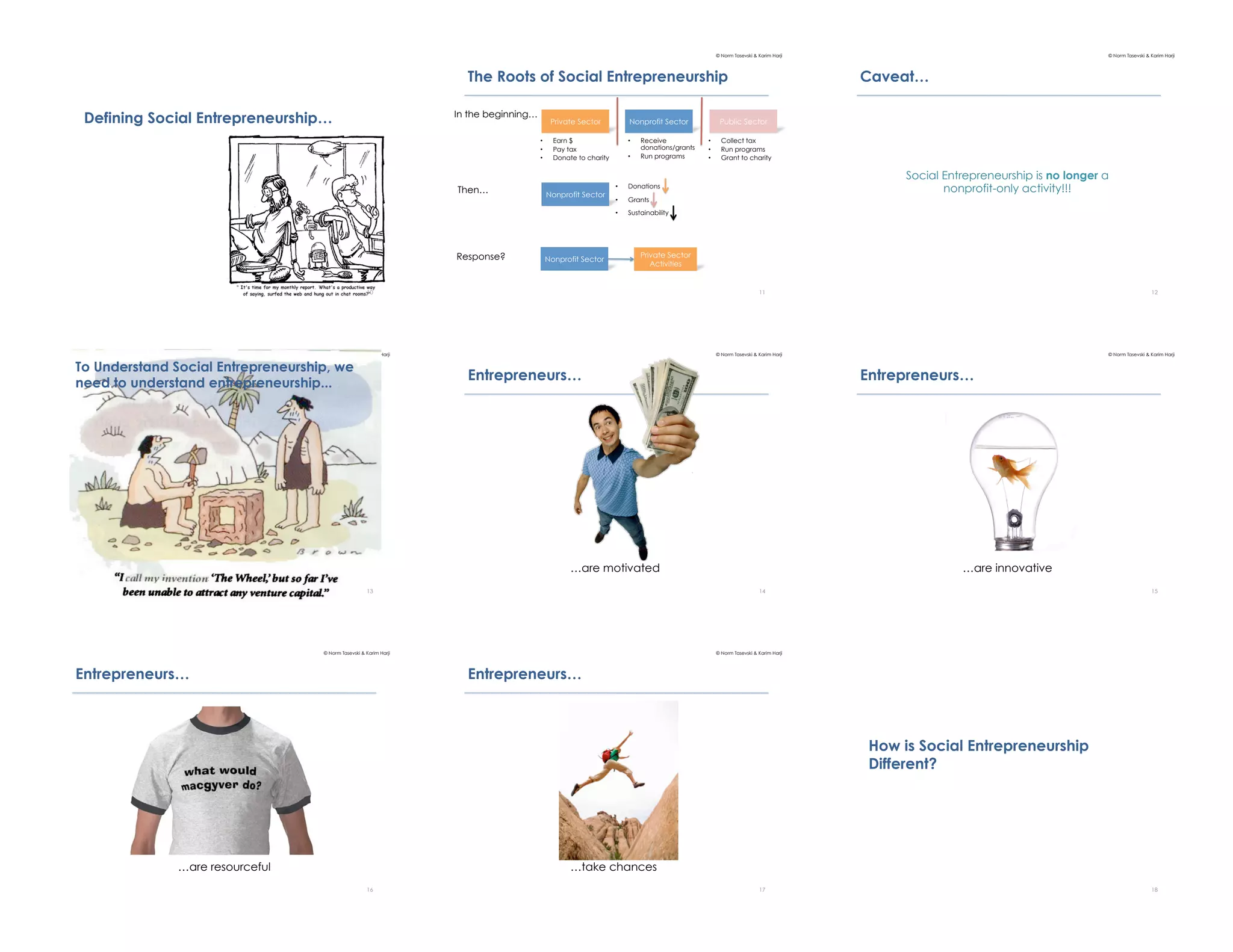
The Roots of Social Entrepreneurship
In the beginning…
11
Then…
Private Sector
•  Earn $
•  Pay tax
•  Donate to charity
Public Sector
•  Collect tax
•  Run programs
•  Grant to charity
Nonprofit Sector
•  Receive
donations/grants
•  Run programs
Nonprofit Sector
•  Donations
•  Grants
•  Sustainability
Response? Nonprofit Sector
Private Sector
Activities
© Norm Tasevski & Karim Harji
Caveat…
12
Social Entrepreneurship is no longer a
nonprofit-only activity!!!
© Norm Tasevski & Karim Harji
To Understand Social Entrepreneurship, we
need to understand entrepreneurship...
13
© Norm Tasevski & Karim Harji
Entrepreneurs…
…are motivated
14
© Norm Tasevski & Karim Harji
Entrepreneurs…
…are innovative
15
© Norm Tasevski & Karim Harji
Entrepreneurs…
…are resourceful
16
© Norm Tasevski & Karim Harji
Entrepreneurs…
…take chances
17
How is Social Entrepreneurship
Different?
18
© Norm Tasevski & Karim Harji
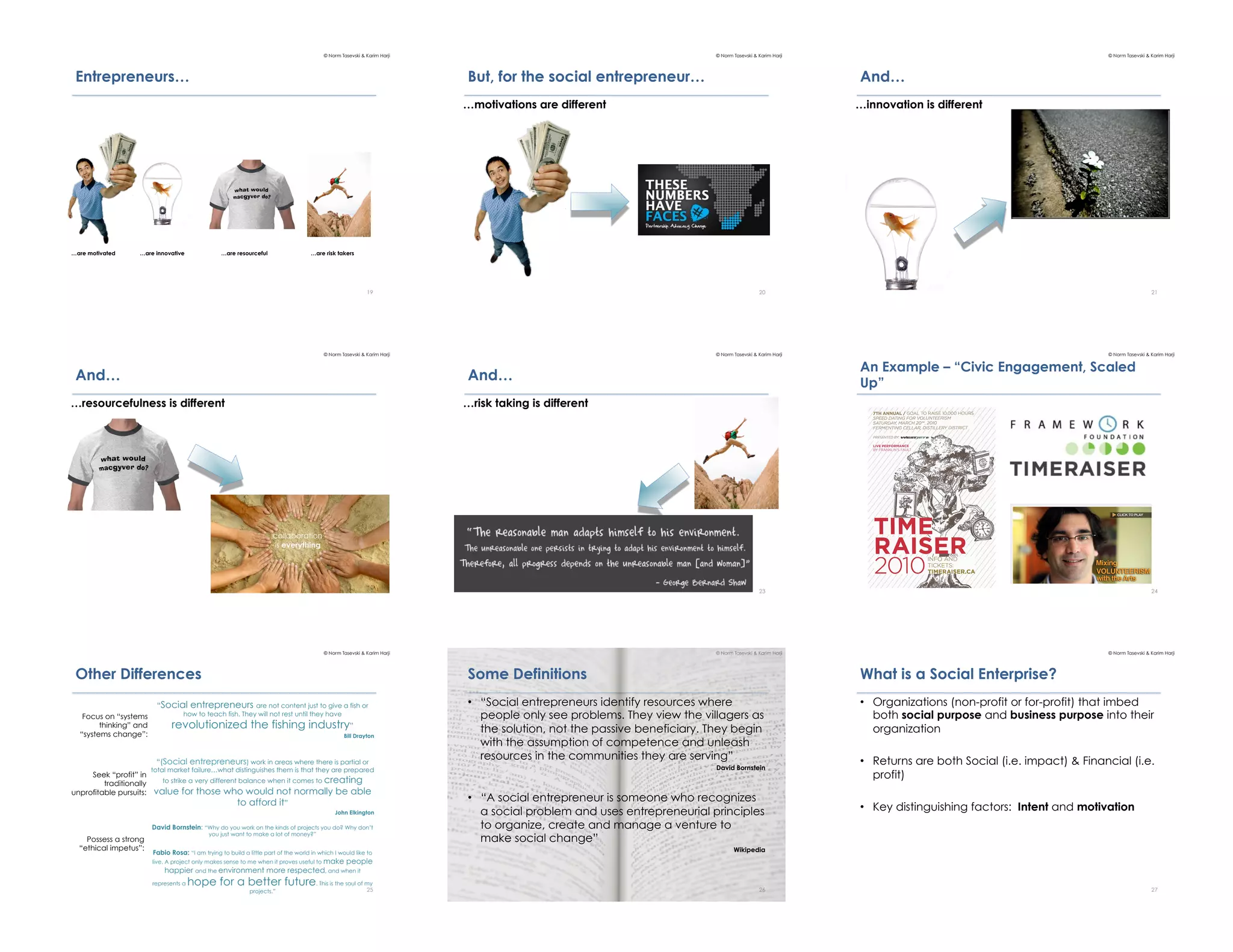
Entrepreneurs…
…are motivated …are resourceful …are risk takers…are innovative
19
© Norm Tasevski & Karim Harji
But, for the social entrepreneur…
…motivations are different
20
© Norm Tasevski & Karim Harji
And…
…innovation is different
21
© Norm Tasevski & Karim Harji
And…
…resourcefulness is different
22
© Norm Tasevski & Karim Harji
And…
…risk taking is different
23
© Norm Tasevski & Karim Harji
An Example – “Civic Engagement, Scaled
Up”
24
© Norm Tasevski & Karim Harji
Other Differences
Focus on “systems
thinking” and
“systems change”:
“Social entrepreneurs are not content just to give a fish or
how to teach fish. They will not rest until they have
revolutionized the fishing industry”
Bill Drayton
Seek “profit” in
traditionally
unprofitable pursuits:
“(Social entrepreneurs) work in areas where there is partial or
total market failure…what distinguishes them is that they are prepared
to strike a very different balance when it comes to creating
value for those who would not normally be able
to afford it”
John Elkington
Possess a strong
“ethical impetus”:
David Bornstein: “Why do you work on the kinds of projects you do? Why don’t
you just want to make a lot of money?”
Fabio Rosa: “I am trying to build a little part of the world in which I would like to
live. A project only makes sense to me when it proves useful to make people
happier and the environment more respected, and when it
represents a hope for a better future. This is the soul of my
projects.” 25
© Norm Tasevski & Karim Harji
Some Definitions
•  “Social entrepreneurs identify resources where
people only see problems. They view the villagers as
the solution, not the passive beneficiary. They begin
with the assumption of competence and unleash
resources in the communities they are serving”
David Bornstein
•  “A social entrepreneur is someone who recognizes
a social problem and uses entrepreneurial principles
to organize, create and manage a venture to
make social change”
Wikipedia
26
© Norm Tasevski & Karim Harji
What is a Social Enterprise?
•  Organizations (non-profit or for-profit) that imbed
both social purpose and business purpose into their
organization
•  Returns are both Social (i.e. impact) & Financial (i.e.
profit)
•  Key distinguishing factors: Intent and motivation
27
© Norm Tasevski & Karim Harji
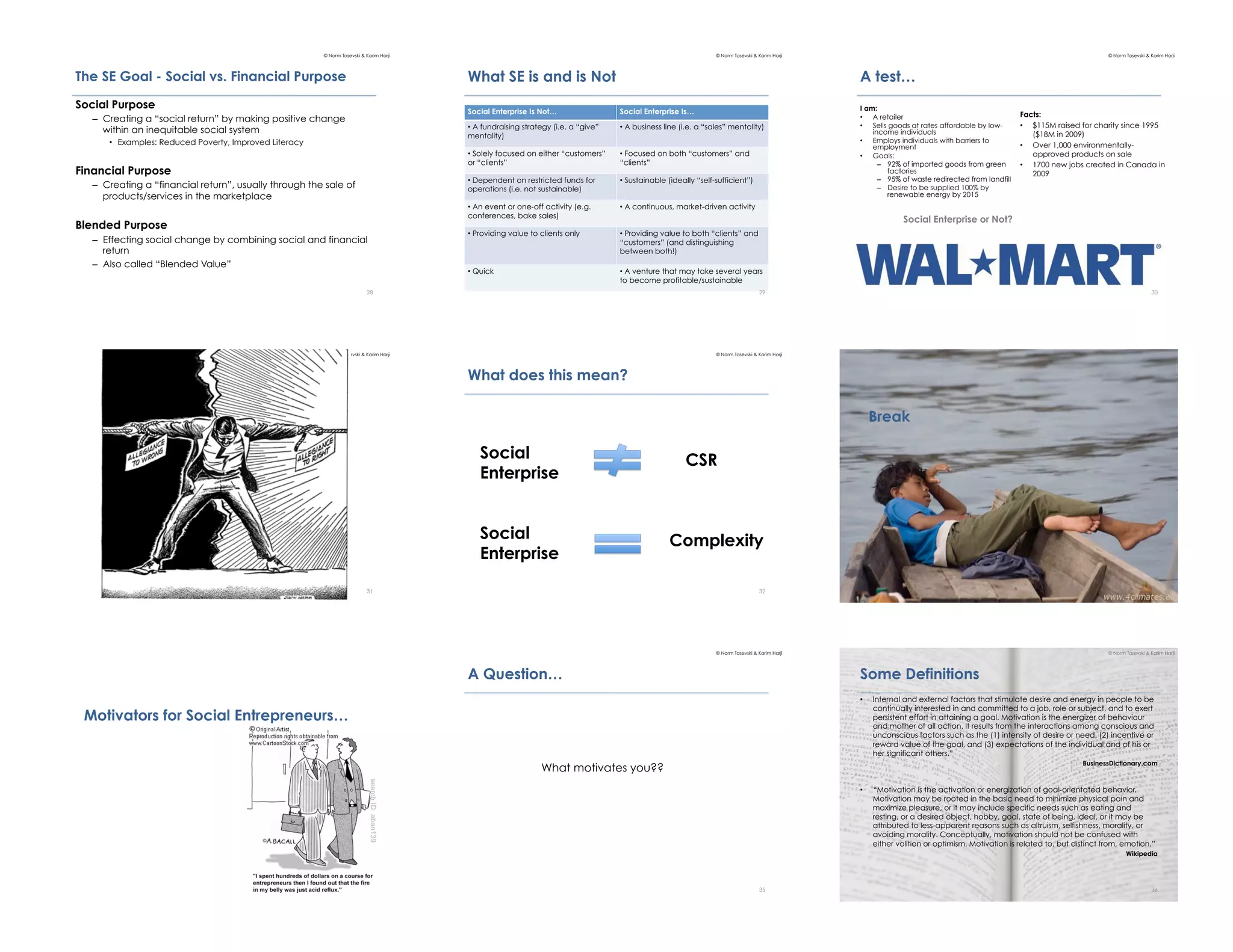
The SE Goal - Social vs. Financial Purpose
Social Purpose
–  Creating a “social return” by making positive change
within an inequitable social system
•  Examples: Reduced Poverty, Improved Literacy
Financial Purpose
–  Creating a “financial return”, usually through the sale of
products/services in the marketplace
Blended Purpose
–  Effecting social change by combining social and financial
return
–  Also called “Blended Value”
28
© Norm Tasevski & Karim Harji
What SE is and is Not
Social Enterprise Is Not… Social Enterprise Is…
• A fundraising strategy (i.e. a “give”
mentality)
• A business line (i.e. a “sales” mentality)
• Solely focused on either “customers”
or “clients”
• Focused on both “customers” and
“clients”
• Dependent on restricted funds for
operations (i.e. not sustainable)
• Sustainable (ideally “self-sufficient”)
• An event or one-off activity (e.g.
conferences, bake sales)
• A continuous, market-driven activity
• Providing value to clients only • Providing value to both “clients” and
“customers” (and distinguishing
between both!)
• Quick • A venture that may take several years
to become profitable/sustainable
29
© Norm Tasevski & Karim Harji
A test…
30
I am:
•  A retailer
•  Sells goods at rates affordable by low-
income individuals
•  Employs individuals with barriers to
employment
•  Goals:
–  92% of imported goods from green
factories
–  95% of waste redirected from landfill
–  Desire to be supplied 100% by
renewable energy by 2015
Social Enterprise or Not?
Facts:
•  $115M raised for charity since 1995
($18M in 2009)
•  Over 1,000 environmentally-
approved products on sale
•  1700 new jobs created in Canada in
2009
© Norm Tasevski & Karim Harji
31
© Norm Tasevski & Karim Harji
What does this mean?
Social
Enterprise
CSR
32
Social
Enterprise
Complexity
Break
33
Motivators for Social Entrepreneurs…
34
© Norm Tasevski & Karim Harji
A Question…
What motivates you??
35
© Norm Tasevski & Karim Harji
Some Definitions
•  Internal and external factors that stimulate desire and energy in people to be
continually interested in and committed to a job, role or subject, and to exert
persistent effort in attaining a goal. Motivation is the energizer of behaviour
and mother of all action. It results from the interactions among conscious and
unconscious factors such as the (1) intensity of desire or need, (2) incentive or
reward value of the goal, and (3) expectations of the individual and of his or
her significant others.”
BusinessDictionary.com
•  “Motivation is the activation or energization of goal-orientated behavior.
Motivation may be rooted in the basic need to minimize physical pain and
maximize pleasure, or it may include specific needs such as eating and
resting, or a desired object, hobby, goal, state of being, ideal, or it may be
attributed to less-apparent reasons such as altruism, selfishness, morality, or
avoiding morality. Conceptually, motivation should not be confused with
either volition or optimism. Motivation is related to, but distinct from, emotion.”
Wikipedia
36
© Norm Tasevski & Karim Harji
37
In response
to why
people are
not giving to
the Pakistani
flood in the
same way as
they did for
Haiti, one
woman said:!
!
“It’s a rogue
state, if they
can afford
the nuclear
bomb they
can look
after their
own”!
!
© Norm Tasevski & Karim Harji
38
Costin Militaru, an
outreach worker…
has met addicts as
young as 9 years
old. "His family
had no money for
food. He was
hungry and kept
crying, so they fed
him heroin,"
Militaru says. "If
you're high, you
don't need food.”!
!
© Norm Tasevski & Karim Harji
39
“On March 24, 1989,
the Exxon Valdez
ran aground in
northern Prince
William Sound,
spilling 42 million
liters of crude oil
and contaminating
1,990 kilometers of
shoreline. Some
2,000 sea otters,
302 harbor
seals and about
250,000
seabirds died
in the days
immediately
following the
spill.”!
© Norm Tasevski & Karim Harji
40
A total of 32,700
different people
stayed in Toronto's
emergency shelters
in 2005. 4,600
were children. !
!
Over half a million
Toronto
households live
below the poverty
line!
!
1 in 10 homeless
report attempted
suicide in 2006!
© Norm Tasevski & Karim Harji
41
© Norm Tasevski & Karim Harji
So What Motivates The Social/
Environmental Entrepreneur?
“…it was an epiphanal experience…”
Ray Anderson, Interface Carpets
© Norm Tasevski & Karim Harji
So What Motivates The Social/
Environmental Entrepreneur?
“I heard the same story again and again. Someone had
experienced an intense kind of pain that branded
them in some way. They said, ‘I had’ to do this. There was
nothing else I could do.”
Jody Jensen, Ashoka
© Norm Tasevski & Karim Harji
So What Motivates The Social/
Environmental Entrepreneur?
“…that made a real impression on me…”
Jeff Skoll, eBay, Skoll Foundation, etc.
© Norm Tasevski & Karim Harji
So What Motivates The Social/
Environmental Entrepreneur?
“I was teaching in one of the universities while the country was
suffering from a severe famine. People were dying of hunger, and I
felt very helpless. As an economist, I had no tool
in my toolbox to fix that kind of situation.”
Mohammed Yunus, Grameen Bank
© Norm Tasevski & Karim Harji
So What Motivates The Social/
Environmental Entrepreneur?
“…powerful moments of inspiration…”
Jacqueline Novogratz, Acumen Fund
© Norm Tasevski & Karim Harji
What about…
Introduction to Social Systems…
48
© Norm Tasevski & Karim Harji
What is a System?
“A set of "Things” (people, organizations, objects…) that are
interconnected in such a way that they form their
own pattern of behaviour over time”
Donella Meadows
© Norm Tasevski & Karim Harji
System Behaviour
•  A system creates/causes its own responses
•  Outside forces can influence system response, but
don’t cause the response
•  The same outside force that acts upon two different
systems can therefore elicit two different responses
•  Example: the flu virus
50
© Norm Tasevski & Karim Harji
System Components
1.  Elements
2.  Interconnections
3.  Functions/Purpose
Example: Soccer (Football)
51
Elements
Interconnections
Purpose
© Norm Tasevski & Karim Harji
System Components
•  Elements
–  Tangible (people, buildings)
–  Intangible (team pride, learned skills)
•  Interconnections
–  Physical flows (e.g. objects moving)
–  Information flows (e.g. rules, instructions)
•  Function/Purpose
–  Intended responses (e.g. goal to win a soccer match)
–  Unintended responses (e.g. violence after a soccer match)
52
© Norm Tasevski & Karim Harji
Social Systems – the Unintended Responses
53
Social System Unintended Response
• Health Care • Obesity
• Spread of preventable disease
• Education • High school dropout
• High education costs
• Transportation • Environmental damage
• Inefficient movement of people
• Food • Food insecurity
• Food waste
© Norm Tasevski & Karim Harji
What is Not a System?
•  Anything with one ore more of the components
(e.g. elements, interconnections or function/
purpose) missing
54
© Norm Tasevski & Karim Harji
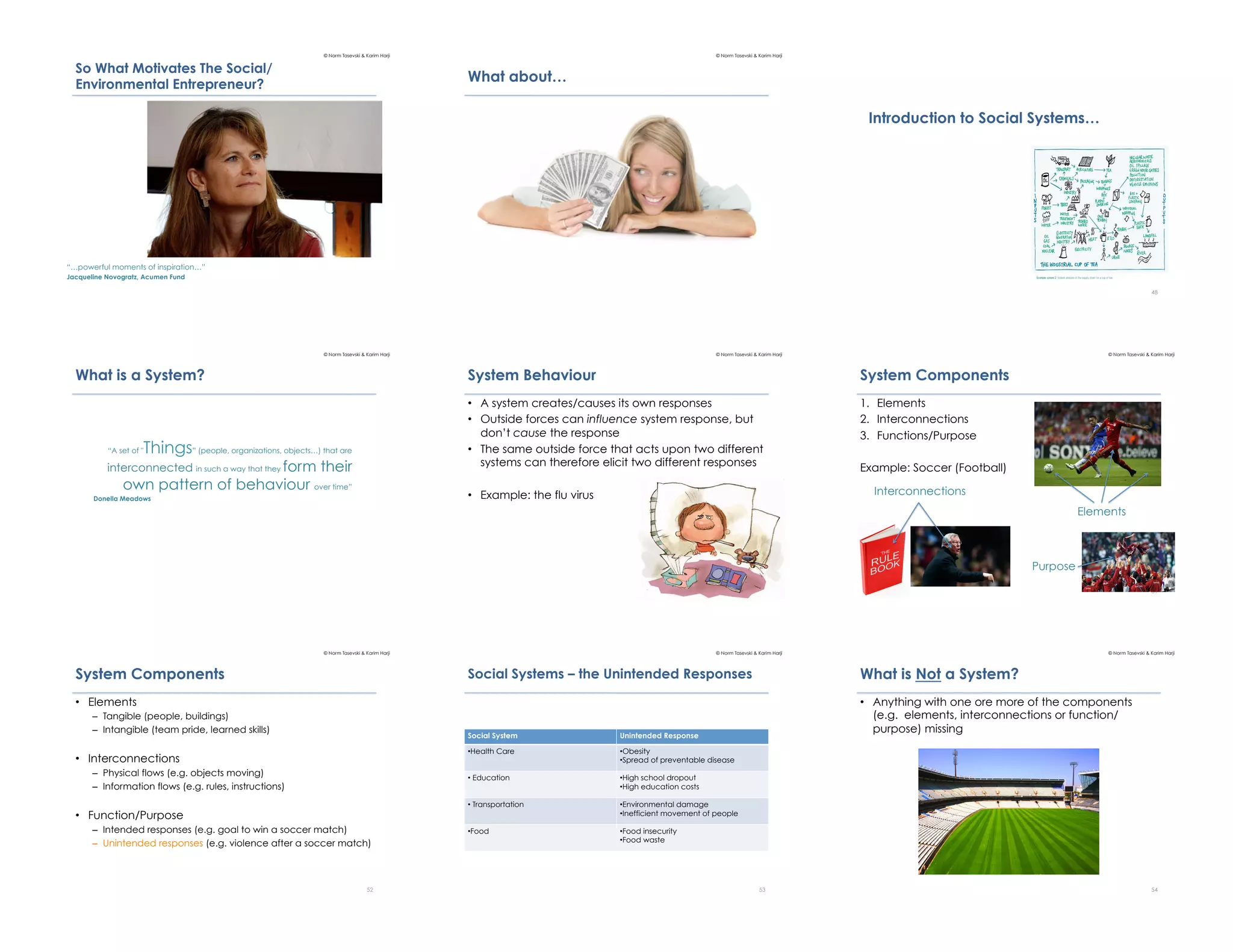
“Mapping” a System
55
© Norm Tasevski & Karim Harji
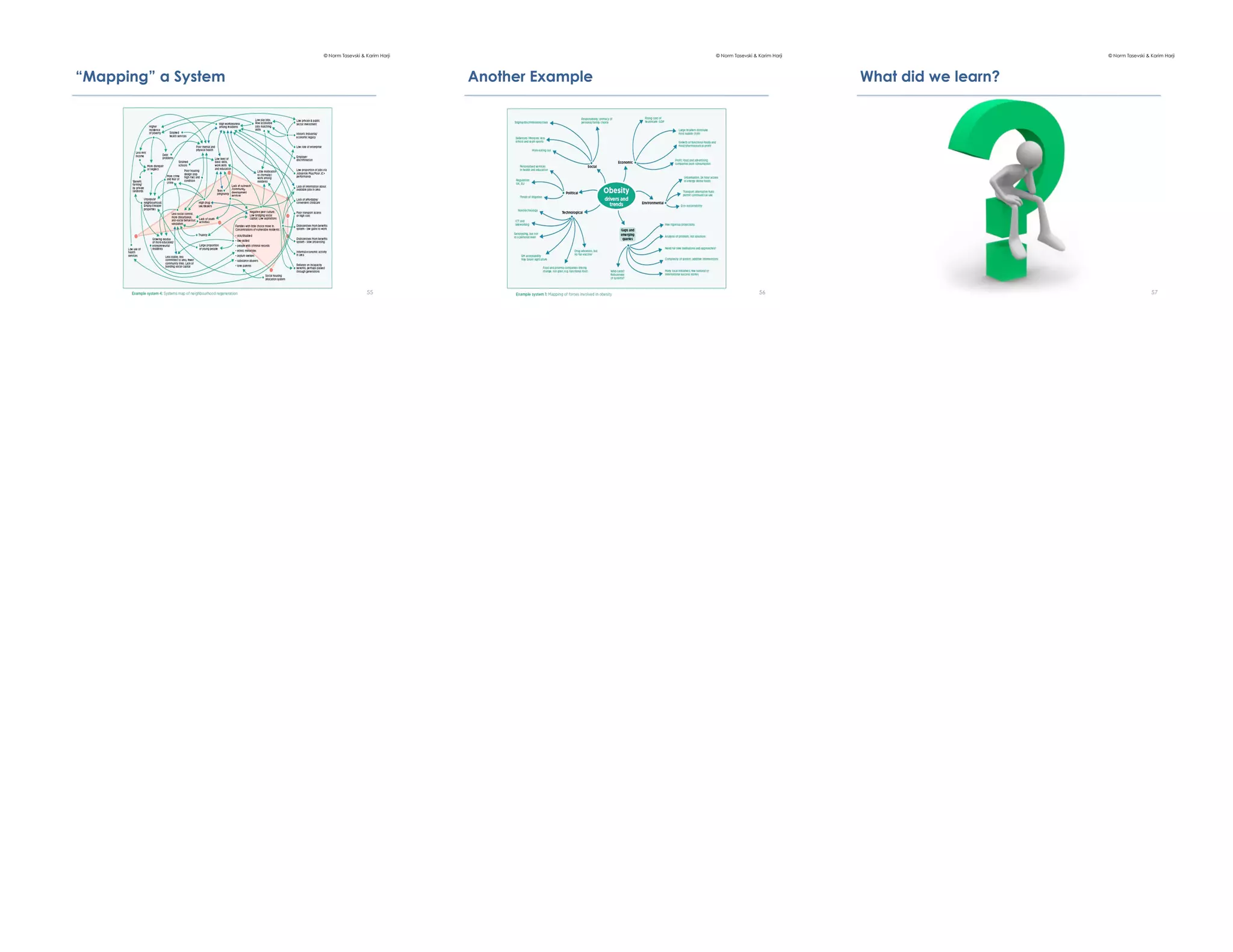
Another Example
56
© Norm Tasevski & Karim Harji
What did we learn?
57

APS1015 Class 1: Introduction to Social Entrepreneurship and Social Systems

  • 1.
    APS 1015: SocialEntrepreneurship Class 1: Introduction to Social Entrepreneurship and Social Systems Wednesday, May 8, 2013 1 Instructors: Norm Tasevski (norm@socialentrepreneurship.ca) Karim Harji (karim@socialentrepreneurship.ca)
  • 2.
    © Norm Tasevski& Karim Harji 2
  • 3.
    © Norm Tasevski& Karim Harji Before we begin… This course is designed for those that want to generate social change 3
  • 4.
    © Norm Tasevski& Karim Harji Course Director – Norm Tasevski 4
  • 5.
    © Norm Tasevski& Karim Harji Course Director – Karim Harji 5
  • 6.
    © Norm Tasevski& Karim Harji What Makes YOU a Budding (Social) Entrepreneur??? 6
  • 7.
    © Norm Tasevski& Karim Harji Agenda •  Class Intros •  Syllabus and Class Structure •  Ground Rules •  Defining Social Entrepreneurship •  What motivates the social entrepreneur? •  Break •  Introduction to Social Systems •  What did we learn? •  Next week 7
  • 8.
    © Norm Tasevski& Karim Harji Syllabus 8
  • 9.
    © Norm Tasevski& Karim Harji Class Rules –  Participation - quality, not quantity! –  No stupid questions (only stupid answers) –  Respect your classmates – attend and be punctual! 9
  • 10.
  • 11.
    © Norm Tasevski& Karim Harji The Roots of Social Entrepreneurship In the beginning… 11 Then… Private Sector •  Earn $ •  Pay tax •  Donate to charity Public Sector •  Collect tax •  Run programs •  Grant to charity Nonprofit Sector •  Receive donations/grants •  Run programs Nonprofit Sector •  Donations •  Grants •  Sustainability Response? Nonprofit Sector Private Sector Activities
  • 12.
    © Norm Tasevski& Karim Harji Caveat… 12 Social Entrepreneurship is no longer a nonprofit-only activity!!!
  • 13.
    © Norm Tasevski& Karim Harji To Understand Social Entrepreneurship, we need to understand entrepreneurship... 13
  • 14.
    © Norm Tasevski& Karim Harji Entrepreneurs… …are motivated 14
  • 15.
    © Norm Tasevski& Karim Harji Entrepreneurs… …are innovative 15
  • 16.
    © Norm Tasevski& Karim Harji Entrepreneurs… …are resourceful 16
  • 17.
    © Norm Tasevski& Karim Harji Entrepreneurs… …take chances 17
  • 18.
    How is SocialEntrepreneurship Different? 18
  • 19.
    © Norm Tasevski& Karim Harji Entrepreneurs… …are motivated …are resourceful …are risk takers…are innovative 19
  • 20.
    © Norm Tasevski& Karim Harji But, for the social entrepreneur… …motivations are different 20
  • 21.
    © Norm Tasevski& Karim Harji And… …innovation is different 21
  • 22.
    © Norm Tasevski& Karim Harji And… …resourcefulness is different 22
  • 23.
    © Norm Tasevski& Karim Harji And… …risk taking is different 23
  • 24.
    © Norm Tasevski& Karim Harji An Example – “Civic Engagement, Scaled Up” 24
  • 25.
    © Norm Tasevski& Karim Harji Other Differences Focus on “systems thinking” and “systems change”: “Social entrepreneurs are not content just to give a fish or how to teach fish. They will not rest until they have revolutionized the fishing industry” Bill Drayton Seek “profit” in traditionally unprofitable pursuits: “(Social entrepreneurs) work in areas where there is partial or total market failure…what distinguishes them is that they are prepared to strike a very different balance when it comes to creating value for those who would not normally be able to afford it” John Elkington Possess a strong “ethical impetus”: David Bornstein: “Why do you work on the kinds of projects you do? Why don’t you just want to make a lot of money?” Fabio Rosa: “I am trying to build a little part of the world in which I would like to live. A project only makes sense to me when it proves useful to make people happier and the environment more respected, and when it represents a hope for a better future. This is the soul of my projects.” 25
  • 26.
    © Norm Tasevski& Karim Harji Some Definitions •  “Social entrepreneurs identify resources where people only see problems. They view the villagers as the solution, not the passive beneficiary. They begin with the assumption of competence and unleash resources in the communities they are serving” David Bornstein •  “A social entrepreneur is someone who recognizes a social problem and uses entrepreneurial principles to organize, create and manage a venture to make social change” Wikipedia 26
  • 27.
    © Norm Tasevski& Karim Harji What is a Social Enterprise? •  Organizations (non-profit or for-profit) that imbed both social purpose and business purpose into their organization •  Returns are both Social (i.e. impact) & Financial (i.e. profit) •  Key distinguishing factors: Intent and motivation 27
  • 28.
    © Norm Tasevski& Karim Harji The SE Goal - Social vs. Financial Purpose Social Purpose –  Creating a “social return” by making positive change within an inequitable social system •  Examples: Reduced Poverty, Improved Literacy Financial Purpose –  Creating a “financial return”, usually through the sale of products/services in the marketplace Blended Purpose –  Effecting social change by combining social and financial return –  Also called “Blended Value” 28
  • 29.
    © Norm Tasevski& Karim Harji What SE is and is Not Social Enterprise Is Not… Social Enterprise Is… • A fundraising strategy (i.e. a “give” mentality) • A business line (i.e. a “sales” mentality) • Solely focused on either “customers” or “clients” • Focused on both “customers” and “clients” • Dependent on restricted funds for operations (i.e. not sustainable) • Sustainable (ideally “self-sufficient”) • An event or one-off activity (e.g. conferences, bake sales) • A continuous, market-driven activity • Providing value to clients only • Providing value to both “clients” and “customers” (and distinguishing between both!) • Quick • A venture that may take several years to become profitable/sustainable 29
  • 30.
    © Norm Tasevski& Karim Harji A test… 30 I am: •  A retailer •  Sells goods at rates affordable by low- income individuals •  Employs individuals with barriers to employment •  Goals: –  92% of imported goods from green factories –  95% of waste redirected from landfill –  Desire to be supplied 100% by renewable energy by 2015 Social Enterprise or Not? Facts: •  $115M raised for charity since 1995 ($18M in 2009) •  Over 1,000 environmentally- approved products on sale •  1700 new jobs created in Canada in 2009
  • 31.
    © Norm Tasevski& Karim Harji 31
  • 32.
    © Norm Tasevski& Karim Harji What does this mean? Social Enterprise CSR 32 Social Enterprise Complexity
  • 33.
  • 34.
    Motivators for SocialEntrepreneurs… 34
  • 35.
    © Norm Tasevski& Karim Harji A Question… What motivates you?? 35
  • 36.
    © Norm Tasevski& Karim Harji Some Definitions •  Internal and external factors that stimulate desire and energy in people to be continually interested in and committed to a job, role or subject, and to exert persistent effort in attaining a goal. Motivation is the energizer of behaviour and mother of all action. It results from the interactions among conscious and unconscious factors such as the (1) intensity of desire or need, (2) incentive or reward value of the goal, and (3) expectations of the individual and of his or her significant others.” BusinessDictionary.com •  “Motivation is the activation or energization of goal-orientated behavior. Motivation may be rooted in the basic need to minimize physical pain and maximize pleasure, or it may include specific needs such as eating and resting, or a desired object, hobby, goal, state of being, ideal, or it may be attributed to less-apparent reasons such as altruism, selfishness, morality, or avoiding morality. Conceptually, motivation should not be confused with either volition or optimism. Motivation is related to, but distinct from, emotion.” Wikipedia 36
  • 37.
    © Norm Tasevski& Karim Harji 37 In response to why people are not giving to the Pakistani flood in the same way as they did for Haiti, one woman said:! ! “It’s a rogue state, if they can afford the nuclear bomb they can look after their own”! !
  • 38.
    © Norm Tasevski& Karim Harji 38 Costin Militaru, an outreach worker… has met addicts as young as 9 years old. "His family had no money for food. He was hungry and kept crying, so they fed him heroin," Militaru says. "If you're high, you don't need food.”! !
  • 39.
    © Norm Tasevski& Karim Harji 39 “On March 24, 1989, the Exxon Valdez ran aground in northern Prince William Sound, spilling 42 million liters of crude oil and contaminating 1,990 kilometers of shoreline. Some 2,000 sea otters, 302 harbor seals and about 250,000 seabirds died in the days immediately following the spill.”!
  • 40.
    © Norm Tasevski& Karim Harji 40 A total of 32,700 different people stayed in Toronto's emergency shelters in 2005. 4,600 were children. ! ! Over half a million Toronto households live below the poverty line! ! 1 in 10 homeless report attempted suicide in 2006!
  • 41.
    © Norm Tasevski& Karim Harji 41
  • 42.
    © Norm Tasevski& Karim Harji So What Motivates The Social/ Environmental Entrepreneur? “…it was an epiphanal experience…” Ray Anderson, Interface Carpets
  • 43.
    © Norm Tasevski& Karim Harji So What Motivates The Social/ Environmental Entrepreneur? “I heard the same story again and again. Someone had experienced an intense kind of pain that branded them in some way. They said, ‘I had’ to do this. There was nothing else I could do.” Jody Jensen, Ashoka
  • 44.
    © Norm Tasevski& Karim Harji So What Motivates The Social/ Environmental Entrepreneur? “…that made a real impression on me…” Jeff Skoll, eBay, Skoll Foundation, etc.
  • 45.
    © Norm Tasevski& Karim Harji So What Motivates The Social/ Environmental Entrepreneur? “I was teaching in one of the universities while the country was suffering from a severe famine. People were dying of hunger, and I felt very helpless. As an economist, I had no tool in my toolbox to fix that kind of situation.” Mohammed Yunus, Grameen Bank
  • 46.
    © Norm Tasevski& Karim Harji So What Motivates The Social/ Environmental Entrepreneur? “…powerful moments of inspiration…” Jacqueline Novogratz, Acumen Fund
  • 47.
    © Norm Tasevski& Karim Harji What about…
  • 48.
  • 49.
    © Norm Tasevski& Karim Harji What is a System? “A set of "Things” (people, organizations, objects…) that are interconnected in such a way that they form their own pattern of behaviour over time” Donella Meadows
  • 50.
    © Norm Tasevski& Karim Harji System Behaviour •  A system creates/causes its own responses •  Outside forces can influence system response, but don’t cause the response •  The same outside force that acts upon two different systems can therefore elicit two different responses •  Example: the flu virus 50
  • 51.
    © Norm Tasevski& Karim Harji System Components 1.  Elements 2.  Interconnections 3.  Functions/Purpose Example: Soccer (Football) 51 Elements Interconnections Purpose
  • 52.
    © Norm Tasevski& Karim Harji System Components •  Elements –  Tangible (people, buildings) –  Intangible (team pride, learned skills) •  Interconnections –  Physical flows (e.g. objects moving) –  Information flows (e.g. rules, instructions) •  Function/Purpose –  Intended responses (e.g. goal to win a soccer match) –  Unintended responses (e.g. violence after a soccer match) 52
  • 53.
    © Norm Tasevski& Karim Harji Social Systems – the Unintended Responses 53 Social System Unintended Response • Health Care • Obesity • Spread of preventable disease • Education • High school dropout • High education costs • Transportation • Environmental damage • Inefficient movement of people • Food • Food insecurity • Food waste
  • 54.
    © Norm Tasevski& Karim Harji What is Not a System? •  Anything with one ore more of the components (e.g. elements, interconnections or function/ purpose) missing 54
  • 55.
    © Norm Tasevski& Karim Harji “Mapping” a System 55
  • 56.
    © Norm Tasevski& Karim Harji Another Example 56
  • 57.
    © Norm Tasevski& Karim Harji What did we learn? 57