Establishment
 The Reserve Bank of India was established on April 1, 1935 in
accordance with the provisions of the Reserve Bank of India
Act, 1934.
 The Central Office of the Reserve Bank was initially
established in Calcutta but was permanently moved to Mumbai
in 1937.
 Though originally privately owned, since nationalisation
in 1949, the Reserve Bank is fully owned by the
Government of India.
RBI Governor
 Urjit Patel is the present and 24th governor of Reserve Bank
of India. He was appointed on 4th september 2016 after Dr.
Raghuram Govinda Rajan.
History
 Royal Commission on Indian Currency and Finance, also
known as Hilton-Young Commission was set up by British
Government of India in 1920s.
 In 1926, this commission had recommended the creation of a
central bank in the country.
 RBI started its operation from April 1, 1935 it was established
via the RBI act 1934, so it is also known as a statutory body.
Preamble
The Preamble of the Reserve Bank of India describes the
basic functions of the Reserve Bank as:
"to regulate the issue of Bank notes and keeping of
reserves with a view to securing monetary stability in
India and generally to operate the currency and credit
system of the country to its advantage; to have a modern
monetary policy framework to meet the challenge of an
increasingly complex economy, to maintain price stability
while keeping in mind the objective of growth."
Central Board
 The Reserve Bank's affairs are governed by a central board of
directors. The board is appointed by the Government of India
in keeping with the Reserve Bank of India Act.
 Appointed for a period of four years
Central board of directors
Official Directors
Non-Official Directors
Official Directors
 Appointed for Full-time
 Governor and not more than four Deputy Governors
Non Official Directors
Nominated by Government:
 ten Directors from various field
 two government Official
four Directors - one each from four local boards
Financial Supervision
The Reserve Bank of India performs this function under the
guidance of the Board for Financial Supervision (BFS). The
Board was constituted in November 1994 as a committee of
the Central Board of Directors of the Reserve Bank of India.
Objective
Primary objective of BFS is to undertake consolidated
supervision of the financial sector comprising commercial
banks, financial institutions and non-banking finance
companies.
Constitution
The Board is constituted by co-opting four Directors from
the Central Board as members for a term of two years and
is chaired by the Governor. The Deputy Governors of the
Reserve Bank are ex-officio members. One Deputy
Governor, usually, the Deputy Governor in charge of banking
regulation and supervision, is nominated as the Vice
Chairman of the Board.
BFS meetings
The Board is required to meet normally once every month. It
considers inspection reports and other supervisory issues
placed before it by the supervisory departments.
to be cont…
The BFS oversees the functioning of Department of Banking
Supervision (DBS), Department of Non-Banking Supervision
(DNBS) and Financial Institutions Division (FID) and gives
directions on the regulatory and supervisory Governor.
Functions
SomeDeputye initiatives taken by BFS incluse:
i. Restucturing of the system of bank snspections.
ii. Introduction of off-site surveillance,
iii. Strengthening of the role of statutory audit.
iv. Strengthening of the internal defences of supervised
institutions.
Local Boards
One each for the four regions of the country in Mumbai,
Calcutta, Chennai and New Delhi
Membership:
 consist of five members each
 appointed by the Central Government
 for a term of four years
Offices & Branches
 Has 20 regional offices, most of them in state capitals and 11 Sub-
offices.
Formulation of Monetary Policy
Issuer of currency
Manager of Foreign Exchange
Control of Credit
Banker to Government
Banker to Banks
Regulator and Supervisor
Development Role
Lender of Last Resorts
Main Functions
(a) Formulation of monetary policy
 Maintain price stability and ensuring adequate flow of credit in the
economy.
 Formulates, implements and monitors the monetary policy.
Instruments of monetary policy
Bank Rate
Repo Rate
Reverse Repo Rate
CRR (Cash Reserve Ratio)
SLR (Statutory liquidity Ratio)
Repo Rate
 Repo rate is the rate at which commercial bank takes money from
RBI for a period up to 90 days.
 Amount: 0.5% of NDTL.
 The present repo rate is 6%.
Reverse Ratio Rate
 It is rate at which banks gives it surplus money to RBI.
 The present reverse repo rate is 5.75%
Bank Rate
 It is rate at which commercial bank takes money from RBI for a
period more than 90 days.
 It is rate at which RBI rediscount Bill of Exchange.
 The present bank rate is 6.25%
CRR(Cash Reserve Ratio)
 Cash Reserve Ratio (CRR) is the amount of Cash that the banks have
to keep with RBI.
 It is calculated on the basis of NDTL.
 It is maintained in cash form.
 The present CRR rate is 4%.

SLR(Statutory liquidity Rate)
 It is an amount that a commercial bank has to keep with itself.
 It is calculated on the basis of NDTL.
 It is maintained in cash, gold, bonds and govt. securities form.
 The present SLR rate is 19.5%.
to be cont…
(b) Issuer of currency:
 Issues and exchanges or destroys currency and
coins not fit for circulation.
 To ensure adequate quantity of supplies of
currency notes and coins of good quality.
to be cont…
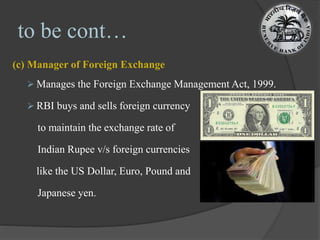
(c) Manager of Foreign Exchange
 Manages the Foreign Exchange Management Act, 1999.
 RBI buys and sells foreign currency
to maintain the exchange rate of
Indian Rupee v/s foreign currencies
like the US Dollar, Euro, Pound and
Japanese yen.
to be cont…
(d) Control of credit
 Credit control is a major weapon of the RBI used to control
Demand & Supply of money in the economy.
to be cont…
(e)Banker to the Government:
 performs merchant banking function for the central and the
state governments; also acts as their banker.
to be cont…
(f)Banker to banks:
 maintains banking accounts of all scheduled banks.
(g)Regulator and supervisor of the financial system:
 Prescribes broad parameters of banking operations within
which the country's banking and financial system
functions.
to be cont…
(h)Developmental role
 Performs a wide range of promotional functions to support
national objectives.
 This is one of the most critical role RBI plays in building the
country's financial structure.
(I)Lender of Last Resorts (LOLR)
 By offering loan to the commercial bank in situations of
emergency, the Central Bank ensures that:
 The banking system of the country does not suffer from any
set back.
 Money market remains stable
Objectives of RBI
 To manage the monetary and credit system of the country.
 To stabilizes internal and external value of rupee.
 For balanced and systematic development of banking in the country.
 For the development of organized money market in the country.
 For proper arrangement of agriculture finance.
 For proper arrangement of industrial finance.
 For proper management of public debts.
to be cont…
 To establish monetary relations with other countries of the world and
international financial institutions.
 For centralization of cash reserves of commercial banks.
 To maintain balance between the demand and supply of currency.
Monetary Authority:
 maintaining price stability while keeping in mind the objective of
growth.
Regulator and supervisor of the financial system:
 Objective: maintain public confidence in the system, protect
depositors' interest and provide cost-effective banking services to
the public.
to be cont…
Manager of Foreign Exchange
 to facilitate external trade and payment and promote orderly
development and maintenance of foreign exchange market in India.
Issuer of currency:
 to give the public adequate quantity of supplies of currency notes
and coins and in good quality.
Legal Framework
to be cont…
2.Other relevant Acts
 Negotiable Instruments Act, 1881
 Bankers' Books Evidence Act, 1891
 State Bank of India Act, 1955
 Companies Act, 1956/ Companies Act, 2013
 Securities Contract (Regulation) Act, 1956
 State Bank of India Subsidiary Banks) Act, 1959
 Deposit Insurance and Credit Guarantee
Corporation Act, 1961
 Banking Companies (Acquisition and Transfer of
Undertakings) Act, 1970
 Regional Rural Banks Act, 1976
Training Establishments
Setting up training colleges & centres to provide training to
banking personnel.
Has five training establishments
 Two, namely, College of Agricultural Banking and Reserve
Bank of India Staff College are part of the Reserve Bank
 Others are autonomous, such as, National Institute for Bank
Management, Indira Gandhi Institute for Development Research
(IGIDR), Institute for Development and Research in Banking
Technology (IDRBT)
Subsidiaries
 Deposit Insurance and Credit Guarantee Corporation of
India(DICGC)
 Bharatiya Reserve Bank Note Mudran Private
Limited(BRBNMPL)
 National Housing Bank(NHB)
Latest RBI presentation

Latest RBI presentation

  • 2.
    Establishment  The ReserveBank of India was established on April 1, 1935 in accordance with the provisions of the Reserve Bank of India Act, 1934.  The Central Office of the Reserve Bank was initially established in Calcutta but was permanently moved to Mumbai in 1937.  Though originally privately owned, since nationalisation in 1949, the Reserve Bank is fully owned by the Government of India.
  • 3.
    RBI Governor  UrjitPatel is the present and 24th governor of Reserve Bank of India. He was appointed on 4th september 2016 after Dr. Raghuram Govinda Rajan.
  • 4.
    History  Royal Commissionon Indian Currency and Finance, also known as Hilton-Young Commission was set up by British Government of India in 1920s.  In 1926, this commission had recommended the creation of a central bank in the country.  RBI started its operation from April 1, 1935 it was established via the RBI act 1934, so it is also known as a statutory body.
  • 5.
    Preamble The Preamble ofthe Reserve Bank of India describes the basic functions of the Reserve Bank as: "to regulate the issue of Bank notes and keeping of reserves with a view to securing monetary stability in India and generally to operate the currency and credit system of the country to its advantage; to have a modern monetary policy framework to meet the challenge of an increasingly complex economy, to maintain price stability while keeping in mind the objective of growth."
  • 6.
    Central Board  TheReserve Bank's affairs are governed by a central board of directors. The board is appointed by the Government of India in keeping with the Reserve Bank of India Act.  Appointed for a period of four years Central board of directors Official Directors Non-Official Directors
  • 7.
    Official Directors  Appointedfor Full-time  Governor and not more than four Deputy Governors Non Official Directors Nominated by Government:  ten Directors from various field  two government Official four Directors - one each from four local boards
  • 8.
    Financial Supervision The ReserveBank of India performs this function under the guidance of the Board for Financial Supervision (BFS). The Board was constituted in November 1994 as a committee of the Central Board of Directors of the Reserve Bank of India. Objective Primary objective of BFS is to undertake consolidated supervision of the financial sector comprising commercial banks, financial institutions and non-banking finance companies.
  • 9.
    Constitution The Board isconstituted by co-opting four Directors from the Central Board as members for a term of two years and is chaired by the Governor. The Deputy Governors of the Reserve Bank are ex-officio members. One Deputy Governor, usually, the Deputy Governor in charge of banking regulation and supervision, is nominated as the Vice Chairman of the Board. BFS meetings The Board is required to meet normally once every month. It considers inspection reports and other supervisory issues placed before it by the supervisory departments.
  • 10.
    to be cont… TheBFS oversees the functioning of Department of Banking Supervision (DBS), Department of Non-Banking Supervision (DNBS) and Financial Institutions Division (FID) and gives directions on the regulatory and supervisory Governor. Functions SomeDeputye initiatives taken by BFS incluse: i. Restucturing of the system of bank snspections. ii. Introduction of off-site surveillance, iii. Strengthening of the role of statutory audit. iv. Strengthening of the internal defences of supervised institutions.
  • 11.
    Local Boards One eachfor the four regions of the country in Mumbai, Calcutta, Chennai and New Delhi Membership:  consist of five members each  appointed by the Central Government  for a term of four years
  • 12.
    Offices & Branches Has 20 regional offices, most of them in state capitals and 11 Sub- offices.
  • 13.
    Formulation of MonetaryPolicy Issuer of currency Manager of Foreign Exchange Control of Credit Banker to Government Banker to Banks Regulator and Supervisor Development Role Lender of Last Resorts
  • 14.
    Main Functions (a) Formulationof monetary policy  Maintain price stability and ensuring adequate flow of credit in the economy.  Formulates, implements and monitors the monetary policy. Instruments of monetary policy Bank Rate Repo Rate Reverse Repo Rate CRR (Cash Reserve Ratio) SLR (Statutory liquidity Ratio)
  • 15.
    Repo Rate  Reporate is the rate at which commercial bank takes money from RBI for a period up to 90 days.  Amount: 0.5% of NDTL.  The present repo rate is 6%. Reverse Ratio Rate  It is rate at which banks gives it surplus money to RBI.  The present reverse repo rate is 5.75% Bank Rate  It is rate at which commercial bank takes money from RBI for a period more than 90 days.  It is rate at which RBI rediscount Bill of Exchange.  The present bank rate is 6.25%
  • 16.
    CRR(Cash Reserve Ratio) Cash Reserve Ratio (CRR) is the amount of Cash that the banks have to keep with RBI.  It is calculated on the basis of NDTL.  It is maintained in cash form.  The present CRR rate is 4%.  SLR(Statutory liquidity Rate)  It is an amount that a commercial bank has to keep with itself.  It is calculated on the basis of NDTL.  It is maintained in cash, gold, bonds and govt. securities form.  The present SLR rate is 19.5%.
  • 17.
    to be cont… (b)Issuer of currency:  Issues and exchanges or destroys currency and coins not fit for circulation.  To ensure adequate quantity of supplies of currency notes and coins of good quality.
  • 19.
    to be cont… (c)Manager of Foreign Exchange  Manages the Foreign Exchange Management Act, 1999.  RBI buys and sells foreign currency to maintain the exchange rate of Indian Rupee v/s foreign currencies like the US Dollar, Euro, Pound and Japanese yen.
  • 20.
    to be cont… (d)Control of credit  Credit control is a major weapon of the RBI used to control Demand & Supply of money in the economy.
  • 21.
    to be cont… (e)Bankerto the Government:  performs merchant banking function for the central and the state governments; also acts as their banker.
  • 22.
    to be cont… (f)Bankerto banks:  maintains banking accounts of all scheduled banks. (g)Regulator and supervisor of the financial system:  Prescribes broad parameters of banking operations within which the country's banking and financial system functions.
  • 23.
    to be cont… (h)Developmentalrole  Performs a wide range of promotional functions to support national objectives.  This is one of the most critical role RBI plays in building the country's financial structure. (I)Lender of Last Resorts (LOLR)  By offering loan to the commercial bank in situations of emergency, the Central Bank ensures that:  The banking system of the country does not suffer from any set back.  Money market remains stable
  • 24.
    Objectives of RBI To manage the monetary and credit system of the country.  To stabilizes internal and external value of rupee.  For balanced and systematic development of banking in the country.  For the development of organized money market in the country.  For proper arrangement of agriculture finance.  For proper arrangement of industrial finance.  For proper management of public debts.
  • 25.
    to be cont… To establish monetary relations with other countries of the world and international financial institutions.  For centralization of cash reserves of commercial banks.  To maintain balance between the demand and supply of currency. Monetary Authority:  maintaining price stability while keeping in mind the objective of growth. Regulator and supervisor of the financial system:  Objective: maintain public confidence in the system, protect depositors' interest and provide cost-effective banking services to the public.
  • 26.
    to be cont… Managerof Foreign Exchange  to facilitate external trade and payment and promote orderly development and maintenance of foreign exchange market in India. Issuer of currency:  to give the public adequate quantity of supplies of currency notes and coins and in good quality.
  • 27.
  • 28.
    to be cont… 2.Otherrelevant Acts  Negotiable Instruments Act, 1881  Bankers' Books Evidence Act, 1891  State Bank of India Act, 1955  Companies Act, 1956/ Companies Act, 2013  Securities Contract (Regulation) Act, 1956  State Bank of India Subsidiary Banks) Act, 1959  Deposit Insurance and Credit Guarantee Corporation Act, 1961  Banking Companies (Acquisition and Transfer of Undertakings) Act, 1970  Regional Rural Banks Act, 1976
  • 29.
    Training Establishments Setting uptraining colleges & centres to provide training to banking personnel. Has five training establishments  Two, namely, College of Agricultural Banking and Reserve Bank of India Staff College are part of the Reserve Bank  Others are autonomous, such as, National Institute for Bank Management, Indira Gandhi Institute for Development Research (IGIDR), Institute for Development and Research in Banking Technology (IDRBT)
  • 30.
    Subsidiaries  Deposit Insuranceand Credit Guarantee Corporation of India(DICGC)  Bharatiya Reserve Bank Note Mudran Private Limited(BRBNMPL)  National Housing Bank(NHB)