Psychoanalysis
     comd 312
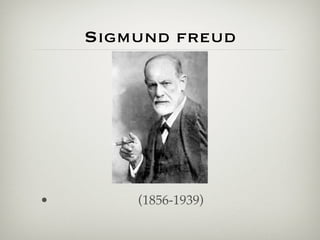
Sigmund freud


•       (1856-1939)
the unconscious


• In order to function in our lives we actively
  repress various desires, fears, memories, and
  fantasies. Hence, beneath our conscious, daily
  social interaction there exists a dynamic, active
  realm of forces of desire that is inaccessible to
  our rational logical selves.
the unconscious

• The unconscious is active in our
  dreams, slips of the tongue, and forms
  of artistic activity


• Talking cure: bringing the repressed
  materials of the unconscious to the
  surface.
the unconscious

• Film’s unconscious: Insofar as films
  deal with fantasies, they could be
  considered analogous to dreams and
  qualify as manifestations of the
  unconscious.
• unconscious of the filmmaker & the
  spectator
oedipus complex

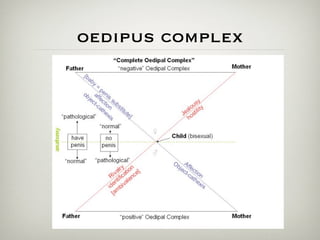
  Boy develops love for his mother
  = libidinal bond with the mother.
  -- This is tied to the fixation on the mother’s breast, its role
  as a source of nourishment, the mother as the font of love,
  caring, etc.
1.Parallel to this the boy begins to identify with his father,
  the figure parallel to him in terms of biological sex.
2.As a result of father’s appearance, the child gives up his
  love-desire for the mother. Repress his feelings for the
  mother (primal repression) because he fears father will
  punish him (castration).
oedipus complex
oedipus complex in film

• Formation of normative identities: what does
  it mean to be/come a man?


• How the male character channels his sexual
   desire away from his mother towards a
   ‘mother substitute’
• Establishment of a nuclear family: male hero /
   female obstacle
id, superego and ego

• Id (unconscious): basic drives. Acts as pleasure
  principle.
• Superego: The Super-ego strives to act in a socially
  appropriate manner, whereas the id just wants instant
  self-gratification. The Super-ego controls our sense of
  right and wrong and guilt.
• Ego: Separates what is real. It seeks to please the id’s
  drive in realistic ways. Balance between primitive
  drives and reality (defence mechanisms)
superego


1) Super-ego = moral conscience, self-disciplining mechanism; it operates by
producing a sense of guilt.

2) The super-ego is formed by a process Freud calls "introjection" = the
internalization of parental, especially paternal authority.
-- The authority of the father is assimilated by the son into his own psychic
constitution.

3) The super-ego is a form of mimesis, imitation of the father; but this
imitation also caries with it the prohibition of being exactly like the father.
4) The super-ego is the source of religious feelings: it is a substitute for the
lost father, just as for Freud "God" is a substitute for the lost father.
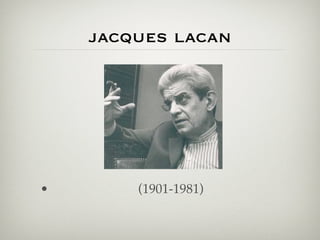
jacques lacan


•       (1901-1981)
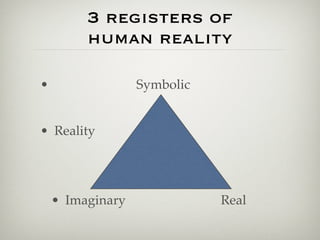
3 registers of
         human reality

•                 Symbolic


• Reality


    • Imaginary              Real
the imaginary


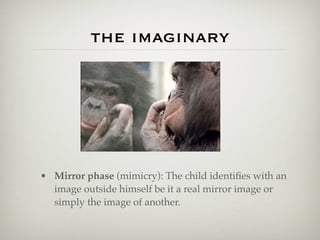
• Mirror phase (mimicry): The child identifies with an
  image outside himself be it a real mirror image or
  simply the image of another.
the imaginary


• The child’s captivation in the image. An
  identification with the other party.
• Mastery of one’s motor functions and entry into the
  human world
the imaginary


• Construction of Ego: the ego is
  constructed by an alienating
  identification, based on an initial lack of
  completeness in the body and nervous
  system.
the symbolic


• Entry into the symbolic universe
  (language)
• Symbolic pronouncements: “You look
  just like your father”, “What a bad boy
  you are!”
the symbolic


• The ideal: symbolic identification with a
  signifying element
• Unconscious: removes the subject from
  the world of the images. Give him a
  base in the symbolic world.
ideal ego and ego ideal


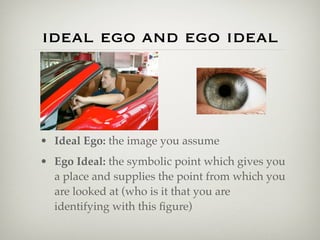
• Ideal Ego: the image you assume
• Ego Ideal: the symbolic point which gives you
  a place and supplies the point from which you
  are looked at (who is it that you are
  identifying with this figure)
the symbolic


• The unconscious is structured like a
  language
• Symptom: words trapped in the body
the name of the father


• Paternity: the symbolic structures
  which organize the relation of man to
  woman (by following these we become
  part of the symbolic network)
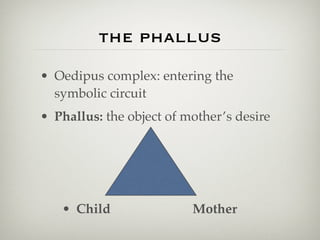
the phallus
• Oedipus complex: entering the
  symbolic circuit
• Phallus: the object of mother’s desire


   • Child                Mother
the phallus


• Child tries to be the phallus for the
  mother
• Castration: the renunciation of the
  sustained attempt to be the phallus for
  the mother
the phallus


• In the larger universe of symbolic
  world: the phallus will be the object
  promised to the child for use in the
  future.
desire and lack


• Demand is ultimately a demand for
  love, and for this reason unsatisfiable.
• Desire: takes up what has been eclipsed
  at the level of need (distortion)
• Wish: something you want consciously
the real

• That which isn’t symbolized, which is
  excluded from the symbolic.


• Reality: an amalgam of symbolic and
  imaginary (specular register + meaning).
• The real would represent what is excluded
  from reality
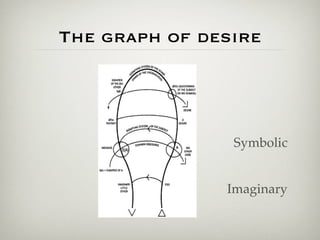
The graph of desire


    •           Symbolic


    •          Imaginary
Slavoj zizek
fantasy
• Imaginary-real axis (instead of
  imaginary-symbolic)
• Fantasy is not in opposition to reality
  but that which secures and anchors our
  sense of reality
• It is fantasy which makes reality’s brute
  facility (the Real) meaningful and
  liveable.
symptom

• Sustains, suspends and subverts the
  apparent meaning or logic of an event
• Mechanism of gender imbalance:
 • Classical Hollywood: gender sustains the
   film (i.e. woman as objects traded between
   men, possessed by the look)
 • film noir: femme fatale announce the agony of
   classical patriarchy (subversion)
drives

• The regime of the brothers: with the
  ‘death’ of the totemic father social
  power reconstitutes itself around the
  ‘regime of the brother’, held together by
  mutual implication in crime, bonded
  through acts of violence, and sustained
  by rituals of humiliation.
drives

• Desire-creatures: live under the threat
  of castration (for them desire is a
  function of lack, and lack can be ‘filled’
  by a fetish-formation)
• Drive-creatures: are not subject to
  desire: they go on regardless, they are
  unstoppable, unkillable, because they
  embody the death drive.
‘enjoying superego’


• The social realm: authoritarian-without-
  authority: without the traditional
  legitimacy of the symbolic as manifest
  (‘submission to the law of castration’)
the ethics of guilt
• The superego orders you to enjoy doing
  what you have to do:
• The categorical imperative (Kant): “You
  can do your duty, because you must do
  it”
• Superego: “You must do your duty,
  because you can” (seem to offer a free
  choice)

Film Theory - COMD 322 (Psychoanalysis)

  • 1.
  • 2.
    Sigmund freud • (1856-1939)
  • 3.
    the unconscious • Inorder to function in our lives we actively repress various desires, fears, memories, and fantasies. Hence, beneath our conscious, daily social interaction there exists a dynamic, active realm of forces of desire that is inaccessible to our rational logical selves.
  • 4.
    the unconscious • Theunconscious is active in our dreams, slips of the tongue, and forms of artistic activity • Talking cure: bringing the repressed materials of the unconscious to the surface.
  • 5.
    the unconscious • Film’sunconscious: Insofar as films deal with fantasies, they could be considered analogous to dreams and qualify as manifestations of the unconscious. • unconscious of the filmmaker & the spectator
  • 6.
    oedipus complex Boy develops love for his mother = libidinal bond with the mother. -- This is tied to the fixation on the mother’s breast, its role as a source of nourishment, the mother as the font of love, caring, etc. 1.Parallel to this the boy begins to identify with his father, the figure parallel to him in terms of biological sex. 2.As a result of father’s appearance, the child gives up his love-desire for the mother. Repress his feelings for the mother (primal repression) because he fears father will punish him (castration).
  • 7.
  • 8.
    oedipus complex infilm • Formation of normative identities: what does it mean to be/come a man? • How the male character channels his sexual desire away from his mother towards a ‘mother substitute’ • Establishment of a nuclear family: male hero / female obstacle
  • 9.
    id, superego andego • Id (unconscious): basic drives. Acts as pleasure principle. • Superego: The Super-ego strives to act in a socially appropriate manner, whereas the id just wants instant self-gratification. The Super-ego controls our sense of right and wrong and guilt. • Ego: Separates what is real. It seeks to please the id’s drive in realistic ways. Balance between primitive drives and reality (defence mechanisms)
  • 10.
    superego 1) Super-ego =moral conscience, self-disciplining mechanism; it operates by producing a sense of guilt. 2) The super-ego is formed by a process Freud calls "introjection" = the internalization of parental, especially paternal authority. -- The authority of the father is assimilated by the son into his own psychic constitution. 3) The super-ego is a form of mimesis, imitation of the father; but this imitation also caries with it the prohibition of being exactly like the father. 4) The super-ego is the source of religious feelings: it is a substitute for the lost father, just as for Freud "God" is a substitute for the lost father.
  • 11.
    jacques lacan • (1901-1981)
  • 12.
    3 registers of human reality • Symbolic • Reality • Imaginary Real
  • 13.
    the imaginary • Mirrorphase (mimicry): The child identifies with an image outside himself be it a real mirror image or simply the image of another.
  • 14.
    the imaginary • Thechild’s captivation in the image. An identification with the other party. • Mastery of one’s motor functions and entry into the human world
  • 15.
    the imaginary • Constructionof Ego: the ego is constructed by an alienating identification, based on an initial lack of completeness in the body and nervous system.
  • 16.
    the symbolic • Entryinto the symbolic universe (language) • Symbolic pronouncements: “You look just like your father”, “What a bad boy you are!”
  • 17.
    the symbolic • Theideal: symbolic identification with a signifying element • Unconscious: removes the subject from the world of the images. Give him a base in the symbolic world.
  • 18.
    ideal ego andego ideal • Ideal Ego: the image you assume • Ego Ideal: the symbolic point which gives you a place and supplies the point from which you are looked at (who is it that you are identifying with this figure)
  • 19.
    the symbolic • Theunconscious is structured like a language • Symptom: words trapped in the body
  • 20.
    the name ofthe father • Paternity: the symbolic structures which organize the relation of man to woman (by following these we become part of the symbolic network)
  • 21.
    the phallus • Oedipuscomplex: entering the symbolic circuit • Phallus: the object of mother’s desire • Child Mother
  • 22.
    the phallus • Childtries to be the phallus for the mother • Castration: the renunciation of the sustained attempt to be the phallus for the mother
  • 23.
    the phallus • Inthe larger universe of symbolic world: the phallus will be the object promised to the child for use in the future.
  • 24.
    desire and lack •Demand is ultimately a demand for love, and for this reason unsatisfiable. • Desire: takes up what has been eclipsed at the level of need (distortion) • Wish: something you want consciously
  • 25.
    the real • Thatwhich isn’t symbolized, which is excluded from the symbolic. • Reality: an amalgam of symbolic and imaginary (specular register + meaning). • The real would represent what is excluded from reality
  • 26.
    The graph ofdesire • Symbolic • Imaginary
  • 27.
  • 28.
    fantasy • Imaginary-real axis(instead of imaginary-symbolic) • Fantasy is not in opposition to reality but that which secures and anchors our sense of reality • It is fantasy which makes reality’s brute facility (the Real) meaningful and liveable.
  • 29.
    symptom • Sustains, suspendsand subverts the apparent meaning or logic of an event • Mechanism of gender imbalance: • Classical Hollywood: gender sustains the film (i.e. woman as objects traded between men, possessed by the look) • film noir: femme fatale announce the agony of classical patriarchy (subversion)
  • 30.
    drives • The regimeof the brothers: with the ‘death’ of the totemic father social power reconstitutes itself around the ‘regime of the brother’, held together by mutual implication in crime, bonded through acts of violence, and sustained by rituals of humiliation.
  • 31.
    drives • Desire-creatures: liveunder the threat of castration (for them desire is a function of lack, and lack can be ‘filled’ by a fetish-formation) • Drive-creatures: are not subject to desire: they go on regardless, they are unstoppable, unkillable, because they embody the death drive.
  • 32.
    ‘enjoying superego’ • Thesocial realm: authoritarian-without- authority: without the traditional legitimacy of the symbolic as manifest (‘submission to the law of castration’)
  • 33.
    the ethics ofguilt • The superego orders you to enjoy doing what you have to do: • The categorical imperative (Kant): “You can do your duty, because you must do it” • Superego: “You must do your duty, because you can” (seem to offer a free choice)