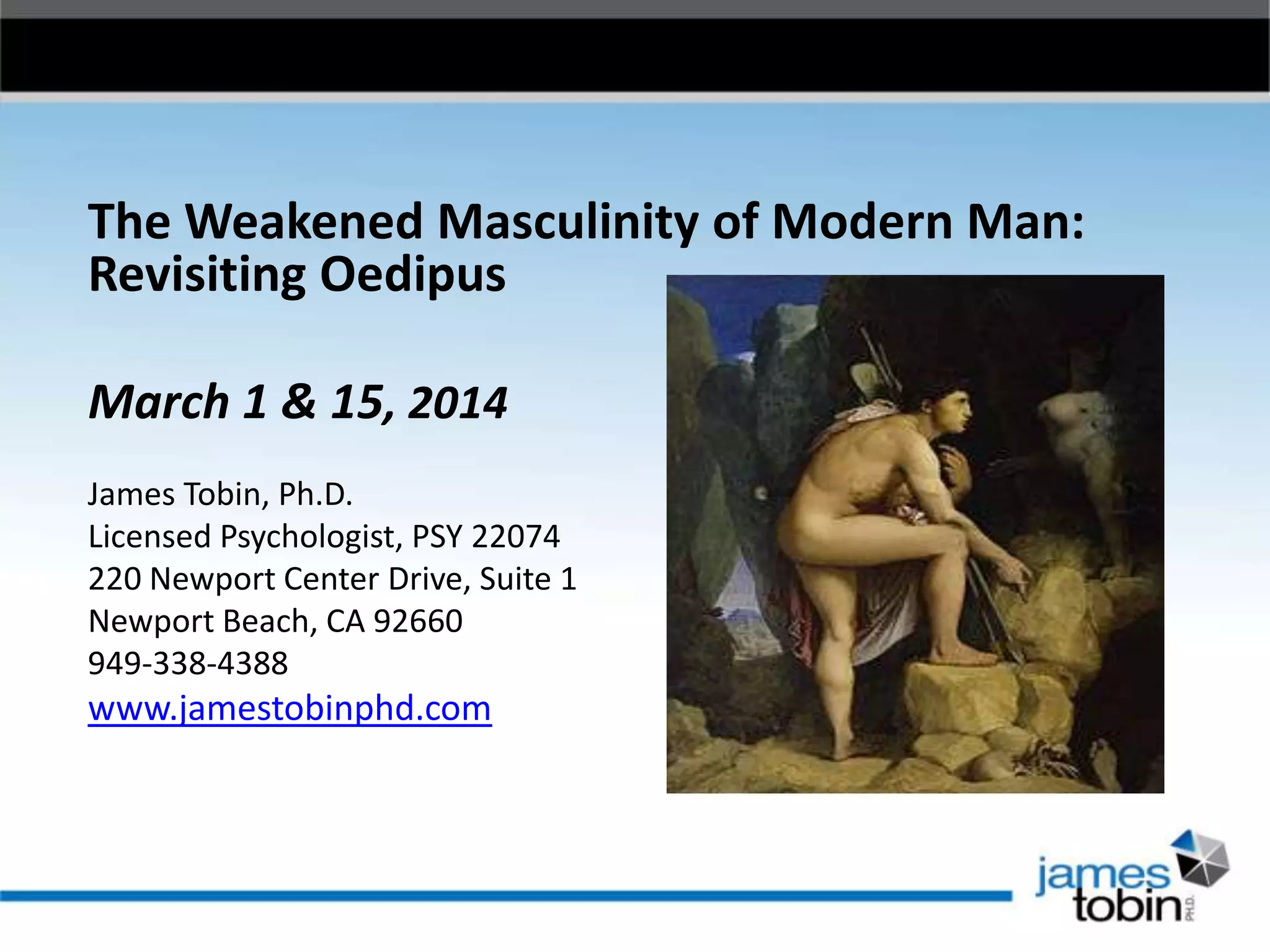

The Weakened Masculinity of Modern Man:
Revisiting Oedipus
March 1 & 15, 2014
James Tobin, Ph.D.
Licensed Psychologist, PSY 22074
220 Newport Center Drive, Suite 1
Newport Beach, CA 92660
949-338-4388
www.jamestobinphd.com
Oedipus in Mythology
• Oedipus, in Greek mythology (Sophocles), was
the king of Thebes who unwittingly killed his
father (King Laius) and married his mother
(Jocasta).
2
Oedipus in Mythology
• Laius, king of Thebes, was warned by an oracle that his
son would slay him.
• Accordingly, when his wife, Jocasta, bore a son, he
exposed the baby on Mt. Cithaeron, first pinning his
ankles together (hence the name Oedipus, meaning
Swell-Foot).
• A shepherd took pity on the infant, who was adopted
by King Polybus of Corinth and his wife and was
brought up as their son.
• In early manhood Oedipus visited Delphi and upon
learning that he was fated to kill his father and marry
his mother, he resolved never to return to Corinth.
3
Oedipus in Mythology
• Horrified, Oedipus fled Corinth and, at a crossroads
while traveling toward Theses, Oedipus met Laius,
quarreled and killed him (not knowing he was his
father).
• Continuing on his way, Oedipus found Thebes plagued
by the Sphinx, who put a riddle to all passersby and
destroyed those who could not answer. Oedipus solved
the riddle, and the Sphinx killed herself. In reward, he
received the throne of Thebes and the hand of the
widowed queen, his mother, Jocasta.
• They had four children: Eteocles, Polyneices, Antigone,
and Ismene.
4
Oedipus in Mythology
• Later, when the truth became known about the
relationship between Oedipus and Jocasta,
Jocasta committed suicide.
• Some versions indicate that Oedipus apparently
continued to rule at Thebes until his death.
According to another version, after Jocasta’s
suicide Oedipus blinded himself, went into exile,
accompanied by Antigone and Ismene, leaving his
brother-in-law Creon as regent. Oedipus died at
Colonus near Athens.
5
Interpretation of Dreams (1899)
• Freud chose the term Oedipus complex to
designate a son’s feeling of love toward his
mother and jealousy and hate toward his
father, although these were not emotions that
motivated Oedipus’ actions or determined his
character in any ancient version of the story.
6
The Electra Complex
• There is a female equivalent, known as the
Electra complex, but Freud was more
concerned with what he termed female "penis
envy.”
7
Freud’s Oedipus
• Freud viewed the Oedipus complex to be a
crucial stage in the normal developmental
process.
• Freud theorized that all small boys select their
mother as their primary object of desire.
• They subconsciously wish to usurp their
fathers and become their mothers' lover. The
boy has considerable jealously and anger
towards his father.
8
Freud’s Oedipus
• Essentially, the boy feels like he is in competition with
his father for possession of his mother. He views his
father as a rival for her attentions and affections.
• Typically, these desires emerge between the ages of
three and five, when a boy is in what Freud defined as
the "phallic" stage of development.
• Around three to five years of age, in consequence of
his approach and attainment of genital sexuality (which
is also to say, object-related sexuality), the child
experiences sexual desire for his parents (the cause of
all restriction and fear to act on one’s wishes).
9
The Positive Oedipal Situation
• In the positive Oedipal situation, the male
child feels desire toward his mother, and
jealously regards the father as a rival; Freud
assumed that most children had direct
knowledge of this rivalry through witness of
the primal scene of intercourse, either
between their parents, or from another
source (such as the sight of animal
copulation).
10
The Positive Oedipal Situation
• Freud also assumed that the child had by this
time become aware of the anatomical difference
between the sexes, and from this discovery,
inferred the threat (or in the case of the female,
the fantasized "fact") of castration—the loss of
the penis as punishment for his incestuous
wishes.
• Because the child suspects that acting on these
feelings would lead to danger, desires are
repressed, leading to anxiety.
11
Resolving the Oedipus Complex
• In order to develop into a successful adult with a health
identity, the child must identify with the same-sex parent in
order to resolve the conflict.
• Freud suggested that while the primal id wants to eliminate
the father, the more realistic ego knows that the father is
much stronger.
• According to Freud, the boy then experiences what he called
castration anxiety -- a fear of both literal and figurative
emasculation.
• Freud believed that as the child becomes aware of the
physical differences between males and females, he assumes
that the female's penis has been removed and that his father
will also castrate him as a punishment for desiring his mother.
12
Resolving the Oedipus Complex
• In order to resolve the conflict, the boy then
identifies with his father. It is at this point that
the super-ego is formed. The super-ego
becomes a sort of inner moral authority, an
internalization of the father figure that strives
to suppress the urges of the id and make the
ego act upon these idealistic standards.
13
Resolving the Oedipus Complex
• In The Ego and the Id, Freud explained, "The super-ego
retains the character of the father, while the more
powerful the Oedipus complex was and the more
rapidly it succumbed to repression (under the
influence of authority, religious teaching, schooling
and reading), the stricter will be the domination of
the super-ego over the ego later on—in the form of
conscience or perhaps of an unconscious sense of
guilt.“
• The development of the super-ego prevents the
continuation of incestuously-oriented relationships.
14
Resolving the Oedipus Complex
• The conjoining in the boy’s mind of these factors
(his rivalry with his father for his mother's love
and the threat of castration) awakens in the
male child an intense anxiety, and set in motion
the repression of the child's incestuous desires,
and a subsequent switch in identification from
the now-dangerous mother to the powerful and
punishing father.
• Significantly, the male child did not at the same
time renounce his sexual desire for the opposite
sex.
15
Resolving the Oedipus Complex
• As a result of the dramatic repression of the
Oedipus complex, the child unconsciously
internalized the Oedipal situation, and especially
the punitive idea of the father as a way to
ensure continued protection from castration.
• These new internalized others collectively
became the new super-ego, which henceforth
governed the child's object-oriented actions, and
superintended his sense of morality.
16
The Negative Oedipal Situation
• Freud also suggested the presence in both
genders of a negative Oedipus complex,
involving the opposite series of identifications.
• In the male child, the father became the object of
his (passive) sexual desire, fostering a sense of
identification with his mother who was the
father's sexual object.
• This constellation, too, required repression, and if
this was insufficiently accomplished, Freud
believed, it could serve as an important
foundation for homosexual object choice.
17
The Negative Oedipal Situation
• Much of the rationale for the Oedipal struggle
is rooted in the sexual, animal child's
acceptance of the moral order of "civilized"
culture, and it is often on this basis that it is
criticized. Nevertheless, Freud believed that
the Oedipus stage was central, not only
because of its implications for the infant's
psycho-sexual development, but also because
it marked the infant's attainment of human
subjectivity.
18
The Negative Oedipal Situation
• With the Oedipus conflict the child also attained
the capacity for "triadic relationships" (in which
the child was able to regard others not simply
from his own frame of reference, but as existing
outside of and independent of his needs and
wishes—and hence different from and at odds
with his own) and with it the complex capacity
for symbolism that was the precondition for
language and for thought itself, as well as for
the free association that was at the heart of
analytic work.
19
Sexual Awakening
• At some point, the child realizes that there is a
difference between their mother and their father.
• Around the same time they realize that they are
more alike one than the other. Thus, the child
acquires gender.
• The child may also form some kind of erotic
attachment to the parent of the opposite sex.
While their understanding of the full sexual act
may be questioned, some kind of primitive
physical sensations are felt when they regard and
think about the parent in question.
20
Jealousies
• The primitive desire for the one parent may
also awaken in the child a jealous motivation
to exclude the other parent.
• Transferring of affections may also occur as
the child seeks to become independent and
escape a perceived 'engulfing mother'.
• A critical point of awakening is where the child
realizes that the mother has affections for
others besides itself.
21
Jealousies
• Primitive jealousies are not necessarily
constrained to the child and both parents may
join in the game, both in terms of competing with
each other for the child's affections and also
competing with the child for the affection of the
other parent.
• Note that opposition to parents may not
necessarily be sexually-based -- this can also be a
part of the struggle to assert one's identity and
rebellion against parental control.
22
The Process of Transitioning
• A critical aspect of the Oedipal stage is loosening
of the ties to the mother of vulnerability,
dependence and intimacy.
• This is a natural part of the child becoming more
independent and is facilitated by the realization
that the mother desires more than just the child.
• The Oedipal move blocks the routes of sexual
and identification love directed toward the
mother.
23
The Process of Transitioning
• She becomes a separate object, removed from his
ideal self. Thus she can be the subject of object
love.
• This separation and externalization of love allows
a transition away from the narcissism of earlier
stages. Oedipus is an escape from early fantasy
of omnipotence.
• The father effectively says 'You must be like me --
you may not be like the mother -- you must wait
to love her, as I do.' The child thus also learns to
wait and share attention.
24
The Process of Transitioning
• The boy thus returns to the mother as a separate
individual.
• That separation may be emphasized with scorn
and a sense of mastery over women, which may
become a source of male denigration of women.
• Women become separated reminders of lost and
forbidden unity. Their unique attributes, from
softness to general femininity are, in
consequence, also lost and must be given up as a
part of the distancing process.
25
The Process of Transitioning
• While the boy becomes separated from the mother, it
is a long time before he can be independent of her.
Separation leads to unavailability and hence
the scarcity principle takes effect, increasing desire.
Women thus create a tension in boys between a lost
paradise and dangerous sirens. Excessive separation
leads to a sense of helplessness that can in turn lead
to patterns of idealized control and self-sufficiency.
• Women become thus both desired and feared.
• The symbolic phallus becomes a means of protection
for the boy and the rituals of mastery used to cover up
feelings of loss.
26
The Process of Transitioning
• The relationship with mother ultimately may reflect
the tension of love and difference the boy feels.
• The relationship thus may return to a closer mother-
son tie, where the point of healthy distance is a
dynamically negotiated position, such that comforting
is available but is required only upon occasion.
• Oedipus represents responsibility and guilt, in contrast
to Narcissus, who represents self-involvement and
denial of reality. Oedipus is an escape from early
fantasy of omnipotence.
27
Girls and the Electra Complex
• Most writings about the Oedipal stage focus largely or exclusively
on boys, who are seen to have a particular problem as they start
with an attachment to the Mother that they have to relinquish both
from the point of view of individual independence and especially as
a result of the social incest taboo which forbids excessively-close in-
family relationships.
• The Electra complex, identified by Carl Jung, occurs where a triangle
of mother-father-daughter plays out is not a part of traditional
psychoanalysis. It is neither a direct mirror image of Oedipus, as the
start position is female-female connection.
• Jung suggested that when the girl discovers she lacks a penis In
the female child, the discovery of the "reality" of her castration
led to penis envy, and with it a hatred of her mother, a sense of
rageful betrayal at having been left unmade, unfinished.
28
Girls and the Electra Complex
• In her anger, Freud postulated that she would turn
toward the father, and seek from him a penis—his
penis—and later a baby; she imagines she will gain
one if he makes her pregnant, and so moves
emotionally closer to him. She thus resents her
mother who she believe castrated her.
• The father symbolizes attractive power and a
potentially hazardous male-female relationship is
formed, with predictable jealousies.
• The dangers of incestuous abuse add, and perhaps
develop, the female position of siren temptation.
29
Girls and the Electra Complex
• Girls, as well as boys, need to find independence and their
separation from the mother is a matter of creating a
separate femininity. This is not as strong a separation as
boys and girls can sustain a closer female-female
relationships with the mothers. This perhaps explains
something of why relationships with others is a more
important part of a female life than it is for a male.
• The father does provide a haven from female-female
jealousies, and so a healthy father-daughter relationship
may be built, that also includes appropriate distance. As
with mother-son, once the incest taboos are established, a
uniquely satisfying opposite-sex relationship can be built,
although secret desires for the father can result in the girl
feeling some guilt about the relationship.
30
Girls and the Electra Complex
• Freud believed a girl's sexuality was initially dominated by
her clitoris, her "little penis." Only with the move to vaginal
sexuality was a woman's sexual maturation complete.
• Freud himself, however, remained unconvinced as to the
motives for this change.
• The "phallocentric" nature of the Oedipus complex had far-
reaching consequences for female development.
• Without the threat of castration, the girl's movement
toward heterosexual object choice is not characterized by
the same intensity of repression as the male's, and
consequently, Freud believed, the super-ego development
that was the legacy of the Oedipus complex was less
developed in girls.
31
Hans Loewald
• Among the most vital of these contributions
have been those of Hans W. Loewald, who
came to regard the Oedipal conflict as an
unending struggle perpetuated in the
superego against the
internalized imagos (unconscious
representatives) of one's parents.
32
Pragmatic Problems in Everyday Life
(1) The boy cannot desire the mother, and/or the mother cannot
tolerate the boy’s desire.
(2) The mother does not recognize the boy as formidable (his penis as
worthy), and so the boy realizes too early that he is unable to
compete for the mother.
(3) The father does not enter and pull the boy away from mother; the
mother engulfs the boy.
(4) The boy cannot identify with the father, and so the boy is left
caught between genders, and between narcissism and
guilt/morality.
(5) The desire for mother and a harsh resolution of the Oedipus
complex may result in an intensive desire for and fear of women,
leading to issues of control, sabotage, abuse, violence, and child-
like attitudes and behaviors.
33
James Tobin, Ph.D.
Licensed Psychologist
PSY 22074
220 Newport Center Drive,
Suite 1
Newport Beach, CA 92660
949-338-4388
Email: jt@jamestobinphd.com
Website: www.jamestobinphd.com

Revisiting Oedipus: The Weakened Masculinity of Modern Man

  • 1.
    The Weakened Masculinityof Modern Man: Revisiting Oedipus March 1 & 15, 2014 James Tobin, Ph.D. Licensed Psychologist, PSY 22074 220 Newport Center Drive, Suite 1 Newport Beach, CA 92660 949-338-4388 www.jamestobinphd.com
  • 2.
    Oedipus in Mythology •Oedipus, in Greek mythology (Sophocles), was the king of Thebes who unwittingly killed his father (King Laius) and married his mother (Jocasta). 2
  • 3.
    Oedipus in Mythology •Laius, king of Thebes, was warned by an oracle that his son would slay him. • Accordingly, when his wife, Jocasta, bore a son, he exposed the baby on Mt. Cithaeron, first pinning his ankles together (hence the name Oedipus, meaning Swell-Foot). • A shepherd took pity on the infant, who was adopted by King Polybus of Corinth and his wife and was brought up as their son. • In early manhood Oedipus visited Delphi and upon learning that he was fated to kill his father and marry his mother, he resolved never to return to Corinth. 3
  • 4.
    Oedipus in Mythology •Horrified, Oedipus fled Corinth and, at a crossroads while traveling toward Theses, Oedipus met Laius, quarreled and killed him (not knowing he was his father). • Continuing on his way, Oedipus found Thebes plagued by the Sphinx, who put a riddle to all passersby and destroyed those who could not answer. Oedipus solved the riddle, and the Sphinx killed herself. In reward, he received the throne of Thebes and the hand of the widowed queen, his mother, Jocasta. • They had four children: Eteocles, Polyneices, Antigone, and Ismene. 4
  • 5.
    Oedipus in Mythology •Later, when the truth became known about the relationship between Oedipus and Jocasta, Jocasta committed suicide. • Some versions indicate that Oedipus apparently continued to rule at Thebes until his death. According to another version, after Jocasta’s suicide Oedipus blinded himself, went into exile, accompanied by Antigone and Ismene, leaving his brother-in-law Creon as regent. Oedipus died at Colonus near Athens. 5
  • 6.
    Interpretation of Dreams(1899) • Freud chose the term Oedipus complex to designate a son’s feeling of love toward his mother and jealousy and hate toward his father, although these were not emotions that motivated Oedipus’ actions or determined his character in any ancient version of the story. 6
  • 7.
    The Electra Complex •There is a female equivalent, known as the Electra complex, but Freud was more concerned with what he termed female "penis envy.” 7
  • 8.
    Freud’s Oedipus • Freudviewed the Oedipus complex to be a crucial stage in the normal developmental process. • Freud theorized that all small boys select their mother as their primary object of desire. • They subconsciously wish to usurp their fathers and become their mothers' lover. The boy has considerable jealously and anger towards his father. 8
  • 9.
    Freud’s Oedipus • Essentially,the boy feels like he is in competition with his father for possession of his mother. He views his father as a rival for her attentions and affections. • Typically, these desires emerge between the ages of three and five, when a boy is in what Freud defined as the "phallic" stage of development. • Around three to five years of age, in consequence of his approach and attainment of genital sexuality (which is also to say, object-related sexuality), the child experiences sexual desire for his parents (the cause of all restriction and fear to act on one’s wishes). 9
  • 10.
    The Positive OedipalSituation • In the positive Oedipal situation, the male child feels desire toward his mother, and jealously regards the father as a rival; Freud assumed that most children had direct knowledge of this rivalry through witness of the primal scene of intercourse, either between their parents, or from another source (such as the sight of animal copulation). 10
  • 11.
    The Positive OedipalSituation • Freud also assumed that the child had by this time become aware of the anatomical difference between the sexes, and from this discovery, inferred the threat (or in the case of the female, the fantasized "fact") of castration—the loss of the penis as punishment for his incestuous wishes. • Because the child suspects that acting on these feelings would lead to danger, desires are repressed, leading to anxiety. 11
  • 12.
    Resolving the OedipusComplex • In order to develop into a successful adult with a health identity, the child must identify with the same-sex parent in order to resolve the conflict. • Freud suggested that while the primal id wants to eliminate the father, the more realistic ego knows that the father is much stronger. • According to Freud, the boy then experiences what he called castration anxiety -- a fear of both literal and figurative emasculation. • Freud believed that as the child becomes aware of the physical differences between males and females, he assumes that the female's penis has been removed and that his father will also castrate him as a punishment for desiring his mother. 12
  • 13.
    Resolving the OedipusComplex • In order to resolve the conflict, the boy then identifies with his father. It is at this point that the super-ego is formed. The super-ego becomes a sort of inner moral authority, an internalization of the father figure that strives to suppress the urges of the id and make the ego act upon these idealistic standards. 13
  • 14.
    Resolving the OedipusComplex • In The Ego and the Id, Freud explained, "The super-ego retains the character of the father, while the more powerful the Oedipus complex was and the more rapidly it succumbed to repression (under the influence of authority, religious teaching, schooling and reading), the stricter will be the domination of the super-ego over the ego later on—in the form of conscience or perhaps of an unconscious sense of guilt.“ • The development of the super-ego prevents the continuation of incestuously-oriented relationships. 14
  • 15.
    Resolving the OedipusComplex • The conjoining in the boy’s mind of these factors (his rivalry with his father for his mother's love and the threat of castration) awakens in the male child an intense anxiety, and set in motion the repression of the child's incestuous desires, and a subsequent switch in identification from the now-dangerous mother to the powerful and punishing father. • Significantly, the male child did not at the same time renounce his sexual desire for the opposite sex. 15
  • 16.
    Resolving the OedipusComplex • As a result of the dramatic repression of the Oedipus complex, the child unconsciously internalized the Oedipal situation, and especially the punitive idea of the father as a way to ensure continued protection from castration. • These new internalized others collectively became the new super-ego, which henceforth governed the child's object-oriented actions, and superintended his sense of morality. 16
  • 17.
    The Negative OedipalSituation • Freud also suggested the presence in both genders of a negative Oedipus complex, involving the opposite series of identifications. • In the male child, the father became the object of his (passive) sexual desire, fostering a sense of identification with his mother who was the father's sexual object. • This constellation, too, required repression, and if this was insufficiently accomplished, Freud believed, it could serve as an important foundation for homosexual object choice. 17
  • 18.
    The Negative OedipalSituation • Much of the rationale for the Oedipal struggle is rooted in the sexual, animal child's acceptance of the moral order of "civilized" culture, and it is often on this basis that it is criticized. Nevertheless, Freud believed that the Oedipus stage was central, not only because of its implications for the infant's psycho-sexual development, but also because it marked the infant's attainment of human subjectivity. 18
  • 19.
    The Negative OedipalSituation • With the Oedipus conflict the child also attained the capacity for "triadic relationships" (in which the child was able to regard others not simply from his own frame of reference, but as existing outside of and independent of his needs and wishes—and hence different from and at odds with his own) and with it the complex capacity for symbolism that was the precondition for language and for thought itself, as well as for the free association that was at the heart of analytic work. 19
  • 20.
    Sexual Awakening • Atsome point, the child realizes that there is a difference between their mother and their father. • Around the same time they realize that they are more alike one than the other. Thus, the child acquires gender. • The child may also form some kind of erotic attachment to the parent of the opposite sex. While their understanding of the full sexual act may be questioned, some kind of primitive physical sensations are felt when they regard and think about the parent in question. 20
  • 21.
    Jealousies • The primitivedesire for the one parent may also awaken in the child a jealous motivation to exclude the other parent. • Transferring of affections may also occur as the child seeks to become independent and escape a perceived 'engulfing mother'. • A critical point of awakening is where the child realizes that the mother has affections for others besides itself. 21
  • 22.
    Jealousies • Primitive jealousiesare not necessarily constrained to the child and both parents may join in the game, both in terms of competing with each other for the child's affections and also competing with the child for the affection of the other parent. • Note that opposition to parents may not necessarily be sexually-based -- this can also be a part of the struggle to assert one's identity and rebellion against parental control. 22
  • 23.
    The Process ofTransitioning • A critical aspect of the Oedipal stage is loosening of the ties to the mother of vulnerability, dependence and intimacy. • This is a natural part of the child becoming more independent and is facilitated by the realization that the mother desires more than just the child. • The Oedipal move blocks the routes of sexual and identification love directed toward the mother. 23
  • 24.
    The Process ofTransitioning • She becomes a separate object, removed from his ideal self. Thus she can be the subject of object love. • This separation and externalization of love allows a transition away from the narcissism of earlier stages. Oedipus is an escape from early fantasy of omnipotence. • The father effectively says 'You must be like me -- you may not be like the mother -- you must wait to love her, as I do.' The child thus also learns to wait and share attention. 24
  • 25.
    The Process ofTransitioning • The boy thus returns to the mother as a separate individual. • That separation may be emphasized with scorn and a sense of mastery over women, which may become a source of male denigration of women. • Women become separated reminders of lost and forbidden unity. Their unique attributes, from softness to general femininity are, in consequence, also lost and must be given up as a part of the distancing process. 25
  • 26.
    The Process ofTransitioning • While the boy becomes separated from the mother, it is a long time before he can be independent of her. Separation leads to unavailability and hence the scarcity principle takes effect, increasing desire. Women thus create a tension in boys between a lost paradise and dangerous sirens. Excessive separation leads to a sense of helplessness that can in turn lead to patterns of idealized control and self-sufficiency. • Women become thus both desired and feared. • The symbolic phallus becomes a means of protection for the boy and the rituals of mastery used to cover up feelings of loss. 26
  • 27.
    The Process ofTransitioning • The relationship with mother ultimately may reflect the tension of love and difference the boy feels. • The relationship thus may return to a closer mother- son tie, where the point of healthy distance is a dynamically negotiated position, such that comforting is available but is required only upon occasion. • Oedipus represents responsibility and guilt, in contrast to Narcissus, who represents self-involvement and denial of reality. Oedipus is an escape from early fantasy of omnipotence. 27
  • 28.
    Girls and theElectra Complex • Most writings about the Oedipal stage focus largely or exclusively on boys, who are seen to have a particular problem as they start with an attachment to the Mother that they have to relinquish both from the point of view of individual independence and especially as a result of the social incest taboo which forbids excessively-close in- family relationships. • The Electra complex, identified by Carl Jung, occurs where a triangle of mother-father-daughter plays out is not a part of traditional psychoanalysis. It is neither a direct mirror image of Oedipus, as the start position is female-female connection. • Jung suggested that when the girl discovers she lacks a penis In the female child, the discovery of the "reality" of her castration led to penis envy, and with it a hatred of her mother, a sense of rageful betrayal at having been left unmade, unfinished. 28
  • 29.
    Girls and theElectra Complex • In her anger, Freud postulated that she would turn toward the father, and seek from him a penis—his penis—and later a baby; she imagines she will gain one if he makes her pregnant, and so moves emotionally closer to him. She thus resents her mother who she believe castrated her. • The father symbolizes attractive power and a potentially hazardous male-female relationship is formed, with predictable jealousies. • The dangers of incestuous abuse add, and perhaps develop, the female position of siren temptation. 29
  • 30.
    Girls and theElectra Complex • Girls, as well as boys, need to find independence and their separation from the mother is a matter of creating a separate femininity. This is not as strong a separation as boys and girls can sustain a closer female-female relationships with the mothers. This perhaps explains something of why relationships with others is a more important part of a female life than it is for a male. • The father does provide a haven from female-female jealousies, and so a healthy father-daughter relationship may be built, that also includes appropriate distance. As with mother-son, once the incest taboos are established, a uniquely satisfying opposite-sex relationship can be built, although secret desires for the father can result in the girl feeling some guilt about the relationship. 30
  • 31.
    Girls and theElectra Complex • Freud believed a girl's sexuality was initially dominated by her clitoris, her "little penis." Only with the move to vaginal sexuality was a woman's sexual maturation complete. • Freud himself, however, remained unconvinced as to the motives for this change. • The "phallocentric" nature of the Oedipus complex had far- reaching consequences for female development. • Without the threat of castration, the girl's movement toward heterosexual object choice is not characterized by the same intensity of repression as the male's, and consequently, Freud believed, the super-ego development that was the legacy of the Oedipus complex was less developed in girls. 31
  • 32.
    Hans Loewald • Amongthe most vital of these contributions have been those of Hans W. Loewald, who came to regard the Oedipal conflict as an unending struggle perpetuated in the superego against the internalized imagos (unconscious representatives) of one's parents. 32
  • 33.
    Pragmatic Problems inEveryday Life (1) The boy cannot desire the mother, and/or the mother cannot tolerate the boy’s desire. (2) The mother does not recognize the boy as formidable (his penis as worthy), and so the boy realizes too early that he is unable to compete for the mother. (3) The father does not enter and pull the boy away from mother; the mother engulfs the boy. (4) The boy cannot identify with the father, and so the boy is left caught between genders, and between narcissism and guilt/morality. (5) The desire for mother and a harsh resolution of the Oedipus complex may result in an intensive desire for and fear of women, leading to issues of control, sabotage, abuse, violence, and child- like attitudes and behaviors. 33
  • 34.
    James Tobin, Ph.D. LicensedPsychologist PSY 22074 220 Newport Center Drive, Suite 1 Newport Beach, CA 92660 949-338-4388 Email: jt@jamestobinphd.com Website: www.jamestobinphd.com