COMPUTED
RADIOGRAPHY &
DIGITAL
RADIOGRAPHY
Dr Mohit Goel
JR II, 1/10/2013
Digital X-ray Technology
There are two ways to obtain Digital X-rays:
• Computed Radiography
• Digital Radiography
Computed Radiography (CR)
• A Digital way of doing general radiography
with Conventional X-ray machines
What is CR?
• Computed Radiography (CR) is a process of
capturing radiographic data from a
conventional X-ray machine and processing
the data digitally to produce crisp and high
quality radiographic images
What is CR?…
• For exposure, an Imaging Plate (IP) is placed in a
cassette instead of a piece of film. The IP captures
and "stores" the X-rays
• The image is "developed" in a CR reader instead
of a film processor. The CR reader extracts the
information stored in the plate and produces a
digital image
What is CR?…
• Computed Radiography is a digital image
acquisition process that produces images that
have much better contrast than a
Conventional X-ray film-screen system
Basic Modules of CR
MA
TRIX
LR 3300
Digitizer
Preview & ID Station
Processing Server
ID Tablet
Laser Camera
Cassette with
Imaging Plate
Imaging Plate (IP)
• The Imaging Plate looks like the intensifying
screens found in Conventional film-screen
cassettes
• They are made of photostimulable phosphor
Imaging Plate (IP)
• Instead of emitting light immediately when exposed
to X-rays, the photostimulable phosphor has the
special property of storing the X-ray energy in a
latent form and releasing the same when stimulated
by a laser energy in the CR Reader / Digitizer
Imaging Plate (IP)…
• Storage phosphors are unique because they
respond to a very wide range of X-ray exposures
• This latitude gives the flexibility in selecting
X-ray technique and takes care of under or over
exposure
• Regardless of the exposure, the image can be
displayed correctly
• As a consequence, retakes due to inappropriate
exposures are drastically reduced
Storage phosphor principle
laser stimulation
Emission
Absorption
x-rays
electron
trap
electron
trap
Storage phosphor principle…
• The imaging plate is coated with
photostimulable phosphor, also called storage
phosphor
• The phosphor material is generally a kind of
Bariumfluorohalide
• The Imaging Plate contains not only the
phosphor layer, but also a protective coat, a
conductive layer, support and laminate layers
Storage phosphor principle…
• Incident X-rays excite electrons into a higher energy
level (electron traps)
• A latent image is created in the form of “stored energy”
• Stimulation with a scanning laser beam releases
electrons
• Typical wavelength of the stimulating laser is 633 nm
• Falling back, electrons emit luminescent light
• Typical wavelength of the emitted light is 390 nm
CR Readout
Storage phosphor principle…
• The emitted light intensity is proportional to
the original incident X-ray intensity
• The emitted light is captured with an optical
array and a photomultiplier and is digitized
• The residual image is erased from the plate by
an intense light source, which returns all
electrons to their original state. This makes
the plate ready to be reused for new exposures
• The storage phosphor plate fits inside a standard
size cassette and is exposed to X-rays exactly like
film
• The X-ray energy is stored on the plate in the form
of latent energy
How is a Storage Phosphor plate
exposed?
Patient ID Station
• Before exposing the cassette, the patient
demographic and exam data is stored on the
microchip attached on cassette
• This is done by inserting the cassette in a slot
of ID station and entering the data with the
help of keyboard
• When cassette is inserted in digitizer after
X-ray exposure, the digitizer reads both
patient data as well as X-ray exposure data
• The two data are combined to display images
along with patient data
Digitizer
• The plate is inserted into the digitizer
where it is scanned with a high power laser
• The laser light causes the storage
phosphors to release the energy they have
captured in the form of blue light
• In the digitizer, this blue light energy is
converted to electrical signals which are
then digitized to produce digital images
What happens to a Storage Phosphor
Plate after it is scanned?
• After exposure and scanning, the phosphor
plate is "erased" by exposing to a bright light
exposure within the digitizer
• The previous image stored in the phosphors is
removed and the plate is ready to be exposed
again
Workstation
• The digitized image
data is processed on
a processing server
and is displayed on
its monitor
How many times can we use a
Storage Phosphor Plate?
• The life of a phosphor plate depends on
how carefully it is handled. Physical
damage to the plate will limit its useful
life
• If properly cared for, a plate will produce
thousands of images
• Imaging Plates are known to last more
than 50000 Exposure Cycles
Does CR require X-ray machine
replacement?
• No, CR uses the existing X-ray equipment
• One CR system can support multiple x-ray
rooms
How is the workflow different with
CR ?
• Instead of taking the film cassette to a dark
room for processing, the technologist takes
the cassette with imaging plate to the CR
reader for digital processing of the image
• Instead of manually taking the films to the
reporting radiologists , the softcopy images
reach the workstation almost immediately
How is the workflow different with
CR ?…
• The time required to acquire a Digital
image is much less compared to
conventional darkroom process
• The film is the first product in Conventional
where as the film is the last product in CR
CR WORKFLOW
Rx
Network
Digitizer
Printing
MA
TRIX
LR 3300
Identification
Processing server
Exposure
Cassette with Imaging Plate
Rx
Network
Digitizer
Printing
MA
TRIX
LR 3300
Identification
Processing server
Exposure
Cassette with Imaging Plate
The cassettes fit into X-ray table. After the exposure, the cassette is identified in the ID-station. Here patient
and exam related information is stored. Next the digitizer reads the identification data, handles the plates, reads
the image and sends out a raw dataset in DICOM-format. The automatic processing server processes the image
according to the type of exam. For each type of exam, an optimized image processing parameter set-up is used.
The processing server then pushes the processed image to the preview station for previewing. After approval
the image is routed to other destinations such as a printer, a review station and an archive server.
Digital Radiography
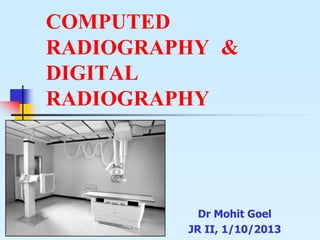
This technique is performed by digital X-ray
machines with flat panel detectors
Digital Radiography
Digital Radiography uses two types of
detectors:
• Direct
• Indirect
 TFT = THIN-FILM TRANSISTOR ARRAY
Indirect detectors
Uses a two step
process that first
converts X-rays
into light, then
converts that
light energy into
electronic signals
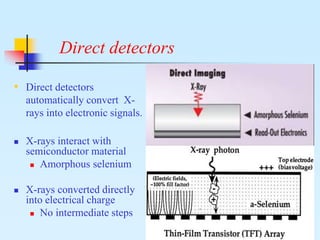
Direct detectors
• Direct detectors
automatically convert X-
rays into electronic signals.
 X-rays interact with
semiconductor material
 Amorphous selenium
 X-rays converted directly
into electrical charge
 No intermediate steps
Direct detectors
• The flat panel detector consists of an amorphous
selenium semiconductor X-ray absorber coating over
a thin-film transistor array of amorphous silicon
• In this system,X-ray photons are immediately
converted into electronic signal
• This immediate conversion eliminates the need for
additional steps to capture and convert incident X-ray
energy
• Corrective image processing which can result in
increased image noise is reduced with the highly
efficient X-ray energy conversion of direct DR
Limitations of Conventional X-ray process
(X-ray film / Screen/Darkroom)
• Film has a limited exposure latitude i.e less
detail contrast
• Time consuming & cumbersome
• Intolerant to exposure errors
• Repeat X-rays ( More radiation exposure )
• Film wastage
Limitations of Conventional X-ray process
(X-ray film / Screen/Darkroom)…
• Cannot be duplicated without loss of quality
• Film storage is a problem
• Scatter radiation reduces contrast and increases
patient dose
• Quality control is an issue
What are the advantages of
Digital X-rays?
• Post processing (soft tissue and bony details can
be viewed at same time )
• Reduction in hazardous X-ray dose to patients
• More info on one image
• Constant image quality
• Possibility of viewing X-ray images wherever
needed
What are the advantages of
Digital X-rays?…
• Digital images are of extremely high
quality
• Digital images have a future scope of
better image management
• Facility of giving multiple images of
investigative studies on a single high
definition laser film
How is Digital X-ray similar to Conventional
basic radiography process ?…
• Radiography consists of following
functions:
-Image data acquisition
-Image processing
-Reproduction of image
-Storage
How is Digital X-ray similar to Conventional
basic radiography process ?…
• In Screen film system, all the processes are
done on the X-ray film itself which is used
for:
-Image data acquisition
-Image reproduction
-Storage
How is Digital X-ray similar to Conventional
basic radiography process ?…
On the other hand, Digital X-ray distributes all the
processes into different stages:
• Imaging plate and digitizer are used for
image data acquisition in CR and Amorphous
Selenium detector array in DR
• Processing server is used for image processing and
storage
• Workstation monitor is used for image reproduction
What is the role of Digital X-ray
in PACS Environment?
• Digital X-ray is the only film less way to
link the existing general radiography set up
into the digital environment of PACS
Features of Digital X-ray
• Image enhancement
• Printing
• Annotation
• Black border
• Panoramic dental package
• Full leg / Full Spine
Under/over exposure
Soft tissue and bone windows
Digital image manipulation
• Image pre-processing
• Scale the data to appropriate range
• Contrast enhancement – Anatomy specific
grayscale manipulation
• Spatial frequency enhancement
Soft tissue and bone windows
Zoom
Collimation
Collimation
MISS.PADMINI 20YRS,F 14/08/2004 20:15:01
SKULL, MASTIODS 23
MISS.PADMINI 20YRS,F 14/08/2004 20:17:01
SKULL, MASTIODS 23
MISS.PADMINI 20YRS,F 14/08/2004 20:15:01
SKULL, MASTIODS 23
MISS.PADMINI 20YRS,F 14/08/2004 20:17:01
SKULL, MASTIODS 23
Magnifying glass
Invert image
Invert image
DIGITIZER, EMERGENCY 1O/07/2004 22:3O:28 DIGITIZER, EMERGENCY 1O/07/2004 22:3O:28
Annotation
Vertical flip
MR.RAVINDER 33YRS, M 19/08/2004 14:20:08
RIGHT LEG, AP&LAT 268
MR.RAVINDER 33YRS, M 19/08/2004 14:20:08
RIGHT LEG, AP&LAT 268
Multiple images on single film
MRS.SWAPNA 30YRS, F 29/06/2004 09:15:32
Multiple images on single film
MRS.FARIDA 30YRS ,F 12/8/2004 09:15:23
BARIUM MEAL FOLLOW THROUGH 286
CR vs DR
CR
 imaging plate
 Processing is done in
a Digital Reader
 Signal sent to
computer
 Viewed on a monitor
DR
 transistor receiver
(like bucky)
 directly into digital
signal
 seen immediately on
monitor –
Thank you

file004736.ppt

  • 1.
  • 2.
    Digital X-ray Technology Thereare two ways to obtain Digital X-rays: • Computed Radiography • Digital Radiography
  • 3.
    Computed Radiography (CR) •A Digital way of doing general radiography with Conventional X-ray machines
  • 4.
    What is CR? •Computed Radiography (CR) is a process of capturing radiographic data from a conventional X-ray machine and processing the data digitally to produce crisp and high quality radiographic images
  • 5.
    What is CR?… •For exposure, an Imaging Plate (IP) is placed in a cassette instead of a piece of film. The IP captures and "stores" the X-rays • The image is "developed" in a CR reader instead of a film processor. The CR reader extracts the information stored in the plate and produces a digital image
  • 6.
    What is CR?… •Computed Radiography is a digital image acquisition process that produces images that have much better contrast than a Conventional X-ray film-screen system
  • 7.
    Basic Modules ofCR MA TRIX LR 3300 Digitizer Preview & ID Station Processing Server ID Tablet Laser Camera Cassette with Imaging Plate
  • 8.
    Imaging Plate (IP) •The Imaging Plate looks like the intensifying screens found in Conventional film-screen cassettes • They are made of photostimulable phosphor
  • 9.
    Imaging Plate (IP) •Instead of emitting light immediately when exposed to X-rays, the photostimulable phosphor has the special property of storing the X-ray energy in a latent form and releasing the same when stimulated by a laser energy in the CR Reader / Digitizer
  • 10.
    Imaging Plate (IP)… •Storage phosphors are unique because they respond to a very wide range of X-ray exposures • This latitude gives the flexibility in selecting X-ray technique and takes care of under or over exposure • Regardless of the exposure, the image can be displayed correctly • As a consequence, retakes due to inappropriate exposures are drastically reduced
  • 11.
    Storage phosphor principle laserstimulation Emission Absorption x-rays electron trap electron trap
  • 12.
    Storage phosphor principle… •The imaging plate is coated with photostimulable phosphor, also called storage phosphor • The phosphor material is generally a kind of Bariumfluorohalide • The Imaging Plate contains not only the phosphor layer, but also a protective coat, a conductive layer, support and laminate layers
  • 13.
    Storage phosphor principle… •Incident X-rays excite electrons into a higher energy level (electron traps) • A latent image is created in the form of “stored energy” • Stimulation with a scanning laser beam releases electrons • Typical wavelength of the stimulating laser is 633 nm • Falling back, electrons emit luminescent light • Typical wavelength of the emitted light is 390 nm
  • 14.
  • 15.
    Storage phosphor principle… •The emitted light intensity is proportional to the original incident X-ray intensity • The emitted light is captured with an optical array and a photomultiplier and is digitized • The residual image is erased from the plate by an intense light source, which returns all electrons to their original state. This makes the plate ready to be reused for new exposures
  • 16.
    • The storagephosphor plate fits inside a standard size cassette and is exposed to X-rays exactly like film • The X-ray energy is stored on the plate in the form of latent energy How is a Storage Phosphor plate exposed?
  • 17.
    Patient ID Station •Before exposing the cassette, the patient demographic and exam data is stored on the microchip attached on cassette • This is done by inserting the cassette in a slot of ID station and entering the data with the help of keyboard • When cassette is inserted in digitizer after X-ray exposure, the digitizer reads both patient data as well as X-ray exposure data • The two data are combined to display images along with patient data
  • 18.
    Digitizer • The plateis inserted into the digitizer where it is scanned with a high power laser • The laser light causes the storage phosphors to release the energy they have captured in the form of blue light • In the digitizer, this blue light energy is converted to electrical signals which are then digitized to produce digital images
  • 19.
    What happens toa Storage Phosphor Plate after it is scanned? • After exposure and scanning, the phosphor plate is "erased" by exposing to a bright light exposure within the digitizer • The previous image stored in the phosphors is removed and the plate is ready to be exposed again
  • 20.
    Workstation • The digitizedimage data is processed on a processing server and is displayed on its monitor
  • 21.
    How many timescan we use a Storage Phosphor Plate? • The life of a phosphor plate depends on how carefully it is handled. Physical damage to the plate will limit its useful life • If properly cared for, a plate will produce thousands of images • Imaging Plates are known to last more than 50000 Exposure Cycles
  • 22.
    Does CR requireX-ray machine replacement? • No, CR uses the existing X-ray equipment • One CR system can support multiple x-ray rooms
  • 23.
    How is theworkflow different with CR ? • Instead of taking the film cassette to a dark room for processing, the technologist takes the cassette with imaging plate to the CR reader for digital processing of the image • Instead of manually taking the films to the reporting radiologists , the softcopy images reach the workstation almost immediately
  • 24.
    How is theworkflow different with CR ?… • The time required to acquire a Digital image is much less compared to conventional darkroom process • The film is the first product in Conventional where as the film is the last product in CR
  • 25.
  • 26.
    Rx Network Digitizer Printing MA TRIX LR 3300 Identification Processing server Exposure Cassettewith Imaging Plate The cassettes fit into X-ray table. After the exposure, the cassette is identified in the ID-station. Here patient and exam related information is stored. Next the digitizer reads the identification data, handles the plates, reads the image and sends out a raw dataset in DICOM-format. The automatic processing server processes the image according to the type of exam. For each type of exam, an optimized image processing parameter set-up is used. The processing server then pushes the processed image to the preview station for previewing. After approval the image is routed to other destinations such as a printer, a review station and an archive server.
  • 27.
    Digital Radiography This techniqueis performed by digital X-ray machines with flat panel detectors
  • 28.
    Digital Radiography Digital Radiographyuses two types of detectors: • Direct • Indirect
  • 29.
     TFT =THIN-FILM TRANSISTOR ARRAY
  • 30.
    Indirect detectors Uses atwo step process that first converts X-rays into light, then converts that light energy into electronic signals
  • 31.
    Direct detectors • Directdetectors automatically convert X- rays into electronic signals.  X-rays interact with semiconductor material  Amorphous selenium  X-rays converted directly into electrical charge  No intermediate steps
  • 32.
    Direct detectors • Theflat panel detector consists of an amorphous selenium semiconductor X-ray absorber coating over a thin-film transistor array of amorphous silicon • In this system,X-ray photons are immediately converted into electronic signal • This immediate conversion eliminates the need for additional steps to capture and convert incident X-ray energy • Corrective image processing which can result in increased image noise is reduced with the highly efficient X-ray energy conversion of direct DR
  • 33.
    Limitations of ConventionalX-ray process (X-ray film / Screen/Darkroom) • Film has a limited exposure latitude i.e less detail contrast • Time consuming & cumbersome • Intolerant to exposure errors • Repeat X-rays ( More radiation exposure ) • Film wastage
  • 34.
    Limitations of ConventionalX-ray process (X-ray film / Screen/Darkroom)… • Cannot be duplicated without loss of quality • Film storage is a problem • Scatter radiation reduces contrast and increases patient dose • Quality control is an issue
  • 35.
    What are theadvantages of Digital X-rays? • Post processing (soft tissue and bony details can be viewed at same time ) • Reduction in hazardous X-ray dose to patients • More info on one image • Constant image quality • Possibility of viewing X-ray images wherever needed
  • 36.
    What are theadvantages of Digital X-rays?… • Digital images are of extremely high quality • Digital images have a future scope of better image management • Facility of giving multiple images of investigative studies on a single high definition laser film
  • 37.
    How is DigitalX-ray similar to Conventional basic radiography process ?… • Radiography consists of following functions: -Image data acquisition -Image processing -Reproduction of image -Storage
  • 38.
    How is DigitalX-ray similar to Conventional basic radiography process ?… • In Screen film system, all the processes are done on the X-ray film itself which is used for: -Image data acquisition -Image reproduction -Storage
  • 39.
    How is DigitalX-ray similar to Conventional basic radiography process ?… On the other hand, Digital X-ray distributes all the processes into different stages: • Imaging plate and digitizer are used for image data acquisition in CR and Amorphous Selenium detector array in DR • Processing server is used for image processing and storage • Workstation monitor is used for image reproduction
  • 40.
    What is therole of Digital X-ray in PACS Environment? • Digital X-ray is the only film less way to link the existing general radiography set up into the digital environment of PACS
  • 41.
    Features of DigitalX-ray • Image enhancement • Printing • Annotation • Black border • Panoramic dental package • Full leg / Full Spine
  • 42.
  • 43.
    Soft tissue andbone windows
  • 44.
    Digital image manipulation •Image pre-processing • Scale the data to appropriate range • Contrast enhancement – Anatomy specific grayscale manipulation • Spatial frequency enhancement
  • 45.
    Soft tissue andbone windows
  • 46.
  • 47.
  • 48.
    Collimation MISS.PADMINI 20YRS,F 14/08/200420:15:01 SKULL, MASTIODS 23 MISS.PADMINI 20YRS,F 14/08/2004 20:17:01 SKULL, MASTIODS 23 MISS.PADMINI 20YRS,F 14/08/2004 20:15:01 SKULL, MASTIODS 23 MISS.PADMINI 20YRS,F 14/08/2004 20:17:01 SKULL, MASTIODS 23
  • 49.
  • 50.
  • 51.
    Invert image DIGITIZER, EMERGENCY1O/07/2004 22:3O:28 DIGITIZER, EMERGENCY 1O/07/2004 22:3O:28
  • 52.
  • 53.
    Vertical flip MR.RAVINDER 33YRS,M 19/08/2004 14:20:08 RIGHT LEG, AP&LAT 268 MR.RAVINDER 33YRS, M 19/08/2004 14:20:08 RIGHT LEG, AP&LAT 268
  • 54.
    Multiple images onsingle film MRS.SWAPNA 30YRS, F 29/06/2004 09:15:32
  • 55.
    Multiple images onsingle film MRS.FARIDA 30YRS ,F 12/8/2004 09:15:23 BARIUM MEAL FOLLOW THROUGH 286
  • 56.
    CR vs DR CR imaging plate  Processing is done in a Digital Reader  Signal sent to computer  Viewed on a monitor DR  transistor receiver (like bucky)  directly into digital signal  seen immediately on monitor –
  • 57.