Computed and Direct
Radiography
2
Conventional Radiography
 Method is film-based.
 Method uses intensifying screens.
 Film is placed between two screens.
 Screens emit light when x-rays strike them.
 Film is processed chemically.
 Processed film is viewed on lightbox.
Limitations of film-based system:
 Exposure error
 Image cannot be manipulated
 Limited dynamic range
 Faults in films can lead to repeated examination
 High storage cost
Digital Radiography
 Digital imaging is defined as process that
produces an electronic image that can be viewed
and manipulated on a computer. It is of two
types:
1. Computed Radiography (CR)
2. Digital Radiography (DR)
Computed Radiography
 Note- Fuji introduced first commercial CR
system.
Definition : Computed Radiography(CR) is
cassette based system that records
radiographic images on special plate called
photostimulable phosphor plates (PSP) and the
acquired electronic latent image are converted
to digital signal through CR reader.
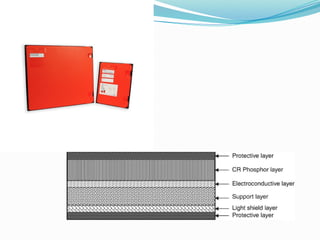
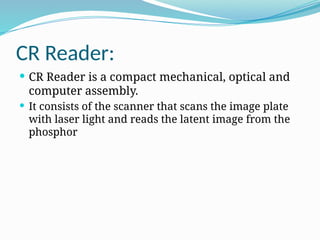
CR cassette:
 CR cassette is rigid holder that contains an imaging
plates(IP) also called storage phosphor plate .The
imaging plates has several layers:
Protective layer
 Very thin tough, clear plastic that protects
phosphor layer
Phosphor layer
 It is the active layer. It is a layer of photostimulable
phosphor that traps electrons during exposure
made of europium activated barium fluorohalide
Electroconductive layer:
• Absorbs and reduce static electricity
Support layer:
• Semi rigid material that gives imaging sheet
strength
Light shield layer:
• Prevents light from erasing data on imaging plate.
Backing layer:
• Protects the base from damage.
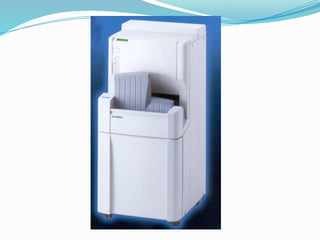
CR Reader:
 CR Reader is a compact mechanical, optical and
computer assembly.
 It consists of the scanner that scans the image plate
with laser light and reads the latent image from the
phosphor
Principle of CR:
 CR cassette that contains an imaging plates(IP)is placed
under body part of object to be examined & x-ray exposed
is made.
 This causes the photostimulable phosphor inside IP to
excite into metastable state.
 Then IP is run through CR reader which uses focused laser
light that causes the metastable electrons to return to
ground state emitting light.
 This light is picked up by a photomultiplier tube and
converted into an electrical signal to produce a digital
image
 Digital image can be viewed & enhanced using software.
 IP can be re-used thousands of times if they
are handled carefully.
 IP is automatically erased after laser
scanning is complete.
Advantage of CR
 CR plate can be reused
 No darkroom processing required
 Image can be manipulated electronically
 Great dynamic range and reduced exposures
Disadvantage
 Costly.
 Low spatial resolution than film screen
system
Direct Digital Radiography
Digital Radiography
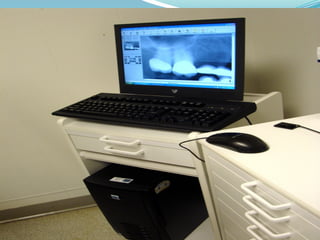
 Digital Radiography is form of x-ray imaging
where digital x-ray sensors are used instead
of traditional photographic film.
 No cassettes are required.
Detectors:
 There are two main types:
 Charge-coupled device detectors (CCD)
 Flat panel detectors (FPD)
 Indirect FPD
 Direct FPD
CCD BASED DETECTOR
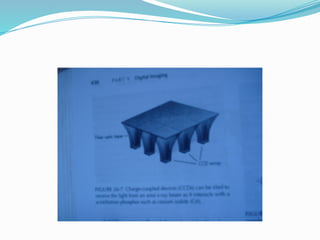
 In CCD based DR ,the imaging device is panel
consisting of scintillation material above
array of CCD.
 Light from scintillator is directed to CCD
array by means of optical lens system which
is light sensing element for most digital
cameras.
FLAT PANEL DETECTORS (FPDs)
 FPDs further classified into two main category.
 Indirect FPDs
 Direct FPDs
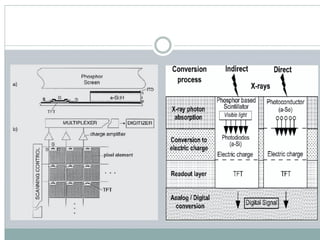
Indirect capture DR
 Amorphous silicon (a-Si) is the most common
material of commercial FPDs.
 Machine absorbs x-rays and converts them to
light.
 CCD or thin-film transistor (TFT) converts
light to electric signals.
 Computer processes electric signals.
 Images are viewed on computer monitor.
Direct capture DR
 Use an amorphous selenium coated thin film
transistor array that directly converts x-ray
energy into electrical signal
 X-rays are absorbed in the selenium where
they form electron-holes.
 Capacitors collect the charge.
 Electrical signal is sent to computer for
processing.
 Image is viewed on computer screen.
Advantage of DR:
 Provides more dose efficiency
 Image is rendered faster
 It offers superior throughput and improved workflow
Computed and Direct Radiography.VVVVVpptx

Computed and Direct Radiography.VVVVVpptx

  • 1.
  • 2.
    2 Conventional Radiography  Methodis film-based.  Method uses intensifying screens.  Film is placed between two screens.  Screens emit light when x-rays strike them.  Film is processed chemically.  Processed film is viewed on lightbox.
  • 3.
    Limitations of film-basedsystem:  Exposure error  Image cannot be manipulated  Limited dynamic range  Faults in films can lead to repeated examination  High storage cost
  • 4.
    Digital Radiography  Digitalimaging is defined as process that produces an electronic image that can be viewed and manipulated on a computer. It is of two types: 1. Computed Radiography (CR) 2. Digital Radiography (DR)
  • 5.
  • 6.
    Computed Radiography  Note-Fuji introduced first commercial CR system. Definition : Computed Radiography(CR) is cassette based system that records radiographic images on special plate called photostimulable phosphor plates (PSP) and the acquired electronic latent image are converted to digital signal through CR reader.
  • 7.
    CR cassette:  CRcassette is rigid holder that contains an imaging plates(IP) also called storage phosphor plate .The imaging plates has several layers: Protective layer  Very thin tough, clear plastic that protects phosphor layer Phosphor layer  It is the active layer. It is a layer of photostimulable phosphor that traps electrons during exposure made of europium activated barium fluorohalide
  • 8.
    Electroconductive layer: • Absorbsand reduce static electricity Support layer: • Semi rigid material that gives imaging sheet strength Light shield layer: • Prevents light from erasing data on imaging plate. Backing layer: • Protects the base from damage.
  • 10.
    CR Reader:  CRReader is a compact mechanical, optical and computer assembly.  It consists of the scanner that scans the image plate with laser light and reads the latent image from the phosphor
  • 11.
    Principle of CR: CR cassette that contains an imaging plates(IP)is placed under body part of object to be examined & x-ray exposed is made.  This causes the photostimulable phosphor inside IP to excite into metastable state.  Then IP is run through CR reader which uses focused laser light that causes the metastable electrons to return to ground state emitting light.  This light is picked up by a photomultiplier tube and converted into an electrical signal to produce a digital image  Digital image can be viewed & enhanced using software.
  • 12.
     IP canbe re-used thousands of times if they are handled carefully.  IP is automatically erased after laser scanning is complete.
  • 13.
    Advantage of CR CR plate can be reused  No darkroom processing required  Image can be manipulated electronically  Great dynamic range and reduced exposures
  • 14.
    Disadvantage  Costly.  Lowspatial resolution than film screen system
  • 15.
  • 16.
    Digital Radiography  DigitalRadiography is form of x-ray imaging where digital x-ray sensors are used instead of traditional photographic film.  No cassettes are required.
  • 17.
    Detectors:  There aretwo main types:  Charge-coupled device detectors (CCD)  Flat panel detectors (FPD)  Indirect FPD  Direct FPD
  • 18.
    CCD BASED DETECTOR In CCD based DR ,the imaging device is panel consisting of scintillation material above array of CCD.  Light from scintillator is directed to CCD array by means of optical lens system which is light sensing element for most digital cameras.
  • 20.
    FLAT PANEL DETECTORS(FPDs)  FPDs further classified into two main category.  Indirect FPDs  Direct FPDs
  • 21.
    Indirect capture DR Amorphous silicon (a-Si) is the most common material of commercial FPDs.  Machine absorbs x-rays and converts them to light.  CCD or thin-film transistor (TFT) converts light to electric signals.  Computer processes electric signals.  Images are viewed on computer monitor.
  • 22.
    Direct capture DR Use an amorphous selenium coated thin film transistor array that directly converts x-ray energy into electrical signal  X-rays are absorbed in the selenium where they form electron-holes.  Capacitors collect the charge.  Electrical signal is sent to computer for processing.  Image is viewed on computer screen.
  • 24.
    Advantage of DR: Provides more dose efficiency  Image is rendered faster  It offers superior throughput and improved workflow