Introduction to Database
Presented by,
V.Santhi,
Assistant Professor,
Department of Computer Applications,
Bon Secours College for Women,
Thanjavur
 What is traditional file system?
 Limitations of traditional file system.
 What is Database and DBMS?
 Overview of DBMS.
Characteristics of Database
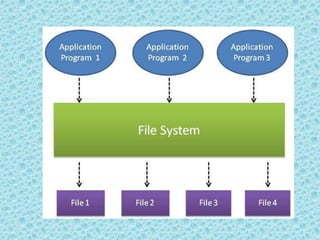
File Systems :
– Store data over long periods of time
– Store large amount of data
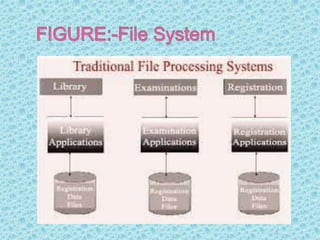
 In a typical file processing system, each
department has its own set of applications
and its own files, designed specifically for
those applications.
5
 For example:
To illustrate Traditional File Processing
Systems definition, lets us take an example
of college where student record for
examination is stored in one file, admission
records on other file and library record is
stored in different file that creates many
duplicate values like roll Number, Name
and Father Name that creates data
redundancy.
6
Drawbacks of using file systems
1. Data redundancy and inconsistency
Multiple file formats, duplication of information in
different files
2. Difficulty in accessing data
Need to write a new program to carry out each new
task
3. Data isolation — multiple files and formats
4. Integrity problems
Integrity constraints (e.g. account balance > 0)
become part of program code
Hard to add new constraints or change existing ones
Drawbacks of using file systems (cont.)
5. Atomicity of updates
Failures may leave database in an inconsistent
state with partial updates carried out
E.g. transfer of funds from one account to another
should either complete or not happen at all
6. Concurrent access by multiple users
Concurrent accessed needed for performance
Uncontrolled concurrent accesses can lead to
inconsistencies
E.g. two people reading a balance and updating it at
the same time
7. Security problems
Data: Known facts that can be recorded
and have an implicit meaning.
Database: A collection of very large,
related data.
DBMS : A Database Management System
(DBMS) is a system software that
allows users to efficiently define, create,
maintain and share databases.
10
Database Management System (DBMS):
A software package/ system to facilitate the creation
and maintenance of a computerized database.
Examples of Database Applications:
Banking: all transactions
Airlines: reservations, schedules
Universities: registration, grades
It
• defines (data types, structures, constraints)
• construct (storing data on some storage medium
controlled by DBMS)
• manipulate (querying, update, report generation)
databases for various applications.
11
Characteristics of Database Technology
 Self-contained nature of a database system: A DBMS catalog
stores the description (structure, type, storage format of each
entities) of the database. The description is called meta-data).
This allows the DBMS software to work with different databases.
 Insulation between programs and data: Called program-data
independence. Allows changing data storage structures and
operations without having to change the DBMS access programs.
 Data Abstraction: A data model is used to hide storage details and
present the users with a conceptual view of the database; does
not include how data is stored and how the operations are
implemented.
-
12
 Support of multiple views of the data: Each user
may see a different view of the database, which
describes only the data of interest to that user.
 Sharing of Data and Multiple users

File system vs database

  • 1.
    Introduction to Database Presentedby, V.Santhi, Assistant Professor, Department of Computer Applications, Bon Secours College for Women, Thanjavur
  • 2.
     What istraditional file system?  Limitations of traditional file system.  What is Database and DBMS?  Overview of DBMS. Characteristics of Database
  • 3.
    File Systems : –Store data over long periods of time – Store large amount of data  In a typical file processing system, each department has its own set of applications and its own files, designed specifically for those applications.
  • 5.
  • 6.
     For example: Toillustrate Traditional File Processing Systems definition, lets us take an example of college where student record for examination is stored in one file, admission records on other file and library record is stored in different file that creates many duplicate values like roll Number, Name and Father Name that creates data redundancy. 6
  • 7.
    Drawbacks of usingfile systems 1. Data redundancy and inconsistency Multiple file formats, duplication of information in different files 2. Difficulty in accessing data Need to write a new program to carry out each new task 3. Data isolation — multiple files and formats 4. Integrity problems Integrity constraints (e.g. account balance > 0) become part of program code Hard to add new constraints or change existing ones
  • 8.
    Drawbacks of usingfile systems (cont.) 5. Atomicity of updates Failures may leave database in an inconsistent state with partial updates carried out E.g. transfer of funds from one account to another should either complete or not happen at all 6. Concurrent access by multiple users Concurrent accessed needed for performance Uncontrolled concurrent accesses can lead to inconsistencies E.g. two people reading a balance and updating it at the same time 7. Security problems
  • 9.
    Data: Known factsthat can be recorded and have an implicit meaning. Database: A collection of very large, related data. DBMS : A Database Management System (DBMS) is a system software that allows users to efficiently define, create, maintain and share databases.
  • 10.
    10 Database Management System(DBMS): A software package/ system to facilitate the creation and maintenance of a computerized database. Examples of Database Applications: Banking: all transactions Airlines: reservations, schedules Universities: registration, grades It • defines (data types, structures, constraints) • construct (storing data on some storage medium controlled by DBMS) • manipulate (querying, update, report generation) databases for various applications.
  • 11.
    11 Characteristics of DatabaseTechnology  Self-contained nature of a database system: A DBMS catalog stores the description (structure, type, storage format of each entities) of the database. The description is called meta-data). This allows the DBMS software to work with different databases.  Insulation between programs and data: Called program-data independence. Allows changing data storage structures and operations without having to change the DBMS access programs.  Data Abstraction: A data model is used to hide storage details and present the users with a conceptual view of the database; does not include how data is stored and how the operations are implemented. -
  • 12.
    12  Support ofmultiple views of the data: Each user may see a different view of the database, which describes only the data of interest to that user.  Sharing of Data and Multiple users