jaya kolekar
102/07/17
Objects
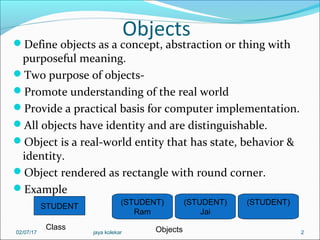
Define objects as a concept, abstraction or thing with
purposeful meaning.
Two purpose of objects-
Promote understanding of the real world
Provide a practical basis for computer implementation.
All objects have identity and are distinguishable.
Object is a real-world entity that has state, behavior &
identity.
Object rendered as rectangle with round corner.
Example
2
STUDENT
Class
(STUDENT)
Ram
(STUDENT)
Jai
(STUDENT)
Objects02/07/17 jaya kolekar
Classes
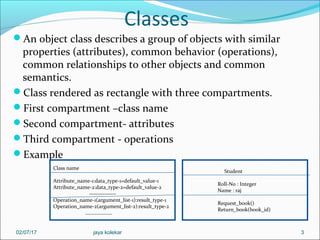
An object class describes a group of objects with similar
properties (attributes), common behavior (operations),
common relationships to other objects and common
semantics.
Class rendered as rectangle with three compartments.
First compartment –class name
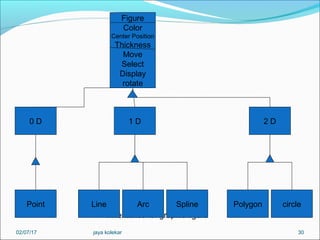
Second compartment- attributes
Third compartment - operations
Example
3
Class name
Attribute_name-1:data_type-1=default_value-1
Attribute_name-2:data_type-2=default_value-2
--------------
Operation_name-1(argument_list-1):result_type-1
Operation_name-2(argument_list-2):result_type-2
…………………
Student
Roll-No : Integer
Name : raj
Request_book()
Return_book(book_id)
02/07/17 jaya kolekar
Object diagram
402/07/17 jaya kolekar
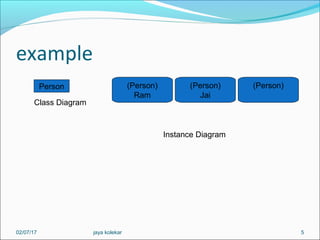
example
5
Person
Class Diagram
(Person)
Ram
(Person)
Jai
(Person)
Instance Diagram
02/07/17 jaya kolekar
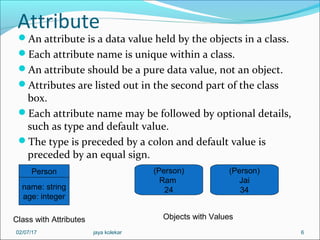
Attribute
An attribute is a data value held by the objects in a class.
Each attribute name is unique within a class.
An attribute should be a pure data value, not an object.
Attributes are listed out in the second part of the class
box.
Each attribute name may be followed by optional details,
such as type and default value.
The type is preceded by a colon and default value is
preceded by an equal sign.
Example
6
Person
name: string
age: integer
Class with Attributes
(Person)
Ram
24
(Person)
Jai
34
Objects with Values
02/07/17 jaya kolekar
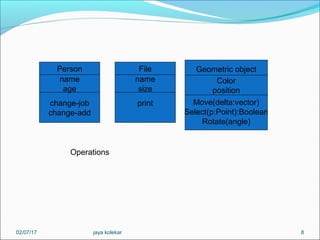
Operations and Methods
An operation is a function or transformation that may be
applied to or by objects in a class.
All objects in a class share the same operations.
The same operation may apply to many different classes,
Such an operation is polymorphic
A method is the implementation of an operation for a class.
Operations are listed in the lower third of the class box.
Each operation name may be followed by optional details,
such as argument list and result type.
702/07/17 jaya kolekar
8
Person
name
age
change-job
change-add
Person
name
age
change-job
change-add
Person
name
age
print
File
name
size
Operations
Person
name
age
change-job
change-add
Person
name
age
Move(delta:vector)
Select(p:Point):Boolean
Rotate(angle)
Geometric object
Color
position
02/07/17 jaya kolekar
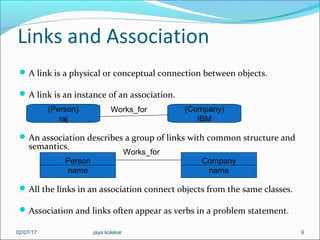
Links and Association
A link is a physical or conceptual connection between objects.
A link is an instance of an association.
An association describes a group of links with common structure and
semantics.
All the links in an association connect objects from the same classes.
Association and links often appear as verbs in a problem statement.
9
(Person)
raj
(Company)
IBM
Works_for
Person
name
Company
name
Works_for
02/07/17 jaya kolekar
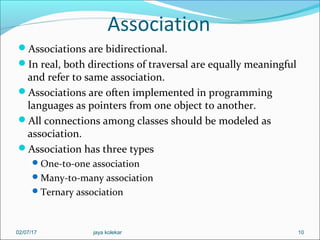
Association
Associations are bidirectional.
In real, both directions of traversal are equally meaningful
and refer to same association.
Associations are often implemented in programming
languages as pointers from one object to another.
All connections among classes should be modeled as
association.
Association has three types
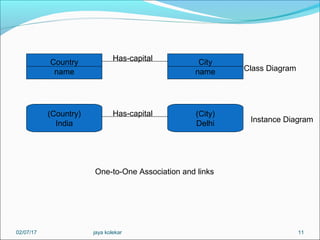
One-to-one association
Many-to-many association
Ternary association
1002/07/17 jaya kolekar
11
Country
name
City
name
Has-capital
(Country)
India
(City)
Delhi
Has-capital
Has-capital
Class Diagram
Instance Diagram
One-to-One Association and links
02/07/17 jaya kolekar
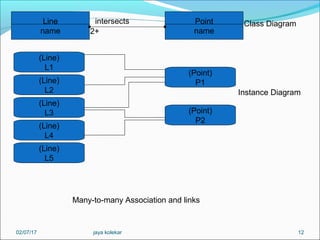
12
Line
name
Point
name
intersects
2+
(Line)
L1
(Line)
L2
(Line)
L3
(Point)
P1
(Line)
L4
(Line)
L5
(Point)
P2
Many-to-many Association and links
Class Diagram
Instance Diagram
02/07/17 jaya kolekar
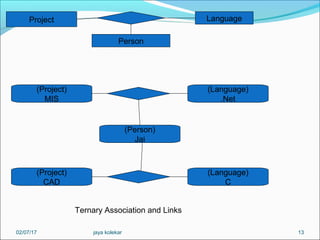
13
Project Language
Person
(Project)
MIS
(Language)
.Net
(Project)
CAD
(Language)
C
(Person)
Jai
Ternary Association and Links
02/07/17 jaya kolekar
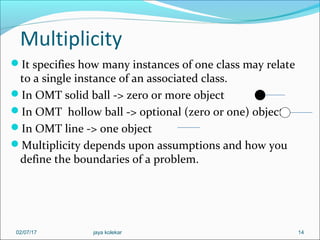
Multiplicity
It specifies how many instances of one class may relate
to a single instance of an associated class.
In OMT solid ball -> zero or more object
In OMT hollow ball -> optional (zero or one) object
In OMT line -> one object
Multiplicity depends upon assumptions and how you
define the boundaries of a problem.
1402/07/17 jaya kolekar
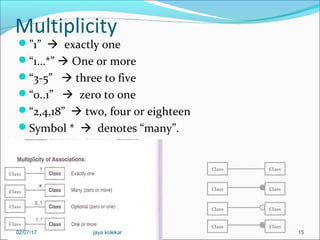
Multiplicity
”1”  exactly one
“1…*”  One or more
“3-5”  three to five
“0..1”  zero to one
“2,4,18”  two, four or eighteen
Symbol *  denotes “many”.
15
Class
Class
Class
Class
ClassClass
ClassClass
Class Class
Class Class
02/07/17 jaya kolekar
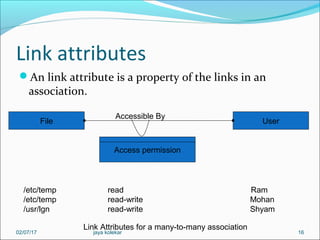
Link attributes
An link attribute is a property of the links in an
association.
16
File User
Accessible By
Access permission
/etc/temp read Ram
/etc/temp read-write Mohan
/usr/lgn read-write Shyam
Link Attributes for a many-to-many association
02/07/17 jaya kolekar
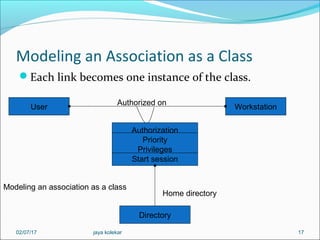
Modeling an Association as a Class
Each link becomes one instance of the class.
17
User Workstation
Authorized on
Authorization
Priority
Privileges
Start session
Directory
Home directory
Modeling an association as a class
02/07/17 jaya kolekar
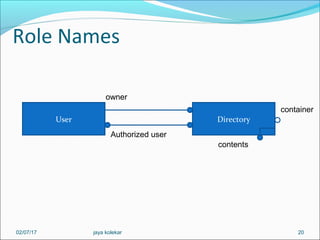
Role Names
A role is one end of an association.
A binary association has 2 roles, each of which
may have a role name.
A role name is a name that uniquely identifies
one end of an association.
Roles often appear as nouns in problem
descriptions.
Use of role name is optional.
Role names are necessary for associations
between two objects of the same class.
1802/07/17 jaya kolekar
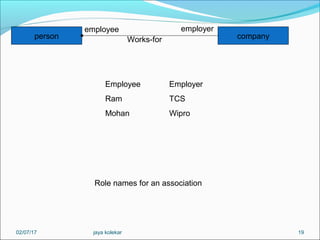
19
person company
employee employer
Works-for
Employee Employer
Ram TCS
Mohan Wipro
Role names for an association
02/07/17 jaya kolekar
Role Names
20
User Directory
owner
Authorized user
contents
container
02/07/17 jaya kolekar
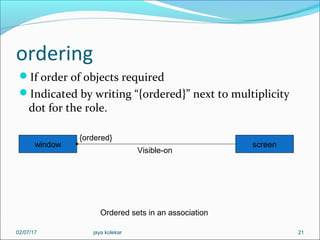
ordering
If order of objects required
Indicated by writing “{ordered}” next to multiplicity
dot for the role.
21
window screen
{ordered}
Visible-on
Ordered sets in an association
02/07/17 jaya kolekar
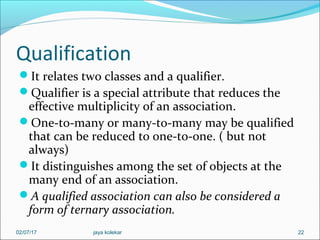
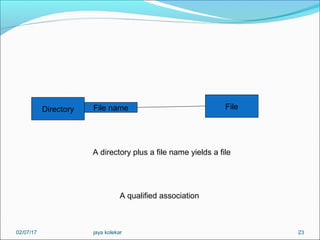
Qualification
It relates two classes and a qualifier.
Qualifier is a special attribute that reduces the
effective multiplicity of an association.
One-to-many or many-to-many may be qualified
that can be reduced to one-to-one. ( but not
always)
It distinguishes among the set of objects at the
many end of an association.
A qualified association can also be considered a
form of ternary association.
2202/07/17 jaya kolekar
23
Directory FileFile name
A qualified association
A directory plus a file name yields a file
02/07/17 jaya kolekar
Aggregation
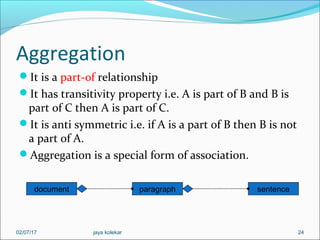
It is a part-of relationship
It has transitivity property i.e. A is part of B and B is
part of C then A is part of C.
It is anti symmetric i.e. if A is a part of B then B is not
a part of A.
Aggregation is a special form of association.
24
document paragraph sentence
02/07/17 jaya kolekar
Aggregation
It is a form of association in which an aggregate
object is made of components.
Components are part of aggregate.
Aggregate is inherently transitive i.e. an aggregate has
parts which may in turn have parts.
2502/07/17 jaya kolekar
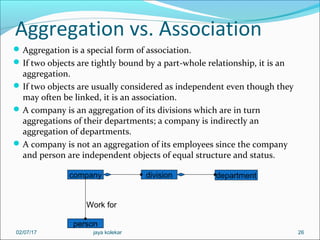
Aggregation vs. Association
Aggregation is a special form of association.
If two objects are tightly bound by a part-whole relationship, it is an
aggregation.
If two objects are usually considered as independent even though they
may often be linked, it is an association.
A company is an aggregation of its divisions which are in turn
aggregations of their departments; a company is indirectly an
aggregation of departments.
A company is not an aggregation of its employees since the company
and person are independent objects of equal structure and status.
26
company division department
person
Work for
02/07/17 jaya kolekar
Recursive Aggregates
Types of Aggregation
Fixed aggregate :
 has a fixed structure , the number of types of subparts are
predefined.
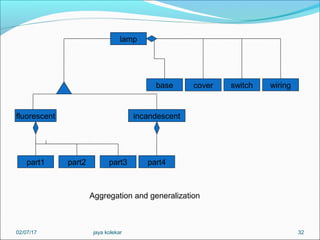
 Eg : lamp
Variable aggregate:
 has a finite number of levels, but the number of parts may
vary.
 Eg : company and department
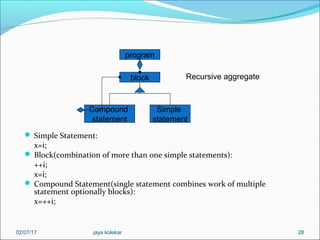
A recursive aggregation :
 contains directly or indirectly an instance of the same kind of
aggregate; the number of potential levels is unlimited .
 Eg : computer program.
2702/07/17 jaya kolekar
 Simple Statement:
x=i;
 Block(combination of more than one simple statements):
++i;
x=i;
 Compound Statement(single statement combines work of multiple
statement optionally blocks):
x=++i;
28
program
block
Compound
statement
Simple
statement
Recursive aggregate
02/07/17 jaya kolekar
Generalization
It is a relationship between a class & one or more refined versions of it.
the class being refined is called the super class & each refined version is
called a subclass.
It is “is-a” relationship because each instance of a sub class is an instance
of super class as well.
The notation for generalization is a triangle with lines, super class
connected by a line to the apex of the triangle and subclasses are
connected by lines to a horizontal bar attached to the base of the triangle.
A discriminator is an attribute of enumeration type that indicates which
property of an object is being abstracted by a particular generalization
relationship
2902/07/17 jaya kolekar
30
Inheritance for graphic figure
Figure
Color
Center Position
Thickness
Move
Select
Display
rotate
0 D 1 D 2 D
Point Line Arc Spline circlePolygon
02/07/17 jaya kolekar
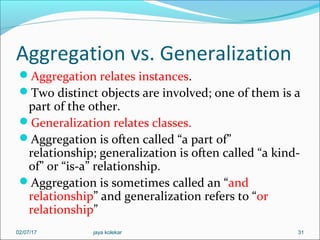
Aggregation vs. Generalization
Aggregation relates instances.
Two distinct objects are involved; one of them is a
part of the other.
Generalization relates classes.
Aggregation is often called “a part of”
relationship; generalization is often called “a kind-
of” or “is-a” relationship.
Aggregation is sometimes called an “and
relationship” and generalization refers to “or
relationship”
3102/07/17 jaya kolekar
32
lamp
base cover switch wiring
incandescentfluorescent
part4part3part2part1
Aggregation and generalization
02/07/17 jaya kolekar
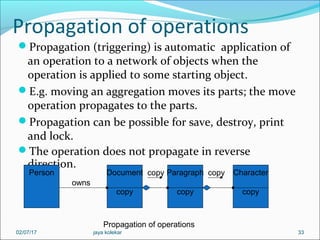
Propagation of operations
Propagation (triggering) is automatic application of
an operation to a network of objects when the
operation is applied to some starting object.
E.g. moving an aggregation moves its parts; the move
operation propagates to the parts.
Propagation can be possible for save, destroy, print
and lock.
The operation does not propagate in reverse
direction.
33
Person Document
copy
Paragraph
copy
Character
copy
owns
copy copy
Propagation of operations
02/07/17 jaya kolekar
Abstract classes
An abstract class is a class that has no direct instances
but whose descendent classes have direct instances.
A concrete class is a class that is instantiable.
It may have abstract subclasses but they must have
concrete descendents.
It may be leaf classes in the inheritance tree.
3402/07/17 jaya kolekar
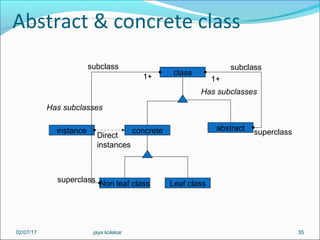
Abstract & concrete class
35
class
concrete abstractinstance
Leaf classNon leaf class
subclass
1+ 1+
subclass
Has subclasses
Has subclasses
superclass
superclass
Direct
instances
02/07/17 jaya kolekar
Abstract classes
It’s organize features common to several classes.
It’s frequently used to define methods to be inherited by
subclasses.
It’s abstract operation defines the form of an operation for
which each concrete subclass must provide its own
implementation.
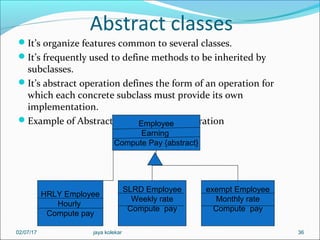
Example of Abstract class & abstract operation
36
Employee
Earning
Compute Pay {abstract}
SLRD Employee
Weekly rate
Compute pay
exempt Employee
Monthly rate
Compute pay
HRLY Employee
Hourly
Compute pay
02/07/17 jaya kolekar
Overriding operations
 Overriding for Extension
The new operation is same as inherited except it adds some behavior
usually affecting new attributes of the subclass.
eg: window and labeledwindow has draw operation
 Overriding for Restriction
The new operation restricts the inherited.
eg: set and integerset with operation add
 Overriding for Optimization
The new method must have the same external protocol (prototype) and
results as the old one but its internal representation and algorithm may
differ completely.
Eg : integerset and sortintegerset with operation maximum
 Overriding for Convenience
The new class is made a subclass of the existing class and overrides the
methods that are inconvenient.
Eg:all query operations are inherited by all subclasses(read) 3702/07/17 jaya kolekar
Multiple inheritance
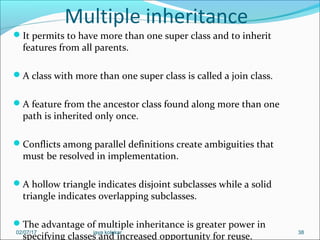
It permits to have more than one super class and to inherit
features from all parents.
A class with more than one super class is called a join class.
A feature from the ancestor class found along more than one
path is inherited only once.
Conflicts among parallel definitions create ambiguities that
must be resolved in implementation.
A hollow triangle indicates disjoint subclasses while a solid
triangle indicates overlapping subclasses.
The advantage of multiple inheritance is greater power in
specifying classes and increased opportunity for reuse.
3802/07/17 jaya kolekar
Multiple inheritance
39
vehicle
WatervehicleLandvehicle
boatamphibiousvehiclecar
Multiple inheritance from overlapping classes
[ join class ]
Overlapping Classes
02/07/17 jaya kolekar
Metadata
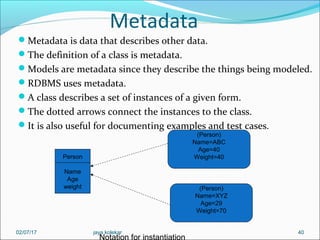
Metadata is data that describes other data.
The definition of a class is metadata.
Models are metadata since they describe the things being modeled.
RDBMS uses metadata.
A class describes a set of instances of a given form.
The dotted arrows connect the instances to the class.
It is also useful for documenting examples and test cases.
40
Person
Name
Age
weight
(Person)
Name=ABC
Age=40
Weight=40
(Person)
Name=XYZ
Age=29
Weight=70
Notation for instantiation
02/07/17 jaya kolekar
Class descriptors
Classes are meta objects and not real world objects.
Class descriptors have features and they have their own
classes which are called meta classes.
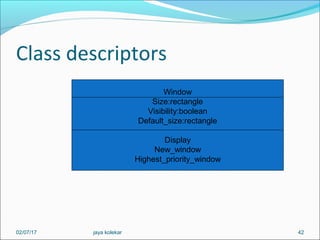
A class attribute describes a value common to an entire
class of objects rather than data particular to each
instance.
A class operation is an operation on the class itself.
4102/07/17 jaya kolekar
Class descriptors
42
Window
Size:rectangle
Visibility:boolean
Default_size:rectangle
Display
New_window
Highest_priority_window
02/07/17 jaya kolekar
Candidate keys
A candidate key is a minimal set of attributes that
uniquely identifies an object or link.
A class may have one or more candidate keys each of
which may have different combinations and numbers
of attributes.
Each candidate key constrains the instances in a class.
Notation is {}
4302/07/17 jaya kolekar
constraints
These are functional relation between entities of an
object model.
Entity includes objects, classes, attributes, links and
associations.
A constraint restricts the values that entities can
assume.
Simple constraints may be placed in object models
and complex may be in functional model.
4402/07/17 jaya kolekar
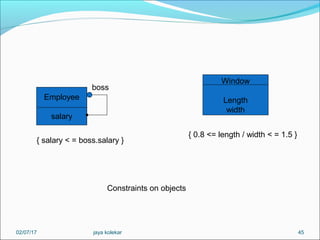
45
Employee
salary
boss
{ salary < = boss.salary }
Window
Length
width
{ 0.8 <= length / width < = 1.5 }
Constraints on objects
02/07/17 jaya kolekar
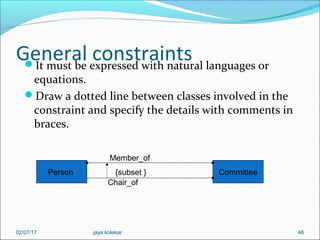
General constraintsIt must be expressed with natural languages or
equations.
Draw a dotted line between classes involved in the
constraint and specify the details with comments in
braces.
46
Person Committee
Member_of
Chair_of
{subset }
02/07/17 jaya kolekar
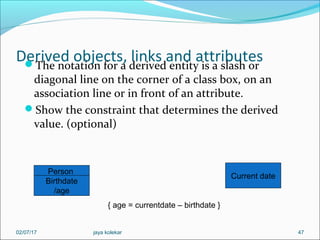
Derived objects, links and attributesThe notation for a derived entity is a slash or
diagonal line on the corner of a class box, on an
association line or in front of an attribute.
Show the constraint that determines the derived
value. (optional)
47
Person
Birthdate
/age
Current date
{ age = currentdate – birthdate }
02/07/17 jaya kolekar
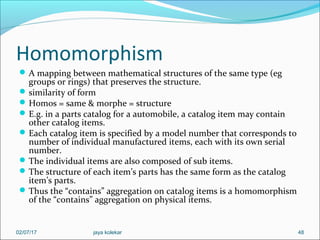
Homomorphism
A mapping between mathematical structures of the same type (eg
groups or rings) that preserves the structure.
similarity of form
Homos = same & morphe = structure
E.g. in a parts catalog for a automobile, a catalog item may contain
other catalog items.
Each catalog item is specified by a model number that corresponds to
number of individual manufactured items, each with its own serial
number.
The individual items are also composed of sub items.
The structure of each item’s parts has the same form as the catalog
item’s parts.
Thus the “contains” aggregation on catalog items is a homomorphism
of the “contains” aggregation on physical items.
4802/07/17 jaya kolekar
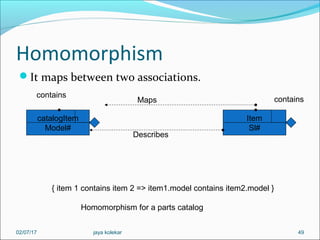
Homomorphism
It maps between two associations.
49
catalogItem
Model#
Item
Sl#
contains
containsMaps
Describes
{ item 1 contains item 2 => item1.model contains item2.model }
Homomorphism for a parts catalog
02/07/17 jaya kolekar
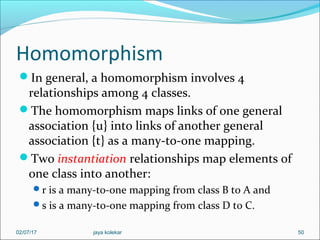
Homomorphism
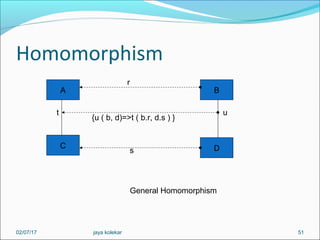
In general, a homomorphism involves 4
relationships among 4 classes.
The homomorphism maps links of one general
association {u} into links of another general
association {t} as a many-to-one mapping.
Two instantiation relationships map elements of
one class into another:
r is a many-to-one mapping from class B to A and
s is a many-to-one mapping from class D to C.
5002/07/17 jaya kolekar
Homomorphism
51
A
C
B
D
r
s
t u
{u ( b, d)=>t ( b.r, d.s ) }
General Homomorphism
02/07/17 jaya kolekar
Homomorphism
In general where t is on a single class and u is on a
single class then A=C, B=D and r=s.
Homomorphism is a special type of relationship
between relationships.
5202/07/17 jaya kolekar
5302/07/17 jaya kolekar
5402/07/17 jaya kolekar
5502/07/17 jaya kolekar

OMD chapter 2 Class modelling

  • 1.
  • 2.
    Objects Define objects asa concept, abstraction or thing with purposeful meaning. Two purpose of objects- Promote understanding of the real world Provide a practical basis for computer implementation. All objects have identity and are distinguishable. Object is a real-world entity that has state, behavior & identity. Object rendered as rectangle with round corner. Example 2 STUDENT Class (STUDENT) Ram (STUDENT) Jai (STUDENT) Objects02/07/17 jaya kolekar
  • 3.
    Classes An object classdescribes a group of objects with similar properties (attributes), common behavior (operations), common relationships to other objects and common semantics. Class rendered as rectangle with three compartments. First compartment –class name Second compartment- attributes Third compartment - operations Example 3 Class name Attribute_name-1:data_type-1=default_value-1 Attribute_name-2:data_type-2=default_value-2 -------------- Operation_name-1(argument_list-1):result_type-1 Operation_name-2(argument_list-2):result_type-2 ………………… Student Roll-No : Integer Name : raj Request_book() Return_book(book_id) 02/07/17 jaya kolekar
  • 4.
  • 5.
  • 6.
    Attribute An attribute isa data value held by the objects in a class. Each attribute name is unique within a class. An attribute should be a pure data value, not an object. Attributes are listed out in the second part of the class box. Each attribute name may be followed by optional details, such as type and default value. The type is preceded by a colon and default value is preceded by an equal sign. Example 6 Person name: string age: integer Class with Attributes (Person) Ram 24 (Person) Jai 34 Objects with Values 02/07/17 jaya kolekar
  • 7.
    Operations and Methods Anoperation is a function or transformation that may be applied to or by objects in a class. All objects in a class share the same operations. The same operation may apply to many different classes, Such an operation is polymorphic A method is the implementation of an operation for a class. Operations are listed in the lower third of the class box. Each operation name may be followed by optional details, such as argument list and result type. 702/07/17 jaya kolekar
  • 8.
  • 9.
    Links and Association Alink is a physical or conceptual connection between objects. A link is an instance of an association. An association describes a group of links with common structure and semantics. All the links in an association connect objects from the same classes. Association and links often appear as verbs in a problem statement. 9 (Person) raj (Company) IBM Works_for Person name Company name Works_for 02/07/17 jaya kolekar
  • 10.
    Association Associations are bidirectional. Inreal, both directions of traversal are equally meaningful and refer to same association. Associations are often implemented in programming languages as pointers from one object to another. All connections among classes should be modeled as association. Association has three types One-to-one association Many-to-many association Ternary association 1002/07/17 jaya kolekar
  • 11.
  • 12.
  • 13.
  • 14.
    Multiplicity It specifies howmany instances of one class may relate to a single instance of an associated class. In OMT solid ball -> zero or more object In OMT hollow ball -> optional (zero or one) object In OMT line -> one object Multiplicity depends upon assumptions and how you define the boundaries of a problem. 1402/07/17 jaya kolekar
  • 15.
    Multiplicity ”1”  exactlyone “1…*”  One or more “3-5”  three to five “0..1”  zero to one “2,4,18”  two, four or eighteen Symbol *  denotes “many”. 15 Class Class Class Class ClassClass ClassClass Class Class Class Class 02/07/17 jaya kolekar
  • 16.
    Link attributes An linkattribute is a property of the links in an association. 16 File User Accessible By Access permission /etc/temp read Ram /etc/temp read-write Mohan /usr/lgn read-write Shyam Link Attributes for a many-to-many association 02/07/17 jaya kolekar
  • 17.
    Modeling an Associationas a Class Each link becomes one instance of the class. 17 User Workstation Authorized on Authorization Priority Privileges Start session Directory Home directory Modeling an association as a class 02/07/17 jaya kolekar
  • 18.
    Role Names A roleis one end of an association. A binary association has 2 roles, each of which may have a role name. A role name is a name that uniquely identifies one end of an association. Roles often appear as nouns in problem descriptions. Use of role name is optional. Role names are necessary for associations between two objects of the same class. 1802/07/17 jaya kolekar
  • 19.
    19 person company employee employer Works-for EmployeeEmployer Ram TCS Mohan Wipro Role names for an association 02/07/17 jaya kolekar
  • 20.
    Role Names 20 User Directory owner Authorizeduser contents container 02/07/17 jaya kolekar
  • 21.
    ordering If order ofobjects required Indicated by writing “{ordered}” next to multiplicity dot for the role. 21 window screen {ordered} Visible-on Ordered sets in an association 02/07/17 jaya kolekar
  • 22.
    Qualification It relates twoclasses and a qualifier. Qualifier is a special attribute that reduces the effective multiplicity of an association. One-to-many or many-to-many may be qualified that can be reduced to one-to-one. ( but not always) It distinguishes among the set of objects at the many end of an association. A qualified association can also be considered a form of ternary association. 2202/07/17 jaya kolekar
  • 23.
    23 Directory FileFile name Aqualified association A directory plus a file name yields a file 02/07/17 jaya kolekar
  • 24.
    Aggregation It is apart-of relationship It has transitivity property i.e. A is part of B and B is part of C then A is part of C. It is anti symmetric i.e. if A is a part of B then B is not a part of A. Aggregation is a special form of association. 24 document paragraph sentence 02/07/17 jaya kolekar
  • 25.
    Aggregation It is aform of association in which an aggregate object is made of components. Components are part of aggregate. Aggregate is inherently transitive i.e. an aggregate has parts which may in turn have parts. 2502/07/17 jaya kolekar
  • 26.
    Aggregation vs. Association Aggregationis a special form of association. If two objects are tightly bound by a part-whole relationship, it is an aggregation. If two objects are usually considered as independent even though they may often be linked, it is an association. A company is an aggregation of its divisions which are in turn aggregations of their departments; a company is indirectly an aggregation of departments. A company is not an aggregation of its employees since the company and person are independent objects of equal structure and status. 26 company division department person Work for 02/07/17 jaya kolekar
  • 27.
    Recursive Aggregates Types ofAggregation Fixed aggregate :  has a fixed structure , the number of types of subparts are predefined.  Eg : lamp Variable aggregate:  has a finite number of levels, but the number of parts may vary.  Eg : company and department A recursive aggregation :  contains directly or indirectly an instance of the same kind of aggregate; the number of potential levels is unlimited .  Eg : computer program. 2702/07/17 jaya kolekar
  • 28.
     Simple Statement: x=i; Block(combination of more than one simple statements): ++i; x=i;  Compound Statement(single statement combines work of multiple statement optionally blocks): x=++i; 28 program block Compound statement Simple statement Recursive aggregate 02/07/17 jaya kolekar
  • 29.
    Generalization It is arelationship between a class & one or more refined versions of it. the class being refined is called the super class & each refined version is called a subclass. It is “is-a” relationship because each instance of a sub class is an instance of super class as well. The notation for generalization is a triangle with lines, super class connected by a line to the apex of the triangle and subclasses are connected by lines to a horizontal bar attached to the base of the triangle. A discriminator is an attribute of enumeration type that indicates which property of an object is being abstracted by a particular generalization relationship 2902/07/17 jaya kolekar
  • 30.
    30 Inheritance for graphicfigure Figure Color Center Position Thickness Move Select Display rotate 0 D 1 D 2 D Point Line Arc Spline circlePolygon 02/07/17 jaya kolekar
  • 31.
    Aggregation vs. Generalization Aggregationrelates instances. Two distinct objects are involved; one of them is a part of the other. Generalization relates classes. Aggregation is often called “a part of” relationship; generalization is often called “a kind- of” or “is-a” relationship. Aggregation is sometimes called an “and relationship” and generalization refers to “or relationship” 3102/07/17 jaya kolekar
  • 32.
    32 lamp base cover switchwiring incandescentfluorescent part4part3part2part1 Aggregation and generalization 02/07/17 jaya kolekar
  • 33.
    Propagation of operations Propagation(triggering) is automatic application of an operation to a network of objects when the operation is applied to some starting object. E.g. moving an aggregation moves its parts; the move operation propagates to the parts. Propagation can be possible for save, destroy, print and lock. The operation does not propagate in reverse direction. 33 Person Document copy Paragraph copy Character copy owns copy copy Propagation of operations 02/07/17 jaya kolekar
  • 34.
    Abstract classes An abstractclass is a class that has no direct instances but whose descendent classes have direct instances. A concrete class is a class that is instantiable. It may have abstract subclasses but they must have concrete descendents. It may be leaf classes in the inheritance tree. 3402/07/17 jaya kolekar
  • 35.
    Abstract & concreteclass 35 class concrete abstractinstance Leaf classNon leaf class subclass 1+ 1+ subclass Has subclasses Has subclasses superclass superclass Direct instances 02/07/17 jaya kolekar
  • 36.
    Abstract classes It’s organizefeatures common to several classes. It’s frequently used to define methods to be inherited by subclasses. It’s abstract operation defines the form of an operation for which each concrete subclass must provide its own implementation. Example of Abstract class & abstract operation 36 Employee Earning Compute Pay {abstract} SLRD Employee Weekly rate Compute pay exempt Employee Monthly rate Compute pay HRLY Employee Hourly Compute pay 02/07/17 jaya kolekar
  • 37.
    Overriding operations  Overridingfor Extension The new operation is same as inherited except it adds some behavior usually affecting new attributes of the subclass. eg: window and labeledwindow has draw operation  Overriding for Restriction The new operation restricts the inherited. eg: set and integerset with operation add  Overriding for Optimization The new method must have the same external protocol (prototype) and results as the old one but its internal representation and algorithm may differ completely. Eg : integerset and sortintegerset with operation maximum  Overriding for Convenience The new class is made a subclass of the existing class and overrides the methods that are inconvenient. Eg:all query operations are inherited by all subclasses(read) 3702/07/17 jaya kolekar
  • 38.
    Multiple inheritance It permitsto have more than one super class and to inherit features from all parents. A class with more than one super class is called a join class. A feature from the ancestor class found along more than one path is inherited only once. Conflicts among parallel definitions create ambiguities that must be resolved in implementation. A hollow triangle indicates disjoint subclasses while a solid triangle indicates overlapping subclasses. The advantage of multiple inheritance is greater power in specifying classes and increased opportunity for reuse. 3802/07/17 jaya kolekar
  • 39.
    Multiple inheritance 39 vehicle WatervehicleLandvehicle boatamphibiousvehiclecar Multiple inheritancefrom overlapping classes [ join class ] Overlapping Classes 02/07/17 jaya kolekar
  • 40.
    Metadata Metadata is datathat describes other data. The definition of a class is metadata. Models are metadata since they describe the things being modeled. RDBMS uses metadata. A class describes a set of instances of a given form. The dotted arrows connect the instances to the class. It is also useful for documenting examples and test cases. 40 Person Name Age weight (Person) Name=ABC Age=40 Weight=40 (Person) Name=XYZ Age=29 Weight=70 Notation for instantiation 02/07/17 jaya kolekar
  • 41.
    Class descriptors Classes aremeta objects and not real world objects. Class descriptors have features and they have their own classes which are called meta classes. A class attribute describes a value common to an entire class of objects rather than data particular to each instance. A class operation is an operation on the class itself. 4102/07/17 jaya kolekar
  • 42.
  • 43.
    Candidate keys A candidatekey is a minimal set of attributes that uniquely identifies an object or link. A class may have one or more candidate keys each of which may have different combinations and numbers of attributes. Each candidate key constrains the instances in a class. Notation is {} 4302/07/17 jaya kolekar
  • 44.
    constraints These are functionalrelation between entities of an object model. Entity includes objects, classes, attributes, links and associations. A constraint restricts the values that entities can assume. Simple constraints may be placed in object models and complex may be in functional model. 4402/07/17 jaya kolekar
  • 45.
    45 Employee salary boss { salary <= boss.salary } Window Length width { 0.8 <= length / width < = 1.5 } Constraints on objects 02/07/17 jaya kolekar
  • 46.
    General constraintsIt mustbe expressed with natural languages or equations. Draw a dotted line between classes involved in the constraint and specify the details with comments in braces. 46 Person Committee Member_of Chair_of {subset } 02/07/17 jaya kolekar
  • 47.
    Derived objects, linksand attributesThe notation for a derived entity is a slash or diagonal line on the corner of a class box, on an association line or in front of an attribute. Show the constraint that determines the derived value. (optional) 47 Person Birthdate /age Current date { age = currentdate – birthdate } 02/07/17 jaya kolekar
  • 48.
    Homomorphism A mapping betweenmathematical structures of the same type (eg groups or rings) that preserves the structure. similarity of form Homos = same & morphe = structure E.g. in a parts catalog for a automobile, a catalog item may contain other catalog items. Each catalog item is specified by a model number that corresponds to number of individual manufactured items, each with its own serial number. The individual items are also composed of sub items. The structure of each item’s parts has the same form as the catalog item’s parts. Thus the “contains” aggregation on catalog items is a homomorphism of the “contains” aggregation on physical items. 4802/07/17 jaya kolekar
  • 49.
    Homomorphism It maps betweentwo associations. 49 catalogItem Model# Item Sl# contains containsMaps Describes { item 1 contains item 2 => item1.model contains item2.model } Homomorphism for a parts catalog 02/07/17 jaya kolekar
  • 50.
    Homomorphism In general, ahomomorphism involves 4 relationships among 4 classes. The homomorphism maps links of one general association {u} into links of another general association {t} as a many-to-one mapping. Two instantiation relationships map elements of one class into another: r is a many-to-one mapping from class B to A and s is a many-to-one mapping from class D to C. 5002/07/17 jaya kolekar
  • 51.
    Homomorphism 51 A C B D r s t u {u (b, d)=>t ( b.r, d.s ) } General Homomorphism 02/07/17 jaya kolekar
  • 52.
    Homomorphism In general wheret is on a single class and u is on a single class then A=C, B=D and r=s. Homomorphism is a special type of relationship between relationships. 5202/07/17 jaya kolekar
  • 53.
  • 54.
  • 55.