“Only if we expand and reformulate our view
of what counts as human intellect, will we
be able to devise more appropriate ways of
assessing it, and more effective ways of
educating it.“
p.4 H. Gardner, FRAMES of MIND
His most notable reasons for investigating MI are:
Examination of how a theory of Multiple
Intelligences could impact education.
Improve understanding of the impact of cultural
variations on cognitive and psychological
development.
Fostering inquiry about how intelligences can
be supported in various cultural settings.
1. Potential isolation by brain damage
2. The existence of savants, prodigies, and uniquely
gifted individuals.
3. Possesses an identifiable core operation or set of
operations.
4. Has a distinct developmental history with end
results.
5. Evolutionary history and plausibility.
6. Support from experimental psychological tasks.
7. Support from findings that emphasize or exclude
certain intelligences.
8. Susceptibility to encoding in a system of symbols
(i.e. words, numbers, notes, pictures, symbols etc.)
Biological –DNA / RNA Genetics
Experiences –Development
Observations
Symbols
Culture
Adaptations
New Applications and the Transfer of Analytical
Processes
Body Movement, Problem Solving Skills,Listening
The Process of Cognitive Learning
Why do we think the way we do ?
Cause & Effects
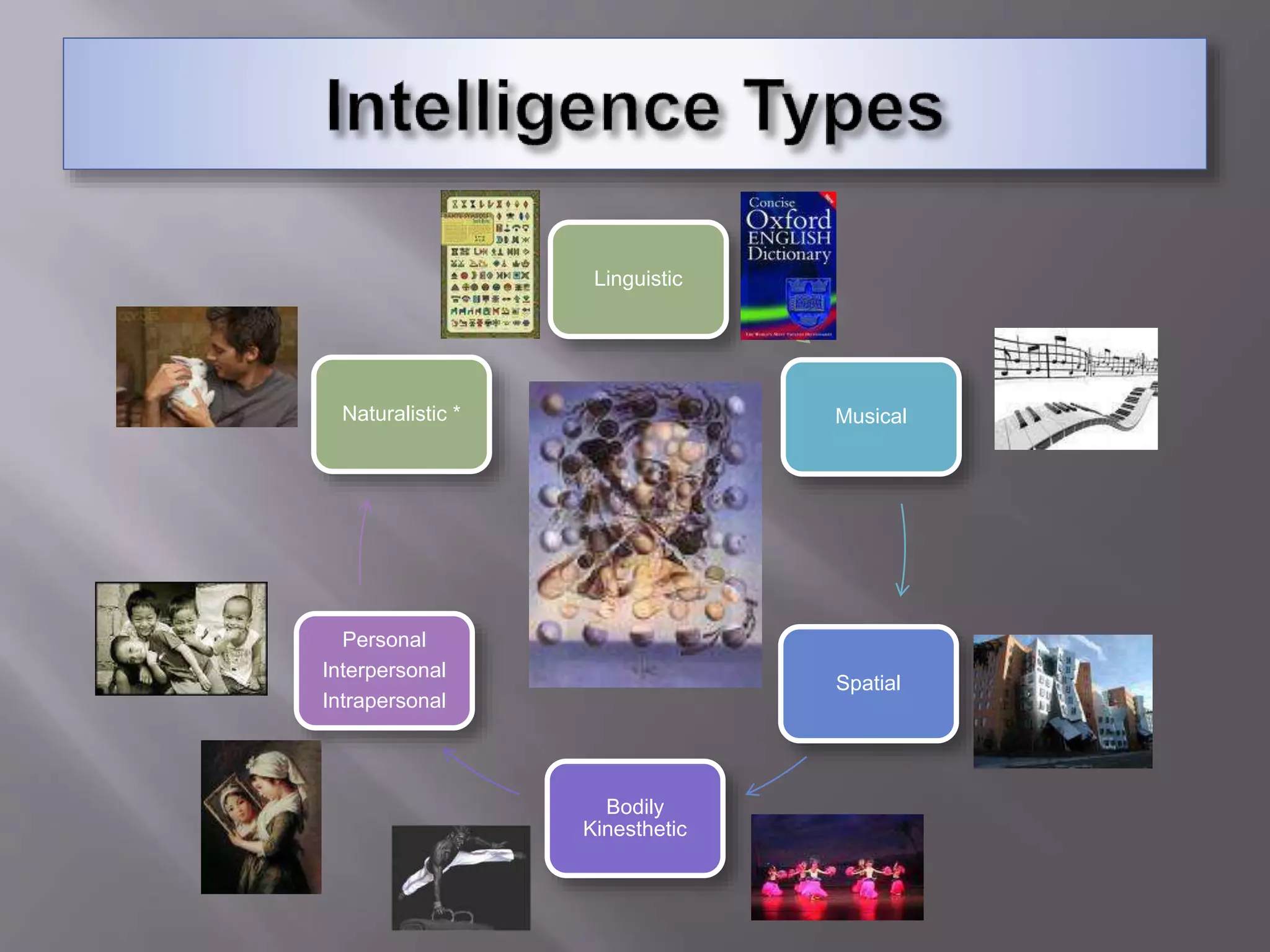
Linguistic
Musical
Spatial
Bodily
Kinesthetic
Personal
Interpersonal
Intrapersonal
Naturalistic *
Gardner’s Own Critical
Look at Multiple
Intelligence
Gardner himself
freely admits that
his theory of
Multiple
Intelligences
does not address
all of the
countless
unknowns that
make up the
human mind.
Points not covered in the theory are:
Social psychology
Personality
Temperment
Psychology of affect to
feelings
Character development
Motivation
Attention
Human will
Humans are plastic, ever developing, adapting
to new situations and evolving.
There are unlimited variations with numerous
and still some undiscovered measurable
intelligences.
H. Gardner believes that we need to continue
to think outside the box.
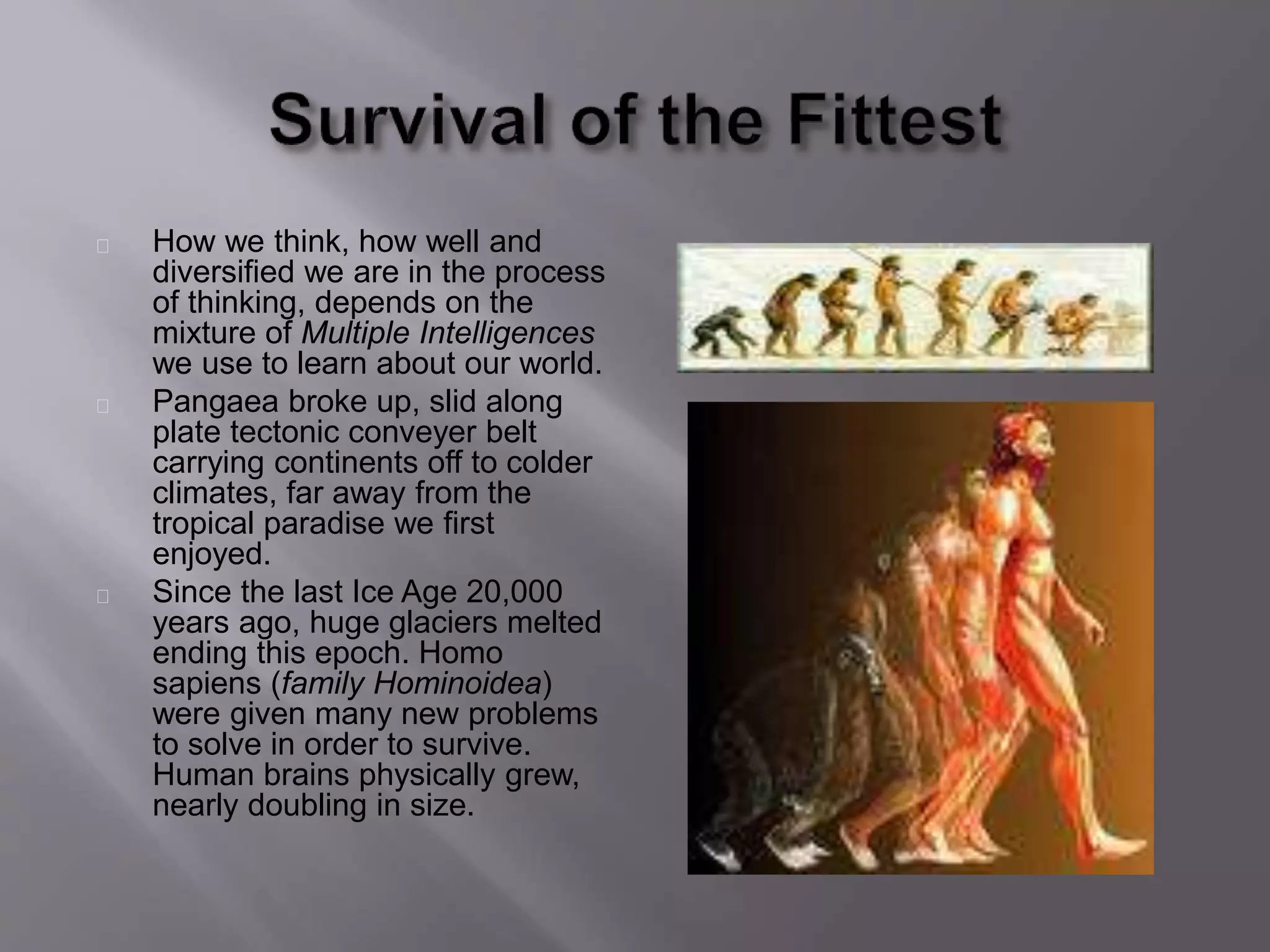
How we think, how well and
diversified we are in the process
of thinking, depends on the
mixture of Multiple Intelligences
we use to learn about our world.
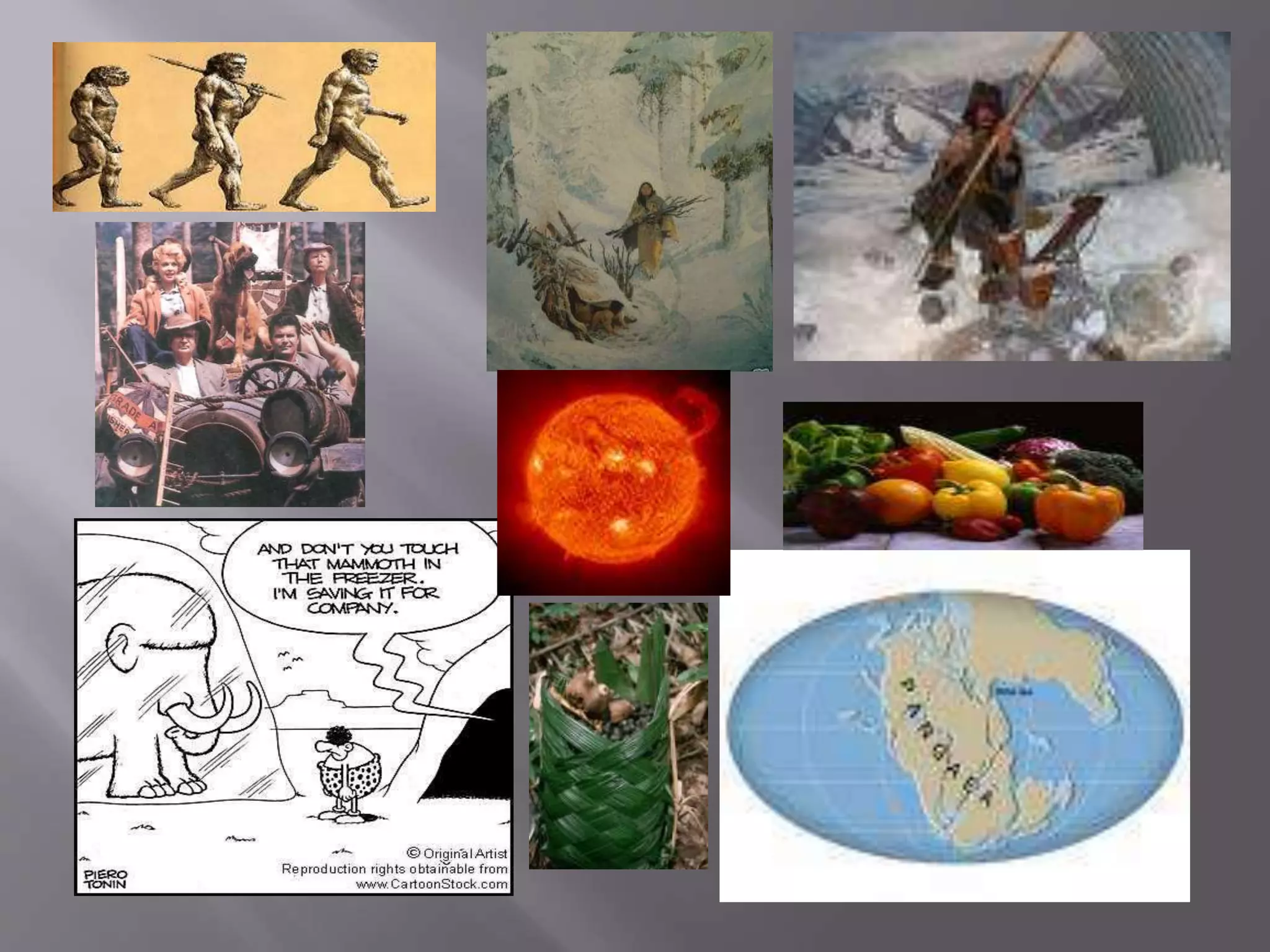
Pangaea broke up, slid along
plate tectonic conveyer belt
carrying continents off to colder
climates, far away from the
tropical paradise we first
enjoyed.
Since the last Ice Age 20,000
years ago, huge glaciers melted
ending this epoch. Homo
sapiens (family Hominoidea)
were given many new problems
to solve in order to survive.
Human brains physically grew,
nearly doubling in size.
We imagine Gardner would have many
concerns about the MCAS and how it is
designed and given to all students no matter
what type of learner.
The importance of grades over the personal
development of the character of youth.
Society needs, ethics and accountability need
to be part of curriculum design.
Why the slow incorporation of M.I. theory into
today pedagogy and assessments.
Agree ?
We firmly believe in
Multiple Intelligences.
More types of
intelligence will be
identified with greater
understanding and
technology to collect
data.
Disagree ?
We feel that there
may be more
integration than
Gardner claims
between the types of
intelligence.
On higher levels,
biological weaving
and interfacing.
What do you think about telepathy/intuition ?
Laptops for all students to use ?
Blending of all cultures, and what happens
when they clash ?
Are we headed for a global intelligence ?
Should we be teaching to a global family ?
Can we combine cultures, yet retain identity or,
will we be change completely ?
What will artifical intelligence (implant nano chips into
living cells) role be in our future ?

File 5 removed 4 slides 1

  • 1.
    “Only if weexpand and reformulate our view of what counts as human intellect, will we be able to devise more appropriate ways of assessing it, and more effective ways of educating it.“ p.4 H. Gardner, FRAMES of MIND
  • 2.
    His most notablereasons for investigating MI are: Examination of how a theory of Multiple Intelligences could impact education. Improve understanding of the impact of cultural variations on cognitive and psychological development. Fostering inquiry about how intelligences can be supported in various cultural settings.
  • 3.
    1. Potential isolationby brain damage 2. The existence of savants, prodigies, and uniquely gifted individuals. 3. Possesses an identifiable core operation or set of operations. 4. Has a distinct developmental history with end results. 5. Evolutionary history and plausibility. 6. Support from experimental psychological tasks. 7. Support from findings that emphasize or exclude certain intelligences. 8. Susceptibility to encoding in a system of symbols (i.e. words, numbers, notes, pictures, symbols etc.)
  • 5.
    Biological –DNA /RNA Genetics Experiences –Development Observations Symbols Culture Adaptations New Applications and the Transfer of Analytical Processes Body Movement, Problem Solving Skills,Listening The Process of Cognitive Learning Why do we think the way we do ? Cause & Effects
  • 6.
  • 7.
    Gardner’s Own Critical Lookat Multiple Intelligence Gardner himself freely admits that his theory of Multiple Intelligences does not address all of the countless unknowns that make up the human mind. Points not covered in the theory are: Social psychology Personality Temperment Psychology of affect to feelings Character development Motivation Attention Human will
  • 9.
    Humans are plastic,ever developing, adapting to new situations and evolving. There are unlimited variations with numerous and still some undiscovered measurable intelligences. H. Gardner believes that we need to continue to think outside the box.
  • 10.
    How we think,how well and diversified we are in the process of thinking, depends on the mixture of Multiple Intelligences we use to learn about our world. Pangaea broke up, slid along plate tectonic conveyer belt carrying continents off to colder climates, far away from the tropical paradise we first enjoyed. Since the last Ice Age 20,000 years ago, huge glaciers melted ending this epoch. Homo sapiens (family Hominoidea) were given many new problems to solve in order to survive. Human brains physically grew, nearly doubling in size.
  • 12.
    We imagine Gardnerwould have many concerns about the MCAS and how it is designed and given to all students no matter what type of learner. The importance of grades over the personal development of the character of youth. Society needs, ethics and accountability need to be part of curriculum design. Why the slow incorporation of M.I. theory into today pedagogy and assessments.
  • 14.
    Agree ? We firmlybelieve in Multiple Intelligences. More types of intelligence will be identified with greater understanding and technology to collect data. Disagree ? We feel that there may be more integration than Gardner claims between the types of intelligence. On higher levels, biological weaving and interfacing.
  • 15.
    What do youthink about telepathy/intuition ? Laptops for all students to use ? Blending of all cultures, and what happens when they clash ? Are we headed for a global intelligence ? Should we be teaching to a global family ? Can we combine cultures, yet retain identity or, will we be change completely ? What will artifical intelligence (implant nano chips into living cells) role be in our future ?