Humans and Nature
Introduction to Eastern and Western Art
“Art is a harmony parallel with nature.”
- Paul Cezanne, French Post-Impressionist artist (1839 - 1906)
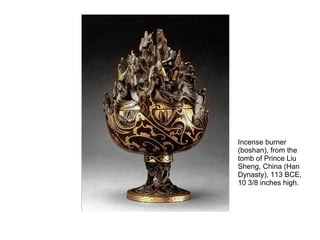
Incense burner
(boshan), from the
tomb of Prince Liu
Sheng, China (Han
Dynasty), 113 BCE,
10 3/8 inches high.
Prince Liu Sheng's bronze incense burner is in the form of a sacred
mountain. Han Daoists believed that everlasting life could be achieved in the
sacred mountains of the Islands of the Immortals in the Eastern Sea.
The basic idea of the Daoists was to enable people to realize that, since
human life is really only a small part of a larger process of nature, the
only human actions which ultimately make sense are those which are
in accord with the flow of Nature — the Dao or the Way. Their sensitivity
to the way of Nature prompted them to reject human ideas or standards
which might lead to an overly assertive mode of behavior or too strong a
commitment to the achievement of worldly goals. For Daoists, such
unnatural assertiveness was the root cause of violence and aggression.
Many Daoists went even further and denounced violence as reflecting the
ultimate ignorance of the Way of Nature.
Retrieved from http://afe.easia.columbia.edu/special/china_1000bce_daoism.htm
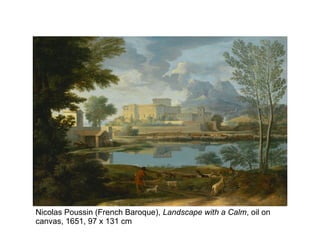
Nicolas Poussin (French Baroque), Landscape with a Calm, oil on
canvas, 1651, 97 x 131 cm
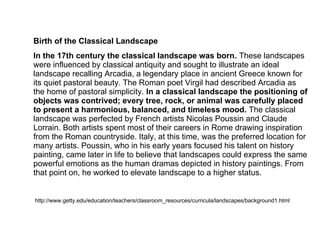
Birth of the Classical Landscape
In the 17th century the classical landscape was born. These landscapes
were influenced by classical antiquity and sought to illustrate an ideal
landscape recalling Arcadia, a legendary place in ancient Greece known for
its quiet pastoral beauty. The Roman poet Virgil had described Arcadia as
the home of pastoral simplicity. In a classical landscape the positioning of
objects was contrived; every tree, rock, or animal was carefully placed
to present a harmonious, balanced, and timeless mood. The classical
landscape was perfected by French artists Nicolas Poussin and Claude
Lorrain. Both artists spent most of their careers in Rome drawing inspiration
from the Roman countryside. Italy, at this time, was the preferred location for
many artists. Poussin, who in his early years focused his talent on history
painting, came later in life to believe that landscapes could express the same
powerful emotions as the human dramas depicted in history paintings. From
that point on, he worked to elevate landscape to a higher status.
http://www.getty.edu/education/teachers/classroom_resources/curricula/landscapes/background1.html
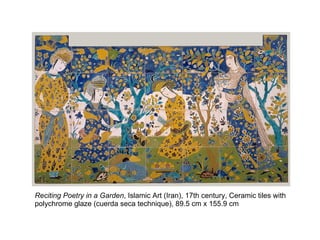
Reciting Poetry in a Garden, Islamic Art (Iran), 17th century, Ceramic tiles with
polychrome glaze (cuerda seca technique), 89.5 cm x 155.9 cm
A lush landscape provides the setting for a picnic, complete with fruit
and beverages in Chinese- style blue-and-white vessels. Two men sit in
conversation, one writing and holding a safina (an oblong format book
typically containing poetry), flanked by a man standing on the left and a
woman on the right carrying a covered bowl decorated with Chinese
designs. The patterned robes, silk sashes, and striped turbans
resemble costumes depicted in seventeenth‑ century Persian drawings
and paintings.
Retrieved from https://www.metmuseum.org/toah/works-of-art/03.9b/
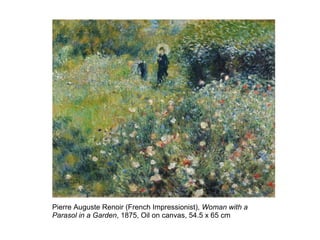
Pierre Auguste Renoir (French Impressionist), Woman with a
Parasol in a Garden, 1875, Oil on canvas, 54.5 x 65 cm
The Modern Landscape
The 19th century held many milestones for the history of landscape art.
As the Industrial Revolution altered the traditions of rural life, the old
hierarchy of subjects crumbled. Throughout Europe and North America
landscape painting gained a new supremacy. Many artists became less
concerned with idealized, classical landscapes and focused more on
painting out‑of‑doors directly from nature—a practice known as plein air
painting.
http://www.getty.edu/education/teachers/classroom_resources/curricula/landscapes/background1.html
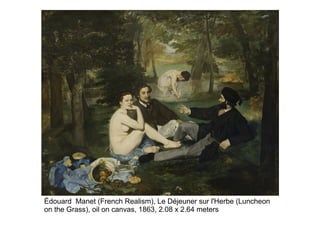
Édouard Manet (French Realism), Le Déjeuner sur l'Herbe (Luncheon
on the Grass), oil on canvas, 1863, 2.08 x 2.64 meters
Luncheon on the Grass ("Le Dejeuner sur l'Herbe," 1863) was one of a
number of impressionist works that broke away from the classical view
that art should obey established conventions and seek to achieve
timelessness. The painting was rejected by the salon that displayed
painting approved by the official French academy. The rejection was
occasioned not so much by the female nudes in Manet's painting, a classical
subject, as by their presence in a modern setting, accompanied by clothed,
bourgeois men. The incongruity suggested that the women were not
goddesses but models, or possibly prostitutes.
Retrieved from http://www.manet.org/luncheon-on-the-grass.jsp
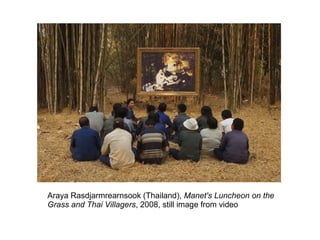
Araya Rasdjarmrearnsook (Thailand), Manet's Luncheon on the
Grass and Thai Villagers, 2008, still image from video
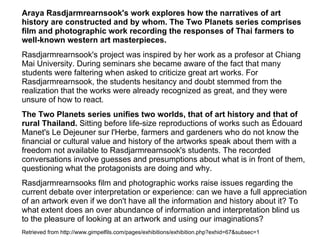
Araya Rasdjarmrearnsook's work explores how the narratives of art
history are constructed and by whom. The Two Planets series comprises
film and photographic work recording the responses of Thai farmers to
well‑known western art masterpieces.
Rasdjarmrearnsook's project was inspired by her work as a profesor at Chiang
Mai University. During seminars she became aware of the fact that many
students were faltering when asked to criticize great art works. For
Rasdjarmrearnsook, the students hesitancy and doubt stemmed from the
realization that the works were already recognized as great, and they were
unsure of how to react.
The Two Planets series unifies two worlds, that of art history and that of
rural Thailand. Sitting before life-size reproductions of works such as Édouard
Manet's Le Dejeuner sur l'Herbe, farmers and gardeners who do not know the
financial or cultural value and history of the artworks speak about them with a
freedom not available to Rasdjarmrearnsook's students. The recorded
conversations involve guesses and presumptions about what is in front of them,
questioning what the protagonists are doing and why.
Rasdjarmrearnsooks film and photographic works raise issues regarding the
current debate over interpretation or experience: can we have a full appreciation
of an artwork even if we don't have all the information and history about it? To
what extent does an over abundance of information and interpretation blind us
to the pleasure of looking at an artwork and using our imaginations?
Retrieved from http://www.gimpelfils.com/pages/exhibitions/exhibition.php?exhid=67&subsec=1
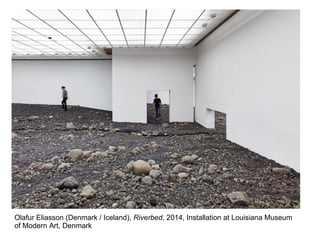
Olafur Eliasson (Denmark / Iceland), Riverbed, 2014, Installation at Louisiana Museum
of Modern Art, Denmark
Blurring the boundaries between the natural world and the manmade in one
wide, sweeping gesture, Danish‑Icelandic artist Olafur Elisson's solo
exhibit, aptly titled, Riverbed, brings the outdoors in.
Recreating an enormous, ruggedly enchanting landscape, complete with riverbed
and rocky earth, the artist draws heavily from site-specific inspiration. The
Louisiana Museum of Modern Art's location on the Danish coast lends a raw,
elemental and powerful character that extends into the building as a major
intervention, transforming into a work of art.
Eliasson's exhibition also questions the meaning and experience of the museum
itself, and the complexities of the relationship between the artist, building, and
viewer. Both grand and humble, the installation overturns expectations of the role
of museum-goer and dances between definitions of observer and participant. By
exploring the process of inhabiting space, Eliasson focuses the visitor's
attention on the art itself by encouraging the visitor to explore the
landscape. Thus, the visitor is both at the exhibit and on it.
By crafting a landscape, the artist evokes a primal sense of freedom.
Avoiding traditional expectations of behavior and thought associated with
museums, Eliasson strips away superficial information through the
emptiness of the landscape. There is nothing on the walls, and there is no
expected way to act within or experience the space, allowing for freedom of
reflection, thought, sensory experience, and sense of self.
Retrieved from https://www.archdaily.com/540338/olafur-eliasson-creates-an-indoor-riverbed-at-danish-museum
Art and Technology
Picture Making and the Birth of Photography
When photography was invented and became public in 1839, painting was
the domain of artists serving a variety of needs. Many of the artist's
functions were practical and served a range of social duties, celebrating and
building the prestige of eminent sitters, spreading information on the physical
appearance of the world, its landscape, its wonders, its cities and architecture,
commemorating events of local interest or of great historical importance, and
providing images which implemented the psychological grip of religions and the
hierarchies and structure of society.
Perhaps the greatest contribution which the new technique of photography
could make to painting was to liberate art from its ties to realism, to factuality.
There was, ultimately, no need for the artist's pencil or brush to labour
intensively to depict and record people, occasions or things which the
photographer could document through his lens with practical ease and speed.
Art was freed on its path to abstraction. The journey was not so swift, however,
nor the goal so immediately evident. The French painter Paul Delaroche is
credited with having claimed, on learning of the invention of photography,
that "from today painting is dead". His immediate anxieties were greatly
exaggerated. Painting flourished through the 19th century within a largely
traditional set of conventions and moved on in the first half of the 20th century
to the ambitious challenges of abstraction, pure form and color, leaving to
photographers the task of making visual records.
Retrieved from https://www.artrev.com/blog/blogentry.asp?bid=156
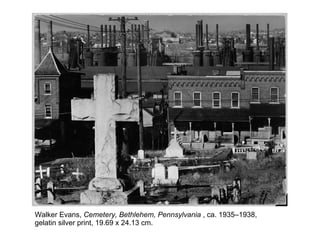
Walker Evans, Cemetery, Bethlehem, Pennsylvania , ca. 1935–1938,
gelatin silver print, 19.69 x 24.13 cm.
Walker Evans is one of the most influential artists of the twentieth century.
His elegant, crystal-clear photographs and articulate publications have inspired
several generations of artists. The progenitor of the documentary tradition in
American photography, Evans had the extraordinary ability to see the present as if
it were already the past, and to translate that knowledge and historically inflected
vision into an enduring art. His principal subject was the vernacular—the
indigenous expressions of a people found in roadside stands, cheap café,
advertisements, simple bedrooms, and small-town main streets. For fifty years,
from the late 1920s to the early 1970s, Evans recorded the American scene
with the nuance of a poet and the precision of a surgeon, creating an
encyclopedic visual catalogue of modern America in the making.
In the late 1930s, Walker Evans worked for the US government, and was
assigned to document small-town life and to demonstrate how the federal
government was attempting to improve the lot of rural communities during the
Depression. Evans, however, worked with little concern for the ideological agenda
or the suggested itineraries and instead answered a personal need to distill the
essence of American life from the simple and the ordinary. His photographs of
roadside architecture, rural churches, small‑town barbers, and cemeteries
reveal a deep respect for the neglected traditions of the common man and
secured his reputation as America’s preeminent documentarian. From their
first appearance in magazines and books in the late 1930s, these direct, iconic
images entered the public’s collective consciousness and are now deeply
embedded in the nation’s shared visual history of the Depression.
Retrieved from https://www.metmuseum.org/toah/hd/evan/hd_evan.htm
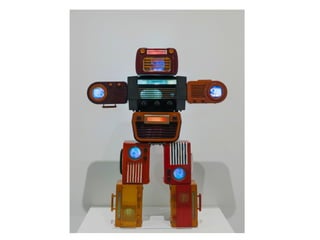
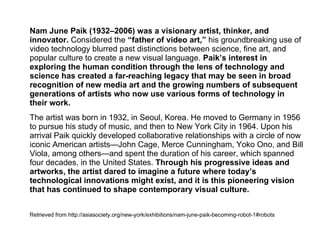
Nam June Paik (1932–2006) was a visionary artist, thinker, and
innovator. Considered the “father of video art,” his groundbreaking use of
video technology blurred past distinctions between science, fine art, and
popular culture to create a new visual language. Paik’s interest in
exploring the human condition through the lens of technology and
science has created a far‑reaching legacy that may be seen in broad
recognition of new media art and the growing numbers of subsequent
generations of artists who now use various forms of technology in
their work.
The artist was born in 1932, in Seoul, Korea. He moved to Germany in 1956
to pursue his study of music, and then to New York City in 1964. Upon his
arrival Paik quickly developed collaborative relationships with a circle of now
iconic American artists—John Cage, Merce Cunningham, Yoko Ono, and Bill
Viola, among others—and spent the duration of his career, which spanned
four decades, in the United States. Through his progressive ideas and
artworks, the artist dared to imagine a future where today’s
technological innovations might exist, and it is this pioneering vision
that has continued to shape contemporary visual culture.
Retrieved from http://asiasociety.org/new-york/exhibitions/nam-june-paik-becoming-robot-1#robots
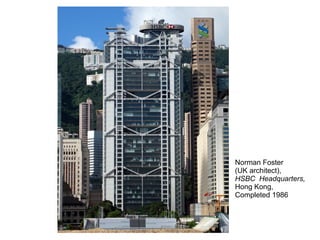
Norman Foster
(UK architect),
HSBC Headquarters,
Hong Kong,
Completed 1986
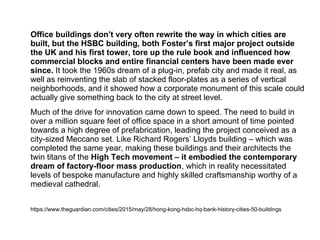
Office buildings don’t very often rewrite the way in which cities are
built, but the HSBC building, both Foster’s first major project outside
the UK and his first tower, tore up the rule book and influenced how
commercial blocks and entire financial centers have been made ever
since. It took the 1960s dream of a plug-in, prefab city and made it real, as
well as reinventing the slab of stacked floor-plates as a series of vertical
neighborhoods, and it showed how a corporate monument of this scale could
actually give something back to the city at street level.
Much of the drive for innovation came down to speed. The need to build in
over a million square feet of office space in a short amount of time pointed
towards a high degree of prefabrication, leading the project conceived as a
city-sized Meccano set. Like Richard Rogers’ Lloyds building – which was
completed the same year, making these buildings and their architects the
twin titans of the High Tech movement – it embodied the contemporary
dream of factory‑floor mass production, which in reality necessitated
levels of bespoke manufacture and highly skilled craftsmanship worthy of a
medieval cathedral.
https://www.theguardian.com/cities/2015/may/28/hong-kong-hsbc-hq-bank-history-cities-50-buildings
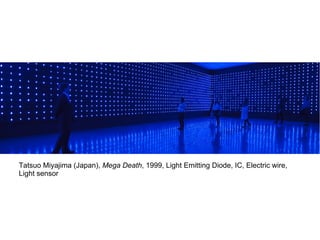
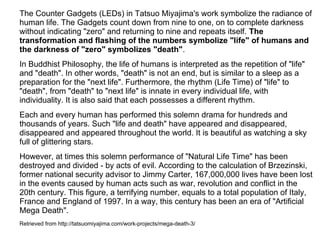
Tatsuo Miyajima (Japan), Mega Death, 1999, Light Emitting Diode, IC, Electric wire,
Light sensor
The Counter Gadgets (LEDs) in Tatsuo Miyajima's work symbolize the radiance of
human life. The Gadgets count down from nine to one, on to complete darkness
without indicating "zero" and returning to nine and repeats itself. The
transformation and flashing of the numbers symbolize "life" of humans and
the darkness of "zero" symbolizes "death".
In Buddhist Philosophy, the life of humans is interpreted as the repetition of "life"
and "death". In other words, "death" is not an end, but is similar to a sleep as a
preparation for the "next life". Furthermore, the rhythm (Life Time) of "life" to
"death", from "death" to "next life" is innate in every individual life, with
individuality. It is also said that each possesses a different rhythm.
Each and every human has performed this solemn drama for hundreds and
thousands of years. Such "life and death" have appeared and disappeared,
disappeared and appeared throughout the world. It is beautiful as watching a sky
full of glittering stars.
However, at times this solemn performance of "Natural Life Time" has been
destroyed and divided - by acts of evil. According to the calculation of Brzezinski,
former national security advisor to Jimmy Carter, 167,000,000 lives have been lost
in the events caused by human acts such as war, revolution and conflict in the
20th century. This figure, a terrifying number, equals to a total population of Italy,
France and England of 1997. In a way, this century has been an era of "Artificial
Mega Death".
Retrieved from http://tatsuomiyajima.com/work-projects/mega-death-3/
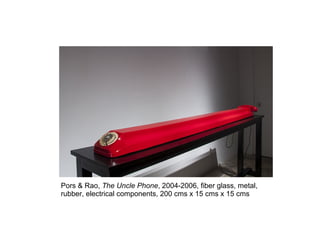
Pors & Rao, The Uncle Phone, 2004-2006, fiber glass, metal,
rubber, electrical components, 200 cms x 15 cms x 15 cms
Bangalore, India‑based artist Aparna Rao (b. 1978), collaborates with
Danish artist Soren Pors (b. 1974), re‑thinks and re‑imagines the
ordinary into something that is high‑tech, playful, witty, and incredibly
creative.
Rao has worked since 2004 with Pors, whom she met while on a research
scholarship at the Interaction Design Institute, Ivrea, Italy. Known as Pors &
Rao, the couple's multidisciplinary art practice draws on knowledge of
mechanical and electronic engineering, programming, and
manufacturing. Their work has been shown in Spain, India, Israel, Italy,
Norway, Japan, South Korea, and the United States.
Retrieved from http://writingwithoutpaper.blogspot.com/2011/12/re-imagination-of-aparna-rao.html

Humans and Nature

  • 1.
    Humans and Nature Introductionto Eastern and Western Art
  • 2.
    “Art is aharmony parallel with nature.” - Paul Cezanne, French Post-Impressionist artist (1839 - 1906)
  • 3.
    Incense burner (boshan), fromthe tomb of Prince Liu Sheng, China (Han Dynasty), 113 BCE, 10 3/8 inches high.
  • 4.
    Prince Liu Sheng'sbronze incense burner is in the form of a sacred mountain. Han Daoists believed that everlasting life could be achieved in the sacred mountains of the Islands of the Immortals in the Eastern Sea. The basic idea of the Daoists was to enable people to realize that, since human life is really only a small part of a larger process of nature, the only human actions which ultimately make sense are those which are in accord with the flow of Nature — the Dao or the Way. Their sensitivity to the way of Nature prompted them to reject human ideas or standards which might lead to an overly assertive mode of behavior or too strong a commitment to the achievement of worldly goals. For Daoists, such unnatural assertiveness was the root cause of violence and aggression. Many Daoists went even further and denounced violence as reflecting the ultimate ignorance of the Way of Nature. Retrieved from http://afe.easia.columbia.edu/special/china_1000bce_daoism.htm
  • 5.
    Nicolas Poussin (FrenchBaroque), Landscape with a Calm, oil on canvas, 1651, 97 x 131 cm
  • 6.
    Birth of theClassical Landscape In the 17th century the classical landscape was born. These landscapes were influenced by classical antiquity and sought to illustrate an ideal landscape recalling Arcadia, a legendary place in ancient Greece known for its quiet pastoral beauty. The Roman poet Virgil had described Arcadia as the home of pastoral simplicity. In a classical landscape the positioning of objects was contrived; every tree, rock, or animal was carefully placed to present a harmonious, balanced, and timeless mood. The classical landscape was perfected by French artists Nicolas Poussin and Claude Lorrain. Both artists spent most of their careers in Rome drawing inspiration from the Roman countryside. Italy, at this time, was the preferred location for many artists. Poussin, who in his early years focused his talent on history painting, came later in life to believe that landscapes could express the same powerful emotions as the human dramas depicted in history paintings. From that point on, he worked to elevate landscape to a higher status. http://www.getty.edu/education/teachers/classroom_resources/curricula/landscapes/background1.html
  • 7.
    Reciting Poetry ina Garden, Islamic Art (Iran), 17th century, Ceramic tiles with polychrome glaze (cuerda seca technique), 89.5 cm x 155.9 cm
  • 8.
    A lush landscapeprovides the setting for a picnic, complete with fruit and beverages in Chinese- style blue-and-white vessels. Two men sit in conversation, one writing and holding a safina (an oblong format book typically containing poetry), flanked by a man standing on the left and a woman on the right carrying a covered bowl decorated with Chinese designs. The patterned robes, silk sashes, and striped turbans resemble costumes depicted in seventeenth‑ century Persian drawings and paintings. Retrieved from https://www.metmuseum.org/toah/works-of-art/03.9b/
  • 9.
    Pierre Auguste Renoir(French Impressionist), Woman with a Parasol in a Garden, 1875, Oil on canvas, 54.5 x 65 cm
  • 10.
    The Modern Landscape The19th century held many milestones for the history of landscape art. As the Industrial Revolution altered the traditions of rural life, the old hierarchy of subjects crumbled. Throughout Europe and North America landscape painting gained a new supremacy. Many artists became less concerned with idealized, classical landscapes and focused more on painting out‑of‑doors directly from nature—a practice known as plein air painting. http://www.getty.edu/education/teachers/classroom_resources/curricula/landscapes/background1.html
  • 11.
    Édouard Manet (FrenchRealism), Le Déjeuner sur l'Herbe (Luncheon on the Grass), oil on canvas, 1863, 2.08 x 2.64 meters
  • 12.
    Luncheon on theGrass ("Le Dejeuner sur l'Herbe," 1863) was one of a number of impressionist works that broke away from the classical view that art should obey established conventions and seek to achieve timelessness. The painting was rejected by the salon that displayed painting approved by the official French academy. The rejection was occasioned not so much by the female nudes in Manet's painting, a classical subject, as by their presence in a modern setting, accompanied by clothed, bourgeois men. The incongruity suggested that the women were not goddesses but models, or possibly prostitutes. Retrieved from http://www.manet.org/luncheon-on-the-grass.jsp
  • 13.
    Araya Rasdjarmrearnsook (Thailand),Manet's Luncheon on the Grass and Thai Villagers, 2008, still image from video
  • 14.
    Araya Rasdjarmrearnsook's workexplores how the narratives of art history are constructed and by whom. The Two Planets series comprises film and photographic work recording the responses of Thai farmers to well‑known western art masterpieces. Rasdjarmrearnsook's project was inspired by her work as a profesor at Chiang Mai University. During seminars she became aware of the fact that many students were faltering when asked to criticize great art works. For Rasdjarmrearnsook, the students hesitancy and doubt stemmed from the realization that the works were already recognized as great, and they were unsure of how to react. The Two Planets series unifies two worlds, that of art history and that of rural Thailand. Sitting before life-size reproductions of works such as Édouard Manet's Le Dejeuner sur l'Herbe, farmers and gardeners who do not know the financial or cultural value and history of the artworks speak about them with a freedom not available to Rasdjarmrearnsook's students. The recorded conversations involve guesses and presumptions about what is in front of them, questioning what the protagonists are doing and why. Rasdjarmrearnsooks film and photographic works raise issues regarding the current debate over interpretation or experience: can we have a full appreciation of an artwork even if we don't have all the information and history about it? To what extent does an over abundance of information and interpretation blind us to the pleasure of looking at an artwork and using our imaginations? Retrieved from http://www.gimpelfils.com/pages/exhibitions/exhibition.php?exhid=67&subsec=1
  • 15.
    Olafur Eliasson (Denmark/ Iceland), Riverbed, 2014, Installation at Louisiana Museum of Modern Art, Denmark
  • 16.
    Blurring the boundariesbetween the natural world and the manmade in one wide, sweeping gesture, Danish‑Icelandic artist Olafur Elisson's solo exhibit, aptly titled, Riverbed, brings the outdoors in. Recreating an enormous, ruggedly enchanting landscape, complete with riverbed and rocky earth, the artist draws heavily from site-specific inspiration. The Louisiana Museum of Modern Art's location on the Danish coast lends a raw, elemental and powerful character that extends into the building as a major intervention, transforming into a work of art. Eliasson's exhibition also questions the meaning and experience of the museum itself, and the complexities of the relationship between the artist, building, and viewer. Both grand and humble, the installation overturns expectations of the role of museum-goer and dances between definitions of observer and participant. By exploring the process of inhabiting space, Eliasson focuses the visitor's attention on the art itself by encouraging the visitor to explore the landscape. Thus, the visitor is both at the exhibit and on it. By crafting a landscape, the artist evokes a primal sense of freedom. Avoiding traditional expectations of behavior and thought associated with museums, Eliasson strips away superficial information through the emptiness of the landscape. There is nothing on the walls, and there is no expected way to act within or experience the space, allowing for freedom of reflection, thought, sensory experience, and sense of self. Retrieved from https://www.archdaily.com/540338/olafur-eliasson-creates-an-indoor-riverbed-at-danish-museum
  • 17.
  • 18.
    Picture Making andthe Birth of Photography When photography was invented and became public in 1839, painting was the domain of artists serving a variety of needs. Many of the artist's functions were practical and served a range of social duties, celebrating and building the prestige of eminent sitters, spreading information on the physical appearance of the world, its landscape, its wonders, its cities and architecture, commemorating events of local interest or of great historical importance, and providing images which implemented the psychological grip of religions and the hierarchies and structure of society. Perhaps the greatest contribution which the new technique of photography could make to painting was to liberate art from its ties to realism, to factuality. There was, ultimately, no need for the artist's pencil or brush to labour intensively to depict and record people, occasions or things which the photographer could document through his lens with practical ease and speed. Art was freed on its path to abstraction. The journey was not so swift, however, nor the goal so immediately evident. The French painter Paul Delaroche is credited with having claimed, on learning of the invention of photography, that "from today painting is dead". His immediate anxieties were greatly exaggerated. Painting flourished through the 19th century within a largely traditional set of conventions and moved on in the first half of the 20th century to the ambitious challenges of abstraction, pure form and color, leaving to photographers the task of making visual records. Retrieved from https://www.artrev.com/blog/blogentry.asp?bid=156
  • 19.
    Walker Evans, Cemetery,Bethlehem, Pennsylvania , ca. 1935–1938, gelatin silver print, 19.69 x 24.13 cm.
  • 20.
    Walker Evans isone of the most influential artists of the twentieth century. His elegant, crystal-clear photographs and articulate publications have inspired several generations of artists. The progenitor of the documentary tradition in American photography, Evans had the extraordinary ability to see the present as if it were already the past, and to translate that knowledge and historically inflected vision into an enduring art. His principal subject was the vernacular—the indigenous expressions of a people found in roadside stands, cheap café, advertisements, simple bedrooms, and small-town main streets. For fifty years, from the late 1920s to the early 1970s, Evans recorded the American scene with the nuance of a poet and the precision of a surgeon, creating an encyclopedic visual catalogue of modern America in the making. In the late 1930s, Walker Evans worked for the US government, and was assigned to document small-town life and to demonstrate how the federal government was attempting to improve the lot of rural communities during the Depression. Evans, however, worked with little concern for the ideological agenda or the suggested itineraries and instead answered a personal need to distill the essence of American life from the simple and the ordinary. His photographs of roadside architecture, rural churches, small‑town barbers, and cemeteries reveal a deep respect for the neglected traditions of the common man and secured his reputation as America’s preeminent documentarian. From their first appearance in magazines and books in the late 1930s, these direct, iconic images entered the public’s collective consciousness and are now deeply embedded in the nation’s shared visual history of the Depression. Retrieved from https://www.metmuseum.org/toah/hd/evan/hd_evan.htm
  • 22.
    Nam June Paik(1932–2006) was a visionary artist, thinker, and innovator. Considered the “father of video art,” his groundbreaking use of video technology blurred past distinctions between science, fine art, and popular culture to create a new visual language. Paik’s interest in exploring the human condition through the lens of technology and science has created a far‑reaching legacy that may be seen in broad recognition of new media art and the growing numbers of subsequent generations of artists who now use various forms of technology in their work. The artist was born in 1932, in Seoul, Korea. He moved to Germany in 1956 to pursue his study of music, and then to New York City in 1964. Upon his arrival Paik quickly developed collaborative relationships with a circle of now iconic American artists—John Cage, Merce Cunningham, Yoko Ono, and Bill Viola, among others—and spent the duration of his career, which spanned four decades, in the United States. Through his progressive ideas and artworks, the artist dared to imagine a future where today’s technological innovations might exist, and it is this pioneering vision that has continued to shape contemporary visual culture. Retrieved from http://asiasociety.org/new-york/exhibitions/nam-june-paik-becoming-robot-1#robots
  • 23.
    Norman Foster (UK architect), HSBCHeadquarters, Hong Kong, Completed 1986
  • 24.
    Office buildings don’tvery often rewrite the way in which cities are built, but the HSBC building, both Foster’s first major project outside the UK and his first tower, tore up the rule book and influenced how commercial blocks and entire financial centers have been made ever since. It took the 1960s dream of a plug-in, prefab city and made it real, as well as reinventing the slab of stacked floor-plates as a series of vertical neighborhoods, and it showed how a corporate monument of this scale could actually give something back to the city at street level. Much of the drive for innovation came down to speed. The need to build in over a million square feet of office space in a short amount of time pointed towards a high degree of prefabrication, leading the project conceived as a city-sized Meccano set. Like Richard Rogers’ Lloyds building – which was completed the same year, making these buildings and their architects the twin titans of the High Tech movement – it embodied the contemporary dream of factory‑floor mass production, which in reality necessitated levels of bespoke manufacture and highly skilled craftsmanship worthy of a medieval cathedral. https://www.theguardian.com/cities/2015/may/28/hong-kong-hsbc-hq-bank-history-cities-50-buildings
  • 25.
    Tatsuo Miyajima (Japan),Mega Death, 1999, Light Emitting Diode, IC, Electric wire, Light sensor
  • 26.
    The Counter Gadgets(LEDs) in Tatsuo Miyajima's work symbolize the radiance of human life. The Gadgets count down from nine to one, on to complete darkness without indicating "zero" and returning to nine and repeats itself. The transformation and flashing of the numbers symbolize "life" of humans and the darkness of "zero" symbolizes "death". In Buddhist Philosophy, the life of humans is interpreted as the repetition of "life" and "death". In other words, "death" is not an end, but is similar to a sleep as a preparation for the "next life". Furthermore, the rhythm (Life Time) of "life" to "death", from "death" to "next life" is innate in every individual life, with individuality. It is also said that each possesses a different rhythm. Each and every human has performed this solemn drama for hundreds and thousands of years. Such "life and death" have appeared and disappeared, disappeared and appeared throughout the world. It is beautiful as watching a sky full of glittering stars. However, at times this solemn performance of "Natural Life Time" has been destroyed and divided - by acts of evil. According to the calculation of Brzezinski, former national security advisor to Jimmy Carter, 167,000,000 lives have been lost in the events caused by human acts such as war, revolution and conflict in the 20th century. This figure, a terrifying number, equals to a total population of Italy, France and England of 1997. In a way, this century has been an era of "Artificial Mega Death". Retrieved from http://tatsuomiyajima.com/work-projects/mega-death-3/
  • 27.
    Pors & Rao,The Uncle Phone, 2004-2006, fiber glass, metal, rubber, electrical components, 200 cms x 15 cms x 15 cms
  • 28.
    Bangalore, India‑based artistAparna Rao (b. 1978), collaborates with Danish artist Soren Pors (b. 1974), re‑thinks and re‑imagines the ordinary into something that is high‑tech, playful, witty, and incredibly creative. Rao has worked since 2004 with Pors, whom she met while on a research scholarship at the Interaction Design Institute, Ivrea, Italy. Known as Pors & Rao, the couple's multidisciplinary art practice draws on knowledge of mechanical and electronic engineering, programming, and manufacturing. Their work has been shown in Spain, India, Israel, Italy, Norway, Japan, South Korea, and the United States. Retrieved from http://writingwithoutpaper.blogspot.com/2011/12/re-imagination-of-aparna-rao.html