MAS10 - REVIEWER
VENUS OF WILLENDORF
       Artist: Unknown
Date: 25,000 B.C to 21,000 B.c
      Period: Prehistoric
The most famous Paleolithic sculpture.
      Carved out of limestone
   Bulbous oval shape emphasizes
 the head, breasts, torso and thighs.

     Considered “Portable art.”
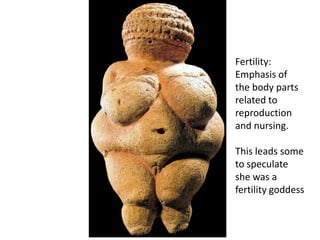
Fertility:
Emphasis of
the body parts
related to
reproduction
and nursing.

This leads some
to speculate
she was a
fertility goddess
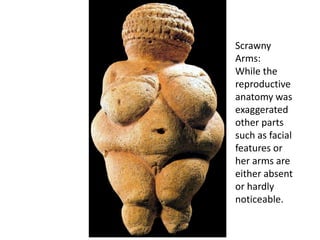
Scrawny
Arms:
While the
reproductive
anatomy was
exaggerated
other parts
such as facial
features or
her arms are
either absent
or hardly
noticeable.
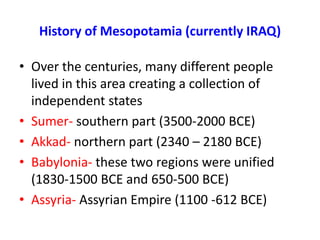
History of Mesopotamia (currently IRAQ)

• Over the centuries, many different people
  lived in this area creating a collection of
  independent states
• Sumer- southern part (3500-2000 BCE)
• Akkad- northern part (2340 – 2180 BCE)
• Babylonia- these two regions were unified
  (1830-1500 BCE and 650-500 BCE)
• Assyria- Assyrian Empire (1100 -612 BCE)
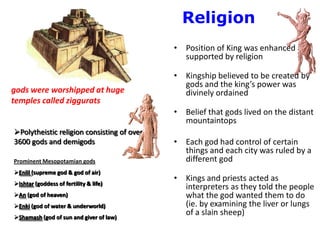
Religion
                                            • Position of King was enhanced and
                                              supported by religion

                                            • Kingship believed to be created by
                                              gods and the king’s power was
gods were worshipped at huge                  divinely ordained
temples called ziggurats
                                            • Belief that gods lived on the distant
                                              mountaintops
Polytheistic religion consisting of over
3600 gods and demigods                      • Each god had control of certain
                                              things and each city was ruled by a
Prominent Mesopotamian gods                   different god
Enlil (supreme god & god of air)
                                            • Kings and priests acted as
Ishtar (goddess of fertility & life)
                                              interpreters as they told the people
An (god of heaven)                           what the god wanted them to do
Enki (god of water & underworld)             (ie. by examining the liver or lungs
Shamash (god of sun and giver of law)
                                              of a slain sheep)
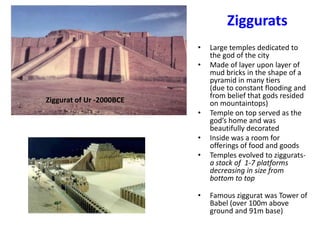
Ziggurats
                          •   Large temples dedicated to
                              the god of the city
                          •   Made of layer upon layer of
                              mud bricks in the shape of a
                              pyramid in many tiers
                              (due to constant flooding and
                              from belief that gods resided
Ziggurat of Ur -2000BCE       on mountaintops)
                          •   Temple on top served as the
                              god’s home and was
                              beautifully decorated
                          •   Inside was a room for
                              offerings of food and goods
                          •   Temples evolved to ziggurats-
                              a stack of 1-7 platforms
                              decreasing in size from
                              bottom to top

                          •   Famous ziggurat was Tower of
                              Babel (over 100m above
                              ground and 91m base)
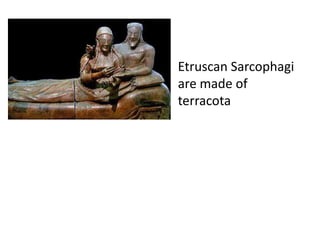
• Etruscan Sarcophagi
  are made of
  terracota
GREEK ART
• Divided into four periods:
  – Geometric period
  – Archaic period
  – Classical Period
  – Hellenistic period
GEOMETRIC PERIOD
• Spanned approximately two centuries, 900 to
  700 BCE.

• Dark age of Greece – collapse of civilization.
  Greece was gripped by chaos and poverty.

• So called due to its predominant style of
  geometric shapes and patterns in works of art.
• Dipylon Vase – a
  large krater used as
  grave marker and
  found in the dipylon
  cemetery of Athens.
ARCHAIC PERIOD
• Spanned roughly from 660 – 480 BCE.

• The expansion of trade with eastern countries
  influenced their art form.

• Flowing forms and fantastic animals –
  MESOPOTAMIAN ART

• Growing emphasis on the HUMAN FIGURE.
GREEK ARCHITECTURE
• Greek life was dominated by religion and so it
  is not surprising that the temples of ancient
  Greece were the biggest and most beautiful.

• Political purpose – celebrate and glorify their
  success in war.

• Developed Three architectural system or
  Orders: Doric, Ionic, and Corinthian.
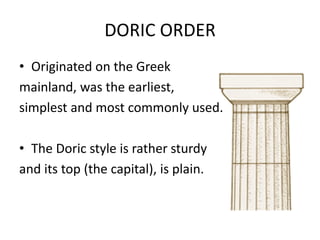
DORIC ORDER
• Originated on the Greek
mainland, was the earliest,
simplest and most commonly used.

• The Doric style is rather sturdy
and its top (the capital), is plain.
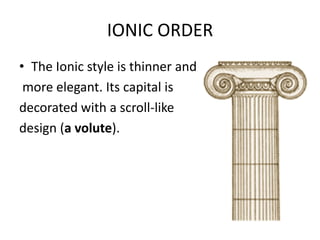
IONIC ORDER
• The Ionic style is thinner and
 more elegant. Its capital is
decorated with a scroll-like
design (a volute).
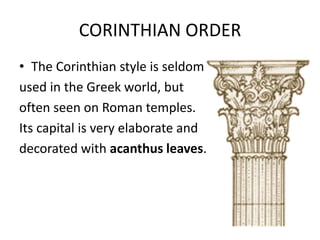
CORINTHIAN ORDER
• The Corinthian style is seldom
used in the Greek world, but
often seen on Roman temples.
Its capital is very elaborate and
decorated with acanthus leaves.
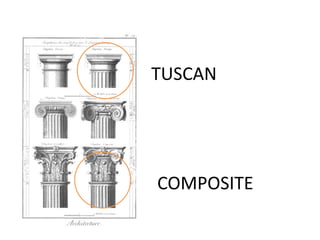
TUSCAN


COMPOSITE
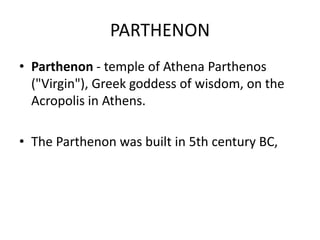
PARTHENON
• Parthenon - temple of Athena Parthenos
  ("Virgin"), Greek goddess of wisdom, on the
  Acropolis in Athens.

• The Parthenon was built in 5th century BC,
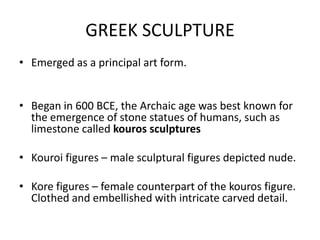
GREEK SCULPTURE
• Emerged as a principal art form.


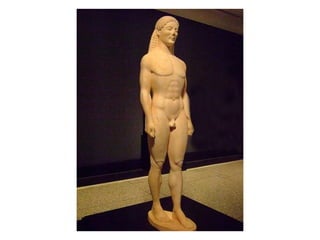
• Began in 600 BCE, the Archaic age was best known for
  the emergence of stone statues of humans, such as
  limestone called kouros sculptures

• Kouroi figures – male sculptural figures depicted nude.

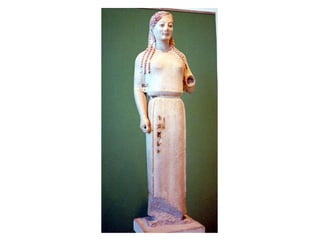
• Kore figures – female counterpart of the kouros figure.
  Clothed and embellished with intricate carved detail.
GOLDEN AGE OF GREECE
• the time Athens rose to prominence and Greek
  expansion

• the Classical age could be seen as a turning point
  in art.

• creating statues and mastered marble

• celebrating mankind as an independent entity
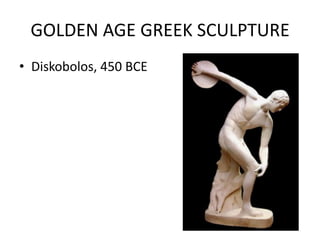
GOLDEN AGE GREEK SCULPTURE
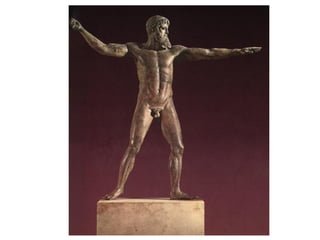
• Diskobolos, 450 BCE
Contrapposto
• Figure rests weight on one leg, which is
  planted firmly on the ground, while the torso
  is slanted or forms a diagonal, creating an S-
  like arrangement for the body
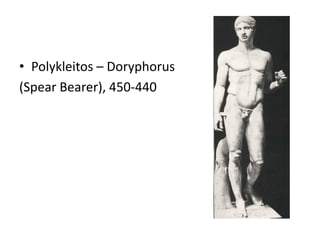
• Polykleitos – Doryphorus
(Spear Bearer), 450-440
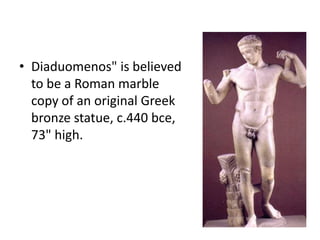
• Diaduomenos" is believed
  to be a Roman marble
  copy of an original Greek
  bronze statue, c.440 bce,
  73" high.
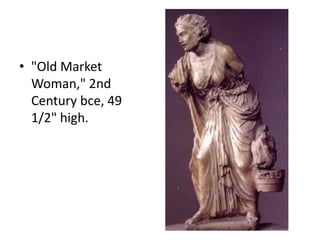
• "Old Market
  Woman," 2nd
  Century bce, 49
  1/2" high.
LATE CLASSICAL PERIOD
• Brought a more humanistic and naturalistic
  style, which emphasizes on the expression of
  the emotion.

• Praxiteles – proponent of the late classical
  period style
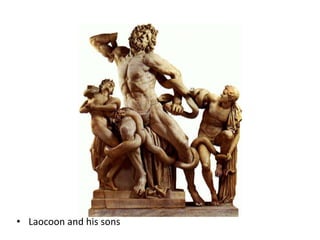
• Laocoon and his sons
HELLENISTIC PERIOD
• began around the death of Alexander the
  Great

• Characterized by excessive, almost theatrical
  emotion and the use of illusionistic effects to
  heighten realism.
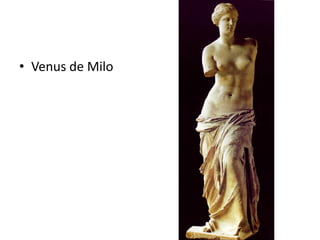
• Venus de Milo
ROMAN ART
• Roman art combined native talent, needs and styles
  with other artistic sources, particularly that of Greece.

• Mt. Vesuvius is important in history for Burying the city
  called Pompeii during the eruption on 79 CE.

• Imitators of Greek Art.

• Master builder – builds from concrete
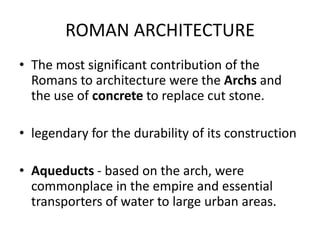
ROMAN SCULPTURE
• Introduced Realism in sculpture – Rome’s
  unique contribution to the arts.

• portrait sculpture of Roman emperors were
  often used for propaganda purposes
ROMAN ARCHITECTURE
• The most significant contribution of the
  Romans to architecture were the Archs and
  the use of concrete to replace cut stone.

• legendary for the durability of its construction

• Aqueducts - based on the arch, were
  commonplace in the empire and essential
  transporters of water to large urban areas.
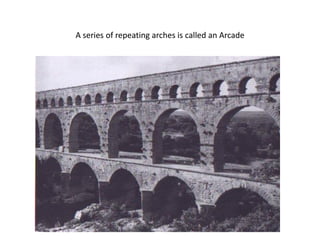
A series of repeating arches is called an Arcade
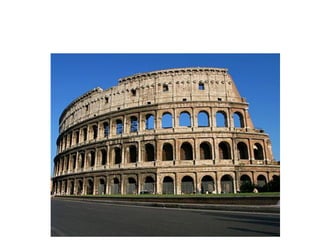
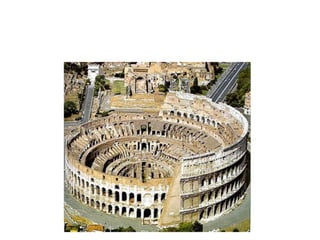
COLLOSSEUM
• Colosseum – a structure consists of two back-
  to-back amphitheaters forming an oval arena,
  around which rows of marble bleachers.
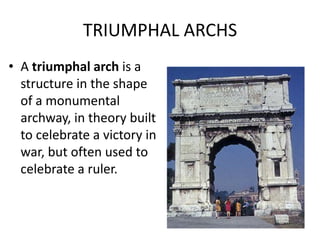
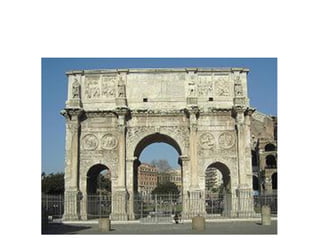
TRIUMPHAL ARCHS
• A triumphal arch is a
  structure in the shape
  of a monumental
  archway, in theory built
  to celebrate a victory in
  war, but often used to
  celebrate a ruler.
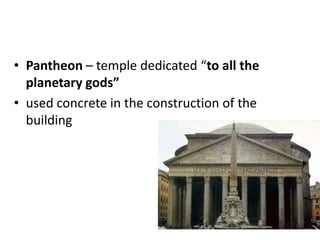
• Pantheon – temple dedicated “to all the
  planetary gods”
• used concrete in the construction of the
  building
Artistic Achievements of the Renaissance
•Renaissance art has the following characteristics:

•It imitates the classical work of Greece/Rome and
rejects the medieval forms of art.

•It is very realistic.

•It portrays secular themes and glorifies the
achievements of the individual.
RENAISSANCE ARTISTS
• Donatello (1386–1466).
• Leonardo da Vinci (1452–1519)
• Michelangelo (1475–1564)
• Raphael (1438–1520)
RENAISSANCE ARTISTS
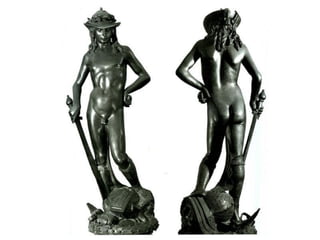
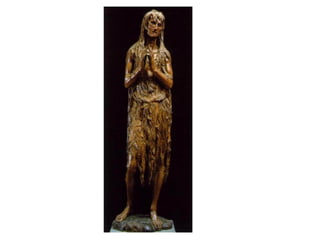
• Donatello di Betto Bardi (1386–1466).

    •was the most influential Florentine artist before Michelangelo. He revived the
    classical figure of the nude body with its balance and self-awareness
RENAISSANCE ARTISTS
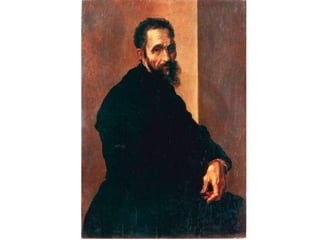
•Michelangelo Buonarotti (1475–1564)


•Born in 1475 in a small town near Florence, is considered
to be one of the most inspired men who ever lived
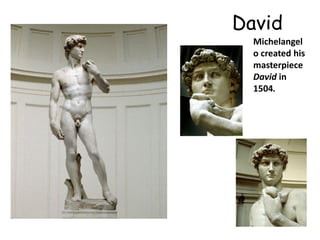
David
  Michelangel
  o created his
  masterpiece
  David in
  1504.
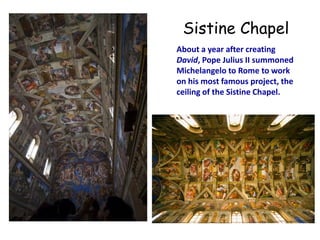
Sistine Chapel
About a year after creating
David, Pope Julius II summoned
Michelangelo to Rome to work
on his most famous project, the
ceiling of the Sistine Chapel.
Creation of Eve                  Creation of Adam


Separation of Light and Darkness   The Last Judgment
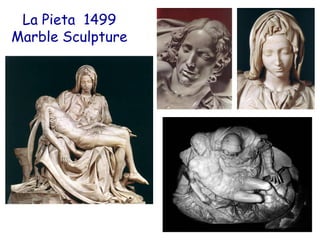
La Pieta 1499
Marble Sculpture
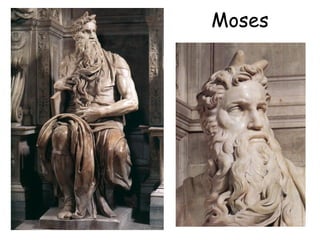
Moses
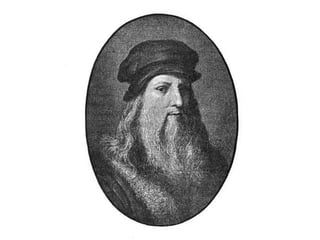
RENAISSANCE ARTISTS
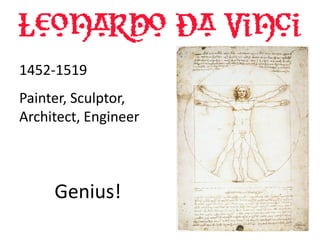
•Leonardo di ser peiro da Vinci (1452–1519)


•is known as a “Renaissance man,” a person expert in many fields who has a wide
range of interests.
1452-1519
Painter, Sculptor,
Architect, Engineer


     Genius!
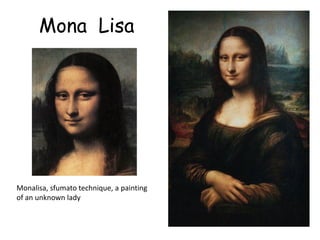
Mona Lisa


Monalisa, sfumato technique, a painting
of an unknown lady
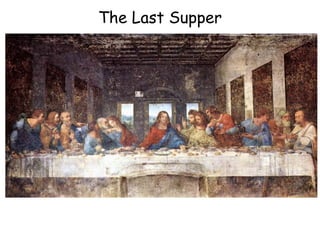
The Last Supper
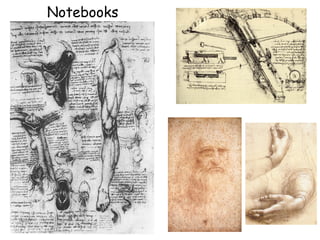
Notebooks
RENAISSANCE ARTISTS
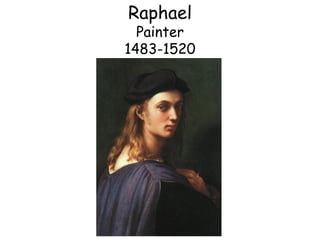
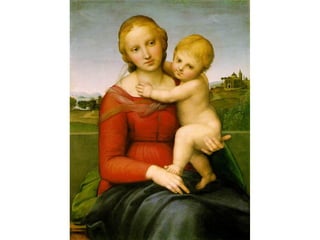
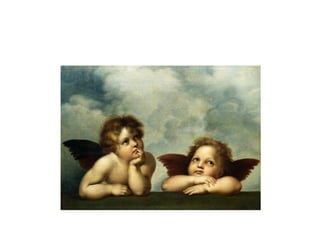
•Raphael Sanzio da Urbino (1438–1520)

•He is considered to be the greatest painter of the Renaissance.

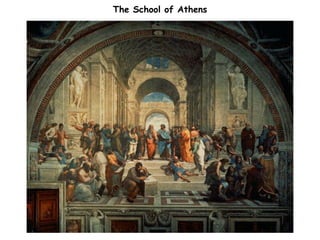
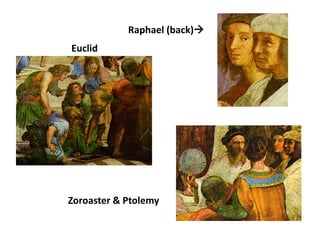
•Famous for his work, the SCHOOL OF ATHENS
Raphael
  Painter
1483-1520
The School of Athens
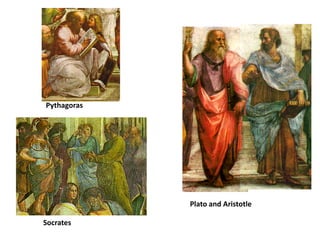
Pythagoras


             Plato and Aristotle

Socrates
Raphael (back)
Euclid


Zoroaster & Ptolemy
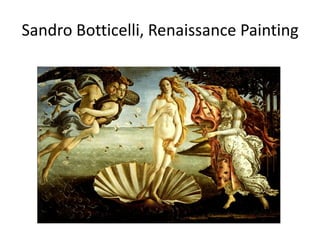
Sandro Botticelli, Renaissance Painting
Neoclassical Art
Art Characteristics
   Rejected the excess & ornamentation of the Baroque period
   Formal
   Used for Propaganda
   Greek and Roman themes
   Restraint in color, space and emotion
   Interested in:
         Discipline
         Order
         A moral view of the universe
         The idea of “art as enlightenment”
 Style features:
         Clean, linear style
         “Simple but elegant”
         Neutral colors
         Shallow depth of background (not much 3-D)
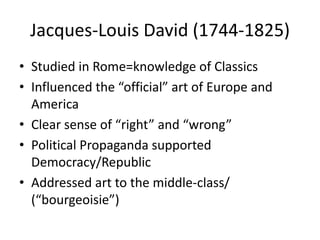
Jacques-Louis David (1744-1825)
• Studied in Rome=knowledge of Classics
• Influenced the “official” art of Europe and
  America
• Clear sense of “right” and “wrong”
• Political Propaganda supported
  Democracy/Republic
• Addressed art to the middle-class/
  (“bourgeoisie”)
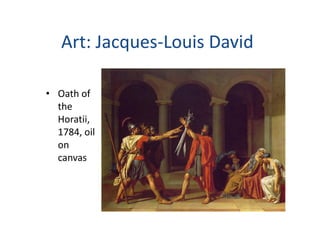
Art: Jacques-Louis David

• Oath of
  the
  Horatii,
  1784, oil
  on
  canvas
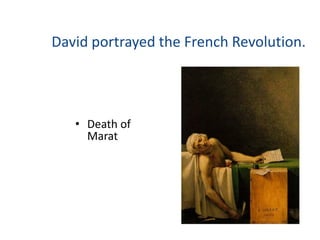
David portrayed the French Revolution.


   • Death of
     Marat
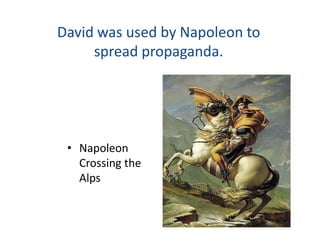
David was used by Napoleon to
     spread propaganda.


 • Napoleon
   Crossing the
   Alps
• Students in 19C art academies were taught to
  draw using plaster casts from museums and
  draw from nude models
DEFINITION OF TERMS
• Byzantine
  Characterized by a rich use of color and figures
  that are applied flat and stiff. The figures also
  tend to appear to be floating and have large eyes.


• Academic Art
  a highly established, often realistic, tradition,
  showing expert command of artistry and other
  techniques in painting.
• Romanesque
  A type of architecture exterior shows a heavy,
  fortress-like structure is enlivened by round
  arches, colonettes, and other Roman motifs.
- Chiarascuro
  a technique first seen during the gothic era in
  the frescoes in the (Arena Chapel) Scrovegni
  Chapel in Padua by Giotto
• Genre painting
  Are paintings of scenes of everyday life
• Fresco
  a painting done on wet plaster
• Classic
  highest standard/excellence in art, refers to
  classical greek and roman culture

Mas10 reviewer

  • 1.
  • 2.
    VENUS OF WILLENDORF Artist: Unknown Date: 25,000 B.C to 21,000 B.c Period: Prehistoric
  • 3.
    The most famousPaleolithic sculpture. Carved out of limestone Bulbous oval shape emphasizes the head, breasts, torso and thighs. Considered “Portable art.”
  • 4.
    Fertility: Emphasis of the bodyparts related to reproduction and nursing. This leads some to speculate she was a fertility goddess
  • 5.
    Scrawny Arms: While the reproductive anatomy was exaggerated otherparts such as facial features or her arms are either absent or hardly noticeable.
  • 6.
    History of Mesopotamia(currently IRAQ) • Over the centuries, many different people lived in this area creating a collection of independent states • Sumer- southern part (3500-2000 BCE) • Akkad- northern part (2340 – 2180 BCE) • Babylonia- these two regions were unified (1830-1500 BCE and 650-500 BCE) • Assyria- Assyrian Empire (1100 -612 BCE)
  • 7.
    Religion • Position of King was enhanced and supported by religion • Kingship believed to be created by gods and the king’s power was gods were worshipped at huge divinely ordained temples called ziggurats • Belief that gods lived on the distant mountaintops Polytheistic religion consisting of over 3600 gods and demigods • Each god had control of certain things and each city was ruled by a Prominent Mesopotamian gods different god Enlil (supreme god & god of air) • Kings and priests acted as Ishtar (goddess of fertility & life) interpreters as they told the people An (god of heaven) what the god wanted them to do Enki (god of water & underworld) (ie. by examining the liver or lungs Shamash (god of sun and giver of law) of a slain sheep)
  • 8.
    Ziggurats • Large temples dedicated to the god of the city • Made of layer upon layer of mud bricks in the shape of a pyramid in many tiers (due to constant flooding and from belief that gods resided Ziggurat of Ur -2000BCE on mountaintops) • Temple on top served as the god’s home and was beautifully decorated • Inside was a room for offerings of food and goods • Temples evolved to ziggurats- a stack of 1-7 platforms decreasing in size from bottom to top • Famous ziggurat was Tower of Babel (over 100m above ground and 91m base)
  • 9.
    • Etruscan Sarcophagi are made of terracota
  • 10.
    GREEK ART • Dividedinto four periods: – Geometric period – Archaic period – Classical Period – Hellenistic period
  • 11.
    GEOMETRIC PERIOD • Spannedapproximately two centuries, 900 to 700 BCE. • Dark age of Greece – collapse of civilization. Greece was gripped by chaos and poverty. • So called due to its predominant style of geometric shapes and patterns in works of art.
  • 12.
    • Dipylon Vase– a large krater used as grave marker and found in the dipylon cemetery of Athens.
  • 13.
    ARCHAIC PERIOD • Spannedroughly from 660 – 480 BCE. • The expansion of trade with eastern countries influenced their art form. • Flowing forms and fantastic animals – MESOPOTAMIAN ART • Growing emphasis on the HUMAN FIGURE.
  • 14.
    GREEK ARCHITECTURE • Greeklife was dominated by religion and so it is not surprising that the temples of ancient Greece were the biggest and most beautiful. • Political purpose – celebrate and glorify their success in war. • Developed Three architectural system or Orders: Doric, Ionic, and Corinthian.
  • 15.
    DORIC ORDER • Originatedon the Greek mainland, was the earliest, simplest and most commonly used. • The Doric style is rather sturdy and its top (the capital), is plain.
  • 16.
    IONIC ORDER • TheIonic style is thinner and more elegant. Its capital is decorated with a scroll-like design (a volute).
  • 17.
    CORINTHIAN ORDER • TheCorinthian style is seldom used in the Greek world, but often seen on Roman temples. Its capital is very elaborate and decorated with acanthus leaves.
  • 18.
  • 19.
    PARTHENON • Parthenon -temple of Athena Parthenos ("Virgin"), Greek goddess of wisdom, on the Acropolis in Athens. • The Parthenon was built in 5th century BC,
  • 21.
    GREEK SCULPTURE • Emergedas a principal art form. • Began in 600 BCE, the Archaic age was best known for the emergence of stone statues of humans, such as limestone called kouros sculptures • Kouroi figures – male sculptural figures depicted nude. • Kore figures – female counterpart of the kouros figure. Clothed and embellished with intricate carved detail.
  • 24.
    GOLDEN AGE OFGREECE • the time Athens rose to prominence and Greek expansion • the Classical age could be seen as a turning point in art. • creating statues and mastered marble • celebrating mankind as an independent entity
  • 25.
    GOLDEN AGE GREEKSCULPTURE • Diskobolos, 450 BCE
  • 26.
    Contrapposto • Figure restsweight on one leg, which is planted firmly on the ground, while the torso is slanted or forms a diagonal, creating an S- like arrangement for the body
  • 27.
    • Polykleitos –Doryphorus (Spear Bearer), 450-440
  • 28.
    • Diaduomenos" isbelieved to be a Roman marble copy of an original Greek bronze statue, c.440 bce, 73" high.
  • 29.
    • "Old Market Woman," 2nd Century bce, 49 1/2" high.
  • 30.
    LATE CLASSICAL PERIOD •Brought a more humanistic and naturalistic style, which emphasizes on the expression of the emotion. • Praxiteles – proponent of the late classical period style
  • 32.
  • 33.
    HELLENISTIC PERIOD • beganaround the death of Alexander the Great • Characterized by excessive, almost theatrical emotion and the use of illusionistic effects to heighten realism.
  • 34.
  • 36.
    ROMAN ART • Romanart combined native talent, needs and styles with other artistic sources, particularly that of Greece. • Mt. Vesuvius is important in history for Burying the city called Pompeii during the eruption on 79 CE. • Imitators of Greek Art. • Master builder – builds from concrete
  • 37.
    ROMAN SCULPTURE • IntroducedRealism in sculpture – Rome’s unique contribution to the arts. • portrait sculpture of Roman emperors were often used for propaganda purposes
  • 39.
    ROMAN ARCHITECTURE • Themost significant contribution of the Romans to architecture were the Archs and the use of concrete to replace cut stone. • legendary for the durability of its construction • Aqueducts - based on the arch, were commonplace in the empire and essential transporters of water to large urban areas.
  • 40.
    A series ofrepeating arches is called an Arcade
  • 41.
    COLLOSSEUM • Colosseum –a structure consists of two back- to-back amphitheaters forming an oval arena, around which rows of marble bleachers.
  • 44.
    TRIUMPHAL ARCHS • Atriumphal arch is a structure in the shape of a monumental archway, in theory built to celebrate a victory in war, but often used to celebrate a ruler.
  • 46.
    • Pantheon –temple dedicated “to all the planetary gods” • used concrete in the construction of the building
  • 47.
    Artistic Achievements ofthe Renaissance •Renaissance art has the following characteristics: •It imitates the classical work of Greece/Rome and rejects the medieval forms of art. •It is very realistic. •It portrays secular themes and glorifies the achievements of the individual.
  • 48.
    RENAISSANCE ARTISTS • Donatello(1386–1466). • Leonardo da Vinci (1452–1519) • Michelangelo (1475–1564) • Raphael (1438–1520)
  • 49.
    RENAISSANCE ARTISTS • Donatellodi Betto Bardi (1386–1466). •was the most influential Florentine artist before Michelangelo. He revived the classical figure of the nude body with its balance and self-awareness
  • 53.
    RENAISSANCE ARTISTS •Michelangelo Buonarotti(1475–1564) •Born in 1475 in a small town near Florence, is considered to be one of the most inspired men who ever lived
  • 55.
    David Michelangel o created his masterpiece David in 1504.
  • 56.
    Sistine Chapel About ayear after creating David, Pope Julius II summoned Michelangelo to Rome to work on his most famous project, the ceiling of the Sistine Chapel.
  • 57.
    Creation of Eve Creation of Adam Separation of Light and Darkness The Last Judgment
  • 58.
  • 59.
  • 60.
    RENAISSANCE ARTISTS •Leonardo diser peiro da Vinci (1452–1519) •is known as a “Renaissance man,” a person expert in many fields who has a wide range of interests.
  • 62.
  • 63.
    Mona Lisa Monalisa, sfumatotechnique, a painting of an unknown lady
  • 64.
  • 65.
  • 68.
    RENAISSANCE ARTISTS •Raphael Sanzioda Urbino (1438–1520) •He is considered to be the greatest painter of the Renaissance. •Famous for his work, the SCHOOL OF ATHENS
  • 69.
  • 72.
  • 73.
    Pythagoras Plato and Aristotle Socrates
  • 74.
  • 75.
  • 76.
  • 77.
    Art Characteristics  Rejected the excess & ornamentation of the Baroque period  Formal  Used for Propaganda  Greek and Roman themes  Restraint in color, space and emotion  Interested in:  Discipline  Order  A moral view of the universe  The idea of “art as enlightenment”  Style features:  Clean, linear style  “Simple but elegant”  Neutral colors  Shallow depth of background (not much 3-D)
  • 78.
    Jacques-Louis David (1744-1825) •Studied in Rome=knowledge of Classics • Influenced the “official” art of Europe and America • Clear sense of “right” and “wrong” • Political Propaganda supported Democracy/Republic • Addressed art to the middle-class/ (“bourgeoisie”)
  • 79.
    Art: Jacques-Louis David •Oath of the Horatii, 1784, oil on canvas
  • 80.
    David portrayed theFrench Revolution. • Death of Marat
  • 81.
    David was usedby Napoleon to spread propaganda. • Napoleon Crossing the Alps
  • 82.
    • Students in19C art academies were taught to draw using plaster casts from museums and draw from nude models
  • 83.
    DEFINITION OF TERMS •Byzantine Characterized by a rich use of color and figures that are applied flat and stiff. The figures also tend to appear to be floating and have large eyes. • Academic Art a highly established, often realistic, tradition, showing expert command of artistry and other techniques in painting.
  • 84.
    • Romanesque A type of architecture exterior shows a heavy, fortress-like structure is enlivened by round arches, colonettes, and other Roman motifs. - Chiarascuro a technique first seen during the gothic era in the frescoes in the (Arena Chapel) Scrovegni Chapel in Padua by Giotto
  • 85.
    • Genre painting Are paintings of scenes of everyday life • Fresco a painting done on wet plaster • Classic highest standard/excellence in art, refers to classical greek and roman culture