




Fighting Cancer with Your Fork:
 Separating Fact From Fiction
    Hillary M. Wright, MEd, RD, LDN
             Dana-Farber Cancer Institute
    Leonard P. Zakim Center for Integrated Therapies
How Do We Figure Out What May
              Affect Cancer Risk/Survivorship?


The American Institute for Cancer Research
     “Food, Nutrition, Physical Activity and the Prevention of
                  Cancer: a Global Perspective”

• The result of an analysis of over 7000 research studies on
  the link between diet, lifestyle and cancer, and for the first
  time cancer survivors

• www.aicr.org   “comprehensive global report”  10
  Recommendations, last one specific to survivors.
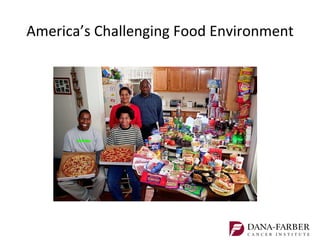
America’s Challenging Food Environment
Question: Is it also our lifestyle?
Watch Your Weight!
• 65% of Americans are overweight or obese.

• Only 6% of Americans identify being overweight or obese as a risk
  factor for cancer despite a clearly established scientific link.

• Research shows that fat cells can act as "hormone pumps,"
  secreting hormones and other growth factors into the
  bloodstream.

• If the body's cells are exposed to very high levels of these
  substances over an extended period, they tend to reproduce
  more quickly  ? Increase cancer cell growth.

• Researchers stress that this potentially dangerous condition is
  reversible!
Question: But after cancer treatment, I
actually lost weight?
Weight Loss during Cancer Treatment
• Possible causes:
   – Changes in metabolism, anorexia, side effects of treatment
      (nausea, vomiting, fatigue, taste changes, dry mouth, throat
      soreness if esophagus affected by radiation), over-aggressive
      efforts to eat a “cancer-fighting” diet.
• Weight loss is associated with increased difficulty tolerating
  treatment and poorer quality of life.
• Nutritionist can help:
    – Five or six small meals/snacks
    – Suggestions for smoothies or liquid nutrition supplements
    – Strategies to concentrate calories in food and increase overall
      intake
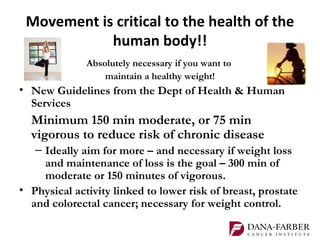
Movement is critical to the health of the
            human body!!
              Absolutely necessary if you want to
                  maintain a healthy weight!
• New Guidelines from the Dept of Health & Human
  Services
  Minimum 150 min moderate, or 75 min
  vigorous to reduce risk of chronic disease
   – Ideally aim for more – and necessary if weight loss
     and maintenance of loss is the goal – 300 min of
     moderate or 150 minutes of vigorous.
• Physical activity linked to lower risk of breast, prostate
  and colorectal cancer; necessary for weight control.
Different ways to be active…
 If you like it – you’ll do it!
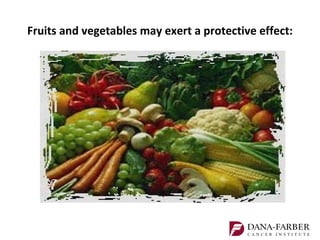
Fruits and vegetables may exert a protective effect:
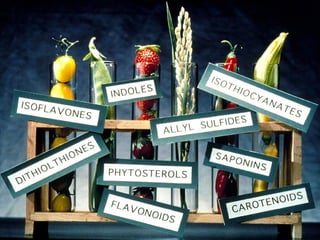
Phytonutrients


• Beyond vitamins, minerals and fiber,
  natural compounds found in plants may
  exert profound disease preventive effects

• The “immune system” of a plant – many
  also represent the pigment that gives the
  plant it’s color.
Phytonutrients:
            Prevention in a Plant
• How do they work?
  – Stimulate enzymes that help the body detoxify
  – Reduce the genetic damage from cancer
    causing agents
  – May interfere with growth and multiplication
    of cancer cells
  – Decrease inflammation
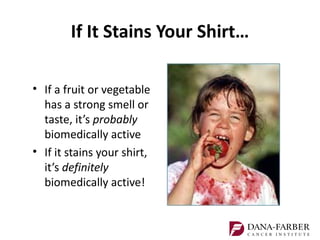
If It Stains Your Shirt…

• If a fruit or vegetable
  has a strong smell or
  taste, it’s probably
  biomedically active
• If it stains your shirt,
  it’s definitely
  biomedically active!
Antioxidants
• Vitamin A, C, E, Selenium & Phytonutrients

• Help prevent damage to cells from the attack of
  free radicals

• “But I take antioxidant supplements in pill
  form, so I’m getting all the antioxidant
  benefits that way, right?”
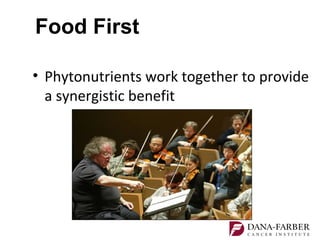
Food First

• Phytonutrients work together to provide
  a synergistic benefit
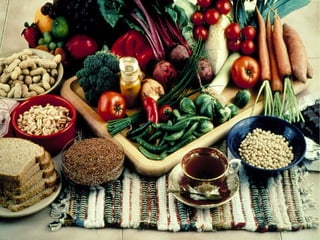
Choose a Predominately Plant Based Diet


• Eat 5-10 servings fruits & veggies each day
  – 1 serving = 1/2 cup cut, cooked or sliced; 1
    piece medium fruit; 1 cup leafy greens

• Emphasis on variety

• Look for richly colored plant foods
Question: What about juicing
vegetables?
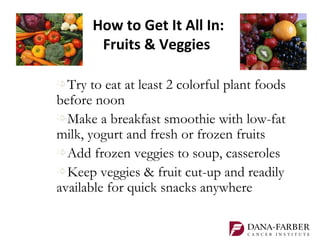
How to Get It All In:
       Fruits & Veggies

lTry to eat at least 2 colorful plant foods
before noon
lMake a breakfast smoothie with low-fat
milk, yogurt and fresh or frozen fruits
lAdd frozen veggies to soup, casseroles
lKeep veggies & fruit cut-up and readily
available for quick snacks anywhere
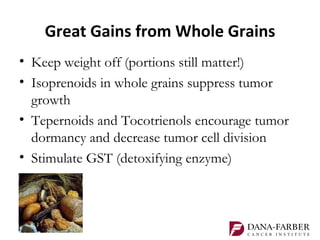
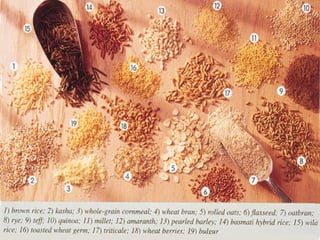
Great Gains from Whole Grains
• Keep weight off (portions still matter!)
• Isoprenoids in whole grains suppress tumor
  growth
• Tepernoids and Tocotrienols encourage tumor
  dormancy and decrease tumor cell division
• Stimulate GST (detoxifying enzyme)
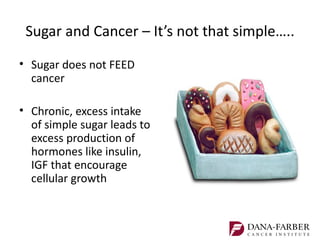
Sugar and Cancer – It’s not that simple…..
• Sugar does not FEED
  cancer

• Chronic, excess intake
  of simple sugar leads to
  excess production of
  hormones like insulin,
  IGF that encourage
  cellular growth
Insulin and Cancer
• Excess insulin can promote tumor cell growth

• Behaviors that increase insulin levels
   –   Consumption of refined sugar and flour
   –   Overeating
   –   Weight gain
   –   Sedentary lifestyle

• Behavior that reduces insulin levels
   – Physical activity, weight loss, unrefined carbs
Question: Some programs I’ve seen
suggest links between sugar and brain
function?
Question: What’s the difference
between sugar and carbohydrates that
turn into sugar?
Question: So should we follow the
adage: eat breakfast like a king, lunch
like a prince and dinner like a pauper?
Insulin and Cancer
• Excess insulin can promote tumor cell growth

• Behaviors that increase insulin levels
   –   Consumption of refined sugar and flour
   –   Overeating
   –   Weight gain
   –   Sedentary lifestyle

• Behavior that reduces insulin levels
   – Physical activity, weight loss, unrefined carbs
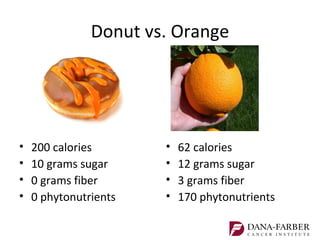
Donut vs. Orange


•   200 calories       •   62 calories
•   10 grams sugar     •   12 grams sugar
•   0 grams fiber      •   3 grams fiber
•   0 phytonutrients   •   170 phytonutrients
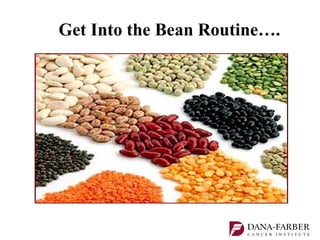
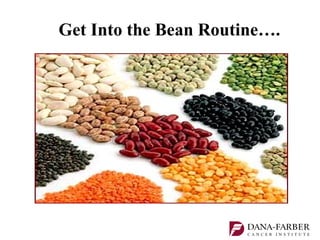
Get Into the Bean Routine….
Question: I take Arimidex so is it not a
good idea to experiment with
soybeans?
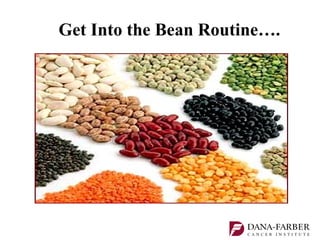
Get Into the Bean Routine….
Question: What about multivitamins?
Question: Can you talk about the acid
vs. alkaline diet?
Get Into the Bean Routine….
Question: Can someone get enough
protein from eating beans?
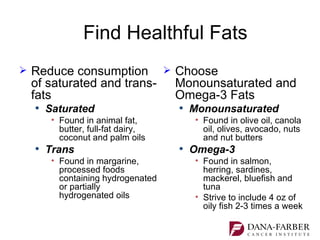
Find Healthful Fats
   Reduce consumption                  Choose
    of saturated and trans-              Monounsaturated and
    fats                                 Omega-3 Fats
       Saturated                           Monounsaturated
         • Found in animal fat,               • Found in olive oil, canola
           butter, full-fat dairy,              oil, olives, avocado, nuts
           coconut and palm oils                and nut butters
       Trans                               Omega-3
         • Found in margarine,                • Found in salmon,
           processed foods                      herring, sardines,
           containing hydrogenated              mackerel, bluefish and
           or partially                         tuna
           hydrogenated oils                  • Strive to include 4 oz of
                                                oily fish 2-3 times a week
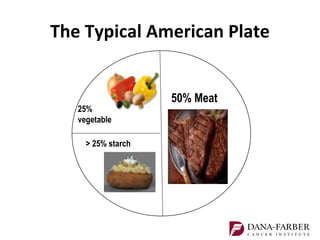
The Typical American Plate


                    50% Meat
   25%
   vegetable

     > 25% starch
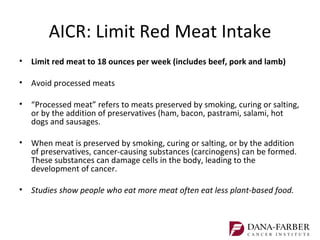
AICR: Limit Red Meat Intake
•   Limit red meat to 18 ounces per week (includes beef, pork and lamb)

•   Avoid processed meats

•   “Processed meat” refers to meats preserved by smoking, curing or salting,
    or by the addition of preservatives (ham, bacon, pastrami, salami, hot
    dogs and sausages.

•   When meat is preserved by smoking, curing or salting, or by the addition
    of preservatives, cancer-causing substances (carcinogens) can be formed.
    These substances can damage cells in the body, leading to the
    development of cancer.

•   Studies show people who eat more meat often eat less plant-based food.
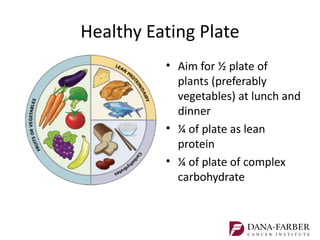
Healthy Eating Plate
          • Aim for ½ plate of
            plants (preferably
            vegetables) at lunch and
            dinner
          • ¼ of plate as lean
            protein
          • ¼ of plate of complex
            carbohydrate
Question: I heard that you should eat
your fruits and vegetables separately.
Is that true?
Organic vs. Conventional

• No scientific evidence to date that organic offers
  anti-cancer advantage at this point

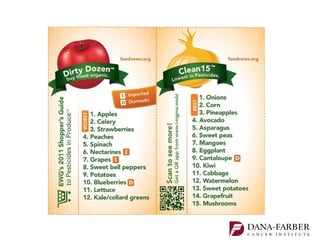
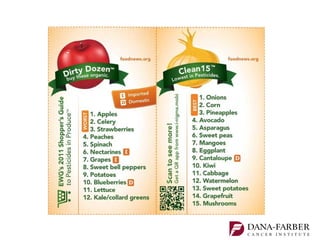
• More than ½ of dietary pesticide exposure comes
  from 12 foods – EWG “Dirty Dozen”

• Bottom line: wash things thoroughly
Question: What about eating the skin
on apples?
Question: What about veggies
washes?
Food First
•   75% of Americans don’t eat “5 a day”

• Americans eat 1.5 servings of vegetables & less than 1
  serving of fruit daily, despite consistent evidence that these
  foods decrease the risk of many chronic diseases.

• We throw away more than 11 billion pounds of fruits and
  vegetables every year in the US!!

• Americans spend $18.7 billion per year on dietary
  supplements despite limited and inconclusive scientific
  evidence of effectiveness in disease prevention and
  treatment
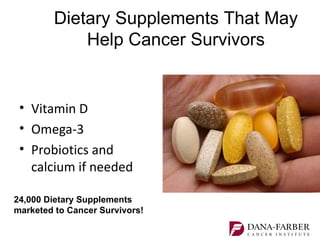
Dietary Supplements That May
            Help Cancer Survivors


 • Vitamin D
 • Omega-3
 • Probiotics and
   calcium if needed

24,000 Dietary Supplements
marketed to Cancer Survivors!
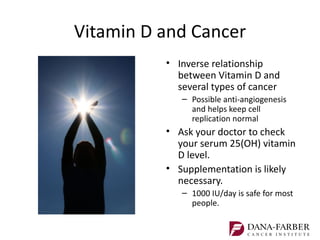
Vitamin D and Cancer
          • Inverse relationship
            between Vitamin D and
            several types of cancer
             – Possible anti-angiogenesis
               and helps keep cell
               replication normal
          • Ask your doctor to check
            your serum 25(OH) vitamin
            D level.
          • Supplementation is likely
            necessary.
             – 1000 IU/day is safe for most
               people.
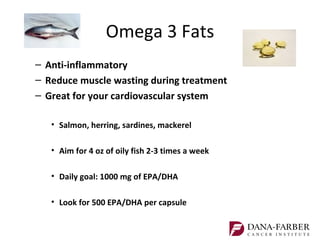
Omega 3 Fats
– Anti-inflammatory
– Reduce muscle wasting during treatment
– Great for your cardiovascular system

   • Salmon, herring, sardines, mackerel

   • Aim for 4 oz of oily fish 2-3 times a week

   • Daily goal: 1000 mg of EPA/DHA

   • Look for 500 EPA/DHA per capsule
Question: Should I be worried about
mercury in Omega 3 supplements?
Question: Can you give yourself too
much Omega 3?
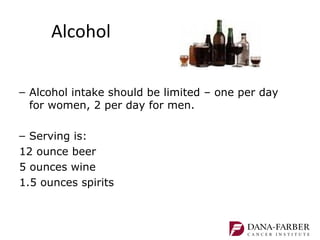
Alcohol

– Alcohol intake should be limited – one per day
  for women, 2 per day for men.

– Serving is:
12 ounce beer
5 ounces wine
1.5 ounces spirits
Question: I have oatmeal and
blueberries for breakfast every day,
but I use the instant oatmeal. Is that
okay?
Question: Is there any research on
pesticides on certain vegetables that
says that contributes to cancer?
Thank You!
• For more information about fighting cancer
  with your fork, please visit the nutrition
  section of our web site:
www.dana-farber.org/Adult-Care/Treatment-and-Su

Fighting Cancer With Your Fork

  • 1.
    Fighting Cancer withYour Fork: Separating Fact From Fiction Hillary M. Wright, MEd, RD, LDN Dana-Farber Cancer Institute Leonard P. Zakim Center for Integrated Therapies
  • 2.
    How Do WeFigure Out What May Affect Cancer Risk/Survivorship? The American Institute for Cancer Research “Food, Nutrition, Physical Activity and the Prevention of Cancer: a Global Perspective” • The result of an analysis of over 7000 research studies on the link between diet, lifestyle and cancer, and for the first time cancer survivors • www.aicr.org   “comprehensive global report”  10 Recommendations, last one specific to survivors.
  • 3.
  • 4.
    Question: Is italso our lifestyle?
  • 5.
    Watch Your Weight! •65% of Americans are overweight or obese. • Only 6% of Americans identify being overweight or obese as a risk factor for cancer despite a clearly established scientific link. • Research shows that fat cells can act as "hormone pumps," secreting hormones and other growth factors into the bloodstream. • If the body's cells are exposed to very high levels of these substances over an extended period, they tend to reproduce more quickly  ? Increase cancer cell growth. • Researchers stress that this potentially dangerous condition is reversible!
  • 6.
    Question: But aftercancer treatment, I actually lost weight?
  • 7.
    Weight Loss duringCancer Treatment • Possible causes: – Changes in metabolism, anorexia, side effects of treatment (nausea, vomiting, fatigue, taste changes, dry mouth, throat soreness if esophagus affected by radiation), over-aggressive efforts to eat a “cancer-fighting” diet. • Weight loss is associated with increased difficulty tolerating treatment and poorer quality of life. • Nutritionist can help: – Five or six small meals/snacks – Suggestions for smoothies or liquid nutrition supplements – Strategies to concentrate calories in food and increase overall intake
  • 8.
    Movement is criticalto the health of the human body!! Absolutely necessary if you want to maintain a healthy weight! • New Guidelines from the Dept of Health & Human Services Minimum 150 min moderate, or 75 min vigorous to reduce risk of chronic disease – Ideally aim for more – and necessary if weight loss and maintenance of loss is the goal – 300 min of moderate or 150 minutes of vigorous. • Physical activity linked to lower risk of breast, prostate and colorectal cancer; necessary for weight control.
  • 9.
    Different ways tobe active… If you like it – you’ll do it!
  • 10.
    Fruits and vegetablesmay exert a protective effect:
  • 11.
    Phytonutrients • Beyond vitamins,minerals and fiber, natural compounds found in plants may exert profound disease preventive effects • The “immune system” of a plant – many also represent the pigment that gives the plant it’s color.
  • 13.
    Phytonutrients: Prevention in a Plant • How do they work? – Stimulate enzymes that help the body detoxify – Reduce the genetic damage from cancer causing agents – May interfere with growth and multiplication of cancer cells – Decrease inflammation
  • 14.
    If It StainsYour Shirt… • If a fruit or vegetable has a strong smell or taste, it’s probably biomedically active • If it stains your shirt, it’s definitely biomedically active!
  • 15.
    Antioxidants • Vitamin A,C, E, Selenium & Phytonutrients • Help prevent damage to cells from the attack of free radicals • “But I take antioxidant supplements in pill form, so I’m getting all the antioxidant benefits that way, right?”
  • 16.
    Food First • Phytonutrientswork together to provide a synergistic benefit
  • 17.
    Choose a PredominatelyPlant Based Diet • Eat 5-10 servings fruits & veggies each day – 1 serving = 1/2 cup cut, cooked or sliced; 1 piece medium fruit; 1 cup leafy greens • Emphasis on variety • Look for richly colored plant foods
  • 18.
    Question: What aboutjuicing vegetables?
  • 19.
    How to GetIt All In: Fruits & Veggies lTry to eat at least 2 colorful plant foods before noon lMake a breakfast smoothie with low-fat milk, yogurt and fresh or frozen fruits lAdd frozen veggies to soup, casseroles lKeep veggies & fruit cut-up and readily available for quick snacks anywhere
  • 20.
    Great Gains fromWhole Grains • Keep weight off (portions still matter!) • Isoprenoids in whole grains suppress tumor growth • Tepernoids and Tocotrienols encourage tumor dormancy and decrease tumor cell division • Stimulate GST (detoxifying enzyme)
  • 22.
    Sugar and Cancer– It’s not that simple….. • Sugar does not FEED cancer • Chronic, excess intake of simple sugar leads to excess production of hormones like insulin, IGF that encourage cellular growth
  • 23.
    Insulin and Cancer •Excess insulin can promote tumor cell growth • Behaviors that increase insulin levels – Consumption of refined sugar and flour – Overeating – Weight gain – Sedentary lifestyle • Behavior that reduces insulin levels – Physical activity, weight loss, unrefined carbs
  • 24.
    Question: Some programsI’ve seen suggest links between sugar and brain function?
  • 25.
    Question: What’s thedifference between sugar and carbohydrates that turn into sugar?
  • 26.
    Question: So shouldwe follow the adage: eat breakfast like a king, lunch like a prince and dinner like a pauper?
  • 27.
    Insulin and Cancer •Excess insulin can promote tumor cell growth • Behaviors that increase insulin levels – Consumption of refined sugar and flour – Overeating – Weight gain – Sedentary lifestyle • Behavior that reduces insulin levels – Physical activity, weight loss, unrefined carbs
  • 28.
    Donut vs. Orange • 200 calories • 62 calories • 10 grams sugar • 12 grams sugar • 0 grams fiber • 3 grams fiber • 0 phytonutrients • 170 phytonutrients
  • 29.
    Get Into theBean Routine….
  • 30.
    Question: I takeArimidex so is it not a good idea to experiment with soybeans?
  • 31.
    Get Into theBean Routine….
  • 32.
    Question: What aboutmultivitamins?
  • 33.
    Question: Can youtalk about the acid vs. alkaline diet?
  • 34.
    Get Into theBean Routine….
  • 35.
    Question: Can someoneget enough protein from eating beans?
  • 36.
    Find Healthful Fats  Reduce consumption  Choose of saturated and trans- Monounsaturated and fats Omega-3 Fats  Saturated  Monounsaturated • Found in animal fat, • Found in olive oil, canola butter, full-fat dairy, oil, olives, avocado, nuts coconut and palm oils and nut butters  Trans  Omega-3 • Found in margarine, • Found in salmon, processed foods herring, sardines, containing hydrogenated mackerel, bluefish and or partially tuna hydrogenated oils • Strive to include 4 oz of oily fish 2-3 times a week
  • 37.
    The Typical AmericanPlate 50% Meat 25% vegetable > 25% starch
  • 38.
    AICR: Limit RedMeat Intake • Limit red meat to 18 ounces per week (includes beef, pork and lamb) • Avoid processed meats • “Processed meat” refers to meats preserved by smoking, curing or salting, or by the addition of preservatives (ham, bacon, pastrami, salami, hot dogs and sausages. • When meat is preserved by smoking, curing or salting, or by the addition of preservatives, cancer-causing substances (carcinogens) can be formed. These substances can damage cells in the body, leading to the development of cancer. • Studies show people who eat more meat often eat less plant-based food.
  • 39.
    Healthy Eating Plate • Aim for ½ plate of plants (preferably vegetables) at lunch and dinner • ¼ of plate as lean protein • ¼ of plate of complex carbohydrate
  • 40.
    Question: I heardthat you should eat your fruits and vegetables separately. Is that true?
  • 41.
    Organic vs. Conventional •No scientific evidence to date that organic offers anti-cancer advantage at this point • More than ½ of dietary pesticide exposure comes from 12 foods – EWG “Dirty Dozen” • Bottom line: wash things thoroughly
  • 42.
    Question: What abouteating the skin on apples?
  • 44.
    Question: What aboutveggies washes?
  • 46.
    Food First • 75% of Americans don’t eat “5 a day” • Americans eat 1.5 servings of vegetables & less than 1 serving of fruit daily, despite consistent evidence that these foods decrease the risk of many chronic diseases. • We throw away more than 11 billion pounds of fruits and vegetables every year in the US!! • Americans spend $18.7 billion per year on dietary supplements despite limited and inconclusive scientific evidence of effectiveness in disease prevention and treatment
  • 47.
    Dietary Supplements ThatMay Help Cancer Survivors • Vitamin D • Omega-3 • Probiotics and calcium if needed 24,000 Dietary Supplements marketed to Cancer Survivors!
  • 48.
    Vitamin D andCancer • Inverse relationship between Vitamin D and several types of cancer – Possible anti-angiogenesis and helps keep cell replication normal • Ask your doctor to check your serum 25(OH) vitamin D level. • Supplementation is likely necessary. – 1000 IU/day is safe for most people.
  • 49.
    Omega 3 Fats –Anti-inflammatory – Reduce muscle wasting during treatment – Great for your cardiovascular system • Salmon, herring, sardines, mackerel • Aim for 4 oz of oily fish 2-3 times a week • Daily goal: 1000 mg of EPA/DHA • Look for 500 EPA/DHA per capsule
  • 50.
    Question: Should Ibe worried about mercury in Omega 3 supplements?
  • 51.
    Question: Can yougive yourself too much Omega 3?
  • 52.
    Alcohol – Alcohol intakeshould be limited – one per day for women, 2 per day for men. – Serving is: 12 ounce beer 5 ounces wine 1.5 ounces spirits
  • 54.
    Question: I haveoatmeal and blueberries for breakfast every day, but I use the instant oatmeal. Is that okay?
  • 55.
    Question: Is thereany research on pesticides on certain vegetables that says that contributes to cancer?
  • 56.
    Thank You! • Formore information about fighting cancer with your fork, please visit the nutrition section of our web site: www.dana-farber.org/Adult-Care/Treatment-and-Su

Editor's Notes

  • #10 Best is combination of weight-bearing exercise for your bones and weight, and cardiovascular exercise for your heart. Cardiovascular exercise recommendations: Walking is a great form of exercise – aim for 150 minutes/week of moderate-intensity exercise or 75 minutes/week of vigorous-intensity exercise. You can get to that goal in whatever way you want. For example: (150 minutes/week): 1.5 hour moderate-intensity gardening = 90 minutes 20 minute walk with friends 3x/week = 60 minutes
  • #17 Singling out one element is not wise as optimal and safe doses have not yet been established Phytonutrients work together to enhance one another’s function James Levine