Primary Systemic Therapy:
Beginning the Journey
Beth Overmoyer MD, FACP
Director, Inflammatory Breast Cancer Program
1st Annual IBC Patient Forum
Dana Farber Cancer Institute
May 13, 2017
Historical Perspective of IBC
• The historical identification of IBC is important as a reminder of the
acceptance of classic clinical criteria that differentiates the disease
from other forms of locally advanced breast cancer
• 1814 – Sir Charles Bell described a grave prognosis associated with
breast cancer when the following characteristics are present:
• “when a purple color is on the skin over the tumor accompanied
by shooting pains it is a very unpropitious beginning”
• Lee and Tannenbaum (1924) – “inflammatory breast cancer”
IBC – A Distinct Subtype of Breast Cancer
Distinct subtype of breast cancer
• Definitive or pathologic
diagnostic criteria do not
exist
• “Clinical diagnosis” fraught
with potential problems,
both underestimating and
overestimating the
diagnosis
• Seer 2004-7: 2-yr BCS
• IBC = 84%
• LABC = 91%
• 43% higher risk of breast cancer death in
IBC vs. LABC
• German study: 4.5x greater risk of
dying within 5 years
Diessner Arch Gyn Obs 2015;292:655; Anderson WF, JCO 21:2254, 2003
IBC
LABC
• 1-5% incidence in US
• Difficulty in tracking the disease due to variation in diagnostic criteria
over time
• Underestimate incidence
Clinical definition with confirmed breast cancer: Rapid onset – 3 – 6 mo
• Erythema > 1/3 breast
• Edema (peau d’orange)
• Often warm breast, pain
• Breast enlargement – often without a mass
• Highly metastatic:
35% metastasis at presentation
Clinical Presentation - IBC
Clinical Diagnosis of IBC
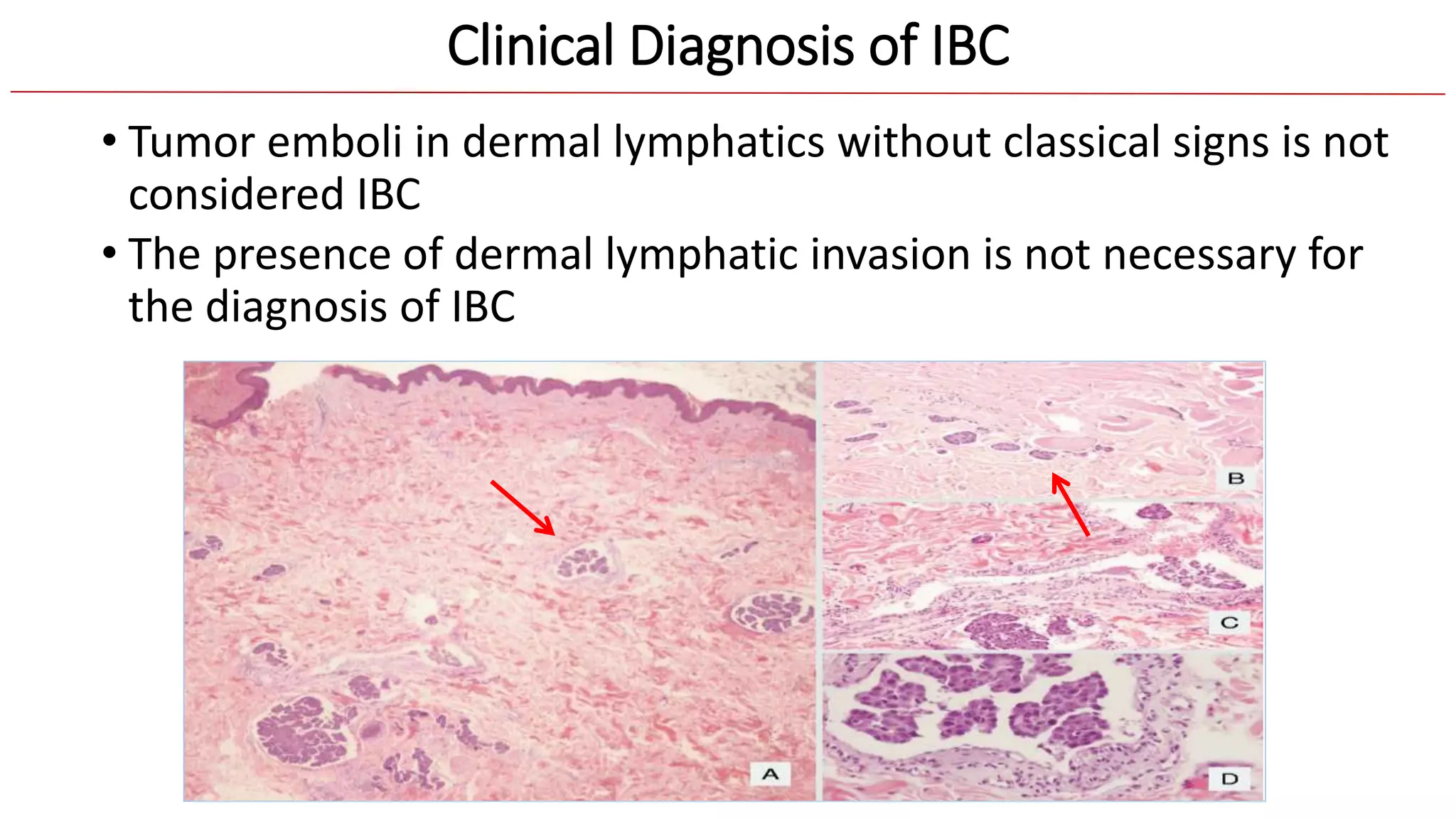
• Tumor emboli in dermal lymphatics without classical signs is not
considered IBC
• The presence of dermal lymphatic invasion is not necessary for
the diagnosis of IBC
“Trimodality” Therapy: Importance of pCR
Primary
Systemic Therapy
Mastectomy +
Axillary LN Dissection
Radiation to Chest Wall
and Regional LN
Adjuvant Endocrine Rx (HR+)
+/or Trastuzumab (HER2+)
Nakhlis 2016
Overall survival
86%
51%
Time to tumor recurrence
79%
33%
Retrospective Studies of Preoperative
Chemotherapy for IBC
No.
IBC
Chemotherapy RR Median
Survival
Italy 68 CAF or CEF / CMF pCR: 3% 4 yr.
U Penn 52 CMF +/- CAF pCR: 12% NR
France 120 FEC-HD pCR: 15% 5 yr.
British Columbia 308 CT v intensive CT (+ T) pCR:
28% v 33%
3.2 yr.
MD Anderson 240 FAC v FAC + T pCR:
10% v 25%
3.4 v 4.3 yr
Primary chemotherapy backbone = anthracycline and taxane
Dose-Dense versus Conventional Preoperative
Chemotherapy (AGO-1) – Overall ≠ IBC
• 668 patients with locally advanced breast cancer
• Overall group benefitted from intensive
chemotherapy:
• Improved pCR – 18% vs 10%
• Improved time to disease recurrence
• Improved overall survival
Untch M JCO 2009; 27:2938
• 100 IBC
• No difference with intensity of chemotherapy:
• No difference in pCR – 12% vs 10%
• No difference in time to disease recurrence
• No difference in overall survival
≠
pCR Rates in SWOG 0012: Standard AC versus
“Continuous” AC
Georgiana K. Ellis et al. JCO 2011;29:1014-1021
• 356 Overall vs 111 IBC (31%)
• Overall: no difference in outcome
• Higher pCR in IBC with continuous dosing of chemotherapy – 27% vs 13%
Finding Therapeutic Targets in IBC
•HER-2
•Angiogenesis
•JAK2-STAT3
Finding Therapeutic Targets in IBC
•Targeting HER-2
•Angiogenesis
•JAK2-STAT3
NOAH – IBC Experience
64% v 24%
74% v 44%
5-YR EFS
5-YR OS
Doxorubicin
60mg/m2 →
Paclitaxel
150mg/m2 q21d x 3
Paclitaxel
175mg/m2 q21d x 4
CMF x 3
Subset Analysis
• 61 / 228 pts with IBC,
HER2+
• pCR = 48 % with
trastuzumab
•13% without trastuzumab
Gianni L. Lancet Oncol 2014 15:640
Anti-HER2 Therapy
Trypheana (13/225
= 6% IBC)
FEC+HP x 3 →T+HP x 3
(N=73)
FEC x 3 → T+HP x 3
(N=75)
TCH+P x 6
(N=77)
IBC 5(7%) 4(5%) 4(5%)
tpCR 41(56%) 41(55%) 48(64%)
NeoSphere
(29/417 = 7% IBC)
T+D (N=107) T+D+P (N=107) T+P (N=107) P+D (N=96)
IBC* 7 (7%) 10 (9%) 7 (7%) 5 (5%)
tpCR (all) 23 (22%) 42 (40%) 12 (11%) 17 (18%)
5y –DFS 81% 84% 80% 75%
Gianni Lancet Oncol 2012;13:25-32; Schneeweiss Ann Oncol 2013;2278-84; Gianni Lancet Oncol 2016; Gianni Lancet Oncol 2012;
Boussen, JCO 2010; Untch Lancet Onc 2012.
Investigating lapatinib Regimen Number enrolled pCR
MDACC Lapatinib +
paclitaxel
32 3/17 (18%)
GeparQuinto EC→D
(L v H)
82/620 =13% IBC 23% v 30% (p=0.04)
Odds ratio IBC = 0.72 (NS)
Run In Phase – Day 1 week 1 (breast biopsy #1)
Pertuzumab IV 840 mg loading dose Trastuzumab IV 4 mg/kg loading
dose
Treatment Phase – Day 8 week 2 (breast biopsy #2)
Trastuzumab IV 2mg/kg weekly and paclitaxel 80 mg/m2 IV weekly x 16 weeks.
Day 21 week 4
Continue trastuzumab and paclitaxel as above and begin pertuzumab 420 mg IV
every 21 days for 5 doses
Modified radical mastectomy
(assess residual disease)
Post-operative Treatment:
Doxorubicin 60 mg/m2 IV and cyclophosphamide 600 mg/m2 IV every 3 weeks x 4 cycles*
Followed by trastuzumab 6 mg/kg and pertuzumab 420 mg every 21 days x 8 months**
(loading dose given first after AC completed)
Radiation Therapy
Endocrine therapy if HR+
*Optional
**Metastatic disease (nodal disease only):
continue on pertuzumab + trastuzumab
until disease progression
Primary Objective: pCR
• Accept benefit if > 8/ 27
pts have pCR
NCI-2013-01110, NCT0179619712-497; Genentech, IBC Network - sponsor
Hypothesis:
Can we limit the amount
of chemotherapy and
maximize the HER2-
directed therapy in the
treatment of HER2+ IBC ?
Finding Therapeutic Targets in IBC
•Targeting HER-2
•Angiogenesis
•JAK2-STAT3
Angiogenesis and Lymphangiogenesis in IBC
• IBC makes its own blood supply and
lymphatic supply throughout the
breast
• Increased expression of
angiogenesis related genes
• Increased expression of
lymphangiogenesis related genes
• Is this “encircling
lymphovasculogenesis” or
lymphovascular invasion ?
Colpaert CG, Br J Ca 2003;88:718; Van der Auwera Clin Can Res 2005;11:7637
Angiogenesis in IBC: Is it a Useful Target ?
Addition of Anti-angiogenic Agents to Pre-operative Chemotherapy
Treatment Number Stage pCR Median
DFS (III)
Correlatives
SU5416, doxorubicin 17 III or IV 0 32 mo DCE/MRI –
(Kep) – 58%
(p=0.033)
Bevacizumab,
docetaxel,
doxorubicin
21 (1 LABC) III or IV 1 (5%) 25.3 mo DCE-MRI –
(Ktrans) – 34%
(p=.003)
BEVERLY-1 (FEC(B) x
4 → D(B) x 4)
100 III 19 (19%) 53 mo CTC not
associated with
pCR
BEVERLY-2 (FEC(B) x
4 → D(B+H) x 4)
52 III 33 (64%) NA CTC not
associated with
pCR
Overmoyer CCR 2007; Wedam JCO 2006; Bertucci 2016; Pierga 2012
Eribulin and Normalization of Vasculature
Region of Interest (ROI) Ktrans (1/min/1000)
Pre-Eribulin Post-Eribulin (d 8)
#1 ROI 78.1 115.2
#2 ROI 47.5 71.4
• Eribulin effects on mice:
• Improves blood flow to inside of tumor
• Increased overall tumor blood flow
• Changes in expression of genes for blood
vessel formation and cancer survival
• In IBC – investigate eribulin’s effect on tumor
blood flow
• Also investigate expression on genes for
blood vessel formation and cancer survival
2
1
Agoulnik Vasc Cell 2014.; Funahashi Cancer Sci 2014; Yoshida Br J Cancer 2014.; Dezso PLoS One 2014.; Overmoyer SABCS 2016.
2
1
Pre-treatment breast biopsy #1
Eribulin x 1 (cycle 1 day 1)
Breast biopsy #2: 1 wk after eribulin
(cycle 1 day 8)
Eribulin q 3 wks x 3 cycles
dd AC q 2 wks x 4 cycles
Mastectomy (harvest residual tumor)
Radiation therapy + endocrine therapy
Imaging subset study
Pre-treatment
breast DCE-MRI
1 wk after eribulin
(c1,d8) breast DCE-
MRI
Eribulin
1.4mg/m2 IV
d1,d8 q21d x 4
cycles
Doxorubicin 60
mg/m2 +
cyclophosphamide
600 mg/m2 IV q2w x
4 cycles
Overview
• Primary Objective: pCR rate
• Two-stage design:
• Reject if pCR is < 15%
• Accept if pCR > 30%
• > 2/16 pCR – go forward
• Accept benefit if > 5/ 25 pts
have pCR
NCI-2016-00329, NCT0262397215-292; Eisai-sponsor
Finding Therapeutic Targets in IBC
•Targeting HER-2
•Angiogenesis
•JAK2-STAT3
Slides curtesy of Kornelia Polyak MD, PhD
N=64
(50 +)
Ruxolitinib x 7
days
(N=32)
Ruxolitinib x 7d +
Paclitaxel x 1 wk
(N=32)
Paclitaxel x 12
weeks (N=16)
Ruxolitinib +
Paclitaxel x 12
weeks (N=16)
Ruxolitinib +
Paclitaxel x 11
weeks (N=32)
dd doxorubicin/cyclophosphamide x
4 cycles (N=64)
Modified radical mastectomy
Radiation therapy
Pre-treatment biopsy #1
Post-run-in biopsy #2
Primary:
Pharmacodynamic
Secondary:
Clinical
TBCRC 039 - SCHEME
Sponsored by Incyte, and
Inflammatory Breast Cancer Research Foundation
Primary Systemic Therapy for IBC:
Beginning the Journey
• IBC is inoperable at the time of diagnosis, therefore initial therapy with
“systemic treatment” is indicated.
• IBC is relatively chemo-resistant, therefore identifying therapeutic targets is
critical.
• We must focus our efforts on designing clinical trials specifically for IBC
• Inclusion of IBC patients into LABC trials will dilute the interpretation of
outcome
• Incorporate translational components
• Identify biologic markers that confirm the diagnosis, not just rely on “clinical
features” that are not consistent.

Primary Systemic Therapy for Inflammatory Breast Cancer

  • 1.
    Primary Systemic Therapy: Beginningthe Journey Beth Overmoyer MD, FACP Director, Inflammatory Breast Cancer Program 1st Annual IBC Patient Forum Dana Farber Cancer Institute May 13, 2017
  • 2.
    Historical Perspective ofIBC • The historical identification of IBC is important as a reminder of the acceptance of classic clinical criteria that differentiates the disease from other forms of locally advanced breast cancer • 1814 – Sir Charles Bell described a grave prognosis associated with breast cancer when the following characteristics are present: • “when a purple color is on the skin over the tumor accompanied by shooting pains it is a very unpropitious beginning” • Lee and Tannenbaum (1924) – “inflammatory breast cancer”
  • 3.
    IBC – ADistinct Subtype of Breast Cancer Distinct subtype of breast cancer • Definitive or pathologic diagnostic criteria do not exist • “Clinical diagnosis” fraught with potential problems, both underestimating and overestimating the diagnosis • Seer 2004-7: 2-yr BCS • IBC = 84% • LABC = 91% • 43% higher risk of breast cancer death in IBC vs. LABC • German study: 4.5x greater risk of dying within 5 years Diessner Arch Gyn Obs 2015;292:655; Anderson WF, JCO 21:2254, 2003 IBC LABC
  • 4.
    • 1-5% incidencein US • Difficulty in tracking the disease due to variation in diagnostic criteria over time • Underestimate incidence Clinical definition with confirmed breast cancer: Rapid onset – 3 – 6 mo • Erythema > 1/3 breast • Edema (peau d’orange) • Often warm breast, pain • Breast enlargement – often without a mass • Highly metastatic: 35% metastasis at presentation Clinical Presentation - IBC
  • 5.
    Clinical Diagnosis ofIBC • Tumor emboli in dermal lymphatics without classical signs is not considered IBC • The presence of dermal lymphatic invasion is not necessary for the diagnosis of IBC
  • 6.
    “Trimodality” Therapy: Importanceof pCR Primary Systemic Therapy Mastectomy + Axillary LN Dissection Radiation to Chest Wall and Regional LN Adjuvant Endocrine Rx (HR+) +/or Trastuzumab (HER2+) Nakhlis 2016 Overall survival 86% 51% Time to tumor recurrence 79% 33%
  • 7.
    Retrospective Studies ofPreoperative Chemotherapy for IBC No. IBC Chemotherapy RR Median Survival Italy 68 CAF or CEF / CMF pCR: 3% 4 yr. U Penn 52 CMF +/- CAF pCR: 12% NR France 120 FEC-HD pCR: 15% 5 yr. British Columbia 308 CT v intensive CT (+ T) pCR: 28% v 33% 3.2 yr. MD Anderson 240 FAC v FAC + T pCR: 10% v 25% 3.4 v 4.3 yr Primary chemotherapy backbone = anthracycline and taxane
  • 8.
    Dose-Dense versus ConventionalPreoperative Chemotherapy (AGO-1) – Overall ≠ IBC • 668 patients with locally advanced breast cancer • Overall group benefitted from intensive chemotherapy: • Improved pCR – 18% vs 10% • Improved time to disease recurrence • Improved overall survival Untch M JCO 2009; 27:2938 • 100 IBC • No difference with intensity of chemotherapy: • No difference in pCR – 12% vs 10% • No difference in time to disease recurrence • No difference in overall survival ≠
  • 9.
    pCR Rates inSWOG 0012: Standard AC versus “Continuous” AC Georgiana K. Ellis et al. JCO 2011;29:1014-1021 • 356 Overall vs 111 IBC (31%) • Overall: no difference in outcome • Higher pCR in IBC with continuous dosing of chemotherapy – 27% vs 13%
  • 10.
    Finding Therapeutic Targetsin IBC •HER-2 •Angiogenesis •JAK2-STAT3
  • 11.
    Finding Therapeutic Targetsin IBC •Targeting HER-2 •Angiogenesis •JAK2-STAT3
  • 12.
    NOAH – IBCExperience 64% v 24% 74% v 44% 5-YR EFS 5-YR OS Doxorubicin 60mg/m2 → Paclitaxel 150mg/m2 q21d x 3 Paclitaxel 175mg/m2 q21d x 4 CMF x 3 Subset Analysis • 61 / 228 pts with IBC, HER2+ • pCR = 48 % with trastuzumab •13% without trastuzumab Gianni L. Lancet Oncol 2014 15:640
  • 13.
    Anti-HER2 Therapy Trypheana (13/225 =6% IBC) FEC+HP x 3 →T+HP x 3 (N=73) FEC x 3 → T+HP x 3 (N=75) TCH+P x 6 (N=77) IBC 5(7%) 4(5%) 4(5%) tpCR 41(56%) 41(55%) 48(64%) NeoSphere (29/417 = 7% IBC) T+D (N=107) T+D+P (N=107) T+P (N=107) P+D (N=96) IBC* 7 (7%) 10 (9%) 7 (7%) 5 (5%) tpCR (all) 23 (22%) 42 (40%) 12 (11%) 17 (18%) 5y –DFS 81% 84% 80% 75% Gianni Lancet Oncol 2012;13:25-32; Schneeweiss Ann Oncol 2013;2278-84; Gianni Lancet Oncol 2016; Gianni Lancet Oncol 2012; Boussen, JCO 2010; Untch Lancet Onc 2012. Investigating lapatinib Regimen Number enrolled pCR MDACC Lapatinib + paclitaxel 32 3/17 (18%) GeparQuinto EC→D (L v H) 82/620 =13% IBC 23% v 30% (p=0.04) Odds ratio IBC = 0.72 (NS)
  • 14.
    Run In Phase– Day 1 week 1 (breast biopsy #1) Pertuzumab IV 840 mg loading dose Trastuzumab IV 4 mg/kg loading dose Treatment Phase – Day 8 week 2 (breast biopsy #2) Trastuzumab IV 2mg/kg weekly and paclitaxel 80 mg/m2 IV weekly x 16 weeks. Day 21 week 4 Continue trastuzumab and paclitaxel as above and begin pertuzumab 420 mg IV every 21 days for 5 doses Modified radical mastectomy (assess residual disease) Post-operative Treatment: Doxorubicin 60 mg/m2 IV and cyclophosphamide 600 mg/m2 IV every 3 weeks x 4 cycles* Followed by trastuzumab 6 mg/kg and pertuzumab 420 mg every 21 days x 8 months** (loading dose given first after AC completed) Radiation Therapy Endocrine therapy if HR+ *Optional **Metastatic disease (nodal disease only): continue on pertuzumab + trastuzumab until disease progression Primary Objective: pCR • Accept benefit if > 8/ 27 pts have pCR NCI-2013-01110, NCT0179619712-497; Genentech, IBC Network - sponsor Hypothesis: Can we limit the amount of chemotherapy and maximize the HER2- directed therapy in the treatment of HER2+ IBC ?
  • 15.
    Finding Therapeutic Targetsin IBC •Targeting HER-2 •Angiogenesis •JAK2-STAT3
  • 16.
    Angiogenesis and Lymphangiogenesisin IBC • IBC makes its own blood supply and lymphatic supply throughout the breast • Increased expression of angiogenesis related genes • Increased expression of lymphangiogenesis related genes • Is this “encircling lymphovasculogenesis” or lymphovascular invasion ? Colpaert CG, Br J Ca 2003;88:718; Van der Auwera Clin Can Res 2005;11:7637
  • 17.
    Angiogenesis in IBC:Is it a Useful Target ? Addition of Anti-angiogenic Agents to Pre-operative Chemotherapy Treatment Number Stage pCR Median DFS (III) Correlatives SU5416, doxorubicin 17 III or IV 0 32 mo DCE/MRI – (Kep) – 58% (p=0.033) Bevacizumab, docetaxel, doxorubicin 21 (1 LABC) III or IV 1 (5%) 25.3 mo DCE-MRI – (Ktrans) – 34% (p=.003) BEVERLY-1 (FEC(B) x 4 → D(B) x 4) 100 III 19 (19%) 53 mo CTC not associated with pCR BEVERLY-2 (FEC(B) x 4 → D(B+H) x 4) 52 III 33 (64%) NA CTC not associated with pCR Overmoyer CCR 2007; Wedam JCO 2006; Bertucci 2016; Pierga 2012
  • 18.
    Eribulin and Normalizationof Vasculature Region of Interest (ROI) Ktrans (1/min/1000) Pre-Eribulin Post-Eribulin (d 8) #1 ROI 78.1 115.2 #2 ROI 47.5 71.4 • Eribulin effects on mice: • Improves blood flow to inside of tumor • Increased overall tumor blood flow • Changes in expression of genes for blood vessel formation and cancer survival • In IBC – investigate eribulin’s effect on tumor blood flow • Also investigate expression on genes for blood vessel formation and cancer survival 2 1 Agoulnik Vasc Cell 2014.; Funahashi Cancer Sci 2014; Yoshida Br J Cancer 2014.; Dezso PLoS One 2014.; Overmoyer SABCS 2016. 2 1
  • 19.
    Pre-treatment breast biopsy#1 Eribulin x 1 (cycle 1 day 1) Breast biopsy #2: 1 wk after eribulin (cycle 1 day 8) Eribulin q 3 wks x 3 cycles dd AC q 2 wks x 4 cycles Mastectomy (harvest residual tumor) Radiation therapy + endocrine therapy Imaging subset study Pre-treatment breast DCE-MRI 1 wk after eribulin (c1,d8) breast DCE- MRI Eribulin 1.4mg/m2 IV d1,d8 q21d x 4 cycles Doxorubicin 60 mg/m2 + cyclophosphamide 600 mg/m2 IV q2w x 4 cycles Overview • Primary Objective: pCR rate • Two-stage design: • Reject if pCR is < 15% • Accept if pCR > 30% • > 2/16 pCR – go forward • Accept benefit if > 5/ 25 pts have pCR NCI-2016-00329, NCT0262397215-292; Eisai-sponsor
  • 20.
    Finding Therapeutic Targetsin IBC •Targeting HER-2 •Angiogenesis •JAK2-STAT3
  • 21.
    Slides curtesy ofKornelia Polyak MD, PhD
  • 22.
    N=64 (50 +) Ruxolitinib x7 days (N=32) Ruxolitinib x 7d + Paclitaxel x 1 wk (N=32) Paclitaxel x 12 weeks (N=16) Ruxolitinib + Paclitaxel x 12 weeks (N=16) Ruxolitinib + Paclitaxel x 11 weeks (N=32) dd doxorubicin/cyclophosphamide x 4 cycles (N=64) Modified radical mastectomy Radiation therapy Pre-treatment biopsy #1 Post-run-in biopsy #2 Primary: Pharmacodynamic Secondary: Clinical TBCRC 039 - SCHEME Sponsored by Incyte, and Inflammatory Breast Cancer Research Foundation
  • 23.
    Primary Systemic Therapyfor IBC: Beginning the Journey • IBC is inoperable at the time of diagnosis, therefore initial therapy with “systemic treatment” is indicated. • IBC is relatively chemo-resistant, therefore identifying therapeutic targets is critical. • We must focus our efforts on designing clinical trials specifically for IBC • Inclusion of IBC patients into LABC trials will dilute the interpretation of outcome • Incorporate translational components • Identify biologic markers that confirm the diagnosis, not just rely on “clinical features” that are not consistent.