Research in the Program for Young
Women with Breast Cancer:
Past, Present and Future
Shoshana Rosenberg, ScD and
Ann H. Partridge, MD MPH
Dana-Farber Cancer Institute
January 24, 2018
• In 2005, we established The Program for Young Women
with Breast Cancer (“Young and Strong”) to address the
unique issues facing the young patients at DFCI
• The program addresses critical issues including:
 Fertility
 Genetics
 Parenting
 Sexual functioning
 Psychosocial and Emotional Health
 Exercise and Nutrition
 Balancing School and/or a Career
 Building Relationships
• Initially, the program served women diagnosed at age
42 and younger but include women up to 45 now
• To date: directly served over 4,000 new young patients
visiting our breast oncology clinics
A Comprehensive and Integrated Program
Focused on Young Women
Clinical Care
Research
Education
(both patient and provider)
Local therapy
Genetics
Endocrine
therapy
Chemotherapy
Fertility
Adherence
Psychosocial
functioning
Sexual health
Young age
Helping Ourselves, Helping Others:
The Young Women’s Breast Cancer Study (YWS)
Prospective cohort established in 2006
• Women age ≤40 at diagnosis of breast cancer
• Eastern Massachusetts, Colorado, MN, Canada
Outcomes
• Disease, tumor biology/molecular characteristics
• Treatment issues (surgical decisions, adherence)
• Psycho-social (fertility, sexuality, workplace issues)
• Lifestyle factors (alcohol, exercise, weight gain)
• Health services (delay in diagnosis, survivorship care)
Accrual
• 1302 participants enrolled
• Surveys: every 6 months x 3 years, annually thereafter
• Blood: 91% of patients with at least one sample
• Tumor: 98% consented, centrally reviewed by study pathologists,
block banked for future research
PI: Partridge
Co-PI: Rosenberg
Participating Sites
o Brigham and Women’s Hospital/DFCI
o Faulkner Hospital
o Massachusetts General Hospital
o Beth Israel Deaconess Medical Center
o South Shore Hospital
o Mass General/North Shore Cancer Center
o Cape Cod Healthcare
o Lowell General Hospital
o Newton Wellesley Hospital
o Sunnybrook Health Sciences Center
o University of Colorado – Denver
o Mayo Clinic
o Also, related studies on-going in Europe, Saudi Arabia, Israel
Recruitment
• Inclusion Criteria
• Female
• New diagnosis of breast cancer (no history of breast cancer)
• Stage 0-4 included but exclude pure LCIS
• Age 40 or younger at diagnosis
• Informed consent obtained from patient
• Ability to understand written and spoken English to the extent necessary to complete
the questionnaires
• At Partners institutions, potentially eligible cases were identified from review of tumor
registry lists
• At some sites, research nurses and/or research coordinators assisted with recruitment
via review of patient lists
Study/Survey timeline
All surveys are sent based on patients’date of
diagnosis, except the baseline and 6 month surveys
Consent
Survey 1
Blood
sample
Survey 2 Survey 3
Blood
sample
Survey 4
Med Rec
Request
Tissue
Request
Survey 5 Survey 6
3 year 20 year =
annual surveys
4 year = final blood
sample
7, 10 year = LTF Re-
engagement
Baseline 6 mos 1 yr 18 mos 2 yrs 30 mos 3 20 yrs
Some examples of survey measures
• Socio-demographics
• Medical and family history
• Genetics
• Fertility issues and outcomes
• General quality of life
• Anxiety and depression
• Menopausal symptoms
• Physical activity
Timepoint Range
Baseline Enrollment – 9 months post diagnosis
1 Year 9 months – 2 years post diagnosis
4 year 3.5 years – 5 years post diagnosis
Blood Specimen Collection
• We work with coordinators at participating sites to arrange these draws or we
send blood kits directly to the patients with appointments offsite
• We process these specimens and isolate whole blood + plasma before freezing
them for future studies
• 1224/1302 =94% women have consented to blood
• Of these, >90% have contributed at least one sample
Tissue Specimen Collection
• We collect specimens to characterize the
tumors and bank for future studies
utilizing:
• molecular evaluations of disease
characteristics (via TMA)
• genetic variability (via whole exome
sequencing)
• 1278/1302=98% have consented to
pathology specimen collection
• Of these, >80% have undergone
pathology review
Overview of selected completed/
Ongoing studies
• Pathologic features and biology of breast cancer in
young women
• Health care delivery
• Local therapy and patient decision making
• Fertility and pregnancy issues
• Psycho-social and quality of life issues
Pathologic features/molecular phenotype
• Pathologic features and molecular phenotype by
patient age in a large cohort of young women with
breast cancer
• Molecular Phenotype of Breast Cancer According to
Time Since Last Pregnancy in a Large Cohort of
Young Women
Collins et al. BCRT 2012
• N=399 women
• No differences in clinico-pathologic phenotype by age
• 35% were luminal B
Collins et al. The Oncologist 2015
• N=707 women
• No association with parity or recency of pregnancy and
molecular phenotype, adjusting for age at diagnosis and family
history
Health care delivery
• Breast cancer presentation and diagnostic delays in
young women
• BRCA1 and BRCA2 mutation testing in young
women with breast cancer
Ruddy et al. Cancer 2014
Rosenberg et al. JAMA Onc 2016
• Perceptions, knowledge, and satisfaction with
contralateral prophylactic mastectomy among
young women with breast cancer: a cross-sectional
survey
• Local therapy decision-making and contralateral
prophylactic mastectomy in young women with
early-stage breast cancer
Local therapy
• 123 women with unilateral breast cancer, age 40 or
younger at diagnosis who had undergone bilateral
mastectomy
• ~25% BRCA 1 or BRCA 2 mutation carriers
• Median time since surgery: 2.1 (range: 0.1-4.3)
years
• Median age at diagnosis: 37 (26-40) years
• 79% Stage I/II at diagnosis
Rosenberg et al. Ann Intern Med 2013
Reasonsfor choosingCPM
• 560 women with Stage I-III unilateral breast cancer
enrolled in YWS
• Characterization of decision-making process,
including involvement and confidence with the
decision
• Assessment of socio-demographic, clinical and
decisional factors associated with CPM vs. breast
conserving surgery and unilateral mastectomy
Decisional involvement
Rosenberg et al. Ann Surg Onc 2015
Local therapy decision-making and CPM in
young women with early-stage breast cancer
Rosenberg et al. Ann Surg Onc 2015
• Among women where BCS was an option or was
recommended, choosing CPM (vs. other types of
surgery) was associated with:
• Testing positive for a BRCA mutation
• Higher levels of generalized anxiety
• Lower BMI
• Lower levels of fear of recurrence
Fertility is a primary issue
Ruddy et al, J Clin Oncol, 2014
Enrolled in YWS, n=1302
Completed abbreviated
surveys, n=137
No baseline survey,
n=89
YWS: fertility outcomes
Analytic cohort, n=1076
Patient, disease, treatment characteristics
Characteristic Patients (n=1076)
Age at diagnosis n (%)
≤30 years (yr) 140 (13)
31-35 years 293 (27)
36 – 40 years 643 (60)
Stage
0 88 (8)
I 355 (33)
II 422 (40)
III 145 (14)
IV 56 (5)
Partnered at diagnosis
Yes 806 (75)
No 263 (25)
Children prior to diagnosis
Yes 691 (64)
No 385 (36)
Phenotype
ER+ 772 (72)
ER- 293 (28)
Adjuvant endocrine therapy
Yes 704 (65)
No 372 (35)
Chemotherapy
Yes 802 (75)
No 270 (25)
Median follow-up:
5 years
38%
26% 27%
24% 24%
20%
15% 14% 13%
11%
7% 7%
0%
10%
20%
30%
40%
50%
Interest in future biologic children
n=1076
Fertility preservation use
79
29
1
34
1
10
0
10
20
30
40
50
60
70
80
90
Embryo
cryopreservation
Oocyte
cryopreservation
Ovarian tissue
cryopreseration
GnRH agonist OCPs Other
Numberofpatients
* 133/1206 (11%) patients took steps to
preserve fertility prior to treatment
OCPs=oral contraceptive pills
87%
70%
64%
13%
30%
36%
0%
20%
40%
60%
80%
100%
≤30 years 31-35 years 36 – 40 years
No TRA
TRA
No amenorrhea
Amenorrhea
100%
60%
0%
40%
0%
20%
40%
60%
80%
100%
No chemotherapy Chemotherapy
No TRA
TRA
No amenorrhea
Amenorrhea
n=69 n=128 n=310 n=111 n=396
76%
64%
24%
36%
0%
20%
40%
60%
80%
No tamoxifen Tamoxifen
No TRA
TRA
No amenorrhea
Amenorrhea
n=188 n=319
Amenorrhea varies by age and use of
chemotherapy and tamoxifen
Poorvu et al, ASCO, 2015
Total cohort,
n=1076
Interested,
n= 387 (36%)
Not interested,
n= 689 (64%)
Cumulative pregnancy interest, attempts,
and outcomes
 Excluded pregnancies occurring
at time of diagnosis
Total cohort,
n=1076
Attempted,
n= 138 (36%)
Interested,
n= 387 (36%)
No attempt,
n= 249 (64%)
Not interested,
n= 689 (64%)
Attempted,
n= 8 (1%)
No attempt,
n= 681 (99%)
Cumulative pregnancy interest, attempts,
and outcomes
 Excluded pregnancies occurring
at time of diagnosis
Total cohort,
n=1076
Attempted,
n= 138 (36%)
Interested,
n= 387 (36%) Pregnant,
n= 13 (5%)
Not pregnant,
n= 236 (95%)
No attempt,
n= 249 (64%)
Pregnant,
n= 1 (13%)
Not pregnant,
n= 7 (87%)Not interested,
n= 689 (64%)
Pregnant,
n= 9 (1%)
Not pregnant,
n= 672 (99%)
Pregnant,
n= 94 (68%)
Not pregnant,
n= 44 (32%)
Attempted,
n= 8 (1%)
No attempt,
n= 681 (99%)
Cumulative pregnancy interest, attempts,
and outcomes
 Excluded pregnancies occurring
at time of diagnosis
Total cohort,
n=1076
Attempted,
n= 138 (36%)
Interested,
n= 387 (36%) Pregnant,
n= 13 (5%)
Not pregnant,
n= 236 (95%)
No attempt,
n= 249 (64%)
Pregnant,
n= 1 (13%)
Not pregnant,
n= 7 (87%)Not interested,
n= 689 (64%)
Pregnant,
n= 9 (1%)
Not pregnant,
n= 672 (99%)
Pregnant,
n= 94 (68%)
Not pregnant,
n= 44 (32%)
Attempted,
n= 8 (1%)
No attempt,
n= 681 (99%)
Cumulative pregnancy interest, attempts,
and outcomes
 Excluded pregnancies occurring
at time of diagnosis
Live births, 108,
61%
Micarriages, 44,
25%
Abortions, 7, 4%
Stillbirths, 2, 1%
TBD, 15,
9% 173 pregnancies
among 117 women
(including 3 sets of
twins)
Median f/u: 5 years
Pregnancy outcomes
Psycho-social and Quality of Life
• Body image
• Body image in recently diagnosed young women with early
breast cancer
• Sexual functioning
• Treatment-related amenorrhea and sexual functioning in
young breast cancer survivors
• Anxiety/Depression
• Partner support and anxiety in young women with breast
cancer
• Depression and anxiety symptoms in young women with
metastatic disease
• Local therapy and QOL
• Breast-Q (Dominici/Rosenberg)
• Longitudinal analysis of QOL outcomes by surgery type
(Rosenberg)
• Adjuvant systemic therapy
• Endocrine therapy adherence (Wassermann)
• Endocrine therapy initiation and persistence (Rosenberg)
• Psychosocial
• Post-traumatic stress disorder (Vazquez, HMS)
• Trajectories in sexual function (von Hippel, HSPH)
• Experience of partners of young women with breast cancer
(Borstelmann)
Ongoing projects
Partner sub-study
• One-time cross-sectional survey of partners of cohort
participants
• Outcomes included social support, quality of life,
coping, parenting concerns, anxiety, depression, post-
traumatic growth, sexual satisfaction
• N=332 respondents
• Almost all respondents were male
• In women not in “active treatment,” median follow-up from
(patient) diagnosis to survey of partner was 58 months
Concern N (%) Missing N
Anxiety (HADS subscore ≥8) 106 (42) 39
Depression (HADS subscore ≥8) 47 (21) 60
Parenting concerns (N=208 with children) 74 (36) 4
Relationship strain 89 (32) 12
Financial insecurity 79 (29) 17
Not sexually active 55 (20) 12
Maladaptive coping style 120 (44) 19
Social support (MOS-SS summary score) Median
(range)
67 (19-95)
15
Table 2. Prevalence of psychosocial concerns in partners (N=289)
Abbreviations: HADS, Hospital Anxiety and Depression Scale; MOS-SS, Medical Outcomes
Survey-Social Support Survey
• Many partners of breast cancer survivors experience substantial psychosocial
distress
• In an analysis of factors associated with anxiety, maladaptive coping during
treatment was associated with higher levels of anxiety
• Attention to the psycho-social health of caregivers is critical during both the
treatment and survivorship phases of care
• Biology
• Understanding the genomic underpinnings of breast
cancer in young women (Wagle)
• ctDNA to identify MRD and risk of recurrence in young
women (Parsons)
• Whole Exome Sequencing of Treatment Resistant HER2+
Breast Cancer (Wagle/Waks)
• Whole Exome Sequencing of Triple Negative Breast
Cancer (Stover)
Ongoing projects
PATHWAYS TO WELLNESS STUDY
Improving Outcomes for Younger Breast Cancer Survivors: A randomized trial comparing
outcomes for women receiving a mindfulness awareness practice group intervention, a
health education curriculum tailored to younger women, or a delayed intervention control
condition PIs: Ganz
and Bower
• Based on successful randomized pilot data from a single
site pilot randomized trial at UCLA
• 3 arm, multi-center RCT evaluating mindfulness vs. ed. vs.
control
• 6 week intervention teaching mindfulness awareness
practices (MAPs)
• Sitting and walking meditations
• Application to physical symptoms, emotions, and
thoughts
• Focus on relevance for cancer survivorship
Study Outcomes: Post-treatment
• Psychological:
• Perceived stress, depression, anxiety
• Symptoms:
• Fatigue, sleep, pain
• Health behaviors:
• Stress-related eating, physical activity
• Biological:
• Inflammation, insulin, glucose
• Heart rate variability
• Reactivity to challenge
Pregnancy Outcome and Safety of Interrupting Therapy
for women with endocrine responsIVE Breast Cancer
IBCSG 48-14 / BIG 8-13
ALLIANCE # A221405
POSITIVE TRIAL
INTERNATIONAL PI: OLIVIA PAGANI
NORTH AMERICAN PI: ANN PARTRIDGE
The POSITIVE Trial: Endocrine therapy interruption for
pregnancy in breast cancer patients
• Phase II trial designed to evaluate safety and
pregnancy outcomes of interrupting ET for young
women with ER+ disease who desire pregnancy
• Enroll 512 women, <42, premenopausal, have
completed between 18-30 months of ET
• Study participants come off endocrine therapy for
up to 2 years for a pregnancy attempt, restart
hormonal therapy
• Outcomes: disease, reproductive, psychosocial
YWS2: from observation to intervention
Diagnosis Treatment Long-term
Survivorship
Enrollment
Surgical DA
Mindfulness
intervention
Symptom management to
improve ET adherence
6 mo 12 mo
Addressing menopausal
sx, sexual dysfunction
Expanding TS/SCP+
research pilot
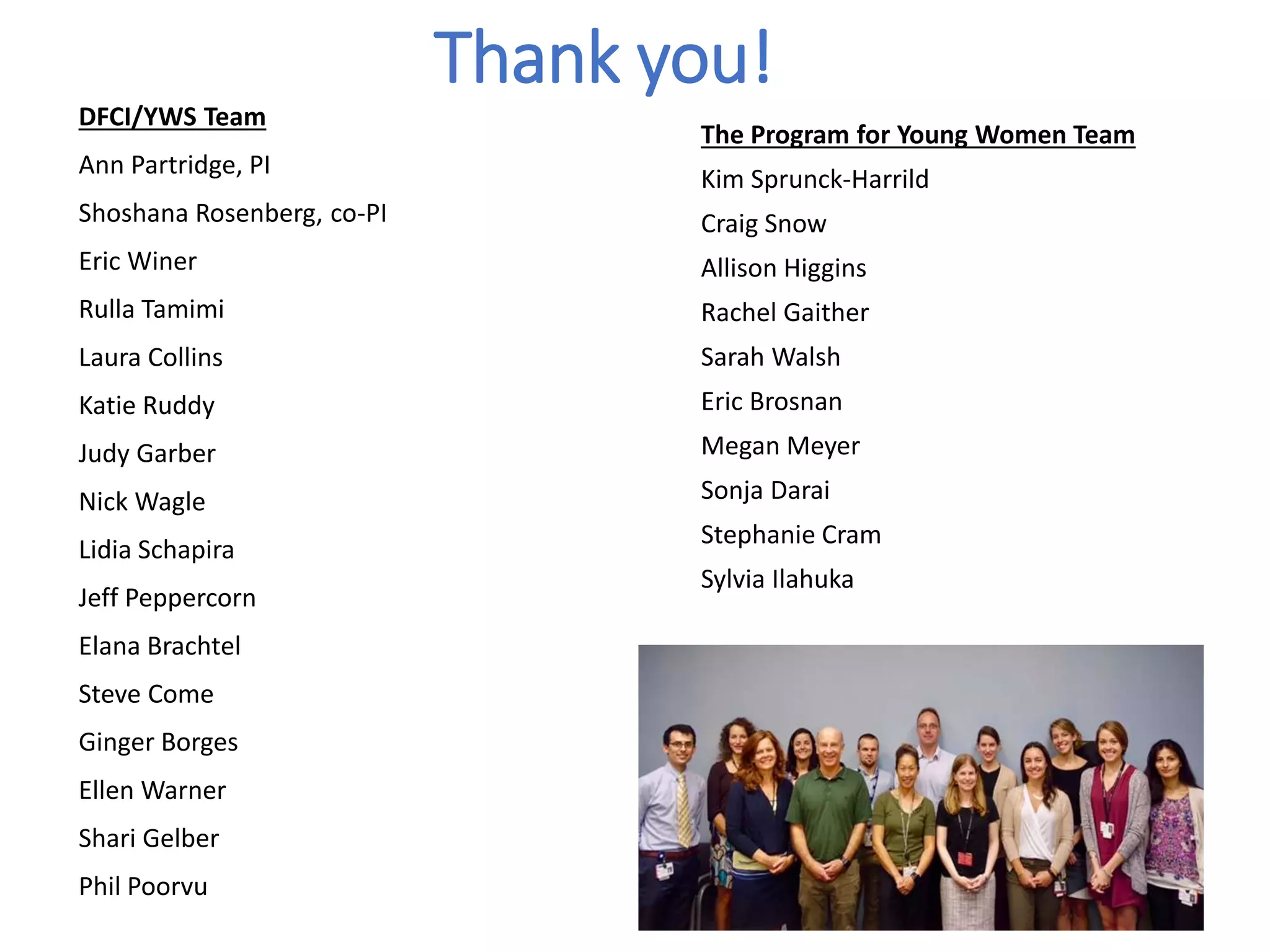
Thank you!
DFCI/YWS Team
Ann Partridge, PI
Shoshana Rosenberg, co-PI
Eric Winer
Rulla Tamimi
Laura Collins
Katie Ruddy
Judy Garber
Nick Wagle
Lidia Schapira
Jeff Peppercorn
Elana Brachtel
Steve Come
Ginger Borges
Ellen Warner
Shari Gelber
Phil Poorvu
The Program for Young Women Team
Kim Sprunck-Harrild
Craig Snow
Allison Higgins
Rachel Gaither
Sarah Walsh
Eric Brosnan
Megan Meyer
Sonja Darai
Stephanie Cram
Sylvia Ilahuka
Thank you!
CDC-DP 14-408
Thank you!
All of the advocates, patients, and partners
who have given their time and participated
in our research
QUESTIONS?

Research in the Program for Young Women with Breast Cancer: Past, Present and Future

  • 1.
    Research in theProgram for Young Women with Breast Cancer: Past, Present and Future Shoshana Rosenberg, ScD and Ann H. Partridge, MD MPH Dana-Farber Cancer Institute January 24, 2018
  • 2.
    • In 2005,we established The Program for Young Women with Breast Cancer (“Young and Strong”) to address the unique issues facing the young patients at DFCI • The program addresses critical issues including:  Fertility  Genetics  Parenting  Sexual functioning  Psychosocial and Emotional Health  Exercise and Nutrition  Balancing School and/or a Career  Building Relationships • Initially, the program served women diagnosed at age 42 and younger but include women up to 45 now • To date: directly served over 4,000 new young patients visiting our breast oncology clinics
  • 3.
    A Comprehensive andIntegrated Program Focused on Young Women Clinical Care Research Education (both patient and provider)
  • 4.
  • 5.
    Helping Ourselves, HelpingOthers: The Young Women’s Breast Cancer Study (YWS) Prospective cohort established in 2006 • Women age ≤40 at diagnosis of breast cancer • Eastern Massachusetts, Colorado, MN, Canada Outcomes • Disease, tumor biology/molecular characteristics • Treatment issues (surgical decisions, adherence) • Psycho-social (fertility, sexuality, workplace issues) • Lifestyle factors (alcohol, exercise, weight gain) • Health services (delay in diagnosis, survivorship care) Accrual • 1302 participants enrolled • Surveys: every 6 months x 3 years, annually thereafter • Blood: 91% of patients with at least one sample • Tumor: 98% consented, centrally reviewed by study pathologists, block banked for future research PI: Partridge Co-PI: Rosenberg
  • 6.
    Participating Sites o Brighamand Women’s Hospital/DFCI o Faulkner Hospital o Massachusetts General Hospital o Beth Israel Deaconess Medical Center o South Shore Hospital o Mass General/North Shore Cancer Center o Cape Cod Healthcare o Lowell General Hospital o Newton Wellesley Hospital o Sunnybrook Health Sciences Center o University of Colorado – Denver o Mayo Clinic o Also, related studies on-going in Europe, Saudi Arabia, Israel
  • 7.
    Recruitment • Inclusion Criteria •Female • New diagnosis of breast cancer (no history of breast cancer) • Stage 0-4 included but exclude pure LCIS • Age 40 or younger at diagnosis • Informed consent obtained from patient • Ability to understand written and spoken English to the extent necessary to complete the questionnaires • At Partners institutions, potentially eligible cases were identified from review of tumor registry lists • At some sites, research nurses and/or research coordinators assisted with recruitment via review of patient lists
  • 8.
    Study/Survey timeline All surveysare sent based on patients’date of diagnosis, except the baseline and 6 month surveys Consent Survey 1 Blood sample Survey 2 Survey 3 Blood sample Survey 4 Med Rec Request Tissue Request Survey 5 Survey 6 3 year 20 year = annual surveys 4 year = final blood sample 7, 10 year = LTF Re- engagement Baseline 6 mos 1 yr 18 mos 2 yrs 30 mos 3 20 yrs
  • 9.
    Some examples ofsurvey measures • Socio-demographics • Medical and family history • Genetics • Fertility issues and outcomes • General quality of life • Anxiety and depression • Menopausal symptoms • Physical activity
  • 10.
    Timepoint Range Baseline Enrollment– 9 months post diagnosis 1 Year 9 months – 2 years post diagnosis 4 year 3.5 years – 5 years post diagnosis Blood Specimen Collection • We work with coordinators at participating sites to arrange these draws or we send blood kits directly to the patients with appointments offsite • We process these specimens and isolate whole blood + plasma before freezing them for future studies • 1224/1302 =94% women have consented to blood • Of these, >90% have contributed at least one sample
  • 11.
    Tissue Specimen Collection •We collect specimens to characterize the tumors and bank for future studies utilizing: • molecular evaluations of disease characteristics (via TMA) • genetic variability (via whole exome sequencing) • 1278/1302=98% have consented to pathology specimen collection • Of these, >80% have undergone pathology review
  • 12.
    Overview of selectedcompleted/ Ongoing studies • Pathologic features and biology of breast cancer in young women • Health care delivery • Local therapy and patient decision making • Fertility and pregnancy issues • Psycho-social and quality of life issues
  • 13.
    Pathologic features/molecular phenotype •Pathologic features and molecular phenotype by patient age in a large cohort of young women with breast cancer • Molecular Phenotype of Breast Cancer According to Time Since Last Pregnancy in a Large Cohort of Young Women
  • 14.
    Collins et al.BCRT 2012 • N=399 women • No differences in clinico-pathologic phenotype by age • 35% were luminal B
  • 15.
    Collins et al.The Oncologist 2015 • N=707 women • No association with parity or recency of pregnancy and molecular phenotype, adjusting for age at diagnosis and family history
  • 16.
    Health care delivery •Breast cancer presentation and diagnostic delays in young women • BRCA1 and BRCA2 mutation testing in young women with breast cancer
  • 17.
    Ruddy et al.Cancer 2014
  • 18.
    Rosenberg et al.JAMA Onc 2016
  • 19.
    • Perceptions, knowledge,and satisfaction with contralateral prophylactic mastectomy among young women with breast cancer: a cross-sectional survey • Local therapy decision-making and contralateral prophylactic mastectomy in young women with early-stage breast cancer Local therapy
  • 20.
    • 123 womenwith unilateral breast cancer, age 40 or younger at diagnosis who had undergone bilateral mastectomy • ~25% BRCA 1 or BRCA 2 mutation carriers • Median time since surgery: 2.1 (range: 0.1-4.3) years • Median age at diagnosis: 37 (26-40) years • 79% Stage I/II at diagnosis
  • 21.
    Rosenberg et al.Ann Intern Med 2013 Reasonsfor choosingCPM
  • 22.
    • 560 womenwith Stage I-III unilateral breast cancer enrolled in YWS • Characterization of decision-making process, including involvement and confidence with the decision • Assessment of socio-demographic, clinical and decisional factors associated with CPM vs. breast conserving surgery and unilateral mastectomy
  • 23.
  • 24.
    Local therapy decision-makingand CPM in young women with early-stage breast cancer Rosenberg et al. Ann Surg Onc 2015 • Among women where BCS was an option or was recommended, choosing CPM (vs. other types of surgery) was associated with: • Testing positive for a BRCA mutation • Higher levels of generalized anxiety • Lower BMI • Lower levels of fear of recurrence
  • 25.
    Fertility is aprimary issue Ruddy et al, J Clin Oncol, 2014
  • 26.
    Enrolled in YWS,n=1302 Completed abbreviated surveys, n=137 No baseline survey, n=89 YWS: fertility outcomes Analytic cohort, n=1076
  • 27.
    Patient, disease, treatmentcharacteristics Characteristic Patients (n=1076) Age at diagnosis n (%) ≤30 years (yr) 140 (13) 31-35 years 293 (27) 36 – 40 years 643 (60) Stage 0 88 (8) I 355 (33) II 422 (40) III 145 (14) IV 56 (5) Partnered at diagnosis Yes 806 (75) No 263 (25) Children prior to diagnosis Yes 691 (64) No 385 (36) Phenotype ER+ 772 (72) ER- 293 (28) Adjuvant endocrine therapy Yes 704 (65) No 372 (35) Chemotherapy Yes 802 (75) No 270 (25) Median follow-up: 5 years
  • 28.
    38% 26% 27% 24% 24% 20% 15%14% 13% 11% 7% 7% 0% 10% 20% 30% 40% 50% Interest in future biologic children n=1076
  • 29.
    Fertility preservation use 79 29 1 34 1 10 0 10 20 30 40 50 60 70 80 90 Embryo cryopreservation Oocyte cryopreservation Ovariantissue cryopreseration GnRH agonist OCPs Other Numberofpatients * 133/1206 (11%) patients took steps to preserve fertility prior to treatment OCPs=oral contraceptive pills
  • 30.
    87% 70% 64% 13% 30% 36% 0% 20% 40% 60% 80% 100% ≤30 years 31-35years 36 – 40 years No TRA TRA No amenorrhea Amenorrhea 100% 60% 0% 40% 0% 20% 40% 60% 80% 100% No chemotherapy Chemotherapy No TRA TRA No amenorrhea Amenorrhea n=69 n=128 n=310 n=111 n=396 76% 64% 24% 36% 0% 20% 40% 60% 80% No tamoxifen Tamoxifen No TRA TRA No amenorrhea Amenorrhea n=188 n=319 Amenorrhea varies by age and use of chemotherapy and tamoxifen Poorvu et al, ASCO, 2015
  • 31.
    Total cohort, n=1076 Interested, n= 387(36%) Not interested, n= 689 (64%) Cumulative pregnancy interest, attempts, and outcomes  Excluded pregnancies occurring at time of diagnosis
  • 32.
    Total cohort, n=1076 Attempted, n= 138(36%) Interested, n= 387 (36%) No attempt, n= 249 (64%) Not interested, n= 689 (64%) Attempted, n= 8 (1%) No attempt, n= 681 (99%) Cumulative pregnancy interest, attempts, and outcomes  Excluded pregnancies occurring at time of diagnosis
  • 33.
    Total cohort, n=1076 Attempted, n= 138(36%) Interested, n= 387 (36%) Pregnant, n= 13 (5%) Not pregnant, n= 236 (95%) No attempt, n= 249 (64%) Pregnant, n= 1 (13%) Not pregnant, n= 7 (87%)Not interested, n= 689 (64%) Pregnant, n= 9 (1%) Not pregnant, n= 672 (99%) Pregnant, n= 94 (68%) Not pregnant, n= 44 (32%) Attempted, n= 8 (1%) No attempt, n= 681 (99%) Cumulative pregnancy interest, attempts, and outcomes  Excluded pregnancies occurring at time of diagnosis
  • 34.
    Total cohort, n=1076 Attempted, n= 138(36%) Interested, n= 387 (36%) Pregnant, n= 13 (5%) Not pregnant, n= 236 (95%) No attempt, n= 249 (64%) Pregnant, n= 1 (13%) Not pregnant, n= 7 (87%)Not interested, n= 689 (64%) Pregnant, n= 9 (1%) Not pregnant, n= 672 (99%) Pregnant, n= 94 (68%) Not pregnant, n= 44 (32%) Attempted, n= 8 (1%) No attempt, n= 681 (99%) Cumulative pregnancy interest, attempts, and outcomes  Excluded pregnancies occurring at time of diagnosis
  • 35.
    Live births, 108, 61% Micarriages,44, 25% Abortions, 7, 4% Stillbirths, 2, 1% TBD, 15, 9% 173 pregnancies among 117 women (including 3 sets of twins) Median f/u: 5 years Pregnancy outcomes
  • 36.
    Psycho-social and Qualityof Life • Body image • Body image in recently diagnosed young women with early breast cancer • Sexual functioning • Treatment-related amenorrhea and sexual functioning in young breast cancer survivors • Anxiety/Depression • Partner support and anxiety in young women with breast cancer • Depression and anxiety symptoms in young women with metastatic disease
  • 37.
    • Local therapyand QOL • Breast-Q (Dominici/Rosenberg) • Longitudinal analysis of QOL outcomes by surgery type (Rosenberg) • Adjuvant systemic therapy • Endocrine therapy adherence (Wassermann) • Endocrine therapy initiation and persistence (Rosenberg) • Psychosocial • Post-traumatic stress disorder (Vazquez, HMS) • Trajectories in sexual function (von Hippel, HSPH) • Experience of partners of young women with breast cancer (Borstelmann) Ongoing projects
  • 38.
    Partner sub-study • One-timecross-sectional survey of partners of cohort participants • Outcomes included social support, quality of life, coping, parenting concerns, anxiety, depression, post- traumatic growth, sexual satisfaction • N=332 respondents • Almost all respondents were male • In women not in “active treatment,” median follow-up from (patient) diagnosis to survey of partner was 58 months
  • 39.
    Concern N (%)Missing N Anxiety (HADS subscore ≥8) 106 (42) 39 Depression (HADS subscore ≥8) 47 (21) 60 Parenting concerns (N=208 with children) 74 (36) 4 Relationship strain 89 (32) 12 Financial insecurity 79 (29) 17 Not sexually active 55 (20) 12 Maladaptive coping style 120 (44) 19 Social support (MOS-SS summary score) Median (range) 67 (19-95) 15 Table 2. Prevalence of psychosocial concerns in partners (N=289) Abbreviations: HADS, Hospital Anxiety and Depression Scale; MOS-SS, Medical Outcomes Survey-Social Support Survey • Many partners of breast cancer survivors experience substantial psychosocial distress • In an analysis of factors associated with anxiety, maladaptive coping during treatment was associated with higher levels of anxiety • Attention to the psycho-social health of caregivers is critical during both the treatment and survivorship phases of care
  • 40.
    • Biology • Understandingthe genomic underpinnings of breast cancer in young women (Wagle) • ctDNA to identify MRD and risk of recurrence in young women (Parsons) • Whole Exome Sequencing of Treatment Resistant HER2+ Breast Cancer (Wagle/Waks) • Whole Exome Sequencing of Triple Negative Breast Cancer (Stover) Ongoing projects
  • 42.
    PATHWAYS TO WELLNESSSTUDY Improving Outcomes for Younger Breast Cancer Survivors: A randomized trial comparing outcomes for women receiving a mindfulness awareness practice group intervention, a health education curriculum tailored to younger women, or a delayed intervention control condition PIs: Ganz and Bower • Based on successful randomized pilot data from a single site pilot randomized trial at UCLA • 3 arm, multi-center RCT evaluating mindfulness vs. ed. vs. control • 6 week intervention teaching mindfulness awareness practices (MAPs) • Sitting and walking meditations • Application to physical symptoms, emotions, and thoughts • Focus on relevance for cancer survivorship
  • 43.
    Study Outcomes: Post-treatment •Psychological: • Perceived stress, depression, anxiety • Symptoms: • Fatigue, sleep, pain • Health behaviors: • Stress-related eating, physical activity • Biological: • Inflammation, insulin, glucose • Heart rate variability • Reactivity to challenge
  • 44.
    Pregnancy Outcome andSafety of Interrupting Therapy for women with endocrine responsIVE Breast Cancer IBCSG 48-14 / BIG 8-13 ALLIANCE # A221405 POSITIVE TRIAL INTERNATIONAL PI: OLIVIA PAGANI NORTH AMERICAN PI: ANN PARTRIDGE
  • 45.
    The POSITIVE Trial:Endocrine therapy interruption for pregnancy in breast cancer patients • Phase II trial designed to evaluate safety and pregnancy outcomes of interrupting ET for young women with ER+ disease who desire pregnancy • Enroll 512 women, <42, premenopausal, have completed between 18-30 months of ET • Study participants come off endocrine therapy for up to 2 years for a pregnancy attempt, restart hormonal therapy • Outcomes: disease, reproductive, psychosocial
  • 46.
    YWS2: from observationto intervention Diagnosis Treatment Long-term Survivorship Enrollment Surgical DA Mindfulness intervention Symptom management to improve ET adherence 6 mo 12 mo Addressing menopausal sx, sexual dysfunction Expanding TS/SCP+ research pilot
  • 47.
    Thank you! DFCI/YWS Team AnnPartridge, PI Shoshana Rosenberg, co-PI Eric Winer Rulla Tamimi Laura Collins Katie Ruddy Judy Garber Nick Wagle Lidia Schapira Jeff Peppercorn Elana Brachtel Steve Come Ginger Borges Ellen Warner Shari Gelber Phil Poorvu The Program for Young Women Team Kim Sprunck-Harrild Craig Snow Allison Higgins Rachel Gaither Sarah Walsh Eric Brosnan Megan Meyer Sonja Darai Stephanie Cram Sylvia Ilahuka
  • 48.
  • 49.
    Thank you! All ofthe advocates, patients, and partners who have given their time and participated in our research
  • 50.