FIDIC 2019 The World Bank and the
Emerald Book
Sean Gibbs on a busy year for FIDIC and a new major contract for
underground works
DURING 2019, the World Bank and Fédération Internationale des
Ingénieurs Conseils (FIDIC) announced they had reached agreement
that will see the international funding organisation adopt the use of six
FIDIC standard contracts for the next five years. Under the terms of
the agreement, FIDIC has granted the World Bank a non-exclusive
licence to refer to the six major FIDIC contracts for projects it finances
and the documents will be used as part of the bank’s standard bidding
documents. FIDIC expects to announce a similar agreement with other
multilateral development banks, having reached agreement with the
Inter-American Development Bank in May 2019.
The six FIDIC contract documents covered by the World Bank agreement are:
• Client/Consultant Model Services Agreement (White Book), fifth edition 2017.
• The Short Form of Contract (Green Book), first edition 1999.
• Conditions of Contract for Construction for Building and Engineering Works
Designed by the Employer (Red Book), second edition 2017.
• Conditions of Contract for Plant and Design-Build for Electrical and Mechanical
Plant and for Building and Engineering Works Designed by the Contractor (Yellow
Book), second edition 2017.
• Conditions of Contract for EPC Turnkey Projects (Silver Book), second edition,
2017).
• Conditions of Contract for Design, Build and Operate Projects (Gold Book), first
edition 2008.
Simplistically, the White Book is used for consultancy services, such as architectural and
engineering; the Red and Green books for building and civil engineering projects designed
by the employer; the Yellow Book is a design-build contract for projects designed by the
contractor; the Silver Book is for where the contractor undertakes engineering,
procurement and construction and hands over a fully commissioned and operational plant
to the employer; and the Gold book is used where the contractor designs, builds and
operates before handing over. Four of the six contracts were released in 2017, with second
editions and corrections released in subsequent years.
FIDIC has an ongoing process of review and drafting and this work is likely to lead to
release in 2019 of:
• An updated 1999 Green Book (short form of contract) in order to bring it to the same
level edition with the other major forms of contract.
• A subcontract form for use back-to-back with the 1999 Yellow Book.
FIDIC
Page 1 of 6
21/09/2019http://ces.pagelizard.co.uk/webviewer/
• The new operate-design-build-operate form of contract (Bronze Book).
• A standard set of particular conditions of contract for renewable energy sector
projects (off-shore wind farms) for use in conjunction with the 2017 Yellow Book.
Emerald Book
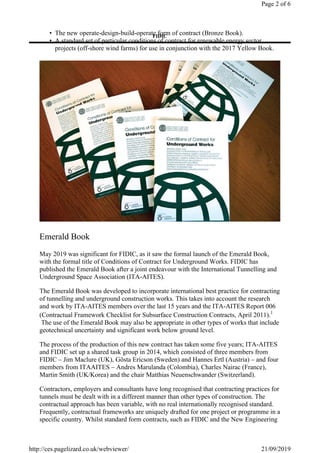
May 2019 was significant for FIDIC, as it saw the formal launch of the Emerald Book,
with the formal title of Conditions of Contract for Underground Works. FIDIC has
published the Emerald Book after a joint endeavour with the International Tunnelling and
Underground Space Association (ITA-AITES).
The Emerald Book was developed to incorporate international best practice for contracting
of tunnelling and underground construction works. This takes into account the research
and work by ITA-AITES members over the last 15 years and the ITA-AITES Report 006
(Contractual Framework Checklist for Subsurface Construction Contracts, April 2011).1
The use of the Emerald Book may also be appropriate in other types of works that include
geotechnical uncertainty and significant work below ground level.
The process of the production of this new contract has taken some five years; ITA-AITES
and FIDIC set up a shared task group in 2014, which consisted of three members from
FIDIC – Jim Maclure (UK), Gösta Ericson (Sweden) and Hannes Ertl (Austria) – and four
members from ITAAITES – Andres Marulanda (Colombia), Charles Nairac (France),
Martin Smith (UK/Korea) and the chair Matthias Neuenschwander (Switzerland).
Contractors, employers and consultants have long recognised that contracting practices for
tunnels must be dealt with in a different manner than other types of construction. The
contractual approach has been variable, with no real internationally recognised standard.
Frequently, contractual frameworks are uniquely drafted for one project or programme in a
specific country. Whilst standard form contracts, such as FIDIC and the New Engineering
FIDIC
Page 2 of 6
21/09/2019http://ces.pagelizard.co.uk/webviewer/
Contract (NEC), have been used as the starting point, following extensive changes they are
entirely different from the way the contract had been originally intended to be used in
terms of risk apportionment.
Those familiar with the second edition Yellow Book will recognise many features in the
Emerald Book, as key parts have been used in drafting. When the working party was
looking at earlier versions of the Yellow Book, it was envisaged that the dispute
adjudication board (DAB) would be utilised. Thankfully, the final version uses the dispute
avoidance and adjudication board (DAAB) as introduced by the 2017 FIDIC suite. This
approach should hopefully encourage the avoidance of disputes to the benefit of all
parties.
New concepts
As there are numerous commentaries on the 2017 suite, I will focus on a number of
conditions that are new or different from those in the Yellow Book. The conditions include
several new concepts in consideration of the risks that are particular to underground
works. They address the risk related to subsurface physical conditions which are not
possible to assess with sufficient precision in advance of the contract, and therefore cannot
be assigned entirely to the contractor. Compared to other works undertaken using FIDIC
contracts, underground construction is predominantly characterised by three unique
features:
1. The method of excavation and ground support are major factors for the successful
realisation of the project, and therefore part of the works.
2. Physical access to the works is often limited to few, or even a single, locations,
which places serious constraints on construction logistics and the environment.
3. The land the works are to be constructed underneath typically belongs to a number of
third parties.
There are two other significant matters that are not unique to underground works:
1. They require extensive investment in contractor’s equipment; for example tunnel
boring machines (TBM).
2. Underground excavation and lining works are very time-consuming.
For a successful project outcome, the employer should give careful consideration to all
five of the above features and matters – at concept stage and during the preparation of
tender documents. They are critical to the feasibility of successful completion of the works
and tenderers’ ability to meaningfully price them.
GBR
The geotechnical baseline report (GBR) is defined as the single contractual source of risk
allocation related to subsurface physical conditions. Equally important to the physical
conditions of the ground, the GBR addresses the reaction of the ground to excavation and
support under the contractually agreed construction methodology. All subsurface physical
conditions not addressed in the GBR shall be considered unforeseeable.
The risks arising out of the foreseen properties of the ground, obstacles and adverse
reaction to the excavation and ground support processes are assigned to the contractor, as
FIDIC
Page 3 of 6
21/09/2019http://ces.pagelizard.co.uk/webviewer/
well as the production rates and cost of performing the works under the same conditions.
Conversely, the risks arising out of unforeseen physical conditions of the ground,
obstacles, and adverse reaction to the excavation and ground support processes are
allocated to the employer, warranting extension of time and/or reimbursement of cost to
the contractor.
The time for completion of the works, of a section or any milestone may largely depend on
the subsurface physical conditions that are encountered during excavation. As the risk
related to these conditions is allocated to the employer, time for completion should be
adjusted by the variation of these conditions within the limits defined by the GBR, insofar
as this variation affects the critical path of the works, of a section or any milestone. In the
case that the amount of more onerous conditions encountered is higher than that described
in the GBR, the time for completion should be extended, while in the case that the amount
of less onerous conditions is higher than described in the GBR, the time for completion
should be reduced. Accordingly, the contractor’s tender shall include production rates for
each excavation drive or zone, based upon the conditions described in the GBR.
The estimated quantities of the excavation, ground support, ancillary measures and lining,
as well as the corresponding production rates, shall be included in the schedule of
baselines (sub-clause 8.2.2), and the corresponding sequential logical links between
milestones shall be included in the completion schedule (sub-clause 8.2.1).
Cost management
The cost of the excavation and lining works will largely depend on the subsurface physical
conditions and/or ground reaction(s) to such works. These conditions provide that the
excavation and lining works are to be measured and paid for using rates and prices set out
in the bill of quantities. Under these conditions, it is the contractor who measures the as-
built quantities which are then agreed or determined by the engineer. All other works
(such as ancillary surface works) are to be paid on a lump sum basis.
Due to the typically long duration of underground works and to the high cost of
investment in equipment, an important portion of the cost to the contractor, such as
equipment depreciation and interest and overhead charges, is time-related, whilst the
remainder of the cost depends on the volume or quantity of the performed works. Hence,
the adjustment of time for completion (if any), due to the difference between the
contractually agreed and encountered subsurface physical conditions, should also lead to
an adjustment of the contractor’s remuneration for time-related charges. The bill of
quantities for excavation and lining works should therefore distinguish between time-
related rate items, quantity-related rate items and fixed rate items for the performance of
the works (sub-clauses 13.8.2 and 13.8.3).
General and particular conditions
The Emerald Book includes conditions which are likely to apply to the majority of
contracts. Essential items of information which are particular to each individual contract
are to be included in Part A, contract data.
In addition, it is recognised that many employers, especially governmental agencies, may
require special conditions of contract or particular procedures which differ from those
included in the general conditions. These should be included in Part B, special provisions.
FIDIC
Page 4 of 6
21/09/2019http://ces.pagelizard.co.uk/webviewer/
However, the amendment of general conditions referring in particular to underground
works is strongly discouraged, as it may alter the balanced risk allocation that is central to
the present form of contract.
It should be noted that the general and particular conditions (Part A and Part B) are both
part of the conditions of contract.
Guidance on the preparation of tender documents and special provisions has been
included, which provides important advice to drafters of contract documents, in particular
the GBR, the schedule of baselines, the completion schedule, the employer’s requirements,
the bill of quantities and special provisions. In drafting special provisions, if clauses or
sub-clauses in the general conditions are to be replaced or supplemented, employers are
urged to seek legal and engineering advice before incorporating any example wording, in
an effort to avoid ambiguity and to ensure completeness and consistency with other
provisions of the contract.
Illustrations and examples
Users are provided with a series of comprehensive flow charts which show in visual form
the sequences of activities which characterise the Emerald Book. The charts are
illustrative, however, and must not be taken into consideration in the interpretation of the
conditions of contract.
There are a number of sample forms to help parties develop a common understanding of
what is required by the contract and/or by third parties such as providers of securities and
guarantees.
As with all FIDIC contracts, they are protected by copyright and trademark and may not
be changed without specific written consent, usually in the form of a licence to amend
from FIDIC. If drafters wish to amend the provisions in the general conditions, the place
for doing this is in Part B.
The effect of the Emerald Book in case law
The case of Obrascon Huarte Lain SA v Her Majesty’s Attorney General for Gibraltar
(2015) EWCA Civ 712 concerned a contract under the 1999 Yellow Book. It highlights
how the Emerald Book’s approach to risk balance by the use of the GBR would have
arguably led to an improved position for the contractor due to the more favourable risk
allocation.
In the Obrascon case, the contractor was unable to persuade the court that the ground
conditions it encountered were unforeseeable. If they had been, the contractor would have
been entitled to time and cost under clause 4.12. The Court of Appeal held that an
experienced contractor would have made its own assessment of all available data, drawing
on its expertise and experience, and not simply accepting someone else’s interpretation of
it. The court agreed with the first instance judge that the contractor did not encounter more
contaminated soil than an experienced contractor could reasonably have foreseen by the
date it submitted its tender. The Emerald Book’s use of the GBR would have made the
employer take on the risk for divergence from the data it contained. In the case of Van
Oord UK and Sicim Roadbridge v Allseas UK (2015) EWHC 3074 (TCC) the contractor
fell foul of not being able to establish that the ground conditions it encountered on a gas
FIDIC
Page 5 of 6
21/09/2019http://ces.pagelizard.co.uk/webviewer/
pipeline project in the Shetland Islands were unforeseen. Referring to the Court of
Appeal’s decision in Obrascon, the court found that it is wrong in principle for a
contractor to argue that, because in some areas of a site ground conditions are different to
those set out in pre-contract information, those conditions are therefore unforeseeable.
The Emerald Book is much more favourable to the contractor than the common law
position, which is that if the building contract does not expressly provide for the contractor
to be entitled to additional time and/or money in the event that it encounters adverse
ground conditions, it has no such entitlement and the contractor will bear the risk.
A contract for contractors
In conclusion the Emerald Book should be appreciated by contractors as it offers an
improvement on the Yellow Books (1999 and 2017) and NEC suite for underground
construction works. It is more favourable than the current common law position.
Sean Sullivan Gibbs BSc LLB(Hon) PG DipArb PGDipBar MICE AFICHEME FRICS
FCIOB FCInstCES, Director, Hanscomb Intercontinental
sean.gibbs@hanscombintercontinental.co.uk @sgibbs121
www.hanscombintercontinental.co.uk
1
ISBN 978-2-9700634-7-9
FIDIC
Page 6 of 6
21/09/2019http://ces.pagelizard.co.uk/webviewer/

FIDIC 2019

  • 1.
    FIDIC 2019 TheWorld Bank and the Emerald Book Sean Gibbs on a busy year for FIDIC and a new major contract for underground works DURING 2019, the World Bank and Fédération Internationale des Ingénieurs Conseils (FIDIC) announced they had reached agreement that will see the international funding organisation adopt the use of six FIDIC standard contracts for the next five years. Under the terms of the agreement, FIDIC has granted the World Bank a non-exclusive licence to refer to the six major FIDIC contracts for projects it finances and the documents will be used as part of the bank’s standard bidding documents. FIDIC expects to announce a similar agreement with other multilateral development banks, having reached agreement with the Inter-American Development Bank in May 2019. The six FIDIC contract documents covered by the World Bank agreement are: • Client/Consultant Model Services Agreement (White Book), fifth edition 2017. • The Short Form of Contract (Green Book), first edition 1999. • Conditions of Contract for Construction for Building and Engineering Works Designed by the Employer (Red Book), second edition 2017. • Conditions of Contract for Plant and Design-Build for Electrical and Mechanical Plant and for Building and Engineering Works Designed by the Contractor (Yellow Book), second edition 2017. • Conditions of Contract for EPC Turnkey Projects (Silver Book), second edition, 2017). • Conditions of Contract for Design, Build and Operate Projects (Gold Book), first edition 2008. Simplistically, the White Book is used for consultancy services, such as architectural and engineering; the Red and Green books for building and civil engineering projects designed by the employer; the Yellow Book is a design-build contract for projects designed by the contractor; the Silver Book is for where the contractor undertakes engineering, procurement and construction and hands over a fully commissioned and operational plant to the employer; and the Gold book is used where the contractor designs, builds and operates before handing over. Four of the six contracts were released in 2017, with second editions and corrections released in subsequent years. FIDIC has an ongoing process of review and drafting and this work is likely to lead to release in 2019 of: • An updated 1999 Green Book (short form of contract) in order to bring it to the same level edition with the other major forms of contract. • A subcontract form for use back-to-back with the 1999 Yellow Book. FIDIC Page 1 of 6 21/09/2019http://ces.pagelizard.co.uk/webviewer/
  • 2.
    • The newoperate-design-build-operate form of contract (Bronze Book). • A standard set of particular conditions of contract for renewable energy sector projects (off-shore wind farms) for use in conjunction with the 2017 Yellow Book. Emerald Book May 2019 was significant for FIDIC, as it saw the formal launch of the Emerald Book, with the formal title of Conditions of Contract for Underground Works. FIDIC has published the Emerald Book after a joint endeavour with the International Tunnelling and Underground Space Association (ITA-AITES). The Emerald Book was developed to incorporate international best practice for contracting of tunnelling and underground construction works. This takes into account the research and work by ITA-AITES members over the last 15 years and the ITA-AITES Report 006 (Contractual Framework Checklist for Subsurface Construction Contracts, April 2011).1 The use of the Emerald Book may also be appropriate in other types of works that include geotechnical uncertainty and significant work below ground level. The process of the production of this new contract has taken some five years; ITA-AITES and FIDIC set up a shared task group in 2014, which consisted of three members from FIDIC – Jim Maclure (UK), Gösta Ericson (Sweden) and Hannes Ertl (Austria) – and four members from ITAAITES – Andres Marulanda (Colombia), Charles Nairac (France), Martin Smith (UK/Korea) and the chair Matthias Neuenschwander (Switzerland). Contractors, employers and consultants have long recognised that contracting practices for tunnels must be dealt with in a different manner than other types of construction. The contractual approach has been variable, with no real internationally recognised standard. Frequently, contractual frameworks are uniquely drafted for one project or programme in a specific country. Whilst standard form contracts, such as FIDIC and the New Engineering FIDIC Page 2 of 6 21/09/2019http://ces.pagelizard.co.uk/webviewer/
  • 3.
    Contract (NEC), havebeen used as the starting point, following extensive changes they are entirely different from the way the contract had been originally intended to be used in terms of risk apportionment. Those familiar with the second edition Yellow Book will recognise many features in the Emerald Book, as key parts have been used in drafting. When the working party was looking at earlier versions of the Yellow Book, it was envisaged that the dispute adjudication board (DAB) would be utilised. Thankfully, the final version uses the dispute avoidance and adjudication board (DAAB) as introduced by the 2017 FIDIC suite. This approach should hopefully encourage the avoidance of disputes to the benefit of all parties. New concepts As there are numerous commentaries on the 2017 suite, I will focus on a number of conditions that are new or different from those in the Yellow Book. The conditions include several new concepts in consideration of the risks that are particular to underground works. They address the risk related to subsurface physical conditions which are not possible to assess with sufficient precision in advance of the contract, and therefore cannot be assigned entirely to the contractor. Compared to other works undertaken using FIDIC contracts, underground construction is predominantly characterised by three unique features: 1. The method of excavation and ground support are major factors for the successful realisation of the project, and therefore part of the works. 2. Physical access to the works is often limited to few, or even a single, locations, which places serious constraints on construction logistics and the environment. 3. The land the works are to be constructed underneath typically belongs to a number of third parties. There are two other significant matters that are not unique to underground works: 1. They require extensive investment in contractor’s equipment; for example tunnel boring machines (TBM). 2. Underground excavation and lining works are very time-consuming. For a successful project outcome, the employer should give careful consideration to all five of the above features and matters – at concept stage and during the preparation of tender documents. They are critical to the feasibility of successful completion of the works and tenderers’ ability to meaningfully price them. GBR The geotechnical baseline report (GBR) is defined as the single contractual source of risk allocation related to subsurface physical conditions. Equally important to the physical conditions of the ground, the GBR addresses the reaction of the ground to excavation and support under the contractually agreed construction methodology. All subsurface physical conditions not addressed in the GBR shall be considered unforeseeable. The risks arising out of the foreseen properties of the ground, obstacles and adverse reaction to the excavation and ground support processes are assigned to the contractor, as FIDIC Page 3 of 6 21/09/2019http://ces.pagelizard.co.uk/webviewer/
  • 4.
    well as theproduction rates and cost of performing the works under the same conditions. Conversely, the risks arising out of unforeseen physical conditions of the ground, obstacles, and adverse reaction to the excavation and ground support processes are allocated to the employer, warranting extension of time and/or reimbursement of cost to the contractor. The time for completion of the works, of a section or any milestone may largely depend on the subsurface physical conditions that are encountered during excavation. As the risk related to these conditions is allocated to the employer, time for completion should be adjusted by the variation of these conditions within the limits defined by the GBR, insofar as this variation affects the critical path of the works, of a section or any milestone. In the case that the amount of more onerous conditions encountered is higher than that described in the GBR, the time for completion should be extended, while in the case that the amount of less onerous conditions is higher than described in the GBR, the time for completion should be reduced. Accordingly, the contractor’s tender shall include production rates for each excavation drive or zone, based upon the conditions described in the GBR. The estimated quantities of the excavation, ground support, ancillary measures and lining, as well as the corresponding production rates, shall be included in the schedule of baselines (sub-clause 8.2.2), and the corresponding sequential logical links between milestones shall be included in the completion schedule (sub-clause 8.2.1). Cost management The cost of the excavation and lining works will largely depend on the subsurface physical conditions and/or ground reaction(s) to such works. These conditions provide that the excavation and lining works are to be measured and paid for using rates and prices set out in the bill of quantities. Under these conditions, it is the contractor who measures the as- built quantities which are then agreed or determined by the engineer. All other works (such as ancillary surface works) are to be paid on a lump sum basis. Due to the typically long duration of underground works and to the high cost of investment in equipment, an important portion of the cost to the contractor, such as equipment depreciation and interest and overhead charges, is time-related, whilst the remainder of the cost depends on the volume or quantity of the performed works. Hence, the adjustment of time for completion (if any), due to the difference between the contractually agreed and encountered subsurface physical conditions, should also lead to an adjustment of the contractor’s remuneration for time-related charges. The bill of quantities for excavation and lining works should therefore distinguish between time- related rate items, quantity-related rate items and fixed rate items for the performance of the works (sub-clauses 13.8.2 and 13.8.3). General and particular conditions The Emerald Book includes conditions which are likely to apply to the majority of contracts. Essential items of information which are particular to each individual contract are to be included in Part A, contract data. In addition, it is recognised that many employers, especially governmental agencies, may require special conditions of contract or particular procedures which differ from those included in the general conditions. These should be included in Part B, special provisions. FIDIC Page 4 of 6 21/09/2019http://ces.pagelizard.co.uk/webviewer/
  • 5.
    However, the amendmentof general conditions referring in particular to underground works is strongly discouraged, as it may alter the balanced risk allocation that is central to the present form of contract. It should be noted that the general and particular conditions (Part A and Part B) are both part of the conditions of contract. Guidance on the preparation of tender documents and special provisions has been included, which provides important advice to drafters of contract documents, in particular the GBR, the schedule of baselines, the completion schedule, the employer’s requirements, the bill of quantities and special provisions. In drafting special provisions, if clauses or sub-clauses in the general conditions are to be replaced or supplemented, employers are urged to seek legal and engineering advice before incorporating any example wording, in an effort to avoid ambiguity and to ensure completeness and consistency with other provisions of the contract. Illustrations and examples Users are provided with a series of comprehensive flow charts which show in visual form the sequences of activities which characterise the Emerald Book. The charts are illustrative, however, and must not be taken into consideration in the interpretation of the conditions of contract. There are a number of sample forms to help parties develop a common understanding of what is required by the contract and/or by third parties such as providers of securities and guarantees. As with all FIDIC contracts, they are protected by copyright and trademark and may not be changed without specific written consent, usually in the form of a licence to amend from FIDIC. If drafters wish to amend the provisions in the general conditions, the place for doing this is in Part B. The effect of the Emerald Book in case law The case of Obrascon Huarte Lain SA v Her Majesty’s Attorney General for Gibraltar (2015) EWCA Civ 712 concerned a contract under the 1999 Yellow Book. It highlights how the Emerald Book’s approach to risk balance by the use of the GBR would have arguably led to an improved position for the contractor due to the more favourable risk allocation. In the Obrascon case, the contractor was unable to persuade the court that the ground conditions it encountered were unforeseeable. If they had been, the contractor would have been entitled to time and cost under clause 4.12. The Court of Appeal held that an experienced contractor would have made its own assessment of all available data, drawing on its expertise and experience, and not simply accepting someone else’s interpretation of it. The court agreed with the first instance judge that the contractor did not encounter more contaminated soil than an experienced contractor could reasonably have foreseen by the date it submitted its tender. The Emerald Book’s use of the GBR would have made the employer take on the risk for divergence from the data it contained. In the case of Van Oord UK and Sicim Roadbridge v Allseas UK (2015) EWHC 3074 (TCC) the contractor fell foul of not being able to establish that the ground conditions it encountered on a gas FIDIC Page 5 of 6 21/09/2019http://ces.pagelizard.co.uk/webviewer/
  • 6.
    pipeline project inthe Shetland Islands were unforeseen. Referring to the Court of Appeal’s decision in Obrascon, the court found that it is wrong in principle for a contractor to argue that, because in some areas of a site ground conditions are different to those set out in pre-contract information, those conditions are therefore unforeseeable. The Emerald Book is much more favourable to the contractor than the common law position, which is that if the building contract does not expressly provide for the contractor to be entitled to additional time and/or money in the event that it encounters adverse ground conditions, it has no such entitlement and the contractor will bear the risk. A contract for contractors In conclusion the Emerald Book should be appreciated by contractors as it offers an improvement on the Yellow Books (1999 and 2017) and NEC suite for underground construction works. It is more favourable than the current common law position. Sean Sullivan Gibbs BSc LLB(Hon) PG DipArb PGDipBar MICE AFICHEME FRICS FCIOB FCInstCES, Director, Hanscomb Intercontinental sean.gibbs@hanscombintercontinental.co.uk @sgibbs121 www.hanscombintercontinental.co.uk 1 ISBN 978-2-9700634-7-9 FIDIC Page 6 of 6 21/09/2019http://ces.pagelizard.co.uk/webviewer/