Taking a look into 2030 – managing water, energy and land for sustainable and inclusive development Lecture Series “The Water-Energy-Food Security Nexus” Winter Semester 2011/2012 Initiated by DIE, Institute of Geography (University of Cologne) and ITT (Cologne University of Applied Sciences)  Dr. Imme Scholz deputy director DIE 24 October 2011
Content Problem definition: sustainability and/or development? Main challenges at the nexus of water, energy and land management Ways forward: contributions of science and policy
Problem definition Today: 1.1 billion without access to safe water close to 1 billion are undernourished 1.5 billion without access to electricity 80% of global energy supplies are based on fossil fuels which cause greenhouse gas emissions and global warming global warming increases risks of droughts, floods, and rainfall variability – with serious current situations of local water overuse Agricultural inputs (water, energy, nitrogene and phosphorus) are  too much in some places, too little in others, rarely just right   agriculture covers 38% of terrestrial surface and continues to expand 10-20% of drylands are degraded (2000)
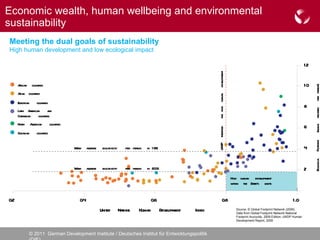
Economic wealth, human wellbeing and environmental sustainability Meeting the dual goals of sustainability  High human development and low ecological impact Source: © Global Footprint Network (2009). Data from Global Footprint Network National Footprint Accounts, 2009 Edition; UNDP Human Development Report, 2009
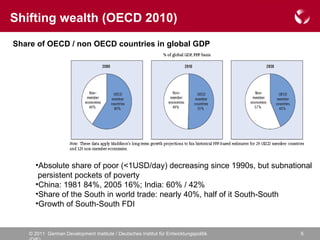
Shifting wealth (OECD 2010) Share of OECD / non OECD countries in global GDP   Absolute share of poor (<1USD/day) decreasing since 1990s, but subnational  persistent pockets of poverty China: 1981 84%, 2005 16%; India: 60% / 42% Share of the South in world trade: nearly 40%, half of it South-South Growth of South-South FDI
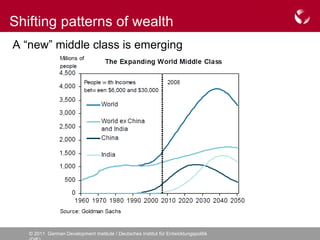
A “new” middle class is emerging Shifting patterns of wealth
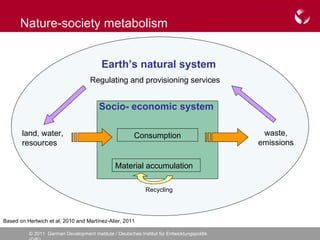
Nature-society metabolism  Socio- economic system land, water,  resources waste, emissions Material accumulation Consumption Recycling Earth’s natural system Regulating and provisioning services Based on Hertwich et al, 2010 and Martínez-Alier, 2011
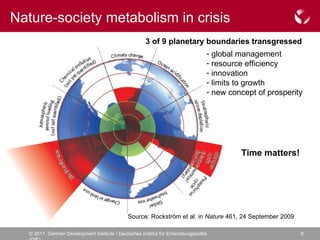
Nature-society metabolism in crisis Source: Rockström et al. in  Nature  461, 24 September 2009 global management resource efficiency innovation limits to growth new concept of prosperity 3 of 9 planetary boundaries transgressed Time matters!
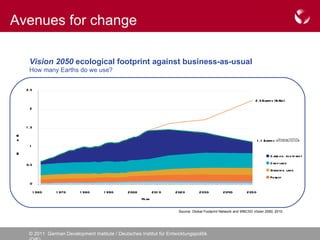
Avenues for change Vision 2050  ecological footprint against business-as-usual  How many Earths do we use? Source: Global Footprint Network and WBCSD  Vision 2050 , 2010
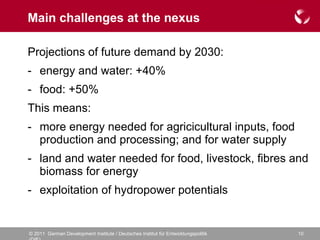
Main challenges at the nexus Projections of future demand by 2030: energy and water: +40% food: +50% This means: more energy needed for agricicultural inputs, food production and processing; and for water supply land and water needed for food, livestock, fibres and biomass for energy exploitation of hydropower potentials
Main challenges at the nexus Development pressures on water, land and the atmosphere have grown to such an extent over the past 5 decades that they are challenging the effectiveness of conventional planning and decision-making. Trying to meet demand through single sector approaches in response to inherently inter-linked and interdependent processes is limiting our ability to provide water, food and energy services in an inclusive and sustainable manner.  Source: Bonn Nexus Conference 2011
Examples of challenges at the nexus -  less than 10% of the world‘s primary energy demand could be met from biofuel if all abandoned agricultural land was planted with biofuel feedstocks water and energy intensity of agriculture is high, and exacerbated by enormous losses and wastages in the food production and consumption chain change input intensive production systems without reducing productivity… (i.e. organic/conservation agriculture, more precise fertilizer application) improve resource efficiency in order to meet competing demands for water/land/energy between food, feed, biofuel and ecosystem services
Public policies   establish frameworks that promote transparency and inclusiveness  promote long-term orientation  internalize externalities  enable and guide markets by linking local uses with global and local thresholds  promote integrated and systemic approaches for managing agriculture, forestry, water, and energy  Governance challenges at the nexus
Governance challenges at the nexus Public governance: clear strategies for sustainable water/land use and energy supply (binding targets, timetables, incentives and support measures) Corporate governance: proactive strategies for innovating core business activities (products, processes) in order to meet sustainability targets and supply the bottom billion Global governance: fair burdensharing, access/use rights for all, cooperation in identifying and implementing innovative solutions EU strategic action as an opportunity
Policy recommendations for EU European consumption and production patterns  – push for major changes, i.a. environmental footprint of agriculture, food wastage and meat consumption. Nexus approach  – adopt an integrated approach to water, energy and food/land both internally in Europe in developing countries  & apply its PCD principles to all EU policies Collaboration with the private sector –  work with EU companies working in resource scarce countries to promote high standards of corporate practice.  EU Development Cooperation  – review programmes in developing countries in light of nexus approach.  Support to the poorest –  work closely with poorest communities in developing countries to help them adapt to changes and strengthen their resilience.  Pricing mechanisms for scarce resources –  support mechanisms to reflect the true value of natural resources and abolish subsidies that distort this pricing.   Transparency  – work closely with partner governments and  private sector to promote  transparency initiatives among European investors and partners. International cooperation  – support binding agreements/regulatory frameworks to reduce emissions and open, transparent and stable trade, investment and migration rules.
Understand feedback mechanisms within the nexus and translate into systemic management approaches Understand linkages between global environmental change and local action and conditions (i.e. global scarcity of arable land vs. local abundance)    design effective global regimes! Anchor them in effective national policies! Understand new patterns of consumption and production in context of shifting patterns of wealth    new concepts of prosperity? Combine different knowledge communities for promoting fundamental transformation of water, land and energy policies – at global and local levels! Contributions by science for policy
Thank you for your attention!

FH Doku Session 1

  • 1.
    Taking a lookinto 2030 – managing water, energy and land for sustainable and inclusive development Lecture Series “The Water-Energy-Food Security Nexus” Winter Semester 2011/2012 Initiated by DIE, Institute of Geography (University of Cologne) and ITT (Cologne University of Applied Sciences) Dr. Imme Scholz deputy director DIE 24 October 2011
  • 2.
    Content Problem definition:sustainability and/or development? Main challenges at the nexus of water, energy and land management Ways forward: contributions of science and policy
  • 3.
    Problem definition Today:1.1 billion without access to safe water close to 1 billion are undernourished 1.5 billion without access to electricity 80% of global energy supplies are based on fossil fuels which cause greenhouse gas emissions and global warming global warming increases risks of droughts, floods, and rainfall variability – with serious current situations of local water overuse Agricultural inputs (water, energy, nitrogene and phosphorus) are too much in some places, too little in others, rarely just right agriculture covers 38% of terrestrial surface and continues to expand 10-20% of drylands are degraded (2000)
  • 4.
    Economic wealth, humanwellbeing and environmental sustainability Meeting the dual goals of sustainability High human development and low ecological impact Source: © Global Footprint Network (2009). Data from Global Footprint Network National Footprint Accounts, 2009 Edition; UNDP Human Development Report, 2009
  • 5.
    Shifting wealth (OECD2010) Share of OECD / non OECD countries in global GDP Absolute share of poor (<1USD/day) decreasing since 1990s, but subnational persistent pockets of poverty China: 1981 84%, 2005 16%; India: 60% / 42% Share of the South in world trade: nearly 40%, half of it South-South Growth of South-South FDI
  • 6.
    A “new” middleclass is emerging Shifting patterns of wealth
  • 7.
    Nature-society metabolism Socio- economic system land, water, resources waste, emissions Material accumulation Consumption Recycling Earth’s natural system Regulating and provisioning services Based on Hertwich et al, 2010 and Martínez-Alier, 2011
  • 8.
    Nature-society metabolism incrisis Source: Rockström et al. in Nature 461, 24 September 2009 global management resource efficiency innovation limits to growth new concept of prosperity 3 of 9 planetary boundaries transgressed Time matters!
  • 9.
    Avenues for changeVision 2050 ecological footprint against business-as-usual How many Earths do we use? Source: Global Footprint Network and WBCSD Vision 2050 , 2010
  • 10.
    Main challenges atthe nexus Projections of future demand by 2030: energy and water: +40% food: +50% This means: more energy needed for agricicultural inputs, food production and processing; and for water supply land and water needed for food, livestock, fibres and biomass for energy exploitation of hydropower potentials
  • 11.
    Main challenges atthe nexus Development pressures on water, land and the atmosphere have grown to such an extent over the past 5 decades that they are challenging the effectiveness of conventional planning and decision-making. Trying to meet demand through single sector approaches in response to inherently inter-linked and interdependent processes is limiting our ability to provide water, food and energy services in an inclusive and sustainable manner. Source: Bonn Nexus Conference 2011
  • 12.
    Examples of challengesat the nexus - less than 10% of the world‘s primary energy demand could be met from biofuel if all abandoned agricultural land was planted with biofuel feedstocks water and energy intensity of agriculture is high, and exacerbated by enormous losses and wastages in the food production and consumption chain change input intensive production systems without reducing productivity… (i.e. organic/conservation agriculture, more precise fertilizer application) improve resource efficiency in order to meet competing demands for water/land/energy between food, feed, biofuel and ecosystem services
  • 13.
    Public policies  establish frameworks that promote transparency and inclusiveness  promote long-term orientation  internalize externalities  enable and guide markets by linking local uses with global and local thresholds  promote integrated and systemic approaches for managing agriculture, forestry, water, and energy Governance challenges at the nexus
  • 14.
    Governance challenges atthe nexus Public governance: clear strategies for sustainable water/land use and energy supply (binding targets, timetables, incentives and support measures) Corporate governance: proactive strategies for innovating core business activities (products, processes) in order to meet sustainability targets and supply the bottom billion Global governance: fair burdensharing, access/use rights for all, cooperation in identifying and implementing innovative solutions EU strategic action as an opportunity
  • 15.
    Policy recommendations forEU European consumption and production patterns – push for major changes, i.a. environmental footprint of agriculture, food wastage and meat consumption. Nexus approach – adopt an integrated approach to water, energy and food/land both internally in Europe in developing countries & apply its PCD principles to all EU policies Collaboration with the private sector – work with EU companies working in resource scarce countries to promote high standards of corporate practice. EU Development Cooperation – review programmes in developing countries in light of nexus approach. Support to the poorest – work closely with poorest communities in developing countries to help them adapt to changes and strengthen their resilience. Pricing mechanisms for scarce resources – support mechanisms to reflect the true value of natural resources and abolish subsidies that distort this pricing. Transparency – work closely with partner governments and private sector to promote transparency initiatives among European investors and partners. International cooperation – support binding agreements/regulatory frameworks to reduce emissions and open, transparent and stable trade, investment and migration rules.
  • 16.
    Understand feedback mechanismswithin the nexus and translate into systemic management approaches Understand linkages between global environmental change and local action and conditions (i.e. global scarcity of arable land vs. local abundance)  design effective global regimes! Anchor them in effective national policies! Understand new patterns of consumption and production in context of shifting patterns of wealth  new concepts of prosperity? Combine different knowledge communities for promoting fundamental transformation of water, land and energy policies – at global and local levels! Contributions by science for policy
  • 17.
    Thank you foryour attention!

Editor's Notes

  • #5 This chart sums up the challenge of sustainable development: meeting human demands within the ecological limits of the planet. It is a snapshot showing how different countries perform according to the United Nations Development Programme’s (UNDP) Human Development Index (HDI) and Global Footprint Network’s Ecological Footprint. In countries to the left of the vertical line marking a score of less than 0.8 on the HDI, a high level of development, as defined by UNDP, has not been attained. Countries above the horizontal dotted line and to the right of the vertical line have achieved a high level of development but place more demand on nature than could be sustained if everyone in the world lived this way. In order to move toward a sustainable future the world will need to address all dimensions of this chart – the concepts of success and progress, the biocapacity available per person, as well as helping countries either improve their levels of development or reduce their ecological impact (several countries face both challenges).
  • #8 Socio-economic system is embedded in the natural system – the material dimension of economic activities matters Material dimension englobes: natural resources (biotic and abiotic raw materials, land, water) and ecosystem regulating and provisioning services
  • #10 In collaboration with the Global Footprint Network, we calculated the Vision 2050 ecological footprint against business-as-usual. We found that by 2050, despite increases in population, humanity will be using the equivalent of just over one planet, based on the changes we embrace in Vision 2050 , as opposed to the 2.3 planets we would be using if we continued on the business-as-usual path we are on today. The world will be in a much better position if we maintain the course implied in the pathway and its elements, with the possibility of getting to one planet by around the end of the 2050s, early 2060s.
  • #14 Pre-conditions: Economic growth has been decoupled from ecosystem destruction and material consumption, and re-coupled with sustainable economic development and societal well-being Society has redefined the notion of prosperity and successful lifestyles, as well as the bases of profit and loss, progress and value creation to include more long-term considerations such as environmental impacts and personal and societal well-being.