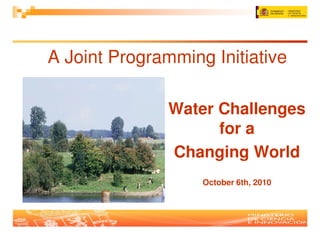
A Joint Programming Initiative

               Water Challenges
                     for a
               Changing World
                   October 6th, 2010
A challenging statement…

“Under an average economic growth and
an actual efficiency improvement of 1% a
year, the world wide water demand and
supply gap will be approximately 40% by
2030”

    Charting Our Water Future (2009)
    The 2030 Water Resource Group
Where we stand today
 In 2008 EC challenged countries to develop
 initiatives on joint programming with the
 purpose of increasing the efficiency and
 impact of national public funding in strategic
 areas.
 Joint programming targets public research
 programmes first and foremost: public-
 public cooperation.
 Following two years of discussion, the kick
 off meeting was held in September 2010
What is a JPI?
Aligning research programming in
Member States + Associated countries
Voluntary basis, variable geometry
Coordination of national research
programmes and funds
Funding projects with a European
Dimension on topics responding to
“grand challenges”
The Vision
          European
      strategic themes
          leading to
      breakthroughs in
        water science
       and technology
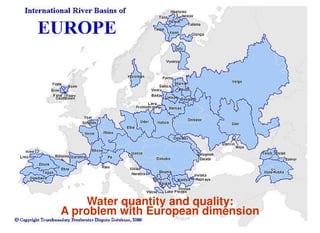
Water quantity and quality:
A problem with European dimension
Water quantity and quality
 Overexploitation: unbalances in water demand and
 availability
 Water quantity issue
   European cities concentrate water use and sanitation
   Groundwater depletion in coastal areas: salinization
   Intensification of agriculture: increased irrigation water
   The price of water can contribute to water scarcity
 Water quality issues:
   Fertilizers, soil and water salts: raising nutrient levels
   Emerging pollutants (surfactants, heavy metals, hormones and
   pharmaceuticals in general, but also cosmetics and
   nanoparticles)
   Release of geogenic elements due to human activities
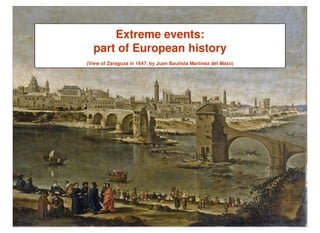
Extreme events:
  part of European history
(View of Zaragoza in 1647, by Juan Bautista Martínez del Mazo)
Extreme events
  Drought and floods:
    Natural traits of European climates,
    Accentuated by human activities
  Climate change
    More frequent river floods
  A clear impact on the quality of European
  ecosystems.
    A variety of societal losses which are not
    always evident or easy to evaluate
  Research is also needed in governance and
  behavioural sciences.
An interrelated set of challenges
 Economic
   The world market water: $ 463 billion/year
   Investments in water technology around the
   world increase every year
   High risk of ineffective investments if the
   water system is not properly understood
 Ecological
   Overexploitation and degradation decrease
   ecosystem ability to provide resources
   Extreme events have a clear impact on
   European ecosystems
An interrelated set of challenges
Societal
  Right to clean drinking water and proper sanitation
  Protection from new and emerging water
  pollutants
Technological
  Major breakthroughs in drinking water technology
  and sanitation
  Reducing energy input in desalination and water
  treatment processes.
  Co-generating energy in processes such as
  sewage treatment
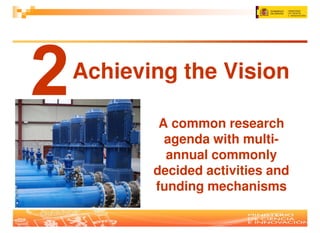
Achieving the Vision

        A common research
         agenda with multi-
         annual commonly
       decided activities and
       funding mechanisms
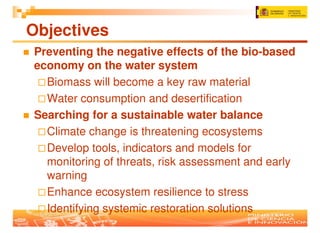
Objectives
Preventing the negative effects of the bio-based
economy on the water system
  Biomass will become a key raw material
  Water consumption and desertification
Searching for a sustainable water balance
  Climate change is threatening ecosystems
  Develop tools, indicators and models for
  monitoring of threats, risk assessment and early
  warning
  Enhance ecosystem resilience to stress
  Identifying systemic restoration solutions
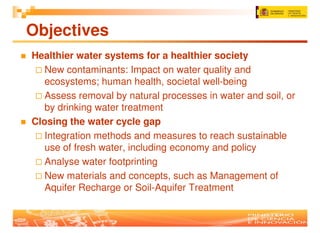
Objectives
Healthier water systems for a healthier society
   New contaminants: Impact on water quality and
   ecosystems; human health, societal well-being
   Assess removal by natural processes in water and soil, or
   by drinking water treatment
Closing the water cycle gap
   Integration methods and measures to reach sustainable
   use of fresh water, including economy and policy
   Analyse water footprinting
   New materials and concepts, such as Management of
   Aquifer Recharge or Soil-Aquifer Treatment
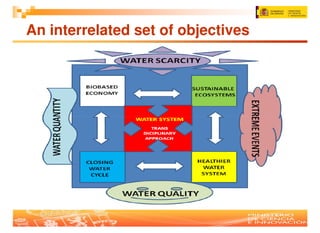
An interrelated set of objectives
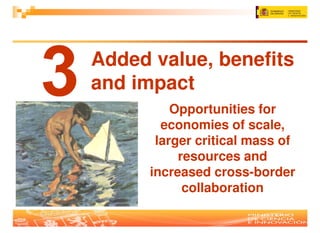
Added value, benefits
and impact
          Opportunities for
        economies of scale,
       larger critical mass of
           resources and
      increased cross-border
            collaboration
Addressing fragmentation
Challenges cannot be fully addressed by any individual
Member State alone
Despite National and EC funding, the variety and
complexity of the challenges have limited our success
This JPI will permit to:
  Increase critical mass, integrate different ecosystems
  Widen up the scope of European proposals
  Share large research facilities (i.e., experimental
  treatment plants)
  Network open field experiments (i.e., experimental
  watersheds)
Added value, benefits and impact
  Policy support
    JPI will provide science-based knowledge
    supporting a large number of EC Directives
    and National policies
  The Framework Programme
    Establish links to ongoing RTD activities
    Capitalise previous efforts on a number of
    water-related ERANETs, ensure
    continuation of their activities
Added value, benefits and impact
 Partnerships beyond Europe
   Strategic partnerships will be sought on the
   basis of mutual benefit and mutual interest
   Actions devoted to training, mobility, and
   dissemination will play a fundamental role to
   support the EUWI
 The Water Supply and Sanitation
 Technology Platform (WSSTP)
   The European industry is very well
   represented in WSSTP
   Synergies between JPI and WSSTP will be
   exploited:
 Additional National Stakeholders
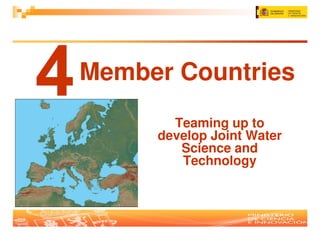
Member Countries
       Teaming up to
     develop Joint Water
        Science and
        Technology
Member Countries
AT, Austrian Federal Ministry of Agriculture, Forestry, Environment and
Water Management
CY, Cyprus Institute, Energy, Environment and Water Research Centre
DE, German Federal Ministry of Education and Research
DK, The Danish Agency for Science, Technology and Innovation.
ES (Coordinator), Spanish Ministry of Science and Innovation
FI, Finnish Funding Agency for Technology and Innovation and Academy
of Finland
FR, Ministry of Ecology, Energy, Sustainable Development and Sea
HU, National Office for Research and Technology
IE, Environmental Protection Agency
IT, Italian Higher Institute for Environmental Protection and Research
NL (Co-coordinator), Dutch Ministry of Economic Affairs
PL, European regional Centre for Ecohydrology u/a UNESCO / PAS
RO, Romanian National Authority for Scientific Research
SE, Swedish Research Council for Environment, Agricultural Sciences
and Spatial Planning
TR, Scientific and Technological Research Council of Turkey
Envisaged activities


      How to implement the
      vision and make it real
JPI Activities
 Elaboration and periodic update of a Strategic
 Research Agenda
 Networking of Ministries and Research Funding
 Agencies, dialogue with scientists and stakeholders
 Coordination with the WSSTP
 Coordinated Calls for Proposals
 Funding of transnational
   Research projects
   Research infrastructures
   Mobility
 Project follow-up
 Internal review
Thanks!

Water Challenges for a Changing World (Joint Programming Initiative)

  • 1.
    A Joint ProgrammingInitiative Water Challenges for a Changing World October 6th, 2010
  • 2.
    A challenging statement… “Underan average economic growth and an actual efficiency improvement of 1% a year, the world wide water demand and supply gap will be approximately 40% by 2030” Charting Our Water Future (2009) The 2030 Water Resource Group
  • 3.
    Where we standtoday In 2008 EC challenged countries to develop initiatives on joint programming with the purpose of increasing the efficiency and impact of national public funding in strategic areas. Joint programming targets public research programmes first and foremost: public- public cooperation. Following two years of discussion, the kick off meeting was held in September 2010
  • 4.
    What is aJPI? Aligning research programming in Member States + Associated countries Voluntary basis, variable geometry Coordination of national research programmes and funds Funding projects with a European Dimension on topics responding to “grand challenges”
  • 5.
    The Vision European strategic themes leading to breakthroughs in water science and technology
  • 6.
    Water quantity andquality: A problem with European dimension
  • 7.
    Water quantity andquality Overexploitation: unbalances in water demand and availability Water quantity issue European cities concentrate water use and sanitation Groundwater depletion in coastal areas: salinization Intensification of agriculture: increased irrigation water The price of water can contribute to water scarcity Water quality issues: Fertilizers, soil and water salts: raising nutrient levels Emerging pollutants (surfactants, heavy metals, hormones and pharmaceuticals in general, but also cosmetics and nanoparticles) Release of geogenic elements due to human activities
  • 8.
    Extreme events: part of European history (View of Zaragoza in 1647, by Juan Bautista Martínez del Mazo)
  • 9.
    Extreme events Drought and floods: Natural traits of European climates, Accentuated by human activities Climate change More frequent river floods A clear impact on the quality of European ecosystems. A variety of societal losses which are not always evident or easy to evaluate Research is also needed in governance and behavioural sciences.
  • 10.
    An interrelated setof challenges Economic The world market water: $ 463 billion/year Investments in water technology around the world increase every year High risk of ineffective investments if the water system is not properly understood Ecological Overexploitation and degradation decrease ecosystem ability to provide resources Extreme events have a clear impact on European ecosystems
  • 11.
    An interrelated setof challenges Societal Right to clean drinking water and proper sanitation Protection from new and emerging water pollutants Technological Major breakthroughs in drinking water technology and sanitation Reducing energy input in desalination and water treatment processes. Co-generating energy in processes such as sewage treatment
  • 12.
    Achieving the Vision A common research agenda with multi- annual commonly decided activities and funding mechanisms
  • 13.
    Objectives Preventing the negativeeffects of the bio-based economy on the water system Biomass will become a key raw material Water consumption and desertification Searching for a sustainable water balance Climate change is threatening ecosystems Develop tools, indicators and models for monitoring of threats, risk assessment and early warning Enhance ecosystem resilience to stress Identifying systemic restoration solutions
  • 14.
    Objectives Healthier water systemsfor a healthier society New contaminants: Impact on water quality and ecosystems; human health, societal well-being Assess removal by natural processes in water and soil, or by drinking water treatment Closing the water cycle gap Integration methods and measures to reach sustainable use of fresh water, including economy and policy Analyse water footprinting New materials and concepts, such as Management of Aquifer Recharge or Soil-Aquifer Treatment
  • 15.
    An interrelated setof objectives
  • 16.
    Added value, benefits andimpact Opportunities for economies of scale, larger critical mass of resources and increased cross-border collaboration
  • 17.
    Addressing fragmentation Challenges cannotbe fully addressed by any individual Member State alone Despite National and EC funding, the variety and complexity of the challenges have limited our success This JPI will permit to: Increase critical mass, integrate different ecosystems Widen up the scope of European proposals Share large research facilities (i.e., experimental treatment plants) Network open field experiments (i.e., experimental watersheds)
  • 18.
    Added value, benefitsand impact Policy support JPI will provide science-based knowledge supporting a large number of EC Directives and National policies The Framework Programme Establish links to ongoing RTD activities Capitalise previous efforts on a number of water-related ERANETs, ensure continuation of their activities
  • 19.
    Added value, benefitsand impact Partnerships beyond Europe Strategic partnerships will be sought on the basis of mutual benefit and mutual interest Actions devoted to training, mobility, and dissemination will play a fundamental role to support the EUWI The Water Supply and Sanitation Technology Platform (WSSTP) The European industry is very well represented in WSSTP Synergies between JPI and WSSTP will be exploited: Additional National Stakeholders
  • 20.
    Member Countries Teaming up to develop Joint Water Science and Technology
  • 21.
    Member Countries AT, AustrianFederal Ministry of Agriculture, Forestry, Environment and Water Management CY, Cyprus Institute, Energy, Environment and Water Research Centre DE, German Federal Ministry of Education and Research DK, The Danish Agency for Science, Technology and Innovation. ES (Coordinator), Spanish Ministry of Science and Innovation FI, Finnish Funding Agency for Technology and Innovation and Academy of Finland FR, Ministry of Ecology, Energy, Sustainable Development and Sea HU, National Office for Research and Technology IE, Environmental Protection Agency IT, Italian Higher Institute for Environmental Protection and Research NL (Co-coordinator), Dutch Ministry of Economic Affairs PL, European regional Centre for Ecohydrology u/a UNESCO / PAS RO, Romanian National Authority for Scientific Research SE, Swedish Research Council for Environment, Agricultural Sciences and Spatial Planning TR, Scientific and Technological Research Council of Turkey
  • 22.
    Envisaged activities How to implement the vision and make it real
  • 23.
    JPI Activities Elaborationand periodic update of a Strategic Research Agenda Networking of Ministries and Research Funding Agencies, dialogue with scientists and stakeholders Coordination with the WSSTP Coordinated Calls for Proposals Funding of transnational Research projects Research infrastructures Mobility Project follow-up Internal review
  • 24.