1Navigating the Social Media LandscapeCapt. Chris Sukach, Chief Emerging TechnologyAir Force Public Affairs Agency
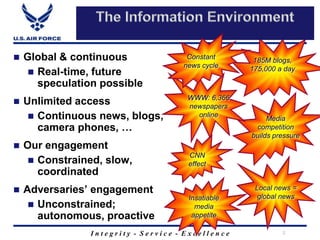
2The Information EnvironmentGlobal & continuousReal-time, future speculation possibleUnlimited accessContinuous news, blogs, camera phones, …
Our engagement
Constrained, slow, coordinated
Adversaries’ engagement
Unconstrained; autonomous, proactiveConstantnews cycle185M blogs, 175,000 a day WWW: 6,366 newspapers onlineMedia competition builds pressureCNN effectLocal news = global newsInsatiable        media appetite
Changing Media LandscapeCBS Morning Show25th Anniversary“How the Media LandscapeHas Changed”
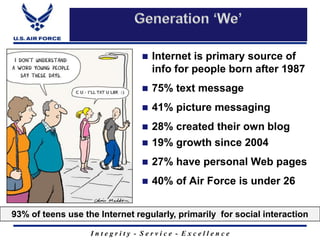
Generation ‘We’Internet is primary source of info for people born after 198775% text message41% picture messaging28% created their own blog19% growth since 2004 27% have personal Web pages40% of Air Force is under 2693% of teens use the Internet regularly, primarily  for social interaction
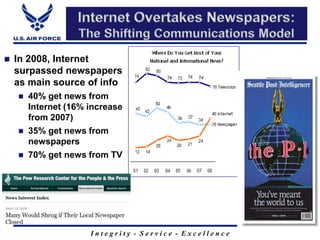
Internet Overtakes Newspapers:The Shifting Communications ModelIn 2008, Internet surpassed newspapers as main source of info 40% get news from Internet (16% increase from 2007)35% get news from newspapers70% get news from TV
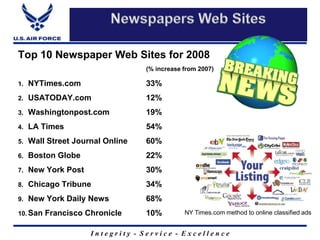
Newspapers Web SitesTop 10 Newspaper Web Sites for 2008 				(% increase from 2007)NYTimes.com             		33%USATODAY.com      		12% Washingtonpost.com        	19% LA Times                          	54% Wall Street Journal Online   	60%Boston Globe			22% New York Post                       	30% Chicago Tribune                        	34%New York Daily News		68%San Francisco Chronicle	10%NY Times.com method to online classified ads
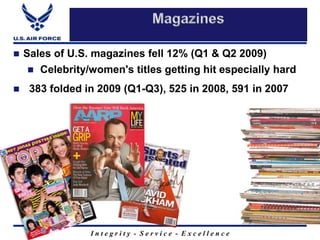
MagazinesSales of U.S. magazines fell 12% (Q1 & Q2 2009)
 Celebrity/women's titles getting hit especially hard
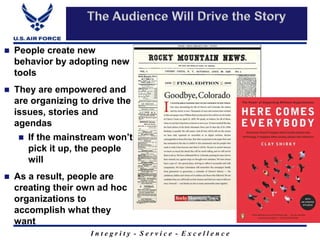
  383 folded in 2009 (Q1-Q3), 525 in 2008, 591 in 2007The Audience Will Drive the StoryPeople create new behavior by adopting new toolsThey are empowered and are organizing to drive the issues, stories and agendas If the mainstream won’t pick it up, the people willAs a result, people are creating their own ad hoc organizations to accomplish what they want
Top 20 Social SitesSocial media use rose 27% among adult users (2005 – 2008)1.  Facebook	11. Multiply2.	MySpace	12. Friendster3.	Twitter	13. Meetup4.	Linkedin	14. BlackPlanet5.	Classmates	15. Gaia Online6.	Ning		16. Piczo7.	Bebo		17. Orkut8.	Hi5		18. FotoLog9. Tagged	19. Skyrock10. MyYearbook	20. Badoo
Social Sites: Some #s22% of adult social network users have a profile on Facebook, 6% on LinkedInFacebook has 300 million active users (If it was a country, would be 4th largest in the world)70% of Facebook users are outside of the USLinkedIn has 50 million active usersHalf are from countries other than USMedian age: LinkedIn: 39; Facebook: 33
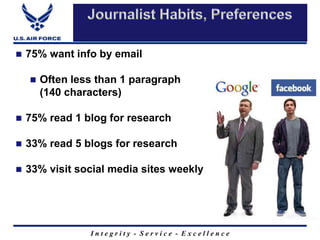
Journalist Habits, Preferences75% want info by email
Often less than 1 paragraph(140 characters)
75% read 1 blog for research

FGCA Conf Presentation Dec 09

  • 1.
    1Navigating the SocialMedia LandscapeCapt. Chris Sukach, Chief Emerging TechnologyAir Force Public Affairs Agency
  • 2.
    2The Information EnvironmentGlobal& continuousReal-time, future speculation possibleUnlimited accessContinuous news, blogs, camera phones, …
  • 3.
  • 4.
  • 5.
  • 6.
    Unconstrained; autonomous, proactiveConstantnewscycle185M blogs, 175,000 a day WWW: 6,366 newspapers onlineMedia competition builds pressureCNN effectLocal news = global newsInsatiable media appetite
  • 7.
    Changing Media LandscapeCBSMorning Show25th Anniversary“How the Media LandscapeHas Changed”
  • 8.
    Generation ‘We’Internet isprimary source of info for people born after 198775% text message41% picture messaging28% created their own blog19% growth since 2004 27% have personal Web pages40% of Air Force is under 2693% of teens use the Internet regularly, primarily for social interaction
  • 9.
    Internet Overtakes Newspapers:TheShifting Communications ModelIn 2008, Internet surpassed newspapers as main source of info 40% get news from Internet (16% increase from 2007)35% get news from newspapers70% get news from TV
  • 10.
    Newspapers Web SitesTop10 Newspaper Web Sites for 2008 (% increase from 2007)NYTimes.com 33%USATODAY.com 12% Washingtonpost.com 19% LA Times 54% Wall Street Journal Online 60%Boston Globe 22% New York Post 30% Chicago Tribune 34%New York Daily News 68%San Francisco Chronicle 10%NY Times.com method to online classified ads
  • 11.
    MagazinesSales of U.S.magazines fell 12% (Q1 & Q2 2009)
  • 12.
    Celebrity/women's titlesgetting hit especially hard
  • 13.
    383folded in 2009 (Q1-Q3), 525 in 2008, 591 in 2007The Audience Will Drive the StoryPeople create new behavior by adopting new toolsThey are empowered and are organizing to drive the issues, stories and agendas If the mainstream won’t pick it up, the people willAs a result, people are creating their own ad hoc organizations to accomplish what they want
  • 14.
    Top 20 SocialSitesSocial media use rose 27% among adult users (2005 – 2008)1. Facebook 11. Multiply2. MySpace 12. Friendster3. Twitter 13. Meetup4. Linkedin 14. BlackPlanet5. Classmates 15. Gaia Online6. Ning 16. Piczo7. Bebo 17. Orkut8. Hi5 18. FotoLog9. Tagged 19. Skyrock10. MyYearbook 20. Badoo
  • 15.
    Social Sites: Some#s22% of adult social network users have a profile on Facebook, 6% on LinkedInFacebook has 300 million active users (If it was a country, would be 4th largest in the world)70% of Facebook users are outside of the USLinkedIn has 50 million active usersHalf are from countries other than USMedian age: LinkedIn: 39; Facebook: 33
  • 16.
  • 17.
    Often less than1 paragraph(140 characters)
  • 18.
    75% read 1blog for research

Editor's Notes

  • #6 --As more people head to the Internet for information, the business model of communications is changing. --2008 and 2009 saw the closing of newspapers, such as the 145-year old Seattle Post Intelligencer and the Rocky Mountain News. Seattle PI still exists, but as an online-only news source. --A 2009 study by the Pew Research Center found that fewer than half of Americans (33%) say they would personally miss reading the local newspaper a lot if it were no longer available.--Newspapers, TV, and radio are all changing how they do business so that they can remain relevant and viable in the increasing online world. If the media doesn’t shift with the times, people will simply move to a source that is keeping up.