FEVER
DR JAYALAKSHMI JAYAPRAKASH
ASST.PROFESSOR MEDICINE
GTDMCH ALAPPUZHA
Body Temperature Regulation
The thermoregulatory center in the hypothalamus
regulates the core body temperature, not the surface
temperature
Neurons in both the preoptic anterior hypothalamus
and the posterior hypothalamus receive two kinds of
signals:
one from peripheral nerves that transmit information
from warmth/cold receptors in the skin and
the other from the temperature of the blood bathing
the region.
 the hypothalamic thermoregulatory center balances
 the excess heat production derived from metabolic
activity in muscle and the liver
 with heat dissipation from the skin and lungs.
 the mean oral temperature is
 36.8° ± 0.4°C (98.2° ± 0.7°F), with low levels at 6 a.m.
and higher levels at 4–6 p.m.
 The maximal normal oral temperature is 37.2°C (98.9°F)
at 6 a.m. and 37.7°C (99.9°F) at 4 p.m.;
 The normal daily temperature variation, also
called the circadian rhythm, is typically 0.5°C
(0.9°F).
 Rectal temperatures are generally 0.4°C
(0.7°F) higher than oral readings.
 Others- tympanic membrane temperature
lower oesophageal temperature
Thermoregulation
Body heat is generated by:
a)basal metabolic activity
b)muscle movement
Lost by:
1) Conduction
2) Convection (which is increased by wind or
fanning)
3) Evaporation which is increased by sweating
FEVER
 Fever is an elevation of body temperature
that exceeds the normal daily variation and
occurs in conjunction with an increase in the
hypothalamic set point
PATHOPHYSIOLOGY
OF FEVER
INITIATION OF FEBRILE
RESPONSE
 Once the hypothalamic set point is raised,
 neurons in the vasomotor center are activated and
vasoconstriction commences.
 vasoconstriction in the hands and feet.
 Shunting of blood away from the periphery to the internal
organs essentially decreases heat loss from the skin
 the person feels cold.
 Shivering, which increases heat production from the muscles,
may begin at this time;
 Nonshivering heat production from the liver also contributes to
increasing core temperature.
 Behavioral adjustments (e.g., putting on more clothing or
bedding) help raise body temperature by decreasing heat loss.
 The processes of heat conservation
(vasoconstriction) and heat production
(shivering and increased nonshivering
thermogenesis) continue until the
temperature reaches the new “thermostat
setting.”
 then hypothalamus maintains the
temperature at the febrile level
BRINGING DOWN FEVER
 hypothalamic set point is again reset downward (in
response to either a reduction in the concentration of
pyrogens or the use of antipyretics),
 the processes of heat loss through vasodilation and
sweating are initiated.
 continues until the blood temperature at the
hypothalamic level matches the lower setting.
 Behavioral changes (e.g., removal of clothing)
facilitate heat loss.
HYPER PYREXIA
 A fever of >41.5°C (>106.7°F) is called hyperpyrexia.
 with severe infections
 most commonly occurs in central nervous system (CNS)
hemorrhages.
 In rare cases, elevated hypothalamic set point also seen
in
 local trauma,
 hemorrhage,
 tumor, or
 intrinsic hypothalamic malfunction.
Febrile Response- how is the
thermostat set higher?
• when exogenous or endogenous stimuli are
presented to specialized host cells, principally
monocytes and macrophages ,they will
stimulate the synthesis and release of various
pyrogenic cytokines including:
1)interleukin-1, interleukin-6 2)TNF-α, and
3)IFN-γ.
• Pyrogens:
Substances that cause fever are called pyrogens
• 1) Exogenous : stimuli from out side the host
Like : microorganism, their products, or
toxins(Endotoxin)
• eg: lipopolysaccharide ( LPS)
• LPS: is found in the outer membrane of all gram negative
organism
• Action :
• 1) through stimulation of monocytes and macrophages
• 2) direct action on endothelial cell of the brain to produce
fever
• 2) Endogenous pyrogens/ Pyrogenic cytokines
• Polypeptides that are produced by the body
• by monocytes, macrophages, endothelial and
epithelial cell and hepatocytes
• in response to stimuli that is usually triggered
by infection or inflammation stimuli
Mechanism of
Action
• Cytokine-receptor interactions in the pre-optic
region of the anterior hypothalamus
activate phospholipase A.
This enzyme liberates plasma membrane
arachidonic acid as substrate for the cyclo-
oxygenase pathway. The resulting mediator,
prostaglandin E2, then modifies the
responsiveness of thermosensitive neurons in
the thermoregulatory centre.
Mechanisms of fever
Mechanisms of fever
Presentation of
Fever
• Feeling hot
A feeling of heat does not necessarily imply fever
• Rigors.
profound chillsaccompanied by chattering of the teeth
and severe shivering and implies a rapid rise in body
temperature. Can be produced by :
1) brucellosis and malaria
2) sepsis with abscess
3) lymphoma
Excessive sweating.
Night sweats are characteristic of tuberculosis, but
sweating from any cause is usually worse at night.
Presentation of
Fever
• Headache
Fever from any cause may provoke headache. Severe
headache and photophobia, may suggests
meningitis
• Delirium
Mental confusion during fever is well described and
relatively more common in extreme of age.
• Muscle pain
Myalgia is characteristic of
Viral infections such as influenza Malaria and
brucellosis
• Is an elevation of core temperature without
elevation of the hypothalamic set point.
• Cause: inadequate heat loss
• Examples:
• 1) Heat stroke (exertional and non exertional)
• 2) Drug induced such as tricyclic antidepressant
MAOI
• 3) Malignant hyperthermia. associated with
psychiatric drugs
• 4) Thyrotoxicosis
• 5) Pheochromocytoma
Hyperthermia
The effects of fever
 It enhance immune function;
 Increases motility and activity of the white blood cells;
 Stimulates the interferon production and activation of T cells;
 Inhibits growth of some microbial agents:
 Many of the microbial agents that cause infection grow best at
normal body temperatures, and their growth is inhibited by
temperatures in the fever range (the rhinoviruses responsible for
the common cold are cultured best at 33°C);
 Dehydration occurs because of sweating.
The effects of fever
 Metabolic effects:
 Increased need for oxygen;
 Increases the heart rate
 Increases the respiration rate
 Increased use of body proteins as an energy source;
 During fever the body switches from using glucose (an excellent
medium for bacterial growth) to metabolism based on protein and
fat breakdown;
 With prolonged fever, there is increased breakdown of
endogenous fat stores;
 If fat breakdown is rapid, metabolic acidosis may result.
Types / patterns of fever
 Intermittent
 Temperature returns to normal at least once every 24 hours;
 It is commonly associated with conditions such as gram - negative /
positive sepsis, abscesses, and acute bacterial endocarditis;
 Remittent
 Temperature does not return to normal and varies a few degrees in
either direction;
 It is associated with viral upper respiratory tract, legionella, and
mycoplasma infections;
 Sustained or continuous
 Temperature remains above normal with minimal variations;
 It is seen in persons with drug fever;
 Relapsing
 There is one or more episodes of fever, each as long as several
days, with one or more days of normal temperature between
episodes;
 It may be caused by a variety of infectious diseases, including
tuberculosis, fungal infections, Lyme disease, and malaria.
Principles of treatment
 Because fever is a disease symptom, its manifestation suggests the
need for treatment of the primary cause.
 Actions:
 modifications of the external environment intended to increase
heat transfer from the internal to the external environment;
 support of the hypermetabolic state that accompanies fever;
 protection of vulnerable body organs and systems;
 treatment of the infection or condition causing the fever.
Antipyretic drugs
 Antipyretic drugs, such as aspirin and acetaminophen, often are
used to alleviate the discomforts of fever and protect vulnerable
organs, such as the brain, from extreme elevations in body
temperature.
 These drugs act by resetting the hypothalamic temperature control
center to a lower level, presumably by blocking the activity of
cyclooxygenase, an enzyme that is required for the conversion of
arachidonic acid to prostaglandin E2.
Fever in children
 The mechanisms for controlling temperature are not well
developed in the infant.
 In infants younger than 3 months, a mild elevation in
temperature (i.e., rectal temperature of 38°C) can
indicate serious infection.
 Both minor and life-threatening infections are common in
the infant to 3-year age group.
 The most common causes of fever in children are minor
or more serious infections of the respiratory system,
urinary system, gastrointestinal tract, or central nervous
system.
 Occult bacteremia and meningitis also occur in this age
group and should be excluded as diagnoses.
Fever in the elderly
 In the elderly, even slight elevations in temperature may
indicate serious infection or disease. This is because the
elderly often have a lower baseline temperature.
 Normal body temperature and the circadian pattern of
temperature variation often are altered in the elderly.
 The absence of fever may delay diagnosis.
 Unexplained changes in functional capacity, worsening
of mental status, weakness and fatigue, and weight loss
are signs of infection in the elderly.
 Confusion and delirium may follow moderate elevations
in temperature.
Mechanisms
 Disturbance in sensing of temperature by the thermoregulatory
center in the hypothalamus;
 Alterations in release of endogenous pyrogens;
 The failure to elicit responses such as vasoconstriction of skin
vessels, increased heat production, and shivering that increase
body temperature during a febrile response.
 Because of the increasingly poor oxygen uptake by the aging lung,
pulmonary function may prove to be a limiting factor in the
hypermetabolism that accompanies fever in older persons.
 Confusion, incoordination, and agitation commonly reflect
cerebral hypoxemia.
Fever of Unknown Origin
 first described by Dr. Petersdorf and Dr.
Beesom in 1961.
 FUO was defined as
1) temperatures of >38.3°C (>101°F) on several
occasions;
2) (2) a duration of fever of >3 weeks; and
3) (3) failure to reach a diagnosis despite 1 week of
inpatient investigation.
Fever of Unknown Origin
 The revised definition proposed by Durack
and Street in 1991 divided cases into
 four distinct subclasses:
 classic FUO,
 nosocomial FUO,
 neutropenic FUO, and
 HIV-related FUO.
CLASSIC FUO
 corresponds closely to the earlier definition of
FUO, differing only with regard to the prior
requirement for 1 week's study in the
hospital.
 The newer definition is broader,
 stipulating three outpatient visits or 3 days in the
hospital without elucidation of a cause
 or 1 week of "intelligent and invasive" ambulatory
investigation
NOSOCOMIAL FUO
 a temperature of 38.3°C (101°F) develops on
several occasions in a hospitalized patient
 who is receiving acute care and
 in whom infection was not manifest or
incubating on admission.
 Three days of investigation, including at least
2 days' incubation of cultures, is the minimum
requirement for this diagnosis.
NEUTROPENIC FUO
 is defined as a temperature of 38.3°C (101°F)
on several occasions
 in a patient whose neutrophil count is <500/L
 or is expected to fall to that level in 1–2 days
 if a specific cause is not identified after 3
days of investigation, including at least 2
days' incubation of cultures.
HIV-associated FUO
 is defined by a temperature of 38.3°C (101°F)
on several occasions
 over a period of >4 weeks for outpatients
 or >3 days for hospitalized patients with HIV
infection.
 if appropriate investigation over 3 days,
including 2 days' incubation of cultures,
reveals no source.
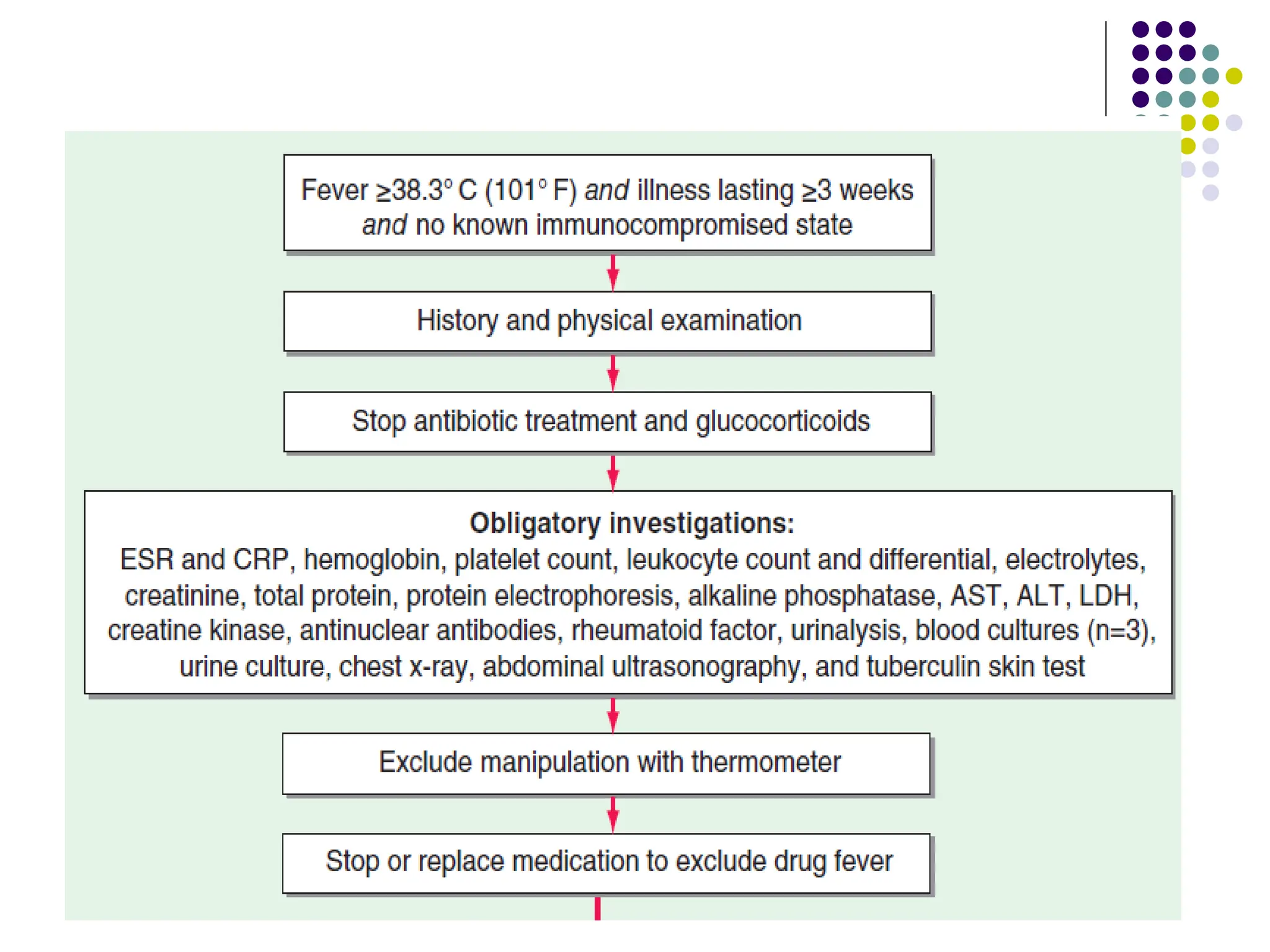
New definition FUO
 FUO is now defined as follows:
 Fever ≥38.3°C (≥101°F) on at least two
occasions
 Illness duration of ≥3 weeks
 No known immunocompromised state
 Diagnosis that remains uncertain after a
thorough history-taking, physical examination,
and the following obligatory investigations:
(ESR) and C-reactive protein (CRP) level;
platelet count; leukocyte count and differential;
measurement of levels of hemoglobin,
electrolytes, creatinine, total protein, ALP, ALT,
AST
 LDH, creatine kinase, ferritin,
 ANA, and RA Factor;
 protein electrophoresis;
 urinalysis;
 blood cultures (n = 3);
 urine culture;
 chest x-ray;
 abdominal ultrasonography;
 and tuberculin skin test (TST) or interferon γ
release assay (IGRA).
PDCs : potentially diagnostic clues (all localizing signs, symptoms,
and abnormalities potentially pointing toward a diagnosis).
Etiology
 The causes of fever of unknown origin (FUO)
are often common conditions presenting
atypically.
 infection,
 noninfectious inflammatory conditions,
 malignancies, and
 miscellaneous.
 Infectious Causes of FUO
 Tuberculosis (TB)
 Q fever
 Brucellosis
 HIV infection
 Abdominopelvic abscesses
 Cat scratch disease (CSD)
 Epstein-Barr virus (EBV) infection
 Cytomegalovirus (CMV) infection
 Enteric (typhoid) fever
 Toxoplasmosis
 Extrapulmonary TB
 Organ-based infectious
causes of FUO:
 Subacute bacterial
endocarditis (SBE)
 Chronic sinusitis/mastoiditis
 Chronic prostatitis
 Discitis
 Vascular graft infections
 Whipple disease
 Multicentric Castleman
disease (MCD)
 Cholecystitis
 Regional infections:
 Histoplasmosis
 Coccidioidomycosis
 Leptospirosis
 Visceral
leishmaniasis
 Rat-bite fever
 Malignant and Neoplastic
Causes of FUO
 Lymphoma
 Renal cell carcinoma
 Myeloproliferative disorder
 Acute myelogenous leukemia
 Multiple myeloma
 Breast/liver/pancreatic/colon
cancer
 Atrial myxoma
 Metastases to brain/liver
 Malignant histiocytosis
 Miscellaneous Causes of FUO
 Cirrhosis (due to portal
endotoxins)
 Drug fever
 Thyroiditis
 Crohn disease
 Pulmonary emboli
 Hypothalamic syndrome
 Familial periodic fever
syndromes
 Cyclic neutropenia
 Factitious fever
Common Causes of Fever in
the Different Subclasses
 Classic FUO:
 The frequency of each category varies by both time and
location
 endocarditis, complicated UTI, abscesses, and
tuberculosis (TB) common
 In patients over the age of 65, connective tissue
diseases are determined to be the cause of fever more
frequently.
 Fever in travelers is more likely to be secondary to
infections such as malaria, typhoid fever, and acute HIV.
Nosocomial FUO:
Healthcare-associated fevers can be due to

drug fever,

complications post-operatively,

venous thromboembolic disease,

malignancy

transfusion-related reactions,
 Clostridium difficile infection.

Risk factors such as surgical procedures, instrumentation,
intravascular devices, immobilization, and medications can help
determine the diagnostic testing
 Neutropenic FUO:
 frequently due to infection.
 HIV-related FUO:
 Fevers can be present
 during acute illness
 untreated infection signifying additional infection
with opportunistic organisms.

Fever- pathophysiology , patterns, types of fuo.ppt

  • 1.
  • 2.
    Body Temperature Regulation Thethermoregulatory center in the hypothalamus regulates the core body temperature, not the surface temperature Neurons in both the preoptic anterior hypothalamus and the posterior hypothalamus receive two kinds of signals: one from peripheral nerves that transmit information from warmth/cold receptors in the skin and the other from the temperature of the blood bathing the region.
  • 3.
     the hypothalamicthermoregulatory center balances  the excess heat production derived from metabolic activity in muscle and the liver  with heat dissipation from the skin and lungs.  the mean oral temperature is  36.8° ± 0.4°C (98.2° ± 0.7°F), with low levels at 6 a.m. and higher levels at 4–6 p.m.  The maximal normal oral temperature is 37.2°C (98.9°F) at 6 a.m. and 37.7°C (99.9°F) at 4 p.m.;
  • 4.
     The normaldaily temperature variation, also called the circadian rhythm, is typically 0.5°C (0.9°F).  Rectal temperatures are generally 0.4°C (0.7°F) higher than oral readings.  Others- tympanic membrane temperature lower oesophageal temperature
  • 5.
    Thermoregulation Body heat isgenerated by: a)basal metabolic activity b)muscle movement Lost by: 1) Conduction 2) Convection (which is increased by wind or fanning) 3) Evaporation which is increased by sweating
  • 6.
    FEVER  Fever isan elevation of body temperature that exceeds the normal daily variation and occurs in conjunction with an increase in the hypothalamic set point
  • 7.
  • 8.
    INITIATION OF FEBRILE RESPONSE Once the hypothalamic set point is raised,  neurons in the vasomotor center are activated and vasoconstriction commences.  vasoconstriction in the hands and feet.  Shunting of blood away from the periphery to the internal organs essentially decreases heat loss from the skin  the person feels cold.  Shivering, which increases heat production from the muscles, may begin at this time;  Nonshivering heat production from the liver also contributes to increasing core temperature.  Behavioral adjustments (e.g., putting on more clothing or bedding) help raise body temperature by decreasing heat loss.
  • 9.
     The processesof heat conservation (vasoconstriction) and heat production (shivering and increased nonshivering thermogenesis) continue until the temperature reaches the new “thermostat setting.”  then hypothalamus maintains the temperature at the febrile level
  • 10.
    BRINGING DOWN FEVER hypothalamic set point is again reset downward (in response to either a reduction in the concentration of pyrogens or the use of antipyretics),  the processes of heat loss through vasodilation and sweating are initiated.  continues until the blood temperature at the hypothalamic level matches the lower setting.  Behavioral changes (e.g., removal of clothing) facilitate heat loss.
  • 11.
    HYPER PYREXIA  Afever of >41.5°C (>106.7°F) is called hyperpyrexia.  with severe infections  most commonly occurs in central nervous system (CNS) hemorrhages.  In rare cases, elevated hypothalamic set point also seen in  local trauma,  hemorrhage,  tumor, or  intrinsic hypothalamic malfunction.
  • 12.
    Febrile Response- howis the thermostat set higher? • when exogenous or endogenous stimuli are presented to specialized host cells, principally monocytes and macrophages ,they will stimulate the synthesis and release of various pyrogenic cytokines including: 1)interleukin-1, interleukin-6 2)TNF-α, and 3)IFN-γ.
  • 13.
    • Pyrogens: Substances thatcause fever are called pyrogens • 1) Exogenous : stimuli from out side the host Like : microorganism, their products, or toxins(Endotoxin) • eg: lipopolysaccharide ( LPS) • LPS: is found in the outer membrane of all gram negative organism • Action : • 1) through stimulation of monocytes and macrophages • 2) direct action on endothelial cell of the brain to produce fever
  • 14.
    • 2) Endogenouspyrogens/ Pyrogenic cytokines • Polypeptides that are produced by the body • by monocytes, macrophages, endothelial and epithelial cell and hepatocytes • in response to stimuli that is usually triggered by infection or inflammation stimuli
  • 15.
    Mechanism of Action • Cytokine-receptorinteractions in the pre-optic region of the anterior hypothalamus activate phospholipase A. This enzyme liberates plasma membrane arachidonic acid as substrate for the cyclo- oxygenase pathway. The resulting mediator, prostaglandin E2, then modifies the responsiveness of thermosensitive neurons in the thermoregulatory centre.
  • 16.
  • 17.
  • 18.
    Presentation of Fever • Feelinghot A feeling of heat does not necessarily imply fever • Rigors. profound chillsaccompanied by chattering of the teeth and severe shivering and implies a rapid rise in body temperature. Can be produced by : 1) brucellosis and malaria 2) sepsis with abscess 3) lymphoma Excessive sweating. Night sweats are characteristic of tuberculosis, but sweating from any cause is usually worse at night.
  • 19.
    Presentation of Fever • Headache Feverfrom any cause may provoke headache. Severe headache and photophobia, may suggests meningitis • Delirium Mental confusion during fever is well described and relatively more common in extreme of age. • Muscle pain Myalgia is characteristic of Viral infections such as influenza Malaria and brucellosis
  • 20.
    • Is anelevation of core temperature without elevation of the hypothalamic set point. • Cause: inadequate heat loss • Examples: • 1) Heat stroke (exertional and non exertional) • 2) Drug induced such as tricyclic antidepressant MAOI • 3) Malignant hyperthermia. associated with psychiatric drugs • 4) Thyrotoxicosis • 5) Pheochromocytoma Hyperthermia
  • 21.
    The effects offever  It enhance immune function;  Increases motility and activity of the white blood cells;  Stimulates the interferon production and activation of T cells;  Inhibits growth of some microbial agents:  Many of the microbial agents that cause infection grow best at normal body temperatures, and their growth is inhibited by temperatures in the fever range (the rhinoviruses responsible for the common cold are cultured best at 33°C);  Dehydration occurs because of sweating.
  • 22.
    The effects offever  Metabolic effects:  Increased need for oxygen;  Increases the heart rate  Increases the respiration rate  Increased use of body proteins as an energy source;  During fever the body switches from using glucose (an excellent medium for bacterial growth) to metabolism based on protein and fat breakdown;  With prolonged fever, there is increased breakdown of endogenous fat stores;  If fat breakdown is rapid, metabolic acidosis may result.
  • 23.
    Types / patternsof fever  Intermittent  Temperature returns to normal at least once every 24 hours;  It is commonly associated with conditions such as gram - negative / positive sepsis, abscesses, and acute bacterial endocarditis;  Remittent  Temperature does not return to normal and varies a few degrees in either direction;  It is associated with viral upper respiratory tract, legionella, and mycoplasma infections;  Sustained or continuous  Temperature remains above normal with minimal variations;  It is seen in persons with drug fever;  Relapsing  There is one or more episodes of fever, each as long as several days, with one or more days of normal temperature between episodes;  It may be caused by a variety of infectious diseases, including tuberculosis, fungal infections, Lyme disease, and malaria.
  • 27.
    Principles of treatment Because fever is a disease symptom, its manifestation suggests the need for treatment of the primary cause.  Actions:  modifications of the external environment intended to increase heat transfer from the internal to the external environment;  support of the hypermetabolic state that accompanies fever;  protection of vulnerable body organs and systems;  treatment of the infection or condition causing the fever.
  • 28.
    Antipyretic drugs  Antipyreticdrugs, such as aspirin and acetaminophen, often are used to alleviate the discomforts of fever and protect vulnerable organs, such as the brain, from extreme elevations in body temperature.  These drugs act by resetting the hypothalamic temperature control center to a lower level, presumably by blocking the activity of cyclooxygenase, an enzyme that is required for the conversion of arachidonic acid to prostaglandin E2.
  • 29.
    Fever in children The mechanisms for controlling temperature are not well developed in the infant.  In infants younger than 3 months, a mild elevation in temperature (i.e., rectal temperature of 38°C) can indicate serious infection.  Both minor and life-threatening infections are common in the infant to 3-year age group.  The most common causes of fever in children are minor or more serious infections of the respiratory system, urinary system, gastrointestinal tract, or central nervous system.  Occult bacteremia and meningitis also occur in this age group and should be excluded as diagnoses.
  • 30.
    Fever in theelderly  In the elderly, even slight elevations in temperature may indicate serious infection or disease. This is because the elderly often have a lower baseline temperature.  Normal body temperature and the circadian pattern of temperature variation often are altered in the elderly.  The absence of fever may delay diagnosis.  Unexplained changes in functional capacity, worsening of mental status, weakness and fatigue, and weight loss are signs of infection in the elderly.  Confusion and delirium may follow moderate elevations in temperature.
  • 31.
    Mechanisms  Disturbance insensing of temperature by the thermoregulatory center in the hypothalamus;  Alterations in release of endogenous pyrogens;  The failure to elicit responses such as vasoconstriction of skin vessels, increased heat production, and shivering that increase body temperature during a febrile response.  Because of the increasingly poor oxygen uptake by the aging lung, pulmonary function may prove to be a limiting factor in the hypermetabolism that accompanies fever in older persons.  Confusion, incoordination, and agitation commonly reflect cerebral hypoxemia.
  • 32.
    Fever of UnknownOrigin  first described by Dr. Petersdorf and Dr. Beesom in 1961.  FUO was defined as 1) temperatures of >38.3°C (>101°F) on several occasions; 2) (2) a duration of fever of >3 weeks; and 3) (3) failure to reach a diagnosis despite 1 week of inpatient investigation.
  • 33.
    Fever of UnknownOrigin  The revised definition proposed by Durack and Street in 1991 divided cases into  four distinct subclasses:  classic FUO,  nosocomial FUO,  neutropenic FUO, and  HIV-related FUO.
  • 34.
    CLASSIC FUO  correspondsclosely to the earlier definition of FUO, differing only with regard to the prior requirement for 1 week's study in the hospital.  The newer definition is broader,  stipulating three outpatient visits or 3 days in the hospital without elucidation of a cause  or 1 week of "intelligent and invasive" ambulatory investigation
  • 35.
    NOSOCOMIAL FUO  atemperature of 38.3°C (101°F) develops on several occasions in a hospitalized patient  who is receiving acute care and  in whom infection was not manifest or incubating on admission.  Three days of investigation, including at least 2 days' incubation of cultures, is the minimum requirement for this diagnosis.
  • 36.
    NEUTROPENIC FUO  isdefined as a temperature of 38.3°C (101°F) on several occasions  in a patient whose neutrophil count is <500/L  or is expected to fall to that level in 1–2 days  if a specific cause is not identified after 3 days of investigation, including at least 2 days' incubation of cultures.
  • 37.
    HIV-associated FUO  isdefined by a temperature of 38.3°C (101°F) on several occasions  over a period of >4 weeks for outpatients  or >3 days for hospitalized patients with HIV infection.  if appropriate investigation over 3 days, including 2 days' incubation of cultures, reveals no source.
  • 38.
    New definition FUO FUO is now defined as follows:  Fever ≥38.3°C (≥101°F) on at least two occasions  Illness duration of ≥3 weeks  No known immunocompromised state  Diagnosis that remains uncertain after a thorough history-taking, physical examination,
  • 39.
    and the followingobligatory investigations: (ESR) and C-reactive protein (CRP) level; platelet count; leukocyte count and differential; measurement of levels of hemoglobin, electrolytes, creatinine, total protein, ALP, ALT, AST  LDH, creatine kinase, ferritin,  ANA, and RA Factor;
  • 40.
     protein electrophoresis; urinalysis;  blood cultures (n = 3);  urine culture;  chest x-ray;  abdominal ultrasonography;  and tuberculin skin test (TST) or interferon γ release assay (IGRA).
  • 42.
    PDCs : potentiallydiagnostic clues (all localizing signs, symptoms, and abnormalities potentially pointing toward a diagnosis).
  • 44.
    Etiology  The causesof fever of unknown origin (FUO) are often common conditions presenting atypically.  infection,  noninfectious inflammatory conditions,  malignancies, and  miscellaneous.
  • 45.
     Infectious Causesof FUO  Tuberculosis (TB)  Q fever  Brucellosis  HIV infection  Abdominopelvic abscesses  Cat scratch disease (CSD)  Epstein-Barr virus (EBV) infection  Cytomegalovirus (CMV) infection  Enteric (typhoid) fever  Toxoplasmosis  Extrapulmonary TB  Organ-based infectious causes of FUO:  Subacute bacterial endocarditis (SBE)  Chronic sinusitis/mastoiditis  Chronic prostatitis  Discitis  Vascular graft infections  Whipple disease  Multicentric Castleman disease (MCD)  Cholecystitis
  • 46.
     Regional infections: Histoplasmosis  Coccidioidomycosis  Leptospirosis  Visceral leishmaniasis  Rat-bite fever
  • 47.
     Malignant andNeoplastic Causes of FUO  Lymphoma  Renal cell carcinoma  Myeloproliferative disorder  Acute myelogenous leukemia  Multiple myeloma  Breast/liver/pancreatic/colon cancer  Atrial myxoma  Metastases to brain/liver  Malignant histiocytosis  Miscellaneous Causes of FUO  Cirrhosis (due to portal endotoxins)  Drug fever  Thyroiditis  Crohn disease  Pulmonary emboli  Hypothalamic syndrome  Familial periodic fever syndromes  Cyclic neutropenia  Factitious fever
  • 48.
    Common Causes ofFever in the Different Subclasses  Classic FUO:  The frequency of each category varies by both time and location  endocarditis, complicated UTI, abscesses, and tuberculosis (TB) common  In patients over the age of 65, connective tissue diseases are determined to be the cause of fever more frequently.  Fever in travelers is more likely to be secondary to infections such as malaria, typhoid fever, and acute HIV.
  • 49.
    Nosocomial FUO: Healthcare-associated feverscan be due to  drug fever,  complications post-operatively,  venous thromboembolic disease,  malignancy  transfusion-related reactions,  Clostridium difficile infection.  Risk factors such as surgical procedures, instrumentation, intravascular devices, immobilization, and medications can help determine the diagnostic testing
  • 50.
     Neutropenic FUO: frequently due to infection.  HIV-related FUO:  Fevers can be present  during acute illness  untreated infection signifying additional infection with opportunistic organisms.