FEVER IN ICU
SAMIR EL ANSARY
Global Critical Care
https://www.facebook.com/groups/1451610115129555/#!/groups/145161011512
9555/
Wellcome in our new group ..... Dr.SAMIR EL ANSARY
fever
A temperature of 38°C (100.4"F) in infants or
38.3"C (100.9"F) in adults defines a fever.
However, immunocompromised or functionally
immunocompromised patients may not be able
to mount a temperature high enough to
constitute a fever by this definition.
In these patients low-grade temperature
elevations should be addressed cautiously.
Examples of patients in which the clinician
should maintain a high index of suspicion for
masked fever include the elderly, diabetics,
intravenous drug users, chronic alcoholics,
Temperature constitutes a
fever
A temperature of 38°C (100.4"F) in infants or
38.3"C (100.9"F) in adults defines a fever.
However, immunocompromised or functionally
immunocompromised patients may not be able
to mount a temperature high enough to
constitute a fever by this definition.
In these patients low-grade temperature
elevations should be addressed cautiously.
Examples of patients in which the clinician
should maintain a high index of suspicion for
Masked fever include the elderly,
diabetics, intravenous drug users,
chronic alcoholics, people with HIV /
AIDS, people on chronic steroids or
immune-modulating drugs, and
neutropenic patients.
Methods of measuring
temperature equivalent
Rectal temperatures
Are the most accurate representation of core
body temperature and are, therefore,
considered the gold standard.
Oral, axillary, and tympanic temperature
measurements lack sensitivity
And thus a lack of fever when measured by
these methods does not rule out a fever.
Methods of measuring
temperature equivalent
In addition, there is no reliable correction factor
for these alternate modalities.
When an accurate temperature measurement
is crucial to the patient's care
A rectal temperature measurement
is necessary.
How does the body create
fever?
Core body temperature is controlled by
the anterior hypothalamus.
A fever is caused by elevation of the
hypothalamic set point.
The body responds by attempting to
generate heat (e.g., by shivering or by
increasing the basal metabolic rate) to
elevate core temperature.
The difference between a fever
and hyperthermia
In contrast to fever, hyperthermia results in
an elevated temperature without alteration of
the hypothalamic set point.
In cases of hyperthermia, the body attempts
to cool itself to achieve a normal
temperature, primarily by increasing
sweating.
A temperature of 41.5"C
(106.7"F) or greater usually
represents hyperthermia
and not a true fever,
especially in adults.
Some examples of
hyperthermia include
Heat stroke, thyroid storm,
burns, and toxidromes, such as
neuroleptic malignant
syndrome, serotonin syndrome,
and malignant hyperthermia.
How do I address a patient with a
subjective fever at home who is
afebrile in the ED?
This situation is mostly commonly encountered
in pediatrics.
Mothers are accurate in assessing the
presence or absence of a fever 50% to 80% of
the time, and they seem to be more accurate
at detecting when the child is febrile than they
are at determining that the child is afebrile.
Most experts feel that palpable fevers
reported by mothers are probably real
and need to be taken seriously.
Additionally, the practice of attributing
fevers to bundling has been disproved;
bundling does not alter core body
temperatures in infants.
Does the degree of fever indicate
the severity of the illness?
In general, no. There is no degree of fever that
has been clearly associated with a specific risk
of serious infection in patients.
The exception to this may be in nonimmunized
children; prior to the widespread use of the
Haemophilus influenza vaccine, temperatures
over 41.1 "C (105.98"F) were associated with
a higher incidence of serious bacterial illness
in children.
Prior to the approval of the
pneumococcal conjugate vaccine in
2000, occult pneumococcal
bacteremia was observed to be
three times more likely in children
with a fever of 39.5"C (103.1°F) or
greater versus a fever of 39.0°C
(102.2"F).
The best way to reduce a fever
Most physicians use antipyretics for patients
who are uncomfortable because of fever.
Within the range of 40°C to 42"C, there is no
evidence that fever is injurious to tissue.
Use of antipyretics should be considered in
pregnant women and patients with preexisting
cardiac compromise who would not tolerate the
increased metabolic demands of a fever.
Acetaminophen is the antipyretic of
choice in most hospitals.
Ibuprofen, other nonsteroidal anti-
inflammatory drugs (NSAIDS), and
aspirin are also effective.
However, due to the association with
Reye's syndrome, aspirin is usually
not recommended for children.
Response to these agents is seen with both
serious and benign causes of fever.
Recurrence of fever after antipyretics wear off is
often concerning for parents
But it does not distinguish between serious and
benign causes of fever, and base our concerns
on the child's behavior rather than the height of
the fever or its response to antipyretics.
Complementary methods, such as
cool bathing and undressing the
patient, are generally not felt to be
effective at significantly lowering core
body temperature and should be
reserved as adjuncts for higher
temperatures.
If the temperature is above
41.5"C (106.7"F)
The diagnosis of hyperthermia
should be considered and rapid
cooling measures used if any
concern about this condition
exists.
Causes of fever
First and foremost, at the top of the list is
infection (both bacterial and viral).
Infection causes the vast majority of fevers,
but other causes must also be included in the
differential diagnosis:
•Neoplastic diseases
•(e.g., leukemia, lymphoma, or solid tumors)
•Collagen vascular diseases
•(e.g., giant cell arteritis, polyarteritis nodosa,
systemic lupus erythematosus, or rheumatoid
arthritis)
Causes of fever
•Central nervous system lesions
(e.g., stroke, intracranial bleed, or trauma)
•Illicit drug use
(cocaine, ecstasy [MDMA], or methamphetamines)
•Withdrawal syndromes
•(delirium tremens or benzodiazepine withdrawal)
•Factitious fever
•Medications
Medications can cause fevers
Any drug is capable of producing a drug
fever; however, the most common culprits are
penicillin and penicillin analogs .
The fever usually begins 7 to 10 days after
initiation of drug therapy.
There is an associated rash or eosinophilia in
about 20% of cases.
Drug fever should always be a diagnosis
of exclusion.
Key elements
for
Fever diagnosis
Pay particular attention to
associated symptoms
(e.g., cough, dysuria, diarrhea, or
headache), duration of fever, ill
contacts, history or risk of
immunecompromise, and past
medical history, particularly
comorbid illnesses.
In the physical examination,
note the general appearance of
the patient, such as mild mental
status changes or rashes that
might be indicative of more
serious systemic diseases.
In addition to a thorough routine
physical examination, in appropriate
cases a more detailed examination of
the patient should be done to look for
occult sites of infection, such as the
nose/sinuses, rectum (i.e., prostatitis,
perirectal abscess), and pelvic
examination (i.e., pelvic inflammatory
disease, tubo-ovarian abscess).
DRUGS COMMONLY
ASSOCIATED
WITH DRUG FEVERS
Antibiotics
lsoniazid (INH)
Nitrofurantoin
Penicillins, cephalosporins
Rifampin
Sulfonamides
Cardiac drugs
Hydralazine
Methyldopa
Nifedipine
Phenytoin
Procainamide
Quinidine
Nonsteroidal anti-inflammatory drugs
Ibuprofen
Salicylates
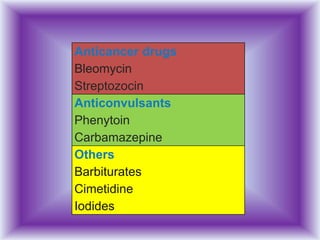
Anticancer drugs
Bleomycin
Streptozocin
Anticonvulsants
Phenytoin
Carbamazepine
Others
Barbiturates
Cimetidine
Iodides
Relationship between fever and
tachycardia
The pulse should increase about 10 beats per
minute for each 0.6"C (1°F) increase in
temperature.
A pulse-temperature dissociation occurs when
the patient has a fever but a heart rate that is
lower than would be expected for the degree of
fever.
This dissociation occurs in
typhoid, malaria, Legionnaires' disease, and
mycoplasma.
Relationship between fever and
tachycardia
In early septic shock,
tachycardia that is
inappropriate for the degree of
fever is often seen.
Relationship between fever and
tachycardia
Tachypnea out of proportion to fever is
characteristic of
Pneumonia and gram-negative
bacteremia.
Hypotension, particularly paired with
tachycardia
raises the concern of sepsis.
Do all septic patients have a fever?
No, in fact, remember that within the
definition of systemic inflammatory
response syndrome (SIRS) is
temperature greater than 38°C
(104"F) or less than 36°C (96.8"F).
Not all fevers are caused by
infection, and not all infected
patients have a fever.
Should everyone with a fever
get antibiotics?
Absolutely not.
Antibiotic use should be based on the
patient's specific presentation and
diagnosis after an appropriate history
and physical examination and directed
laboratory and ancillary tests.
Most clinicians advocate giving
antibiotics immediately to any patient
who appears toxic or has suspected
bacterial meningitis, without delaying
for results of ancillary test or culture
results.
Other patients who should be
considered for early antibiotics are
Immuneoc-ompromised patients and
elderly patients.
Neutropenic fever
In patients with neutropenia (an
absolute neutrophil count below 1,000
per square mm),
A single temperature above 38.3"C
(100.9"F) is considered a fever, and
fever in these patients is secondary to
infection until proven other-wise.
Neutropenic fever
The risk of severe sepsis and septicemia is
higher in these patients, and this initial
workup should include screening for all
sources of infection.
Initial studies should include, at a minimum, a
cell count
and differential, metabolic panel, blood
cultures, chest radiograph, and urinalysis; All
these patients should receive antibiotics.
Fever of unknown origin (FUO)
A fever greater than 38.3"C (100.9"F)
documented on several occasions during a
period longer than 3 weeks, with an uncertain
diagnosis after 1 week of evaluation in the
hospital.
The most common cause of FUO is
occult infection
(particularly tuberculosis) and
malignancy
Each accounting for approximately
30% of cases.
For how long do typical
febrile illnesses last?
In most cases, the fever
resolves within 3 to 7 days.
Is a fever a friend or foe?
Although fever per se is self-limiting and rarely
serious, it is often considered by patients and
doctors to be a major and harmful sign of
illness, and parents and medical practitioners
may develop what has been termed fever
phobia, treating the fever almost as an illness
in itself rather than a symptom.
More and more research is proving, however,
that fever may be beneficial in fighting some
infections.
Higher
Tempertures increase the activity of
neutrophils and lymphocytes and decrease
the levels of serum iron, a substrate that many
bacteria need to reproduce.
It enhances immunological
processes, including the activity
of IL-1, T helper cells and
cytolytic T cells, and B cell and
immunoglobulin synthesis.
Alternating acetaminophen and
ibuprofen for fevers. Is this
effective?
This is not an evidence-based practice.
There is presently no scientific evidence that
this combination is safe or achieves faster
antipyresis than an adequate dose of either
agent alone.
The observed fever reduction of 0.5"C when
combining antipyretics,
Compared with a single antipyretic, is
insufficient to warrant routine use.
Additionally, alternating antipyretics can be
confusing for caregivers, potentially leading to
incorrect dosing of either product.
The practice can also increase parents' fever
phobia because it increases parental
preoccupation with the height of the fever.
Global Critical Care
https://www.facebook.com/groups/1451610115129555/#!/groups/145161011512
9555/
Wellcome in our new group ..... Dr.SAMIR EL ANSARY
GOOD LUCK
SAMIR EL ANSARY
ICU PROFESSOR
AIN SHAMS
CAIRO
elansarysamir@yahoo.com

Fever in icu

  • 1.
  • 2.
  • 3.
    fever A temperature of38°C (100.4"F) in infants or 38.3"C (100.9"F) in adults defines a fever. However, immunocompromised or functionally immunocompromised patients may not be able to mount a temperature high enough to constitute a fever by this definition. In these patients low-grade temperature elevations should be addressed cautiously. Examples of patients in which the clinician should maintain a high index of suspicion for masked fever include the elderly, diabetics, intravenous drug users, chronic alcoholics,
  • 4.
    Temperature constitutes a fever Atemperature of 38°C (100.4"F) in infants or 38.3"C (100.9"F) in adults defines a fever. However, immunocompromised or functionally immunocompromised patients may not be able to mount a temperature high enough to constitute a fever by this definition.
  • 5.
    In these patientslow-grade temperature elevations should be addressed cautiously. Examples of patients in which the clinician should maintain a high index of suspicion for Masked fever include the elderly, diabetics, intravenous drug users, chronic alcoholics, people with HIV / AIDS, people on chronic steroids or immune-modulating drugs, and neutropenic patients.
  • 6.
    Methods of measuring temperatureequivalent Rectal temperatures Are the most accurate representation of core body temperature and are, therefore, considered the gold standard. Oral, axillary, and tympanic temperature measurements lack sensitivity And thus a lack of fever when measured by these methods does not rule out a fever.
  • 7.
    Methods of measuring temperatureequivalent In addition, there is no reliable correction factor for these alternate modalities. When an accurate temperature measurement is crucial to the patient's care A rectal temperature measurement is necessary.
  • 8.
    How does thebody create fever? Core body temperature is controlled by the anterior hypothalamus. A fever is caused by elevation of the hypothalamic set point. The body responds by attempting to generate heat (e.g., by shivering or by increasing the basal metabolic rate) to elevate core temperature.
  • 9.
    The difference betweena fever and hyperthermia In contrast to fever, hyperthermia results in an elevated temperature without alteration of the hypothalamic set point. In cases of hyperthermia, the body attempts to cool itself to achieve a normal temperature, primarily by increasing sweating.
  • 10.
    A temperature of41.5"C (106.7"F) or greater usually represents hyperthermia and not a true fever, especially in adults.
  • 11.
    Some examples of hyperthermiainclude Heat stroke, thyroid storm, burns, and toxidromes, such as neuroleptic malignant syndrome, serotonin syndrome, and malignant hyperthermia.
  • 12.
    How do Iaddress a patient with a subjective fever at home who is afebrile in the ED? This situation is mostly commonly encountered in pediatrics. Mothers are accurate in assessing the presence or absence of a fever 50% to 80% of the time, and they seem to be more accurate at detecting when the child is febrile than they are at determining that the child is afebrile.
  • 13.
    Most experts feelthat palpable fevers reported by mothers are probably real and need to be taken seriously. Additionally, the practice of attributing fevers to bundling has been disproved; bundling does not alter core body temperatures in infants.
  • 14.
    Does the degreeof fever indicate the severity of the illness? In general, no. There is no degree of fever that has been clearly associated with a specific risk of serious infection in patients. The exception to this may be in nonimmunized children; prior to the widespread use of the Haemophilus influenza vaccine, temperatures over 41.1 "C (105.98"F) were associated with a higher incidence of serious bacterial illness in children.
  • 15.
    Prior to theapproval of the pneumococcal conjugate vaccine in 2000, occult pneumococcal bacteremia was observed to be three times more likely in children with a fever of 39.5"C (103.1°F) or greater versus a fever of 39.0°C (102.2"F).
  • 16.
    The best wayto reduce a fever Most physicians use antipyretics for patients who are uncomfortable because of fever. Within the range of 40°C to 42"C, there is no evidence that fever is injurious to tissue. Use of antipyretics should be considered in pregnant women and patients with preexisting cardiac compromise who would not tolerate the increased metabolic demands of a fever.
  • 17.
    Acetaminophen is theantipyretic of choice in most hospitals. Ibuprofen, other nonsteroidal anti- inflammatory drugs (NSAIDS), and aspirin are also effective. However, due to the association with Reye's syndrome, aspirin is usually not recommended for children.
  • 18.
    Response to theseagents is seen with both serious and benign causes of fever. Recurrence of fever after antipyretics wear off is often concerning for parents But it does not distinguish between serious and benign causes of fever, and base our concerns on the child's behavior rather than the height of the fever or its response to antipyretics.
  • 19.
    Complementary methods, suchas cool bathing and undressing the patient, are generally not felt to be effective at significantly lowering core body temperature and should be reserved as adjuncts for higher temperatures.
  • 20.
    If the temperatureis above 41.5"C (106.7"F) The diagnosis of hyperthermia should be considered and rapid cooling measures used if any concern about this condition exists.
  • 21.
    Causes of fever Firstand foremost, at the top of the list is infection (both bacterial and viral). Infection causes the vast majority of fevers, but other causes must also be included in the differential diagnosis: •Neoplastic diseases •(e.g., leukemia, lymphoma, or solid tumors) •Collagen vascular diseases •(e.g., giant cell arteritis, polyarteritis nodosa, systemic lupus erythematosus, or rheumatoid arthritis)
  • 22.
    Causes of fever •Centralnervous system lesions (e.g., stroke, intracranial bleed, or trauma) •Illicit drug use (cocaine, ecstasy [MDMA], or methamphetamines) •Withdrawal syndromes •(delirium tremens or benzodiazepine withdrawal) •Factitious fever •Medications
  • 23.
    Medications can causefevers Any drug is capable of producing a drug fever; however, the most common culprits are penicillin and penicillin analogs . The fever usually begins 7 to 10 days after initiation of drug therapy. There is an associated rash or eosinophilia in about 20% of cases. Drug fever should always be a diagnosis of exclusion.
  • 24.
  • 25.
    Pay particular attentionto associated symptoms (e.g., cough, dysuria, diarrhea, or headache), duration of fever, ill contacts, history or risk of immunecompromise, and past medical history, particularly comorbid illnesses.
  • 26.
    In the physicalexamination, note the general appearance of the patient, such as mild mental status changes or rashes that might be indicative of more serious systemic diseases.
  • 27.
    In addition toa thorough routine physical examination, in appropriate cases a more detailed examination of the patient should be done to look for occult sites of infection, such as the nose/sinuses, rectum (i.e., prostatitis, perirectal abscess), and pelvic examination (i.e., pelvic inflammatory disease, tubo-ovarian abscess).
  • 28.
  • 29.
    Antibiotics lsoniazid (INH) Nitrofurantoin Penicillins, cephalosporins Rifampin Sulfonamides Cardiacdrugs Hydralazine Methyldopa Nifedipine Phenytoin Procainamide Quinidine Nonsteroidal anti-inflammatory drugs Ibuprofen Salicylates
  • 30.
  • 31.
    Relationship between feverand tachycardia The pulse should increase about 10 beats per minute for each 0.6"C (1°F) increase in temperature. A pulse-temperature dissociation occurs when the patient has a fever but a heart rate that is lower than would be expected for the degree of fever. This dissociation occurs in typhoid, malaria, Legionnaires' disease, and mycoplasma.
  • 32.
    Relationship between feverand tachycardia In early septic shock, tachycardia that is inappropriate for the degree of fever is often seen.
  • 33.
    Relationship between feverand tachycardia Tachypnea out of proportion to fever is characteristic of Pneumonia and gram-negative bacteremia. Hypotension, particularly paired with tachycardia raises the concern of sepsis.
  • 34.
    Do all septicpatients have a fever? No, in fact, remember that within the definition of systemic inflammatory response syndrome (SIRS) is temperature greater than 38°C (104"F) or less than 36°C (96.8"F). Not all fevers are caused by infection, and not all infected patients have a fever.
  • 35.
    Should everyone witha fever get antibiotics? Absolutely not. Antibiotic use should be based on the patient's specific presentation and diagnosis after an appropriate history and physical examination and directed laboratory and ancillary tests.
  • 36.
    Most clinicians advocategiving antibiotics immediately to any patient who appears toxic or has suspected bacterial meningitis, without delaying for results of ancillary test or culture results. Other patients who should be considered for early antibiotics are Immuneoc-ompromised patients and elderly patients.
  • 37.
    Neutropenic fever In patientswith neutropenia (an absolute neutrophil count below 1,000 per square mm), A single temperature above 38.3"C (100.9"F) is considered a fever, and fever in these patients is secondary to infection until proven other-wise.
  • 38.
    Neutropenic fever The riskof severe sepsis and septicemia is higher in these patients, and this initial workup should include screening for all sources of infection. Initial studies should include, at a minimum, a cell count and differential, metabolic panel, blood cultures, chest radiograph, and urinalysis; All these patients should receive antibiotics.
  • 39.
    Fever of unknownorigin (FUO) A fever greater than 38.3"C (100.9"F) documented on several occasions during a period longer than 3 weeks, with an uncertain diagnosis after 1 week of evaluation in the hospital. The most common cause of FUO is occult infection (particularly tuberculosis) and malignancy Each accounting for approximately 30% of cases.
  • 40.
    For how longdo typical febrile illnesses last? In most cases, the fever resolves within 3 to 7 days.
  • 41.
    Is a fevera friend or foe? Although fever per se is self-limiting and rarely serious, it is often considered by patients and doctors to be a major and harmful sign of illness, and parents and medical practitioners may develop what has been termed fever phobia, treating the fever almost as an illness in itself rather than a symptom.
  • 42.
    More and moreresearch is proving, however, that fever may be beneficial in fighting some infections. Higher Tempertures increase the activity of neutrophils and lymphocytes and decrease the levels of serum iron, a substrate that many bacteria need to reproduce.
  • 43.
    It enhances immunological processes,including the activity of IL-1, T helper cells and cytolytic T cells, and B cell and immunoglobulin synthesis.
  • 44.
    Alternating acetaminophen and ibuprofenfor fevers. Is this effective? This is not an evidence-based practice. There is presently no scientific evidence that this combination is safe or achieves faster antipyresis than an adequate dose of either agent alone.
  • 45.
    The observed feverreduction of 0.5"C when combining antipyretics, Compared with a single antipyretic, is insufficient to warrant routine use. Additionally, alternating antipyretics can be confusing for caregivers, potentially leading to incorrect dosing of either product. The practice can also increase parents' fever phobia because it increases parental preoccupation with the height of the fever.
  • 46.
  • 47.
    GOOD LUCK SAMIR ELANSARY ICU PROFESSOR AIN SHAMS CAIRO elansarysamir@yahoo.com