Continuing Assessment: FEVER
Body Temperature - The balance
between the heat produced by the body
and the heat lost from the body
Hypothalamus – the heat regulating
center of the body
TYPES OF BODY TEMPERATURE
• Core Temperature – temperature of the deep
tissues of the body. Measured by taking oral and
rectal temperature
• Surface Temperature – temperature of the skin,
subcutaneous tissue, and fat. Measured by
taking axillary temperature
Processes Involved in Heat Loss:
1. Radiation – transfer of heat from the surface
of one object to the surface of another without
contact between two objects
Ex: It feels warm in a crowded room.
2. Conduction – transfer of heat from one
surface to another. It requires temperature
difference between the two surfaces
Ex: Application of moist wash cloth over skin
3. Convection – the dissipation of heat by air
currents
Ex: Exposure of the skin towards an electric fan
4. Evaporation – continuous vaporation of
moisture from the skin, oral mucosa, or
respiratory tract (insensible heat loss)
Ex: Tepid Sponge Bath increases peripheral
circulation, thereby increasing heat loss by
evaporation)
ALTERATIONS IN BODY TEMPERATURE
• Pyrexia – body temperature above normal range
Also called as hyperthermia or fever
• Hyperpyrexia – Very high fever
Usually 41 Degree Celsius and above
• Hypothermia – Subnormal core body
temperature
TYPES OF FEVER
1. Intermittent Fever – Temperature fluctuates
between periods of fever and periods of normal /
subnormal temperature
2. Remittent Fever – Temperature fluctuates
within a wide range over the 24 hour period but
remains above normal range
3. Relapsing Fever – Temperature is elevated
for few days, alternated with 1 or 2 days of
normal temperature
4. Constant Fever – Body temperature is
consistently high
Very high temperatures (41-42 degree-celsius)
cause irreversible brain cell damage
DECLINE OF FEVER
1. Crisis – Sudden decline of fever. This indicates
impairment of the function of the
hypothalamus
2. Lysis – Gradual decline of fever. This indicates
that the body is able to maintain homeostatis.
This is the desired decline of fever.
METHODS OF TEMPERATURE TAKING
1. ORAL – most accessible and convenient
method
- If the client has taken hot or cold food, or has
smoked, allow 15 minutes to elapse before
measuring oral temperature
- Place thermometer under the tongue, directed
towards the side
- Wash thermometer
Before use: From bulb to the stem
After use: From stem to bulb
CONTRAINDICATIONS TO ORAL
TEMPERATURE TAKING
• Oral lesions or surgery
• Cough
• Nausea and vomiting
• Presence of oro-nasal pack, nasogastric tube,
endotracheal tube
• Seizure-prone
• Unconscious
• Restless, Disoriented, Confused
2. Rectal – most accurate measurement of
temperature
- Assist client to assume lateral position
- Lubricate thermometer before insertion
- Insert thermometer by 0.5 – 1.5 inches
- Instruct client to take a deep breath during the
insertion of the thermometer to relax the
internal sphincter
CONTRAINDICATIONS TO RECTAL
TEMPERATURE TAKING
• Anal or Rectal conditions or surgeries
• Diarrhea
• Quadriplegic clients.
Vagal stimulation may occur, causing
bradycardia and suncope
3. Axillary – Safest and most non-invasive
method of temperature taking (will not
penetrate through anything)
- Pat dry the axilla
- Place the arm tightly across the chest to keep the
thermometer in place
4. Tympanic
- Useful with toddlers who squirm at the restraint
needed for the rectal route
- Useful for pre-schoolers who are not yet able to
cooperate for an oral temperature and fear the
use of rectal thermometer
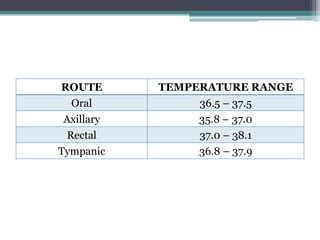
ROUTE TEMPERATURE RANGE
Oral 36.5 – 37.5
Axillary 35.8 – 37.0
Rectal 37.0 – 38.1
Tympanic 36.8 – 37.9

Fever

  • 1.
  • 2.
    Body Temperature -The balance between the heat produced by the body and the heat lost from the body Hypothalamus – the heat regulating center of the body
  • 3.
    TYPES OF BODYTEMPERATURE • Core Temperature – temperature of the deep tissues of the body. Measured by taking oral and rectal temperature • Surface Temperature – temperature of the skin, subcutaneous tissue, and fat. Measured by taking axillary temperature
  • 4.
    Processes Involved inHeat Loss: 1. Radiation – transfer of heat from the surface of one object to the surface of another without contact between two objects Ex: It feels warm in a crowded room. 2. Conduction – transfer of heat from one surface to another. It requires temperature difference between the two surfaces Ex: Application of moist wash cloth over skin
  • 5.
    3. Convection –the dissipation of heat by air currents Ex: Exposure of the skin towards an electric fan 4. Evaporation – continuous vaporation of moisture from the skin, oral mucosa, or respiratory tract (insensible heat loss) Ex: Tepid Sponge Bath increases peripheral circulation, thereby increasing heat loss by evaporation)
  • 8.
    ALTERATIONS IN BODYTEMPERATURE • Pyrexia – body temperature above normal range Also called as hyperthermia or fever • Hyperpyrexia – Very high fever Usually 41 Degree Celsius and above • Hypothermia – Subnormal core body temperature
  • 9.
    TYPES OF FEVER 1.Intermittent Fever – Temperature fluctuates between periods of fever and periods of normal / subnormal temperature 2. Remittent Fever – Temperature fluctuates within a wide range over the 24 hour period but remains above normal range
  • 10.
    3. Relapsing Fever– Temperature is elevated for few days, alternated with 1 or 2 days of normal temperature 4. Constant Fever – Body temperature is consistently high Very high temperatures (41-42 degree-celsius) cause irreversible brain cell damage
  • 11.
    DECLINE OF FEVER 1.Crisis – Sudden decline of fever. This indicates impairment of the function of the hypothalamus 2. Lysis – Gradual decline of fever. This indicates that the body is able to maintain homeostatis. This is the desired decline of fever.
  • 12.
    METHODS OF TEMPERATURETAKING 1. ORAL – most accessible and convenient method - If the client has taken hot or cold food, or has smoked, allow 15 minutes to elapse before measuring oral temperature - Place thermometer under the tongue, directed towards the side - Wash thermometer Before use: From bulb to the stem After use: From stem to bulb
  • 13.
    CONTRAINDICATIONS TO ORAL TEMPERATURETAKING • Oral lesions or surgery • Cough • Nausea and vomiting • Presence of oro-nasal pack, nasogastric tube, endotracheal tube • Seizure-prone • Unconscious • Restless, Disoriented, Confused
  • 14.
    2. Rectal –most accurate measurement of temperature - Assist client to assume lateral position - Lubricate thermometer before insertion - Insert thermometer by 0.5 – 1.5 inches - Instruct client to take a deep breath during the insertion of the thermometer to relax the internal sphincter
  • 15.
    CONTRAINDICATIONS TO RECTAL TEMPERATURETAKING • Anal or Rectal conditions or surgeries • Diarrhea • Quadriplegic clients. Vagal stimulation may occur, causing bradycardia and suncope
  • 16.
    3. Axillary –Safest and most non-invasive method of temperature taking (will not penetrate through anything) - Pat dry the axilla - Place the arm tightly across the chest to keep the thermometer in place
  • 17.
    4. Tympanic - Usefulwith toddlers who squirm at the restraint needed for the rectal route - Useful for pre-schoolers who are not yet able to cooperate for an oral temperature and fear the use of rectal thermometer
  • 18.
    ROUTE TEMPERATURE RANGE Oral36.5 – 37.5 Axillary 35.8 – 37.0 Rectal 37.0 – 38.1 Tympanic 36.8 – 37.9