

Athletic Developmenttraining for high performancePRESENTED BY:Max MARTIN BAppSc (Hons) AEP
Please keep your phone ON!!&This is a                                                                                  Friendly session!@iNformMaxMartinCorrectiveExerciseAustralia
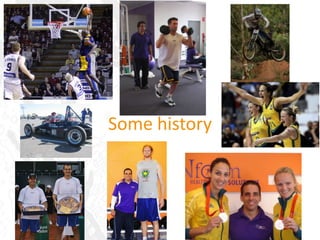
Some history
Plan for todayAddressing your expectations!Flexible practical componentPrescriptive philosophiesTraining the athlete vs the sportBreak (11-11.10)Athletic demandsOlympic lifting for athletes?Lunch!! 12.20 – 1.00Programming for athletic developmentAssessment (1.00-2.30)Key movement prescription (2.30-4.30)
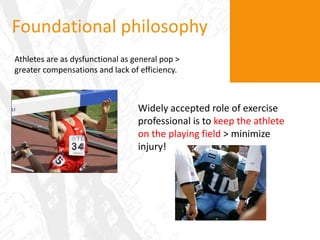
Foundational philosophyAthletes are as dysfunctional as general pop > greater compensations and lack of efficiency.Widely accepted role of exercise professional is to keep the athlete on the playing field> minimize injury!
Foundational philosophyAre these the fastest men in the world?Or are they the coming together of many factors??
Foundational philosophyMovement is a behaviourDevelopmental and learnedQuality over quantityPosture is a good baseline for movementPosture is not the cause of dysfunction but a SYMPTOMSuch dysfunction corresponds to compromised activity of musclesStabilisers typically become hypotonic/inhibited – ‘allowing’ faulty posture Gross movers typically become hypertonic/facilitated – ‘driving’ faulty posture
Training the athlete or the sport??Large cross over of movement skills across sports – Training sport feeds problems and overuseThe most specific sports training is sports itselfBy adding resistance we strengthen the pattern (whether good or bad)Can you be an expert technician in every sport??
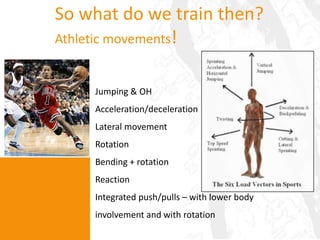
So what do we train then?Athletic movements!Jumping & OHAcceleration/decelerationLateral movementRotationBending + rotationReactionIntegrated push/pulls – with lower body involvement and with rotation
Forces affecting the athleteAthletes face various force demands:Gravity - Ground reaction - MomentumGravity -  train standing up – or mimicking sports demandsGround Reaction - axial loading (jumping sports) vs angular loading and intensity (height of jump/step)Momentum – consider loading purpose and direction of force - for example – to add deceleration load, pull with tube, but resist with tube to decrease load To develop OH squat pattern -
for Tx extuse cables > greater extension demand
but for anti extension use a free weight such as MBLoad to unload
Matching movements to exercisesBending + rotation (DLs > SL DL > SL DL with pelvic rot > ++)Acceleration/deceleration (Squat > SL Sq > weighted SLDLs > hops ++)Lateral movement (SL SQ > Speedskaters > +resistance)Rotation (cable rot resistance > pro-rotation)Integrated push/pulls – with lower body involvement and with rotationJumping – (resisted acceleration – power/explosive squats) OH – Explosive (push press variations) and Control (OH holds = OH squats/split,  rainbow squats, squat extensions ++)Reaction (various perturbation progressions)
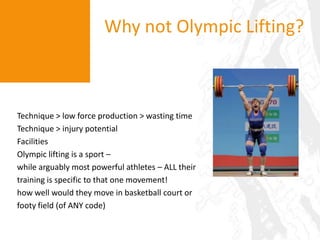
Why not Olympic Lifting?Technique > low force production > wasting timeTechnique > injury potentialFacilitiesOlympic lifting is a sport –while arguably most powerful athletes – ALL their training is specific to that one movement!how well would they move in basketball court or footy field (of ANY code)
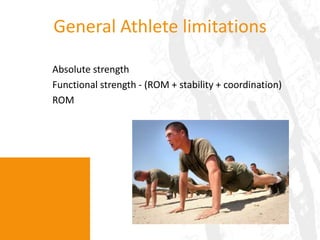
General Athlete limitationsAbsolute strengthFunctional strength- (ROM + stability + coordination)ROM
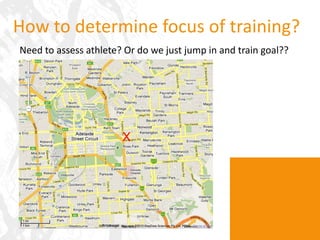
How to determine focus of training?Need to assess athlete? Or do we just jump in and train goal?? X
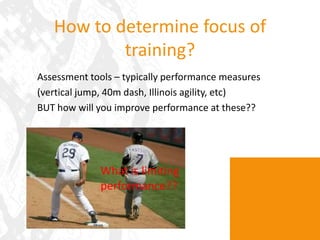
How to determine focus of training?Assessment tools – typically performance measures (vertical jump, 40m dash, Illinois agility, etc)BUT how will you improve performance at these?? What is limiting performance??
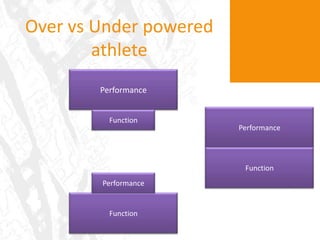
Over vs Under powered athletePerformancePerformanceFunctionFunctionPerformanceFunction
Assessing function and key movementsThe Australian Movement Screen (AMS)OH SquatSquatSL SQOH mobilityPush upRotary
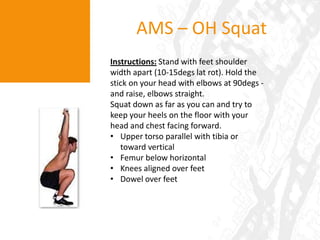
AMS – OH SquatInstructions: Stand with feet shoulder width apart (10-15degs latrot). Hold the stick on your head with elbows at 90degs - and raise, elbows straight. Squat down as far as you can and try to keep your heels on the floor with your head and chest facing forward.Upper torso parallel with tibia or toward vertical
Femur below horizontal
Knees aligned over feet
Dowel over feetAMS – OH MobilityInstructions: client to stand ‘comfortably’ and lift their arms overhead so as to touch palms above their head (“above ears” = in the frontal plane). participant is to keep their elbows extended. Limitations in performance would suggest poor Tx spine and shld girdle flexibility/mobility, evidenced by:pain
Bending of the elbows– indicative of lat tightness and or various other shld girdle or Tx stiffness
Hands meeting in front of the frontal plane –

Athletic development – training for performance

  • 1.
    Athletic Developmenttraining forhigh performancePRESENTED BY:Max MARTIN BAppSc (Hons) AEP
  • 2.
    Please keep yourphone ON!!&This is a Friendly session!@iNformMaxMartinCorrectiveExerciseAustralia
  • 3.
  • 4.
    Plan for todayAddressingyour expectations!Flexible practical componentPrescriptive philosophiesTraining the athlete vs the sportBreak (11-11.10)Athletic demandsOlympic lifting for athletes?Lunch!! 12.20 – 1.00Programming for athletic developmentAssessment (1.00-2.30)Key movement prescription (2.30-4.30)
  • 5.
    Foundational philosophyAthletes areas dysfunctional as general pop > greater compensations and lack of efficiency.Widely accepted role of exercise professional is to keep the athlete on the playing field> minimize injury!
  • 6.
    Foundational philosophyAre thesethe fastest men in the world?Or are they the coming together of many factors??
  • 7.
    Foundational philosophyMovement isa behaviourDevelopmental and learnedQuality over quantityPosture is a good baseline for movementPosture is not the cause of dysfunction but a SYMPTOMSuch dysfunction corresponds to compromised activity of musclesStabilisers typically become hypotonic/inhibited – ‘allowing’ faulty posture Gross movers typically become hypertonic/facilitated – ‘driving’ faulty posture
  • 8.
    Training the athleteor the sport??Large cross over of movement skills across sports – Training sport feeds problems and overuseThe most specific sports training is sports itselfBy adding resistance we strengthen the pattern (whether good or bad)Can you be an expert technician in every sport??
  • 9.
    So what dowe train then?Athletic movements!Jumping & OHAcceleration/decelerationLateral movementRotationBending + rotationReactionIntegrated push/pulls – with lower body involvement and with rotation
  • 10.
    Forces affecting theathleteAthletes face various force demands:Gravity - Ground reaction - MomentumGravity - train standing up – or mimicking sports demandsGround Reaction - axial loading (jumping sports) vs angular loading and intensity (height of jump/step)Momentum – consider loading purpose and direction of force - for example – to add deceleration load, pull with tube, but resist with tube to decrease load To develop OH squat pattern -
  • 11.
    for Tx extusecables > greater extension demand
  • 12.
    but for antiextension use a free weight such as MBLoad to unload
  • 13.
    Matching movements toexercisesBending + rotation (DLs > SL DL > SL DL with pelvic rot > ++)Acceleration/deceleration (Squat > SL Sq > weighted SLDLs > hops ++)Lateral movement (SL SQ > Speedskaters > +resistance)Rotation (cable rot resistance > pro-rotation)Integrated push/pulls – with lower body involvement and with rotationJumping – (resisted acceleration – power/explosive squats) OH – Explosive (push press variations) and Control (OH holds = OH squats/split, rainbow squats, squat extensions ++)Reaction (various perturbation progressions)
  • 14.
    Why not OlympicLifting?Technique > low force production > wasting timeTechnique > injury potentialFacilitiesOlympic lifting is a sport –while arguably most powerful athletes – ALL their training is specific to that one movement!how well would they move in basketball court or footy field (of ANY code)
  • 15.
    General Athlete limitationsAbsolutestrengthFunctional strength- (ROM + stability + coordination)ROM
  • 16.
    How to determinefocus of training?Need to assess athlete? Or do we just jump in and train goal?? X
  • 17.
    How to determinefocus of training?Assessment tools – typically performance measures (vertical jump, 40m dash, Illinois agility, etc)BUT how will you improve performance at these?? What is limiting performance??
  • 18.
    Over vs Underpowered athletePerformancePerformanceFunctionFunctionPerformanceFunction
  • 19.
    Assessing function andkey movementsThe Australian Movement Screen (AMS)OH SquatSquatSL SQOH mobilityPush upRotary
  • 20.
    AMS – OHSquatInstructions: Stand with feet shoulder width apart (10-15degs latrot). Hold the stick on your head with elbows at 90degs - and raise, elbows straight. Squat down as far as you can and try to keep your heels on the floor with your head and chest facing forward.Upper torso parallel with tibia or toward vertical
  • 21.
  • 22.
  • 23.
    Dowel over feetAMS– OH MobilityInstructions: client to stand ‘comfortably’ and lift their arms overhead so as to touch palms above their head (“above ears” = in the frontal plane). participant is to keep their elbows extended. Limitations in performance would suggest poor Tx spine and shld girdle flexibility/mobility, evidenced by:pain
  • 24.
    Bending of theelbows– indicative of lat tightness and or various other shld girdle or Tx stiffness
  • 25.
    Hands meeting infront of the frontal plane –
  • 26.
    Lx spine Othercompensatory movements, such as forward head deviation, etc.AMS –SquatInstructions: Stand with feet shoulder width apart (10-15degs lat rot). Squat down as far as you can and try to keep your heels on the floor with your head and chest facing forward.Upper torso parallel with tibia or toward vertical
  • 27.
  • 28.
    Knees aligned overfeetAMS – SL SquatInstructions: client to stand ‘comfortably’ with feet together and lift one leg so that heel reaches height of tibial tuberosity– observe path of leg:Knee and foot should travel vertically with no rotationAsk client to then perform a SL SQ:Hip/knee/foot alignment to be maintained
  • 29.
    Neutral pelvis (maintainhorizontal level)
  • 30.
    SQ to atleast 45degs
  • 31.
    Maintain neutral spineAMS– Push upInstructions: Place your hands down on the floor, shoulder width apart with your thumbs at arm-pit creaseFor a male: With your knees straight and together and on your toes, perform one push-up while keeping your back straight.For a female: With your knees together – keeping them on the floor - perform one push-up while keeping your back straight.Look for a ‘whole’ body liftwith no sway
  • 32.
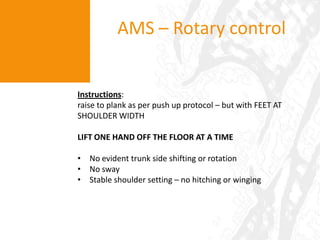
    Stable shoulder setting– no hitching or wingingAMS – Rotary controlInstructions: raise to plank as per push up protocol – but with FEET AT SHOULDER WIDTHLIFT ONE HAND OFF THE FLOOR AT A TIMENo evident trunk side shifting or rotation
  • 33.
  • 34.
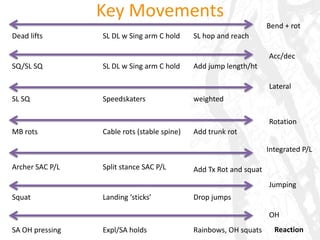
    Stable shoulder setting– no hitching or wingingKey MovementsBend + rotDead liftsSL DL w Sing arm C holdSL hop and reachAcc/decSQ/SL SQSL DL w Sing arm C holdAdd jump length/htLateralSL SQSpeedskatersweightedRotationMB rotsCable rots (stable spine)Add trunk rotIntegrated P/LArcher SAC P/LSplit stance SAC P/LAdd Tx Rot and squatJumpingSquatLanding ‘sticks’Drop jumpsOHReactionSA OH pressingExpl/SA holdsRainbows, OH squats
  • 35.
    PRESENTED BY:Max MARTINBAppSc (Hons)AEP@iNformMaxMartinmax@correctiveexerciseaustralia.comwww.correctiveexerciseaustralia.com

Editor's Notes

  • #4 DAVE?
  • #5 Overview of day – practical very losely structuredAsk them what they want to achieve/get out of session
  • #11 Gravity – demonstrate (clip?) upright loads eg sac press. Ground based – KB side to side drag, renegade push up row combos, etcGround reaction – axial = axial loads – non impact vs impact Angular loading = (holding cables at angles)
  • #12 Jumping - resisted acceleration – power/explosive squatsOH explosive (push presses) – push presses (from MB up to O-bar)OH control (OH squats/split, rainbow squats, squat into extension)Lateral change of direction (speedskater)Deceleration > acceleration (lateral sling)Rotation (anti (cable rots) and pro (row/presses + Tx rot – C rot press)Bending variations (deadlift > SL DL > SL DL with pelvic rot > + Tx rot > add step > add/change resistance (Vipr/MB/ cable) (split stance + rotation, etc) - Have Lunge and row – for posterior sling and as foundation for bendingUpright pressing (ant oblique sling)
  • #18 use a continuum line
  • #19 use a continuum line
  • #20 use a continuum line
  • #21 use a continuum line
  • #22 use a continuum line
  • #23 use a continuum line
  • #24 use a continuum line
  • #25 Bending + rotation (DLs > SL DL > SL DL with pelvic rot > ++)Acceleration/deceleration (Squat > SL Sq > weighted SLDLs > hops ++)Lateral movement (SL SQ > Speedskaters > +resistance)Rotation (cable rot resistance > pro-rotation)Integrated push/pulls – with lower body involvement and with rotationJumping – (resisted acceleration – power/explosive squats) OH – Explosive (push press variations) and Control (OH holds = OH squats/split, rainbow squats, squat extensions ++)Reaction (various perturbation progressions)