   “the science of food, the nutrients and the
    substances, their action, interaction, and
    balance in relation to health and disease, and
    the process by which the organism ingests,
    absorbs, transport, utilizes, and excretes food
    substances”----The Council on Food and Nutrition of the
    American Medical Association

   The social, cultural, psychological implications of
    food and eating
 Provide   energy
 Provide building blocks
 Vital for growth and maintenance
 Essential
 Omission  leads to decline
 Regain normal function when

  restored to the diet
 Has specific biological function
 Poor diet and sedentary lifestyle
 Risk factors for chronic diseases

 Poor diet and sedentary lifestyle are risk

  factors for chronic diseases:
    ◦   Disease of the heart (26.6% of all deaths)
    ◦   Cancer (22.8%)
    ◦   Cerebrovascular disease (5.9%)
    ◦   Diabetes (3.1%)
    ◦   Accounts for ~2/3 of all deaths
 “Affliction of affluence”
 Optimal health

 We are living longer

 Your choice
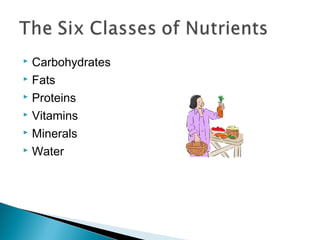
 Carbohydrates
 Fats

 Proteins

 Vitamins

 Minerals

 Water
 Kcals-measure energy
 Essential nutrients

 Nonessential nutrients

 Energy-yielding nutrients: CHOs, P, fats

 Nutrients for growth, development, and

  maintenance
 Nutrients that regulate body processes
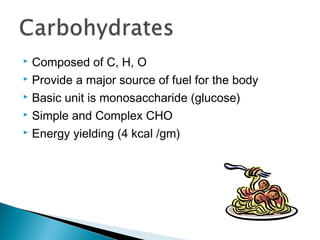
 Composed of C, H, O
 Provide a major source of fuel for the body

 Basic unit is monosaccharide (glucose)

 Simple and Complex CHO

 Energy yielding (4 kcal /gm)
 Composed of C, H and fewer O
 Triglyceride is the major form of lipid

 Fats and oils

 Unsaturated Fatty Acids

 Saturated Fatty Acids

 Essential Fatty Acids (Omega 3, 6)

 Energy yielding (9 kcal /gm)

 Cholesterol and phospholipids
   Composed of C, O, H,   N
 Basic unit is amino acid
 Make up bones, muscles, other tissues, and

  components
 (9) Essential amino acid

 (11) Nonessential amino acid

 Energy yielding (4 kcal /gm)
 Composed of various elements
 Vital to life

 Enable chemical reactions

 Needed in tiny amounts

 Fat soluble

 Water soluble-destroyed in cooking

 Yields no energy
 Inorganic substances-lacking carbon
 Function in cellular process, nervous system,

  water balance, structural
 Needed in tiny amounts

 Not destroyed in cooking

 Trace minerals

 Major minerals

 Yields no energy
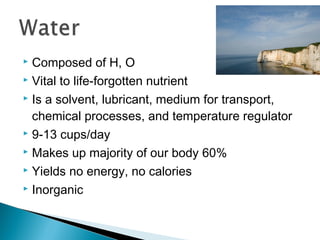
 Composed of H, O
 Vital to life-forgotten nutrient

 Is a solvent, lubricant, medium for transport,

  chemical processes, and temperature regulator
 9-13 cups/day

 Makes up majority of our body 60%

 Yields no energy, no calories

 Inorganic
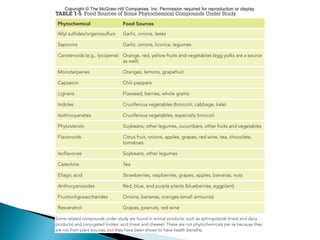
   A chemical found in plants

    ◦ Not considered essential nutrients
    ◦ Provide significant health benefits
    ◦ Primarily found in fruits and vegetables
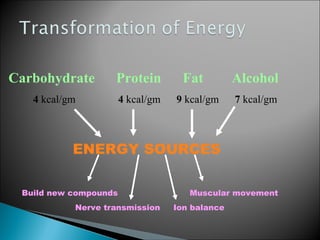
Carbohydrate       Protein           Fat         Alcohol
   4 kcal/gm           4 kcal/gm   9 kcal/gm     7 kcal/gm


           ENERGY SOURCES

 Build new compounds                  Muscular movement
           Nerve transmission      Ion balance
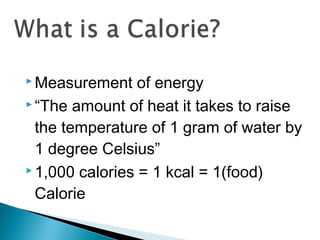
 Measurement    of energy
 “The amount of heat it takes to raise

  the temperature of 1 gram of water by
  1 degree Celsius”
 1,000 calories = 1 kcal = 1(food)

  Calorie
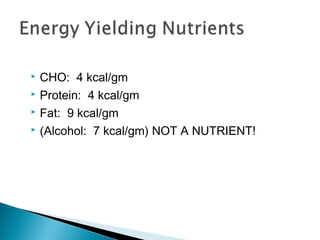
 CHO: 4 kcal/gm
 Protein: 4 kcal/gm

 Fat: 9 kcal/gm

 (Alcohol: 7 kcal/gm) NOT A NUTRIENT!
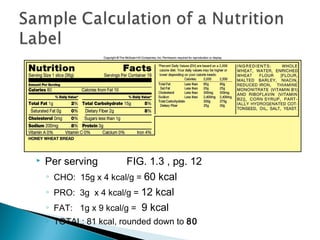
   Per serving         FIG. 1.3 , pg. 12
    ◦ CHO: 15g x 4 kcal/g = 60 kcal
    ◦ PRO: 3g x 4 kcal/g = 12 kcal
    ◦ FAT: 1g x 9 kcal/g = 9 kcal
    ◦ TOTAL: 81 kcal, rounded down to 80
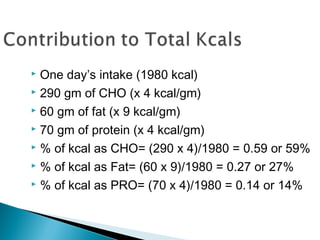
 One day’s intake (1980 kcal)
 290 gm of CHO (x 4 kcal/gm)

 60 gm of fat (x 9 kcal/gm)

 70 gm of protein (x 4 kcal/gm)

 % of kcal as CHO= (290 x 4)/1980 = 0.59 or 59%

 % of kcal as Fat= (60 x 9)/1980 = 0.27 or 27%

 % of kcal as PRO= (70 x 4)/1980 = 0.14 or 14%
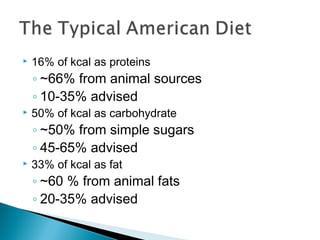
   16% of kcal as proteins
    ◦ ~66% from animal sources
    ◦ 10-35% advised
   50% of kcal as carbohydrate
    ◦ ~50% from simple sugars
    ◦ 45-65% advised
   33% of kcal as fat
    ◦ ~60 % from animal fats
    ◦ 20-35% advised
   National Health and Nutrition Examination Survey
    (NHANES) [US Dept. of Health & Human
    Services]
 Monitor energy intake
 Salt (sodium) in moderation
 Alcohol in moderation
 Fat in moderation
 Adequate fluids
 Eat 5-A-Day; DASH 8-A-Day
 Use supplements wisely, if at all
 Mealtime is a social time
 Promote healthy lifestyle
 Reduce preventable deaths and diseases
 Reduce obesity in adults and children
 Increase intake of fruits, vegetables, and whole

  grain products
 Lower intake of fat, saturated fats, and sodium
 Increase intake of calcium and iron
   Hunger
    ◦ Physical biological drive
   Appetite
    ◦ Psychological drive
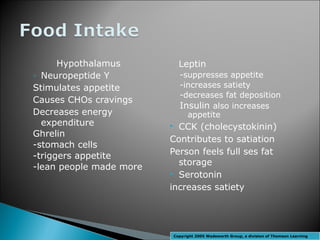
Hypothalamus           Leptin
◦ Neuropeptide Y             -suppresses appetite
Stimulates appetite          -increases satiety
                             -decreases fat deposition
Causes CHOs cravings
                             Insulin also increases
Decreases energy               appetite
  expenditure             CCK (cholecystokinin)
Ghrelin
                         Contributes to satiation
-stomach cells
-triggers appetite       Person feels full ses fat
                           storage
-lean people made more
                          Serotonin

                         increases satiety


                         Copyright 2005 Wadsworth Group, a division of Thomson Learning
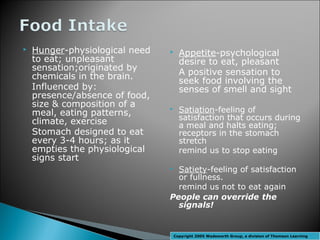
   Hunger-physiological need        Appetite-psychological
    to eat; unpleasant                desire to eat, pleasant
    sensation;originated by
    chemicals in the brain.           A positive sensation to
                                      seek food involving the
    Influenced by:                    senses of smell and sight
    presence/absence of food,
    size & composition of a
    meal, eating patterns,
                                     Satiation-feeling of
                                      satisfaction that occurs during
    climate, exercise                 a meal and halts eating;
    Stomach designed to eat           receptors in the stomach
    every 3-4 hours; as it            stretch
    empties the physiological         remind us to stop eating
    signs start
                                 Satiety-feeling of satisfaction
                                  or fullness.
                                  remind us not to eat again
                                People can override the
                                  signals!


                                    Copyright 2005 Wadsworth Group, a division of Thomson Learning
After fatty foods pass your lips and before they settle on to your hips, they go to your
brain. And that may be an important clue to why - and when - we're prone to overeat.
Research from the University of Texas Southwestern Medical Center in Dallas
suggests that when certain molecules of saturated fat reach the brain, they interrupt
signals (from the hormones leptin and insulin) that normally suppress appetite
after we've eaten. The culprit most responsible is palmitic acid, a saturated fat found
in foods such as butter, cheese, milk and beef. Absent this signal from the brain that
we've had enough, we keep eating. The signaling disruption lasts about three days,
the investigators said. They looked at the effects of fat on animals' brains by feeding
them palmitic acid, monounsaturated fatty acid and oleic acid, an unsaturated fat
found in olive and grapeseed oils. The only fat that sabotaged leptin and insulin
signals was palmitic. The study was published in the September 2009 issue of The
Journal of Clinical Investigation. Other new research showed that we tend to eat less
when with a heavy friend who eats large portions and more when we're with a thin
friend who eats a lot, suggesting social signals also influence patterns of eating. That
study was published online on August 25, 2009 in the Journal of Consumer
Research.
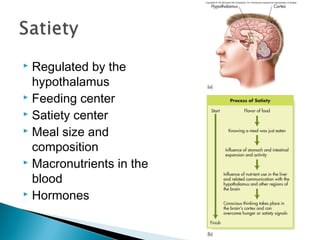
 Regulated by the
  hypothalamus
 Feeding center
 Satiety center
 Meal size and

  composition
 Macronutrients in the

  blood
 Hormones
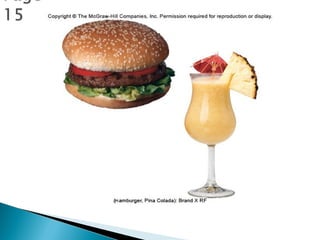
   Freshman Fifteen
    ◦   Stressful situations
    ◦   University environment
    ◦   Peer pressure
    ◦   Alcohol
    ◦   Lack of Exercise
   Tips to avoid the freshmen fifteen
    ◦   Eat breakfast
    ◦   Plan ahead
    ◦   Limit liquid calories
    ◦   Stock the fridge with healthy choices
    ◦   Exercise regularly

Contemporary ch1 fall_2011

  • 2.
    “the science of food, the nutrients and the substances, their action, interaction, and balance in relation to health and disease, and the process by which the organism ingests, absorbs, transport, utilizes, and excretes food substances”----The Council on Food and Nutrition of the American Medical Association  The social, cultural, psychological implications of food and eating
  • 4.
     Provide energy  Provide building blocks  Vital for growth and maintenance  Essential
  • 5.
     Omission leads to decline  Regain normal function when restored to the diet  Has specific biological function
  • 6.
     Poor dietand sedentary lifestyle  Risk factors for chronic diseases  Poor diet and sedentary lifestyle are risk factors for chronic diseases: ◦ Disease of the heart (26.6% of all deaths) ◦ Cancer (22.8%) ◦ Cerebrovascular disease (5.9%) ◦ Diabetes (3.1%) ◦ Accounts for ~2/3 of all deaths
  • 7.
     “Affliction ofaffluence”  Optimal health  We are living longer  Your choice
  • 8.
     Carbohydrates  Fats Proteins  Vitamins  Minerals  Water
  • 9.
     Kcals-measure energy Essential nutrients  Nonessential nutrients  Energy-yielding nutrients: CHOs, P, fats  Nutrients for growth, development, and maintenance  Nutrients that regulate body processes
  • 10.
     Composed ofC, H, O  Provide a major source of fuel for the body  Basic unit is monosaccharide (glucose)  Simple and Complex CHO  Energy yielding (4 kcal /gm)
  • 11.
     Composed ofC, H and fewer O  Triglyceride is the major form of lipid  Fats and oils  Unsaturated Fatty Acids  Saturated Fatty Acids  Essential Fatty Acids (Omega 3, 6)  Energy yielding (9 kcal /gm)  Cholesterol and phospholipids
  • 12.
    Composed of C, O, H, N  Basic unit is amino acid  Make up bones, muscles, other tissues, and components  (9) Essential amino acid  (11) Nonessential amino acid  Energy yielding (4 kcal /gm)
  • 13.
     Composed ofvarious elements  Vital to life  Enable chemical reactions  Needed in tiny amounts  Fat soluble  Water soluble-destroyed in cooking  Yields no energy
  • 14.
     Inorganic substances-lackingcarbon  Function in cellular process, nervous system, water balance, structural  Needed in tiny amounts  Not destroyed in cooking  Trace minerals  Major minerals  Yields no energy
  • 15.
     Composed ofH, O  Vital to life-forgotten nutrient  Is a solvent, lubricant, medium for transport, chemical processes, and temperature regulator  9-13 cups/day  Makes up majority of our body 60%  Yields no energy, no calories  Inorganic
  • 16.
    A chemical found in plants ◦ Not considered essential nutrients ◦ Provide significant health benefits ◦ Primarily found in fruits and vegetables
  • 19.
    Carbohydrate Protein Fat Alcohol 4 kcal/gm 4 kcal/gm 9 kcal/gm 7 kcal/gm ENERGY SOURCES Build new compounds Muscular movement Nerve transmission Ion balance
  • 20.
     Measurement of energy  “The amount of heat it takes to raise the temperature of 1 gram of water by 1 degree Celsius”  1,000 calories = 1 kcal = 1(food) Calorie
  • 21.
     CHO: 4kcal/gm  Protein: 4 kcal/gm  Fat: 9 kcal/gm  (Alcohol: 7 kcal/gm) NOT A NUTRIENT!
  • 22.
    Per serving FIG. 1.3 , pg. 12 ◦ CHO: 15g x 4 kcal/g = 60 kcal ◦ PRO: 3g x 4 kcal/g = 12 kcal ◦ FAT: 1g x 9 kcal/g = 9 kcal ◦ TOTAL: 81 kcal, rounded down to 80
  • 23.
     One day’sintake (1980 kcal)  290 gm of CHO (x 4 kcal/gm)  60 gm of fat (x 9 kcal/gm)  70 gm of protein (x 4 kcal/gm)  % of kcal as CHO= (290 x 4)/1980 = 0.59 or 59%  % of kcal as Fat= (60 x 9)/1980 = 0.27 or 27%  % of kcal as PRO= (70 x 4)/1980 = 0.14 or 14%
  • 24.
    16% of kcal as proteins ◦ ~66% from animal sources ◦ 10-35% advised  50% of kcal as carbohydrate ◦ ~50% from simple sugars ◦ 45-65% advised  33% of kcal as fat ◦ ~60 % from animal fats ◦ 20-35% advised
  • 25.
    National Health and Nutrition Examination Survey (NHANES) [US Dept. of Health & Human Services]
  • 26.
     Monitor energyintake  Salt (sodium) in moderation  Alcohol in moderation  Fat in moderation  Adequate fluids  Eat 5-A-Day; DASH 8-A-Day  Use supplements wisely, if at all  Mealtime is a social time
  • 27.
     Promote healthylifestyle  Reduce preventable deaths and diseases  Reduce obesity in adults and children  Increase intake of fruits, vegetables, and whole grain products  Lower intake of fat, saturated fats, and sodium  Increase intake of calcium and iron
  • 29.
    Hunger ◦ Physical biological drive  Appetite ◦ Psychological drive
  • 30.
    Hypothalamus Leptin ◦ Neuropeptide Y -suppresses appetite Stimulates appetite -increases satiety -decreases fat deposition Causes CHOs cravings Insulin also increases Decreases energy appetite expenditure  CCK (cholecystokinin) Ghrelin Contributes to satiation -stomach cells -triggers appetite Person feels full ses fat storage -lean people made more  Serotonin increases satiety Copyright 2005 Wadsworth Group, a division of Thomson Learning
  • 31.
    Hunger-physiological need  Appetite-psychological to eat; unpleasant desire to eat, pleasant sensation;originated by chemicals in the brain. A positive sensation to seek food involving the Influenced by: senses of smell and sight presence/absence of food, size & composition of a meal, eating patterns,  Satiation-feeling of satisfaction that occurs during climate, exercise a meal and halts eating; Stomach designed to eat receptors in the stomach every 3-4 hours; as it stretch empties the physiological remind us to stop eating signs start  Satiety-feeling of satisfaction or fullness. remind us not to eat again People can override the signals! Copyright 2005 Wadsworth Group, a division of Thomson Learning
  • 32.
    After fatty foodspass your lips and before they settle on to your hips, they go to your brain. And that may be an important clue to why - and when - we're prone to overeat. Research from the University of Texas Southwestern Medical Center in Dallas suggests that when certain molecules of saturated fat reach the brain, they interrupt signals (from the hormones leptin and insulin) that normally suppress appetite after we've eaten. The culprit most responsible is palmitic acid, a saturated fat found in foods such as butter, cheese, milk and beef. Absent this signal from the brain that we've had enough, we keep eating. The signaling disruption lasts about three days, the investigators said. They looked at the effects of fat on animals' brains by feeding them palmitic acid, monounsaturated fatty acid and oleic acid, an unsaturated fat found in olive and grapeseed oils. The only fat that sabotaged leptin and insulin signals was palmitic. The study was published in the September 2009 issue of The Journal of Clinical Investigation. Other new research showed that we tend to eat less when with a heavy friend who eats large portions and more when we're with a thin friend who eats a lot, suggesting social signals also influence patterns of eating. That study was published online on August 25, 2009 in the Journal of Consumer Research.
  • 33.
     Regulated bythe hypothalamus  Feeding center  Satiety center  Meal size and composition  Macronutrients in the blood  Hormones
  • 35.
    Freshman Fifteen ◦ Stressful situations ◦ University environment ◦ Peer pressure ◦ Alcohol ◦ Lack of Exercise
  • 37.
    Tips to avoid the freshmen fifteen ◦ Eat breakfast ◦ Plan ahead ◦ Limit liquid calories ◦ Stock the fridge with healthy choices ◦ Exercise regularly

Editor's Notes