



Australian Pre-Exercise Screen The New Standard PRESENTED BY: Max MARTIN  BAppSc (Hons) AEP
Please keep your phone  ON !! @ Fitnessorgau #filex2011 @ iNformMaxMartin facebook.com/fitnessorgau This is a  Friendly session! &
An industry exposed April 27 th  2010
 
“ I’d like to know what sort of pre-screening they’ve had”
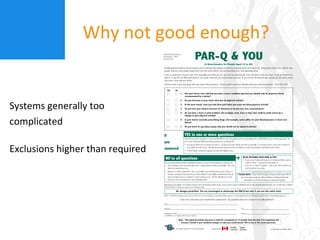
Satisfactory answer? Common for clients to be screened prior to physical activity programs referrals do occur to medical and AHP for guidance Part of qualification content and industry codes of practice However practice is variable and non-systematic American College of Sports Medicine (ACSM) Sports Medicine Australia (SMA – 2005) Physical Activity Readiness Questionnaire (PAR-Q)
Why not good enough? Systems generally too complicated Exclusions higher than required
 
Industry practice Reps council and NIC (7 x RICs) = 40 businesses adapted tool without clear process for information 5% of business reported using an endorsed system in its entirety 10% complied with formal health management process identifies lack of clarity and surety  75% included a legal with 35% being ½ page in length or longer! ‘ point of sale ’  items to satisfy legal requirements, rather than thorough health screening and advice. Applied at reception and then filed away
Industry practice **Usage is High – Application is low** Limited risk stratification and  ‘ good ’  referral practices
Industry feedback Weaknesses in current practice Legal rather than health orientation Info not being passed on to EPs Not sure what to do with info provided No clear definition of risk and no reference to intensity No education element to client No electronic version
Industry feedback Desirables – the shopping list A standardized Q, preferable 1 page Application across different delivery modes and settings Practical and efficient (no unnecessary questions) Clear process for information handling and client care Understanding health and legal liability Opportunity for network with AHP Ensuring EPs highlighting benefit to client in educating them and making them aware of their health Educating EPs to write ‘good’ referral letters to GPs leading to good relationships
The challenge Broad range of professionals 23,500 registered exercise professionals (REPS) in many roles 3,100 Accredited Exercise Physiologists in various settings A largely sedentary population increasing in age and fatness and decreasing in fitness Government, media and medical messages to improve health through participation in exercise Obviously positive message but  with potential for negative health outcomes in ‘at risk’ population
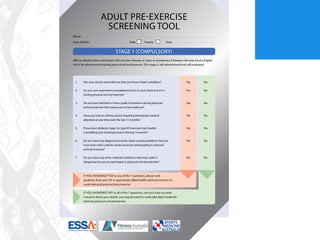
An ideal answer Development of  a national, standardised, fitness industry specific tool. First step in identifying those ‘at risk’ prior to commencement. Reduction in risks to participants. Risk stratification and adequate programming Client education about their health
A health, fitness and exercise consortium Recognition of need to develop tool Broad application across physical activity and exercise sectors and experience Need to engage broad based national support and endorsement from the health sector
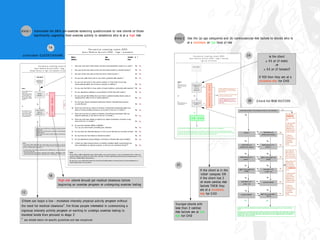
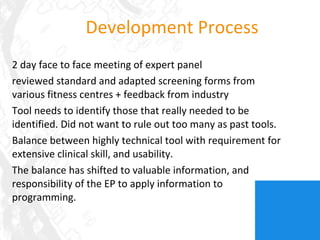
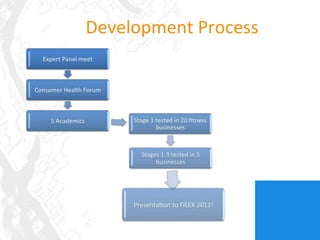
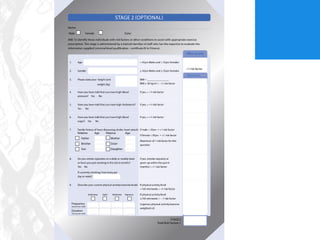
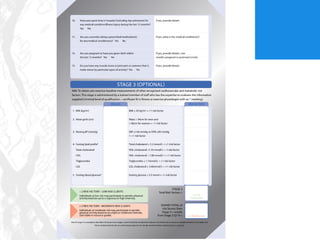
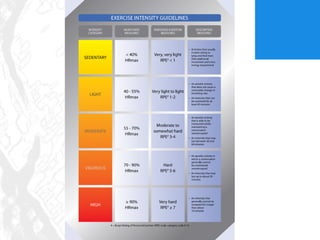
Development Process 2 day face to face meeting of expert panel reviewed standard and adapted screening forms from various fitness centres + feedback from industry  Tool needs to identify those that really needed to be identified. Did not want to rule out too many as past tools. Balance between highly technical tool with requirement for extensive clinical skill, and usability. The balance has shifted to valuable information, and responsibility of the EP to apply information to programming.
Development Process


Benefits of tool confidence and education to client programming guide opportunity for better referrals (great marketing strategy!) increased respect from medical and AHP community
Barriers to your application??
Where to from here? Referred to in the training package (under continuing improvement). Government aware and supportive AGPN and DOHA - briefed and aware of development process – grant application for education forums – as part of Healthy Communities Initiative – tool can be highlighted during this process Building block for future path for referral pathways Ongoing development through industry feedback Children’s tool – understanding of need
A vision for change April 27 th  2010
 
An invitation to participate
PRESENTED BY: Max MARTIN  BAppSc (Hons)AEP @iNformMaxMartin [email_address]

Pre exercise cv screening tool launch

  • 1.
    Australian Pre-Exercise ScreenThe New Standard PRESENTED BY: Max MARTIN BAppSc (Hons) AEP
  • 2.
    Please keep yourphone ON !! @ Fitnessorgau #filex2011 @ iNformMaxMartin facebook.com/fitnessorgau This is a Friendly session! &
  • 3.
    An industry exposedApril 27 th 2010
  • 4.
  • 5.
    “ I’d liketo know what sort of pre-screening they’ve had”
  • 6.
    Satisfactory answer? Commonfor clients to be screened prior to physical activity programs referrals do occur to medical and AHP for guidance Part of qualification content and industry codes of practice However practice is variable and non-systematic American College of Sports Medicine (ACSM) Sports Medicine Australia (SMA – 2005) Physical Activity Readiness Questionnaire (PAR-Q)
  • 7.
    Why not goodenough? Systems generally too complicated Exclusions higher than required
  • 8.
  • 9.
    Industry practice Repscouncil and NIC (7 x RICs) = 40 businesses adapted tool without clear process for information 5% of business reported using an endorsed system in its entirety 10% complied with formal health management process identifies lack of clarity and surety 75% included a legal with 35% being ½ page in length or longer! ‘ point of sale ’ items to satisfy legal requirements, rather than thorough health screening and advice. Applied at reception and then filed away
  • 10.
    Industry practice **Usageis High – Application is low** Limited risk stratification and ‘ good ’ referral practices
  • 11.
    Industry feedback Weaknessesin current practice Legal rather than health orientation Info not being passed on to EPs Not sure what to do with info provided No clear definition of risk and no reference to intensity No education element to client No electronic version
  • 12.
    Industry feedback Desirables– the shopping list A standardized Q, preferable 1 page Application across different delivery modes and settings Practical and efficient (no unnecessary questions) Clear process for information handling and client care Understanding health and legal liability Opportunity for network with AHP Ensuring EPs highlighting benefit to client in educating them and making them aware of their health Educating EPs to write ‘good’ referral letters to GPs leading to good relationships
  • 13.
    The challenge Broadrange of professionals 23,500 registered exercise professionals (REPS) in many roles 3,100 Accredited Exercise Physiologists in various settings A largely sedentary population increasing in age and fatness and decreasing in fitness Government, media and medical messages to improve health through participation in exercise Obviously positive message but with potential for negative health outcomes in ‘at risk’ population
  • 14.
    An ideal answerDevelopment of a national, standardised, fitness industry specific tool. First step in identifying those ‘at risk’ prior to commencement. Reduction in risks to participants. Risk stratification and adequate programming Client education about their health
  • 15.
    A health, fitnessand exercise consortium Recognition of need to develop tool Broad application across physical activity and exercise sectors and experience Need to engage broad based national support and endorsement from the health sector
  • 16.
    Development Process 2day face to face meeting of expert panel reviewed standard and adapted screening forms from various fitness centres + feedback from industry Tool needs to identify those that really needed to be identified. Did not want to rule out too many as past tools. Balance between highly technical tool with requirement for extensive clinical skill, and usability. The balance has shifted to valuable information, and responsibility of the EP to apply information to programming.
  • 17.
  • 18.
  • 19.
  • 20.
  • 21.
  • 22.
    Benefits of toolconfidence and education to client programming guide opportunity for better referrals (great marketing strategy!) increased respect from medical and AHP community
  • 23.
    Barriers to yourapplication??
  • 24.
    Where to fromhere? Referred to in the training package (under continuing improvement). Government aware and supportive AGPN and DOHA - briefed and aware of development process – grant application for education forums – as part of Healthy Communities Initiative – tool can be highlighted during this process Building block for future path for referral pathways Ongoing development through industry feedback Children’s tool – understanding of need
  • 25.
    A vision forchange April 27 th 2010
  • 26.
  • 27.
    An invitation toparticipate
  • 28.
    PRESENTED BY: MaxMARTIN BAppSc (Hons)AEP @iNformMaxMartin [email_address]