FEMORAL ARTERY
ACCESS
ANATOMY
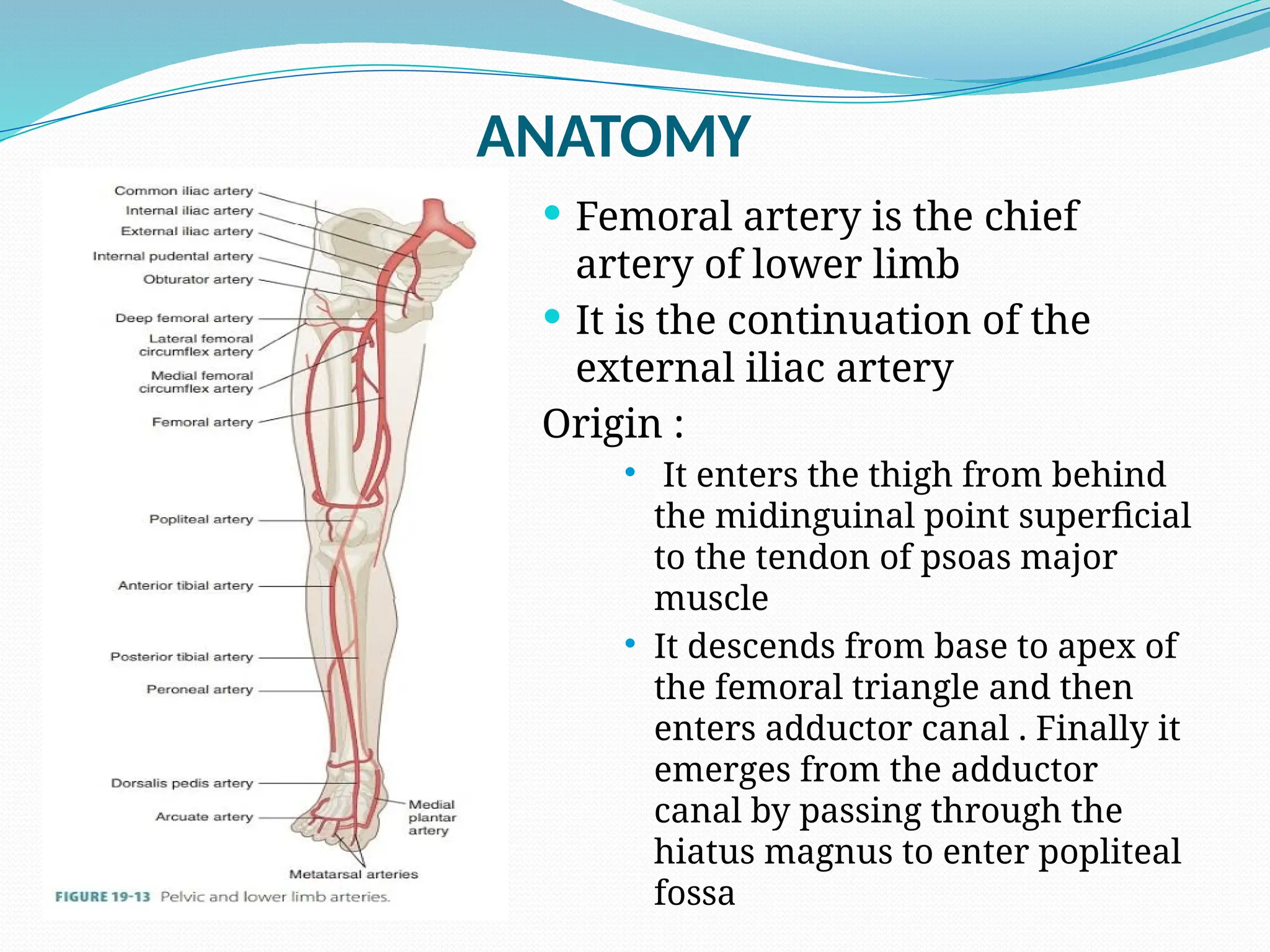
 Femoral artery is the chief
artery of lower limb
 It is the continuation of the
external iliac artery
Origin :
 It enters the thigh from behind
the midinguinal point superficial
to the tendon of psoas major
muscle
 It descends from base to apex of
the femoral triangle and then
enters adductor canal . Finally it
emerges from the adductor
canal by passing through the
hiatus magnus to enter popliteal
fossa
Femoral Artery Branches
3 Superficial
branches
3 Deep branches
 Superficial epigastric
artery
 Superficial
circumflex iliac
artery
 Superficial external
pudendal artery
 Profunda femoris
artery
 deeep external
pudendal artery
 Muscular branches
How to Access Femoral Artery ?
 Both right and left femoral artery used for
cardiac catheterization
 Right femoral artery is the most commonly used
 The inguinal area is prepared and draped under
sterile conditions
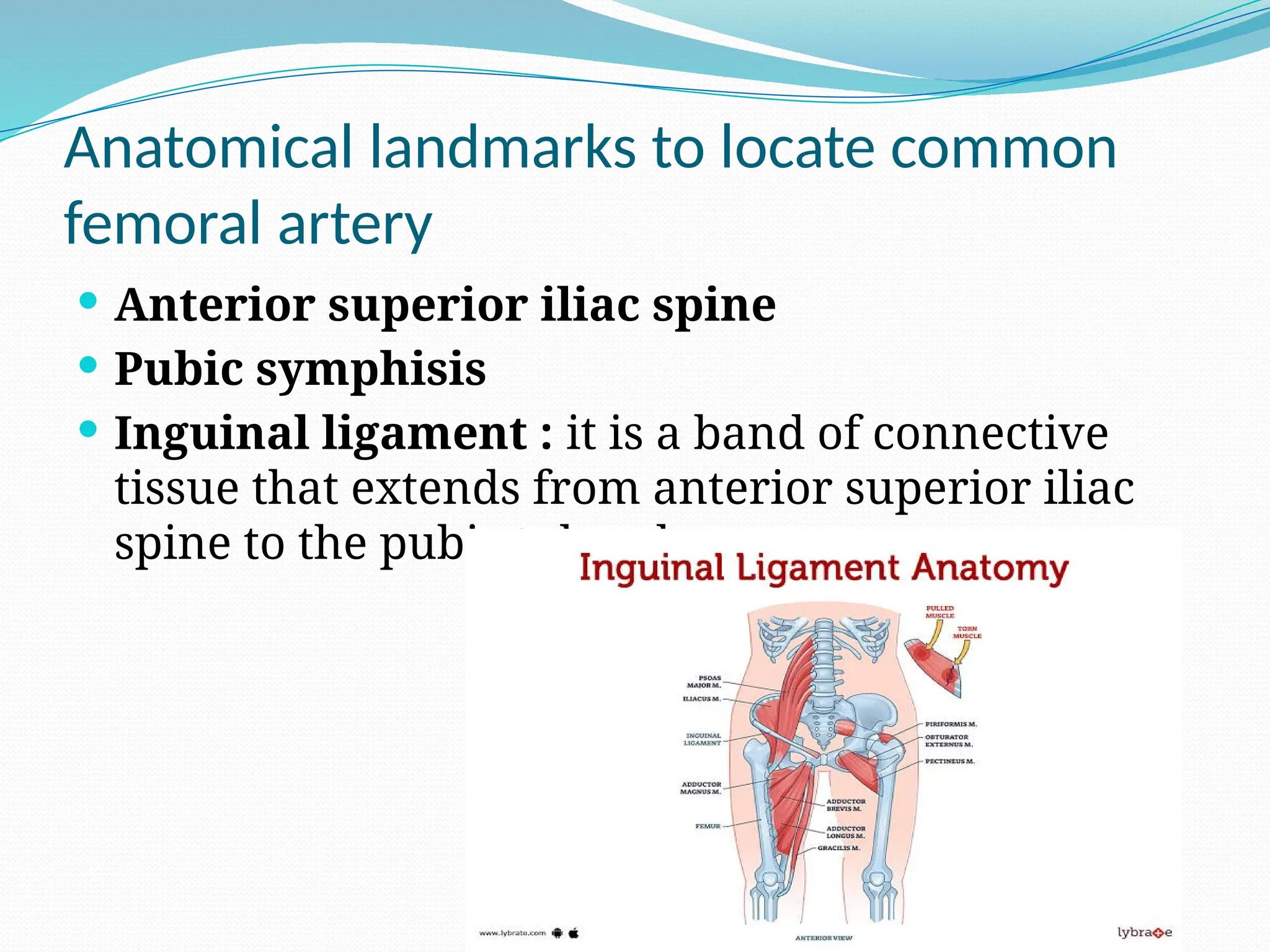
Anatomical landmarks to locate common
femoral artery
 Anterior superior iliac spine
 Pubic symphisis
 Inguinal ligament : it is a band of connective
tissue that extends from anterior superior iliac
spine to the pubic tubercle .
Palpation of femoral pulse
 It is felt 1/3rd
and 1/2half of the distance from
the medial end of the inguinal ligament
 For right CFA : Place the right thumb on the right
anterior superior iliac spine and the right middle
finger on the pubic symphysis.right index finger
should be located over the femoral artery above
the femoral head
 For left CFA : Place the right thumb on the pubic
symphysis and the middle finger on the left
anterior superior iliac spine . Index finger located
over the femoral artery above the femoral head
Where to puncture ?
 The perfect puncture site is the midpoint of
femoral head
 Locate the puncture site is better to locate the
femoral head in ANTEROPOSTERIOR ( AP )VIEW
 Puncture at or above the inguinal ligament
results in retroperitonial bleeding
 Puncture near/lower the femoral head give rise
to pseudoaneurysm formation .
STEPS TO PERFORM
 Administration of local anesthesia
 Femoral artery puncture
 Insertion of a 0.018 inch guidewire
 Skin nick (optional)
 Sheath insertion
 Advancement of catheter over a 0.035 inch
guidewire
 Sheath aspiration and flushing
 Femoral angiography
Local anesthetic administration
 Load a syringe (usually 10cc of lignocaine)with
local anesthetic
 Insert the syringe needle (usually 26-31 gauge)in
the skin at the intended puncture site
 Aspirate to confirm that the tip of the needle is
not within a vessel
 Administer 10-20 cc of local anesthetic in the
subcutaneous tissue close to the target femoral
artery
To Puncture the Femoral Artery
 A single anterior , arterial wall puncture is the
goal
 An 18 gauge needle is inserted at a 45 degree
angle through the skin at the maximal arterial
pulse
 Advance the tip gently through the subcutaneous
tissue, the arterial pulsation is feel at the hub
from the anterior wall of the artery
 Adjust the angulation of the needle depending on
the depth of the artery
 Confirm the entry into the artery by blood flow
Wrong puncture
 High puncture : increases the risk of
retroperitoneal hematoma.
Remove the needle ,hold pressure for 1-2mins and
obtain access again.
 Low puncture : increases the risk of
pseudoaneurysm formation.
Remove the needle and obtain the access again at
a higher location
Insert 0.08 inch guidewire
 Advance the 0.018 inch guidewire through the
access needle
Skin nick ( optional )
 use a scalpel to make a nick at a guidewire entry
point through the skin
 Do not perform this maneuver with a sheath in
place , since the blade could cut the sheath
causing significant bleeding
Insertion of sheath and catheter
over a 0.035 inch guidewire
 Select a sheath for insertion , usually six french
sheaths are usually used for diagnostic
angiography .
 Advance the sheath over the 0.018 inch
guidewire until the hub reaches the skin
 Remove the dilator,and the 0.018 inch guidewire .
 Insert a 0.035 inch guidewire with the cathetrer
through the sheath into the aorta .
Sheath aspiration and flushing
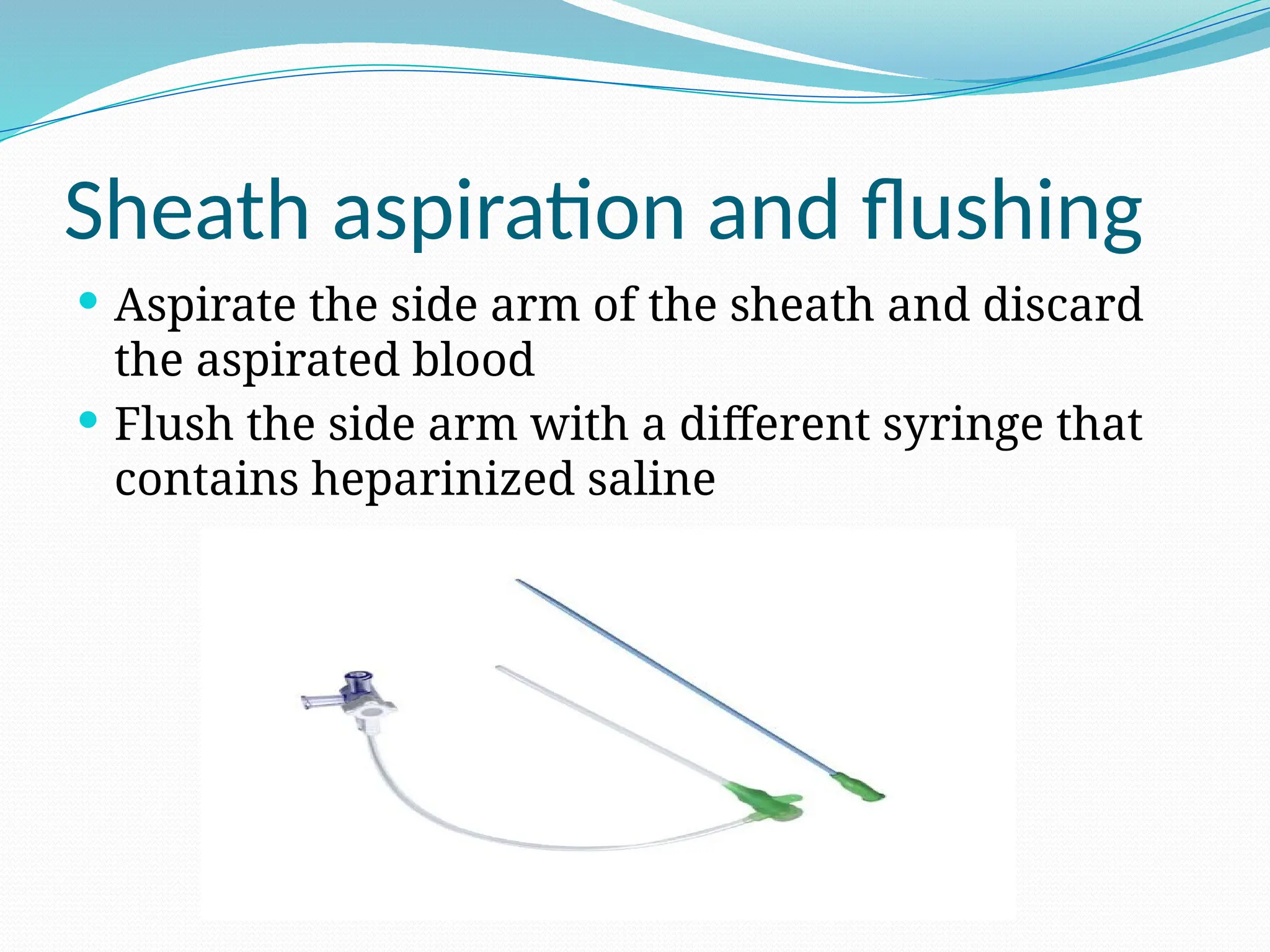
 Aspirate the side arm of the sheath and discard
the aspirated blood
 Flush the side arm with a different syringe that
contains heparinized saline
Femoral angiography
 Connect the side arm of the femoral sheath with
the manifold
 Confirm the arterial pressure waveform without
dampening
 Perform fluroscopy of the groin area and place
the femoral sheath in the center of the
image .use low magnification to allow
visualization of both iliac vessels and the CFA
bifurction.
Continuation
 The most commonly used projection is 20-30
degree RAO for Right CFA (or) LAO for Left CFA to
facilitate visualization of the CFA bifurcation .
 Perform cine angiography ,usually injecting 5-
10ml of contrast .Diluted contrast can be used as
well . The sheath if often pulled medially during
image acquisition , to help identify its entry point
into the femoral artery
Femoral artery to coronary
 Common femoral artery
 External iliac artery
 Common iliac artery
 Abdominal aorta
 Thoracic aorta
 Descending aorta
 Arch of aorta
 Ascending aorta
 Coronary ostium
Advantages
 Ease catheter and guidewire advancement
 High succesful rate
 Have no recurrent loop,tortuosity
 Have no chances of arterial vasospasm
Disadvantages
 Compress the access site with more pressure
 High risk of retroperitoneal bleeding and
pseudoaneurysm formation
 Immobile of the accessment site for 4-6 hrs
 Femoral artery is the only supply to the leg
Contraindication
 Severe abdominal aortic aneurysm
 Severe peripheral vascular disease
 Complex aorto-ileo femoral grafts
 Arterio-iliac venous fistula
 Decreased femoral pulse .
Post Procedural Complications
Major complications
 RETROPERITONEAL BLEEDING :
 It is a potential life threatening complication of femoral
artery puncture that should be suspected in
postcatheterzation patient who develops
hypotension ,ipsilateral flank,abdominal pain or back
pain ,or drop in a hemoglobin without a source , result
in puncture at or above the inguinal ligament
Major complications cont …
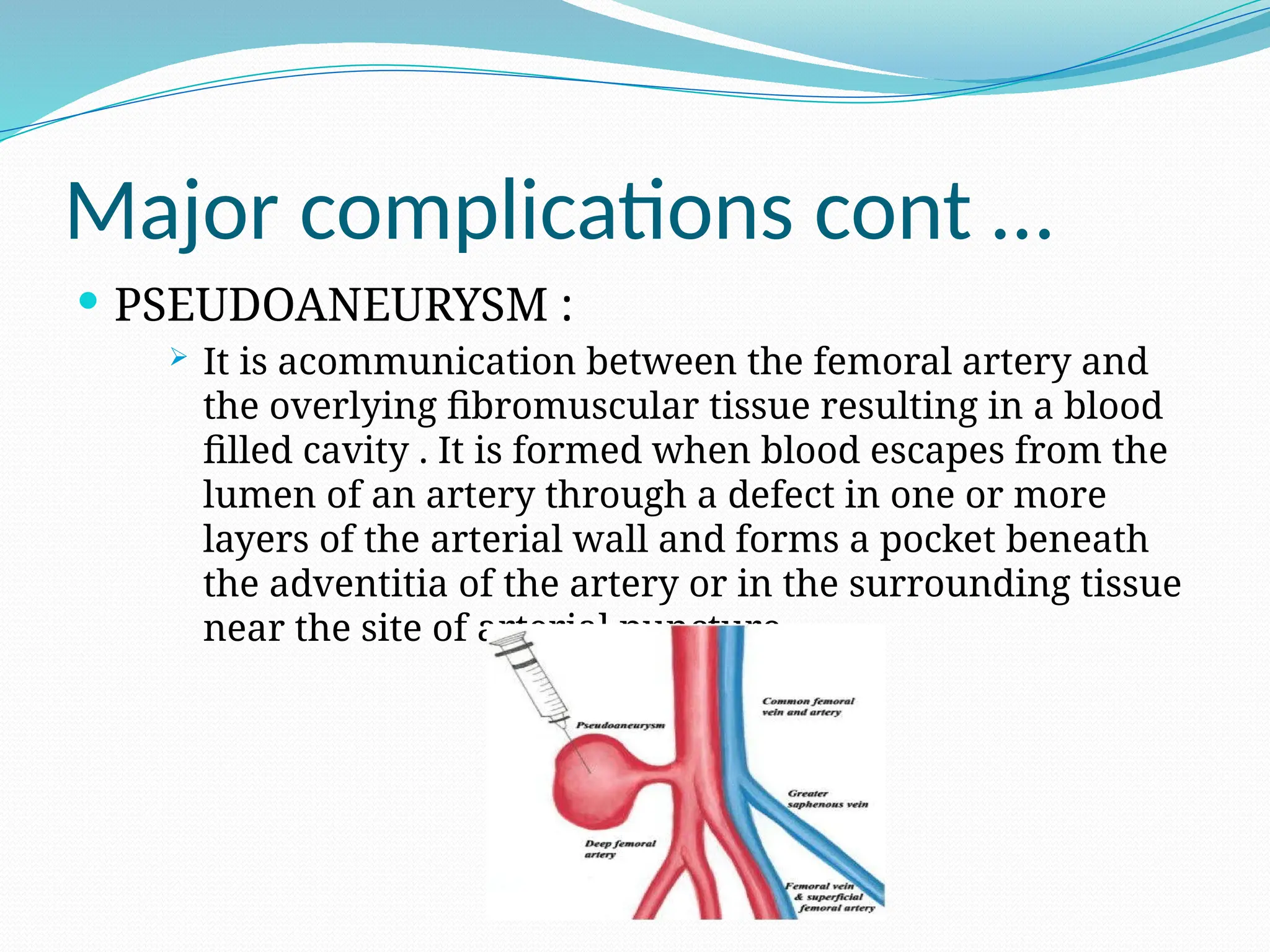
 PSEUDOANEURYSM :
 It is acommunication between the femoral artery and
the overlying fibromuscular tissue resulting in a blood
filled cavity . It is formed when blood escapes from the
lumen of an artery through a defect in one or more
layers of the arterial wall and forms a pocket beneath
the adventitia of the artery or in the surrounding tissue
near the site of arterial puncture
Major complication cont…
 AV FISTULA :
 It is an abnormal connection between a vein and
artery,asymptomatic,it is result from arterial puncture
below the femoral artery bifurcation ,created between
the superficial or deep feemoral artery and the adjacent
lateral circumflex vein .
Others
 Hematoma
 Limb ischemia
 Infection
 Perforation
 Dissection
THANK YOU

Femoral Artery Access for catheterization procedureure.pptx

  • 1.
  • 2.
    ANATOMY  Femoral arteryis the chief artery of lower limb  It is the continuation of the external iliac artery Origin :  It enters the thigh from behind the midinguinal point superficial to the tendon of psoas major muscle  It descends from base to apex of the femoral triangle and then enters adductor canal . Finally it emerges from the adductor canal by passing through the hiatus magnus to enter popliteal fossa
  • 3.
    Femoral Artery Branches 3Superficial branches 3 Deep branches  Superficial epigastric artery  Superficial circumflex iliac artery  Superficial external pudendal artery  Profunda femoris artery  deeep external pudendal artery  Muscular branches
  • 5.
    How to AccessFemoral Artery ?  Both right and left femoral artery used for cardiac catheterization  Right femoral artery is the most commonly used  The inguinal area is prepared and draped under sterile conditions
  • 6.
    Anatomical landmarks tolocate common femoral artery  Anterior superior iliac spine  Pubic symphisis  Inguinal ligament : it is a band of connective tissue that extends from anterior superior iliac spine to the pubic tubercle .
  • 7.
    Palpation of femoralpulse  It is felt 1/3rd and 1/2half of the distance from the medial end of the inguinal ligament  For right CFA : Place the right thumb on the right anterior superior iliac spine and the right middle finger on the pubic symphysis.right index finger should be located over the femoral artery above the femoral head  For left CFA : Place the right thumb on the pubic symphysis and the middle finger on the left anterior superior iliac spine . Index finger located over the femoral artery above the femoral head
  • 9.
    Where to puncture?  The perfect puncture site is the midpoint of femoral head  Locate the puncture site is better to locate the femoral head in ANTEROPOSTERIOR ( AP )VIEW  Puncture at or above the inguinal ligament results in retroperitonial bleeding  Puncture near/lower the femoral head give rise to pseudoaneurysm formation .
  • 10.
    STEPS TO PERFORM Administration of local anesthesia  Femoral artery puncture  Insertion of a 0.018 inch guidewire  Skin nick (optional)  Sheath insertion  Advancement of catheter over a 0.035 inch guidewire  Sheath aspiration and flushing  Femoral angiography
  • 11.
    Local anesthetic administration Load a syringe (usually 10cc of lignocaine)with local anesthetic  Insert the syringe needle (usually 26-31 gauge)in the skin at the intended puncture site  Aspirate to confirm that the tip of the needle is not within a vessel  Administer 10-20 cc of local anesthetic in the subcutaneous tissue close to the target femoral artery
  • 12.
    To Puncture theFemoral Artery  A single anterior , arterial wall puncture is the goal  An 18 gauge needle is inserted at a 45 degree angle through the skin at the maximal arterial pulse  Advance the tip gently through the subcutaneous tissue, the arterial pulsation is feel at the hub from the anterior wall of the artery  Adjust the angulation of the needle depending on the depth of the artery  Confirm the entry into the artery by blood flow
  • 14.
    Wrong puncture  Highpuncture : increases the risk of retroperitoneal hematoma. Remove the needle ,hold pressure for 1-2mins and obtain access again.  Low puncture : increases the risk of pseudoaneurysm formation. Remove the needle and obtain the access again at a higher location
  • 15.
    Insert 0.08 inchguidewire  Advance the 0.018 inch guidewire through the access needle Skin nick ( optional )  use a scalpel to make a nick at a guidewire entry point through the skin  Do not perform this maneuver with a sheath in place , since the blade could cut the sheath causing significant bleeding
  • 16.
    Insertion of sheathand catheter over a 0.035 inch guidewire  Select a sheath for insertion , usually six french sheaths are usually used for diagnostic angiography .  Advance the sheath over the 0.018 inch guidewire until the hub reaches the skin  Remove the dilator,and the 0.018 inch guidewire .  Insert a 0.035 inch guidewire with the cathetrer through the sheath into the aorta .
  • 17.
    Sheath aspiration andflushing  Aspirate the side arm of the sheath and discard the aspirated blood  Flush the side arm with a different syringe that contains heparinized saline
  • 18.
    Femoral angiography  Connectthe side arm of the femoral sheath with the manifold  Confirm the arterial pressure waveform without dampening  Perform fluroscopy of the groin area and place the femoral sheath in the center of the image .use low magnification to allow visualization of both iliac vessels and the CFA bifurction.
  • 19.
    Continuation  The mostcommonly used projection is 20-30 degree RAO for Right CFA (or) LAO for Left CFA to facilitate visualization of the CFA bifurcation .  Perform cine angiography ,usually injecting 5- 10ml of contrast .Diluted contrast can be used as well . The sheath if often pulled medially during image acquisition , to help identify its entry point into the femoral artery
  • 20.
    Femoral artery tocoronary  Common femoral artery  External iliac artery  Common iliac artery  Abdominal aorta  Thoracic aorta  Descending aorta  Arch of aorta  Ascending aorta  Coronary ostium
  • 22.
    Advantages  Ease catheterand guidewire advancement  High succesful rate  Have no recurrent loop,tortuosity  Have no chances of arterial vasospasm
  • 23.
    Disadvantages  Compress theaccess site with more pressure  High risk of retroperitoneal bleeding and pseudoaneurysm formation  Immobile of the accessment site for 4-6 hrs  Femoral artery is the only supply to the leg
  • 24.
    Contraindication  Severe abdominalaortic aneurysm  Severe peripheral vascular disease  Complex aorto-ileo femoral grafts  Arterio-iliac venous fistula  Decreased femoral pulse .
  • 25.
    Post Procedural Complications Majorcomplications  RETROPERITONEAL BLEEDING :  It is a potential life threatening complication of femoral artery puncture that should be suspected in postcatheterzation patient who develops hypotension ,ipsilateral flank,abdominal pain or back pain ,or drop in a hemoglobin without a source , result in puncture at or above the inguinal ligament
  • 26.
    Major complications cont…  PSEUDOANEURYSM :  It is acommunication between the femoral artery and the overlying fibromuscular tissue resulting in a blood filled cavity . It is formed when blood escapes from the lumen of an artery through a defect in one or more layers of the arterial wall and forms a pocket beneath the adventitia of the artery or in the surrounding tissue near the site of arterial puncture
  • 27.
    Major complication cont… AV FISTULA :  It is an abnormal connection between a vein and artery,asymptomatic,it is result from arterial puncture below the femoral artery bifurcation ,created between the superficial or deep feemoral artery and the adjacent lateral circumflex vein .
  • 28.
    Others  Hematoma  Limbischemia  Infection  Perforation  Dissection
  • 29.