November | December 2010
Feature title: Feed management in an intensive shrimp farming system with bioflocs
The International magazine for the aquaculture feed industry
International Aquafeed is published five times a year by Perendale Publishers Ltd of the United Kingdom.
All data is published in good faith, based on information received, and while every care is taken to prevent inaccuracies,
the publishers accept no liability for any errors or omissions or for the consequences of action taken on the basis of
information published.
©Copyright 2009 Perendale Publishers Ltd.All rights reserved.No part of this publication may be reproduced in any form
or by any means without prior permission of the copyright owner. Printed by Perendale Publishers Ltd. ISSN: 1464-0058
F
eed management in exten-
sive and semi-intensive
shrimp farming systems
differs a lot with the feed
management, which is practiced for
fish farming.
Feeding frequency is limited
to four or six times per day.
The feed is spread over the whole
pond, which is labor-intensive. There are
also some indications that lower feeding
frequencies are not affecting growth. The
reason is most probably the availability of
natural feeds in the pond, which comple-
ment the shrimp nutrition in the absence of
feed (between feedings).
The lower the feed quality the better it
will be to decrease the feeding frequency,
because it forces the shrimp to go for
natural feed, which has a better quality than
the feed.
In the continuous presence of low qual-
ity feeds,the shrimp will fill its stomach with
this feed with slower growth as a result.
Intensive farming
with bioflocs
However, the feeding affects the water
quality parameters in the ponds.An oxygen
drop is observed after feeding.
A continuous feeding will result in a more
continuous water quality and less stress for the
shrimp.In intensive farming,the natural produc-
tion of the tank is represented by bioflocs.
These bioflocs
directly interfere
with the water
quality. Intensive
farming also allows
the mechanization
of feeding without
extra labour.
Trial
The influence of
feeding frequency on
growth and FCR was
observed in the AFT-
CreveTec Research
station in Venray,
Netherlands.
Four different diets with crude protein
content of 38 percent and lipid content of
eight percent were formulated and pro-
duced with a pellet press at two mm.
Shrimp (Litopeneaus vannamei) were
imported from Thailand and raised till six
grams. They were divided over 20 nets,
which resulted in 23 per net. They were
weighed individually at start and finish.
Feed management
in an intensive shrimp farming system with bioflocs
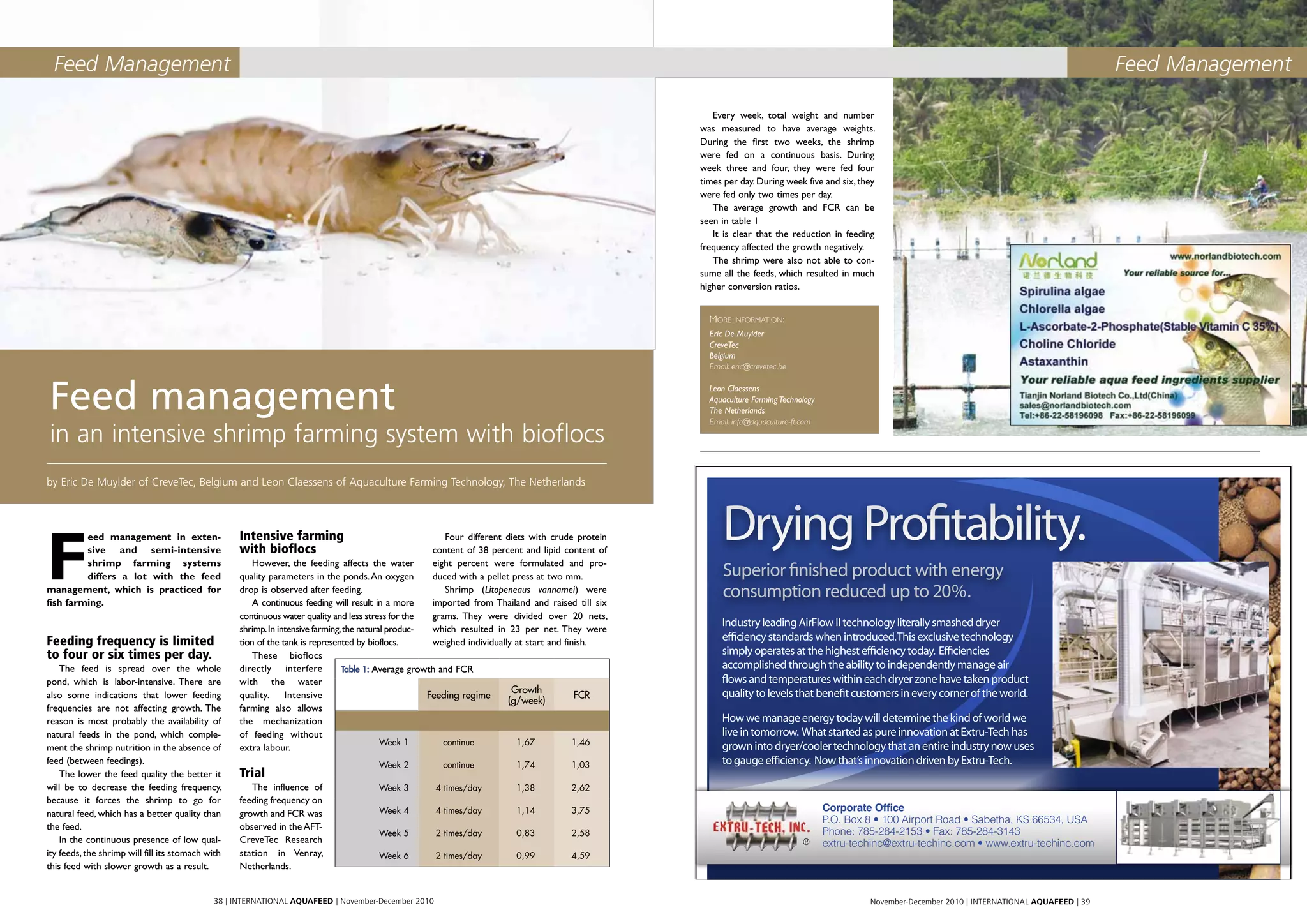
Table 1: Average growth and FCR
Feeding regime
Growth
(g/week)
FCr
Week 1 continue 1,67 1,46
Week 2 continue 1,74 1,03
Week 3 4 times/day 1,38 2,62
Week 4 4 times/day 1,14 3,75
Week 5 2 times/day 0,83 2,58
Week 6 2 times/day 0,99 4,59
by Eric De Muylder of CreveTec, Belgium and Leon Claessens of Aquaculture Farming Technology, The Netherlands
38 | InternatIonal AquAFeed | november-December 2010
Feed Management
november-December 2010 | InternatIonal AquAFeed | 39
Every week, total weight and number
was measured to have average weights.
During the first two weeks, the shrimp
were fed on a continuous basis. During
week three and four, they were fed four
times per day. During week five and six, they
were fed only two times per day.
The average growth and FCR can be
seen in table 1
It is clear that the reduction in feeding
frequency affected the growth negatively.
The shrimp were also not able to con-
sume all the feeds, which resulted in much
higher conversion ratios.
More inforMation:
Eric De Muylder
CreveTec
Belgium
Email: eric@crevetec.be
Leon Claessens
Aquaculture Farming Technology
The Netherlands
Email: info@aquaculture-ft.com
38 | InternatIonal AquAFeed | november-December 2010 november-December 2010 | InternatIonal AquAFeed | 39
Feed Management
9-11 March, BITEC Bangkok, Thailand
Find your suppliers of innovative products and services
in the Fish, Molluscs, Crustaceans and Algae business
Visit our
website for
more information!
www.aquatic-asia.net
adv_aqua2011_210x147_aV2.indd 1 17-09-10 15:49
A
fter researching a wide
array of cage netting to
farm their tilapia in,Trapia
Malaysia Sdn Bhd selected the
Aquagrid® Containment System
because - it met and exceeded
their operational objectives for
net strength and resistance to
bio-fouling.
Headquartered in Ipoh in the
State of Perak, Malaysia, their
eco-friendly farm operates in the
pristine rainforest-fed, freshwater
lakes of Tasik Temenggor of the
Perak River system.
Trapia's management sought
to protect this unique grow-out
environment by searching for
a cage system that would keep
their tilapia in and the preda-
tors out while ensuring profit-
ability and minimising environ-
mental impacts. Tilapias have the
annoying habit of grazing on cage
netting, damaging the fibres of tra-
ditional netting but the coating
on the Aquagrid® containment
system prevents this from hap-
pening.
In addition, to escape- and pred-
ator-proof netting, Trapia also
required netting that was more
resistant to bio-fouling and would
last longer than traditional mate-
rials used for aquaculture, such
as nylon.
Aquagrid® netting's semirigid,
PVC coated polyester material and
special design makes it up to 100
percent stronger than nylon or poly-
ester and eliminates the use of anti-
fouling products which can leach
into the surrounding water.
The Aquagrid® contain-
ment system's LiftUP® Mortality
Retrieval System, designed to fit
the special conical bottoms of the
Aquagrid® cages, collects mortal-
ities, unconverted feed and feces
and pumps them to the surface for
disposal, ensuring the watersTrapia
operates in are kept clean and safe
for future generations of fish.
Trapia COOAlejandroTola is very
impressed with the performance of
the Aquagrid® cages since their
installation in November 2008.
"The nets are very easy to
clean by simple brushing and the
strength of the material is definitely
keeping away and avoiding break-
ins from carnivorous species in the
lake.The logistics consequences of
this are huge," he says.
More inforMation:
TenCate Industrial Fabrics
365 South Holland Drive
Pendergrass, Georgia 30567
USA
Tel: +1 706 6932226
Fax: +1 706 6934400
Website: www.aquagrid.com
Trapia Malaysia selects TenCate Aquagrid® containment system
to ensure profitability while protecting the environment
6 | InternatIonal AquAFeed | november-December 2010 november-December 2010 | InternatIonal AquAFeed | 7
®
Superior finished product with energy
consumption reduced up to 20%.
Drying Profitability.
Industry leading AirFlow II technology literally smashed dryer
efficiency standards when introduced.This exclusive technology
simply operates at the highest efficiency today. Efficiencies
accomplished through the ability to independently manage air
flows and temperatures within each dryer zone have taken product
quality to levels that benefit customers in every corner of the world.
How we manage energy today will determine the kind of world we
live in tomorrow. What started as pure innovation at Extru-Tech has
grown into dryer/cooler technology that an entire industry now uses
to gauge efficiency. Now that’s innovation driven by Extru-Tech.
Corporate Office
P.O. Box 8 • 100 Airport Road • Sabetha, KS 66534, USA
Phone: 785-284-2153 • Fax: 785-284-3143
extru-techinc@extru-techinc.com • www.extru-techinc.com®
ET-202B.indd 1 12/18/09 10:26:40 AM
Salmon Farmers Association is
eager to be part of a larger dis-
cussion about what the real issues
are.
"We have seen large variations
in wild salmon populations as
our farm operations remain the
same," says Mary Ellen Walling,
Executive Director of the BC
Salmon Farmers Association.
“For example - there was no
significant difference in opera-
tions between the poor Sockeye
return of 2009 and the trium-
phant return in 2010.
"That tells us that more needs
to be considered as we talk about
standing for the Cohen
Commission Inquiry into the
decline of Fraser River Sockeye
Salmon.Along with groups repre-
senting a wide range of interests,
they will be participating in the
evidentiary hearings beginning
October 25, 2010 to share infor-
mation about their operations
and research, as well as correct
erroneous claims.
The message from anti-
salmon farm activists during a
recent campaign oversimplifies a
complex situation. It ignores any
effects rising water temperatures,
failed plankton blooms, extraordi-
the life-cycle of BC's salmon. All
of these items are on the list of
things Justice Bruce Cohen will be
investigating.
In the meantime, BC's salmon
farmers continue to grow a
healthy product in a sustain-
able way, while leading the way
in research and development
and working with environmental
groups and the community to
find answers to industry ques-
tions.
"Salmon farming is a highly-reg-
ulated industry that is continually
improving," adds Ms Walling.
"We believe that our well-
employs roughly 6,000 people
directly and indirectly, contrib-
uting US$800-million to the pro-
vincial economy. Farmed salmon
is the province's largest agricul-
tural export.
More inforMation:
Mary Ellen Walling
Executive Director
British Columbia Salmon Farmers
Association
#302 - 871 Island Highway
Campbell River, BC V9W 2C2, Canada
Tel: +1 250 2861636 x223
Fax: +1 250 2861574
Email: mwalling@salmonfarmers.org
Website: www.salmonfarmers.org
4 | InternatIonal AquAFeed | november-December 2010 november-December 2010 | InternatIonal AquAFeed | 5
ONLINE ARCHIVE
Our readers can find an archive of back issue's on the
aquafeed website. We also make individual features
available to view and download
www.aquafeed.co.uk/archive.php
FOR FISHMEAL REPLACEMENT
Functional Hydrolysates for Aqua Feed
Contact us at : +33 2 97 93 89 36
contact@aquativ-diana.com
www.aquativ-diana.com
FRANCE/0033297404209
AP-TEASING_87x267.indd 1 16/08/10 16:44
r t
of
o
ut
ls
st
ic
g,
es
ts
d
e
o
or
n
e
h
w
al
nt
s.
is
rs
| InternatIonal AquAFeed | 9
larval and juvenile post -larval stages before
reaching the mature or adult phase. The
length of the culture period varies but
for Pacific white shrimp it can take about
20 days for the larvae to metamorphose
to post larvae and approximately another
three to four months to reach market size
in tropical waters at 25-27°C.
The rate of growth of the shrimp is a
function of the frequency of molting and the
increase in size at each molt.
However, the frequency of molting
decreases as the shrimp increases in weight
with the intermolt period increasing in
length. In the 20 day larval period, from egg
to post-larvae, there can be 16-20 molts,
a further 20 molts in the 40 day nursery
phase to approximately 2g and an additional
eight molts in the final 80 day grow out
phase to 20g.
The diet quality during the exponential
nursery growth period, from approxi-
mately 0.5mg to 2.0g, with high molting
frequency, is especially critical as it is dur-
ing this period that the final yield potential
is laid down.
Lipids, such as phospholipids, triglycer-
ides and cholesterol, are a major source
of energy in shrimp diets as well as being
involved in several essential processes for
their growth, molting and reproduction.
Cholesterol is an essential dietary nutri-
ent, for members of the crustacean family,
as they are incapable of synthesising their
own cholesterol from fatty acids unlike
other animals.
Cholesterol is an essential component of
all animal tissues, it plays a major role in cell
membrane structure, is a precursor for sex
hormones, for bile acids and for vitamin D.
In crustaceans cholesterol is a precursor
for many hormones, including ecdysteroids,
which are critical for the initiation of meta-
morphosis and the
moulting process
(Teshima, 1997).
Cholesterol
availability
In their natural
habitat shrimps will
obtain naturally
occurring sterols
from algae and
zooplankton, how-
ever these sources
will not be avail-
able to shrimp in
semi-intensive or
intensive cultiva-
tion in the required
amount.
In commercial
diets cholesterol
is a natural com-
ponent of marine
invertebrate meals
and oils, for exam-
ple from squid,
shrimp, clams and
crab. However the
cholesterol content
of these ingredients
varies considerably
and is present in
a less esterified
form requiring
more energy for
its utilisation than
it manufactured
alternative.
The industry
requirement for
guaranteed quality
characteristics with
higher bioavail-
Figure 1: Effect of 3 cholesterol levels on the
growth and survival of Litopenaeus vannamei
bred in ponds ( Ir A.H.Mogollon and Ir. V.V. Rubin,
University of Tumbes, Peru)
november-December 2010 | InternatIonal AquAFeed | 31
F: Shrimp farming
Rising feed
cost
Escalating
fish meal price
Opportunistic
diseases
Environmental
impact
Low Shrimp
& fish prices
Feed is the main cost
in most aquaculture
operations …
and the most difficult one
to reduce when ingredient
prices are rising …
Tired of hearing
only bad news?
AQUAGEST®
maximizes digestibility
and feed utilization
efficiency
AQUABITE®
enhances palatability
and appetite
SANACORE®
GM
improves growth and
productivity by promoting
a healthy gut microflora
info.aqua@nutriad.net
www.nutriad.net
applying nature for a healthy and sustainable future
2 | InternatIonal AquAFeed | november-December 2010
Only from Tapco, the two most popular
bucket designs in the world!
For North American style elevators: the
classic CC-HD design. For European style
elevators: the Super EuroBucket.
Do you need more capacity? Consider the
Tapco 8" and 9" CC-HD Super Capacity
buckets. Our 9" projection cups provide
25% more capacity than the 8" buckets at a
very cost effective price.
Wear and tear is a fact of life in many
elevators. Tapco urethane buckets are known
for their exceptional wear characteristics.
Our nylon buckets are extremely strong,
yet lightweight. If you are not using Tapco
buckets, you are not getting the most out of
your elevator!
Tapco elevator bolts have been specifically
designed to work with nonmetallic buckets.
To achieve the most secure assembly, use
Tapco fanged elevator bolts and self-locking
nuts. Tapco stocks over 14 million bolts
in six styles. If you would
like to improve your
elevator performance,
contact Tapco or visit
www.tapcoinc.com.
I Precise Discharge
Consistent profile shape assures uniform discharge
characteristics over the entire bucket range.
FLAT
COUNTERSUNK
HEAD
Elevator Bolt
I Tough & Flexible
Injection molded polyethylene “gives” or “yields” to
bypass obstructions in your elevator, allowing the
bucket to return to its original shape.
I Unequaled Strength
Thick walls and prime virgin engineered
resins provide exceptional strength.
I I Accurate & Reliable
Capacity Ratings
Equal or greater
carrying
capacity of
equivalent
size steel
buckets.
Rounded
front lip aids
in filling of
bucket.
I Cost Efficient
Prime virgin resins give unsurpassed bucket life
for maximum return on investment.
I Perfect Fit
Direct replacement of existing steel and plastic
buckets. No modifications to your elevator
are needed.
I Ease of Installation
Lighter weight aids in mounting buckets and
reduces load on belt and running components.
Nonmetallic materials eliminate hazardous sharp
edges of steel buckets.
I Increased Safety
Non-metallic materials eliminate
the possibility of explosion-causing
sparking from bent and torn
steel buckets.
I Ordered Today, Shipped Today
900,000 buckets in stock worldwide in more than
64 sizes, 12 styles & 6 materials for fast delivery.
How Tapco Buckets Make a World of Difference
in Your Elevator Facility
The color blue, when used in connection with elevator buckets, is a U.S. registered trademark owned by Tapco Inc. Super EuroBucket ™ is a registered trademark of Tapco Inc. © 2010 Tapco Inc.® All rights reserved.
FANGED HEAD
Elevator Bolt
STYLE SUPER EUROBUCKET
™
and STYLE CC-HD Polyethylene Elevator Buckets (pictured)
Tel.: +1 314 739 9191 • +1 800 AT-TAPCO (+1 800 288 2726) • Fax: +1 314 739 5880 • www.tapcoinc.com
ELEVATOR BUCKETS - ELEVATOR BOLTS
St. Louis, Missouri U.S.A.
I Profitable,
High-Speed
Handling
Tested and proven
designs allow a
direct, compact
discharge path for
improved, high-speed
performance.
®
www.aquafeed.co.uk
LINKS
•	 See the full issue
•	 Visit the International Aquafeed website
•	 Contact the International Aquafeed Team
•	 Subscribe to International Aquafeed
Volume 13 Issue 6 2010
the international magazine for the aquaculture feed industry
Seaweeds as Ingredients
in Aquatic Feeds
A new and revolutionary type
of feather meal for fish feed
New dimension in the production
of hygienized feed meal
Chromium
- the forgotten mineral that plays an essential
role in the utilization
This digital re-print is part of the November | December 2010 edition of International Aquafeed magazine. 	
Content from the magazine is available to view free-of-charge, both as a full online magazine on our
website, and as an archive of individual features on the docstoc website.
Please click here to view our other publications on www.docstoc.com.
To purchase a paper copy of the magazine, or to subscribe to the paper edition please contact
our Circulation and Subscriptions Manager on the link above.  
INFORMATION FOR ADVERTISERS - CLICK HERE

Feed management in an intensive shrimp farming system with bioflocs

  • 1.
    November | December2010 Feature title: Feed management in an intensive shrimp farming system with bioflocs The International magazine for the aquaculture feed industry International Aquafeed is published five times a year by Perendale Publishers Ltd of the United Kingdom. All data is published in good faith, based on information received, and while every care is taken to prevent inaccuracies, the publishers accept no liability for any errors or omissions or for the consequences of action taken on the basis of information published. ©Copyright 2009 Perendale Publishers Ltd.All rights reserved.No part of this publication may be reproduced in any form or by any means without prior permission of the copyright owner. Printed by Perendale Publishers Ltd. ISSN: 1464-0058
  • 2.
    F eed management inexten- sive and semi-intensive shrimp farming systems differs a lot with the feed management, which is practiced for fish farming. Feeding frequency is limited to four or six times per day. The feed is spread over the whole pond, which is labor-intensive. There are also some indications that lower feeding frequencies are not affecting growth. The reason is most probably the availability of natural feeds in the pond, which comple- ment the shrimp nutrition in the absence of feed (between feedings). The lower the feed quality the better it will be to decrease the feeding frequency, because it forces the shrimp to go for natural feed, which has a better quality than the feed. In the continuous presence of low qual- ity feeds,the shrimp will fill its stomach with this feed with slower growth as a result. Intensive farming with bioflocs However, the feeding affects the water quality parameters in the ponds.An oxygen drop is observed after feeding. A continuous feeding will result in a more continuous water quality and less stress for the shrimp.In intensive farming,the natural produc- tion of the tank is represented by bioflocs. These bioflocs directly interfere with the water quality. Intensive farming also allows the mechanization of feeding without extra labour. Trial The influence of feeding frequency on growth and FCR was observed in the AFT- CreveTec Research station in Venray, Netherlands. Four different diets with crude protein content of 38 percent and lipid content of eight percent were formulated and pro- duced with a pellet press at two mm. Shrimp (Litopeneaus vannamei) were imported from Thailand and raised till six grams. They were divided over 20 nets, which resulted in 23 per net. They were weighed individually at start and finish. Feed management in an intensive shrimp farming system with bioflocs Table 1: Average growth and FCR Feeding regime Growth (g/week) FCr Week 1 continue 1,67 1,46 Week 2 continue 1,74 1,03 Week 3 4 times/day 1,38 2,62 Week 4 4 times/day 1,14 3,75 Week 5 2 times/day 0,83 2,58 Week 6 2 times/day 0,99 4,59 by Eric De Muylder of CreveTec, Belgium and Leon Claessens of Aquaculture Farming Technology, The Netherlands 38 | InternatIonal AquAFeed | november-December 2010 Feed Management november-December 2010 | InternatIonal AquAFeed | 39 Every week, total weight and number was measured to have average weights. During the first two weeks, the shrimp were fed on a continuous basis. During week three and four, they were fed four times per day. During week five and six, they were fed only two times per day. The average growth and FCR can be seen in table 1 It is clear that the reduction in feeding frequency affected the growth negatively. The shrimp were also not able to con- sume all the feeds, which resulted in much higher conversion ratios. More inforMation: Eric De Muylder CreveTec Belgium Email: eric@crevetec.be Leon Claessens Aquaculture Farming Technology The Netherlands Email: info@aquaculture-ft.com 38 | InternatIonal AquAFeed | november-December 2010 november-December 2010 | InternatIonal AquAFeed | 39 Feed Management 9-11 March, BITEC Bangkok, Thailand Find your suppliers of innovative products and services in the Fish, Molluscs, Crustaceans and Algae business Visit our website for more information! www.aquatic-asia.net adv_aqua2011_210x147_aV2.indd 1 17-09-10 15:49 A fter researching a wide array of cage netting to farm their tilapia in,Trapia Malaysia Sdn Bhd selected the Aquagrid® Containment System because - it met and exceeded their operational objectives for net strength and resistance to bio-fouling. Headquartered in Ipoh in the State of Perak, Malaysia, their eco-friendly farm operates in the pristine rainforest-fed, freshwater lakes of Tasik Temenggor of the Perak River system. Trapia's management sought to protect this unique grow-out environment by searching for a cage system that would keep their tilapia in and the preda- tors out while ensuring profit- ability and minimising environ- mental impacts. Tilapias have the annoying habit of grazing on cage netting, damaging the fibres of tra- ditional netting but the coating on the Aquagrid® containment system prevents this from hap- pening. In addition, to escape- and pred- ator-proof netting, Trapia also required netting that was more resistant to bio-fouling and would last longer than traditional mate- rials used for aquaculture, such as nylon. Aquagrid® netting's semirigid, PVC coated polyester material and special design makes it up to 100 percent stronger than nylon or poly- ester and eliminates the use of anti- fouling products which can leach into the surrounding water. The Aquagrid® contain- ment system's LiftUP® Mortality Retrieval System, designed to fit the special conical bottoms of the Aquagrid® cages, collects mortal- ities, unconverted feed and feces and pumps them to the surface for disposal, ensuring the watersTrapia operates in are kept clean and safe for future generations of fish. Trapia COOAlejandroTola is very impressed with the performance of the Aquagrid® cages since their installation in November 2008. "The nets are very easy to clean by simple brushing and the strength of the material is definitely keeping away and avoiding break- ins from carnivorous species in the lake.The logistics consequences of this are huge," he says. More inforMation: TenCate Industrial Fabrics 365 South Holland Drive Pendergrass, Georgia 30567 USA Tel: +1 706 6932226 Fax: +1 706 6934400 Website: www.aquagrid.com Trapia Malaysia selects TenCate Aquagrid® containment system to ensure profitability while protecting the environment 6 | InternatIonal AquAFeed | november-December 2010 november-December 2010 | InternatIonal AquAFeed | 7 ® Superior finished product with energy consumption reduced up to 20%. Drying Profitability. Industry leading AirFlow II technology literally smashed dryer efficiency standards when introduced.This exclusive technology simply operates at the highest efficiency today. Efficiencies accomplished through the ability to independently manage air flows and temperatures within each dryer zone have taken product quality to levels that benefit customers in every corner of the world. How we manage energy today will determine the kind of world we live in tomorrow. What started as pure innovation at Extru-Tech has grown into dryer/cooler technology that an entire industry now uses to gauge efficiency. Now that’s innovation driven by Extru-Tech. Corporate Office P.O. Box 8 • 100 Airport Road • Sabetha, KS 66534, USA Phone: 785-284-2153 • Fax: 785-284-3143 extru-techinc@extru-techinc.com • www.extru-techinc.com® ET-202B.indd 1 12/18/09 10:26:40 AM Salmon Farmers Association is eager to be part of a larger dis- cussion about what the real issues are. "We have seen large variations in wild salmon populations as our farm operations remain the same," says Mary Ellen Walling, Executive Director of the BC Salmon Farmers Association. “For example - there was no significant difference in opera- tions between the poor Sockeye return of 2009 and the trium- phant return in 2010. "That tells us that more needs to be considered as we talk about standing for the Cohen Commission Inquiry into the decline of Fraser River Sockeye Salmon.Along with groups repre- senting a wide range of interests, they will be participating in the evidentiary hearings beginning October 25, 2010 to share infor- mation about their operations and research, as well as correct erroneous claims. The message from anti- salmon farm activists during a recent campaign oversimplifies a complex situation. It ignores any effects rising water temperatures, failed plankton blooms, extraordi- the life-cycle of BC's salmon. All of these items are on the list of things Justice Bruce Cohen will be investigating. In the meantime, BC's salmon farmers continue to grow a healthy product in a sustain- able way, while leading the way in research and development and working with environmental groups and the community to find answers to industry ques- tions. "Salmon farming is a highly-reg- ulated industry that is continually improving," adds Ms Walling. "We believe that our well- employs roughly 6,000 people directly and indirectly, contrib- uting US$800-million to the pro- vincial economy. Farmed salmon is the province's largest agricul- tural export. More inforMation: Mary Ellen Walling Executive Director British Columbia Salmon Farmers Association #302 - 871 Island Highway Campbell River, BC V9W 2C2, Canada Tel: +1 250 2861636 x223 Fax: +1 250 2861574 Email: mwalling@salmonfarmers.org Website: www.salmonfarmers.org 4 | InternatIonal AquAFeed | november-December 2010 november-December 2010 | InternatIonal AquAFeed | 5 ONLINE ARCHIVE Our readers can find an archive of back issue's on the aquafeed website. We also make individual features available to view and download www.aquafeed.co.uk/archive.php
  • 3.
    FOR FISHMEAL REPLACEMENT FunctionalHydrolysates for Aqua Feed Contact us at : +33 2 97 93 89 36 contact@aquativ-diana.com www.aquativ-diana.com FRANCE/0033297404209 AP-TEASING_87x267.indd 1 16/08/10 16:44 r t of o ut ls st ic g, es ts d e o or n e h w al nt s. is rs | InternatIonal AquAFeed | 9 larval and juvenile post -larval stages before reaching the mature or adult phase. The length of the culture period varies but for Pacific white shrimp it can take about 20 days for the larvae to metamorphose to post larvae and approximately another three to four months to reach market size in tropical waters at 25-27°C. The rate of growth of the shrimp is a function of the frequency of molting and the increase in size at each molt. However, the frequency of molting decreases as the shrimp increases in weight with the intermolt period increasing in length. In the 20 day larval period, from egg to post-larvae, there can be 16-20 molts, a further 20 molts in the 40 day nursery phase to approximately 2g and an additional eight molts in the final 80 day grow out phase to 20g. The diet quality during the exponential nursery growth period, from approxi- mately 0.5mg to 2.0g, with high molting frequency, is especially critical as it is dur- ing this period that the final yield potential is laid down. Lipids, such as phospholipids, triglycer- ides and cholesterol, are a major source of energy in shrimp diets as well as being involved in several essential processes for their growth, molting and reproduction. Cholesterol is an essential dietary nutri- ent, for members of the crustacean family, as they are incapable of synthesising their own cholesterol from fatty acids unlike other animals. Cholesterol is an essential component of all animal tissues, it plays a major role in cell membrane structure, is a precursor for sex hormones, for bile acids and for vitamin D. In crustaceans cholesterol is a precursor for many hormones, including ecdysteroids, which are critical for the initiation of meta- morphosis and the moulting process (Teshima, 1997). Cholesterol availability In their natural habitat shrimps will obtain naturally occurring sterols from algae and zooplankton, how- ever these sources will not be avail- able to shrimp in semi-intensive or intensive cultiva- tion in the required amount. In commercial diets cholesterol is a natural com- ponent of marine invertebrate meals and oils, for exam- ple from squid, shrimp, clams and crab. However the cholesterol content of these ingredients varies considerably and is present in a less esterified form requiring more energy for its utilisation than it manufactured alternative. The industry requirement for guaranteed quality characteristics with higher bioavail- Figure 1: Effect of 3 cholesterol levels on the growth and survival of Litopenaeus vannamei bred in ponds ( Ir A.H.Mogollon and Ir. V.V. Rubin, University of Tumbes, Peru) november-December 2010 | InternatIonal AquAFeed | 31 F: Shrimp farming Rising feed cost Escalating fish meal price Opportunistic diseases Environmental impact Low Shrimp & fish prices Feed is the main cost in most aquaculture operations … and the most difficult one to reduce when ingredient prices are rising … Tired of hearing only bad news? AQUAGEST® maximizes digestibility and feed utilization efficiency AQUABITE® enhances palatability and appetite SANACORE® GM improves growth and productivity by promoting a healthy gut microflora info.aqua@nutriad.net www.nutriad.net applying nature for a healthy and sustainable future 2 | InternatIonal AquAFeed | november-December 2010 Only from Tapco, the two most popular bucket designs in the world! For North American style elevators: the classic CC-HD design. For European style elevators: the Super EuroBucket. Do you need more capacity? Consider the Tapco 8" and 9" CC-HD Super Capacity buckets. Our 9" projection cups provide 25% more capacity than the 8" buckets at a very cost effective price. Wear and tear is a fact of life in many elevators. Tapco urethane buckets are known for their exceptional wear characteristics. Our nylon buckets are extremely strong, yet lightweight. If you are not using Tapco buckets, you are not getting the most out of your elevator! Tapco elevator bolts have been specifically designed to work with nonmetallic buckets. To achieve the most secure assembly, use Tapco fanged elevator bolts and self-locking nuts. Tapco stocks over 14 million bolts in six styles. If you would like to improve your elevator performance, contact Tapco or visit www.tapcoinc.com. I Precise Discharge Consistent profile shape assures uniform discharge characteristics over the entire bucket range. FLAT COUNTERSUNK HEAD Elevator Bolt I Tough & Flexible Injection molded polyethylene “gives” or “yields” to bypass obstructions in your elevator, allowing the bucket to return to its original shape. I Unequaled Strength Thick walls and prime virgin engineered resins provide exceptional strength. I I Accurate & Reliable Capacity Ratings Equal or greater carrying capacity of equivalent size steel buckets. Rounded front lip aids in filling of bucket. I Cost Efficient Prime virgin resins give unsurpassed bucket life for maximum return on investment. I Perfect Fit Direct replacement of existing steel and plastic buckets. No modifications to your elevator are needed. I Ease of Installation Lighter weight aids in mounting buckets and reduces load on belt and running components. Nonmetallic materials eliminate hazardous sharp edges of steel buckets. I Increased Safety Non-metallic materials eliminate the possibility of explosion-causing sparking from bent and torn steel buckets. I Ordered Today, Shipped Today 900,000 buckets in stock worldwide in more than 64 sizes, 12 styles & 6 materials for fast delivery. How Tapco Buckets Make a World of Difference in Your Elevator Facility The color blue, when used in connection with elevator buckets, is a U.S. registered trademark owned by Tapco Inc. Super EuroBucket ™ is a registered trademark of Tapco Inc. © 2010 Tapco Inc.® All rights reserved. FANGED HEAD Elevator Bolt STYLE SUPER EUROBUCKET ™ and STYLE CC-HD Polyethylene Elevator Buckets (pictured) Tel.: +1 314 739 9191 • +1 800 AT-TAPCO (+1 800 288 2726) • Fax: +1 314 739 5880 • www.tapcoinc.com ELEVATOR BUCKETS - ELEVATOR BOLTS St. Louis, Missouri U.S.A. I Profitable, High-Speed Handling Tested and proven designs allow a direct, compact discharge path for improved, high-speed performance. ®
  • 4.
    www.aquafeed.co.uk LINKS • See thefull issue • Visit the International Aquafeed website • Contact the International Aquafeed Team • Subscribe to International Aquafeed Volume 13 Issue 6 2010 the international magazine for the aquaculture feed industry Seaweeds as Ingredients in Aquatic Feeds A new and revolutionary type of feather meal for fish feed New dimension in the production of hygienized feed meal Chromium - the forgotten mineral that plays an essential role in the utilization This digital re-print is part of the November | December 2010 edition of International Aquafeed magazine. Content from the magazine is available to view free-of-charge, both as a full online magazine on our website, and as an archive of individual features on the docstoc website. Please click here to view our other publications on www.docstoc.com. To purchase a paper copy of the magazine, or to subscribe to the paper edition please contact our Circulation and Subscriptions Manager on the link above. INFORMATION FOR ADVERTISERS - CLICK HERE