Coastal Aquaculture
Eco-innovator Indicator System    Econoving Master


                                 •Kevin Ramirez
                                 •Javad Mahmoudi
                                 •Elodie Gonthier
                                 •Marcel Roquette
                                 •Maria Stoica
                                 •Adrian Carrillo
                                 •Serene Hamsho
1) Context


What is aquaculture?
The farming of aquatic organisms including fish, mollusks, crustaceans, and aquatic plants. Farming
    implies some form of intervention in the rearing process to enhance production, such as regular
    stocking, feeding, protection from predators and others. Farming also implies individual or
    corporate ownership of the stock being cultivated.
                                                           Food and Agriculture Organization (1990)

The geographical area covered by the term “coastal” includes the shore land influenced by the sea,
    the water column and the sea bed extending to edge of the continental edge
                                                                     (Sorensen and McCreary, 1990).


Therefore the term “coastal aquaculture” …
…Covers land-based and water-based brackish and marine aquaculture practices.
   (Guidelines for the promotion of environmental management of coastal aquaculture development,
                                                                                       U.C.Barg)
1) Context


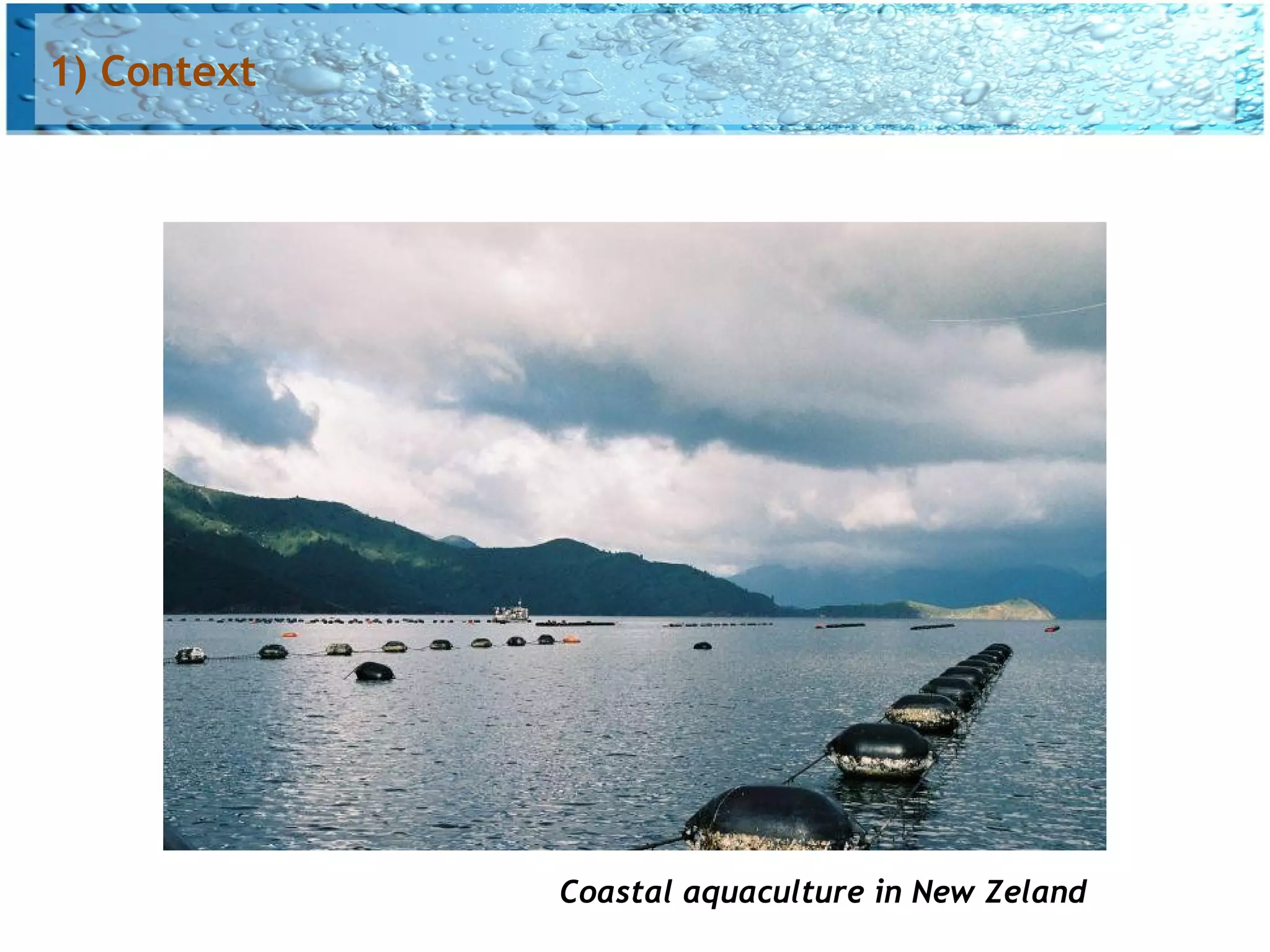
             Coastal aquaculture in New Zeland
1) Context

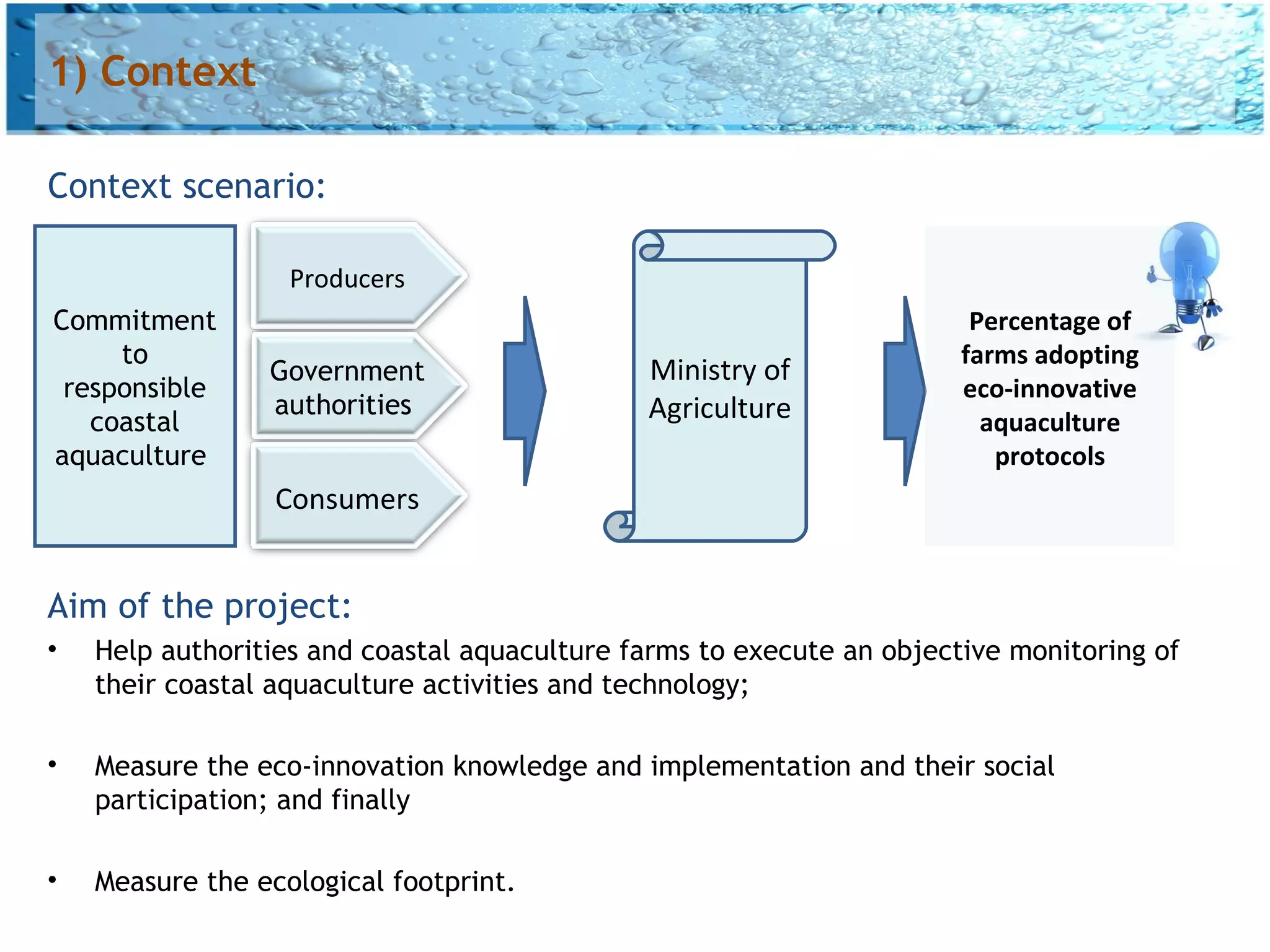
Context scenario:

                   Producers
Commitment                                                              Percentage of
     to                                                                farms adopting
                 Government                   Ministry of
 responsible                                                           eco-innovative
   coastal
                 authorities                  Agriculture                aquaculture
aquaculture                                                               protocols
                  Consumers


Aim of the project:
•   Help authorities and coastal aquaculture farms to execute an objective monitoring of
    their coastal aquaculture activities and technology;

•   Measure the eco-innovation knowledge and implementation and their social
    participation; and finally

•   Measure the ecological footprint.
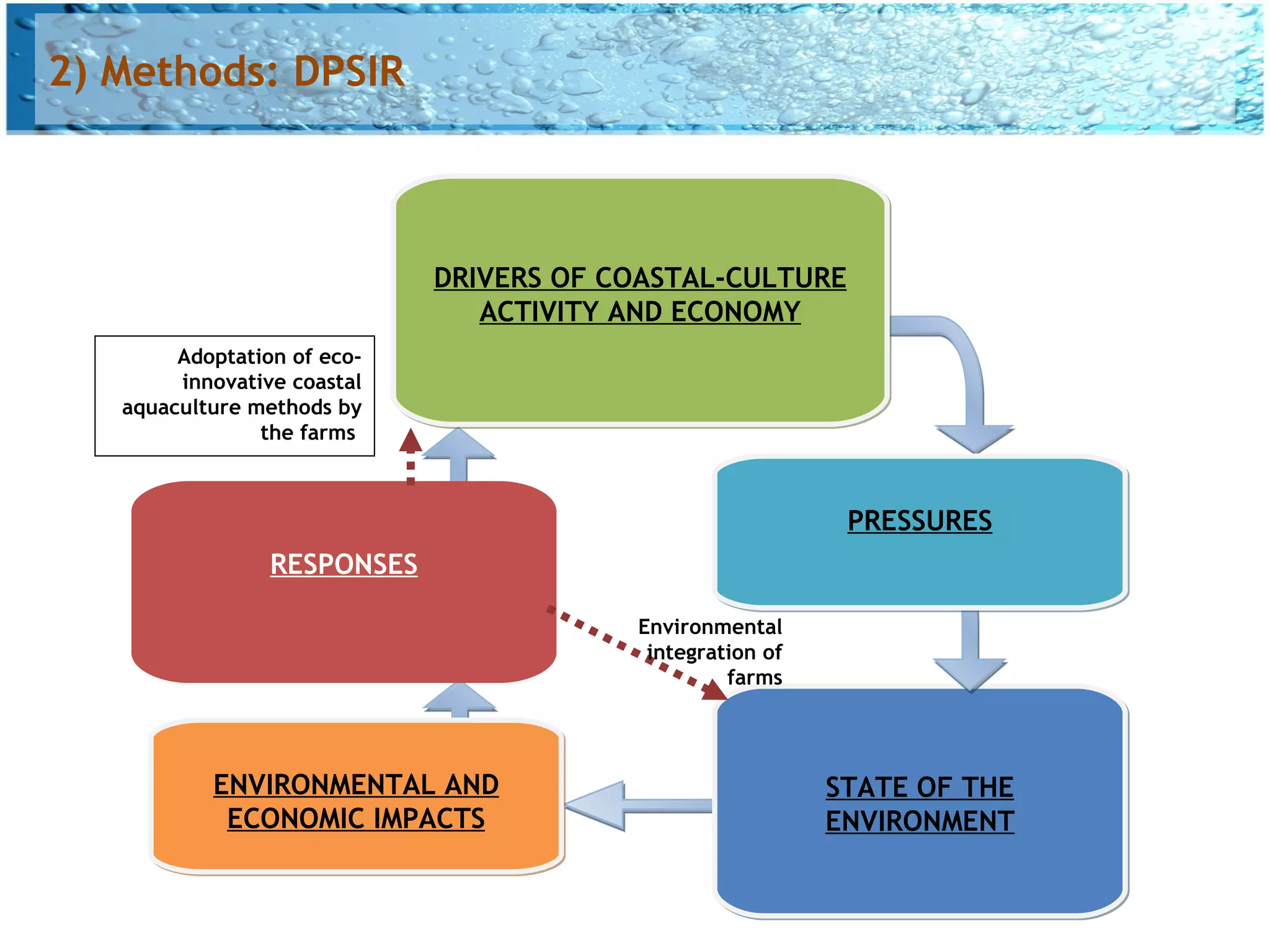
2) Methods: DPSIR


                             DRIVERS OF COASTAL-CULTURE
                                ACTIVITY AND ECONOMY
        Adoptation of eco-
        innovative coastal
   aquaculture methods by
                the farms


                                                            PRESSURES
                 RESPONSES

                                         Environmental
                                          integration of
                                                  farms


           ENVIRONMENTAL AND                               STATE OF THE
            ECONOMIC IMPACTS                               ENVIRONMENT
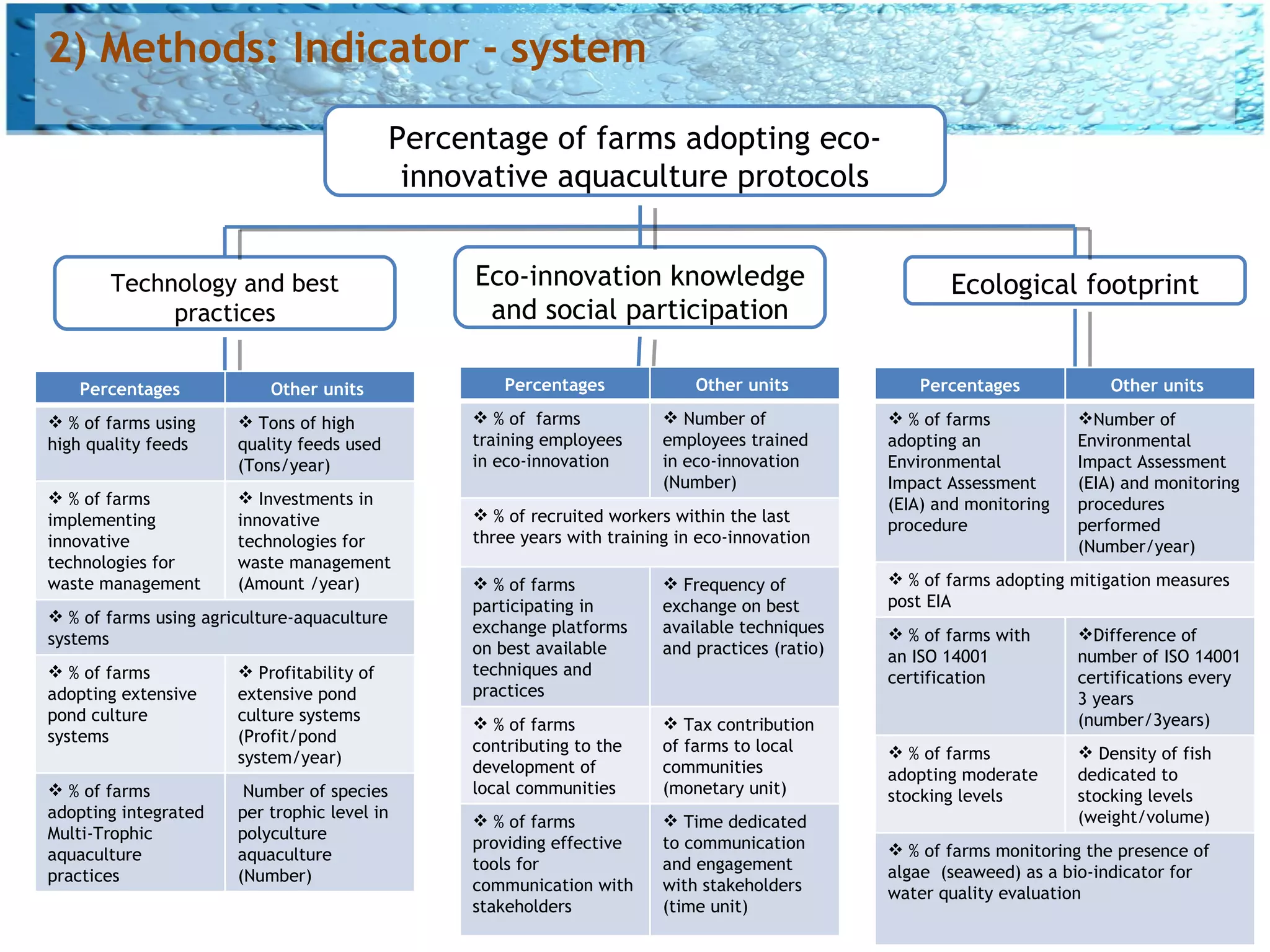
2) Methods: Indicator - system

                                             Percentage of farms adopting eco-
                                              innovative aquaculture protocols


       Technology and best                        Eco-innovation knowledge                               Ecological footprint
            practices                              and social participation

   Percentages             Other units                Percentages             Other units            Percentages             Other units

 % of farms using      Tons of high              % of farms             Number of              % of farms           Number of
high quality feeds     quality feeds used         training employees      employees trained       adopting an            Environmental
                       (Tons/year)                in eco-innovation       in eco-innovation       Environmental          Impact Assessment
                                                                          (Number)                Impact Assessment      (EIA) and monitoring
 % of farms            Investments in                                                           (EIA) and monitoring   procedures
implementing           innovative                  % of recruited workers within the last
                                                                                                  procedure              performed
innovative             technologies for           three years with training in eco-innovation
                                                                                                                         (Number/year)
technologies for       waste management
waste management       (Amount /year)              % of farms             Frequency of           % of farms adopting mitigation measures
                                                  participating in        exchange on best        post EIA
 % of farms using agriculture-aquaculture
                                                  exchange platforms      available techniques     % of farms with      Difference of
systems
                                                  on best available       and practices (ratio)   an ISO 14001           number of ISO 14001
 % of farms            Profitability of         techniques and                                  certification          certifications every
adopting extensive     extensive pond             practices                                                              3 years
pond culture           culture systems             % of farms             Tax contribution                             (number/3years)
systems                (Profit/pond
                                                  contributing to the     of farms to local        % of farms            Density of fish
                       system/year)
                                                  development of          communities             adopting moderate      dedicated to
 % of farms            Number of species         local communities       (monetary unit)         stocking levels        stocking levels
adopting integrated    per trophic level in        % of farms             Time dedicated                               (weight/volume)
Multi-Trophic          polyculture
                                                  providing effective     to communication         % of farms monitoring the presence of
aquaculture            aquaculture
                                                  tools for               and engagement          algae (seaweed) as a bio-indicator for
practices              (Number)
                                                  communication with      with stakeholders       water quality evaluation
                                                  stakeholders            (time unit)
2) Methods: Indicator - system


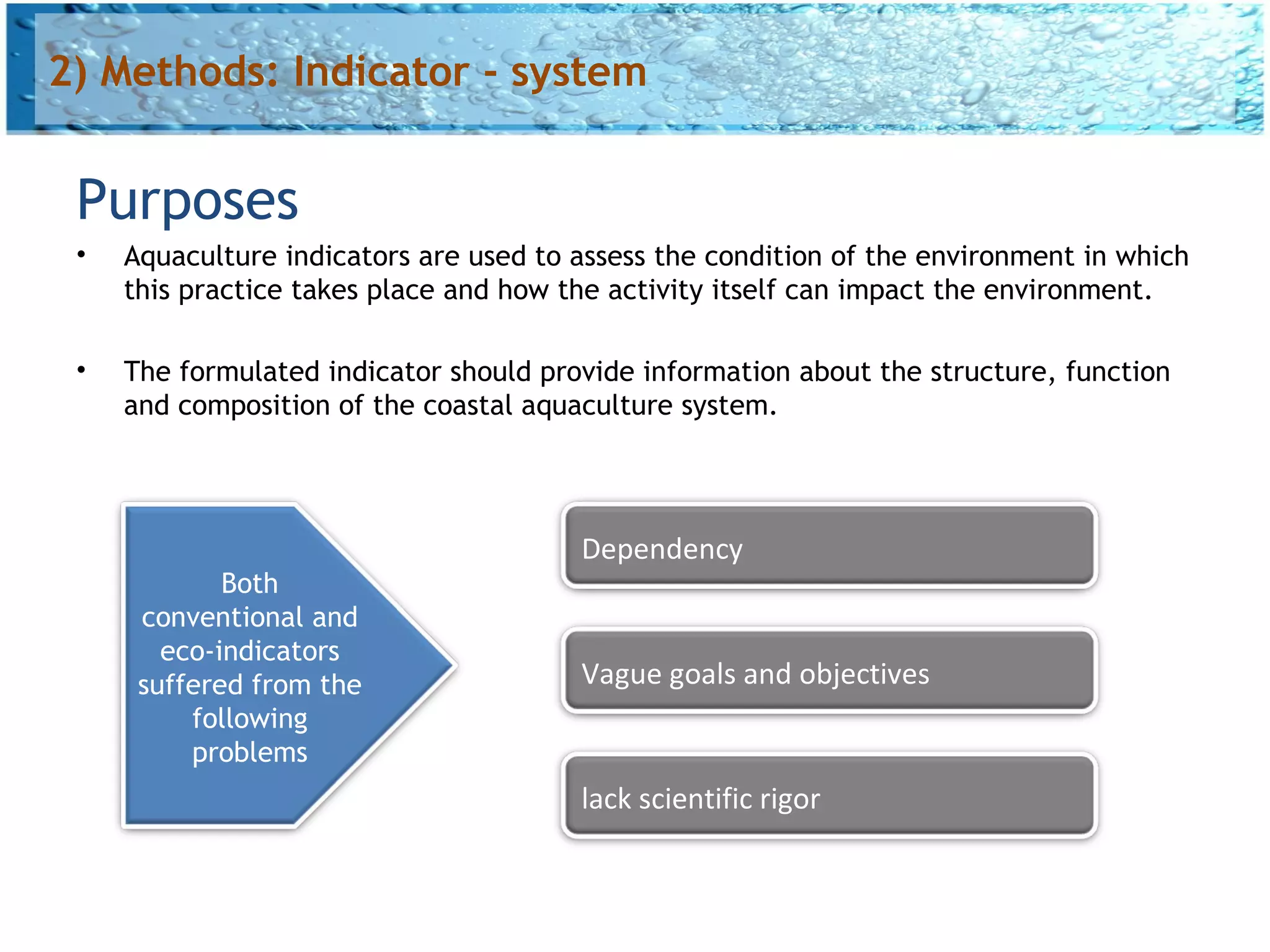
 Purposes
 •   Aquaculture indicators are used to assess the condition of the environment in which
     this practice takes place and how the activity itself can impact the environment.

 •   The formulated indicator should provide information about the structure, function
     and composition of the coastal aquaculture system.


                                        Dependency
             Both
      conventional and
        eco-indicators
      suffered from the                 Vague goals and objectives
          following
          problems
                                        lack scientific rigor
2) Methods: Indicator - system

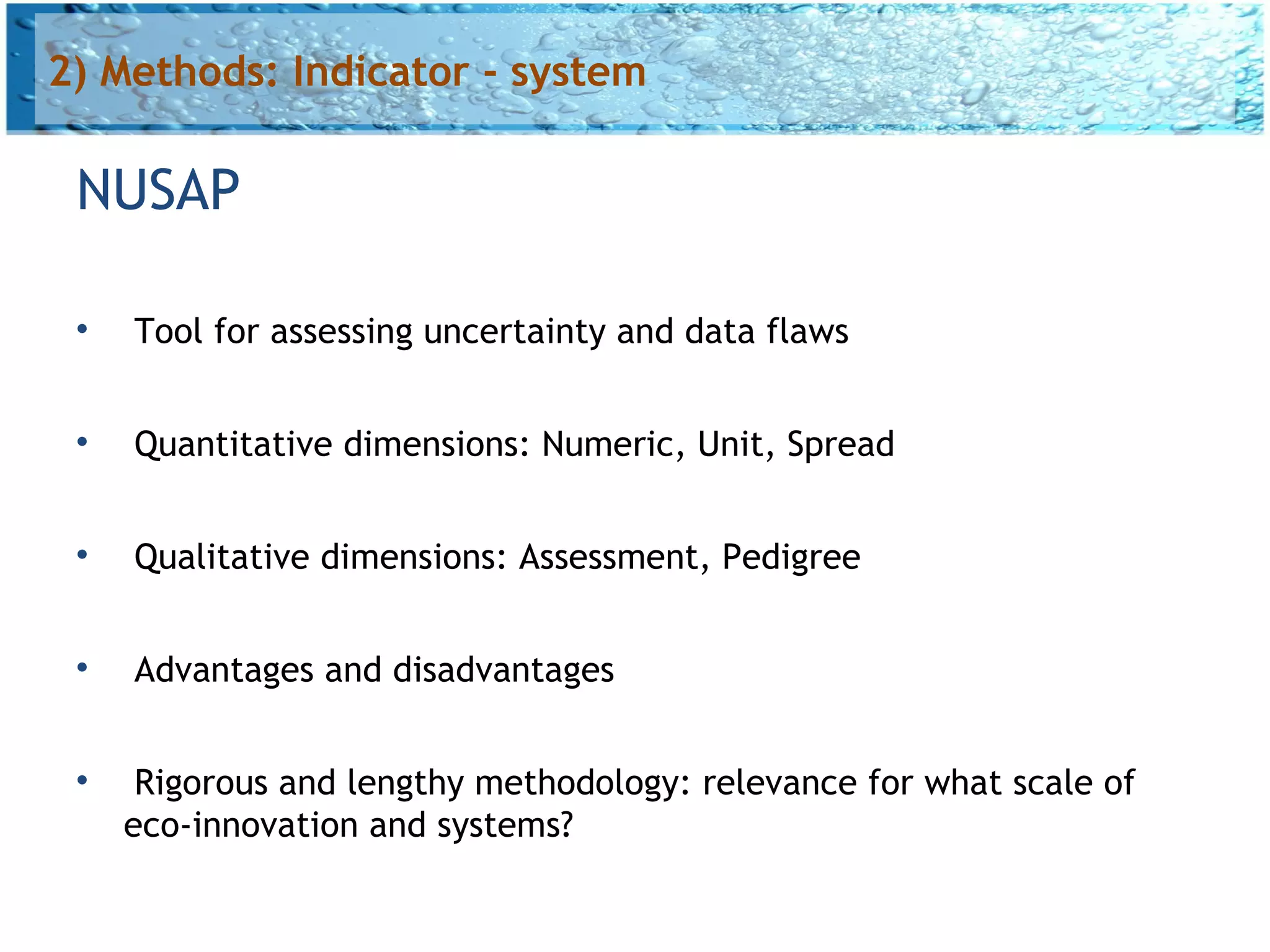
 NUSAP

 
     Tool for assessing uncertainty and data flaws

 
     Quantitative dimensions: Numeric, Unit, Spread

 
     Qualitative dimensions: Assessment, Pedigree

 
     Advantages and disadvantages

 
      Rigorous and lengthy methodology: relevance for what scale of
     eco-innovation and systems?
2) Methods: Indicator - system


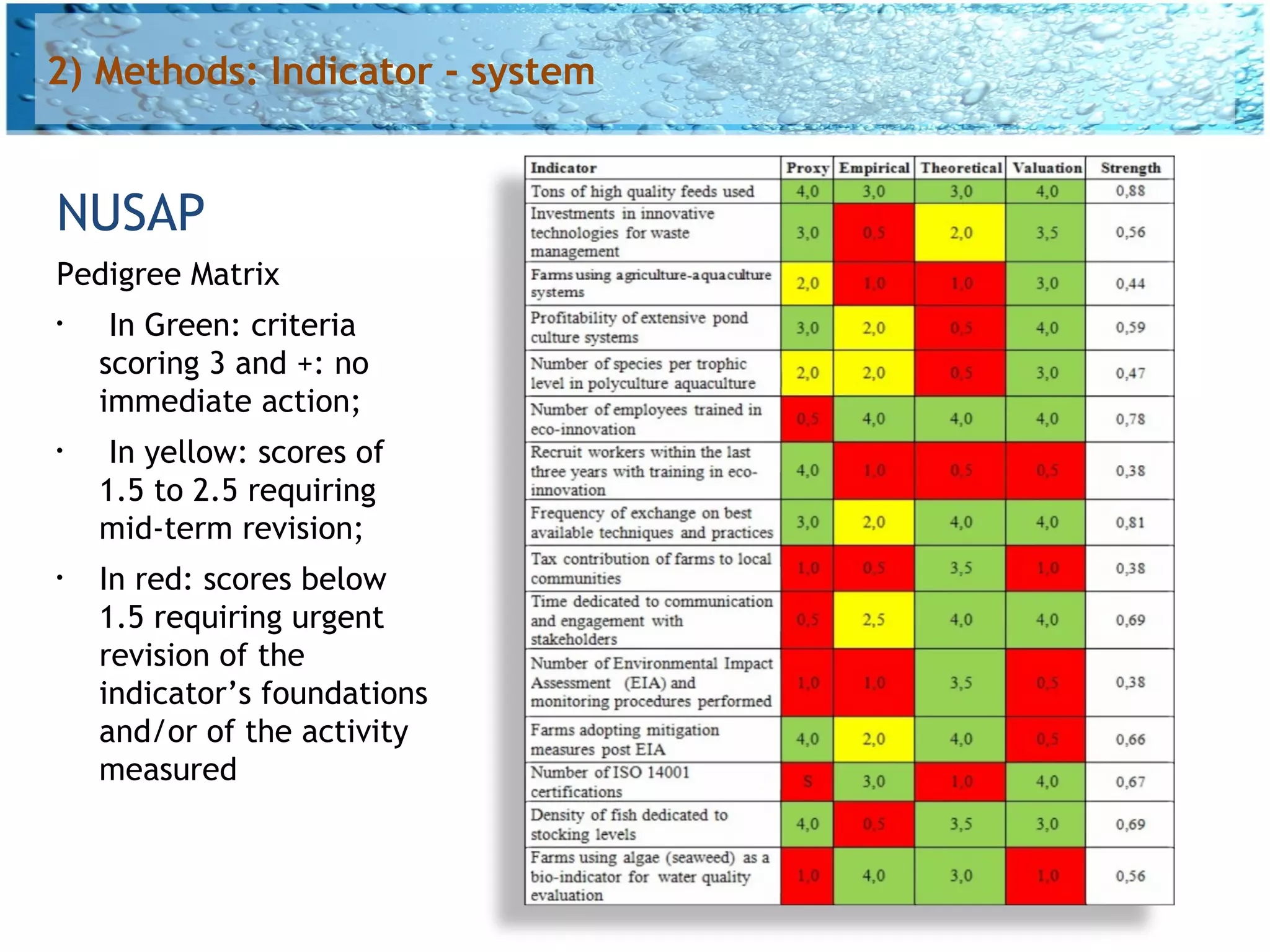
NUSAP
Pedigree Matrix
•
     In Green: criteria
    scoring 3 and +: no
    immediate action;
•
     In yellow: scores of
    1.5 to 2.5 requiring
    mid-term revision;
•
    In red: scores below
    1.5 requiring urgent
    revision of the
    indicator’s foundations
    and/or of the activity
    measured
2) Methods: Indicator - system


                                         NUSAP
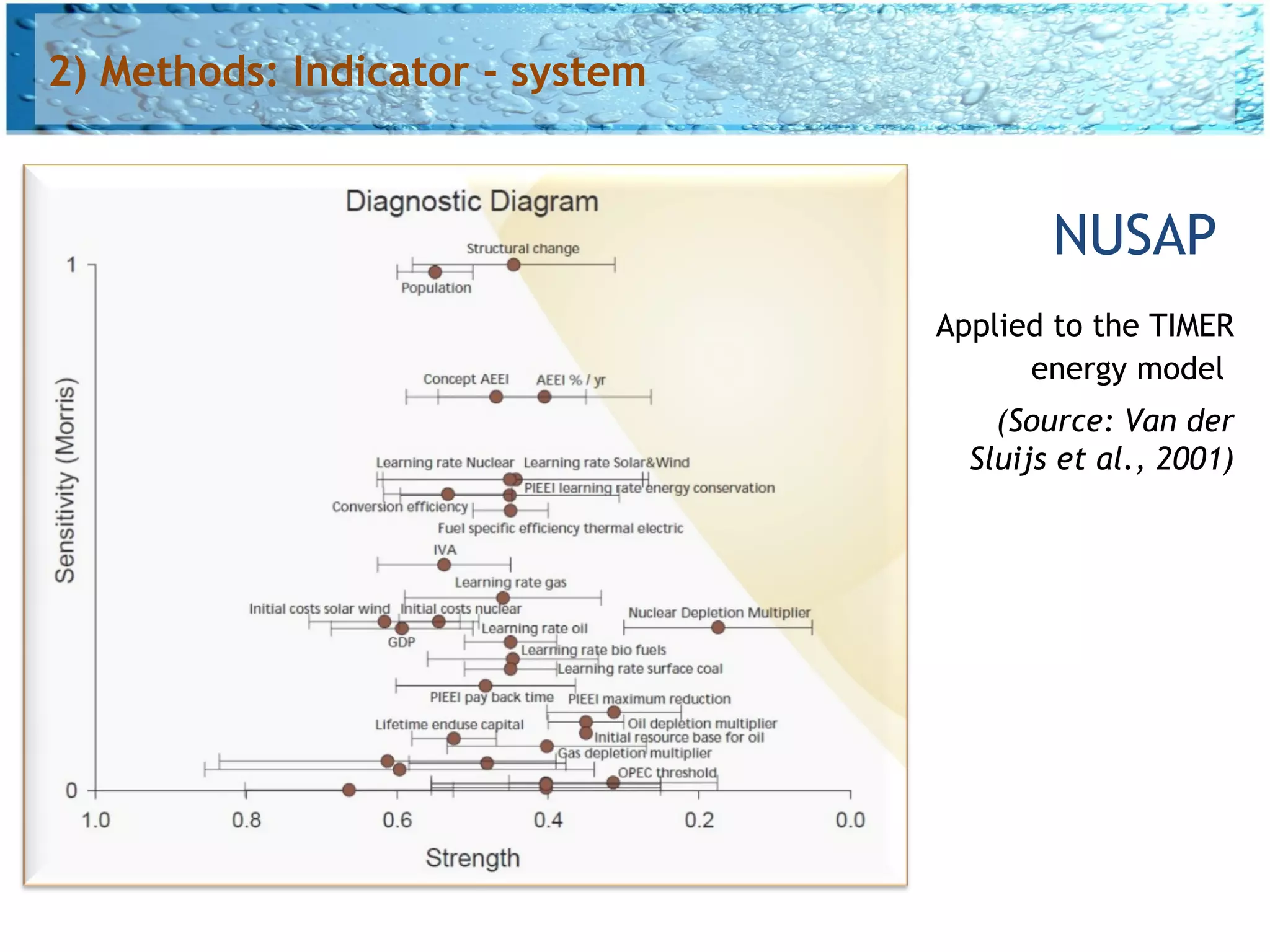
                                 Applied to the TIMER
                                       energy model
                                     (Source: Van der
                                   Sluijs et al., 2001)
2) Methods: Indicator - system

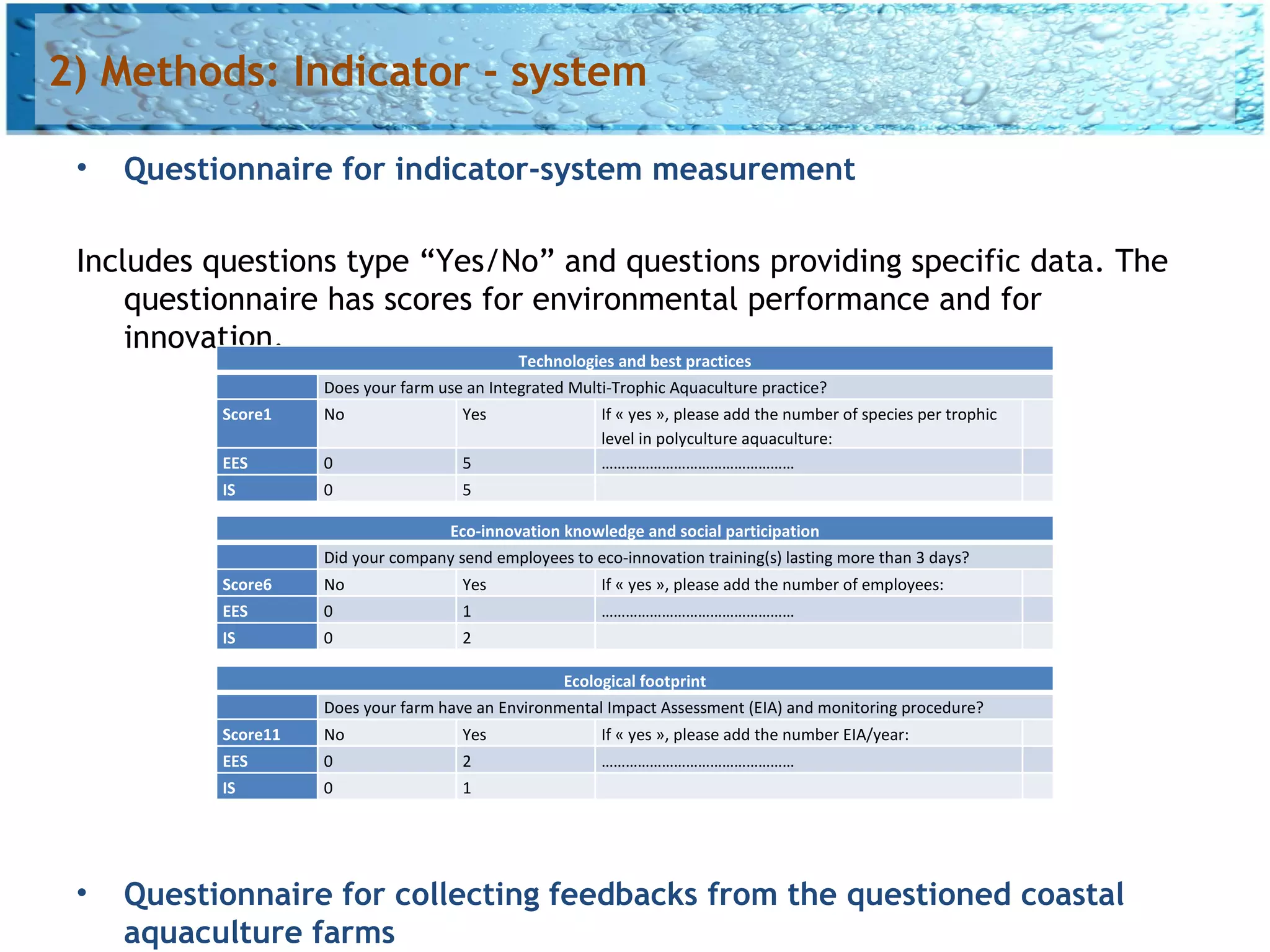
 •   Questionnaire for indicator-system measurement

 Includes questions type “Yes/No” and questions providing specific data. The
     questionnaire has scores for environmental performance and for
     innovation.
                                               Technologies and best practices
                     Does your farm use an Integrated Multi-Trophic Aquaculture practice?
           Score1    No                Yes                If « yes », please add the number of species per trophic
                                                          level in polyculture aquaculture:
           EES       0                 5                  …………………………………………
           IS        0                 5

                                    Eco-innovation knowledge and social participation
                     Did your company send employees to eco-innovation training(s) lasting more than 3 days?
           Score6    No                Yes                If « yes », please add the number of employees:
           EES       0                 1                  …………………………………………
           IS        0                 2

                                                    Ecological footprint
                     Does your farm have an Environmental Impact Assessment (EIA) and monitoring procedure?
           Score11   No                Yes                If « yes », please add the number EIA/year:
           EES       0                 2                  …………………………………………
           IS        0                 1


 •   Questionnaire for collecting feedbacks from the questioned coastal
     aquaculture farms
3) Conclusions


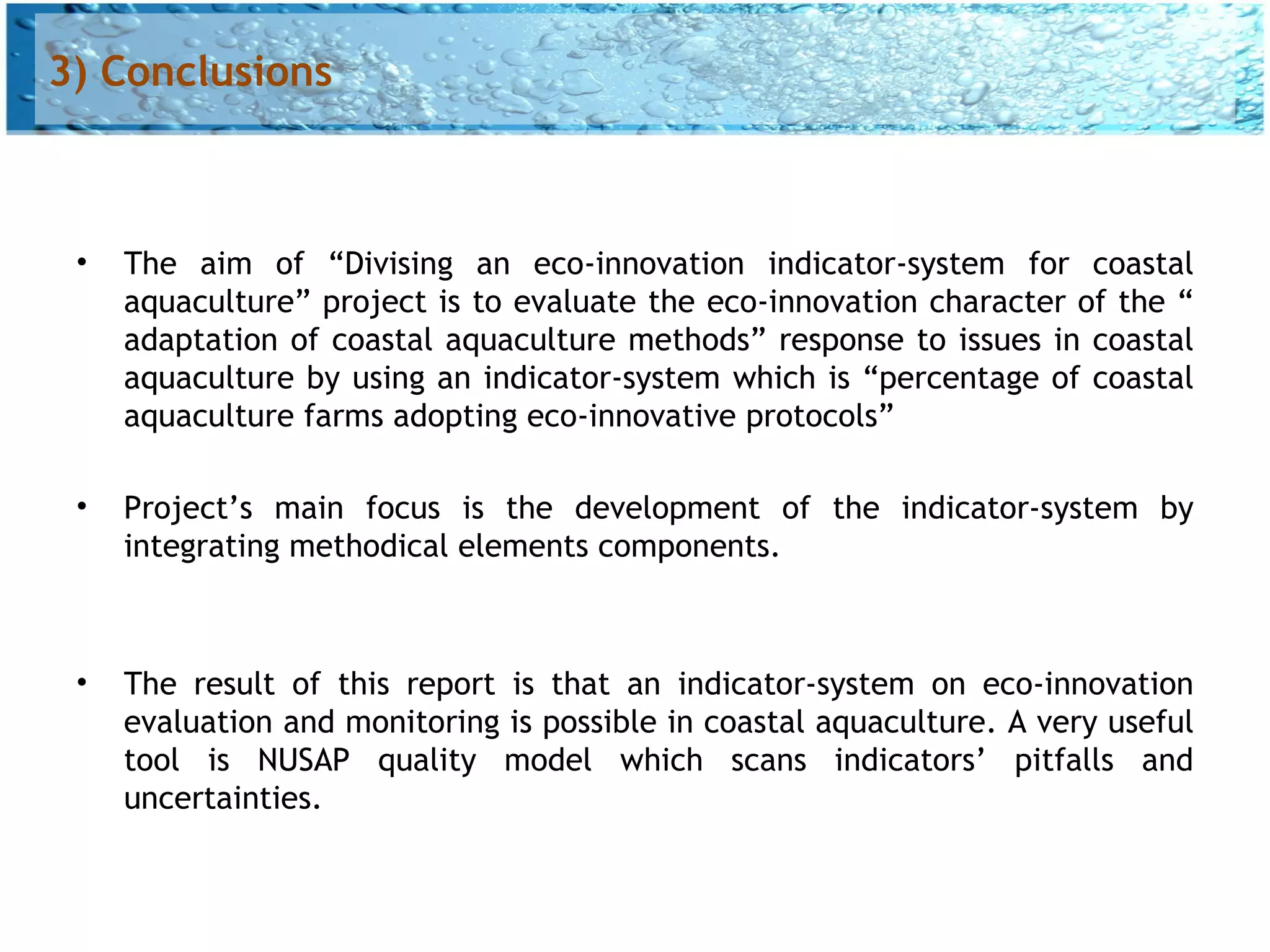
 •   The aim of “Divising an eco-innovation indicator-system for coastal
     aquaculture” project is to evaluate the eco-innovation character of the “
     adaptation of coastal aquaculture methods” response to issues in coastal
     aquaculture by using an indicator-system which is “percentage of coastal
     aquaculture farms adopting eco-innovative protocols”

 •   Project’s main focus is the development of the indicator-system by
     integrating methodical elements components.


 •   The result of this report is that an indicator-system on eco-innovation
     evaluation and monitoring is possible in coastal aquaculture. A very useful
     tool is NUSAP quality model which scans indicators’ pitfalls and
     uncertainties.
4) Questions


               Thank you

Aquaculture indicators final presentation

  • 1.
    Coastal Aquaculture Eco-innovator IndicatorSystem Econoving Master •Kevin Ramirez •Javad Mahmoudi •Elodie Gonthier •Marcel Roquette •Maria Stoica •Adrian Carrillo •Serene Hamsho
  • 2.
    1) Context What isaquaculture? The farming of aquatic organisms including fish, mollusks, crustaceans, and aquatic plants. Farming implies some form of intervention in the rearing process to enhance production, such as regular stocking, feeding, protection from predators and others. Farming also implies individual or corporate ownership of the stock being cultivated. Food and Agriculture Organization (1990) The geographical area covered by the term “coastal” includes the shore land influenced by the sea, the water column and the sea bed extending to edge of the continental edge (Sorensen and McCreary, 1990). Therefore the term “coastal aquaculture” … …Covers land-based and water-based brackish and marine aquaculture practices. (Guidelines for the promotion of environmental management of coastal aquaculture development, U.C.Barg)
  • 3.
    1) Context Coastal aquaculture in New Zeland
  • 4.
    1) Context Context scenario: Producers Commitment Percentage of to farms adopting Government Ministry of responsible eco-innovative coastal authorities Agriculture aquaculture aquaculture protocols Consumers Aim of the project: • Help authorities and coastal aquaculture farms to execute an objective monitoring of their coastal aquaculture activities and technology; • Measure the eco-innovation knowledge and implementation and their social participation; and finally • Measure the ecological footprint.
  • 5.
    2) Methods: DPSIR DRIVERS OF COASTAL-CULTURE ACTIVITY AND ECONOMY Adoptation of eco- innovative coastal aquaculture methods by the farms PRESSURES RESPONSES Environmental integration of farms ENVIRONMENTAL AND STATE OF THE ECONOMIC IMPACTS ENVIRONMENT
  • 6.
    2) Methods: Indicator- system Percentage of farms adopting eco- innovative aquaculture protocols Technology and best Eco-innovation knowledge Ecological footprint practices and social participation Percentages Other units Percentages Other units Percentages Other units  % of farms using  Tons of high  % of farms  Number of  % of farms Number of high quality feeds quality feeds used training employees employees trained adopting an Environmental (Tons/year) in eco-innovation in eco-innovation Environmental Impact Assessment (Number) Impact Assessment (EIA) and monitoring  % of farms  Investments in (EIA) and monitoring procedures implementing innovative  % of recruited workers within the last procedure performed innovative technologies for three years with training in eco-innovation (Number/year) technologies for waste management waste management (Amount /year)  % of farms  Frequency of  % of farms adopting mitigation measures participating in exchange on best post EIA  % of farms using agriculture-aquaculture exchange platforms available techniques  % of farms with Difference of systems on best available and practices (ratio) an ISO 14001 number of ISO 14001  % of farms  Profitability of techniques and certification certifications every adopting extensive extensive pond practices 3 years pond culture culture systems  % of farms  Tax contribution (number/3years) systems (Profit/pond contributing to the of farms to local  % of farms  Density of fish system/year) development of communities adopting moderate dedicated to  % of farms Number of species local communities (monetary unit) stocking levels stocking levels adopting integrated per trophic level in  % of farms  Time dedicated (weight/volume) Multi-Trophic polyculture providing effective to communication  % of farms monitoring the presence of aquaculture aquaculture tools for and engagement algae (seaweed) as a bio-indicator for practices (Number) communication with with stakeholders water quality evaluation stakeholders (time unit)
  • 7.
    2) Methods: Indicator- system Purposes • Aquaculture indicators are used to assess the condition of the environment in which this practice takes place and how the activity itself can impact the environment. • The formulated indicator should provide information about the structure, function and composition of the coastal aquaculture system. Dependency Both conventional and eco-indicators suffered from the Vague goals and objectives following problems lack scientific rigor
  • 8.
    2) Methods: Indicator- system NUSAP  Tool for assessing uncertainty and data flaws  Quantitative dimensions: Numeric, Unit, Spread  Qualitative dimensions: Assessment, Pedigree  Advantages and disadvantages  Rigorous and lengthy methodology: relevance for what scale of eco-innovation and systems?
  • 9.
    2) Methods: Indicator- system NUSAP Pedigree Matrix • In Green: criteria scoring 3 and +: no immediate action; • In yellow: scores of 1.5 to 2.5 requiring mid-term revision; • In red: scores below 1.5 requiring urgent revision of the indicator’s foundations and/or of the activity measured
  • 10.
    2) Methods: Indicator- system NUSAP Applied to the TIMER energy model (Source: Van der Sluijs et al., 2001)
  • 11.
    2) Methods: Indicator- system • Questionnaire for indicator-system measurement Includes questions type “Yes/No” and questions providing specific data. The questionnaire has scores for environmental performance and for innovation. Technologies and best practices Does your farm use an Integrated Multi-Trophic Aquaculture practice? Score1 No Yes If « yes », please add the number of species per trophic level in polyculture aquaculture: EES 0 5 ………………………………………… IS 0 5 Eco-innovation knowledge and social participation Did your company send employees to eco-innovation training(s) lasting more than 3 days? Score6 No Yes If « yes », please add the number of employees: EES 0 1 ………………………………………… IS 0 2 Ecological footprint Does your farm have an Environmental Impact Assessment (EIA) and monitoring procedure? Score11 No Yes If « yes », please add the number EIA/year: EES 0 2 ………………………………………… IS 0 1 • Questionnaire for collecting feedbacks from the questioned coastal aquaculture farms
  • 12.
    3) Conclusions • The aim of “Divising an eco-innovation indicator-system for coastal aquaculture” project is to evaluate the eco-innovation character of the “ adaptation of coastal aquaculture methods” response to issues in coastal aquaculture by using an indicator-system which is “percentage of coastal aquaculture farms adopting eco-innovative protocols” • Project’s main focus is the development of the indicator-system by integrating methodical elements components. • The result of this report is that an indicator-system on eco-innovation evaluation and monitoring is possible in coastal aquaculture. A very useful tool is NUSAP quality model which scans indicators’ pitfalls and uncertainties.
  • 13.
    4) Questions Thank you

Editor's Notes

  • #5 -Stronger commitment to responsible coastal aquaculture is needed not only from the producers, but also from government authorities and general public, including consumers. -To address this problem, the Ministry of Agriculture made a survey to determine the actual situation referring to eco-innovations in aquaculture farms, taking into account the economic, social and environmental point of view. -After gathering and analyzing the information, the general response to this topic, is an apparent lack –and therefore a need- of specific, measurable, achievable, realistic and time-framed indicators. -As showed in the poll and after a prioritization was made, this work was made to tackle this situation with a main indicator: “Percentage of farms adopting eco-innovative aquaculture protocols”. -The main objectives of this release are to help authorities and coastal aquaculture farms to execute an objective monitoring of their coastal aquaculture activities and technology; to measure the eco-innovation knowledge and implementation and their social participation; and finally measure the ecological footprint.