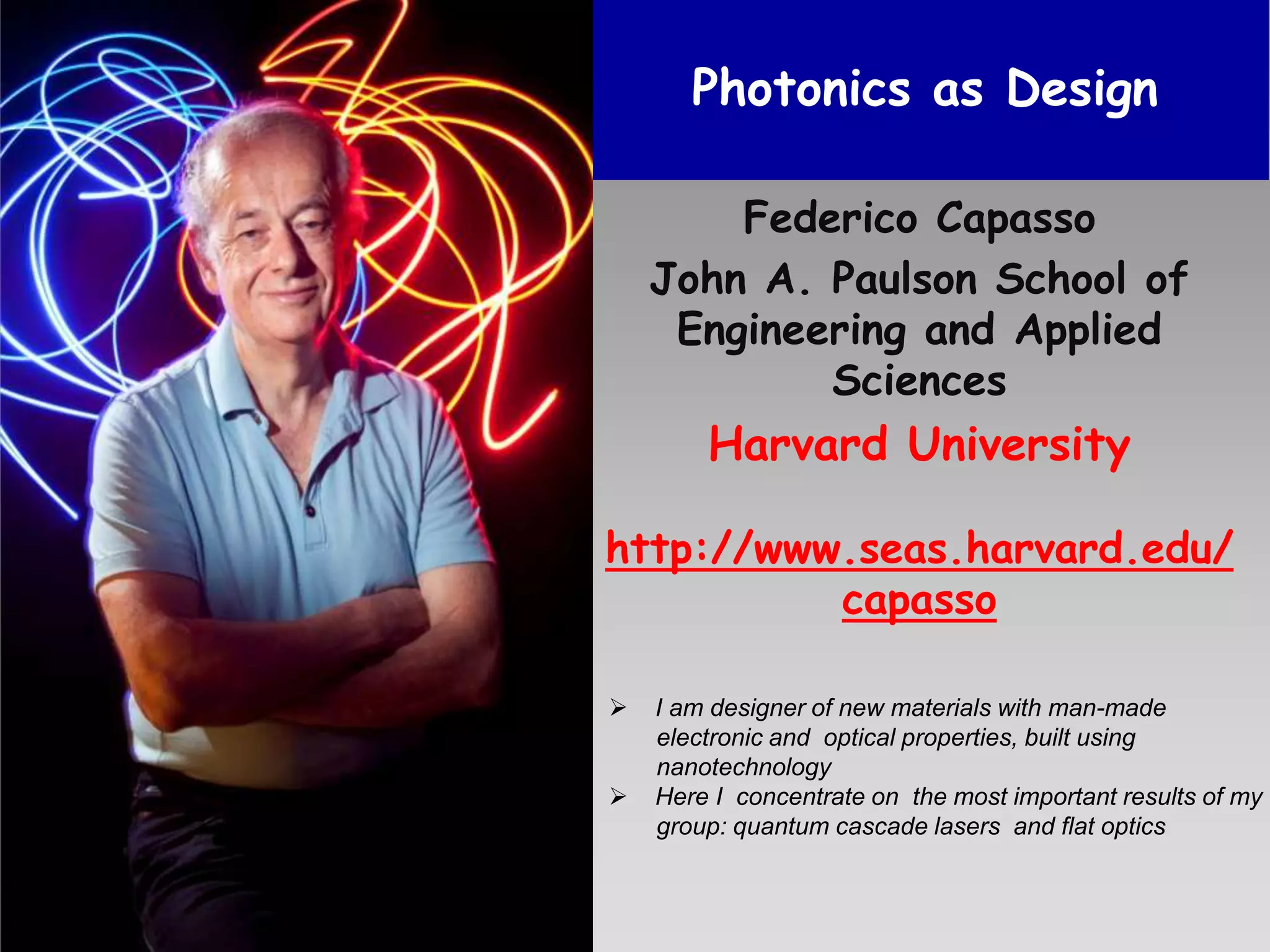
Photonics as Design
Federico Capasso
John A. Paulson School of
Engineering and Applied
Sciences
Harvard University
http://www.seas.harvard.edu/
capasso
 I am designer of new materials with man-made
electronic and optical properties, built using
nanotechnology
 Here I concentrate on the most important results of my
group: quantum cascade lasers and flat optics
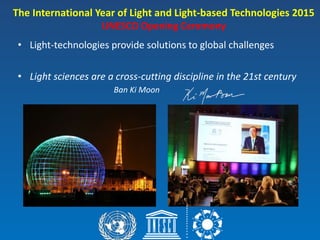
• Light-technologies provide solutions to global challenges
• Light sciences are a cross-cutting discipline in the 21st century
Ban Ki Moon
The International Year of Light and Light-based Technologies 2015
UNESCO Opening Ceremony
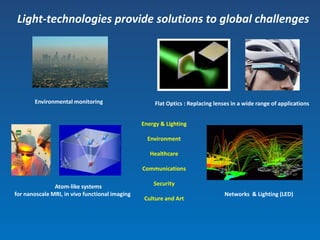
Light-technologies provide solutions to global challenges
Environmental monitoring
Networks & Lighting (LED)
Atom-like systems
for nanoscale MRI, in vivo functional imaging
Flat Optics : Replacing lenses in a wide range of applications
Energy & Lighting
Environment
Healthcare
Communications
Security
Culture and Art
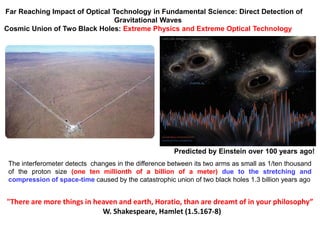
The interferometer detects changes in the difference between its two arms as small as 1/ten thousand
of the proton size (one ten millionth of a billion of a meter) due to the stretching and
compression of space-time caused by the catastrophic union of two black holes 1.3 billion years ago
Far Reaching Impact of Optical Technology in Fundamental Science: Direct Detection of
Gravitational Waves
Cosmic Union of Two Black Holes: Extreme Physics and Extreme Optical Technology
"There are more things in heaven and earth, Horatio, than are dreamt of in your philosophy”
W. Shakespeare, Hamlet (1.5.167-8)
Predicted by Einstein over 100 years ago!
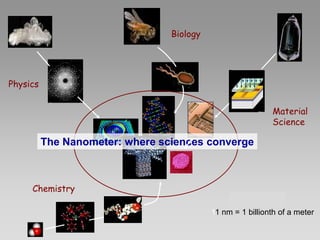
Chemistry
Beryllium
Aluminum
Silicate, lauePhysics
Biology
Material
Science
The Nanometer: where sciences converge
Why now?
11 nm = 1 billionth of a meter
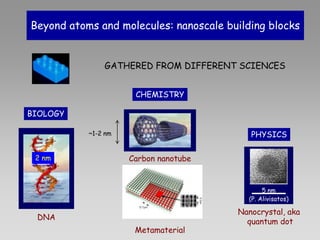
Beyond atoms and molecules: nanoscale building blocks
DNA
2 nm Carbon nanotube
~1-2 nm
5 nm
Nanocrystal, aka
quantum dot
BIOLOGY
CHEMISTRY
PHYSICS
GATHERED FROM DIFFERENT SCIENCES
(P. Alivisatos)
Metamaterial
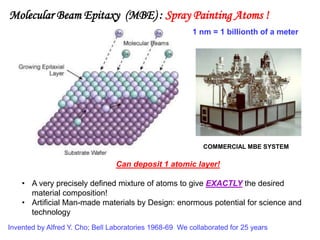
Molecular Beam Epitaxy (MBE) : Spray Painting Atoms !
Can deposit 1 atomic layer!
• A very precisely defined mixture of atoms to give EXACTLY the desired
material composition!
• Artificial Man-made materials by Design: enormous potential for science and
technology
Invented by Alfred Y. Cho; Bell Laboratories 1968-69 We collaborated for 25 years
COMMERCIAL MBE SYSTEM
1 nm = 1 billionth of a meter
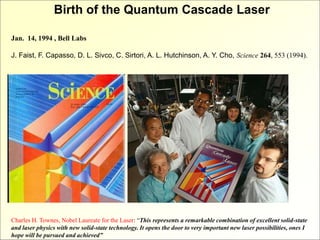
Birth of the Quantum Cascade Laser
Jan. 14, 1994 , Bell Labs
J. Faist, F. Capasso, D. L. Sivco, C. Sirtori, A. L. Hutchinson, A. Y. Cho, Science 264, 553 (1994).
Charles H. Townes, Nobel Laureate for the Laser: “This represents a remarkable combination of excellent solid-state
and laser physics with new solid-state technology. It opens the door to very important new laser possibilities, ones I
hope will be pursued and achieved”
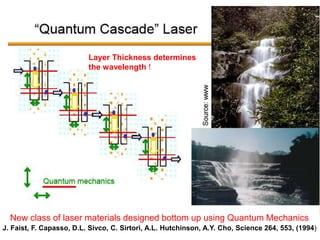
New class of laser materials designed bottom up using Quantum Mechanics
J. Faist, F. Capasso, D.L. Sivco, C. Sirtori, A.L. Hutchinson, A.Y. Cho, Science 264, 553, (1994)
Layer Thickness determines
the wavelength !
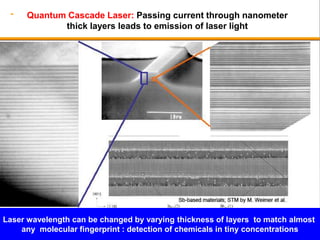
Laser wavelength can be changed by varying thickness of layers to match almost
any molecular fingerprint : detection of chemicals in tiny concentrations
Quantum Cascade Laser: Passing current through nanometer
thick layers leads to emission of laser light
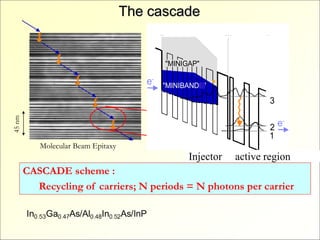
The cascade
Molecular Beam Epitaxy
45nm
"MINIGAP"
Zone de transport Zone d ’émission
3
2
1
e-
e-
"MINIBANDE"
CASCADE scheme :
Recycling of carriers; N periods = N photons per carrier
Injector active region
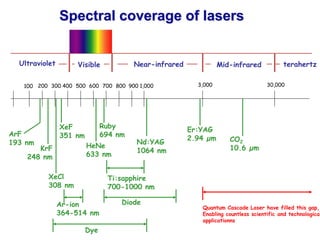
Spectral coverage of lasers
100 200 300 400 500 600 700 800 900 1,000 3,000 30,000
Ultraviolet Visible Near-infrared Mid-infrared terahertz
HeNe
633 nm
Ruby
694 nm
Nd:YAG
1064 nm
XeF
351 nm
XeCl
308 nm
KrF
248 nm
ArF
193 nm
Ti:sapphire
700-1000 nm
Ar-ion
364-514 nm
Diode
Dye
CO2
10.6 µm
Quantum Cascade Laser have filled this gap,
Enabling countless scientific and technological
applicationns
Er:YAG
2.94 µm
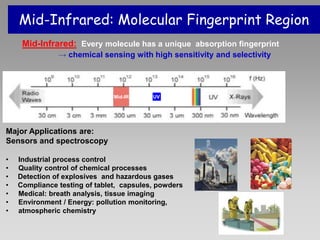
Molecular Fingerprint Region
Microwaves THz Mid-IR
Near
-IR
UV
Mid-Infrared: Molecular Fingerprint Region
Mid-Infrared: Every molecule has a unique absorption fingerprint
→ chemical sensing with high sensitivity and selectivity
Major Applications are:
Sensors and spectroscopy
• Industrial process control
• Quality control of chemical processes
• Detection of explosives and hazardous gases
• Compliance testing of tablet, capsules, powders
• Medical: breath analysis, tissue imaging
• Environment / Energy: pollution monitoring,
• atmospheric chemistry
15
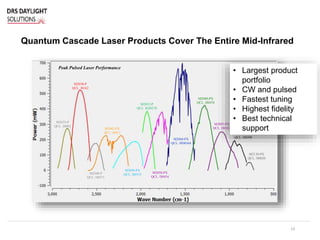
Quantum Cascade Laser Products Cover The Entire Mid-Infrared
Peak Pulsed Laser Performance
M2095-PX
QCL: D0102
M2068-PX
QCL: HD0364
M2080-PX
QCL: D0470
M2049-PX
QCL: D0519
M2042-PX
QCL: J0017
M2058-PX
QCL: D0454
M2052-P
QCL: KD0370
M2100-PX
QCL: D0398
M2130-PX
QCL: D0820
M2038-P
QCL: J0162
M2035-P
QCL: J0092
M2040-P
QCL: D0571
• Largest product
portfolio
• CW and pulsed
• Fastest tuning
• Highest fidelity
• Best technical
support
1E-5
1E-6
1E-7
1E-8
1E-9
1E-10
1E-11
1E-12
PowerSpectralDensity(W/2cm-
1)
Wavelength (µm)
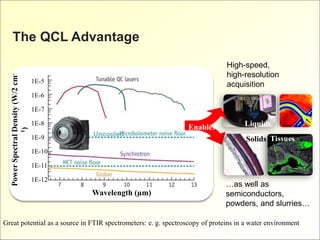
Uncooled
Enables
High-speed,
high-resolution
acquisition
Liquids
Solids Tissues
…as well as
semiconductors,
powders, and slurries…
The QCL Advantage
Great potential as a source in FTIR spectrometers: e. g. spectroscopy of proteins in a water environment
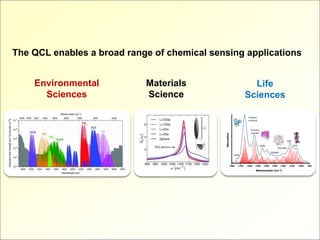
The QCL enables a broad range of chemical sensing applications
Life
Sciences
Environmental
Sciences
Materials
Science
1800 1700 1600 1500 1200 1100 1000 9001400 1300
Absorption
Wavenumber (cm-1)
Proteins
β-sheet
Proteins
α-helical
RNA
DNA
Lipids
Lipids
Collagen
Glycogen
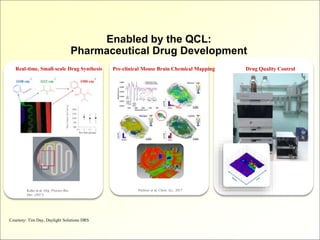
Enabled by the QCL:
Pharmaceutical Drug Development
Keles et al. Org. Process Res.
Dev. (2017)
Petibois et al, Chem. Sci., 2017
Real-time, Small-scale Drug Synthesis Pre-clinical Mouse Brain Chemical Mapping Drug Quality Control
Courtesy: Tim Day, Daylight Solutions DRS
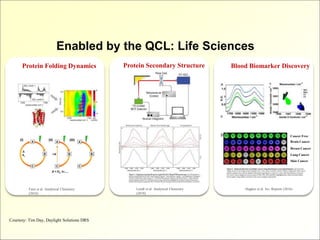
Enabled by the QCL: Life Sciences
Protein Folding Dynamics
Faist et al. Analytical Chemistry
(2018)
Lendl et al. Analytical Chemistry
(2018)
Protein Secondary Structure Blood Biomarker Discovery
Hughes et al. Sci. Reports (2016)
Cancer Free
Brain Cancer
Breast Cancer
Lung Cancer
Skin Cancer
Courtesy: Tim Day, Daylight Solutions DRS
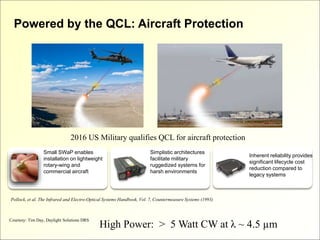
Powered by the QCL: Aircraft Protection
Pollock, et al. The Infrared and Electro-Optical Systems Handbook, Vol. 7, Countermeasure Systems (1993)
Small SWaP enables
installation on lightweight
rotary-wing and
commercial aircraft
Simplistic architectures
facilitate military
ruggedized systems for
harsh environments
Inherent reliability provides
significant lifecycle cost
reduction compared to
legacy systems
Courtesy: Tim Day, Daylight Solutions DRS
High Power: > 5 Watt CW at λ ~ 4.5 µm
2016 US Military qualifies QCL for aircraft protection
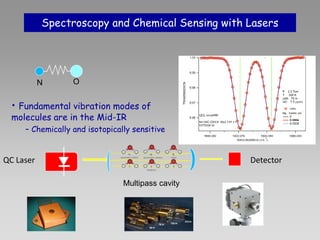
QC Laser
Multipass cavity
Detector
Spectroscopy and Chemical Sensing with Lasers
• Fundamental vibration modes of
molecules are in the Mid-IR
– Chemically and isotopically sensitive
N O
Real-time Exhaled Human NH3 Breath Measurements
Successful testing of a 2nd generation breath
ammonia monitor installed in a clinical
environment.(Johns Hopkins, Baltimore, MD
and St. Luke’s Hospital, Bethlehem, PA)
14:24:00 14:24:20 14:24:40 14:25:00 14:25:20
0
50
100
150
200
250
300
350
400
NH3
concentration[ppb]
Time [HH:MM:SS]
Breath data from NH3
Rice sensor
Max NH3
concentration is: 351 ppb
0 1000 2000 3000 4000
0
2
4
6
8
10
12
0
50
100
150
200
250
CO2
concentration[%]
AirwayPressure[mbar]
Point [-]
Pressure
CO2
NH3
NH3
concnetration[ppb]
Airway pressure (black), CO2 (red), and NH3 (blue)
profiles of a single breath exhalation lasting 40sec.
Minimum detectable concentration of NH3 is:
~ 6 ppbv at 967.35 cm-1 (1σ; 1 s time resolution)
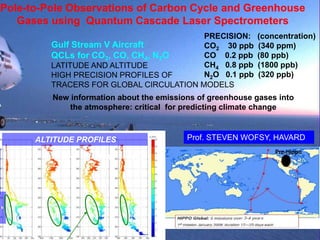
Pole-to-Pole Observations of Carbon Cycle and Greenhouse
Gases using Quantum Cascade Laser Spectrometers
Gulf Stream V Aircraft
QCLs for CO2, CO, CH4, N2O
LATITUDE AND ALTITUDE
HIGH PRECISION PROFILES OF
TRACERS FOR GLOBAL CIRCULATION MODELS
PRECISION: (concentration)
CO2 30 ppb (340 ppm)
CO 0.2 ppb (80 ppb)
CH4 0.8 ppb (1800 ppb)
N2O 0.1 ppb (320 ppb)
Prof. STEVEN WOFSY, HAVARD
e
ALTITUDE PROFILES
CO CH4 N2O CO2
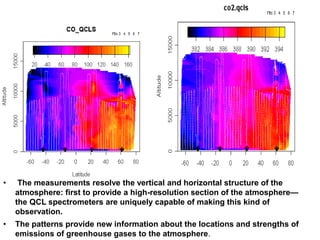
New information about the emissions of greenhouse gases into
the atmosphere: critical for predicting climate change
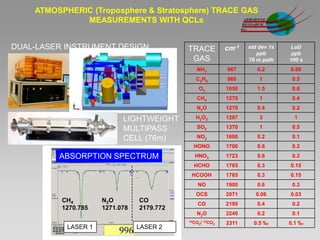
ATMOSPHERIC (Troposphere & Stratosphere) TRACE GAS
MEASUREMENTS WITH QCLs
TRACE
GAS
cm-1 std dev 1s
ppb
76 m path
LoD
ppb
100 s
NH3 967 0.2 0.06
C2H4 960 1 0.5
O3 1050 1.5 0.6
CH4 1270 1 0.4
N2O 1270 0.4 0.2
H2O2 1267 3 1
SO2 1370 1 0.5
NO2 1600 0.2 0.1
HONO 1700 0.6 0.3
HNO3 1723 0.6 0.3
HCHO 1765 0.3 0.15
HCOOH 1765 0.3 0.15
NO 1900 0.6 0.3
OCS 2071 0.06 0.03
CO 2190 0.4 0.2
N2O 2240 0.2 0.1
13CO2/ 12CO2 2311 0.5 ‰ 0.1 ‰
LIGHTWEIGHT
MULTIPASS
CELL (76m)
LASER 1
CH4
1270.785
N2O
1271.078
CO
2179.772
LASER 2
ABSORPTION SPECTRUM
DUAL-LASER INSTRUMENT DESIGN
• The measurements resolve the vertical and horizontal structure of the
atmosphere: first to provide a high-resolution section of the atmosphere—
the QCL spectrometers are uniquely capable of making this kind of
observation.
• The patterns provide new information about the locations and strengths of
emissions of greenhouse gases to the atmosphere.
27
NASA Altair UAV
Drone for detection of chemical in impervious regions
Jim Anderson, Harvard
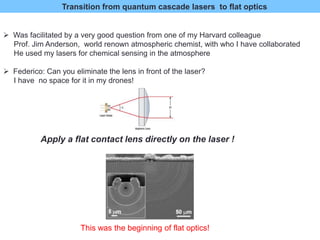
Transition from quantum cascade lasers to flat optics
 Was facilitated by a very good question from one of my Harvard colleague
Prof. Jim Anderson, world renown atmospheric chemist, with who I have collaborated
He used my lasers for chemical sensing in the atmosphere
 Federico: Can you eliminate the lens in front of the laser?
I have no space for it in my drones!
Apply a flat contact lens directly on the laser !
This was the beginning of flat optics!
Designer metasurfaces
• Can we design an artificial surface (metasurface)
that refracts a light beam by an arbitrary angle
(generalized Snell’s law)?
• Simple application of Fermat’s principle: light
beam follows the path of minimum time ( for the
experts “path of stationary phase”)
• Can we make a flat lens with no spherical
aberrations: i.e. a wavelength size focal spot?
N.Yu and F. Capasso, Nature Materials 13, 139 (2014)
N. Yu et al., Science 334, 333 (2011)
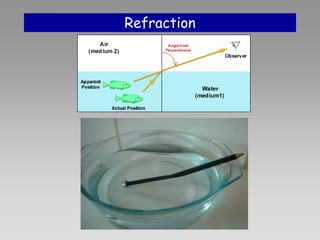
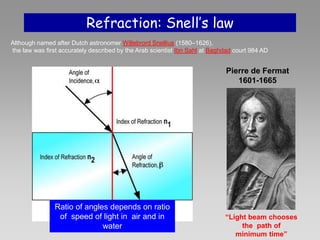
Refraction
Refraction: Snell’s law
“Light beam chooses
the path of
minimum time”
Although named after Dutch astronomer Willebrord Snellius (1580–1626),
the law was first accurately described by the Arab scientist Ibn Sahl at Baghdad court 984 AD
Pierre de Fermat
1601-1665
Ratio of angles depends on ratio
of speed of light in air and in
water
32
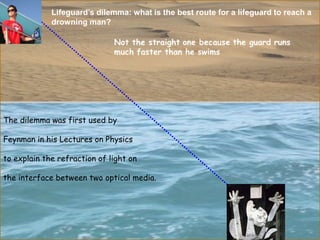
The dilemma was first used by
Feynman in his Lectures on Physics
to explain the refraction of light on
the interface between two optical media.
Lifeguard’s dilemma: what is the best route for a lifeguard to reach a
drowning man?
t
i
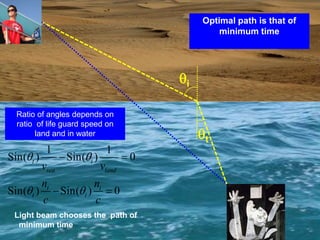
Optimal path is that of
minimum time
Ratio of angles depends on
ratio of life guard speed on
land and in water
1 1
Sin( ) Sin( ) 0
Sin( ) Sin( ) 0
t i
sea land
t i
t i
v v
n n
c c
 
 
 
 
Light beam chooses the path of
minimum time
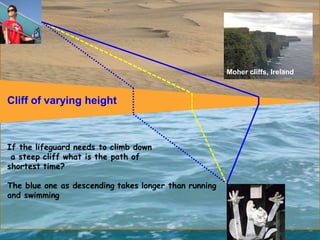
Cliff of varying height
Moher cliffs, Ireland
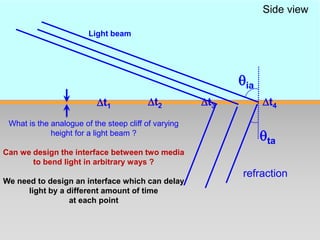
What is the analogue of the steep cliff of varying
height for a light beam ?
Can we design the interface between two media
to bend light in arbitrary ways ?
We need to design an interface which can delay
light by a different amount of time
at each point
ta
refraction
Side view
ia
Light beam
t1 t2 t3 t4
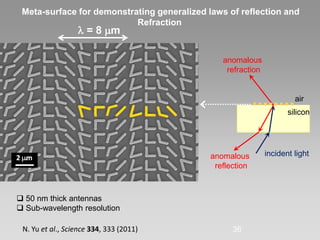
 = 8 m
Meta-surface for demonstrating generalized laws of reflection and
Refraction
36
 50 nm thick antennas
 Sub-wavelength resolution
silicon
air
incident lightanomalous
reflection
anomalous
refraction
N. Yu et al., Science 334, 333 (2011)
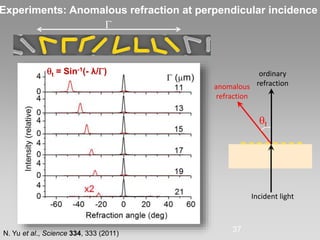
ordinary
refraction
Incident light
anomalous
refraction
t

37
Experiments: Anomalous refraction at perpendicular incidence
t = Sin-1(- λ/)
N. Yu et al., Science 334, 333 (2011)
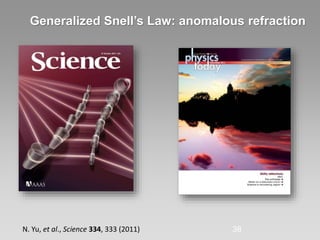
Generalized Snell’s Law: anomalous refraction
38N. Yu, et al., Science 334, 333 (2011)
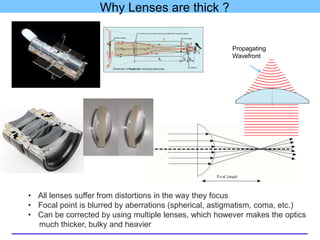
Why Lenses are thick ?
n1 n2 Propagating
Wavefront
• All lenses suffer from distortions in the way they focus
• Focal point is blurred by aberrations (spherical, astigmatism, coma, etc.)
• Can be corrected by using multiple lenses, which however makes the optics
much thicker, bulky and heavier
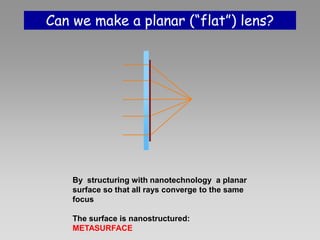
Can we make a planar (“flat”) lens?
By structuring with nanotechnology a planar
surface so that all rays converge to the same
focus
The surface is nanostructured:
METASURFACE
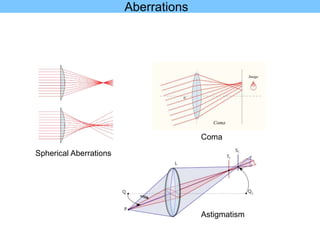
Spherical Aberrations
Coma
Astigmatism
Aberrations
Harvard John A. Paulson School of Engineering and Applied Sciences
3
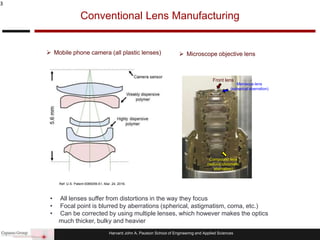
Conventional Lens Manufacturing
Ref: U.S. Patent 0085059 A1, Mar. 24, 2016.
 Mobile phone camera (all plastic lenses)
Front lens
Compound lens
(reduce chromatic
aberration)
Meniscus lens
(spherical aberration)
 Microscope objective lens
• All lenses suffer from distortions in the way they focus
• Focal point is blurred by aberrations (spherical, astigmatism, coma, etc.)
• Can be corrected by using multiple lenses, which however makes the optics
much thicker, bulky and heavier
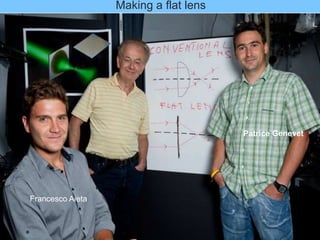
Making a flat lens
Francesco Aieta
Patrice Genevet
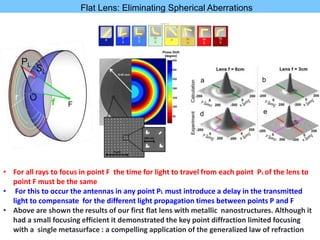
Flat Lens: Eliminating Spherical Aberrations
• For all rays to focus in point F the time for light to travel from each point PL of the lens to
point F must be the same
• For this to occur the antennas in any point PL must introduce a delay in the transmitted
light to compensate for the different light propagation times between points P and F
• Above are shown the results of our first flat lens with metallic nanostructures. Although it
had a small focusing efficient it demonstrated the key point diffraction limited focusing
with a single metasurface : a compelling application of the generalized law of refraction
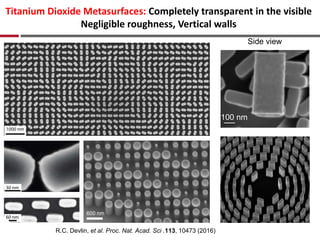
Titanium Dioxide Metasurfaces: Completely transparent in the visible
Negligible roughness, Vertical walls
46
100 nm
Side view
600 nm
R.C. Devlin, et al. Proc. Nat. Acad. Sci .113, 10473 (2016)
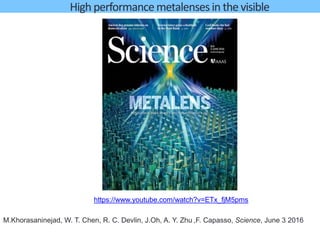
High performancemetalenses in the visible
M.Khorasaninejad, W. T. Chen, R. C. Devlin, J.Oh, A. Y. Zhu ,F. Capasso, Science, June 3 2016
https://www.youtube.com/watch?v=ETx_fjM5pms
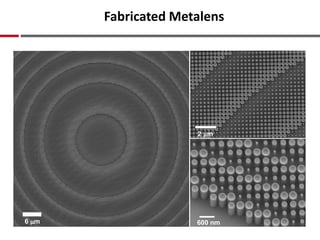
Fabricated Metalens
6 m 600 nm
2 m
500
nm
F
500
nm
E
500
nm
D
500
nm
B
500
nm
C
500
nm
A
405 nm532 nm660 nm
Meta-Lens
Objective
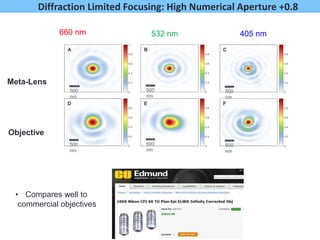
Diffraction Limited Focusing: High Numerical Aperture +0.8
• Compares well to
commercial objectives
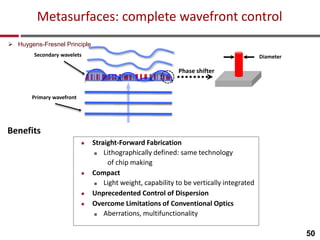
Metasurfaces: complete wavefront control
Secondary wavelets
Primary wavefront
Diameter
 Straight-Forward Fabrication
■ Lithographically defined: same technology
of chip making
 Compact
■ Light weight, capability to be vertically integrated
 Unprecedented Control of Dispersion
 Overcome Limitations of Conventional Optics
■ Aberrations, multifunctionality
Phase shifter
Benefits
 Huygens-Fresnel Principle
50
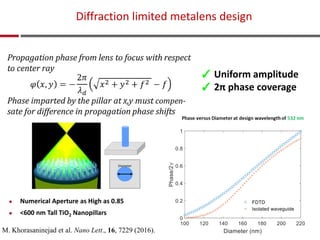
✓ Uniform amplitude
✓ 2π phase coverage
M. Khorasaninejad et al. Nano Lett., 16, 7229 (2016).
Diffraction limited metalens design
Diameter
 Numerical Aperture as High as 0.85
 <600 nm Tall TiO2 Nanopillars
Harvard John A. Paulson School of Engineering and Applied Sciences 52
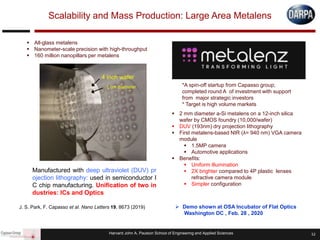
Scalability and Mass Production: Large Area Metalens
4 inch wafer
1 cm diameter
 All-glass metalens
 Nanometer-scale precision with high-throughput
 160 million nanopillars per metalens
Manufactured with deep ultraviolet (DUV) pr
ojection lithography: used in semiconductor I
C chip manufacturing. Unification of two in
dustries: ICs and Optics
J. S. Park, F. Capasso et al. Nano Letters 19, 8673 (2019)
 2 mm diameter a-Si metalens on a 12-inch silica
wafer by CMOS foundry (10,000/wafer)
 DUV (193nm) dry projection lithography
 First metalens-based NIR (λ= 940 nm) VGA camera
module
 1.5MP camera
 Automotive applications
 Benefits:
 Uniform illumination
 2X brighter compared to 4P plastic lenses
refractive camera module
 Simpler configuration
*A spin-off startup from Capasso group;
completed round A of investment with support
from major strategic investors
* Target is high volume markets
 Demo shown at OSA Incubator of Flat Optics
Washington DC , Feb. 28 , 2020
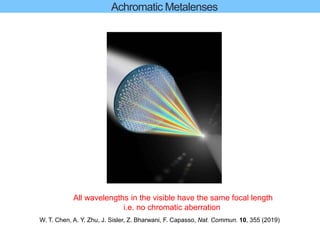
Achromatic Metalenses
W. T. Chen, A. Y. Zhu, J. Sisler, Z. Bharwani, F. Capasso, Nat. Commun. 10, 355 (2019)
All wavelengths in the visible have the same focal length
i.e. no chromatic aberration
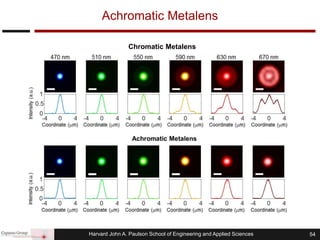
Harvard John A. Paulson School of Engineering and Applied Sciences 54
Achromatic Metalens
Chromatic Metalens
Harvard John A. Paulson School of Engineering and Applied Sciences
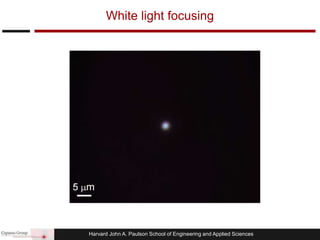
White light focusing
Harvard John A. Paulson School of Engineering and Applied Sciences
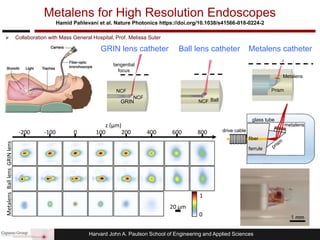
Metalens for High Resolution Endoscopes
Hamid Pahlevani et al. Nature Photonics https://doi.org/10.1038/s41566-018-0224-2
metalens
glass tube
fiber
drive cable
ferrule
NCF
GRIN
NCF
tangential
focus
GRIN lens catheter
NCF Ball
Ball lens catheter
Prism
Metalens
Metalens catheter
0 100 200 400 600 800-100-200
z (μm)
20 μm
GRINlensBalllensMetalens
0
1
 Collaboration with Mass General Hospital, Prof. Melissa Suter
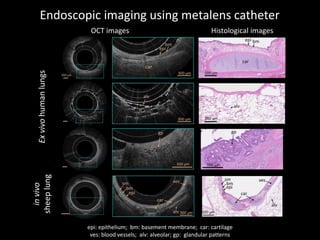
Endoscopic imaging using metalens catheter
Exvivohumanlungs
invivo
sheeplung
Histological imagesOCT images
epi: epithelium; bm: basement membrane; car: cartilage
ves: blood vessels; alv: alveolar; gp: glandular patterns
Harvard John A. Paulson School of Engineering and Applied Sciences
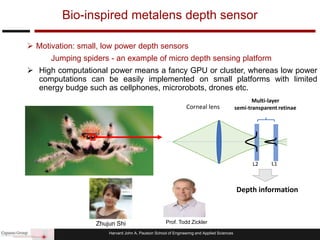
 Motivation: small, low power depth sensors
Jumping spiders - an example of micro depth sensing platform
 High computational power means a fancy GPU or cluster, whereas low power
computations can be easily implemented on small platforms with limited
energy budge such as cellphones, microrobots, drones etc.
Bio-inspired metalens depth sensor
L2 L1
Corneal lens
Multi-layer
semi-transparent retinae
Depth information
Prof. Todd ZicklerZhujun Shi
Harvard John A. Paulson School of Engineering and Applied Sciences
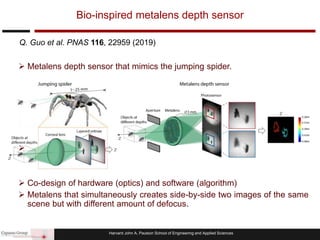
 Metalens depth sensor that mimics the jumping spider.

 Co-design of hardware (optics) and software (algorithm)
 Metalens that simultaneously creates side-by-side two images of the same
scene but with different amount of defocus.
Bio-inspired metalens depth sensor
Q. Guo et al. PNAS 116, 22959 (2019)
Harvard John A. Paulson School of Engineering and Applied Sciences
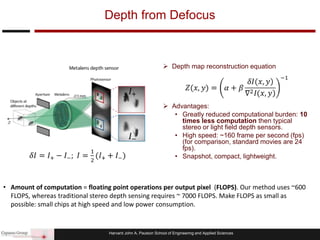
 Depth map reconstruction equation
 Advantages:
• Greatly reduced computational burden: 10
times less computation then typical
stereo or light field depth sensors.
• High speed: ~160 frame per second (fps)
(for comparison, standard movies are 24
fps).
• Snapshot, compact, lightweight.
Depth from Defocus
• Amount of computation = floating point operations per output pixel (FLOPS). Our method uses ~600
FLOPS, whereas traditional stereo depth sensing requires ~ 7000 FLOPS. Make FLOPS as small as
possible: small chips at high speed and low power consumption.
Harvard John A. Paulson School of Engineering and Applied Sciences
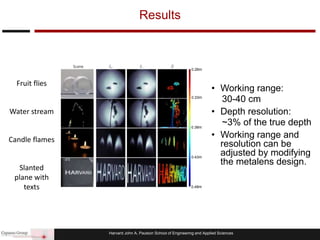
Results
0.28m
0.33m
0.38m
0.43m
0.48m
Fruit flies
Water stream
Candle flames
Slanted
plane with
texts
• Working range:
30-40 cm
• Depth resolution:
~3% of the true depth
• Working range and
resolution can be
adjusted by modifying
the metalens design.
Results
Click on slide for movie
F. Capasso, Nanophotonics, 6 953 (2018)
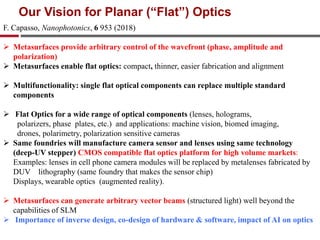
 Metasurfaces provide arbitrary control of the wavefront (phase, amplitude and
polarization)
 Metasurfaces enable flat optics: compact, thinner, easier fabrication and alignment
 Multifunctionality: single flat optical components can replace multiple standard
components
 Flat Optics for a wide range of optical components (lenses, holograms,
polarizers, phase plates, etc.) and applications: machine vision, biomed imaging,
drones, polarimetry, polarization sensitive cameras
 Same foundries will manufacture camera sensor and lenses using same technology
(deep-UV stepper) CMOS compatible flat optics platform for high volume markets:
Examples: lenses in cell phone camera modules will be replaced by metalenses fabricated by
DUV lithography (same foundry that makes the sensor chip)
Displays, wearable optics (augmented reality).
 Metasurfaces can generate arbitrary vector beams (structured light) well beyond the
capabilities of SLM
 Importance of inverse design, co-design of hardware & software, impact of AI on optics
Our Vision for Planar (“Flat”) Optics
Flat Optics Future
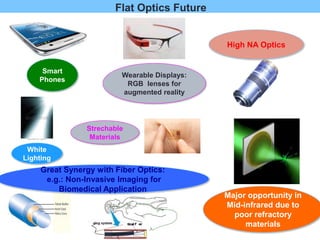
High NA Optics
Great Synergy with Fiber Optics:
e.g.: Non-Invasive Imaging for
Biomedical Application
Major opportunity in
Mid-infrared due to
poor refractory
materials
Smart
Phones
Strechable
Materials
Wearable Displays:
RGB lenses for
augmented reality
White
Lighting
Thank you and have Fun
with Science and
Technology
Federico Capasso
John A. Paulson School of
Engineering and Applied
Sciences
Harvard University
http://www.seas.harvard.edu/
capasso

Federico Capasso: Photonics as Design

  • 1.
    Photonics as Design FedericoCapasso John A. Paulson School of Engineering and Applied Sciences Harvard University http://www.seas.harvard.edu/ capasso  I am designer of new materials with man-made electronic and optical properties, built using nanotechnology  Here I concentrate on the most important results of my group: quantum cascade lasers and flat optics
  • 3.
    • Light-technologies providesolutions to global challenges • Light sciences are a cross-cutting discipline in the 21st century Ban Ki Moon The International Year of Light and Light-based Technologies 2015 UNESCO Opening Ceremony
  • 4.
    Light-technologies provide solutionsto global challenges Environmental monitoring Networks & Lighting (LED) Atom-like systems for nanoscale MRI, in vivo functional imaging Flat Optics : Replacing lenses in a wide range of applications Energy & Lighting Environment Healthcare Communications Security Culture and Art
  • 5.
    The interferometer detectschanges in the difference between its two arms as small as 1/ten thousand of the proton size (one ten millionth of a billion of a meter) due to the stretching and compression of space-time caused by the catastrophic union of two black holes 1.3 billion years ago Far Reaching Impact of Optical Technology in Fundamental Science: Direct Detection of Gravitational Waves Cosmic Union of Two Black Holes: Extreme Physics and Extreme Optical Technology "There are more things in heaven and earth, Horatio, than are dreamt of in your philosophy” W. Shakespeare, Hamlet (1.5.167-8) Predicted by Einstein over 100 years ago!
  • 6.
    Chemistry Beryllium Aluminum Silicate, lauePhysics Biology Material Science The Nanometer:where sciences converge Why now? 11 nm = 1 billionth of a meter
  • 7.
    Beyond atoms andmolecules: nanoscale building blocks DNA 2 nm Carbon nanotube ~1-2 nm 5 nm Nanocrystal, aka quantum dot BIOLOGY CHEMISTRY PHYSICS GATHERED FROM DIFFERENT SCIENCES (P. Alivisatos) Metamaterial
  • 8.
    Molecular Beam Epitaxy(MBE) : Spray Painting Atoms ! Can deposit 1 atomic layer! • A very precisely defined mixture of atoms to give EXACTLY the desired material composition! • Artificial Man-made materials by Design: enormous potential for science and technology Invented by Alfred Y. Cho; Bell Laboratories 1968-69 We collaborated for 25 years COMMERCIAL MBE SYSTEM 1 nm = 1 billionth of a meter
  • 9.
    Birth of theQuantum Cascade Laser Jan. 14, 1994 , Bell Labs J. Faist, F. Capasso, D. L. Sivco, C. Sirtori, A. L. Hutchinson, A. Y. Cho, Science 264, 553 (1994). Charles H. Townes, Nobel Laureate for the Laser: “This represents a remarkable combination of excellent solid-state and laser physics with new solid-state technology. It opens the door to very important new laser possibilities, ones I hope will be pursued and achieved”
  • 10.
    New class oflaser materials designed bottom up using Quantum Mechanics J. Faist, F. Capasso, D.L. Sivco, C. Sirtori, A.L. Hutchinson, A.Y. Cho, Science 264, 553, (1994) Layer Thickness determines the wavelength !
  • 11.
    Laser wavelength canbe changed by varying thickness of layers to match almost any molecular fingerprint : detection of chemicals in tiny concentrations Quantum Cascade Laser: Passing current through nanometer thick layers leads to emission of laser light
  • 12.
    The cascade Molecular BeamEpitaxy 45nm "MINIGAP" Zone de transport Zone d ’émission 3 2 1 e- e- "MINIBANDE" CASCADE scheme : Recycling of carriers; N periods = N photons per carrier Injector active region
  • 13.
    Spectral coverage oflasers 100 200 300 400 500 600 700 800 900 1,000 3,000 30,000 Ultraviolet Visible Near-infrared Mid-infrared terahertz HeNe 633 nm Ruby 694 nm Nd:YAG 1064 nm XeF 351 nm XeCl 308 nm KrF 248 nm ArF 193 nm Ti:sapphire 700-1000 nm Ar-ion 364-514 nm Diode Dye CO2 10.6 µm Quantum Cascade Laser have filled this gap, Enabling countless scientific and technological applicationns Er:YAG 2.94 µm
  • 14.
    Molecular Fingerprint Region MicrowavesTHz Mid-IR Near -IR UV Mid-Infrared: Molecular Fingerprint Region Mid-Infrared: Every molecule has a unique absorption fingerprint → chemical sensing with high sensitivity and selectivity Major Applications are: Sensors and spectroscopy • Industrial process control • Quality control of chemical processes • Detection of explosives and hazardous gases • Compliance testing of tablet, capsules, powders • Medical: breath analysis, tissue imaging • Environment / Energy: pollution monitoring, • atmospheric chemistry
  • 15.
    15 Quantum Cascade LaserProducts Cover The Entire Mid-Infrared Peak Pulsed Laser Performance M2095-PX QCL: D0102 M2068-PX QCL: HD0364 M2080-PX QCL: D0470 M2049-PX QCL: D0519 M2042-PX QCL: J0017 M2058-PX QCL: D0454 M2052-P QCL: KD0370 M2100-PX QCL: D0398 M2130-PX QCL: D0820 M2038-P QCL: J0162 M2035-P QCL: J0092 M2040-P QCL: D0571 • Largest product portfolio • CW and pulsed • Fastest tuning • Highest fidelity • Best technical support
  • 16.
    1E-5 1E-6 1E-7 1E-8 1E-9 1E-10 1E-11 1E-12 PowerSpectralDensity(W/2cm- 1) Wavelength (µm) Uncooled Enables High-speed, high-resolution acquisition Liquids Solids Tissues …aswell as semiconductors, powders, and slurries… The QCL Advantage Great potential as a source in FTIR spectrometers: e. g. spectroscopy of proteins in a water environment
  • 17.
    The QCL enablesa broad range of chemical sensing applications Life Sciences Environmental Sciences Materials Science 1800 1700 1600 1500 1200 1100 1000 9001400 1300 Absorption Wavenumber (cm-1) Proteins β-sheet Proteins α-helical RNA DNA Lipids Lipids Collagen Glycogen
  • 18.
    Enabled by theQCL: Pharmaceutical Drug Development Keles et al. Org. Process Res. Dev. (2017) Petibois et al, Chem. Sci., 2017 Real-time, Small-scale Drug Synthesis Pre-clinical Mouse Brain Chemical Mapping Drug Quality Control Courtesy: Tim Day, Daylight Solutions DRS
  • 19.
    Enabled by theQCL: Life Sciences Protein Folding Dynamics Faist et al. Analytical Chemistry (2018) Lendl et al. Analytical Chemistry (2018) Protein Secondary Structure Blood Biomarker Discovery Hughes et al. Sci. Reports (2016) Cancer Free Brain Cancer Breast Cancer Lung Cancer Skin Cancer Courtesy: Tim Day, Daylight Solutions DRS
  • 20.
    Powered by theQCL: Aircraft Protection Pollock, et al. The Infrared and Electro-Optical Systems Handbook, Vol. 7, Countermeasure Systems (1993) Small SWaP enables installation on lightweight rotary-wing and commercial aircraft Simplistic architectures facilitate military ruggedized systems for harsh environments Inherent reliability provides significant lifecycle cost reduction compared to legacy systems Courtesy: Tim Day, Daylight Solutions DRS High Power: > 5 Watt CW at λ ~ 4.5 µm 2016 US Military qualifies QCL for aircraft protection
  • 21.
    QC Laser Multipass cavity Detector Spectroscopyand Chemical Sensing with Lasers • Fundamental vibration modes of molecules are in the Mid-IR – Chemically and isotopically sensitive N O
  • 22.
    Real-time Exhaled HumanNH3 Breath Measurements Successful testing of a 2nd generation breath ammonia monitor installed in a clinical environment.(Johns Hopkins, Baltimore, MD and St. Luke’s Hospital, Bethlehem, PA) 14:24:00 14:24:20 14:24:40 14:25:00 14:25:20 0 50 100 150 200 250 300 350 400 NH3 concentration[ppb] Time [HH:MM:SS] Breath data from NH3 Rice sensor Max NH3 concentration is: 351 ppb 0 1000 2000 3000 4000 0 2 4 6 8 10 12 0 50 100 150 200 250 CO2 concentration[%] AirwayPressure[mbar] Point [-] Pressure CO2 NH3 NH3 concnetration[ppb] Airway pressure (black), CO2 (red), and NH3 (blue) profiles of a single breath exhalation lasting 40sec. Minimum detectable concentration of NH3 is: ~ 6 ppbv at 967.35 cm-1 (1σ; 1 s time resolution)
  • 24.
    Pole-to-Pole Observations ofCarbon Cycle and Greenhouse Gases using Quantum Cascade Laser Spectrometers Gulf Stream V Aircraft QCLs for CO2, CO, CH4, N2O LATITUDE AND ALTITUDE HIGH PRECISION PROFILES OF TRACERS FOR GLOBAL CIRCULATION MODELS PRECISION: (concentration) CO2 30 ppb (340 ppm) CO 0.2 ppb (80 ppb) CH4 0.8 ppb (1800 ppb) N2O 0.1 ppb (320 ppb) Prof. STEVEN WOFSY, HAVARD e ALTITUDE PROFILES CO CH4 N2O CO2 New information about the emissions of greenhouse gases into the atmosphere: critical for predicting climate change
  • 25.
    ATMOSPHERIC (Troposphere &Stratosphere) TRACE GAS MEASUREMENTS WITH QCLs TRACE GAS cm-1 std dev 1s ppb 76 m path LoD ppb 100 s NH3 967 0.2 0.06 C2H4 960 1 0.5 O3 1050 1.5 0.6 CH4 1270 1 0.4 N2O 1270 0.4 0.2 H2O2 1267 3 1 SO2 1370 1 0.5 NO2 1600 0.2 0.1 HONO 1700 0.6 0.3 HNO3 1723 0.6 0.3 HCHO 1765 0.3 0.15 HCOOH 1765 0.3 0.15 NO 1900 0.6 0.3 OCS 2071 0.06 0.03 CO 2190 0.4 0.2 N2O 2240 0.2 0.1 13CO2/ 12CO2 2311 0.5 ‰ 0.1 ‰ LIGHTWEIGHT MULTIPASS CELL (76m) LASER 1 CH4 1270.785 N2O 1271.078 CO 2179.772 LASER 2 ABSORPTION SPECTRUM DUAL-LASER INSTRUMENT DESIGN
  • 26.
    • The measurementsresolve the vertical and horizontal structure of the atmosphere: first to provide a high-resolution section of the atmosphere— the QCL spectrometers are uniquely capable of making this kind of observation. • The patterns provide new information about the locations and strengths of emissions of greenhouse gases to the atmosphere.
  • 27.
    27 NASA Altair UAV Dronefor detection of chemical in impervious regions Jim Anderson, Harvard
  • 28.
    Transition from quantumcascade lasers to flat optics  Was facilitated by a very good question from one of my Harvard colleague Prof. Jim Anderson, world renown atmospheric chemist, with who I have collaborated He used my lasers for chemical sensing in the atmosphere  Federico: Can you eliminate the lens in front of the laser? I have no space for it in my drones! Apply a flat contact lens directly on the laser ! This was the beginning of flat optics!
  • 29.
    Designer metasurfaces • Canwe design an artificial surface (metasurface) that refracts a light beam by an arbitrary angle (generalized Snell’s law)? • Simple application of Fermat’s principle: light beam follows the path of minimum time ( for the experts “path of stationary phase”) • Can we make a flat lens with no spherical aberrations: i.e. a wavelength size focal spot? N.Yu and F. Capasso, Nature Materials 13, 139 (2014) N. Yu et al., Science 334, 333 (2011)
  • 30.
  • 31.
    Refraction: Snell’s law “Lightbeam chooses the path of minimum time” Although named after Dutch astronomer Willebrord Snellius (1580–1626), the law was first accurately described by the Arab scientist Ibn Sahl at Baghdad court 984 AD Pierre de Fermat 1601-1665 Ratio of angles depends on ratio of speed of light in air and in water
  • 32.
    32 The dilemma wasfirst used by Feynman in his Lectures on Physics to explain the refraction of light on the interface between two optical media. Lifeguard’s dilemma: what is the best route for a lifeguard to reach a drowning man?
  • 33.
    t i Optimal path isthat of minimum time Ratio of angles depends on ratio of life guard speed on land and in water 1 1 Sin( ) Sin( ) 0 Sin( ) Sin( ) 0 t i sea land t i t i v v n n c c         Light beam chooses the path of minimum time
  • 34.
    Cliff of varyingheight Moher cliffs, Ireland
  • 35.
    What is theanalogue of the steep cliff of varying height for a light beam ? Can we design the interface between two media to bend light in arbitrary ways ? We need to design an interface which can delay light by a different amount of time at each point ta refraction Side view ia Light beam t1 t2 t3 t4
  • 36.
     = 8m Meta-surface for demonstrating generalized laws of reflection and Refraction 36  50 nm thick antennas  Sub-wavelength resolution silicon air incident lightanomalous reflection anomalous refraction N. Yu et al., Science 334, 333 (2011)
  • 37.
    ordinary refraction Incident light anomalous refraction t  37 Experiments: Anomalousrefraction at perpendicular incidence t = Sin-1(- λ/) N. Yu et al., Science 334, 333 (2011)
  • 38.
    Generalized Snell’s Law:anomalous refraction 38N. Yu, et al., Science 334, 333 (2011)
  • 40.
    Why Lenses arethick ? n1 n2 Propagating Wavefront • All lenses suffer from distortions in the way they focus • Focal point is blurred by aberrations (spherical, astigmatism, coma, etc.) • Can be corrected by using multiple lenses, which however makes the optics much thicker, bulky and heavier
  • 41.
    Can we makea planar (“flat”) lens? By structuring with nanotechnology a planar surface so that all rays converge to the same focus The surface is nanostructured: METASURFACE
  • 42.
  • 43.
    Harvard John A.Paulson School of Engineering and Applied Sciences 3 Conventional Lens Manufacturing Ref: U.S. Patent 0085059 A1, Mar. 24, 2016.  Mobile phone camera (all plastic lenses) Front lens Compound lens (reduce chromatic aberration) Meniscus lens (spherical aberration)  Microscope objective lens • All lenses suffer from distortions in the way they focus • Focal point is blurred by aberrations (spherical, astigmatism, coma, etc.) • Can be corrected by using multiple lenses, which however makes the optics much thicker, bulky and heavier
  • 44.
    Making a flatlens Francesco Aieta Patrice Genevet
  • 45.
    Flat Lens: EliminatingSpherical Aberrations • For all rays to focus in point F the time for light to travel from each point PL of the lens to point F must be the same • For this to occur the antennas in any point PL must introduce a delay in the transmitted light to compensate for the different light propagation times between points P and F • Above are shown the results of our first flat lens with metallic nanostructures. Although it had a small focusing efficient it demonstrated the key point diffraction limited focusing with a single metasurface : a compelling application of the generalized law of refraction
  • 46.
    Titanium Dioxide Metasurfaces:Completely transparent in the visible Negligible roughness, Vertical walls 46 100 nm Side view 600 nm R.C. Devlin, et al. Proc. Nat. Acad. Sci .113, 10473 (2016)
  • 47.
    High performancemetalenses inthe visible M.Khorasaninejad, W. T. Chen, R. C. Devlin, J.Oh, A. Y. Zhu ,F. Capasso, Science, June 3 2016 https://www.youtube.com/watch?v=ETx_fjM5pms
  • 48.
  • 49.
    500 nm F 500 nm E 500 nm D 500 nm B 500 nm C 500 nm A 405 nm532 nm660nm Meta-Lens Objective Diffraction Limited Focusing: High Numerical Aperture +0.8 • Compares well to commercial objectives
  • 50.
    Metasurfaces: complete wavefrontcontrol Secondary wavelets Primary wavefront Diameter  Straight-Forward Fabrication ■ Lithographically defined: same technology of chip making  Compact ■ Light weight, capability to be vertically integrated  Unprecedented Control of Dispersion  Overcome Limitations of Conventional Optics ■ Aberrations, multifunctionality Phase shifter Benefits  Huygens-Fresnel Principle 50
  • 51.
    ✓ Uniform amplitude ✓2π phase coverage M. Khorasaninejad et al. Nano Lett., 16, 7229 (2016). Diffraction limited metalens design Diameter  Numerical Aperture as High as 0.85  <600 nm Tall TiO2 Nanopillars
  • 52.
    Harvard John A.Paulson School of Engineering and Applied Sciences 52 Scalability and Mass Production: Large Area Metalens 4 inch wafer 1 cm diameter  All-glass metalens  Nanometer-scale precision with high-throughput  160 million nanopillars per metalens Manufactured with deep ultraviolet (DUV) pr ojection lithography: used in semiconductor I C chip manufacturing. Unification of two in dustries: ICs and Optics J. S. Park, F. Capasso et al. Nano Letters 19, 8673 (2019)  2 mm diameter a-Si metalens on a 12-inch silica wafer by CMOS foundry (10,000/wafer)  DUV (193nm) dry projection lithography  First metalens-based NIR (λ= 940 nm) VGA camera module  1.5MP camera  Automotive applications  Benefits:  Uniform illumination  2X brighter compared to 4P plastic lenses refractive camera module  Simpler configuration *A spin-off startup from Capasso group; completed round A of investment with support from major strategic investors * Target is high volume markets  Demo shown at OSA Incubator of Flat Optics Washington DC , Feb. 28 , 2020
  • 53.
    Achromatic Metalenses W. T.Chen, A. Y. Zhu, J. Sisler, Z. Bharwani, F. Capasso, Nat. Commun. 10, 355 (2019) All wavelengths in the visible have the same focal length i.e. no chromatic aberration
  • 54.
    Harvard John A.Paulson School of Engineering and Applied Sciences 54 Achromatic Metalens Chromatic Metalens
  • 55.
    Harvard John A.Paulson School of Engineering and Applied Sciences White light focusing
  • 56.
    Harvard John A.Paulson School of Engineering and Applied Sciences Metalens for High Resolution Endoscopes Hamid Pahlevani et al. Nature Photonics https://doi.org/10.1038/s41566-018-0224-2 metalens glass tube fiber drive cable ferrule NCF GRIN NCF tangential focus GRIN lens catheter NCF Ball Ball lens catheter Prism Metalens Metalens catheter 0 100 200 400 600 800-100-200 z (μm) 20 μm GRINlensBalllensMetalens 0 1  Collaboration with Mass General Hospital, Prof. Melissa Suter
  • 57.
    Endoscopic imaging usingmetalens catheter Exvivohumanlungs invivo sheeplung Histological imagesOCT images epi: epithelium; bm: basement membrane; car: cartilage ves: blood vessels; alv: alveolar; gp: glandular patterns
  • 58.
    Harvard John A.Paulson School of Engineering and Applied Sciences  Motivation: small, low power depth sensors Jumping spiders - an example of micro depth sensing platform  High computational power means a fancy GPU or cluster, whereas low power computations can be easily implemented on small platforms with limited energy budge such as cellphones, microrobots, drones etc. Bio-inspired metalens depth sensor L2 L1 Corneal lens Multi-layer semi-transparent retinae Depth information Prof. Todd ZicklerZhujun Shi
  • 59.
    Harvard John A.Paulson School of Engineering and Applied Sciences  Metalens depth sensor that mimics the jumping spider.   Co-design of hardware (optics) and software (algorithm)  Metalens that simultaneously creates side-by-side two images of the same scene but with different amount of defocus. Bio-inspired metalens depth sensor Q. Guo et al. PNAS 116, 22959 (2019)
  • 60.
    Harvard John A.Paulson School of Engineering and Applied Sciences  Depth map reconstruction equation  Advantages: • Greatly reduced computational burden: 10 times less computation then typical stereo or light field depth sensors. • High speed: ~160 frame per second (fps) (for comparison, standard movies are 24 fps). • Snapshot, compact, lightweight. Depth from Defocus • Amount of computation = floating point operations per output pixel (FLOPS). Our method uses ~600 FLOPS, whereas traditional stereo depth sensing requires ~ 7000 FLOPS. Make FLOPS as small as possible: small chips at high speed and low power consumption.
  • 61.
    Harvard John A.Paulson School of Engineering and Applied Sciences Results 0.28m 0.33m 0.38m 0.43m 0.48m Fruit flies Water stream Candle flames Slanted plane with texts • Working range: 30-40 cm • Depth resolution: ~3% of the true depth • Working range and resolution can be adjusted by modifying the metalens design.
  • 62.
  • 63.
    F. Capasso, Nanophotonics,6 953 (2018)  Metasurfaces provide arbitrary control of the wavefront (phase, amplitude and polarization)  Metasurfaces enable flat optics: compact, thinner, easier fabrication and alignment  Multifunctionality: single flat optical components can replace multiple standard components  Flat Optics for a wide range of optical components (lenses, holograms, polarizers, phase plates, etc.) and applications: machine vision, biomed imaging, drones, polarimetry, polarization sensitive cameras  Same foundries will manufacture camera sensor and lenses using same technology (deep-UV stepper) CMOS compatible flat optics platform for high volume markets: Examples: lenses in cell phone camera modules will be replaced by metalenses fabricated by DUV lithography (same foundry that makes the sensor chip) Displays, wearable optics (augmented reality).  Metasurfaces can generate arbitrary vector beams (structured light) well beyond the capabilities of SLM  Importance of inverse design, co-design of hardware & software, impact of AI on optics Our Vision for Planar (“Flat”) Optics
  • 64.
    Flat Optics Future HighNA Optics Great Synergy with Fiber Optics: e.g.: Non-Invasive Imaging for Biomedical Application Major opportunity in Mid-infrared due to poor refractory materials Smart Phones Strechable Materials Wearable Displays: RGB lenses for augmented reality White Lighting
  • 65.
    Thank you andhave Fun with Science and Technology Federico Capasso John A. Paulson School of Engineering and Applied Sciences Harvard University http://www.seas.harvard.edu/ capasso