Happy Monday 
Enduring Understanding
Federalism is a system of
government that divides
power between two
levels: National & state
Essential Questions
• How does federalism
divide government
power?
• How does the
Constitution describes
the relationship between
the national government
and the states?
• How does the
Constitution promotes
cooperation between
states?
Federalism
Federalism
• System of Gov't that divides power between two levels
• National
• State
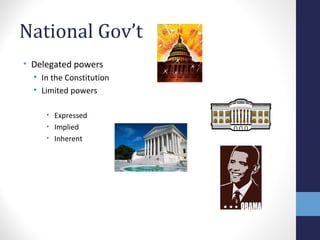
National Gov’t
• Delegated powers
• In the Constitution
• Limited powers
• Expressed
• Implied
• Inherent
National Gov’t
•Expressed power – National
governments powers found in the
Constitution
•It is “expressed”
National Gov’t
•Implied Powers – national
governments powers that are
NOT in the Constitution.
• They can be connected to something in
the Constitution by the necessary and
proper clause (elastic clause)
National Gov’t
•Inherent Powers – National
governments powers that ALL
national governments have.
State Powers
• Reserved Powers
• 10th
Amendment
• Education
• Driving
• Marriage
• License
Concurrent Powers
• Shared by both
• Taxes
• Crime
• Court
Conflict between the National &
State Governments
• Slavery and States Rights
• Settled by the Civil War
• Medical/Recreational Marijuana
• The Definition of Marriage
• National Healthcare (“Obamacare”)
VS
Supreme Court
• Interprets the Constitution to determine appropriate use of
power.
• “Umpire”
Guarantees to the States
•The National government
guarantees three things to the
States
•1. Guarantee Representation
•2. Protect the States
•3. Respect the States
Supremacy of Laws in the US
•US Constitution
•Act of Congress
•State Constitutions
•State laws
•City and County ordinances
Student Learning Objective
• Define: Federalism, Expressed Power, Implied Power, and
Inherited Power
• Understand the workings of federalism as a system of
government.
• Analyze and catalog various national and state laws
Happy Monday 
Enduring Understanding
Federalism is a system of
government that divides
power between two
levels: National & state
Essential Questions
• How federalism divides
government power
• How the Constitution
describes the
relationship between the
national Government
and the states
• How the Constitution
promotes cooperation
between states
Exit Ticket:
• On the scrap piece of paper:
• Name & class period
• Identify two examples of a national, state, and concurrent power.
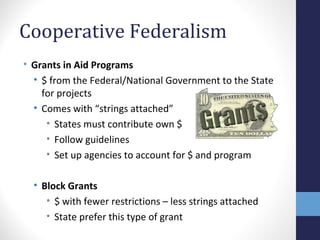
Cooperative Federalism
• Grants in Aid Programs
• $ from the Federal/National Government to the State
for projects
• Comes with “strings attached”
• States must contribute own $
• Follow guidelines
• Set up agencies to account for $ and program
• Block Grants
• $ with fewer restrictions – less strings attached
• State prefer this type of grant
Relations Among the States
• Interstate Relations
• Interstate Compacts
• “Full Faith and Credit”
• “Privileges and Immunities”
• Extradition
Relations Among the States
•Interstate Compacts –
Agreements between two
or more states
Relations Among the States
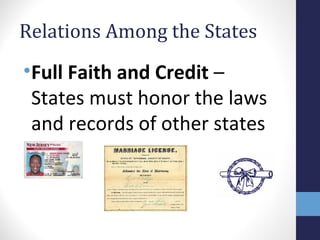
•Full Faith and Credit –
States must honor the laws
and records of other states
Relations Among the States
•Privileges and immunities – No
State can discriminate against a
person who lives in another state.
•There are exceptions
Relations Among the States
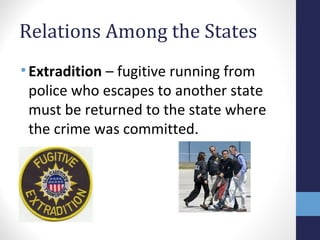
•Extradition – fugitive running from
police who escapes to another state
must be returned to the state where
the crime was committed.
Federalism a Review…for those who weren't listening
the first time
• Federalism is the division of power between a national and
state government
• US National Government –
Washington DC – Barak Obama President
• Pa State Government
• Harrisburg PA – Tome Wolfe - Governor
Federalism a Review…for those who weren't listening
the first time
• National government
• Has delegated (expressed) powers
• Listed in the US Constitution
• Article 1 – Leg Branch
• Article 2 – Executive Branch
• Article 3 – Judicial Branch
Federalism a Review…for those who weren't listening
the first time
• National Powers
• Sign a military Treaty
• Negotiate Border disputes
• Fix(determine) standards of weights and measures
• Maintain military establishments
• Coin (make) a new fifty cent piece
• Grant a copyright on a new book/movie
• Establish a post office
• Regulate the code of conduct on the public airwaves (tv/radio)
Federalism a Review…for those who weren't listening
the first time
• States have “reserved powers”
• 10th
Amendment – “any power not given to the US National
government is reserved to the states”
• Education
• License
• Driving
Federalism a Review…for those who weren't listening the
first time
• State Powers
• Pass a bill to allow gambling
• Establish speed limits
• Define high school graduation requirements
• Marriages and divorces
• Sell hunting a fishing licenses
• Requirements for automobile use
• Regulate smoking in restaurants and bars
Federalism a Review…for those who weren't listening
the first time
•Concurrent of Shared powers
•Powers held by both the
National and State
governments
Federalism a Review…for those who weren't listening
the first time
• Concurrent or Shared Powers
• Increase sales tax
• Increase income tax
• Grant a charter or license for a new bank to open
• Establish holiday observances
• Make and enforce criminal codes
• Establish courts
Federalism a Review…for those who weren't listening
the first time
• There are conflicts or disagreements over powers between
the National Government and the State governments
• Most conflicts settled by the Supreme
Court.
• Slavery and states rights settled by the Civil War
Federalism a Review…for those who weren't listening
the first time
• Interstate Relations
• Interstate Compacts
• “Full Faith and Credit”
• “Privileges and Immunities”
• Extradition
Federalism a Review…for those who weren't listening
the first time
•Federalism provides a check
and balance on the powers
held by each government and
protects the liberties and
freedoms of its citizens

Federalism2015

  • 1.
    Happy Monday  EnduringUnderstanding Federalism is a system of government that divides power between two levels: National & state Essential Questions • How does federalism divide government power? • How does the Constitution describes the relationship between the national government and the states? • How does the Constitution promotes cooperation between states?
  • 2.
  • 3.
    Federalism • System ofGov't that divides power between two levels • National • State
  • 4.
    National Gov’t • Delegatedpowers • In the Constitution • Limited powers • Expressed • Implied • Inherent
  • 5.
    National Gov’t •Expressed power– National governments powers found in the Constitution •It is “expressed”
  • 6.
    National Gov’t •Implied Powers– national governments powers that are NOT in the Constitution. • They can be connected to something in the Constitution by the necessary and proper clause (elastic clause)
  • 7.
    National Gov’t •Inherent Powers– National governments powers that ALL national governments have.
  • 8.
    State Powers • ReservedPowers • 10th Amendment • Education • Driving • Marriage • License
  • 9.
    Concurrent Powers • Sharedby both • Taxes • Crime • Court
  • 10.
    Conflict between theNational & State Governments • Slavery and States Rights • Settled by the Civil War • Medical/Recreational Marijuana • The Definition of Marriage • National Healthcare (“Obamacare”) VS
  • 11.
    Supreme Court • Interpretsthe Constitution to determine appropriate use of power. • “Umpire”
  • 12.
    Guarantees to theStates •The National government guarantees three things to the States •1. Guarantee Representation •2. Protect the States •3. Respect the States
  • 13.
    Supremacy of Lawsin the US •US Constitution •Act of Congress •State Constitutions •State laws •City and County ordinances
  • 14.
    Student Learning Objective •Define: Federalism, Expressed Power, Implied Power, and Inherited Power • Understand the workings of federalism as a system of government. • Analyze and catalog various national and state laws
  • 15.
    Happy Monday  EnduringUnderstanding Federalism is a system of government that divides power between two levels: National & state Essential Questions • How federalism divides government power • How the Constitution describes the relationship between the national Government and the states • How the Constitution promotes cooperation between states
  • 16.
    Exit Ticket: • Onthe scrap piece of paper: • Name & class period • Identify two examples of a national, state, and concurrent power.
  • 17.
    Cooperative Federalism • Grantsin Aid Programs • $ from the Federal/National Government to the State for projects • Comes with “strings attached” • States must contribute own $ • Follow guidelines • Set up agencies to account for $ and program • Block Grants • $ with fewer restrictions – less strings attached • State prefer this type of grant
  • 18.
    Relations Among theStates • Interstate Relations • Interstate Compacts • “Full Faith and Credit” • “Privileges and Immunities” • Extradition
  • 19.
    Relations Among theStates •Interstate Compacts – Agreements between two or more states
  • 20.
    Relations Among theStates •Full Faith and Credit – States must honor the laws and records of other states
  • 21.
    Relations Among theStates •Privileges and immunities – No State can discriminate against a person who lives in another state. •There are exceptions
  • 22.
    Relations Among theStates •Extradition – fugitive running from police who escapes to another state must be returned to the state where the crime was committed.
  • 23.
    Federalism a Review…forthose who weren't listening the first time • Federalism is the division of power between a national and state government • US National Government – Washington DC – Barak Obama President • Pa State Government • Harrisburg PA – Tome Wolfe - Governor
  • 24.
    Federalism a Review…forthose who weren't listening the first time • National government • Has delegated (expressed) powers • Listed in the US Constitution • Article 1 – Leg Branch • Article 2 – Executive Branch • Article 3 – Judicial Branch
  • 25.
    Federalism a Review…forthose who weren't listening the first time • National Powers • Sign a military Treaty • Negotiate Border disputes • Fix(determine) standards of weights and measures • Maintain military establishments • Coin (make) a new fifty cent piece • Grant a copyright on a new book/movie • Establish a post office • Regulate the code of conduct on the public airwaves (tv/radio)
  • 26.
    Federalism a Review…forthose who weren't listening the first time • States have “reserved powers” • 10th Amendment – “any power not given to the US National government is reserved to the states” • Education • License • Driving
  • 27.
    Federalism a Review…forthose who weren't listening the first time • State Powers • Pass a bill to allow gambling • Establish speed limits • Define high school graduation requirements • Marriages and divorces • Sell hunting a fishing licenses • Requirements for automobile use • Regulate smoking in restaurants and bars
  • 28.
    Federalism a Review…forthose who weren't listening the first time •Concurrent of Shared powers •Powers held by both the National and State governments
  • 29.
    Federalism a Review…forthose who weren't listening the first time • Concurrent or Shared Powers • Increase sales tax • Increase income tax • Grant a charter or license for a new bank to open • Establish holiday observances • Make and enforce criminal codes • Establish courts
  • 30.
    Federalism a Review…forthose who weren't listening the first time • There are conflicts or disagreements over powers between the National Government and the State governments • Most conflicts settled by the Supreme Court. • Slavery and states rights settled by the Civil War
  • 31.
    Federalism a Review…forthose who weren't listening the first time • Interstate Relations • Interstate Compacts • “Full Faith and Credit” • “Privileges and Immunities” • Extradition
  • 32.
    Federalism a Review…forthose who weren't listening the first time •Federalism provides a check and balance on the powers held by each government and protects the liberties and freedoms of its citizens