02/11/2025 1
NAVODAYA VIDYALAYA SAMITI
HYDERABAD REGION
CLASS:X
SUBJECT:SOCIAL SCIENCE
02/11/2025
PREPARED BY:
Mr. A.K Basavaraj
PGT-History
2
JAWAHAR NAVODAYA VIDYALAYA
KURNOOL DIST. ANDHRA PRADESH
02/11/2025 3
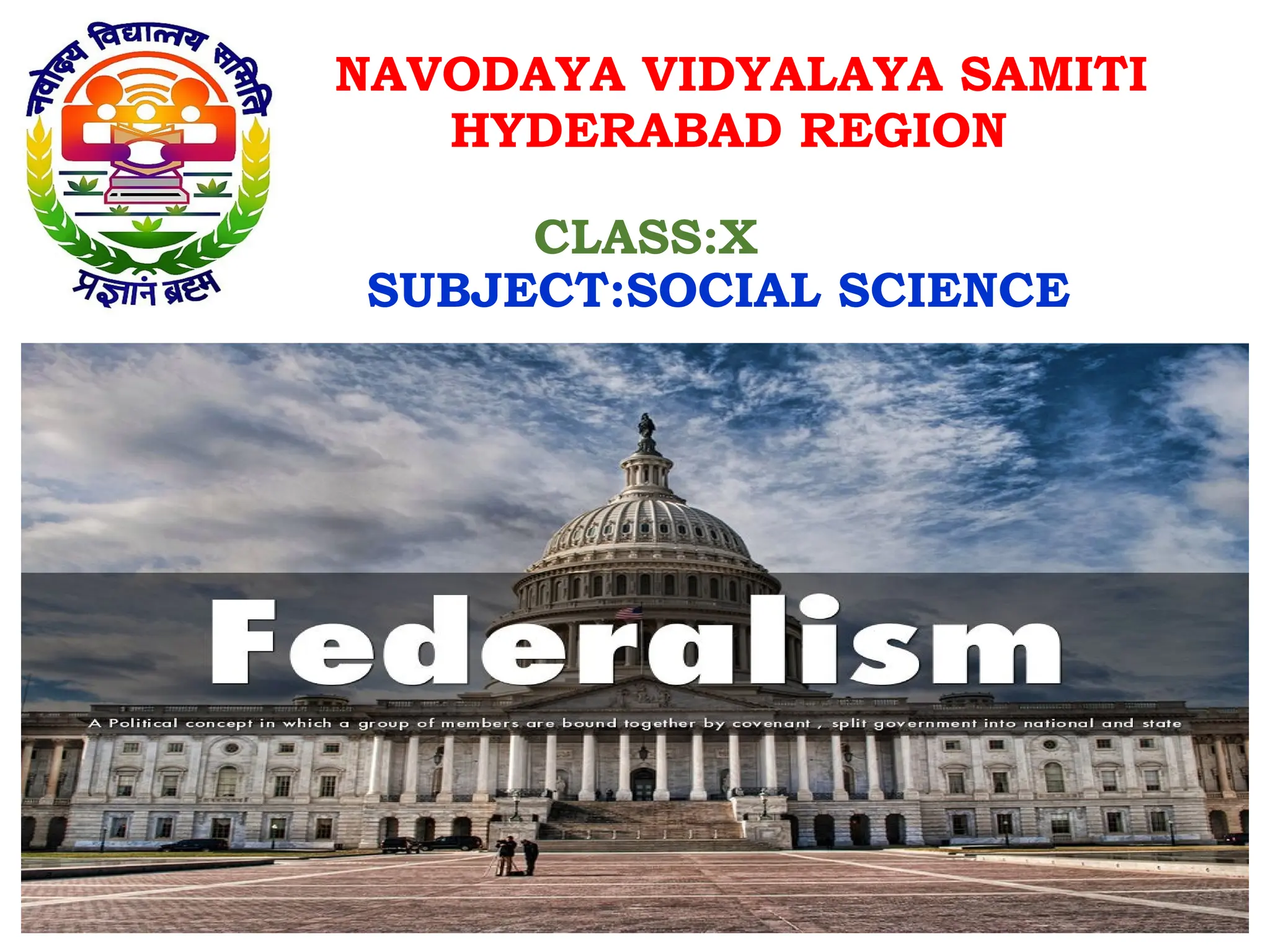
Federalism
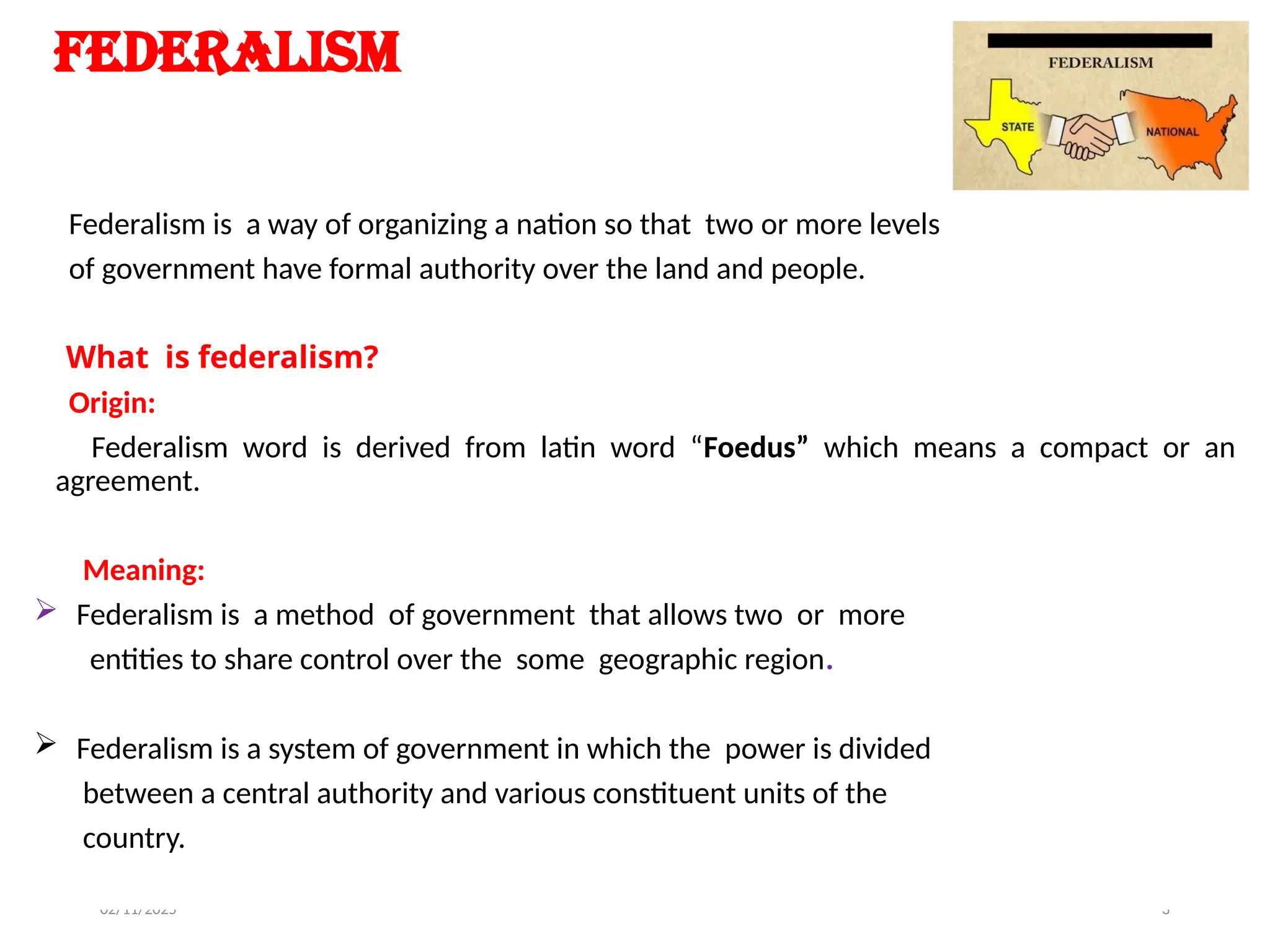
Federalism is a way of organizing a nation so that two or more levels
of government have formal authority over the land and people.
What is federalism?
Origin:
Federalism word is derived from latin word “Foedus” which means a compact or an
agreement.
Meaning:
 Federalism is a method of government that allows two or more
entities to share control over the some geographic region.
 Federalism is a system of government in which the power is divided
between a central authority and various constituent units of the
country.
02/11/2025 4
Federalism
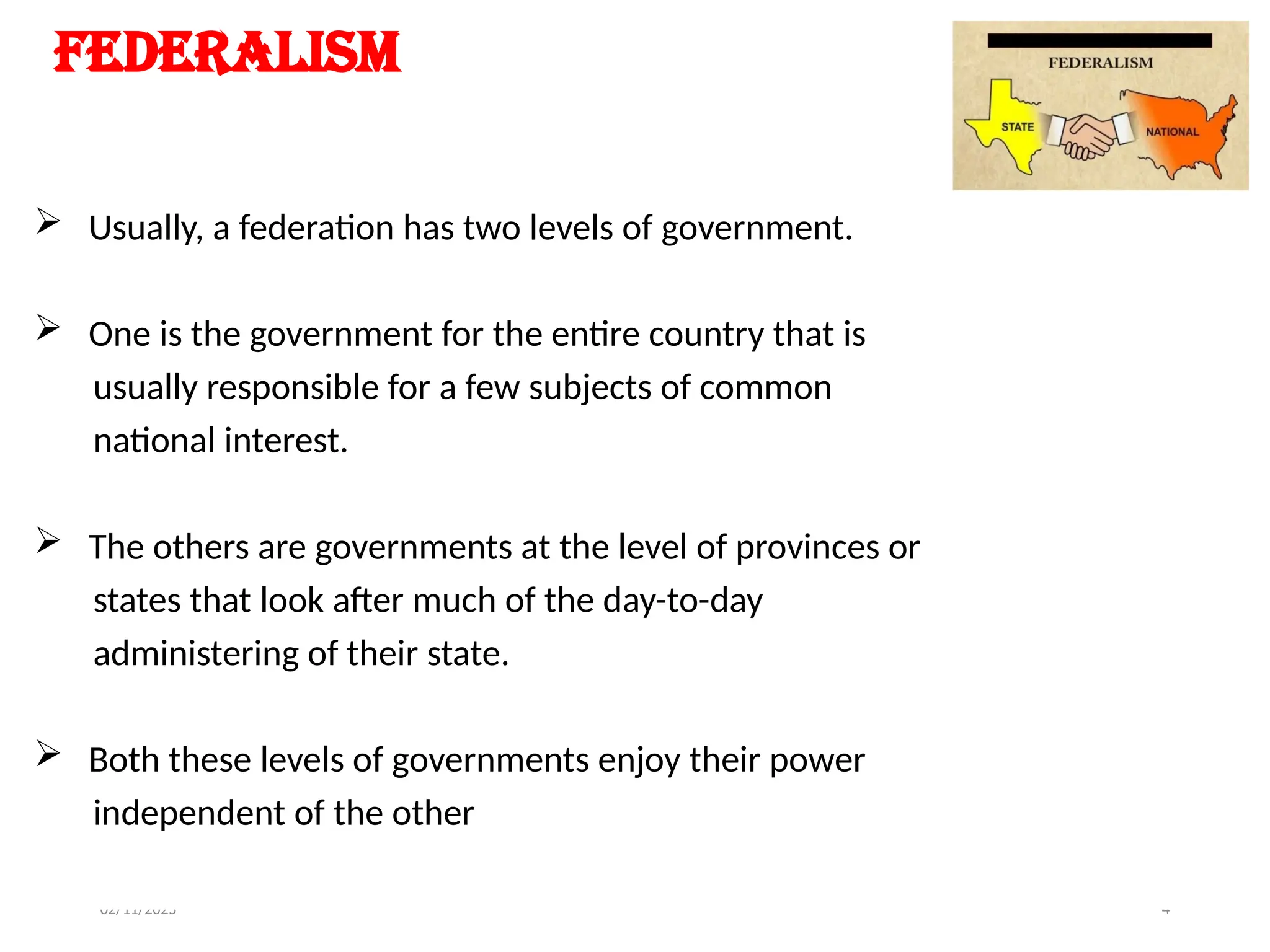
 Usually, a federation has two levels of government.
 One is the government for the entire country that is
usually responsible for a few subjects of common
national interest.
 The others are governments at the level of provinces or
states that look after much of the day-to-day
administering of their state.
 Both these levels of governments enjoy their power
independent of the other
02/11/2025 5
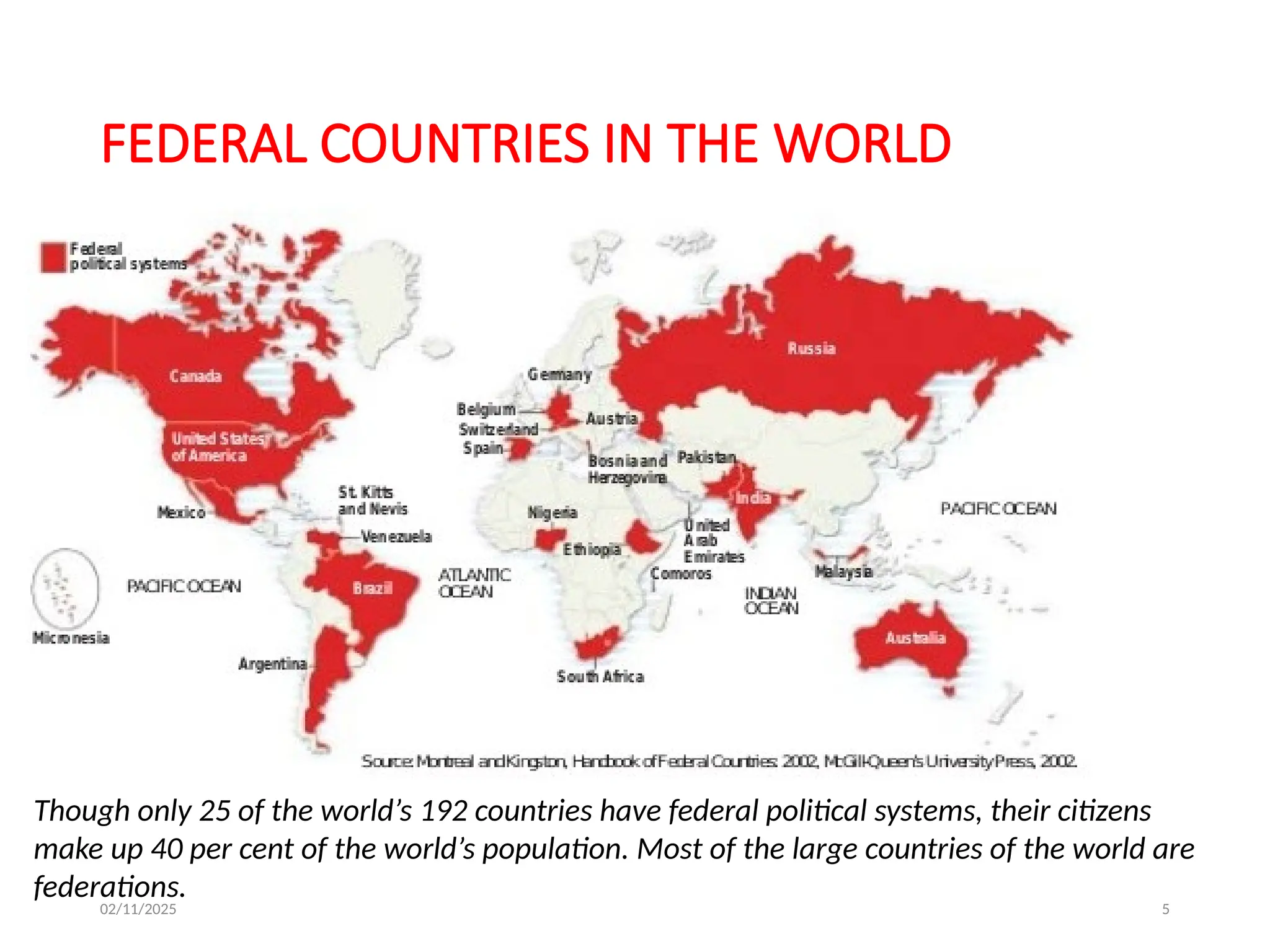
FEDERAL COUNTRIES IN THE WORLD
Though only 25 of the world’s 192 countries have federal political systems, their citizens
make up 40 per cent of the world’s population. Most of the large countries of the world are
federations.
02/11/2025 6
What is unitary system?
• In this form of administration, there is only one level of government over the
whole country. If there are more sub-units, they are subordinates to central.
• Here, central government passes on the orders to other levels of
government(provincial or the local government).
• Other levels of government are subordinate to central government
• Example: United kingdom
02/11/2025 7
What is Federal system?
• In this form of administration, there are two levels of
government(Central/National and State).
• The central government cannot order the state government to do something.
(two different types of law-Central and states laws).
• State government has powers of its own for which it is not answerable to the
central government.
• Both these governments are separately answerable to the people.
• Example: USA.
02/11/2025 8
Unitary and Federal System Countries in the World
02/11/2025 9
The Key Features of federation
• There are two or more levels (or tiers) of government.
• Different tiers of government govern the same citizens, but each tier has its own
JURISDICTION in specific matters of legislation, taxation and administration.
• The jurisdictions of the respective levels or tiers of government are specified in the
constitution. So the existence and authority of each tier of government is
constitutionally guaranteed.
• The fundamental provisions of the constitution cannot be unilaterally changed by one
level of government. Such changes require the consent of both the levels of
government.
• Courts have the power to interpret the constitution and the powers of different levels
of government. The highest court acts as an umpire if disputes arise between different
levels of government in the exercise of their respective powers.
02/11/2025 10
The Key Features of federation
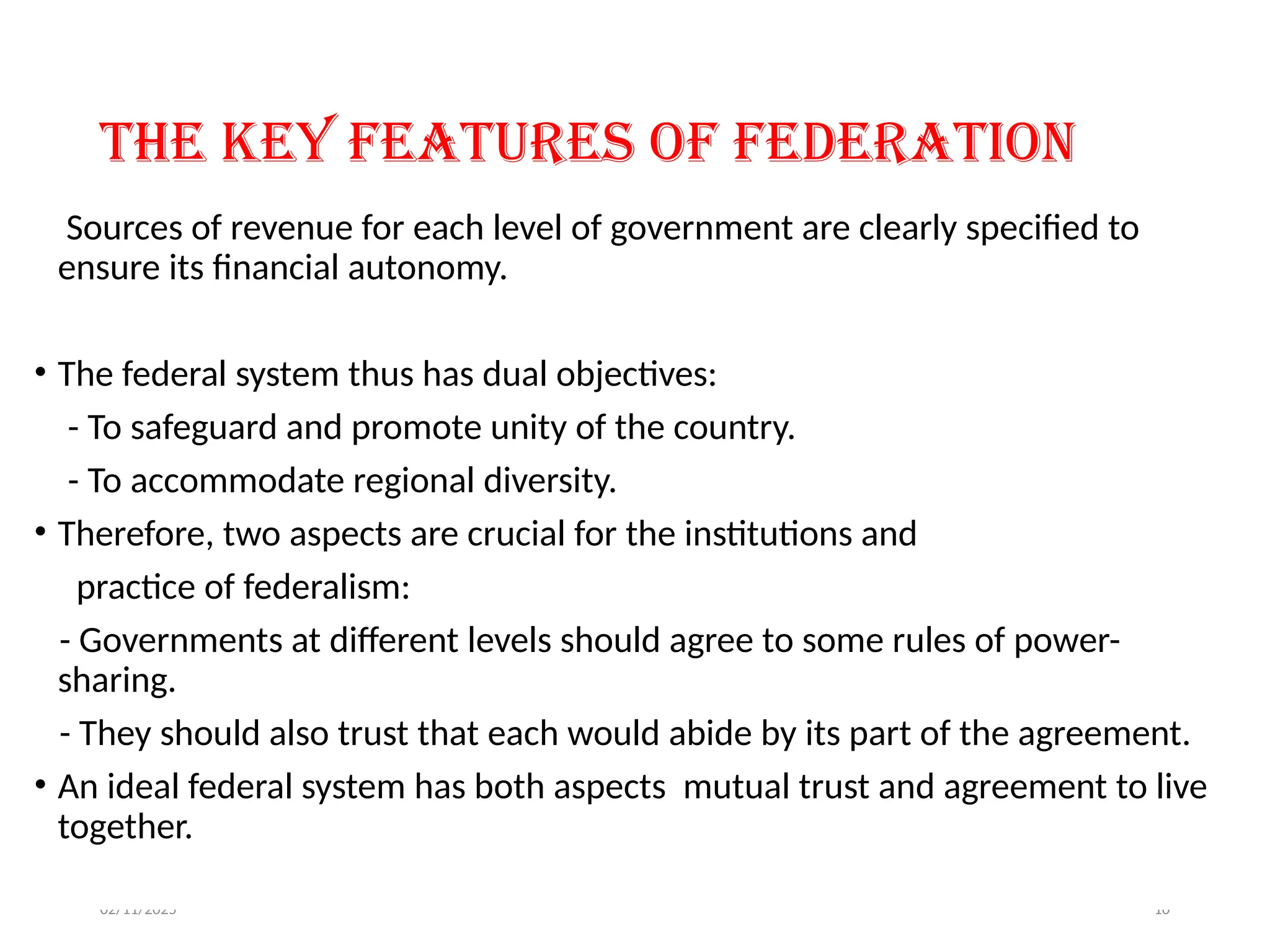
• Sources of revenue for each level of government are clearly specified to
ensure its financial autonomy.
• The federal system thus has dual objectives:
- To safeguard and promote unity of the country.
- To accommodate regional diversity.
• Therefore, two aspects are crucial for the institutions and
practice of federalism:
- Governments at different levels should agree to some rules of power-
sharing.
- They should also trust that each would abide by its part of the agreement.
• An ideal federal system has both aspects mutual trust and agreement to live
together.
02/11/2025 11
Balance of power
• The exact balance of power between the central and the state government
varies from one federation to another.
• This balance depends mainly on the historical context in which the federation
was formed.
02/11/2025 12
TYPES OF FEDERALISM
There are two kinds of routes through which federations have been formed:
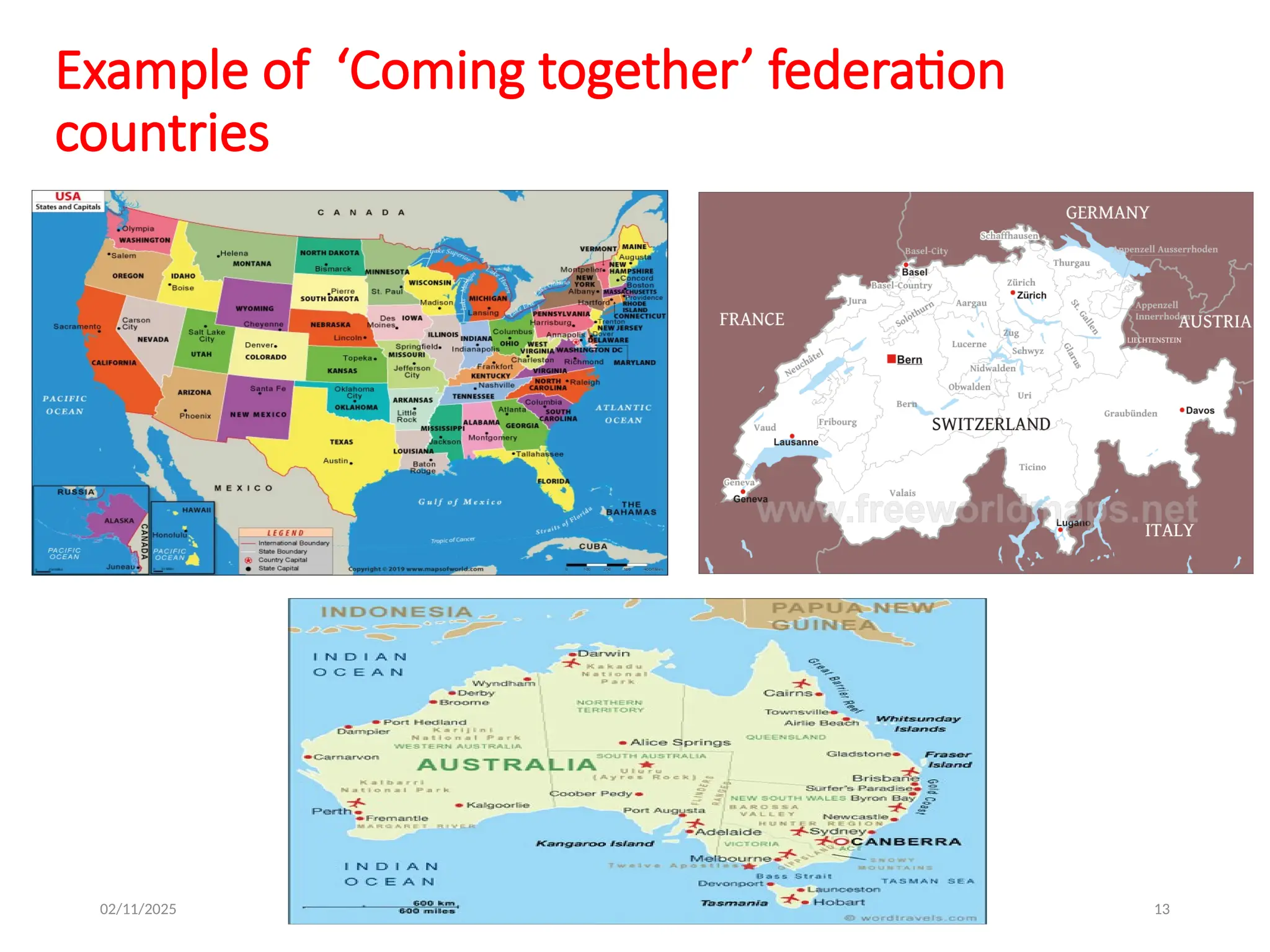
1. ‘Coming together’ federation’:-
- it involves independent states coming together on their own to
form a bigger unit.
- It helps to maintain sovereignty and security.
- Each state is equally strong.
Example: USA, Switzerland and Australia.
02/11/2025 13
Example of ‘Coming together’ federation
countries
02/11/2025 14
TYPES OF FEDERALISM
2. ‘Holding together’ federation:
- It is where a large country decides to divide its power between the
constituent States and the national government (Country is divided into
states for better Administration).
- It helps for accommodation of diversity.
- Some states might be given more power. The
ultimate power lies in the hand of central.
Example: India, Spain and Belgium.
02/11/2025 15
Example of ‘Holding together’ federation
countries
02/11/2025 16
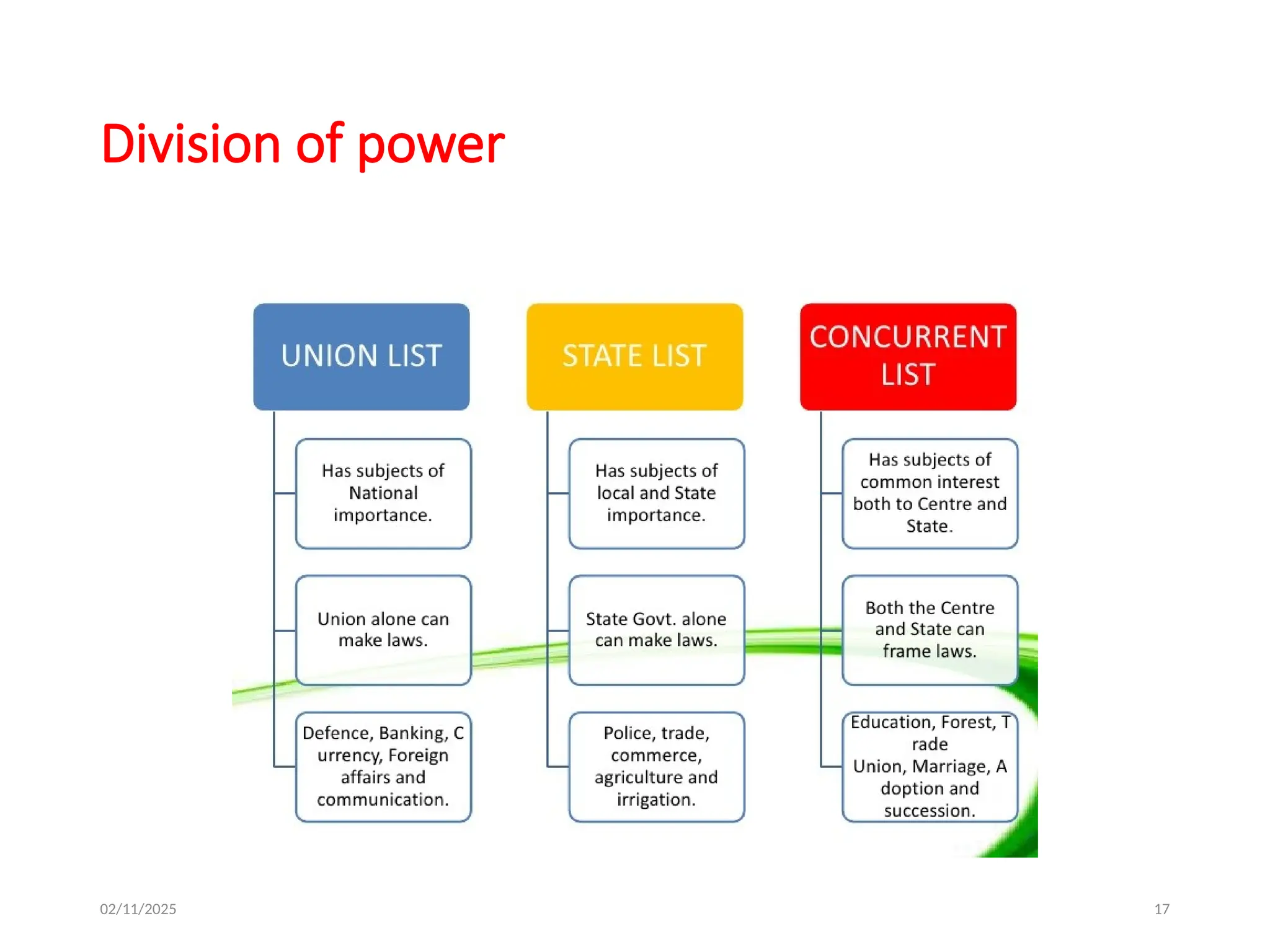
What makes India a federal Country?
• Division of powers
• Some states are given more
powers
• Written constitution
• Union territories
• Jurisdiction
• Levels of Government
02/11/2025 17
Division of power
02/11/2025 18
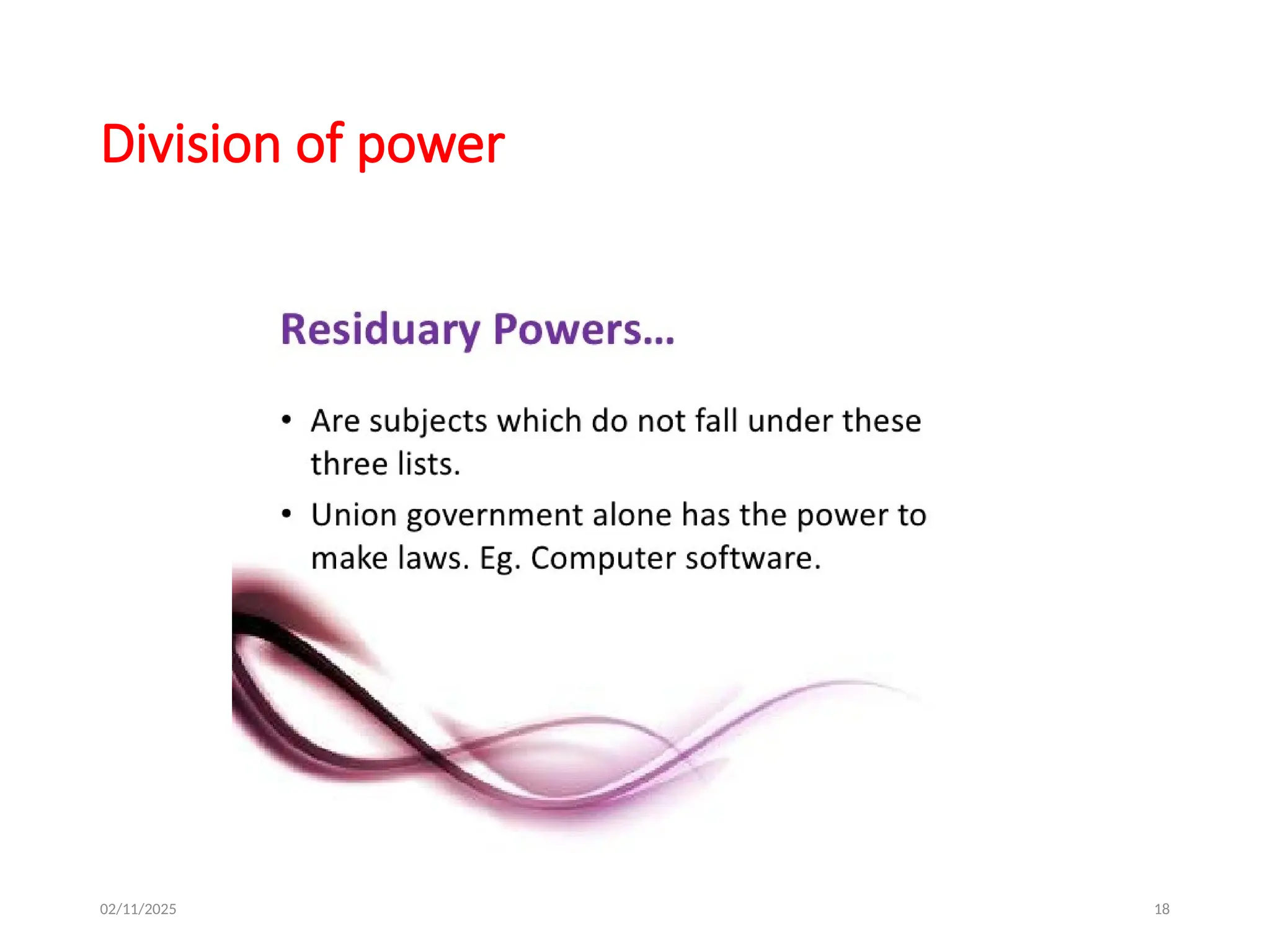
Division of power
02/11/2025 19
How is Federalism Practiced in India
02/11/2025 20
How is Federalism Practiced in India
Linguistic States:
• The first challenge faced after independence was linguistic states.
• In 1947, the areas, boundaries and names of several old states of India were
changed in order to create new states.
• New states were formed on the basis of language and culture.
(who spoke the same language lived in the same state.)
Ex: Gujarat, West-Bengal and Bihar.
• Some states were formed on the basis of ethnicity and geography such as
Nagaland, Uttarakhand and Jharkhand
• Some concerned that it might lead to disintegration of the nation, but worked
well and effectively.
02/11/2025 21
How is Federalism Practiced in India
Language Policy :
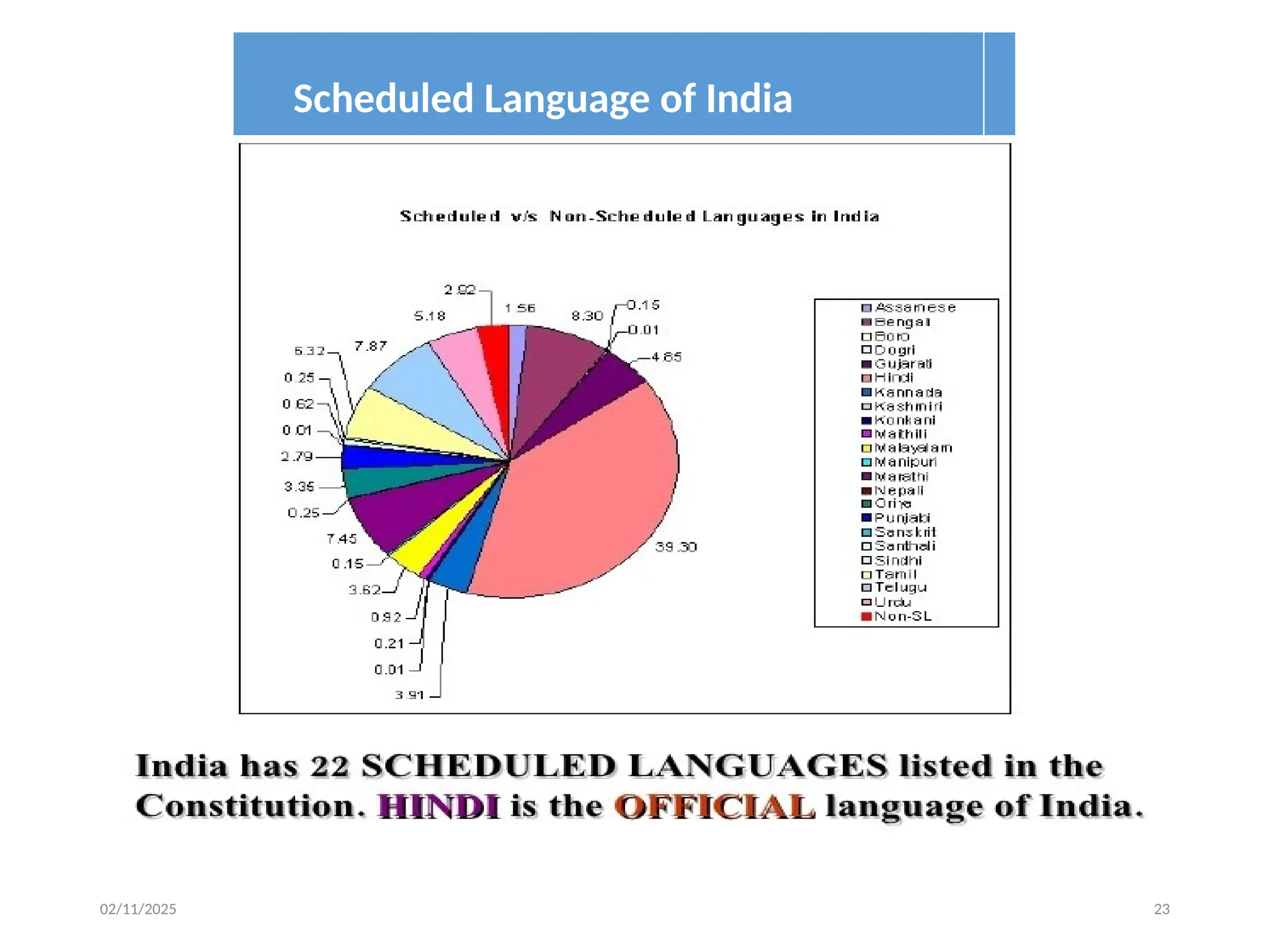
• A second test for Indian federation is the language policy. Our constitution did
not give the status of national language to any one language. Hindi was
identified as the official language. But it is the mother tongue of only about
40% of Indians.
• There are 21 other Scheduled languages. State can enjoy its own language for
official purpose.
• We have adopted three languages structure and any two languages can be
used for administrative purpose.
02/11/2025 22
How is Federalism Practiced in India
Language Policy :
• According to constitution, the use of English for official Purposes was to stop
in 1965. but non-Hindi speaking States demanded that the use of English,
therefore the central government said to continue the use of English along
with Hindi for official purposes.
• A candidate in an examination conducted for the central government
positions may opt to take the examination in any of these languages. States
too have their own official languages.
02/11/2025 23
Scheduled Language of India
02/11/2025 24
How is Federalism Practiced in India
Central and State Relation :
• It helped a lot to avoid clashes between central and states.
• When same political party ruling in central and state. State couldn't enjoy more power as central
government could influence the decisions of states.
• But after 1990, many regional parties came up and acquired the power in states. This was also the
beginning of the era of Coalition Governments at the centre.
• Since no single party got a clear majority in the Lok Sabha, the major national parties had to enter
into an alliance with many parties including several regional parties to form a government at the
centre.
• This led to a new culture of power sharing and respect for the autonomy of the state governments.
Thus more independent decisions were taken by states and federal system was practiced.
• Today, these regional political parties are even affecting the decision making in central also.
• So we can say that today’s power sharing is more effective than it was practiced in the early days when
constitution was written.
02/11/2025 25
LINGUISTIC DIVERSITY OF INDIA
• As per the census report, 2001 of India held in 2001 there are 1500 distinct
languages.
• These languages were grouped together under some major languages like
Bhojpuri, Magadhi, Bundelkhandi, Chattisgarhi, Rajasthani, Bhili and many
others were grouped together under ‘Hindi’.
• Even after this grouping, the census found 114 major languages of these 22
languages are now included in Eighth scheduled of the Indian constitution and
are therefore called scheduled languages others are called non- scheduled
languages.
• In terms of languages, India is perhaps the most diverse country in the world.
02/11/2025 26
DECENTRALIZATION IN INDIA
• When power is taken away from central and given to other levels of
government(state government and given to local government) is called
‘Decentralization’.
• It plays very important role in democracy as
- It helps to reduce the burden of central government
- It helps to increase the participation of people in decision making and also
democratic process.
- It helps to solve local problems effectively.
- Local self government is called schools of democracy.
02/11/2025 27
DECENTRALIZATION IN INDIA
• We have after independence two tiers of government in our country. But now
we have three tier of government in our country. Why?
- India is a vast country therefore India cannot be run only through these two
tiers government.
- States in India are as large as independent countries of Europe.(in terms of
population, Uttar Pradesh is bigger than Russia, Maharashtra is about as big as
Germany).
- Many of these states are internally very diverse so there is thus a need for
power sharing within these states.
02/11/2025 28
DECENTRALIZATION IN INDIA
• A major step towards decentralization was taken in 1992. The Constitution was
amended to make the third-tier of democracy more powerful and effective. Here are
the key features of 3-tier democracy:
- It is constitutionally mandatory to hold regular elections to local government bodies.
- Seats are reserved in the elected bodies and the executive heads of these institutions
for the Scheduled Castes, Scheduled Tribes and Other Backward Classes.
- At least one-third of all positions are reserved for women.
- State Election Commission has been created in each State to conduct panchayat and
municipal elections.
-The State governments are required to share some powers and revenue with local
government bodies. The nature of sharing varies from State to State.
02/11/2025 29
DECENTRALIZATION IN INDIA
Federal structure in India
02/11/2025 30
STRUCTURE OF SELF LOCAL GOVERNMENT
( Rural)
02/11/2025 31
STRUCTURE OF SELF LOCAL
GOVERNMENT(Urban)
02/11/2025 32
Deficiencies of Local Self Government
• Elections to Gram Sabhas are not held regularly.
• Most of the state governments are not transferring powers and resources (Ex.
Financial Needs).
• Women inactive participation.
SMT. G. ANUSUYA
HON’BLE DEPUTY COMMISSIONER
NVS, HYDERABAD REGION
HYDERABAD, TS
SRI. M. VENKATARAMANA
PRINCIPAL, JNV. MEDAK
SMT. V. SHANTHI
VICE PRINCIPAL, JNV. ANANTAPUR
02/11/2025 34
THANK YOU
Chapter 2 Federalism class 10 CBSE Civics

Chapter 2 Federalism class 10 CBSE Civics

  • 1.
    02/11/2025 1 NAVODAYA VIDYALAYASAMITI HYDERABAD REGION CLASS:X SUBJECT:SOCIAL SCIENCE
  • 2.
    02/11/2025 PREPARED BY: Mr. A.KBasavaraj PGT-History 2 JAWAHAR NAVODAYA VIDYALAYA KURNOOL DIST. ANDHRA PRADESH
  • 3.
    02/11/2025 3 Federalism Federalism isa way of organizing a nation so that two or more levels of government have formal authority over the land and people. What is federalism? Origin: Federalism word is derived from latin word “Foedus” which means a compact or an agreement. Meaning:  Federalism is a method of government that allows two or more entities to share control over the some geographic region.  Federalism is a system of government in which the power is divided between a central authority and various constituent units of the country.
  • 4.
    02/11/2025 4 Federalism  Usually,a federation has two levels of government.  One is the government for the entire country that is usually responsible for a few subjects of common national interest.  The others are governments at the level of provinces or states that look after much of the day-to-day administering of their state.  Both these levels of governments enjoy their power independent of the other
  • 5.
    02/11/2025 5 FEDERAL COUNTRIESIN THE WORLD Though only 25 of the world’s 192 countries have federal political systems, their citizens make up 40 per cent of the world’s population. Most of the large countries of the world are federations.
  • 6.
    02/11/2025 6 What isunitary system? • In this form of administration, there is only one level of government over the whole country. If there are more sub-units, they are subordinates to central. • Here, central government passes on the orders to other levels of government(provincial or the local government). • Other levels of government are subordinate to central government • Example: United kingdom
  • 7.
    02/11/2025 7 What isFederal system? • In this form of administration, there are two levels of government(Central/National and State). • The central government cannot order the state government to do something. (two different types of law-Central and states laws). • State government has powers of its own for which it is not answerable to the central government. • Both these governments are separately answerable to the people. • Example: USA.
  • 8.
    02/11/2025 8 Unitary andFederal System Countries in the World
  • 9.
    02/11/2025 9 The KeyFeatures of federation • There are two or more levels (or tiers) of government. • Different tiers of government govern the same citizens, but each tier has its own JURISDICTION in specific matters of legislation, taxation and administration. • The jurisdictions of the respective levels or tiers of government are specified in the constitution. So the existence and authority of each tier of government is constitutionally guaranteed. • The fundamental provisions of the constitution cannot be unilaterally changed by one level of government. Such changes require the consent of both the levels of government. • Courts have the power to interpret the constitution and the powers of different levels of government. The highest court acts as an umpire if disputes arise between different levels of government in the exercise of their respective powers.
  • 10.
    02/11/2025 10 The KeyFeatures of federation • Sources of revenue for each level of government are clearly specified to ensure its financial autonomy. • The federal system thus has dual objectives: - To safeguard and promote unity of the country. - To accommodate regional diversity. • Therefore, two aspects are crucial for the institutions and practice of federalism: - Governments at different levels should agree to some rules of power- sharing. - They should also trust that each would abide by its part of the agreement. • An ideal federal system has both aspects mutual trust and agreement to live together.
  • 11.
    02/11/2025 11 Balance ofpower • The exact balance of power between the central and the state government varies from one federation to another. • This balance depends mainly on the historical context in which the federation was formed.
  • 12.
    02/11/2025 12 TYPES OFFEDERALISM There are two kinds of routes through which federations have been formed: 1. ‘Coming together’ federation’:- - it involves independent states coming together on their own to form a bigger unit. - It helps to maintain sovereignty and security. - Each state is equally strong. Example: USA, Switzerland and Australia.
  • 13.
    02/11/2025 13 Example of‘Coming together’ federation countries
  • 14.
    02/11/2025 14 TYPES OFFEDERALISM 2. ‘Holding together’ federation: - It is where a large country decides to divide its power between the constituent States and the national government (Country is divided into states for better Administration). - It helps for accommodation of diversity. - Some states might be given more power. The ultimate power lies in the hand of central. Example: India, Spain and Belgium.
  • 15.
    02/11/2025 15 Example of‘Holding together’ federation countries
  • 16.
    02/11/2025 16 What makesIndia a federal Country? • Division of powers • Some states are given more powers • Written constitution • Union territories • Jurisdiction • Levels of Government
  • 17.
  • 18.
  • 19.
    02/11/2025 19 How isFederalism Practiced in India
  • 20.
    02/11/2025 20 How isFederalism Practiced in India Linguistic States: • The first challenge faced after independence was linguistic states. • In 1947, the areas, boundaries and names of several old states of India were changed in order to create new states. • New states were formed on the basis of language and culture. (who spoke the same language lived in the same state.) Ex: Gujarat, West-Bengal and Bihar. • Some states were formed on the basis of ethnicity and geography such as Nagaland, Uttarakhand and Jharkhand • Some concerned that it might lead to disintegration of the nation, but worked well and effectively.
  • 21.
    02/11/2025 21 How isFederalism Practiced in India Language Policy : • A second test for Indian federation is the language policy. Our constitution did not give the status of national language to any one language. Hindi was identified as the official language. But it is the mother tongue of only about 40% of Indians. • There are 21 other Scheduled languages. State can enjoy its own language for official purpose. • We have adopted three languages structure and any two languages can be used for administrative purpose.
  • 22.
    02/11/2025 22 How isFederalism Practiced in India Language Policy : • According to constitution, the use of English for official Purposes was to stop in 1965. but non-Hindi speaking States demanded that the use of English, therefore the central government said to continue the use of English along with Hindi for official purposes. • A candidate in an examination conducted for the central government positions may opt to take the examination in any of these languages. States too have their own official languages.
  • 23.
  • 24.
    02/11/2025 24 How isFederalism Practiced in India Central and State Relation : • It helped a lot to avoid clashes between central and states. • When same political party ruling in central and state. State couldn't enjoy more power as central government could influence the decisions of states. • But after 1990, many regional parties came up and acquired the power in states. This was also the beginning of the era of Coalition Governments at the centre. • Since no single party got a clear majority in the Lok Sabha, the major national parties had to enter into an alliance with many parties including several regional parties to form a government at the centre. • This led to a new culture of power sharing and respect for the autonomy of the state governments. Thus more independent decisions were taken by states and federal system was practiced. • Today, these regional political parties are even affecting the decision making in central also. • So we can say that today’s power sharing is more effective than it was practiced in the early days when constitution was written.
  • 25.
    02/11/2025 25 LINGUISTIC DIVERSITYOF INDIA • As per the census report, 2001 of India held in 2001 there are 1500 distinct languages. • These languages were grouped together under some major languages like Bhojpuri, Magadhi, Bundelkhandi, Chattisgarhi, Rajasthani, Bhili and many others were grouped together under ‘Hindi’. • Even after this grouping, the census found 114 major languages of these 22 languages are now included in Eighth scheduled of the Indian constitution and are therefore called scheduled languages others are called non- scheduled languages. • In terms of languages, India is perhaps the most diverse country in the world.
  • 26.
    02/11/2025 26 DECENTRALIZATION ININDIA • When power is taken away from central and given to other levels of government(state government and given to local government) is called ‘Decentralization’. • It plays very important role in democracy as - It helps to reduce the burden of central government - It helps to increase the participation of people in decision making and also democratic process. - It helps to solve local problems effectively. - Local self government is called schools of democracy.
  • 27.
    02/11/2025 27 DECENTRALIZATION ININDIA • We have after independence two tiers of government in our country. But now we have three tier of government in our country. Why? - India is a vast country therefore India cannot be run only through these two tiers government. - States in India are as large as independent countries of Europe.(in terms of population, Uttar Pradesh is bigger than Russia, Maharashtra is about as big as Germany). - Many of these states are internally very diverse so there is thus a need for power sharing within these states.
  • 28.
    02/11/2025 28 DECENTRALIZATION ININDIA • A major step towards decentralization was taken in 1992. The Constitution was amended to make the third-tier of democracy more powerful and effective. Here are the key features of 3-tier democracy: - It is constitutionally mandatory to hold regular elections to local government bodies. - Seats are reserved in the elected bodies and the executive heads of these institutions for the Scheduled Castes, Scheduled Tribes and Other Backward Classes. - At least one-third of all positions are reserved for women. - State Election Commission has been created in each State to conduct panchayat and municipal elections. -The State governments are required to share some powers and revenue with local government bodies. The nature of sharing varies from State to State.
  • 29.
    02/11/2025 29 DECENTRALIZATION ININDIA Federal structure in India
  • 30.
    02/11/2025 30 STRUCTURE OFSELF LOCAL GOVERNMENT ( Rural)
  • 31.
    02/11/2025 31 STRUCTURE OFSELF LOCAL GOVERNMENT(Urban)
  • 32.
    02/11/2025 32 Deficiencies ofLocal Self Government • Elections to Gram Sabhas are not held regularly. • Most of the state governments are not transferring powers and resources (Ex. Financial Needs). • Women inactive participation.
  • 33.
    SMT. G. ANUSUYA HON’BLEDEPUTY COMMISSIONER NVS, HYDERABAD REGION HYDERABAD, TS SRI. M. VENKATARAMANA PRINCIPAL, JNV. MEDAK SMT. V. SHANTHI VICE PRINCIPAL, JNV. ANANTAPUR
  • 34.