
Extended Gateways: Improving the Port/Hinterland Interface Extended Gateways: Improving the Port/Hinterland Interface Alasdair Crooke
Topics What is the Extended Gateway? Role of Port Integration with hinterland Extended Gateway Value Adding Hinterland connection Emissions & congestion
What is the Extended Gateway Concept? The Extended Gateway shifts the primary gateway of the seaport into the hinterland Offers efficient connections with the traditional gateways Provides a location for value adding alongside integrated multimodal hinterland networks ( Flanders Institute of Technology 2006)
Role of Port The role of ports has changed Ports now compete as elements within a supply chain Hinterland access is the area where ports can  create a competitive advantage over their rivals Movement of containers from the port to the customer make up between 40 to 80% of total container shipping costs   ( Notteboom & Rodrigue 2005)
Role of Port cont. “ routing choices, and to some extent port choices are strongly dependent on hinterland transport conditions and reliability of the route has become increasingly important to those in the supply chain making the routing decisions”  (International Transport Forum 2008, p. 8)
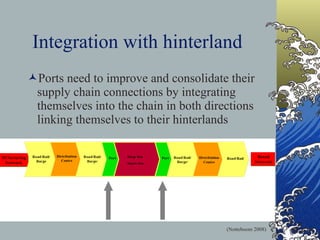
Integration with hinterland Ports need to improve and consolidate their supply chain connections by integrating themselves into the chain in both directions linking themselves to their hinterlands (Notteboom 2008)
Extended Gateway Extended Gateways provide ports with an opportunity to further integrate themselves into supply chains by  improving   hinterland connections  and establishing locations that support activities that  add value  to the freight that passes through them
Value adding Consolidation/Deconsolidation Building up/Breaking down shipments Transloading Transloading of maritime units to domestic Postponement Warehouse-based terminalisation Light Transformations Product and package transformations ( Rodrigue, Debrie, Fremont & Gouvernal n.d)
Hinterland connection Improving hinterland connections Reduce congestion at the port Freight delivered to extended gateway Freight consolidated at extended gateway Freight transported from extended gateway in loading sequence and just-in-time for transshipment Transported during off peak traffic hours Maximise vehicle utilisation Increase backloading
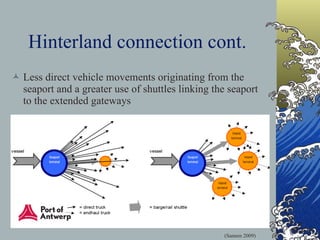
Hinterland connection cont. Less direct vehicle movements originating from the seaport and a greater use of shuttles linking the seaport to the extended gateways   (Sannen 2009)


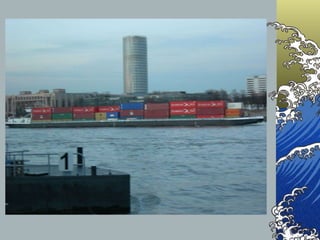
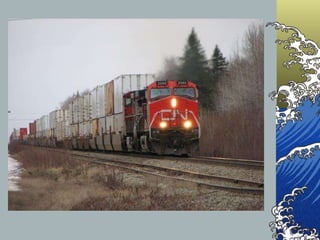
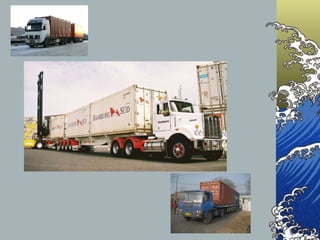
Emissions & Congestion Reduced port related traffic Trade off between reduction of truck miles compared to additional rail or barge miles incurred Make sure problem isn’t just shifted to a new location Consideration of new technology
Questions?
References Flanders Institute of Technology 2006,  Flanders: a unique value proposition for logistics,  Flanders Institute of Technology,  http:// extendedgateways . vil .be/docs/ ExtendedgatewaysDeLloyd . pdf , accessed  23 September 2009.   International Transport Forum 2008, ‘Port competition and hinterland connections. Summary and  conclusions’,  Joint Transport Research Centre Round Table,  10-11 April 2008, Paris,  http://www. internationaltransportforum .org/ jtrc / DiscussionPapers /DP200819. pdf ,  accessed 28 March 2009. Notteboom, T. & Rodrigue, J. 2005, ‘Port regionalization: towards a new phase in port  development’,  Maritime Policy and Management,  vol. 32, no. 3, pp. 297-313.   Notteboom, T. 2008, ‘The facilitating role of port authorities in the logistics chain’,  ESPO/EFIP  International Workshop on ‘Ports-facilitators in the logistics chain’,  11 March 2008,  Strasbourg,  http://www. espo .be/downloads/archive/34195bf2-7923-4736-8a08-	cd2a3635dfdf. pdf , accessed 23 September 2009.   Rodrigue, J., Debrie, J., Fremont, A. & Gouvernal, E. n.d., ‘Functions and actors of inland ports:  European and North American dynamics’,  http://people. hofstra .edu/Jean- 	paul _ Rodrigue /downloads/Actors_Functions_Inland_Ports. pdf , accessed 23 September  2009. Sannen, G. 2009, ‘Antwerp’s view on extended gateways: from ‘mainport’ to ‘chainport’’,  PORT-NET  Workshop,  10-12 June, Antwerp,  http://www.port-	net.net/activities/ pdf / sannen _ antwerp _11062009. pdf , accessed 28 September 2009.

Extended Gateways : Improving the Port / Hinterland Interface

  • 1.
    Extended Gateways: Improvingthe Port/Hinterland Interface Extended Gateways: Improving the Port/Hinterland Interface Alasdair Crooke
  • 2.
    Topics What isthe Extended Gateway? Role of Port Integration with hinterland Extended Gateway Value Adding Hinterland connection Emissions & congestion
  • 3.
    What is theExtended Gateway Concept? The Extended Gateway shifts the primary gateway of the seaport into the hinterland Offers efficient connections with the traditional gateways Provides a location for value adding alongside integrated multimodal hinterland networks ( Flanders Institute of Technology 2006)
  • 4.
    Role of PortThe role of ports has changed Ports now compete as elements within a supply chain Hinterland access is the area where ports can create a competitive advantage over their rivals Movement of containers from the port to the customer make up between 40 to 80% of total container shipping costs ( Notteboom & Rodrigue 2005)
  • 5.
    Role of Portcont. “ routing choices, and to some extent port choices are strongly dependent on hinterland transport conditions and reliability of the route has become increasingly important to those in the supply chain making the routing decisions” (International Transport Forum 2008, p. 8)
  • 6.
    Integration with hinterlandPorts need to improve and consolidate their supply chain connections by integrating themselves into the chain in both directions linking themselves to their hinterlands (Notteboom 2008)
  • 7.
    Extended Gateway ExtendedGateways provide ports with an opportunity to further integrate themselves into supply chains by improving hinterland connections and establishing locations that support activities that add value to the freight that passes through them
  • 8.
    Value adding Consolidation/DeconsolidationBuilding up/Breaking down shipments Transloading Transloading of maritime units to domestic Postponement Warehouse-based terminalisation Light Transformations Product and package transformations ( Rodrigue, Debrie, Fremont & Gouvernal n.d)
  • 9.
    Hinterland connection Improvinghinterland connections Reduce congestion at the port Freight delivered to extended gateway Freight consolidated at extended gateway Freight transported from extended gateway in loading sequence and just-in-time for transshipment Transported during off peak traffic hours Maximise vehicle utilisation Increase backloading
  • 10.
    Hinterland connection cont.Less direct vehicle movements originating from the seaport and a greater use of shuttles linking the seaport to the extended gateways (Sannen 2009)
  • 11.
  • 12.
  • 13.
  • 14.
  • 15.
    Emissions & CongestionReduced port related traffic Trade off between reduction of truck miles compared to additional rail or barge miles incurred Make sure problem isn’t just shifted to a new location Consideration of new technology
  • 16.
  • 17.
    References Flanders Instituteof Technology 2006, Flanders: a unique value proposition for logistics, Flanders Institute of Technology, http:// extendedgateways . vil .be/docs/ ExtendedgatewaysDeLloyd . pdf , accessed 23 September 2009. International Transport Forum 2008, ‘Port competition and hinterland connections. Summary and conclusions’, Joint Transport Research Centre Round Table, 10-11 April 2008, Paris, http://www. internationaltransportforum .org/ jtrc / DiscussionPapers /DP200819. pdf , accessed 28 March 2009. Notteboom, T. & Rodrigue, J. 2005, ‘Port regionalization: towards a new phase in port development’, Maritime Policy and Management, vol. 32, no. 3, pp. 297-313. Notteboom, T. 2008, ‘The facilitating role of port authorities in the logistics chain’, ESPO/EFIP International Workshop on ‘Ports-facilitators in the logistics chain’, 11 March 2008, Strasbourg, http://www. espo .be/downloads/archive/34195bf2-7923-4736-8a08- cd2a3635dfdf. pdf , accessed 23 September 2009. Rodrigue, J., Debrie, J., Fremont, A. & Gouvernal, E. n.d., ‘Functions and actors of inland ports: European and North American dynamics’, http://people. hofstra .edu/Jean- paul _ Rodrigue /downloads/Actors_Functions_Inland_Ports. pdf , accessed 23 September 2009. Sannen, G. 2009, ‘Antwerp’s view on extended gateways: from ‘mainport’ to ‘chainport’’, PORT-NET Workshop, 10-12 June, Antwerp, http://www.port- net.net/activities/ pdf / sannen _ antwerp _11062009. pdf , accessed 28 September 2009.

Editor's Notes

  • #5 In order to remain competitive ports must now integrate themselves into the supply chain, they need to become key elements within value-driven chain systems by adding value and creating a competitive advantage
  • #6 The selection criteria on which seaports will be chosen are as elements within a supply chain are based on efficiency and reliability as the focus shifts from port performance to supply chain performance, which includes the ability to minimise the incidence of delays to inland transport
  • #11 80% of all container port trade in Melbourne and Sydney moved by road 1.2 million truck visits a year for Melbourne Port of Melbourne where by 2035 the amount of container traffic is expected increase to 8 million twenty-foot equivalents (TEU) quadrupling from 2008 levels. The worrying factor is that Melbourne’s roads are estimated to be only able to handle approximately 4 million TEU
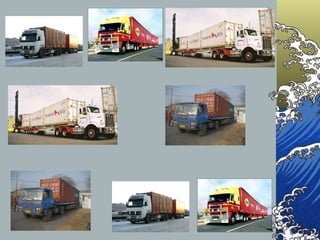
  • #15 Super B Double able to carry 4 TEU
  • #16 Eliminate surplus fuel consumption caused by the stop-start nature of driving in heavy traffic Less visibility