Teaching vs Learning
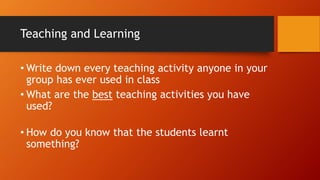
Teaching and Learning
• Write down every teaching activity anyone in your
group has ever used in class
• What are the best teaching activities you have
used?
• How do you know that the students learnt
something?
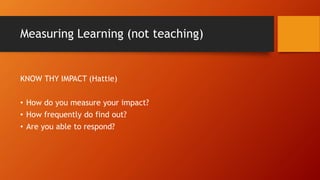
Measuring Learning (not teaching)
KNOW THY IMPACT (Hattie)
• How do you measure your impact?
• How frequently do find out?
• Are you able to respond?
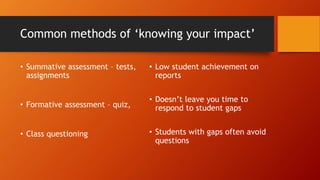
Common methods of ‘knowing your impact’
• Summative assessment – tests,
assignments
• Formative assessment – quiz,
• Class questioning
• Low student achievement on
reports
• Doesn’t leave you time to
respond to student gaps
• Students with gaps often avoid
questions
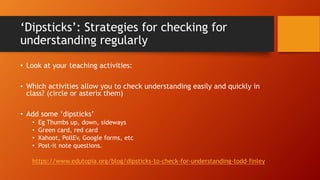
‘Dipsticks’: Strategies for checking for
understanding regularly
• Look at your teaching activities:
• Which activities allow you to check understanding easily and quickly in
class? (circle or asterix them)
• Add some ‘dipsticks’
• Eg Thumbs up, down, sideways
• Green card, red card
• Kahoot, PollEv, Google forms, etc
• Post-it note questions.
https://www.edutopia.org/blog/dipsticks-to-check-for-understanding-todd-finley
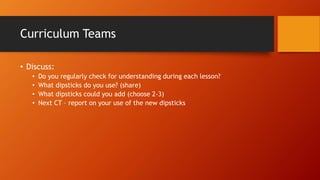
Curriculum Teams
• Discuss:
• Do you regularly check for understanding during each lesson?
• What dipsticks do you use? (share)
• What dipsticks could you add (choose 2-3)
• Next CT – report on your use of the new dipsticks

Checking for understanding: Dipsticks

  • 1.
  • 2.
    Teaching and Learning •Write down every teaching activity anyone in your group has ever used in class • What are the best teaching activities you have used? • How do you know that the students learnt something?
  • 3.
    Measuring Learning (notteaching) KNOW THY IMPACT (Hattie) • How do you measure your impact? • How frequently do find out? • Are you able to respond?
  • 4.
    Common methods of‘knowing your impact’ • Summative assessment – tests, assignments • Formative assessment – quiz, • Class questioning • Low student achievement on reports • Doesn’t leave you time to respond to student gaps • Students with gaps often avoid questions
  • 5.
    ‘Dipsticks’: Strategies forchecking for understanding regularly • Look at your teaching activities: • Which activities allow you to check understanding easily and quickly in class? (circle or asterix them) • Add some ‘dipsticks’ • Eg Thumbs up, down, sideways • Green card, red card • Kahoot, PollEv, Google forms, etc • Post-it note questions. https://www.edutopia.org/blog/dipsticks-to-check-for-understanding-todd-finley
  • 6.
    Curriculum Teams • Discuss: •Do you regularly check for understanding during each lesson? • What dipsticks do you use? (share) • What dipsticks could you add (choose 2-3) • Next CT – report on your use of the new dipsticks