Floor Care Training for distributor sales Guardamiglio 26-27 May 2009 By: Urs Nielsen Product & Training Manager Nilfisk-Advance A/S
Presentasi Trainers Pietro Mambrini, Group Product Manager Single discs and Scrubber driers Urs Nielsen, Product & Training Manager International Markets You Name and company Country Job Experience with cleaning Personal motto
Welcome to Guardamiglio Let’s have a great training together!
Expectations What are you expectations to The training? The trainer? Your fellow participants? -  Your self?
Meetings How many meetings have you attended? What didn’t you like?
Aim To educate sales and marketing partners and employees in the principles of cleaning with machine s
The next two days  Generally about floor care       Floor care with single disc      Scrubbing    Detergents       Sweeping    Road sweeping    Summary      Closure
Program Arrival 08:30  30 min mail & phone break 3-4 breaks of 5 min 2 coffee breaks 10 min Lunch 30 min Day end at 5 pm Optional dinner at 8 pm Handouts Material online Training program, FCT week 22 Time / Day Monday Tuesday Wednesday 08:00 Arrival Departure Hotel  08:30 Phone & mail Phone & mail 09:00 Opening Sweepers application 11:00 Coffee break 11:15 General floor care Sweepers application 13:00 Lunch break 13:30 Single disc application Road sweepers application 15:15 Coffee break 15:30 Scrubbers applications Summary 17:00 Departure factory 20:00 Welcome dinner *Dinner*
Break
 Generally about floor care       Floor care with single disc      Scrubbing    Detergents       Sweeping    Road sweeping    Summary      Closure
Module 1 Floor care in general 
What is floor care?  1.  Cleaning on a building site: ....after renovation,construction of a building, to remove mortar, varnish, glue etc...before installing a new floor 2.  Inital cleaning/treatment:   .....after a new floor is installed the surface must be prepared and protected for the future 3.  Basic cleaning/stripping:   .....deep cleaning of carpet,- vinyl,- lino,- stone floors to remove dirt, coatings. .....made once, twice a year or in longer periods 4.  Daily maintenance:   .....regular cleaning like scrubbing, spray cleaning... 5.  Intermediate cleaning:   .....is a deeper cleaning process to improve again the shine and look  .....used to postpone basic cleaning/ stripping 6.  Spot cleaning:   .....is used to remove local heel marks in the entrance area, or dirty spots to keep a general good floor appearance
Why maintain floors? clean and safe life of the floor socially acceptable environment company image NOTE: 80% of the dirt is brought via the shoes into facilities 
Before you start cleaning Identify Type of floor Type of dirt Type of chemical = Type of equipment to clean cost-efficiently 
Cleaning Performed daily or weekly Usually not very aggressive  
Dust mop (dust sweeping) Function: Dry method, fast and easy, to remove dust or litter Used before cleaning with an automatic scrubber 
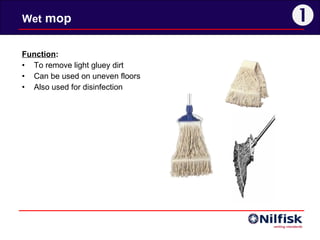
Wet  mop  Function : To remove light gluey dirt Can be used on uneven floors Also used for disinfection  
Damp  mop  Function : Collecting fine dust with a damp textile Used only on even floors  Cannot remove sticky or gluey dirt 
The two mop working methods 1-step method 2-step method Works with one bucket, wringer & mop clean and dirt water in one bucket Works with two buckets, wringer or multi press & mop clean and dirt water in separate buckets better hygiene 
Break 
Vacuuming Function :   Vacuum cleaners are designed to collect fine dust with integrated filter system and filter bag 
Sweeping Function:   To collect and remove debris, litter and dust. Daily or weekly. Over throw Direct throw Used hopper capacity ~ 85 - 100 % Used hopper capacity ~ 40 - 50 % Ride-on sweeper Walk behind sweeper 
Scrubbing Function:   To remove dirt Daily or weekly Disc brush Cylindrical brushes Scrubber dryer elements Scrub deck Squeegee Solution tank Recovery tank Single disc > 200 rpm & wet pick-up Scrubber dryer 
Carpet  Extraction  & Shampooing Carpet shampooing With a single disc machine, carpet shampoo for deep carpet cleaning Carpet extraction With handheld-  or automatic carpet extractors. Used for regular carpet maintenance.  
Cleaning identification
Restoration Performed monthly or annually Personal protection Requires closure of facility 
Stripping Function :  Used to remove worn protection coat or dirt Single disc < 200 rpm & wet pick-up  Walk behind scrubber dryer Ride-on scrubber dryer 
Polishing Function :  To clean and remove heel marks, improve gloss on protected floors 
Spraycleaning Function :   To remove tenacious dirt, heel marks etc. on vinyl, linoleum, polyolefin or wooden floors 
My right foot
Burnishing Function:   Used to harden the protection film 
Vitrification Function:  To improve gloss and surface hardness on marble and terrazzo floors.  
Sanding Function : Use a low speed single disc machine, high brush pressure and brush torque,  dust collection device, sanding screen with 30 to 180 grit  
Construction Performed during construction or rebuilding Project oriented No repetitive intervals 
Scarifying Function :   Use a heavy duty low speed single disc < 200 rpm, very high brush pressure    and brush torque and agressive brushes made from springsteel 
Grinding/Honing Function :   Use heavy duty single disc machine, tank, carborundum ring to grind concrete or special diamond pads for marble and terrazzo floors renovation.  
Brushes Application:Polishing/spraycleaning Name:Union Fibre:Union/Aranga Application: Scrubbing Name: Prolen/Prolite Fibre: PPN/Polypropylene Application: Shampooing Name: Nylon brush Fibre: Polyamid (Nylon/Perlon) Application:Polishing/spraycleaning Name:Union/Sica Fibre:Union/Silicon carbide Application: Scrubbing,Stripping Name: Prolen//wire Fibre: Polypropylene/steelwire Application: Scrubbing/Stripping Name: MidLite/MidGrit/ Dyna/ Fibre: Nylon/Silicon carbide mixture 
Brushes Application: Dry cleaning Name: Wire brush Fibre: Spring steel Application: Scarifying, dry cleaning Name: Aggregate crossed brushes  Fibe: Steel wire, rigid Application: Scarifying, dry cleaning Name: Aggregate spring steel wire  Fibe: Spring steel wire Application: Scrubbing,Stripping Name: Brush-aggregate Fibre: Polypropylene/steelwire Application: De-rusting Name: Wire brush Fibre: Steelwire Application: De-rusting Name: Brush-aggregate Fibre: Steelwire 
Bristle material Natural fibre  (Union brushes) Natural fibre with silicon carbide Nylon Polypropylene  (Prolene, Prolite) Applications Polishing of wooden/vinyl/lino & stone floors. Used instead of white or beige pad. Polishing/spray cleaning of resilient and polyolefin and wooden floors. Used instead of red pad. Carpet shampooing, light scrubbing For light to medium duty scrubbing on stone, cement, ceramic, linoleum, vinyl floors. Used instead of red, blue, green pad 
Bristle material Nylon bristles  impregnated with silicon grit carbide like (MidGrit, Dyna Grit, AgLite Grit...etc...) Polypropylene  mixed with steelwire bristles Steelwire  steel wire, spring steel  Applications Medium to heavy duty scrubbing on concrete, vinyl, resilient floors.  Used in place of  green,  brown  or black pad. Scrubbing in warehouse Scarifying on concret based  industrial floors to remove tenacious, compressed dirt in a dry process prior wet scrubbing 
Bristle diameter Diameter Polishing, approx.  0.2 - 0.3 mm Light to medium scrubbing 0.4 - 0.5 mm Medium to heavy duty scrubbing 0.6 - 1.1 mm Frictional Resistance  Fine brush more motor power required Coarse brush less motor power required 
Break 
Pads variants Polishing Spraycleaning Stripping Burnishing Scrubbing 
Pad quality Bright colour   Low aggressivity Dark colour   High aggressivity Fine pad   Higher friction  (more motor power required) Coarse pad   Less friction   (less motor power required) Note: The risk of motor overload and fuse  blowing is higher with fine pads. 
Applications   Stripping   Scrubbing Scrubbing Spray cleaning black < 800 rpm brown < 800 rpm green < 800 rpm blue < 1200 rpm red < 1200 rpm blue HS < 1200 rpm 
Polishing   Burnishing with UHS- machines Vitrification Applications beige < 800 rpm white < 800 rpm blended white < 3000 rpm bronce < 200 rpm silver < 500 rpm green < 2000 rpm Steel wool 
General polishing and cleaning ingredients and their function Polymers Waxes Resins Zinc Plasticizers Wetting agent Solvents Preservatives shine,wear resistance polish, removability slip resistance connect metal ions flexibility good liquid distribution improves drying process product conservation 
Cleaning identification 
Overview Sticky Loose Wet Dry 
Break 
 Generally about floor care       Floor care with single disc      Scrubbing    Detergents       Sweeping    Road sweeping    Summary      Closure
 Module 2  Single disc
Content Single discs Purpose Build up Accessories Burnishers Purpose Build up Accessories 
Purpose of an SD Scrubbing, stripping, sanding, crystalising, honing, polishing, spray cleaning, vitrification …. 
Build up – Basic SD Brush motor Gear or belt Handle   kg brush
Considerations about the handle Ergonomics Wide and ergonomic angle Soft-grip on bar  Round (non-cutting edged) Multiple adjustment levels in the handle bar 
Considerations about the base Strong base Low deck Stable connection for handle Multi directional? Strong wheel and metal axle Balance 
Considerations on safety Visible red cord Safety switch Safety light for load Rubber bumper – protects the surroundings Thermal switch IPX4 
Accessories/ options Vac-unit Suction skirt Spray unit Tank Other accessories: Brushes Pad drive discs (low, high and dual speed) Additional weights 
Break 
Typical machine configuration Scrubbing Spray cleaning Polishing/Burnishing Equipment Equipment Equipment Low speed machine Tank Scrubbing brush Low speed machine or a strong high speed machine Spray unit Pad drive disc Cleaning pads High/Ultra high speed machine (Vacuum unit + suction skirt) Pad drive disc Polishing/Burnishing pads 
1. Machine 421 A/B/C 2. Blower 230V/50Hz 3. Carpet shampoo device with: hose nozzle  4. Tank 5. Shampoo brush, Nylon 6. Chemical 2 5 4 3 1 Carpet Shampooing 
3 different segments Light-duty series: Polyamide construction with steel reinforcement belt-driven  affordable price Medium-duty series: Aluminum construction belt-driven professional/daily use Heavy duty-series: Steel and aluminum gear driven difficult cleaning tasks and tough jobs Single discs divide into 3 categories 
Purpose of a burnisher To smoothen and harden
Build up Motor Gear Handle Pressure
Burnishers A quick comparison shows the main differences: Traction: yes On board charger: yes, standard Runtime: 2 to 2,5 hours Noise level: 68 dB Weight (net): 88 kg Dimensions (L x W x H): 136x56x106 cm Pad pressure: automatic Dust control: passive (active optional) Productivity (hour): 2.230 m2 Traction: yes On board charger: no Runtime: - Noise level: 70 dB Weight (net): 85 kg Dimensions (L x W x H): 132x61x102 cm Pad pressure: adjustable Dust control: passive Productivity (hour): 2.225 m2 Nilfisk UHB   51-1500 Tennant 2550 
Burnishing applications Designed for fast burnishing of hard floors, in medium-large areas Where high gloss expectation is required and air pollution is not allowed (LPG burnisher) Battery burnishers are the most suitable solution for: supermarkets, grocery shops,  department stores hospitals office buildings educational facilities 
Burnishing applications – Ride on Designed for fast burnishing of hard floors, in large areas Where high gloss expectation is required Key customers will be: - Large supermarkets - Airports - Office space - Hospitals - Government facilities - Education 
Accessories On board charger Active dust control system Headlights Armrest for drivers seat Seatbelt Strobe – beacon light 166 L trash can carrier 
Examples  
Segments “ Light duty segment” “ Heavy-duty segment” “ Medium-duty segment” High volume market Light duty applications Very high competition level Niche market/ low volume Heavy-duty applications Low competition level Volume market Medium duty applications Medium competition level 
Lunch – 30 min 
 Generally about floor care       Floor care with single disc      Scrubbing    Detergents       Sweeping    Road sweeping    Summary      Closure
Module 3 Hard floor cleaning and Scrubber dryers / Combination machines  training 
Mopping Dust control / Vacuuming Sweeping Scrubbing Spray cleaning Burnishing Stripping (wet) Stripping (dry) Sanding Vitrification  Scarifying Grinding/Honing Hard floor cleaning methods             Floor mop (wet, dry or antistatic) Vacuum cleaner with good filtration Sweeper (indoor or outdoor) Low speed Single-disc or Scrubber/dryer Single-disc (150-450 rpm) or Scrubber/dryer Ultra High Speed Single-disc (above 800 rpm) Strong Low Speed Single-disc + wet pick-up Strong High Speed Single-disc with suction Strong Low Speed Single-disc with suction Strong and heavy Low Speed Single-disc Very strong Low Speed Single-disc Very strong Low Speed Single-disc Main application Equipment needed = Common/daily applications = Mainly renovation purposes 
Why use a scrubber dryer? The most savings can be achieved when investing in machines to reduce labour costs CLEANING COST TODAY 
What is a scrubber dryer ? + = 
How does a scrubber dryer work ? Front scrubbing unit: mechanical abrasive action (brushes) + emulsifying action of a water-detergent solution  Rear drying unit:  collects the water-detergent solution + dirt   
How does a scrubber dryer work? Recovery tank Fresh water tank Control panel squeegee Brush deck Batteries Vacuum motor Detergent cartridge Battery charger Brush motor 
Sinner Circle on a scrubber dryer 2. Detergent + Type + Dosage 1. Mechanic + Brush pressure + Rated motor power + Working Width 3. Time + Chemical reaction + Working speed 4. Temperature + Water + Environment Sinner circle on a scrubber dryer 
Brush pressure [ kg] intensive mechanical action by brush or pad reduction of water and chemicals reduction of work time better cleaning results  kg brush
Working width 1-brush version 3-brush version 2-brush version Cylindrical brush working width working width working direction 
Higher on cord driven scrubbers Rated motor power [W] VS 
15 minutes break 
Scrubber dryers – key comparison points 1. With cable With batteries 3. With user behind (walk-behind machine) With user on board (ride-on machine) 4.  With flat scrubbing system (brush or pad) With cylindrical scrubbing system (brush) 2. With brush traction With traction motor 
Cable vs Batteries scrubbers  Cable Batteries Lower weight Higher practical productivity rate Higher brush pressure No electrical source necessary More powerful vacuum motor More comfortable to operate Unlimited  running time Less noisy
Brush traction vs traction scrubbers On small scrubbers, the brush rotation helps the operator in pushing the scrubber/dryer (single brush only) On medium/large scrubbers wheels with traction propels the scrubber/dryer Traction – Potentiometer on the control panel Non traction – brush rotation 
Walk-behind vs Ride-on A ride-on scrubber, if compared to a walk-behind one, allows: Higher working forward speed Better maneuverability Better visibility Better ergonomy Higher productivity Labor savings 
If comparing walk-behind and ride-on machines of similar tank capacities and scrubbing widths, the size of the machine is the same. However, on a ride-on, the absence of the operator at the back of the machine allows the scrubber to be overall more compact than a walk-behind scrubber Walk-behind vs Ride-on Walk-behind scrubbers: +50 cm operator’s position 
Disc vs cylindrical scrubbing Cylindrical type Disc type Ceramics Marble, Granite Vinyl, Linoleum  Concrete, smooth Resilient Terrazzo Concrete, rough Pirelli Ceramics Anti-slip floors Debris + unlevel floors 
Combination machines Sweeper and scrubber/dryer in one Wet sweeper pre-sweep accessory 
Accessories Dosage / mixing system Batteries and chargers Brushes Pads Squeegee and blades 
Water and detergent mixing systems Check valve (one way) Detergent pump Detergent flow Solution flow to brushes Water pump Solenoid valve Magnetic slider for detergent concentration setting Tee mixing barb (water + detergentl) 
Disposable/refillable cartridges Disposable cartridge: Refillable cartridge: 
Batteries and chargers Several choices: monoblocs or cells in a tray batteries (depending of running time) Wet or Dry (maintenance free) batteries depending of the service you want to put on Charger on board or not 
Squeegee and blades Front blade non-marking (sensitive plastic floors: sport enviroments…) Kit red gum (abrasion resistant) Kit polyurethane (oil resistant & abrasion resistant) 
15 minutes break 
 Generally about floor care       Floor care with single disc      Scrubbing    Detergents       Sweeping    Road sweeping    Summary      Closure
Module 4 Cleaning Detergents  
Chemical substances attacking dirt Tensides Acids Alkalines Solvents Abrasive material Oxidation agents Reduction agents Enzymes 
pH - Index 0  1  2  3  4  5  6   7  8  9  10  11  12  13  14 A C I D S A L K A L I E S N E U T R A L Negative effects on health (allergies etc..) Damage to floors or other surfaces 
Tenside - action Reduces the surface tension of water Attracts dirt such as: oils, greasy substances, waxes etc. Forms an emulsion with water The slurry can be picked up Water molecules tend to be round. Only by adding tensides can dirt be removed Water reaction to dirt  without  tensides: Reduced surface tension with  tensides = better vacuuming 
Tensides on a natural basis Natural   fat   (from animals, plants) + Alkalins with pH 14   (saponifies fat) Soap  pH 11-13   (soft soap) 
Tensides on a natural basis PROS + very good cleaning + biological spillt up +  can be polished with a high speed machine CONS - high pH index (11-13) - attacks human skin - attacks various materials  (linoleum, marble, travertine, elastomer floors) - reacts with lime in lime soap   (saponification) - Makes floor slippery  if too much soap cleaner is used - Causes black joints in ceramic floors etc. 
Synthetic tensides PROS = less sensitive against hard water  = different cleaning result CONS = biological spillt up 
Break 
The months of a year 
September is the last month December is the third month February is the next month after December. February is followed by January June follows July October follows November May is the month that follows March. August is just before December April is the first month.
Alkalins Caustic potash pH 12 - 14 (potassium hydroxide) Caustic soda pH 12 - 14 (sodium hydroxide) Liquid ammonia pH 12 - 14 (ammonium hydroxide) 
Acids Used in: Toilets Laboratories Sanitary rooms Acetic acid Citric acid Formic acid Aminosulfric acid Phosphoric acid Dissolve lime  + minerals 
Solvents Alcohol Gasoline Glykole Aceton Aromatic hydrocarbons  Chlorinated hydrocarbons Dissolve:  fat, oil, varnish, glue 
Disinfecting detergents Aldehyde Formaldehyde Phenole Chlorine Acids Ammoniumcompounds Alcohols Disinfect - conserve 
Alcoholic detergents pH-value 6,0-9,0 Dilution mostly  0,5% to 0,25% For all  stone and  tile floors Dries without stripes Do not use hot water When concentration is too high, polymere coatings get damaged No disinfective effects Natural stones do not get dark Less cleaning effect than an all-purpose detergent 
All-purpose detergents   (neutral detergents) Ingredients:   -tensides -water -complexing agents -colours and flavours -conserving agents  With pH-value 7   = neutral detergent Dilution: mostly  1:100 to 1:200 pH-value 6-10 For oily, greasy dirt, soilage from the street, drink stains Offers better cleaning than alcoholic detergents Surfaces and joints may become dark To be recommended economically/ecologically 
Sanitary detergents Ingredients: -acids -inhibitors  (to prevent corrosion) -tensides -flavours -solvents (sometimes) Dilution mostly  1:100 pH-value <4 Remove: -lime, lime soap -cement film -Uric stone, skin grease -rosty spots Do not use on floors sensitive to acids, e.g. marble, terrazzo etc. 
Detergents for automatic scrubbers Identical with all-purpose detergents pH-value 6-10 With reduced foam formation 
Conclusion Do not use warm or hot water because Follow manufacturers instructions  Avoid contact with skin, eyes. Wear protective gloves and goggles. Use measuring device to save chemicals. 
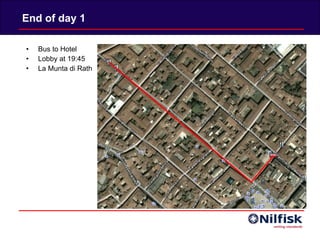
End of day 1 Bus to Hotel Lobby at 19:45 La Munta di Rath
Day 2  Generally about floor care       Floor care with single disc      Scrubbing    Detergents       Sweeping    Road sweeping    Summary      Closure
The months of a year 
September is the last month December is the third month February is the next month after December. February is followed by January June follows July October follows November May is the month that follows March. August is just before December April is the first month.
Module 5 
What is a sweeper? A sweeper is a machine able to: - collect dirt - contain dust It is mainly sold for dry cleaning on dry surfaces 
Main/side broom Flap Hopper Filter 4 elements  
Direct Throw VS Over Throw  Over throw Direct throw Used hopper capacity ~ 85 - 100 % Used hopper capacity ~ 40 - 50 %
Manual Dumping  (commercial applications): Little capacity hoppers and  Light debris Manual VS Hydraulic Dumping  Hydraulic dumping (industrial applications) Big capacity of the hopper Heavy debris To be used on external dustbins Variable dumping heights
A good suction guarantees a dust free operation of the sweeper. No dust would lie on the floor after the sweeper  Turbine Filter Filter shaker Vacuum system 
Size of the place to be swept   Size of the sweeper   Narrowest passage Dust to be swept Identifying the right sweeper for the job? 
Heavy Debris Heavy debris  wood sand gravel stones metal dust: cement, aluminium dust, metal dust Light Debris  cigarettes butts  paper carton stuffs leaves plastic cans light airborne dust Identifying the right sweeper for the job? 
Chosing the right filters  Type of filter  Material Filter Surface Conditions Suggested Application Plus Minus PANEL Paper (disposable) SMALL Dry Normal dusty environment i.e. Parking Areas, logistic centres, Supermarkets 1. Cheap 2. Easy to replace 3. Easy to clean. 4. Fine filtering power (5 micron) 1. Disposable 2. Poor performances in dusty applications 3. Easy to clog Polyester (washable) Dry Wet Polyester Antistatic (washable) Dry Wet Static POCKET Polyester (washable) LARGE Dry Very dusty environment i.e. cement, wood, steel & ceramic factories 1. Long lasting 2. High performance in dusty environm. 3. No need to clean frequently 1. Expensive 2. Hard to dismount 3. Hard to clean 4. Rough filtering power (20 micron) Polyester Antistatic Waterproof treated (washable) Dry Wet Static
Bristle size Bristle material Steel mix Density Chosing the right brooms 
Break
 Generally about floor care       Floor care with single disc      Scrubbing    Detergents       Sweeping    Road sweeping    Summary      Closure 
Module 6 Road Sweepers 
Sweeping Theory MECHANICAL Sweeping VACUUM Sweeping 
Main elements Side brooms Fan Hopper Water tank Car 
Contact only  key customer  with right cleaning application: Understand your customer,  survey  the customer! Organize a  good demo : Key points to be successful 
After installing the machine  train the customer : How to use the machine How to service the machine Don’t under-estimate the  service , it’s the key to win and to ensure life span of the machine: 2 type of service:  Daily  &  Schedule  maintenance Key points to be successful 
Types of outdoor sweepers Vacuum sweeping Mechanical sweeping Using a vacuum system to suck debris into the hopper at the rear of the machine. (N-A) Using a cylindrical broom and an elevator to sweep debris into a hopper (Dulevo & Gavia)  Regenerative Air Air is re-circulated through hopper and back though vacuum head (Tymco) Market: EU is 90% Vacuum – 0% Regenerative – 10% Mechanical US is 10% Vacuum – 25% Regenerative – 65% Mechanical  
Vacuum and Regenerative Municipalities for main sweeping jobs Parking Lots Private areas (University, Hospitals, Residential)  Plus Reduced cost of maintenance Able to deal better with light debris, leaves, plastic bags, etc. Minus Heavy and large debris Working speed of the machines Mechanical Municipalities in general, especially for after-parade, market place areas Industrial areas (cement & steelwork factories) Construction & road pavement clean areas. Plus Fast sweeping Bulky an heavy debris Fine dust control Minus Higher costs of maintenance Light debris Different Applications 
Break
Module 7  Generally about floor care       Floor care with single disc      Scrubbing    Detergents       Sweeping    Road sweeping    Summary      Closure  
Cases - Instructions Individually Suggest your best technical /cost effective solution generically Present solution to the group 10 min preparation 2 min presentation
Case – Floor cleaning of warehouse business Your customer owns a warehouse. His main business is to function as warehouse to his customers. His warehouse is 50.000 sqm under roof. He has 5 loading bays for trucks. He stores all sort of merchandise. Non-food only. The floor is coated concrete as in the picture. All other equipment is electrical. There are no parted sections in the warehouse. All doors and gates are big enough for his fork lifts top pass through. He has one office in one end of the building for 4 employees plus his own office. They are carpeted. The aisles between his shelves are typically 1.5m wide, many of them are only open from one end. Goods are typically stored on standard pallets. Outside there is an area for employee parking in connection with the loading bays. The ground outside is paved with concrete slaps. All paved areas are open, rectangular to allow free passage for the trucks.
Program Training program, FCT week 22 Time / Day Monday Tuesday Wednesday 08:00 Arrival Departure Hotel  08:30 Phone & mail Phone & mail 09:00 Opening Sweepers application 11:00 Coffee break 11:15 General floor care Sweepers application 13:00 Lunch break 13:30 Single disc application Road sweepers application 15:15 Coffee break 15:30 Scrubbers applications Summary 17:00 Departure factory 20:00 Welcome dinner *Dinner*
Important points Module 2 Module 3 Module 4 Module 5 Module 6 Why clean?
Break
Module 8  Generally about floor care       Floor care with single disc      Scrubbing    Detergents       Sweeping    Road sweeping    Summary      Closure  
Evaluation - Expectations 
Course evaluation 
End of day 2 Bus to Hotel Hotel restaurant at 20:00 

Fct Full Training3

  • 1.
    Floor Care Trainingfor distributor sales Guardamiglio 26-27 May 2009 By: Urs Nielsen Product & Training Manager Nilfisk-Advance A/S
  • 2.
    Presentasi Trainers PietroMambrini, Group Product Manager Single discs and Scrubber driers Urs Nielsen, Product & Training Manager International Markets You Name and company Country Job Experience with cleaning Personal motto
  • 3.
    Welcome to GuardamiglioLet’s have a great training together!
  • 4.
    Expectations What areyou expectations to The training? The trainer? Your fellow participants? - Your self?
  • 5.
    Meetings How manymeetings have you attended? What didn’t you like?
  • 6.
    Aim To educatesales and marketing partners and employees in the principles of cleaning with machine s
  • 7.
    The next twodays  Generally about floor care  Floor care with single disc  Scrubbing  Detergents  Sweeping  Road sweeping  Summary  Closure
  • 8.
    Program Arrival 08:30 30 min mail & phone break 3-4 breaks of 5 min 2 coffee breaks 10 min Lunch 30 min Day end at 5 pm Optional dinner at 8 pm Handouts Material online Training program, FCT week 22 Time / Day Monday Tuesday Wednesday 08:00 Arrival Departure Hotel 08:30 Phone & mail Phone & mail 09:00 Opening Sweepers application 11:00 Coffee break 11:15 General floor care Sweepers application 13:00 Lunch break 13:30 Single disc application Road sweepers application 15:15 Coffee break 15:30 Scrubbers applications Summary 17:00 Departure factory 20:00 Welcome dinner *Dinner*
  • 9.
  • 10.
     Generally aboutfloor care  Floor care with single disc  Scrubbing  Detergents  Sweeping  Road sweeping  Summary  Closure
  • 11.
    Module 1 Floorcare in general 
  • 12.
    What is floorcare?  1. Cleaning on a building site: ....after renovation,construction of a building, to remove mortar, varnish, glue etc...before installing a new floor 2. Inital cleaning/treatment: .....after a new floor is installed the surface must be prepared and protected for the future 3. Basic cleaning/stripping: .....deep cleaning of carpet,- vinyl,- lino,- stone floors to remove dirt, coatings. .....made once, twice a year or in longer periods 4. Daily maintenance: .....regular cleaning like scrubbing, spray cleaning... 5. Intermediate cleaning: .....is a deeper cleaning process to improve again the shine and look .....used to postpone basic cleaning/ stripping 6. Spot cleaning: .....is used to remove local heel marks in the entrance area, or dirty spots to keep a general good floor appearance
  • 13.
    Why maintain floors?clean and safe life of the floor socially acceptable environment company image NOTE: 80% of the dirt is brought via the shoes into facilities 
  • 14.
    Before you startcleaning Identify Type of floor Type of dirt Type of chemical = Type of equipment to clean cost-efficiently 
  • 15.
    Cleaning Performed dailyor weekly Usually not very aggressive  
  • 16.
    Dust mop (dustsweeping) Function: Dry method, fast and easy, to remove dust or litter Used before cleaning with an automatic scrubber 
  • 17.
    Wet mop Function : To remove light gluey dirt Can be used on uneven floors Also used for disinfection 
  • 18.
    Damp mop Function : Collecting fine dust with a damp textile Used only on even floors Cannot remove sticky or gluey dirt 
  • 19.
    The two mopworking methods 1-step method 2-step method Works with one bucket, wringer & mop clean and dirt water in one bucket Works with two buckets, wringer or multi press & mop clean and dirt water in separate buckets better hygiene 
  • 20.
  • 21.
    Vacuuming Function : Vacuum cleaners are designed to collect fine dust with integrated filter system and filter bag 
  • 22.
    Sweeping Function: To collect and remove debris, litter and dust. Daily or weekly. Over throw Direct throw Used hopper capacity ~ 85 - 100 % Used hopper capacity ~ 40 - 50 % Ride-on sweeper Walk behind sweeper 
  • 23.
    Scrubbing Function: To remove dirt Daily or weekly Disc brush Cylindrical brushes Scrubber dryer elements Scrub deck Squeegee Solution tank Recovery tank Single disc > 200 rpm & wet pick-up Scrubber dryer 
  • 24.
    Carpet Extraction & Shampooing Carpet shampooing With a single disc machine, carpet shampoo for deep carpet cleaning Carpet extraction With handheld- or automatic carpet extractors. Used for regular carpet maintenance. 
  • 25.
  • 26.
    Restoration Performed monthlyor annually Personal protection Requires closure of facility 
  • 27.
    Stripping Function : Used to remove worn protection coat or dirt Single disc < 200 rpm & wet pick-up Walk behind scrubber dryer Ride-on scrubber dryer 
  • 28.
    Polishing Function : To clean and remove heel marks, improve gloss on protected floors 
  • 29.
    Spraycleaning Function : To remove tenacious dirt, heel marks etc. on vinyl, linoleum, polyolefin or wooden floors 
  • 30.
  • 31.
    Burnishing Function: Used to harden the protection film 
  • 32.
    Vitrification Function: To improve gloss and surface hardness on marble and terrazzo floors. 
  • 33.
    Sanding Function :Use a low speed single disc machine, high brush pressure and brush torque, dust collection device, sanding screen with 30 to 180 grit 
  • 34.
    Construction Performed duringconstruction or rebuilding Project oriented No repetitive intervals 
  • 35.
    Scarifying Function : Use a heavy duty low speed single disc < 200 rpm, very high brush pressure and brush torque and agressive brushes made from springsteel 
  • 36.
    Grinding/Honing Function : Use heavy duty single disc machine, tank, carborundum ring to grind concrete or special diamond pads for marble and terrazzo floors renovation. 
  • 37.
    Brushes Application:Polishing/spraycleaning Name:UnionFibre:Union/Aranga Application: Scrubbing Name: Prolen/Prolite Fibre: PPN/Polypropylene Application: Shampooing Name: Nylon brush Fibre: Polyamid (Nylon/Perlon) Application:Polishing/spraycleaning Name:Union/Sica Fibre:Union/Silicon carbide Application: Scrubbing,Stripping Name: Prolen//wire Fibre: Polypropylene/steelwire Application: Scrubbing/Stripping Name: MidLite/MidGrit/ Dyna/ Fibre: Nylon/Silicon carbide mixture 
  • 38.
    Brushes Application: Drycleaning Name: Wire brush Fibre: Spring steel Application: Scarifying, dry cleaning Name: Aggregate crossed brushes Fibe: Steel wire, rigid Application: Scarifying, dry cleaning Name: Aggregate spring steel wire Fibe: Spring steel wire Application: Scrubbing,Stripping Name: Brush-aggregate Fibre: Polypropylene/steelwire Application: De-rusting Name: Wire brush Fibre: Steelwire Application: De-rusting Name: Brush-aggregate Fibre: Steelwire 
  • 39.
    Bristle material Naturalfibre (Union brushes) Natural fibre with silicon carbide Nylon Polypropylene (Prolene, Prolite) Applications Polishing of wooden/vinyl/lino & stone floors. Used instead of white or beige pad. Polishing/spray cleaning of resilient and polyolefin and wooden floors. Used instead of red pad. Carpet shampooing, light scrubbing For light to medium duty scrubbing on stone, cement, ceramic, linoleum, vinyl floors. Used instead of red, blue, green pad 
  • 40.
    Bristle material Nylonbristles impregnated with silicon grit carbide like (MidGrit, Dyna Grit, AgLite Grit...etc...) Polypropylene mixed with steelwire bristles Steelwire steel wire, spring steel Applications Medium to heavy duty scrubbing on concrete, vinyl, resilient floors. Used in place of green, brown or black pad. Scrubbing in warehouse Scarifying on concret based industrial floors to remove tenacious, compressed dirt in a dry process prior wet scrubbing 
  • 41.
    Bristle diameter DiameterPolishing, approx. 0.2 - 0.3 mm Light to medium scrubbing 0.4 - 0.5 mm Medium to heavy duty scrubbing 0.6 - 1.1 mm Frictional Resistance Fine brush more motor power required Coarse brush less motor power required 
  • 42.
  • 43.
    Pads variants PolishingSpraycleaning Stripping Burnishing Scrubbing 
  • 44.
    Pad quality Brightcolour Low aggressivity Dark colour High aggressivity Fine pad Higher friction (more motor power required) Coarse pad Less friction (less motor power required) Note: The risk of motor overload and fuse blowing is higher with fine pads. 
  • 45.
    Applications Stripping Scrubbing Scrubbing Spray cleaning black < 800 rpm brown < 800 rpm green < 800 rpm blue < 1200 rpm red < 1200 rpm blue HS < 1200 rpm 
  • 46.
    Polishing Burnishing with UHS- machines Vitrification Applications beige < 800 rpm white < 800 rpm blended white < 3000 rpm bronce < 200 rpm silver < 500 rpm green < 2000 rpm Steel wool 
  • 47.
    General polishing andcleaning ingredients and their function Polymers Waxes Resins Zinc Plasticizers Wetting agent Solvents Preservatives shine,wear resistance polish, removability slip resistance connect metal ions flexibility good liquid distribution improves drying process product conservation 
  • 48.
  • 49.
  • 50.
  • 51.
     Generally aboutfloor care  Floor care with single disc  Scrubbing  Detergents  Sweeping  Road sweeping  Summary  Closure
  • 52.
     Module 2 Single disc
  • 53.
    Content Single discsPurpose Build up Accessories Burnishers Purpose Build up Accessories 
  • 54.
    Purpose of anSD Scrubbing, stripping, sanding, crystalising, honing, polishing, spray cleaning, vitrification …. 
  • 55.
    Build up –Basic SD Brush motor Gear or belt Handle   kg brush
  • 56.
    Considerations about thehandle Ergonomics Wide and ergonomic angle Soft-grip on bar Round (non-cutting edged) Multiple adjustment levels in the handle bar 
  • 57.
    Considerations about thebase Strong base Low deck Stable connection for handle Multi directional? Strong wheel and metal axle Balance 
  • 58.
    Considerations on safetyVisible red cord Safety switch Safety light for load Rubber bumper – protects the surroundings Thermal switch IPX4 
  • 59.
    Accessories/ options Vac-unitSuction skirt Spray unit Tank Other accessories: Brushes Pad drive discs (low, high and dual speed) Additional weights 
  • 60.
  • 61.
    Typical machine configurationScrubbing Spray cleaning Polishing/Burnishing Equipment Equipment Equipment Low speed machine Tank Scrubbing brush Low speed machine or a strong high speed machine Spray unit Pad drive disc Cleaning pads High/Ultra high speed machine (Vacuum unit + suction skirt) Pad drive disc Polishing/Burnishing pads 
  • 62.
    1. Machine 421A/B/C 2. Blower 230V/50Hz 3. Carpet shampoo device with: hose nozzle 4. Tank 5. Shampoo brush, Nylon 6. Chemical 2 5 4 3 1 Carpet Shampooing 
  • 63.
    3 different segmentsLight-duty series: Polyamide construction with steel reinforcement belt-driven affordable price Medium-duty series: Aluminum construction belt-driven professional/daily use Heavy duty-series: Steel and aluminum gear driven difficult cleaning tasks and tough jobs Single discs divide into 3 categories 
  • 64.
    Purpose of aburnisher To smoothen and harden
  • 65.
    Build up MotorGear Handle Pressure
  • 66.
    Burnishers A quickcomparison shows the main differences: Traction: yes On board charger: yes, standard Runtime: 2 to 2,5 hours Noise level: 68 dB Weight (net): 88 kg Dimensions (L x W x H): 136x56x106 cm Pad pressure: automatic Dust control: passive (active optional) Productivity (hour): 2.230 m2 Traction: yes On board charger: no Runtime: - Noise level: 70 dB Weight (net): 85 kg Dimensions (L x W x H): 132x61x102 cm Pad pressure: adjustable Dust control: passive Productivity (hour): 2.225 m2 Nilfisk UHB 51-1500 Tennant 2550 
  • 67.
    Burnishing applications Designedfor fast burnishing of hard floors, in medium-large areas Where high gloss expectation is required and air pollution is not allowed (LPG burnisher) Battery burnishers are the most suitable solution for: supermarkets, grocery shops, department stores hospitals office buildings educational facilities 
  • 68.
    Burnishing applications –Ride on Designed for fast burnishing of hard floors, in large areas Where high gloss expectation is required Key customers will be: - Large supermarkets - Airports - Office space - Hospitals - Government facilities - Education 
  • 69.
    Accessories On boardcharger Active dust control system Headlights Armrest for drivers seat Seatbelt Strobe – beacon light 166 L trash can carrier 
  • 70.
  • 71.
    Segments “ Lightduty segment” “ Heavy-duty segment” “ Medium-duty segment” High volume market Light duty applications Very high competition level Niche market/ low volume Heavy-duty applications Low competition level Volume market Medium duty applications Medium competition level 
  • 72.
    Lunch – 30min 
  • 73.
     Generally aboutfloor care  Floor care with single disc  Scrubbing  Detergents  Sweeping  Road sweeping  Summary  Closure
  • 74.
    Module 3 Hardfloor cleaning and Scrubber dryers / Combination machines training 
  • 75.
    Mopping Dust control/ Vacuuming Sweeping Scrubbing Spray cleaning Burnishing Stripping (wet) Stripping (dry) Sanding Vitrification Scarifying Grinding/Honing Hard floor cleaning methods             Floor mop (wet, dry or antistatic) Vacuum cleaner with good filtration Sweeper (indoor or outdoor) Low speed Single-disc or Scrubber/dryer Single-disc (150-450 rpm) or Scrubber/dryer Ultra High Speed Single-disc (above 800 rpm) Strong Low Speed Single-disc + wet pick-up Strong High Speed Single-disc with suction Strong Low Speed Single-disc with suction Strong and heavy Low Speed Single-disc Very strong Low Speed Single-disc Very strong Low Speed Single-disc Main application Equipment needed = Common/daily applications = Mainly renovation purposes 
  • 76.
    Why use ascrubber dryer? The most savings can be achieved when investing in machines to reduce labour costs CLEANING COST TODAY 
  • 77.
    What is ascrubber dryer ? + = 
  • 78.
    How does ascrubber dryer work ? Front scrubbing unit: mechanical abrasive action (brushes) + emulsifying action of a water-detergent solution Rear drying unit: collects the water-detergent solution + dirt 
  • 79.
    How does ascrubber dryer work? Recovery tank Fresh water tank Control panel squeegee Brush deck Batteries Vacuum motor Detergent cartridge Battery charger Brush motor 
  • 80.
    Sinner Circle ona scrubber dryer 2. Detergent + Type + Dosage 1. Mechanic + Brush pressure + Rated motor power + Working Width 3. Time + Chemical reaction + Working speed 4. Temperature + Water + Environment Sinner circle on a scrubber dryer 
  • 81.
    Brush pressure [kg] intensive mechanical action by brush or pad reduction of water and chemicals reduction of work time better cleaning results  kg brush
  • 82.
    Working width 1-brushversion 3-brush version 2-brush version Cylindrical brush working width working width working direction 
  • 83.
    Higher on corddriven scrubbers Rated motor power [W] VS 
  • 84.
  • 85.
    Scrubber dryers –key comparison points 1. With cable With batteries 3. With user behind (walk-behind machine) With user on board (ride-on machine) 4. With flat scrubbing system (brush or pad) With cylindrical scrubbing system (brush) 2. With brush traction With traction motor 
  • 86.
    Cable vs Batteriesscrubbers  Cable Batteries Lower weight Higher practical productivity rate Higher brush pressure No electrical source necessary More powerful vacuum motor More comfortable to operate Unlimited running time Less noisy
  • 87.
    Brush traction vstraction scrubbers On small scrubbers, the brush rotation helps the operator in pushing the scrubber/dryer (single brush only) On medium/large scrubbers wheels with traction propels the scrubber/dryer Traction – Potentiometer on the control panel Non traction – brush rotation 
  • 88.
    Walk-behind vs Ride-onA ride-on scrubber, if compared to a walk-behind one, allows: Higher working forward speed Better maneuverability Better visibility Better ergonomy Higher productivity Labor savings 
  • 89.
    If comparing walk-behindand ride-on machines of similar tank capacities and scrubbing widths, the size of the machine is the same. However, on a ride-on, the absence of the operator at the back of the machine allows the scrubber to be overall more compact than a walk-behind scrubber Walk-behind vs Ride-on Walk-behind scrubbers: +50 cm operator’s position 
  • 90.
    Disc vs cylindricalscrubbing Cylindrical type Disc type Ceramics Marble, Granite Vinyl, Linoleum Concrete, smooth Resilient Terrazzo Concrete, rough Pirelli Ceramics Anti-slip floors Debris + unlevel floors 
  • 91.
    Combination machines Sweeperand scrubber/dryer in one Wet sweeper pre-sweep accessory 
  • 92.
    Accessories Dosage /mixing system Batteries and chargers Brushes Pads Squeegee and blades 
  • 93.
    Water and detergentmixing systems Check valve (one way) Detergent pump Detergent flow Solution flow to brushes Water pump Solenoid valve Magnetic slider for detergent concentration setting Tee mixing barb (water + detergentl) 
  • 94.
    Disposable/refillable cartridges Disposablecartridge: Refillable cartridge: 
  • 95.
    Batteries and chargersSeveral choices: monoblocs or cells in a tray batteries (depending of running time) Wet or Dry (maintenance free) batteries depending of the service you want to put on Charger on board or not 
  • 96.
    Squeegee and bladesFront blade non-marking (sensitive plastic floors: sport enviroments…) Kit red gum (abrasion resistant) Kit polyurethane (oil resistant & abrasion resistant) 
  • 97.
  • 98.
     Generally aboutfloor care  Floor care with single disc  Scrubbing  Detergents  Sweeping  Road sweeping  Summary  Closure
  • 99.
    Module 4 CleaningDetergents 
  • 100.
    Chemical substances attackingdirt Tensides Acids Alkalines Solvents Abrasive material Oxidation agents Reduction agents Enzymes 
  • 101.
    pH - Index0 1 2 3 4 5 6 7 8 9 10 11 12 13 14 A C I D S A L K A L I E S N E U T R A L Negative effects on health (allergies etc..) Damage to floors or other surfaces 
  • 102.
    Tenside - actionReduces the surface tension of water Attracts dirt such as: oils, greasy substances, waxes etc. Forms an emulsion with water The slurry can be picked up Water molecules tend to be round. Only by adding tensides can dirt be removed Water reaction to dirt without tensides: Reduced surface tension with tensides = better vacuuming 
  • 103.
    Tensides on anatural basis Natural fat (from animals, plants) + Alkalins with pH 14 (saponifies fat) Soap pH 11-13 (soft soap) 
  • 104.
    Tensides on anatural basis PROS + very good cleaning + biological spillt up + can be polished with a high speed machine CONS - high pH index (11-13) - attacks human skin - attacks various materials (linoleum, marble, travertine, elastomer floors) - reacts with lime in lime soap (saponification) - Makes floor slippery if too much soap cleaner is used - Causes black joints in ceramic floors etc. 
  • 105.
    Synthetic tensides PROS= less sensitive against hard water = different cleaning result CONS = biological spillt up 
  • 106.
  • 107.
    The months ofa year 
  • 108.
    September is thelast month December is the third month February is the next month after December. February is followed by January June follows July October follows November May is the month that follows March. August is just before December April is the first month.
  • 109.
    Alkalins Caustic potashpH 12 - 14 (potassium hydroxide) Caustic soda pH 12 - 14 (sodium hydroxide) Liquid ammonia pH 12 - 14 (ammonium hydroxide) 
  • 110.
    Acids Used in:Toilets Laboratories Sanitary rooms Acetic acid Citric acid Formic acid Aminosulfric acid Phosphoric acid Dissolve lime + minerals 
  • 111.
    Solvents Alcohol GasolineGlykole Aceton Aromatic hydrocarbons Chlorinated hydrocarbons Dissolve: fat, oil, varnish, glue 
  • 112.
    Disinfecting detergents AldehydeFormaldehyde Phenole Chlorine Acids Ammoniumcompounds Alcohols Disinfect - conserve 
  • 113.
    Alcoholic detergents pH-value6,0-9,0 Dilution mostly 0,5% to 0,25% For all stone and tile floors Dries without stripes Do not use hot water When concentration is too high, polymere coatings get damaged No disinfective effects Natural stones do not get dark Less cleaning effect than an all-purpose detergent 
  • 114.
    All-purpose detergents (neutral detergents) Ingredients: -tensides -water -complexing agents -colours and flavours -conserving agents With pH-value 7 = neutral detergent Dilution: mostly 1:100 to 1:200 pH-value 6-10 For oily, greasy dirt, soilage from the street, drink stains Offers better cleaning than alcoholic detergents Surfaces and joints may become dark To be recommended economically/ecologically 
  • 115.
    Sanitary detergents Ingredients:-acids -inhibitors (to prevent corrosion) -tensides -flavours -solvents (sometimes) Dilution mostly 1:100 pH-value <4 Remove: -lime, lime soap -cement film -Uric stone, skin grease -rosty spots Do not use on floors sensitive to acids, e.g. marble, terrazzo etc. 
  • 116.
    Detergents for automaticscrubbers Identical with all-purpose detergents pH-value 6-10 With reduced foam formation 
  • 117.
    Conclusion Do notuse warm or hot water because Follow manufacturers instructions Avoid contact with skin, eyes. Wear protective gloves and goggles. Use measuring device to save chemicals. 
  • 118.
    End of day1 Bus to Hotel Lobby at 19:45 La Munta di Rath
  • 119.
    Day 2 Generally about floor care  Floor care with single disc  Scrubbing  Detergents  Sweeping  Road sweeping  Summary  Closure
  • 120.
    The months ofa year 
  • 121.
    September is thelast month December is the third month February is the next month after December. February is followed by January June follows July October follows November May is the month that follows March. August is just before December April is the first month.
  • 122.
  • 123.
    What is asweeper? A sweeper is a machine able to: - collect dirt - contain dust It is mainly sold for dry cleaning on dry surfaces 
  • 124.
    Main/side broom FlapHopper Filter 4 elements  
  • 125.
    Direct Throw VSOver Throw  Over throw Direct throw Used hopper capacity ~ 85 - 100 % Used hopper capacity ~ 40 - 50 %
  • 126.
    Manual Dumping (commercial applications): Little capacity hoppers and Light debris Manual VS Hydraulic Dumping  Hydraulic dumping (industrial applications) Big capacity of the hopper Heavy debris To be used on external dustbins Variable dumping heights
  • 127.
    A good suctionguarantees a dust free operation of the sweeper. No dust would lie on the floor after the sweeper Turbine Filter Filter shaker Vacuum system 
  • 128.
    Size of theplace to be swept Size of the sweeper Narrowest passage Dust to be swept Identifying the right sweeper for the job? 
  • 129.
    Heavy Debris Heavydebris wood sand gravel stones metal dust: cement, aluminium dust, metal dust Light Debris cigarettes butts paper carton stuffs leaves plastic cans light airborne dust Identifying the right sweeper for the job? 
  • 130.
    Chosing the rightfilters  Type of filter Material Filter Surface Conditions Suggested Application Plus Minus PANEL Paper (disposable) SMALL Dry Normal dusty environment i.e. Parking Areas, logistic centres, Supermarkets 1. Cheap 2. Easy to replace 3. Easy to clean. 4. Fine filtering power (5 micron) 1. Disposable 2. Poor performances in dusty applications 3. Easy to clog Polyester (washable) Dry Wet Polyester Antistatic (washable) Dry Wet Static POCKET Polyester (washable) LARGE Dry Very dusty environment i.e. cement, wood, steel & ceramic factories 1. Long lasting 2. High performance in dusty environm. 3. No need to clean frequently 1. Expensive 2. Hard to dismount 3. Hard to clean 4. Rough filtering power (20 micron) Polyester Antistatic Waterproof treated (washable) Dry Wet Static
  • 131.
    Bristle size Bristlematerial Steel mix Density Chosing the right brooms 
  • 132.
  • 133.
     Generally aboutfloor care  Floor care with single disc  Scrubbing  Detergents  Sweeping  Road sweeping  Summary  Closure 
  • 134.
    Module 6 RoadSweepers 
  • 135.
    Sweeping Theory MECHANICALSweeping VACUUM Sweeping 
  • 136.
    Main elements Sidebrooms Fan Hopper Water tank Car 
  • 137.
    Contact only key customer with right cleaning application: Understand your customer, survey the customer! Organize a good demo : Key points to be successful 
  • 138.
    After installing themachine train the customer : How to use the machine How to service the machine Don’t under-estimate the service , it’s the key to win and to ensure life span of the machine: 2 type of service: Daily & Schedule maintenance Key points to be successful 
  • 139.
    Types of outdoorsweepers Vacuum sweeping Mechanical sweeping Using a vacuum system to suck debris into the hopper at the rear of the machine. (N-A) Using a cylindrical broom and an elevator to sweep debris into a hopper (Dulevo & Gavia) Regenerative Air Air is re-circulated through hopper and back though vacuum head (Tymco) Market: EU is 90% Vacuum – 0% Regenerative – 10% Mechanical US is 10% Vacuum – 25% Regenerative – 65% Mechanical 
  • 140.
    Vacuum and RegenerativeMunicipalities for main sweeping jobs Parking Lots Private areas (University, Hospitals, Residential) Plus Reduced cost of maintenance Able to deal better with light debris, leaves, plastic bags, etc. Minus Heavy and large debris Working speed of the machines Mechanical Municipalities in general, especially for after-parade, market place areas Industrial areas (cement & steelwork factories) Construction & road pavement clean areas. Plus Fast sweeping Bulky an heavy debris Fine dust control Minus Higher costs of maintenance Light debris Different Applications 
  • 141.
  • 142.
    Module 7 Generally about floor care  Floor care with single disc  Scrubbing  Detergents  Sweeping  Road sweeping  Summary  Closure  
  • 143.
    Cases - InstructionsIndividually Suggest your best technical /cost effective solution generically Present solution to the group 10 min preparation 2 min presentation
  • 144.
    Case – Floorcleaning of warehouse business Your customer owns a warehouse. His main business is to function as warehouse to his customers. His warehouse is 50.000 sqm under roof. He has 5 loading bays for trucks. He stores all sort of merchandise. Non-food only. The floor is coated concrete as in the picture. All other equipment is electrical. There are no parted sections in the warehouse. All doors and gates are big enough for his fork lifts top pass through. He has one office in one end of the building for 4 employees plus his own office. They are carpeted. The aisles between his shelves are typically 1.5m wide, many of them are only open from one end. Goods are typically stored on standard pallets. Outside there is an area for employee parking in connection with the loading bays. The ground outside is paved with concrete slaps. All paved areas are open, rectangular to allow free passage for the trucks.
  • 145.
    Program Training program,FCT week 22 Time / Day Monday Tuesday Wednesday 08:00 Arrival Departure Hotel 08:30 Phone & mail Phone & mail 09:00 Opening Sweepers application 11:00 Coffee break 11:15 General floor care Sweepers application 13:00 Lunch break 13:30 Single disc application Road sweepers application 15:15 Coffee break 15:30 Scrubbers applications Summary 17:00 Departure factory 20:00 Welcome dinner *Dinner*
  • 146.
    Important points Module2 Module 3 Module 4 Module 5 Module 6 Why clean?
  • 147.
  • 148.
    Module 8 Generally about floor care  Floor care with single disc  Scrubbing  Detergents  Sweeping  Road sweeping  Summary  Closure  
  • 149.
  • 150.
  • 151.
    End of day2 Bus to Hotel Hotel restaurant at 20:00 