The Whys and How's of Facility
Maintenance
Evaluate, Match, Process, Analyze, Cleanup
Meet your Speaker
Dusty Brown
Director of Sales
FlexPAC, Inc.
dbrown@flexp.com
Credentials:
6 years in the Jan/San Industry
ISSA Certified Expert – CIMS/CIMS-GB
CITS Certified Trainer
Certified HAZCOM/GHS Trainer
Green Cleaning Specialist – cert. #525
Why do we Clean & Maintain our Facilities?
What we will cover:
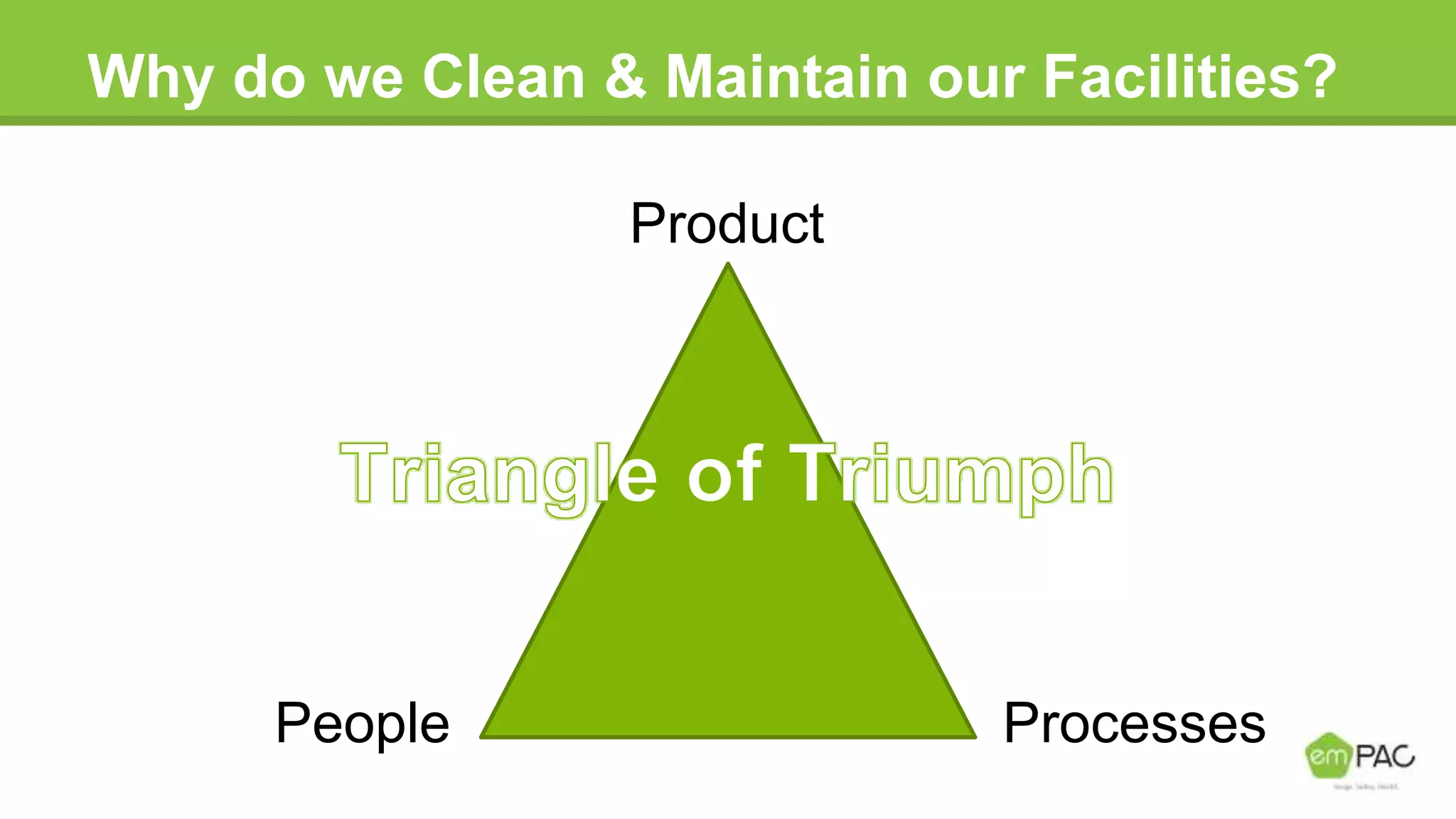
• The Triangle of Triumph
• Understanding associated Operational & Maintenance costs
• Sustainability of assets
• Clean for Health - IAQ & BRI
• The Operational & Maintenance Ecosystem
How do we Clean & Maintain our Facilities?
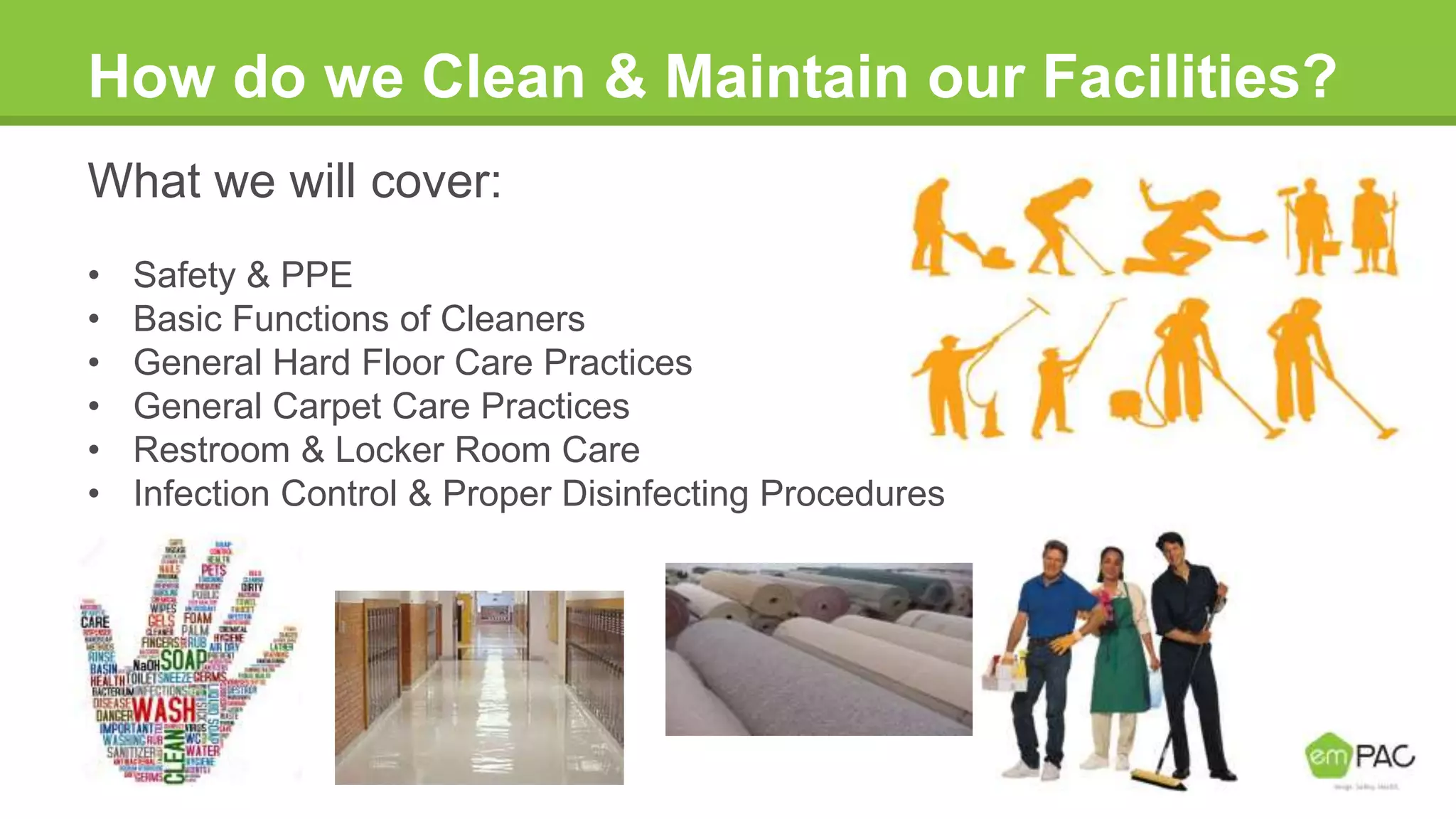
What we will cover:
• Safety & PPE
• Basic Functions of Cleaners
• General Hard Floor Care Practices
• General Carpet Care Practices
• Restroom & Locker Room Care
• Infection Control & Proper Disinfecting Procedures
Why do we Clean & Maintain our Facilities?
People Processes
Product
Why do we Clean & Maintain our Facilities?
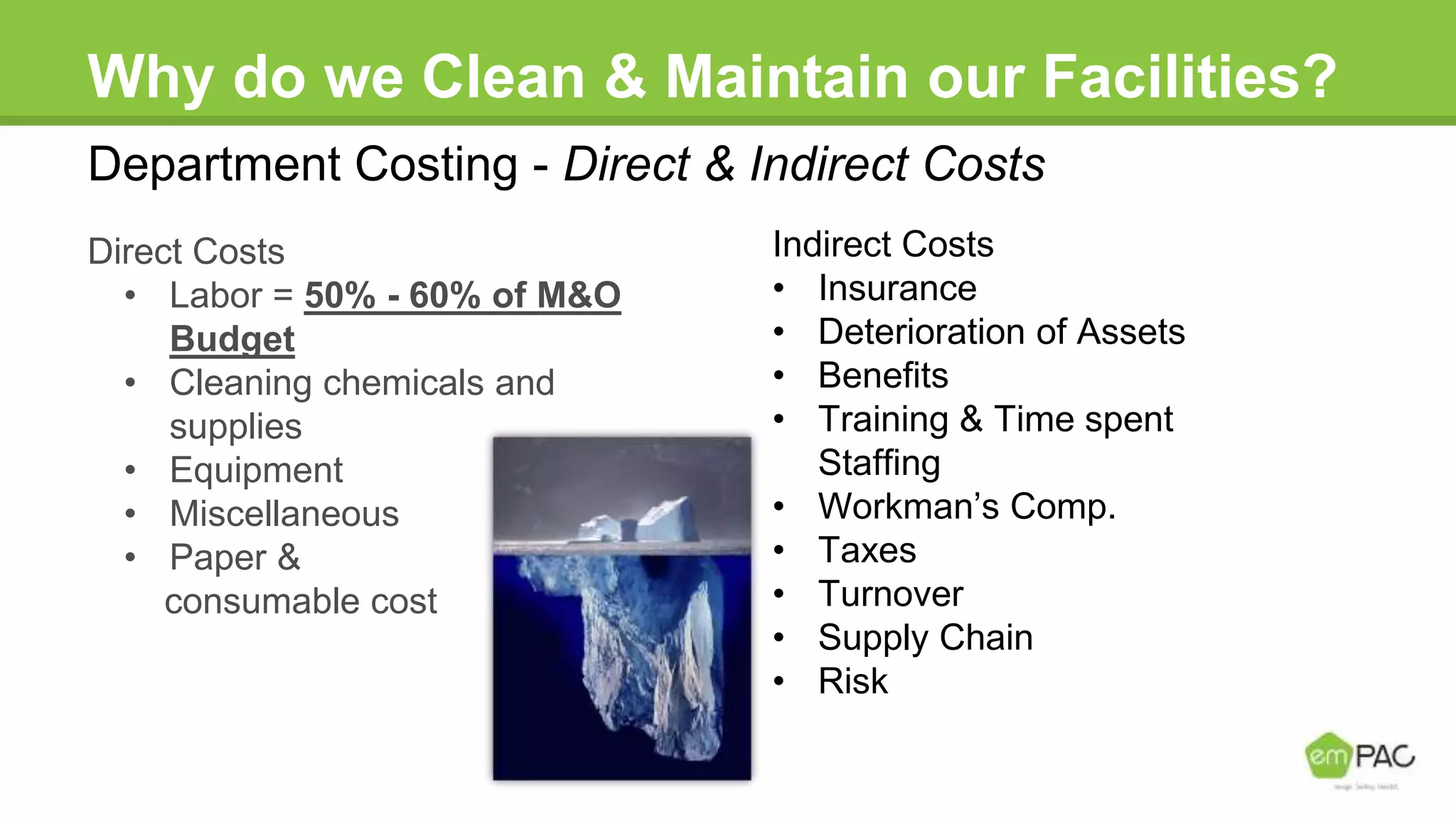
Direct Costs
• Labor = 50% - 60% of M&O
Budget
• Cleaning chemicals and
supplies
• Equipment
• Miscellaneous
• Paper &
consumable cost
Indirect Costs
• Insurance
• Deterioration of Assets
• Benefits
• Training & Time spent
Staffing
• Workman’s Comp.
• Taxes
• Turnover
• Supply Chain
• Risk
Department Costing - Direct & Indirect Costs
Why do we Clean & Maintain our Facilities?
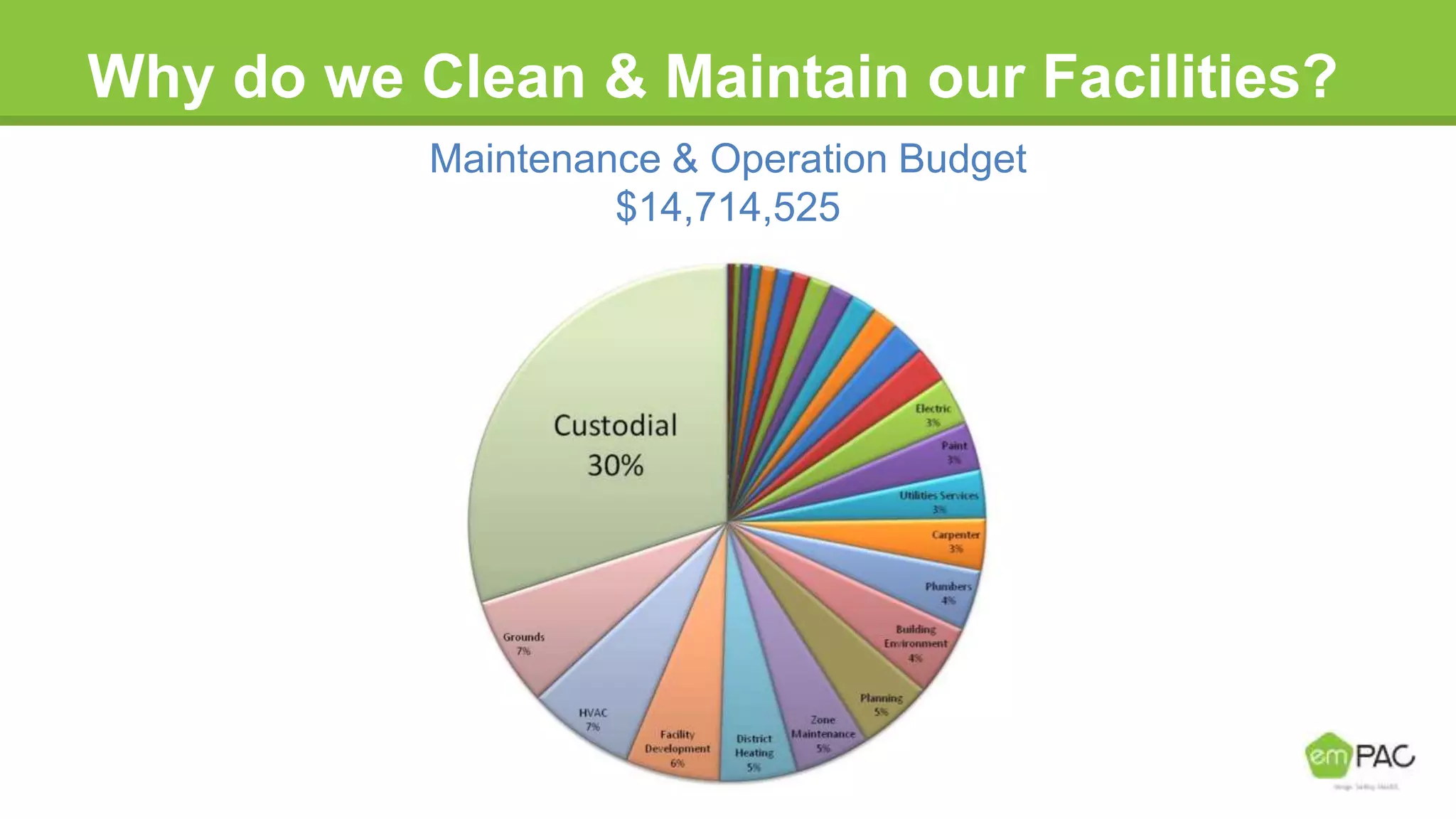
Maintenance & Operation Budget
$14,714,525
Why do we Clean & Maintain our Facilities?
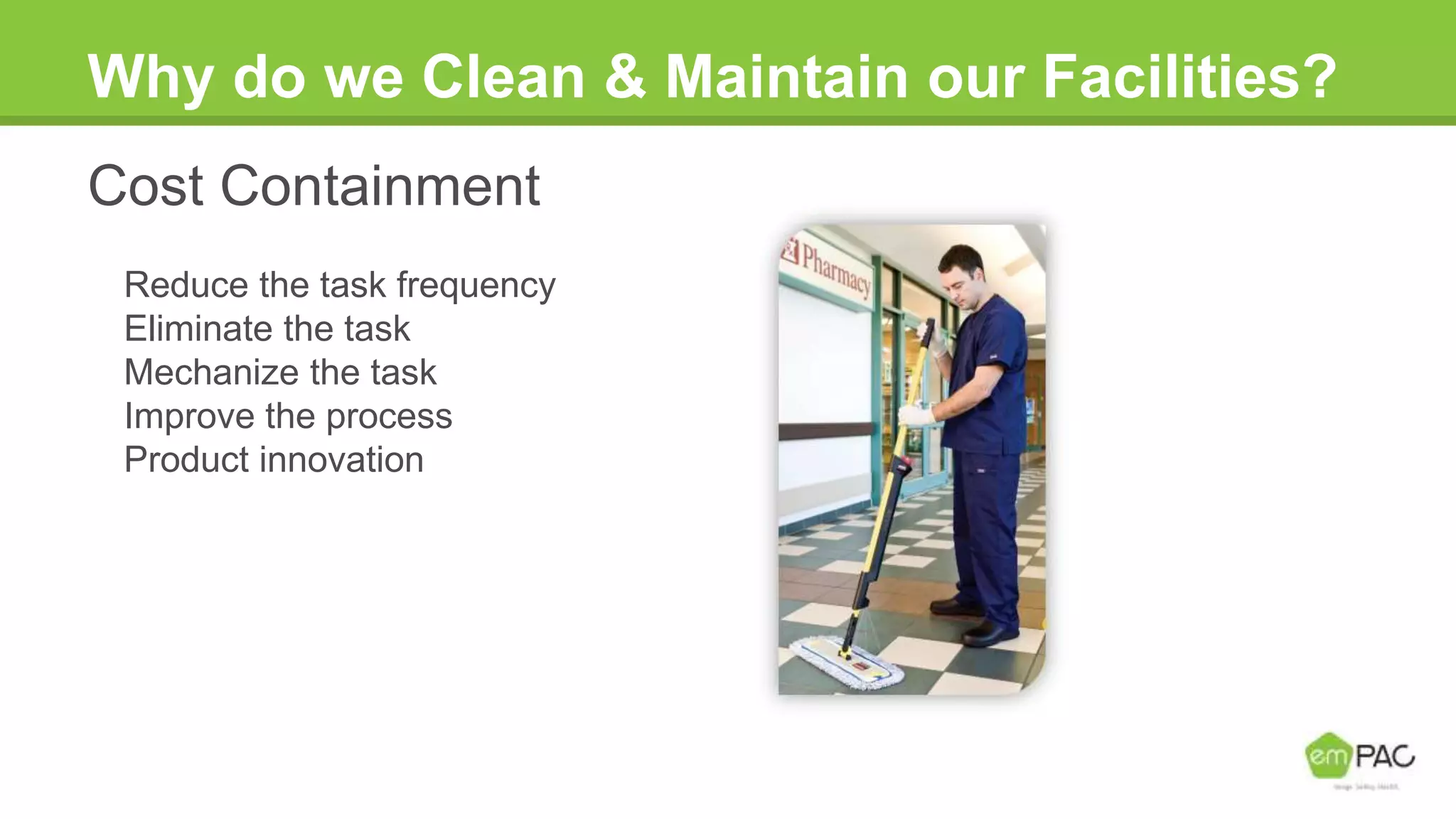
Cost Containment
Reduce the task frequency
Eliminate the task
Mechanize the task
Improve the process
Product innovation
Why do we Clean & Maintain our Facilities?
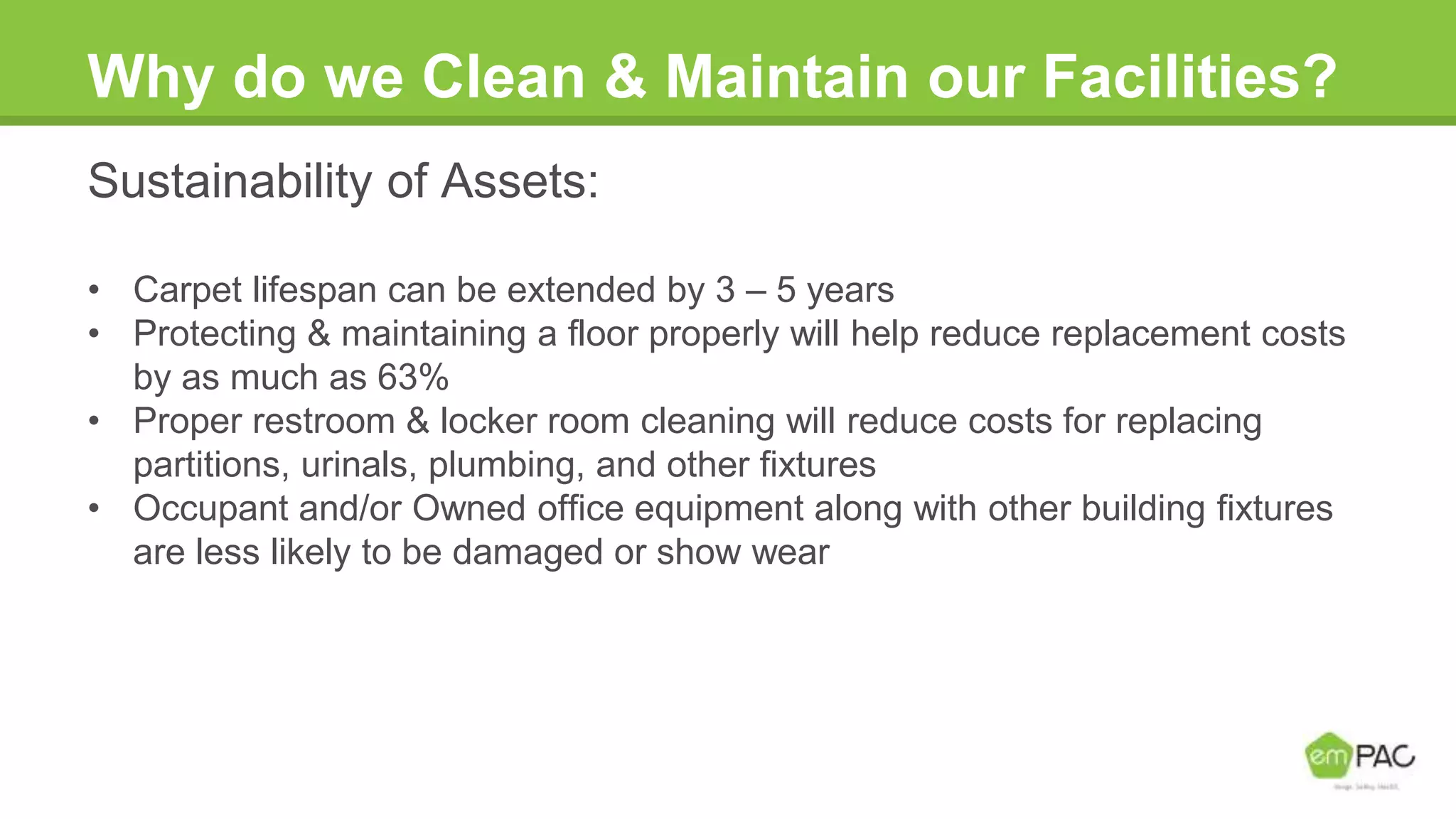
Sustainability of Assets:
• Carpet lifespan can be extended by 3 – 5 years
• Protecting & maintaining a floor properly will help reduce replacement costs
by as much as 63%
• Proper restroom & locker room cleaning will reduce costs for replacing
partitions, urinals, plumbing, and other fixtures
• Occupant and/or Owned office equipment along with other building fixtures
are less likely to be damaged or show wear
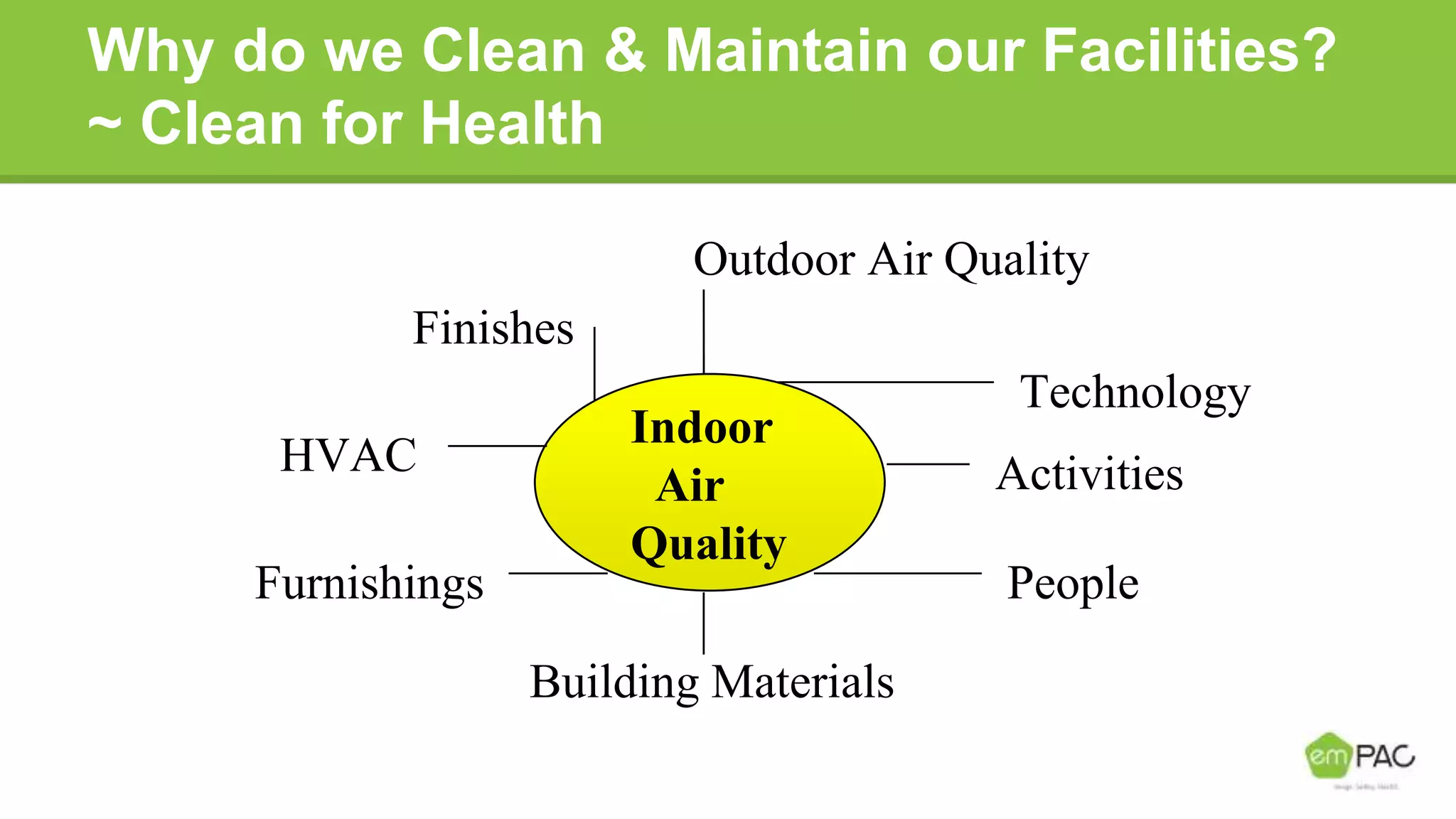
Why do we Clean & Maintain our Facilities?
~ Clean for Health
Indoor
Air
Quality
Technology
Activities
People
Building Materials
Furnishings
HVAC
Finishes
Outdoor Air Quality
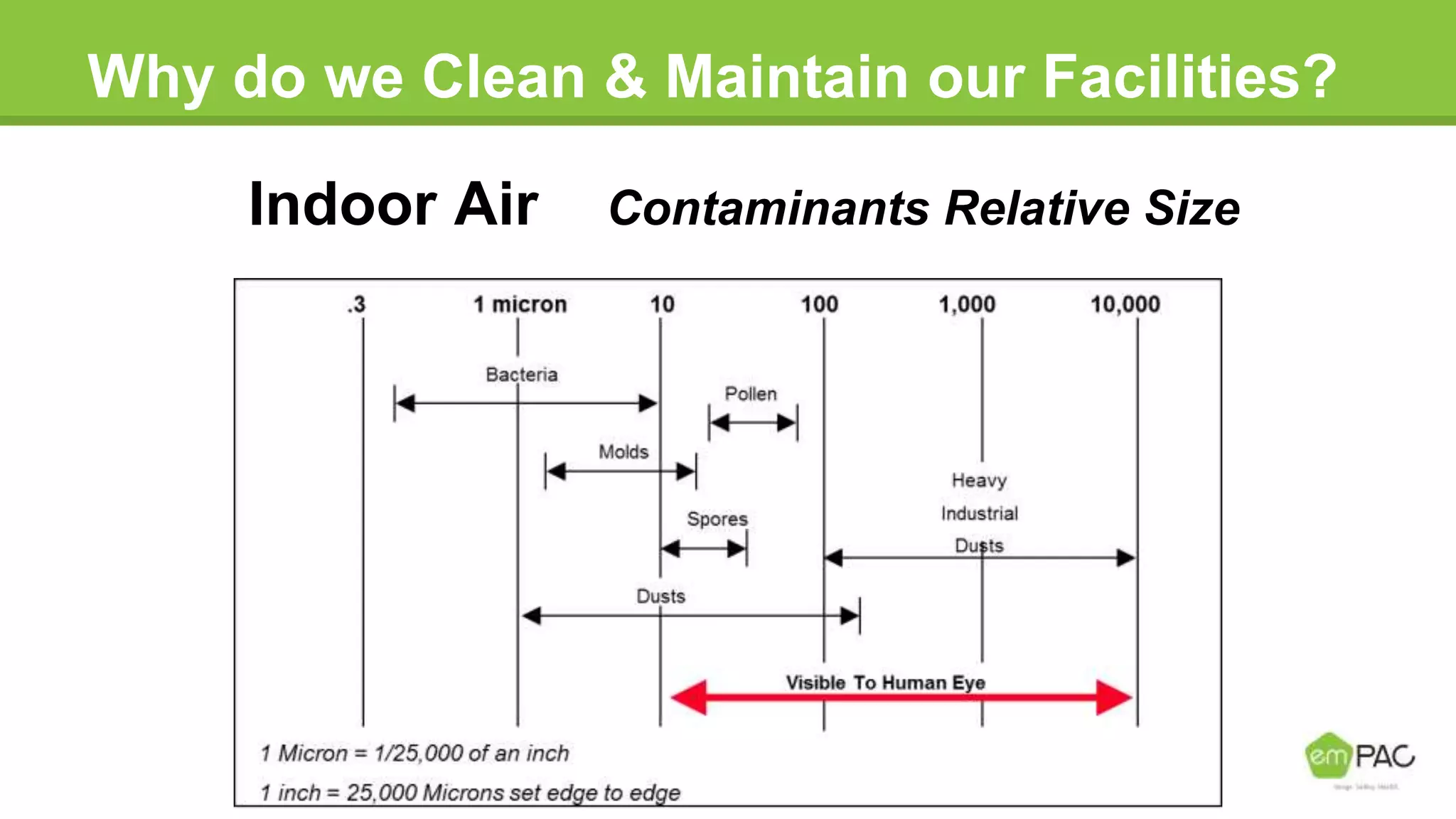
Why do we Clean & Maintain our Facilities?
Indoor Air Contaminants Relative Size
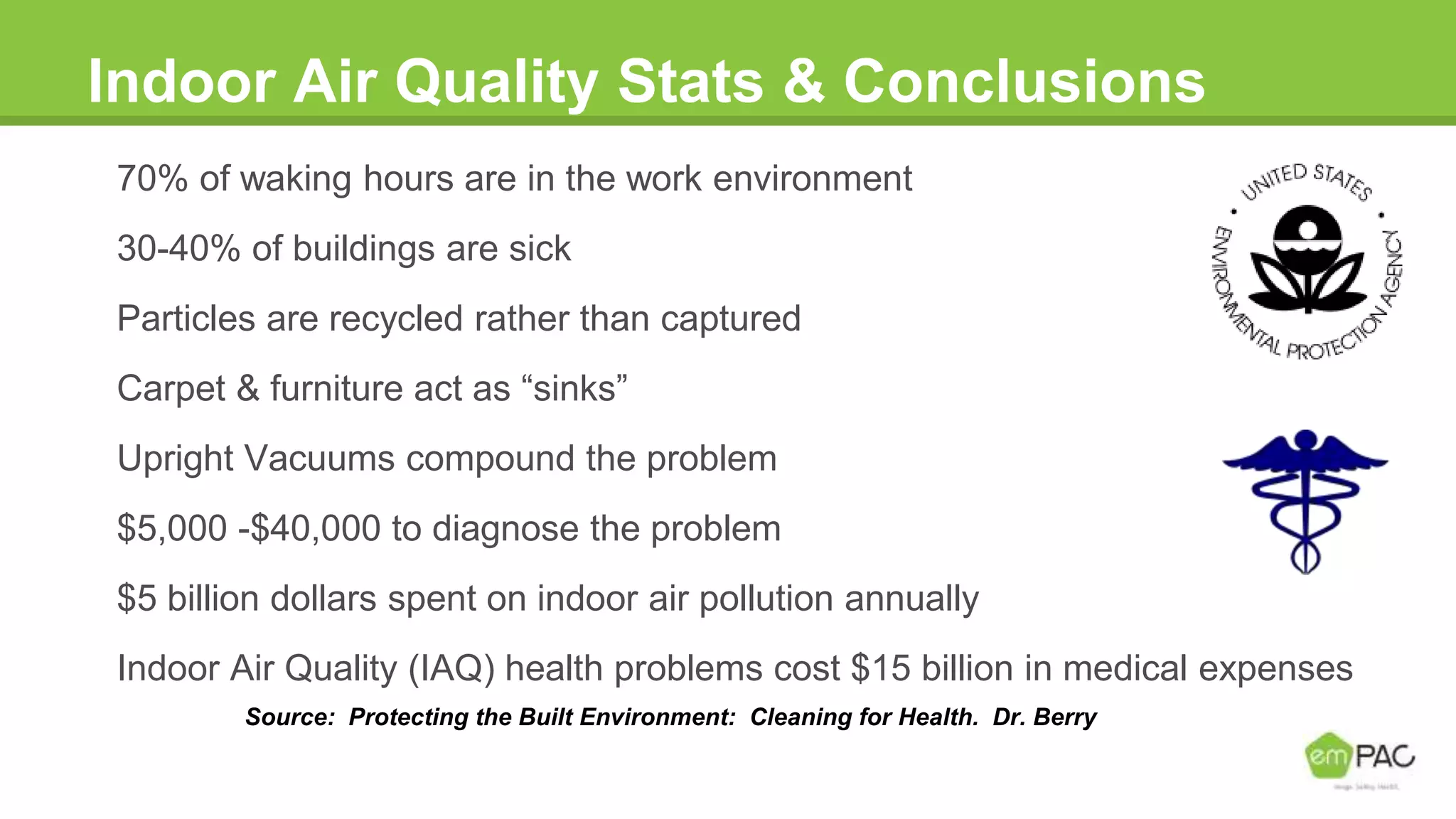
Indoor Air Quality Stats & Conclusions
Source: Protecting the Built Environment: Cleaning for Health. Dr. Berry
70% of waking hours are in the work environment
30-40% of buildings are sick
Particles are recycled rather than captured
Carpet & furniture act as “sinks”
Upright Vacuums compound the problem
$5,000 -$40,000 to diagnose the problem
$5 billion dollars spent on indoor air pollution annually
Indoor Air Quality (IAQ) health problems cost $15 billion in medical expenses
Why do we Clean & Maintain our Facilities?
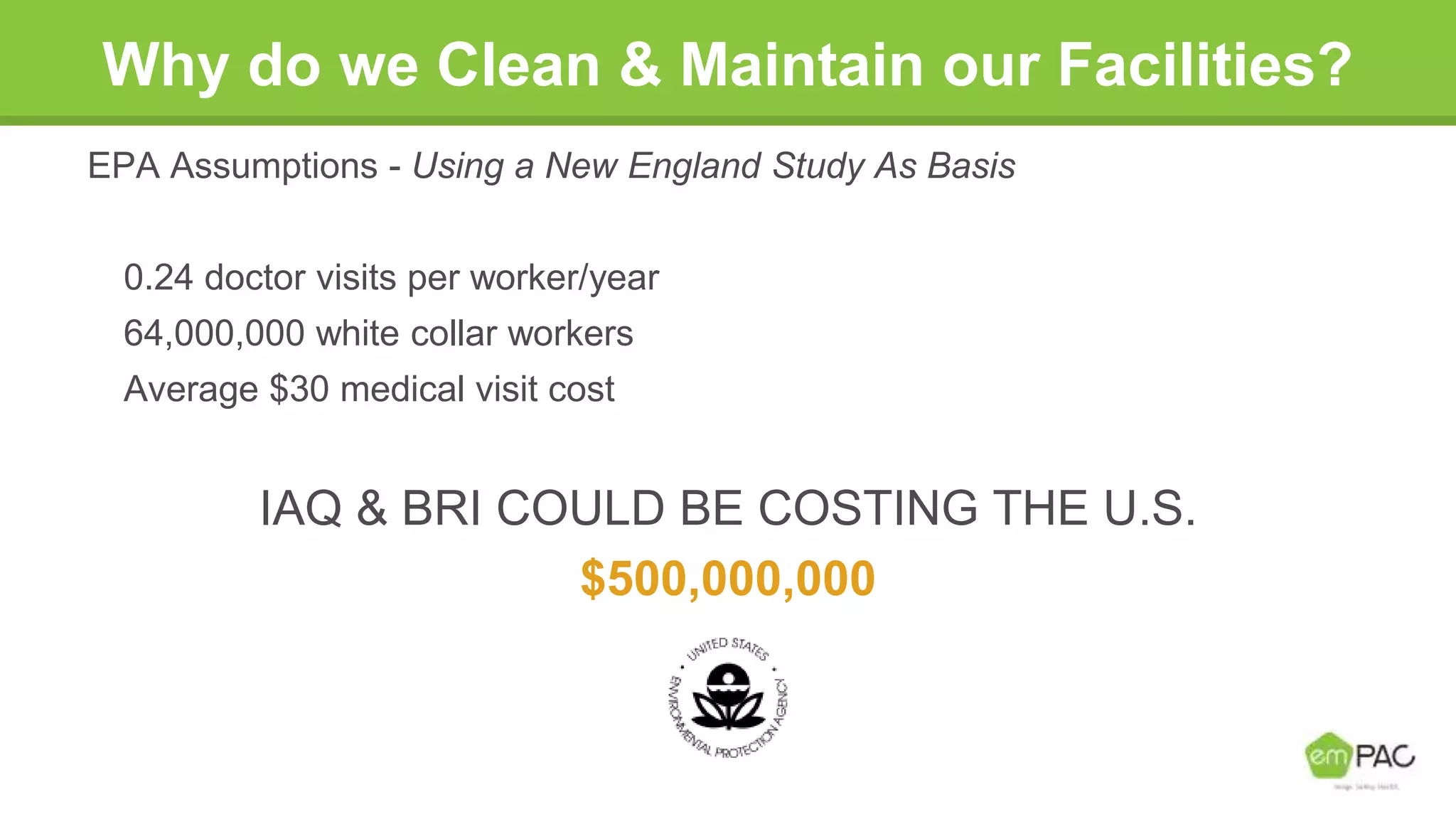
EPA Assumptions - Using a New England Study As Basis
0.24 doctor visits per worker/year
64,000,000 white collar workers
Average $30 medical visit cost
IAQ & BRI COULD BE COSTING THE U.S.
$500,000,000
Why do we Clean & Maintain our Facilities?
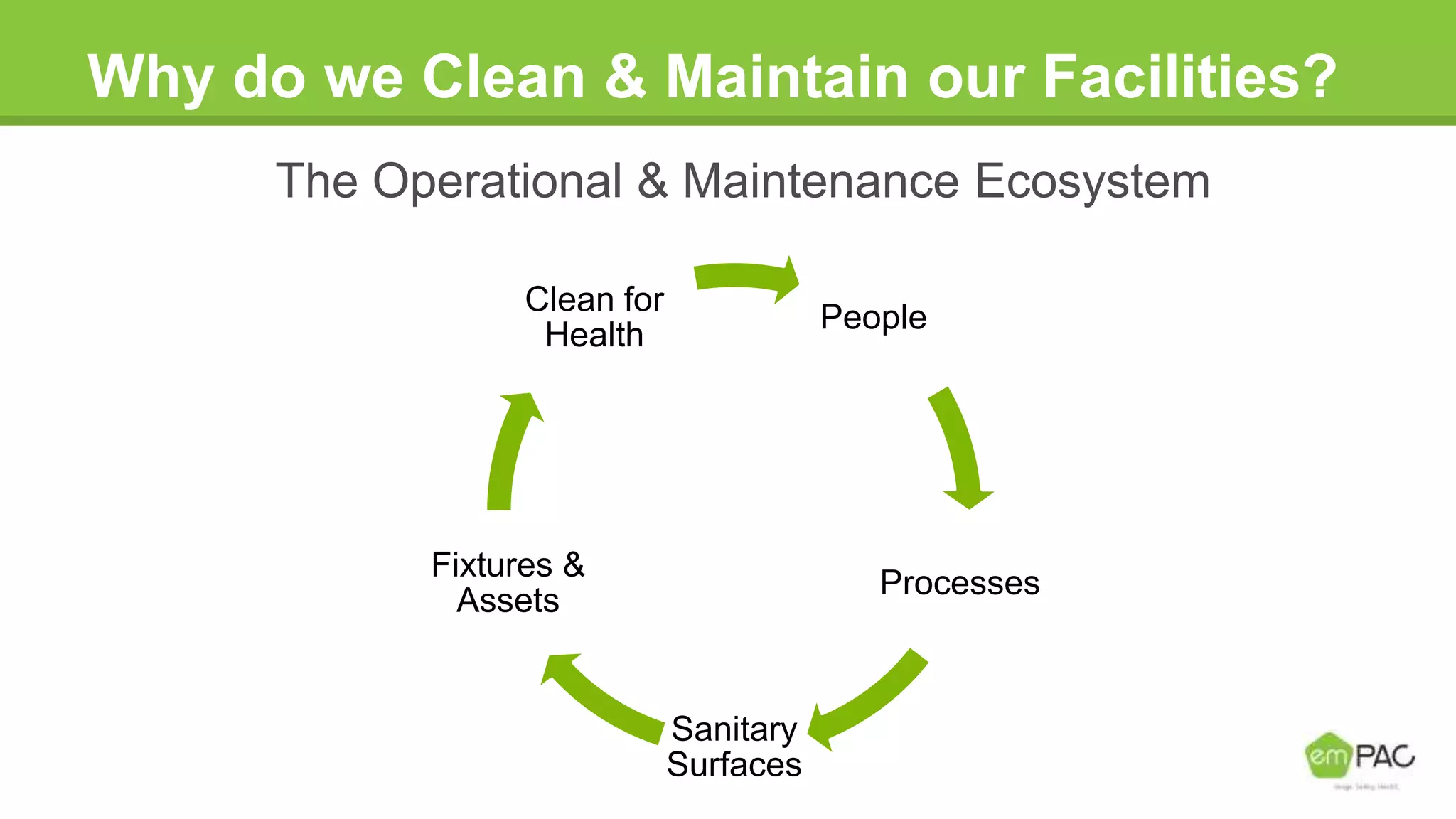
The Operational & Maintenance Ecosystem
People
Processes
Sanitary
Surfaces
Fixtures &
Assets
Clean for
Health
How do we Clean &
Maintain our Facilities?
Safety & PPE
Job Related Injuries
Most Frequent OSHA Citations
Facilities Maintenance Departments
Bloodborne pathogens
Hazard communication
General requirements (PPE)
www.osha.gov/dcsp/products/topics/cleaningindustry/standards.html
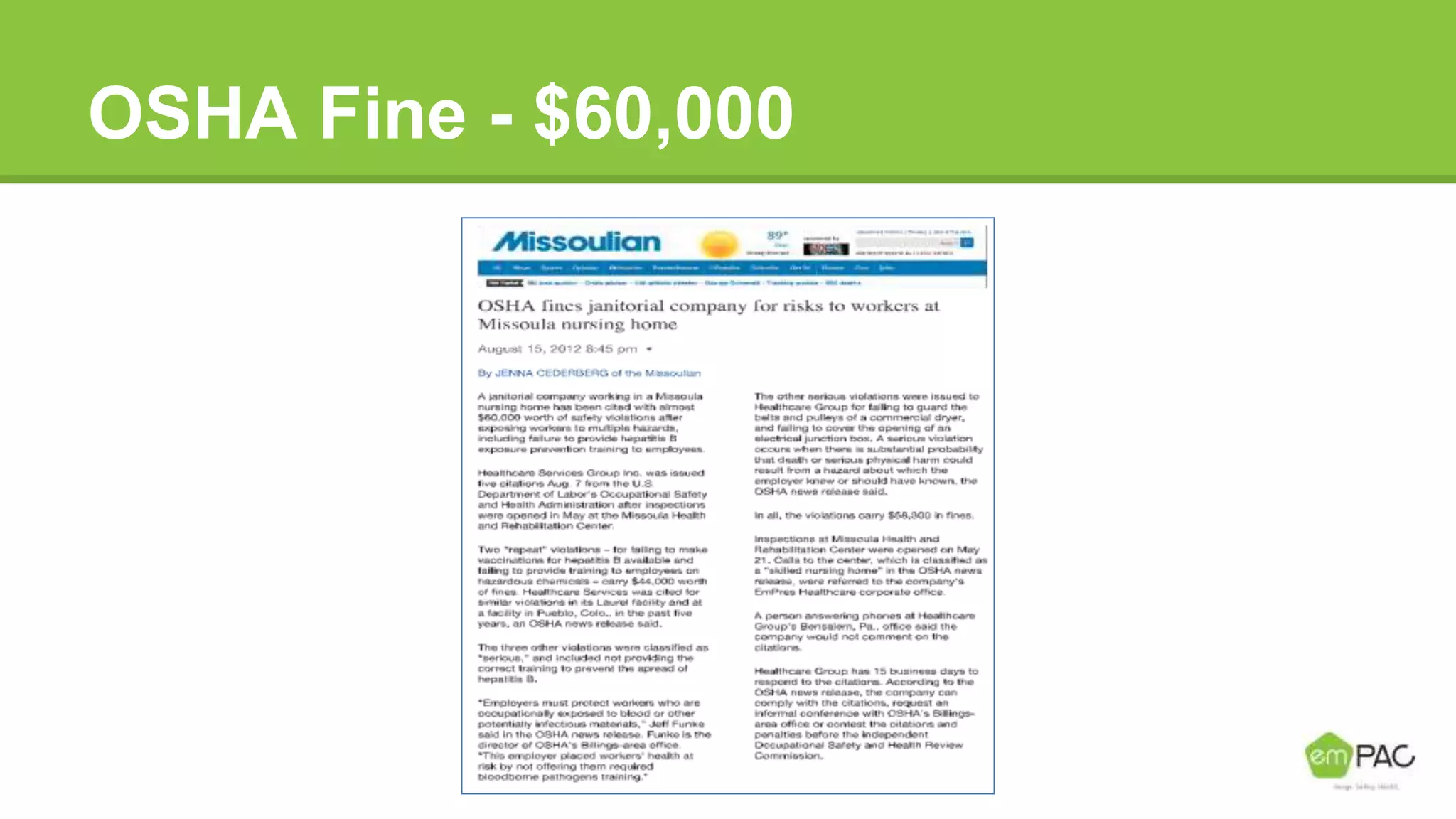
OSHA Fine - $60,000
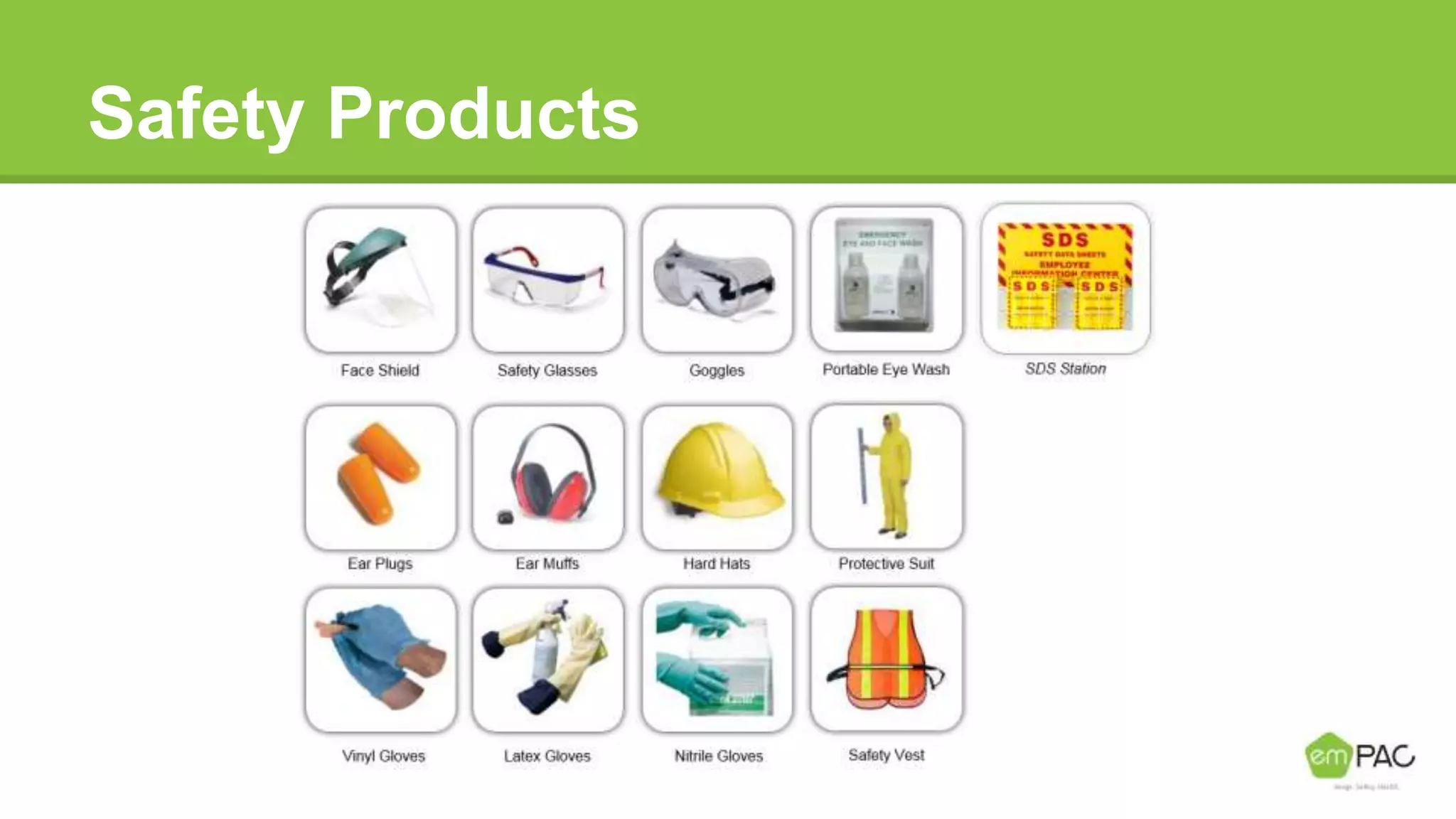
Safety Products
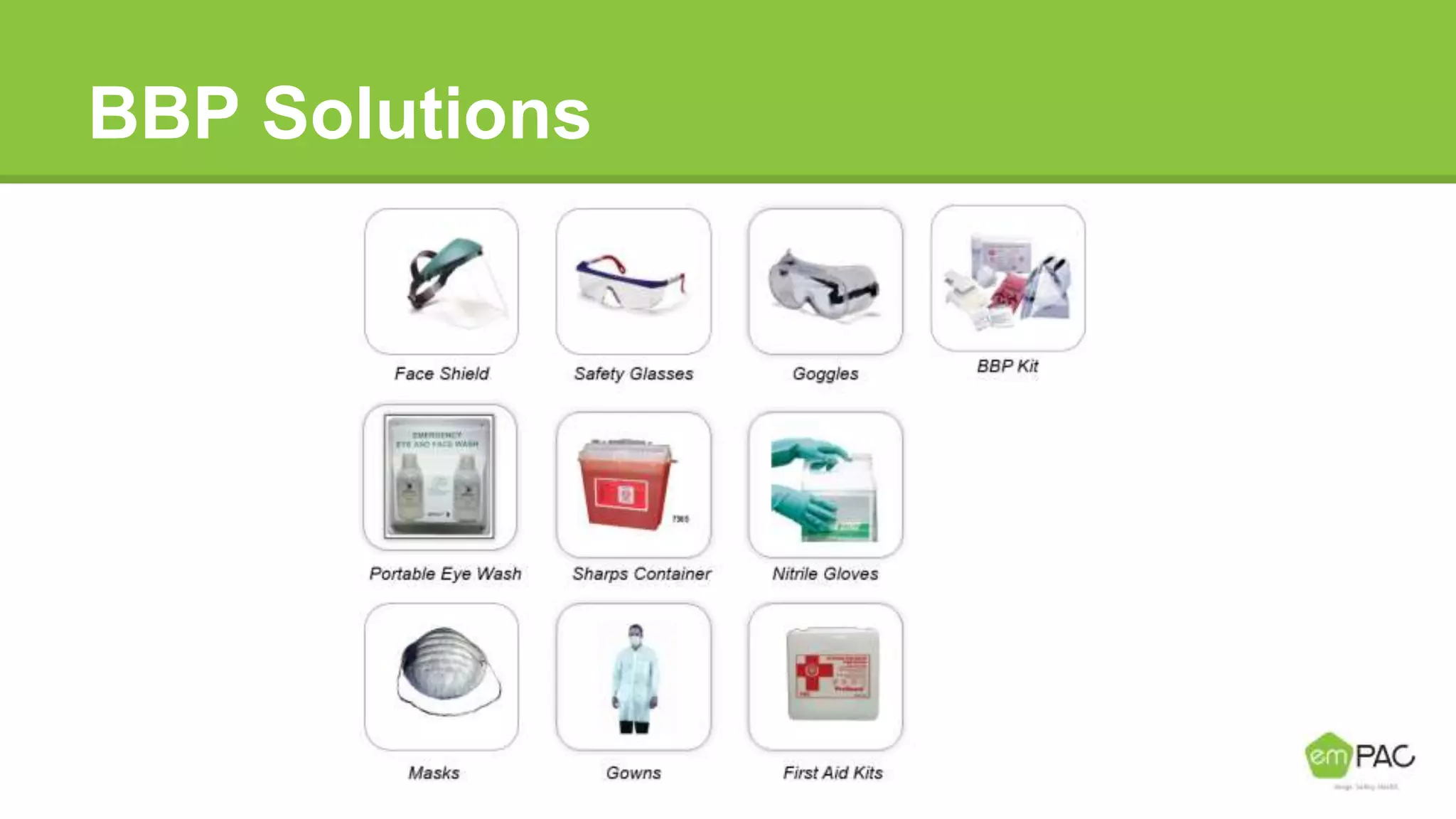
BBP Solutions
Eye Protection
Use appropriate eye protection when exposed to potential hazards
Dispensing chemicals
Splash
Handling chemicals
Splash
Chemical spraying
Splash
Dusting
Airborne debris
Pesticide application
Spray
Grounds maintenance
Flying particles
Light discomfort
Glare
Eyewear Must Meet ANSI Std. Z87.1- 2003 Eyewear Must Have Side shields
Hand Protection
Use appropriate hand protection when exposed to potential hazards
Skin absorption of harmful substances
Punctures, chemical burns
Harmful temperature extremes
Chemical handling and chemical burns
Sharp or abrasive objects
Hand Protection
Gloves Help Provide Proper Hand Protection
Four types of gloves
1. Chemical Resistant/Liquid Resistant
2. General Purpose - Work Gloves
3. Disposables
4. Specialty
Make Sure to Select The Proper Chemical Resistant Gloves For The Job
Hand Protection
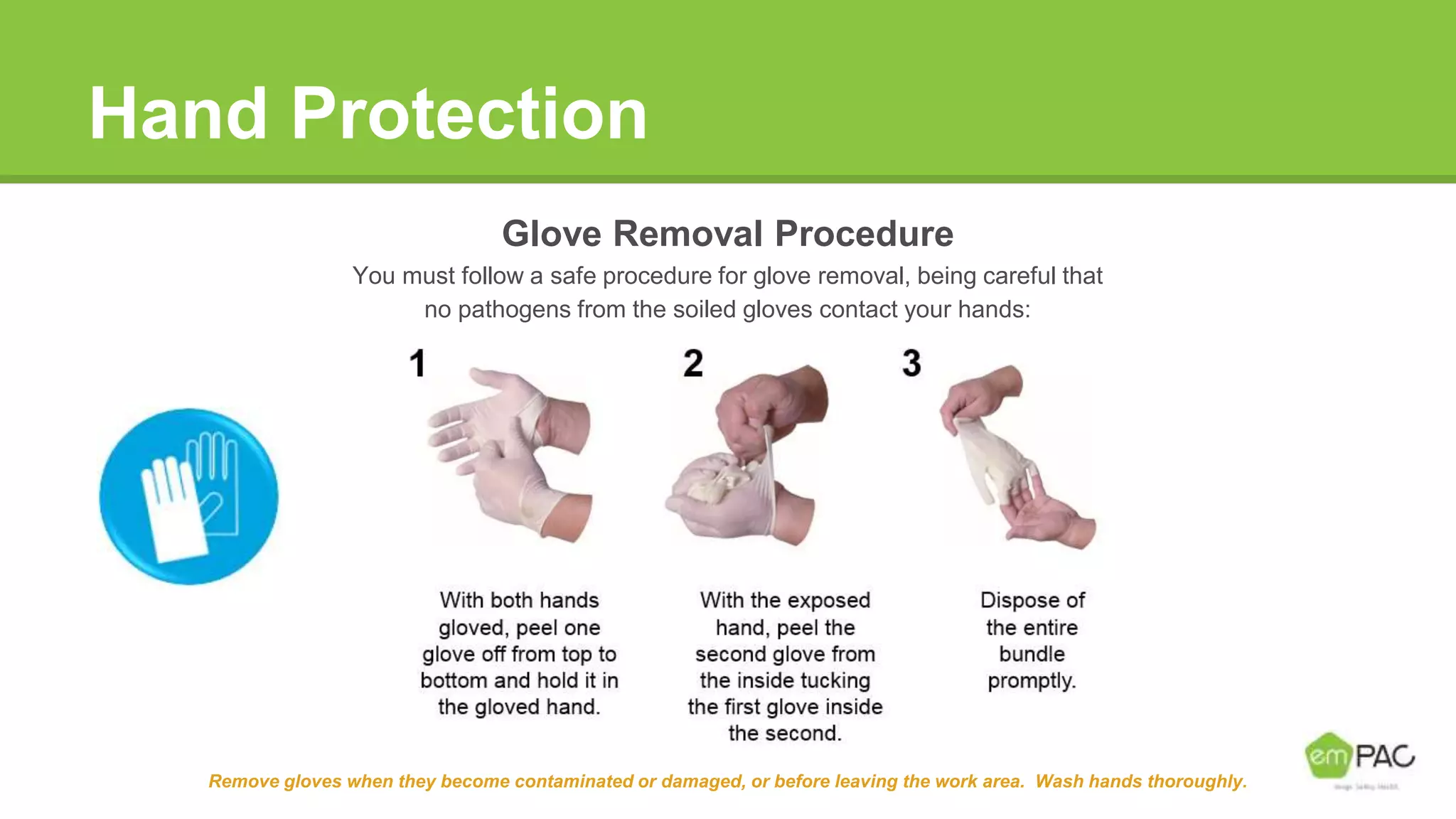
Glove Removal Procedure
You must follow a safe procedure for glove removal, being careful that
no pathogens from the soiled gloves contact your hands:
Remove gloves when they become contaminated or damaged, or before leaving the work area. Wash hands thoroughly.
How do we Clean &
Maintain our Facilities?
Basic Functions of Cleaners
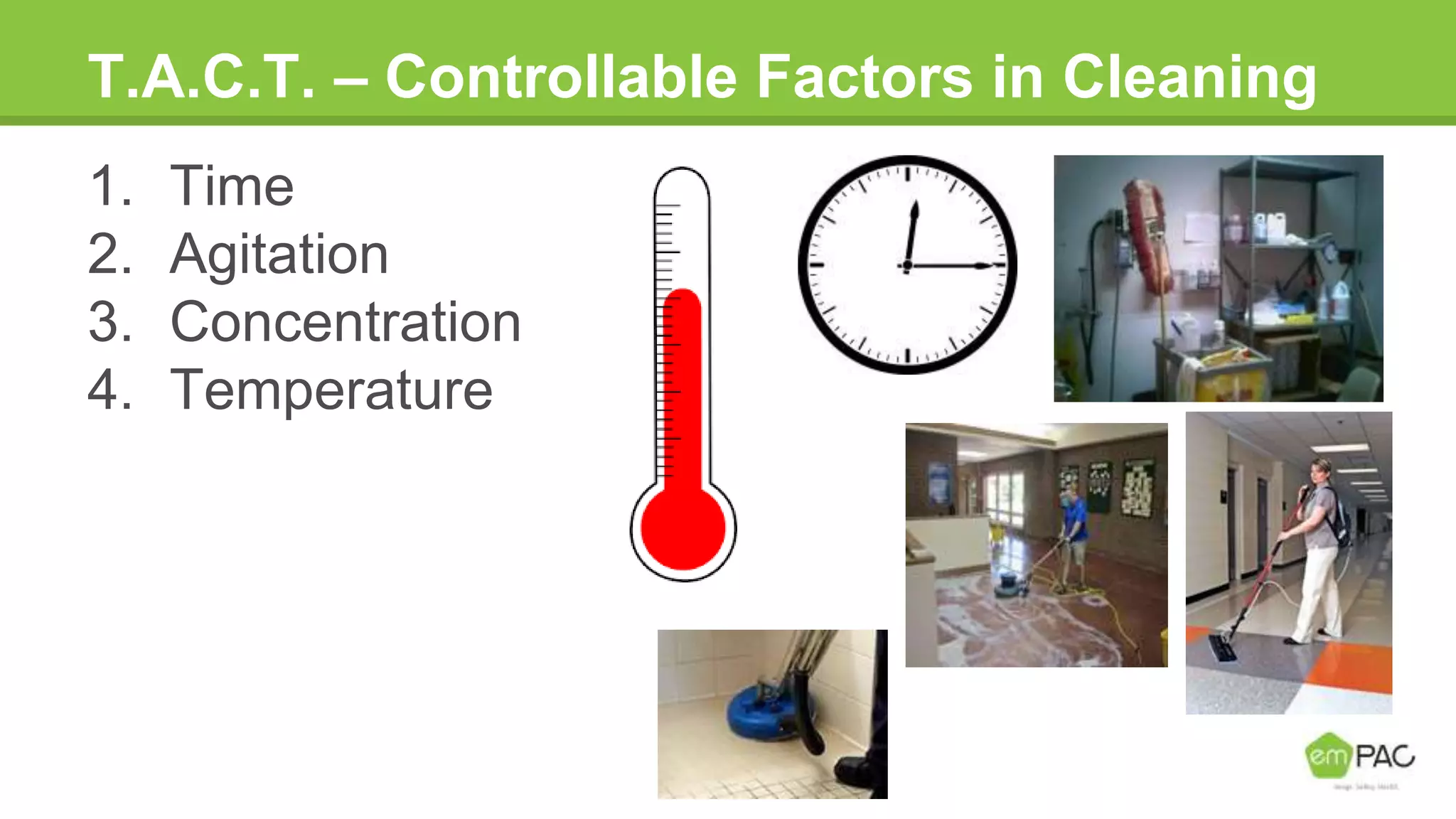
T.A.C.T. – Controllable Factors in Cleaning
1. Time
2. Agitation
3. Concentration
4. Temperature
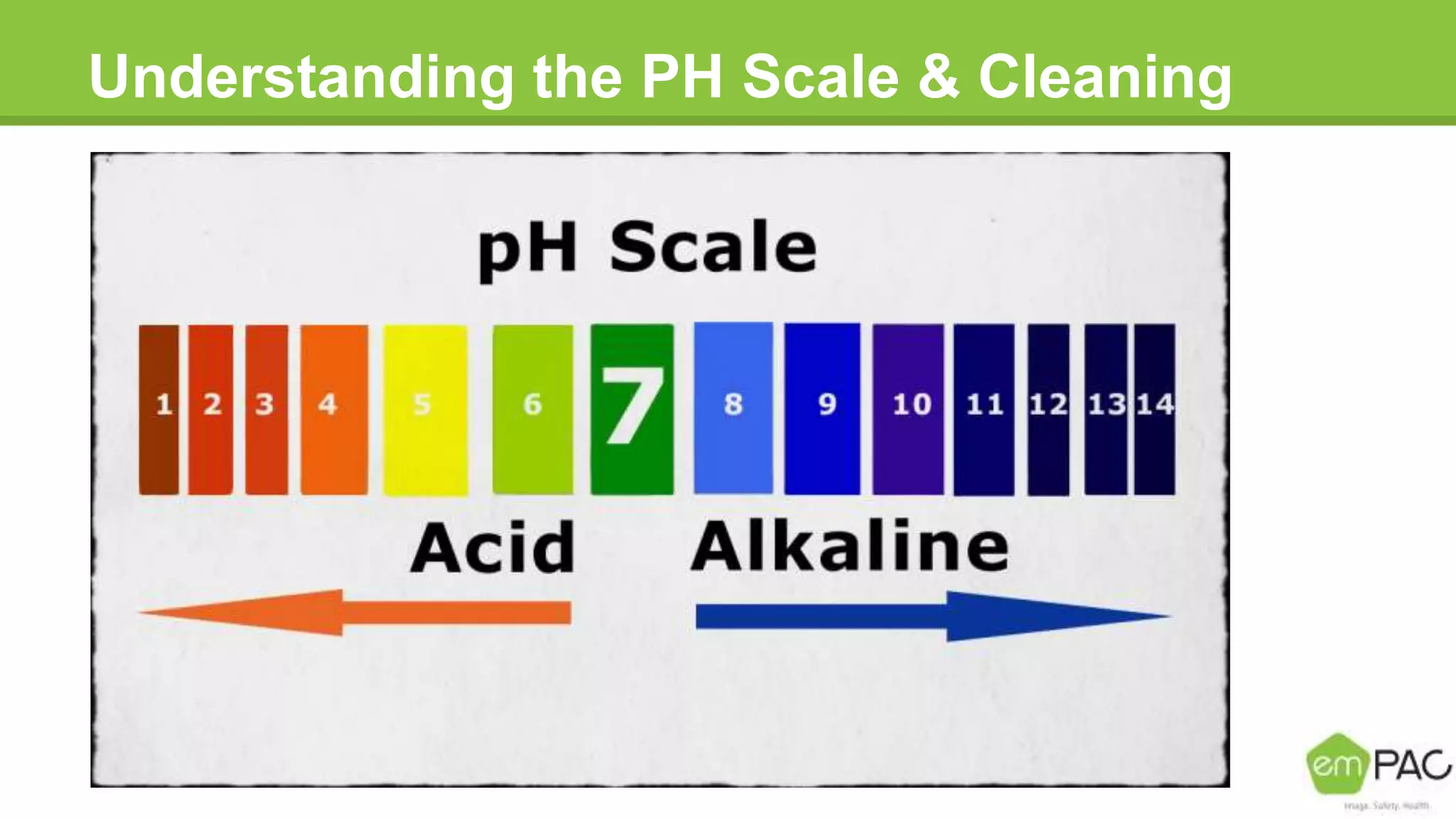
Understanding the PH Scale & Cleaning
How do we Clean &
Maintain our Facilities?
Hard Floor Care
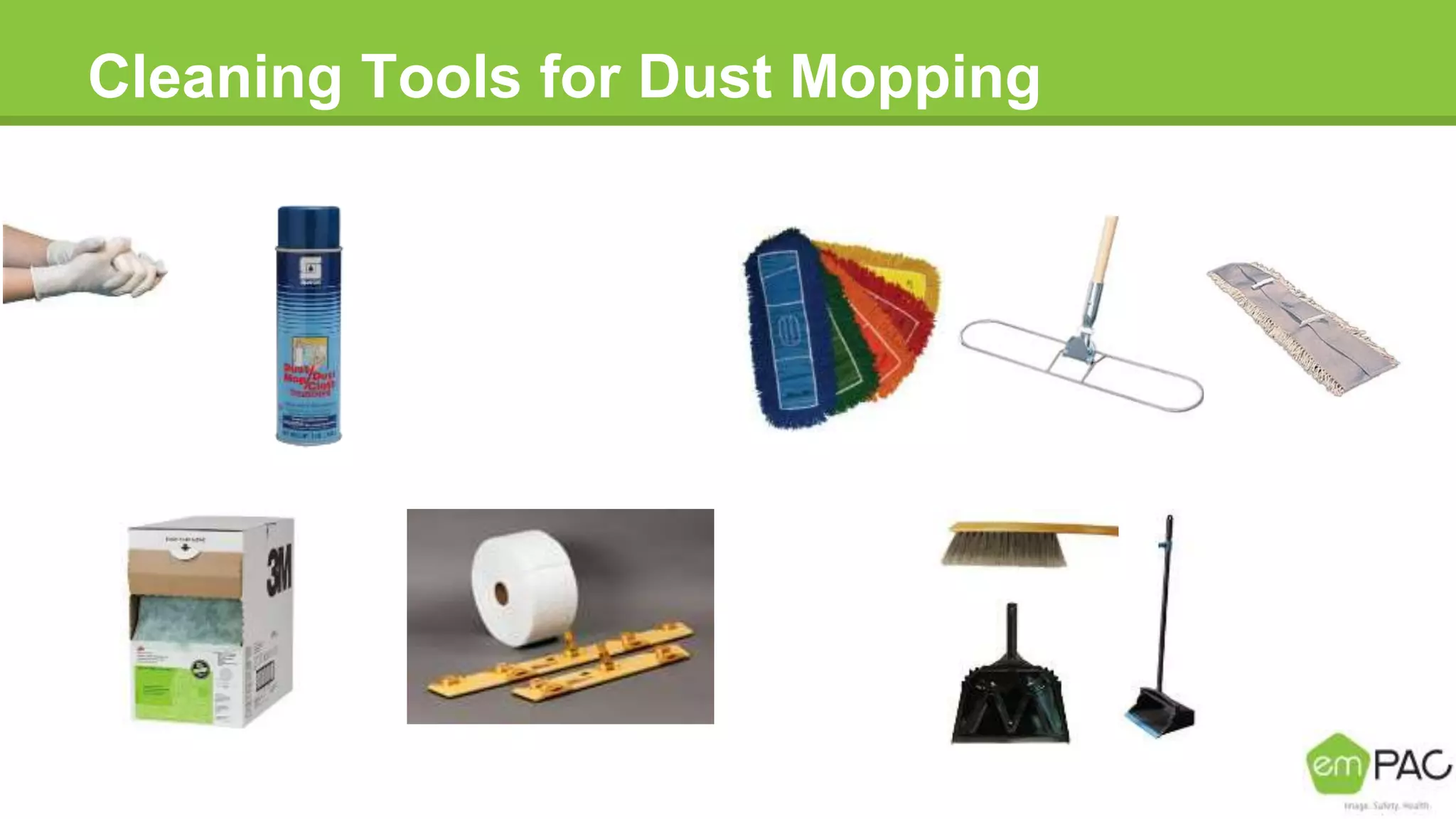
Cleaning Tools for Dust Mopping
Dust Mopping Tips & Takeaways
• The difference between a laundered and disposables dust mops
• When using a dust mop keep on the floor at all times using the swivel head
• Dust mopping collects all of the fine debris
• Any heavy dirt you can collect in front of the mop and scoop up with dust pan
• Flop the mop to release grit and contaminates
• Do not use on wet floors
• Test floor with a light color microfiber run across floor to see if you need to dust mop
• Apply mop treatment the night before using if needed
• Supplement your dust mop with flag-tipped brushes to get areas the mops will not get
• Clean-up (throw disposable away, use a vacuum to clean off the mops, launder the mop by
placing it into a mesh bag if needed)
Your imPACt
Size your dust mops to maximize coverage and reduce labor
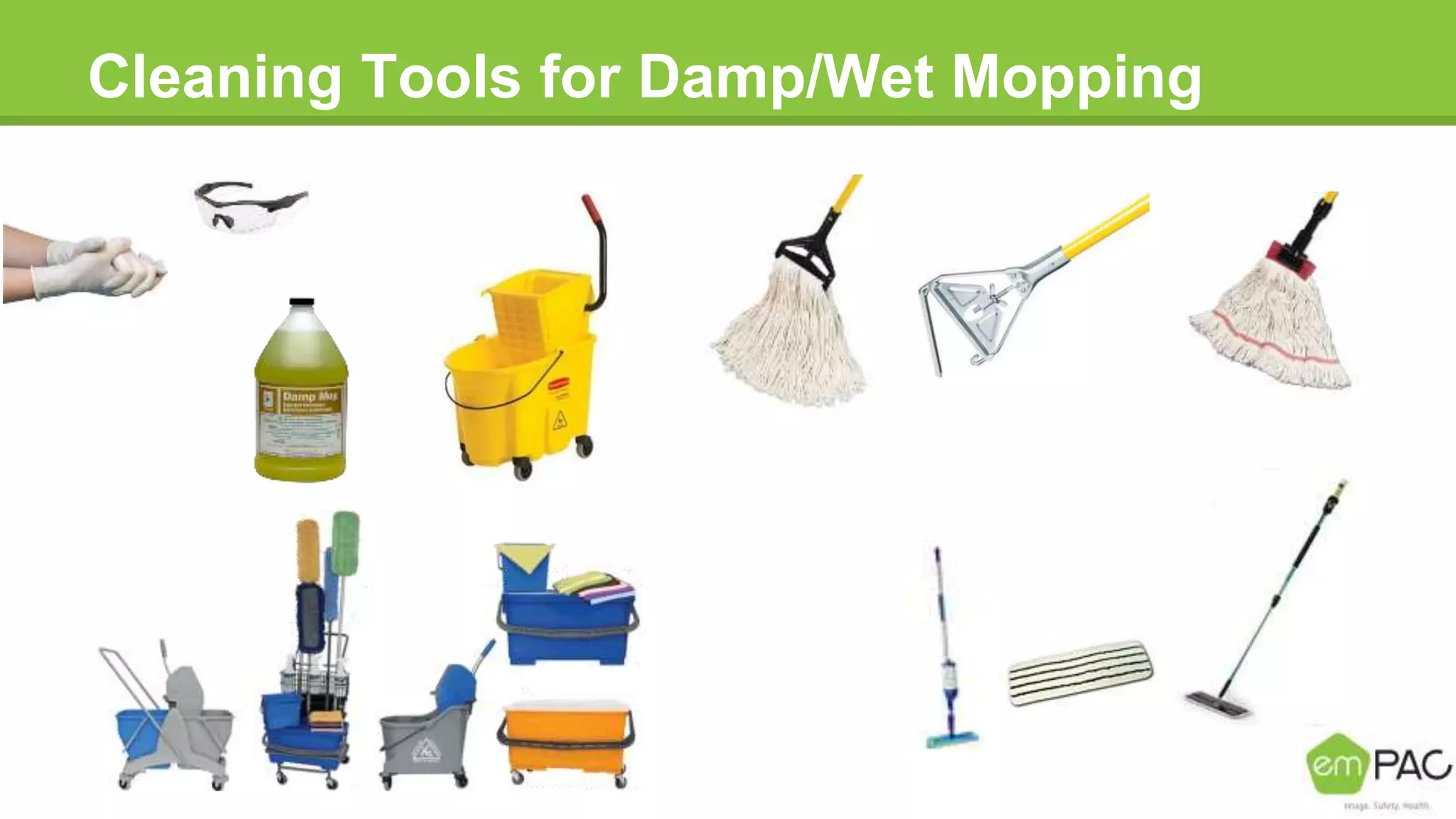
Cleaning Tools for Damp/Wet Mopping
Damp/Wet Mopping Tips & Takeaways
• Difference between damp mopping and wet mopping
• Why damp mop?
• To extend time before recoating floor
• Why wet mop?
• To remove soil that can not be removed by damp mopping
• Dilute the chemical according to manufacturer's recommendation
• Using figure eight pattern
• Put a wet floor sign out
• Difference between conventional damp mopping and microfiber flat mops
• Microfiber mops reduce cross contamination as well as eliminate chemical waste
• Clean-up (rinse conventional mops with clean water, hang to dry, rinse buckets and wringers
and store face down)
Your imPACt
By using microfiber flat mops you eliminate going back and forth for clean water and more
chemical. The travel time reduces labor.
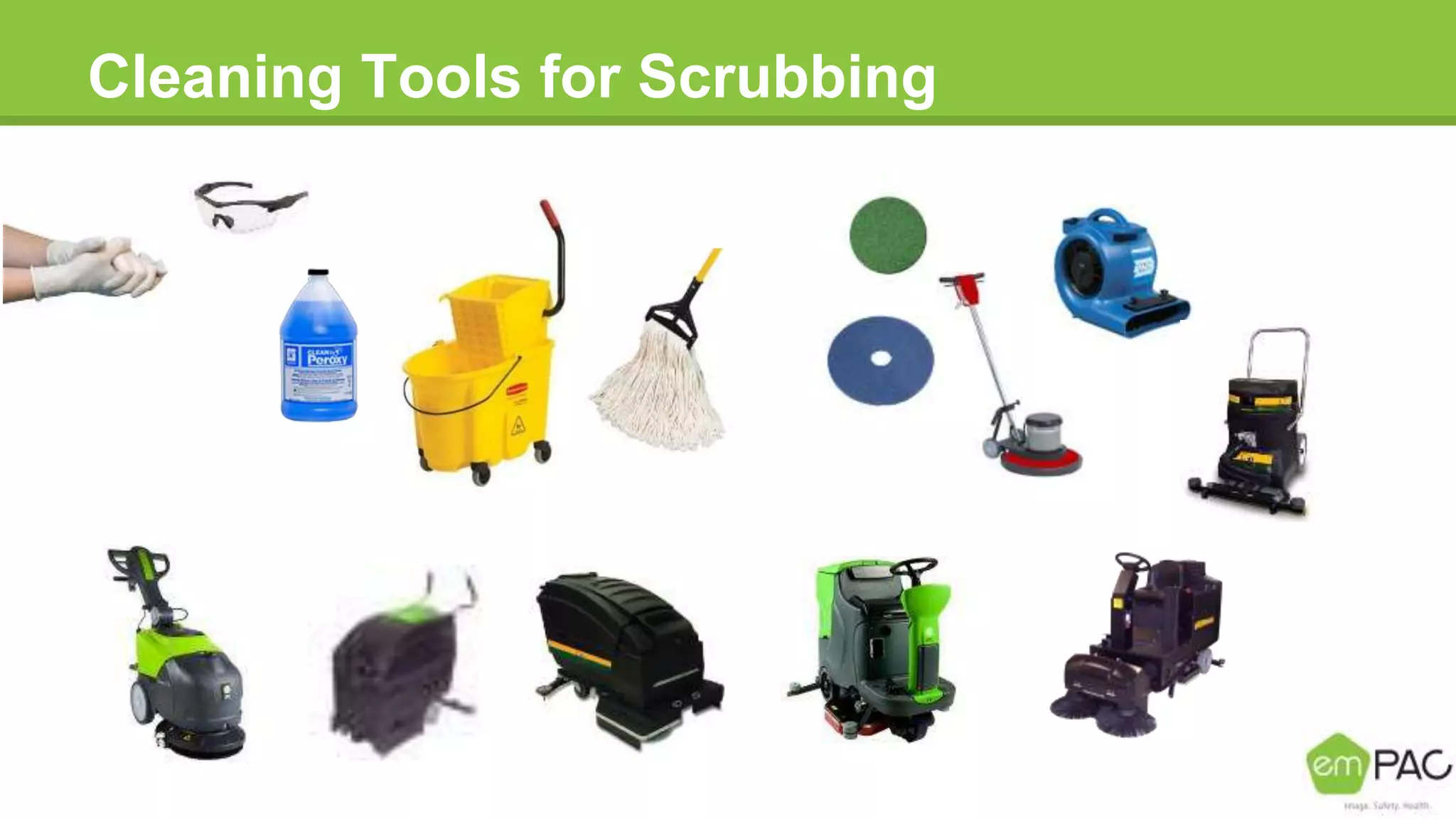
Cleaning Tools for Scrubbing
Scrubbing Tips & Takeaways
• Scrubbing the floor can be done the conventional way by using a floor machine and wet/dry
vacuum or by using an automatic scrubber
• Dilute the chemical according to manufacturer's recommendation
• Put wet floor signs out
• Apply chemical to floor with mop and bucket and let chemical sit for 5 minutes
• Scrub floor with floor machine and blue or green pad (sized to machine) starting from the farthest
point from water source. Pick up with wet/dry vacuum
• Using an auto-scrubber you can mix chemical in the tank, dispense chemical from the tank and
double scrub (using blue or green pads) the area while picking up dirty water with the same unit
• Clean-Up
Your imPACt
Rightsizing an automatic scrubber instead of all of the mops and buckets needed for a two man
operation. One man scrubbing will reduce your labor by 60%
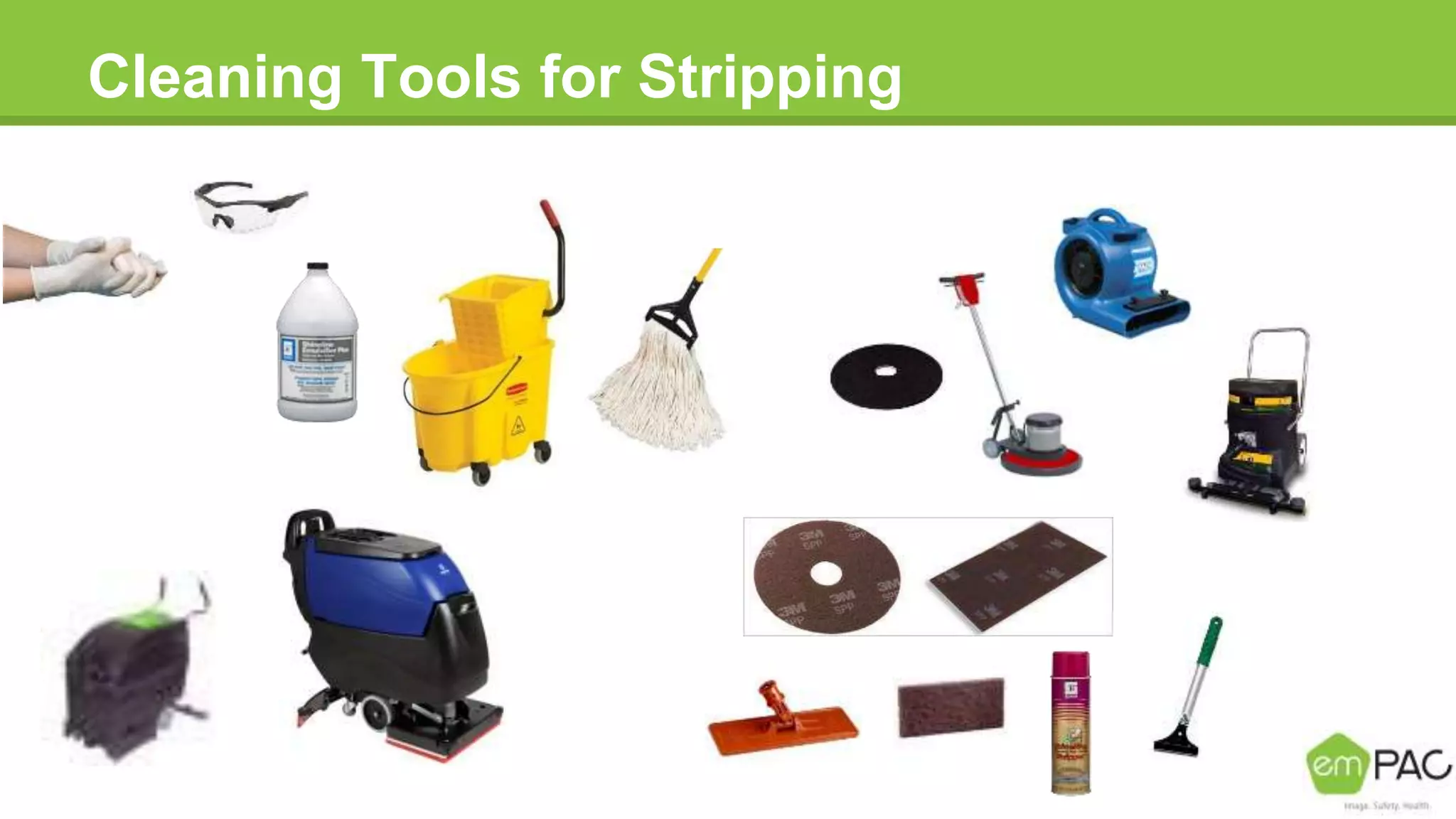
Cleaning Tools for Stripping
Floor Stripping Tips & Takeaways
• Stripping the floor can be done the conventional way by using a floor machine and wet/dry vacuum or by using
an automatic scrubber
• Dilute the chemical according to manufacturer's recommendation
• Put wet floor signs out
• Apply chemical to floor with mop and bucket and let chemical sit for 15 minutes. Put heavy along baseboards
(you may need additional gel baseboard stripper, scrappers, and doodlebug)
• Strip floor with floor machine using a black pad (sized to machine) starting from the farthest point from water
source. Pick up with wet/dry vacuum
• Rinse the floor before coating (check the chalk)
• Using an auto-scrubber you can have rinse water in the tank only, double scrub (using black pads) the area
while picking up and rinsing with the same unit
• Option to use an oscillating scrubber with (maroon 3M surface prep pad) and plain water to remove floor finish
and recoat
• Clean-Up
Your imPACt
By utilizing the oscillating technology you can eliminate time consuming procedures and reduce
cost of stripping and cleaning by up to 60%
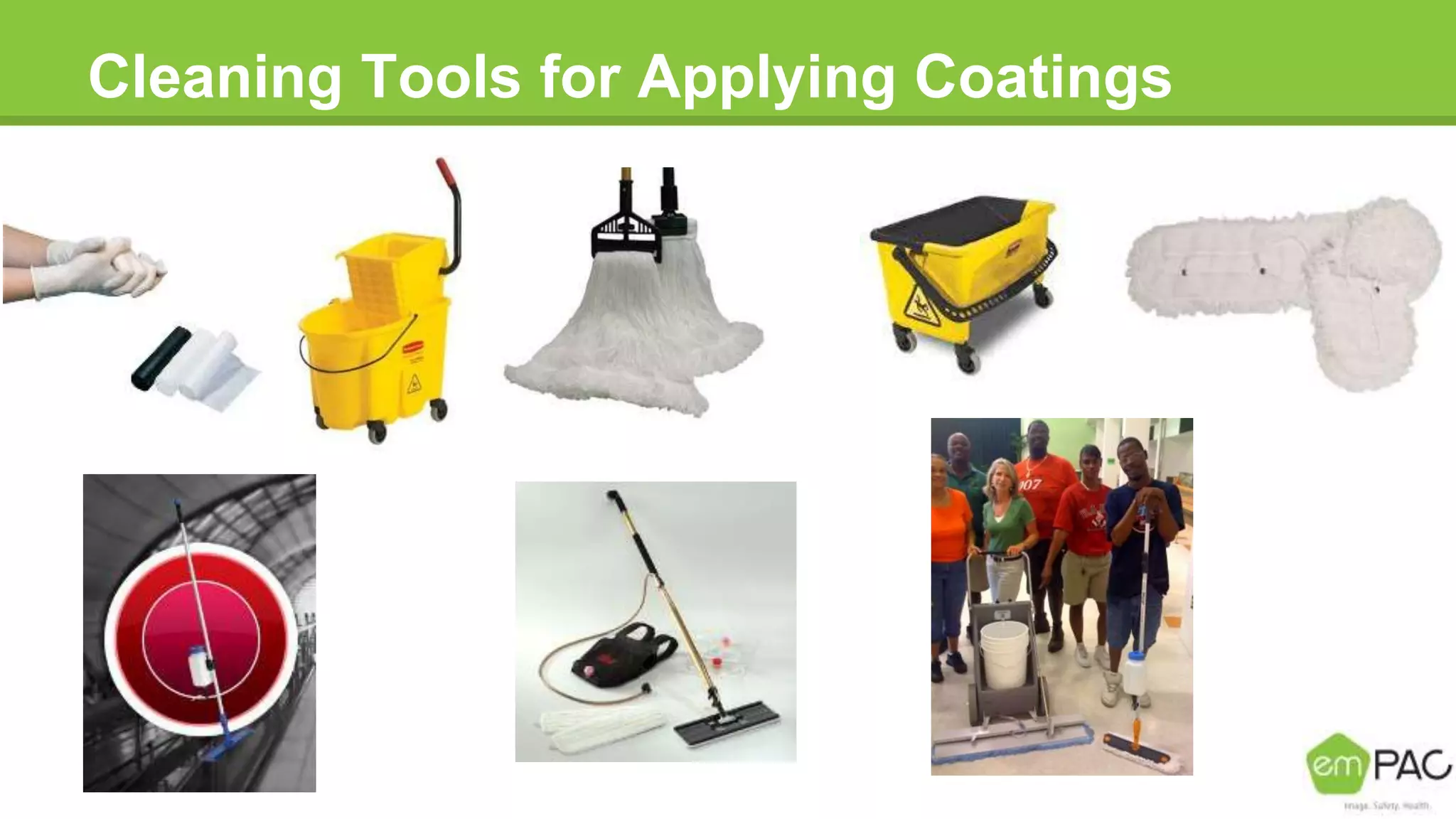
Cleaning Tools for Applying Coatings
Applying Floor Coatings Tips & Takeaways
Why use floor coating
Protect the surface of the floor
Enhance the image of the floor
Increase overall appearance of facility
First impression is lasting
Four ways to apply floor coatings
Using a conventional mop, bucket (can liner), and finish mop
Using a tool (applicator)
Using a backpack (applicator)
Using a walk-behind (applicator)
You want to coat small squares at a time so that you eliminate and lap marks
You want to apply first coat to wall and then working your way away from wall on the remaining coats until the last
coat back to wall
Before applying additional coats you must wait 30 minutes or to the floor is completely dry
Clean-up (Rinse everything with hot water to clean thoroughly)
Your imPACt
By utilizing right size applicators you can reduce your time on coating floors.
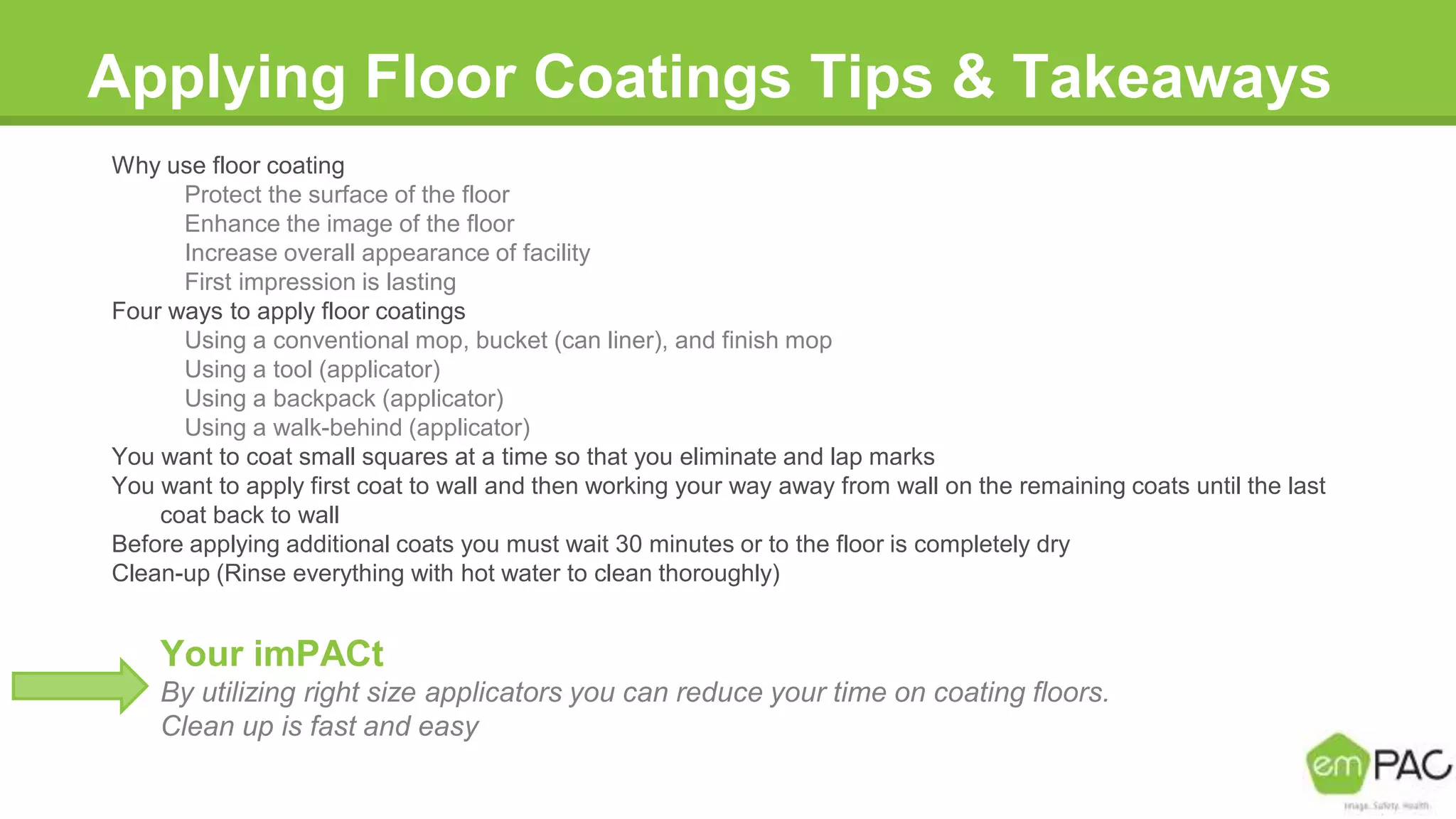
Clean up is fast and easy
Cleaning Tools for High Speed Burnishing
Spray Buffing/High Speed Burnishing
Why Spray Buff or Burnish?
To extend the life of the floor
To smooth floor for light reaction
Make sure you dust mop or damp mop floor if needed first
Spray buffing you use a standard 175 rpm or dual speed floor machine, spray buff chemical (wax n’
water) and a red pad (sized to machine)
Burnishing the floor you will use a standard 1500 rpm burnishing machine, floor restorer chemical.
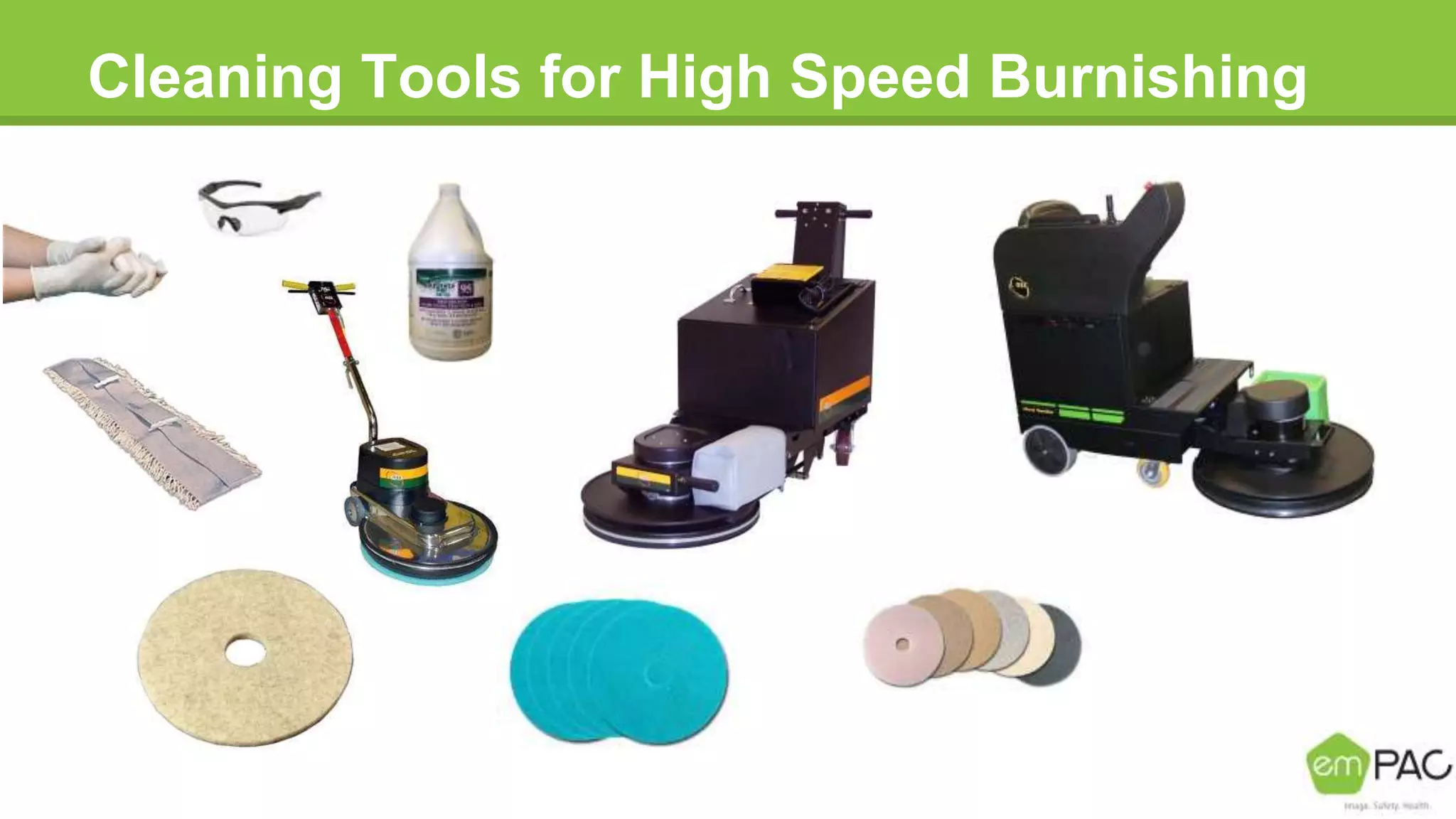
and a pink, tan, aqua, or hogs hair pad
Clean-up (make sure you soak pads in stripping solution and rinse them good before hang dry, if you
have a pressure washer or access to a faucet that has good pressure and hot water you can
rinse them)
Your imPACt
By applying the restorer with your scrubber when you clean the floor (leaves a haze) you can
follow up with a cord or battery burnisher to drastically reduce your time
How do we Clean &
Maintain our Facilities?
Carpet Care
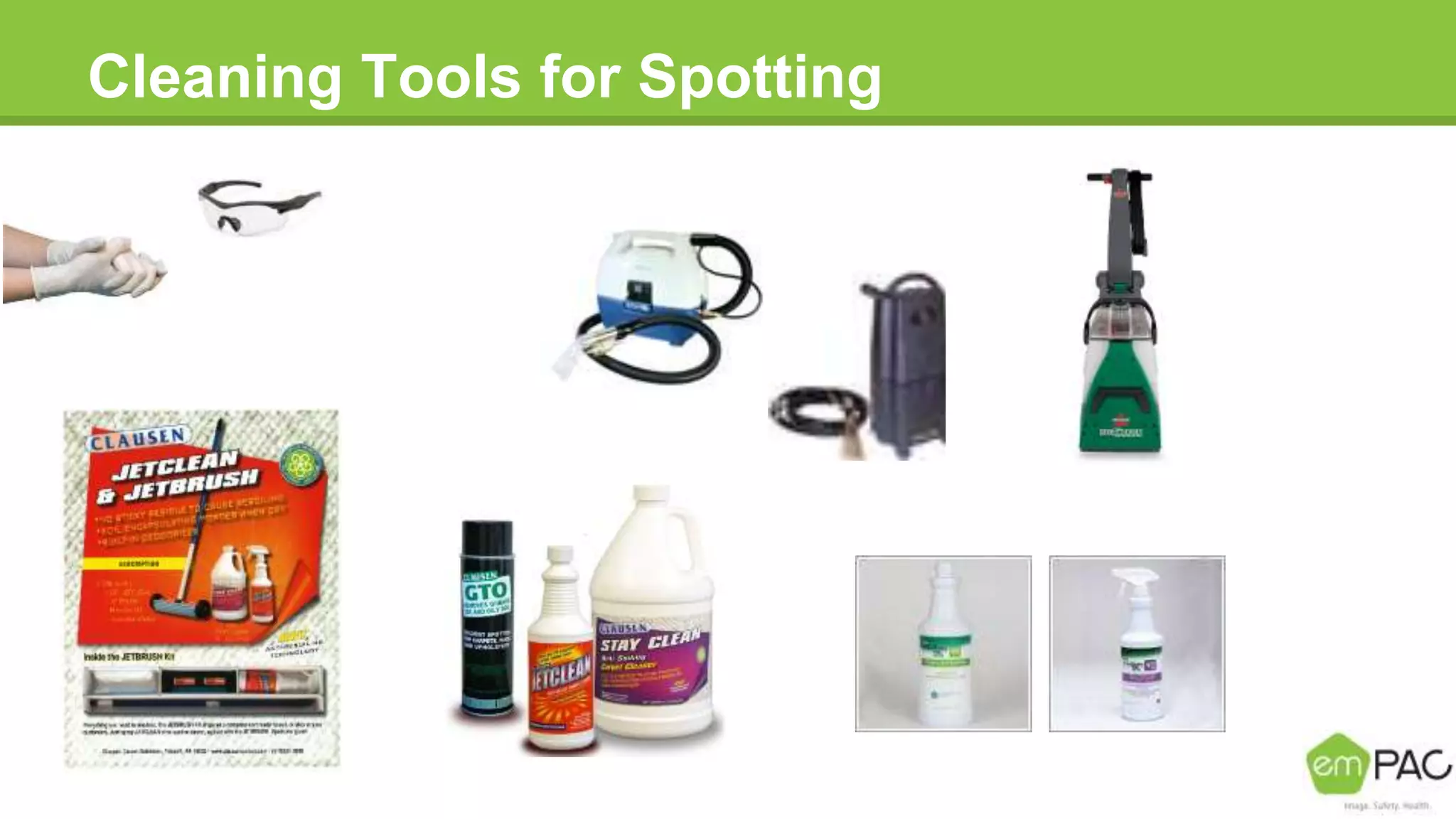
Cleaning Tools for Spotting
Carpet Spotting Tips & Takeaways
What is a spot?
Spot is fresh and has not set yet
What is a Stain?
Stain is a set in spot
The right chemical to remove the source (spotting kit)
How important is my FlexPac carpet spotting guide?
How important is water/flushing?
The key to success moisture/flood removal
How do I remove pink stains (wine, fruit drinks, etc.) ?
Different methods of spotting
Wet extraction with spotting equipment
Low moisture with a brush
Dry extraction with a vacuum
Your imPACt
Set up a scheduled spot identification system. Put signs up in food areas to contact extension
#101 if you spill something and what it is. This will give you time to remove the spot before it sets
thus reducing your labor costs
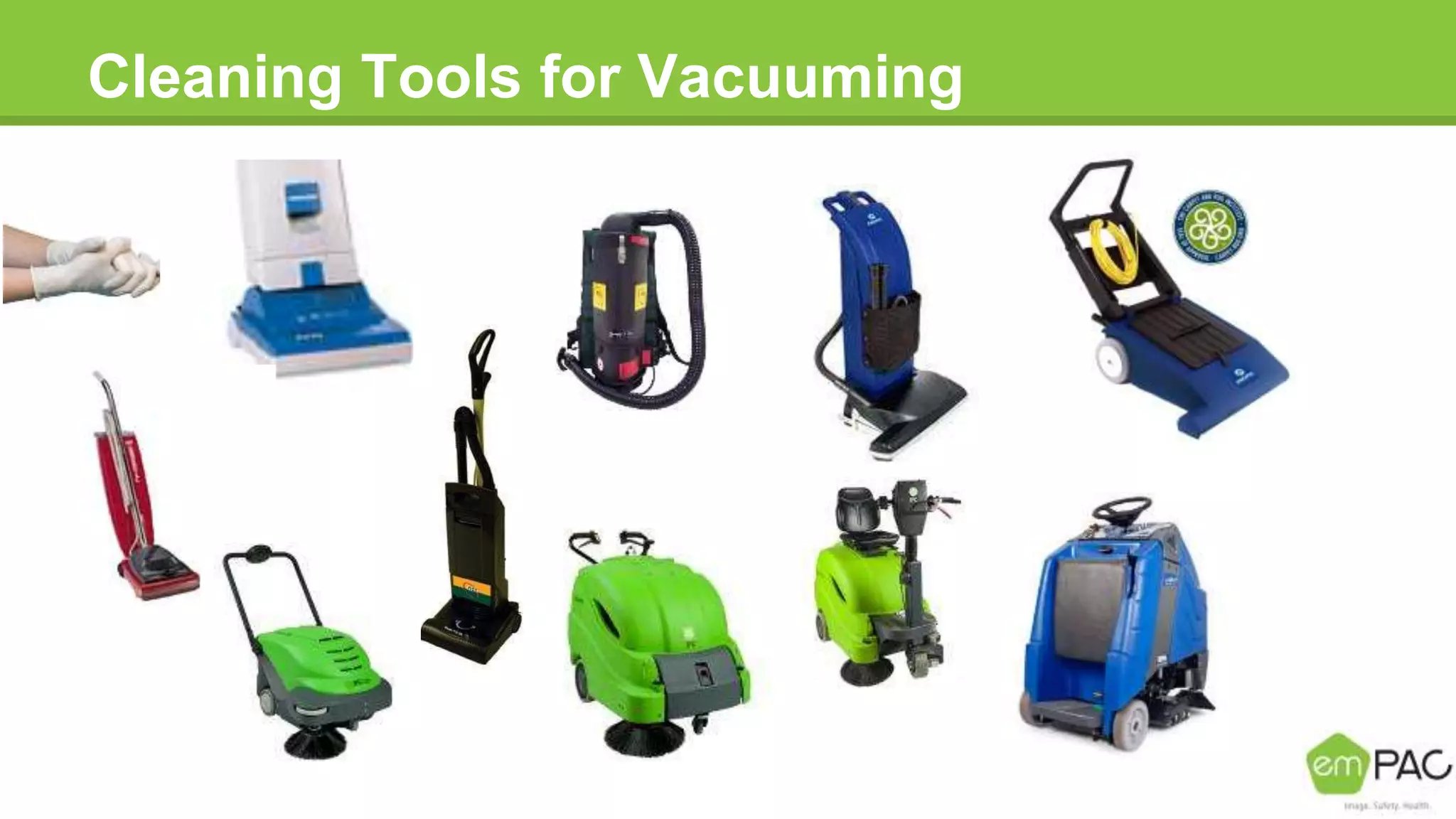
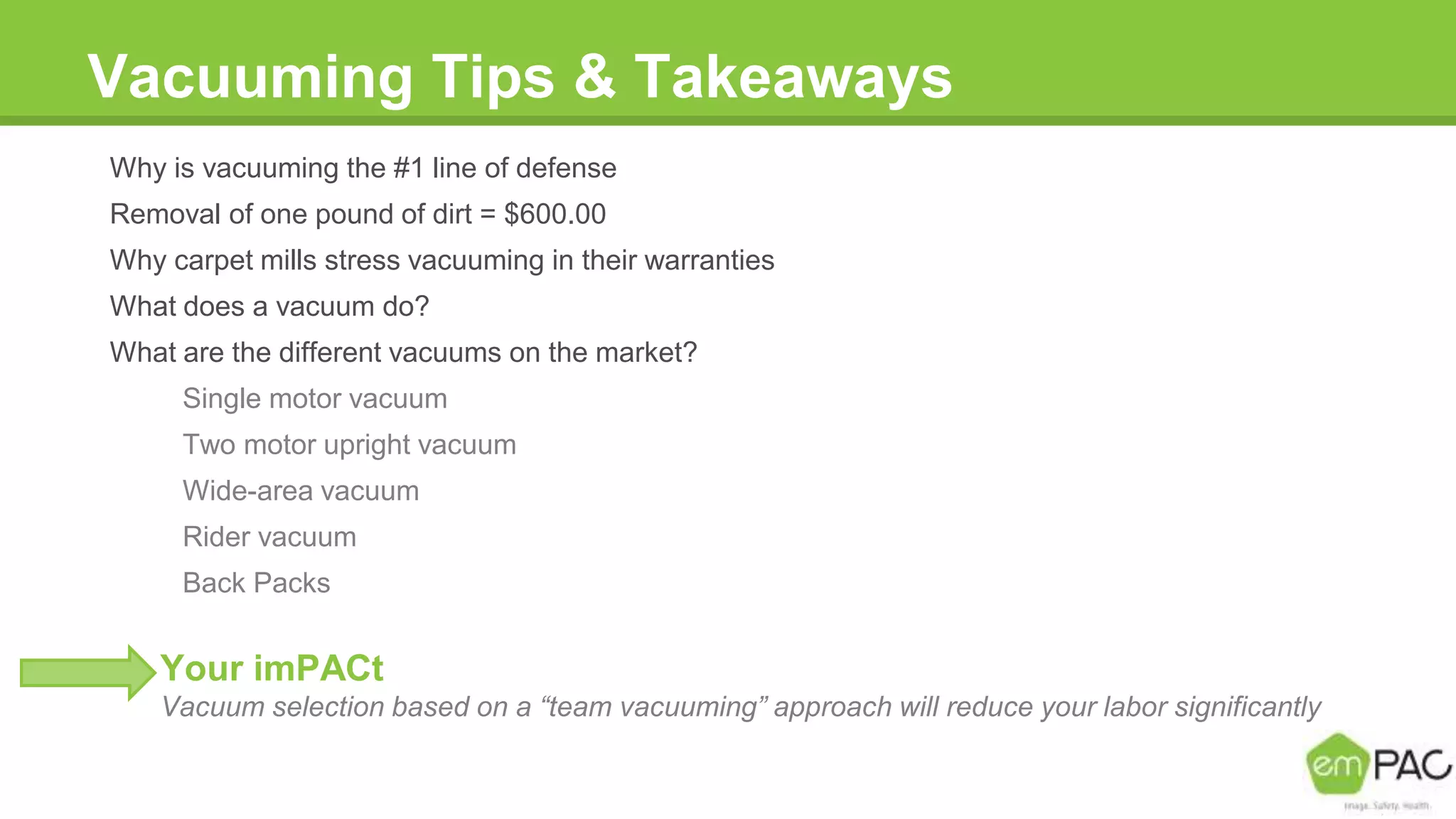
Cleaning Tools for Vacuuming
Vacuuming Tips & Takeaways
Why is vacuuming the #1 line of defense
Removal of one pound of dirt = $600.00
Why carpet mills stress vacuuming in their warranties
What does a vacuum do?
What are the different vacuums on the market?
Single motor vacuum
Two motor upright vacuum
Wide-area vacuum
Rider vacuum
Back Packs
Your imPACt
Vacuum selection based on a “team vacuuming” approach will reduce your labor significantly
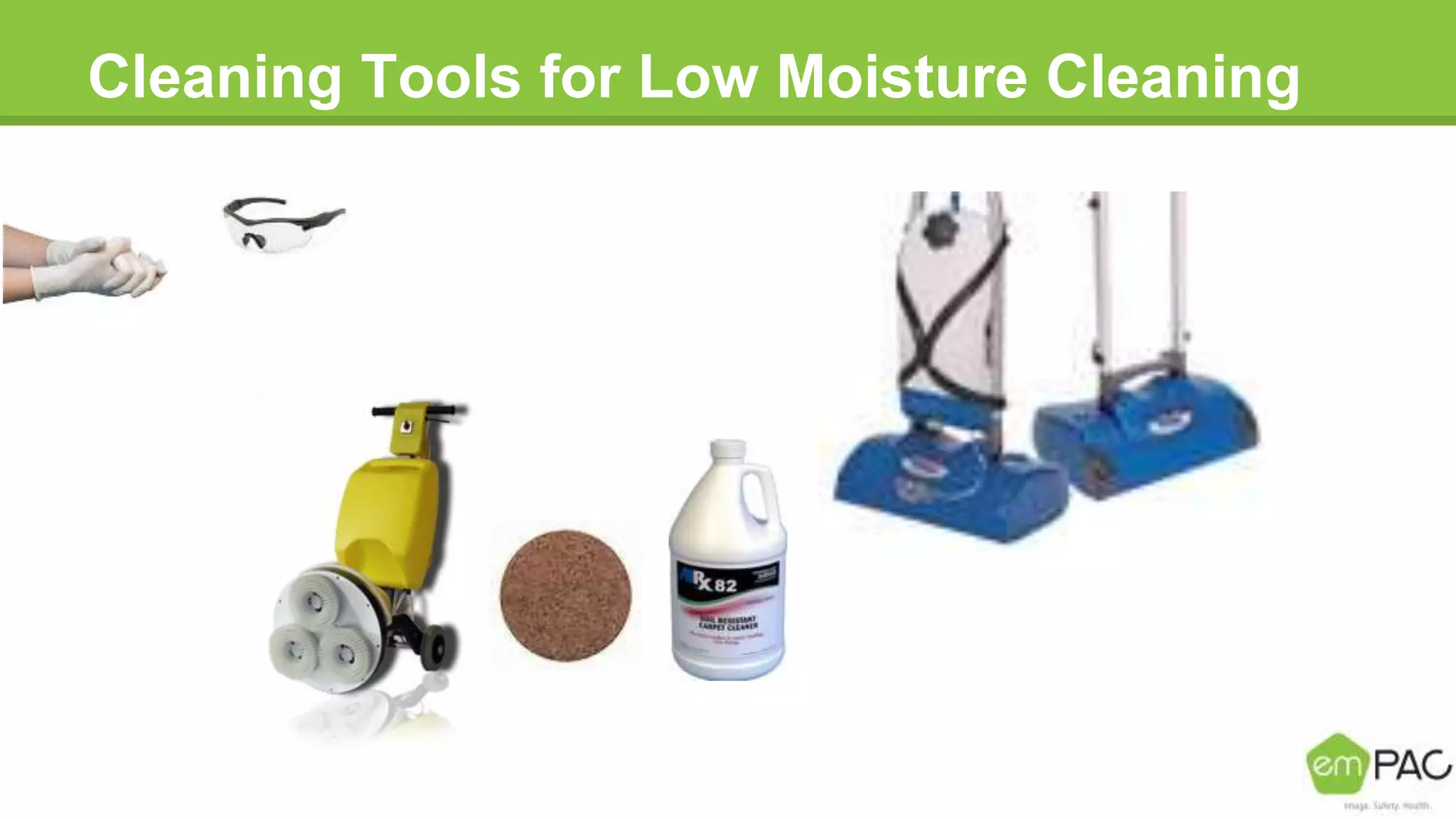
Cleaning Tools for Low Moisture Cleaning
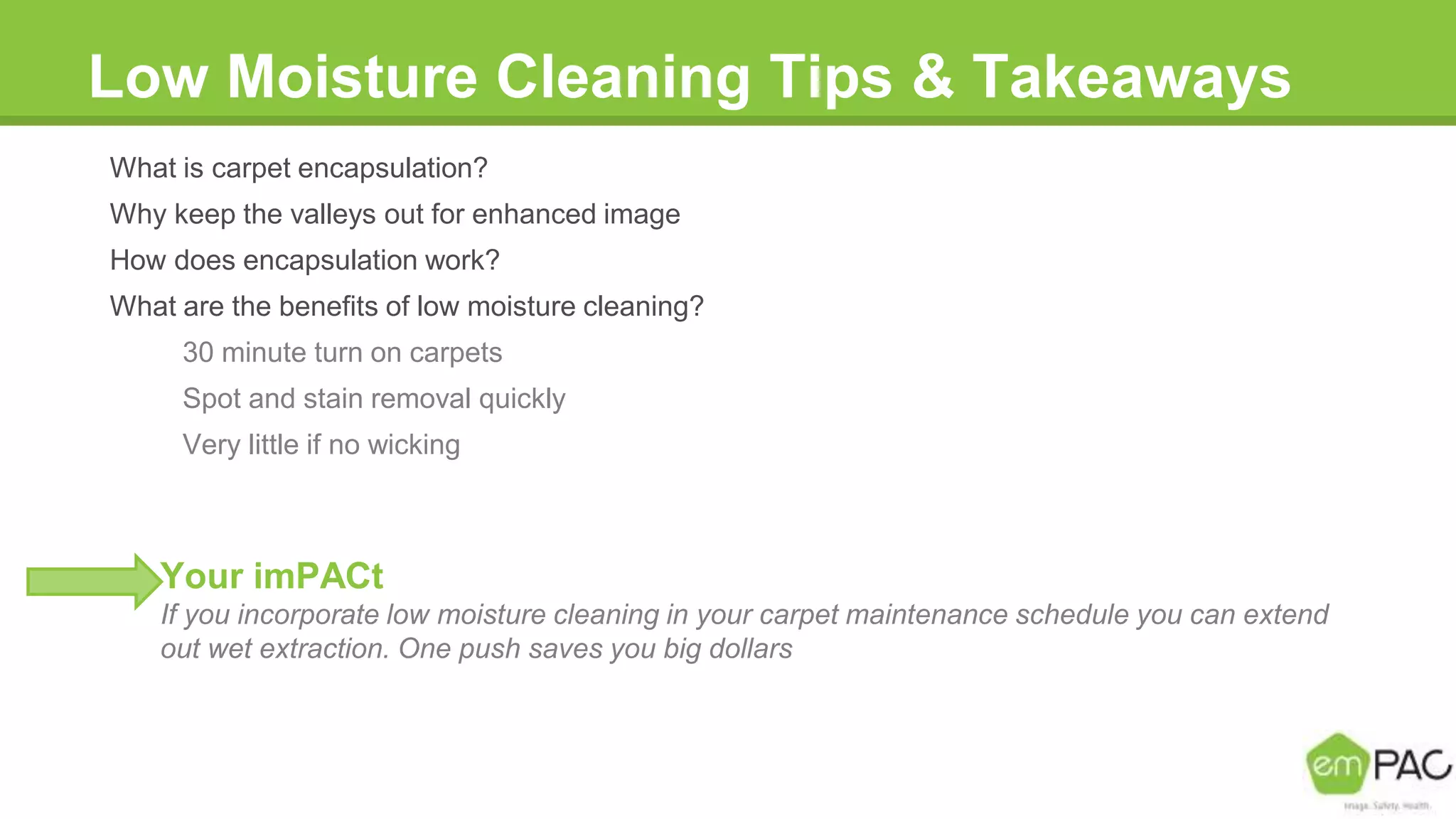
Low Moisture Cleaning Tips & Takeaways
What is carpet encapsulation?
Why keep the valleys out for enhanced image
How does encapsulation work?
What are the benefits of low moisture cleaning?
30 minute turn on carpets
Spot and stain removal quickly
Very little if no wicking
Your imPACt
If you incorporate low moisture cleaning in your carpet maintenance schedule you can extend
out wet extraction. One push saves you big dollars
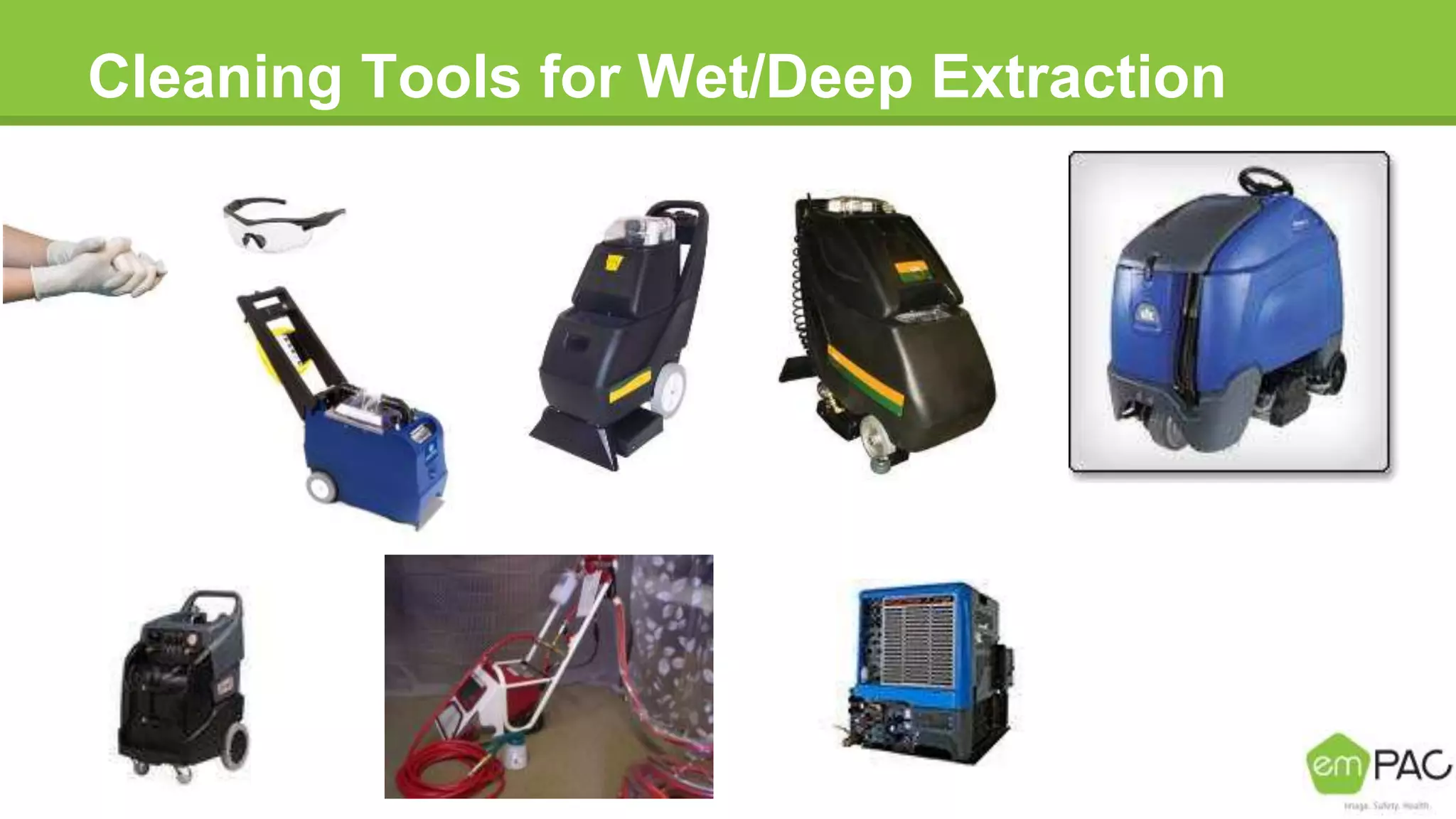
Cleaning Tools for Wet/Deep Extraction
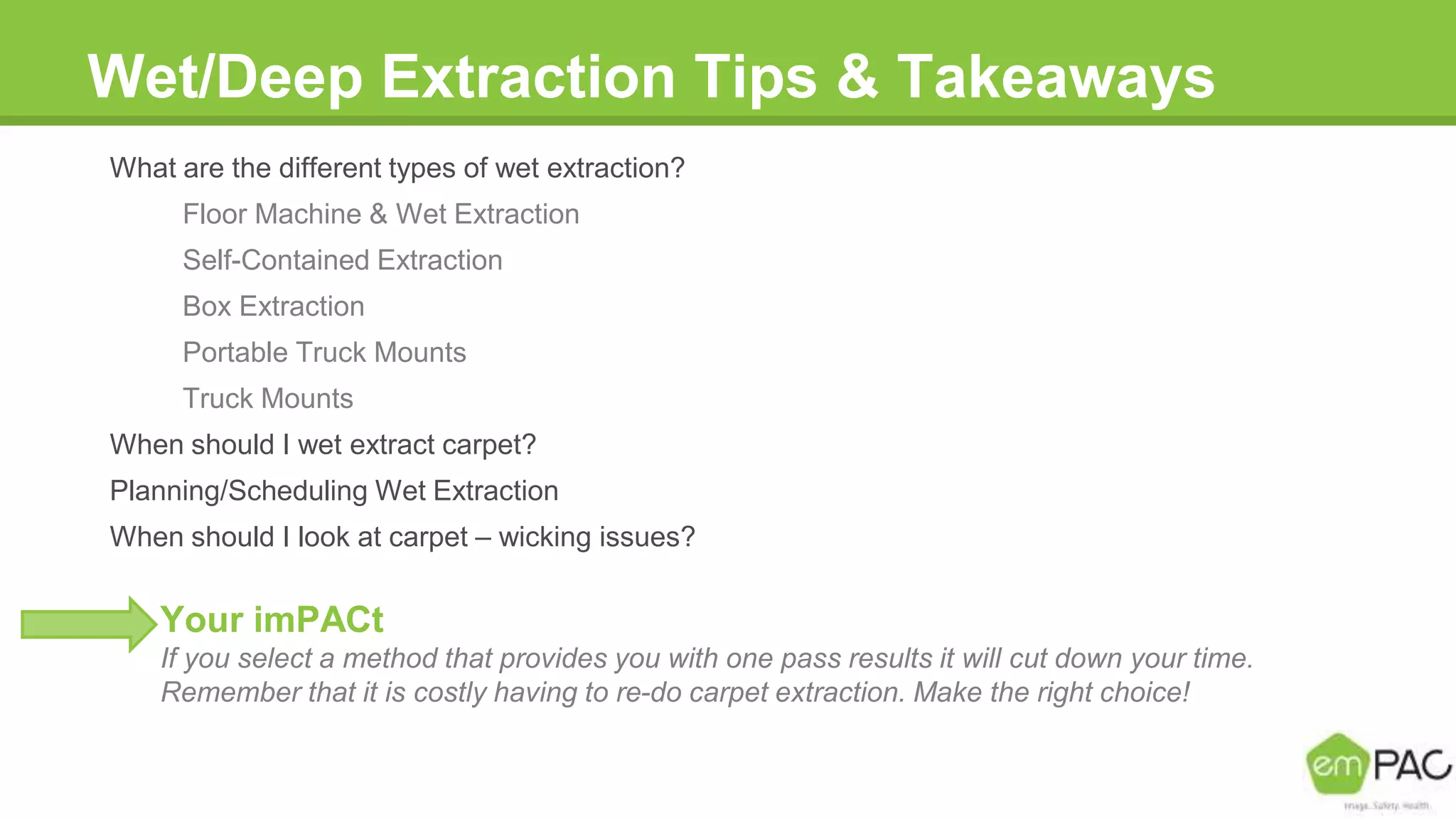
Wet/Deep Extraction Tips & Takeaways
What are the different types of wet extraction?
Floor Machine & Wet Extraction
Self-Contained Extraction
Box Extraction
Portable Truck Mounts
Truck Mounts
When should I wet extract carpet?
Planning/Scheduling Wet Extraction
When should I look at carpet – wicking issues?
Your imPACt
If you select a method that provides you with one pass results it will cut down your time.
Remember that it is costly having to re-do carpet extraction. Make the right choice!
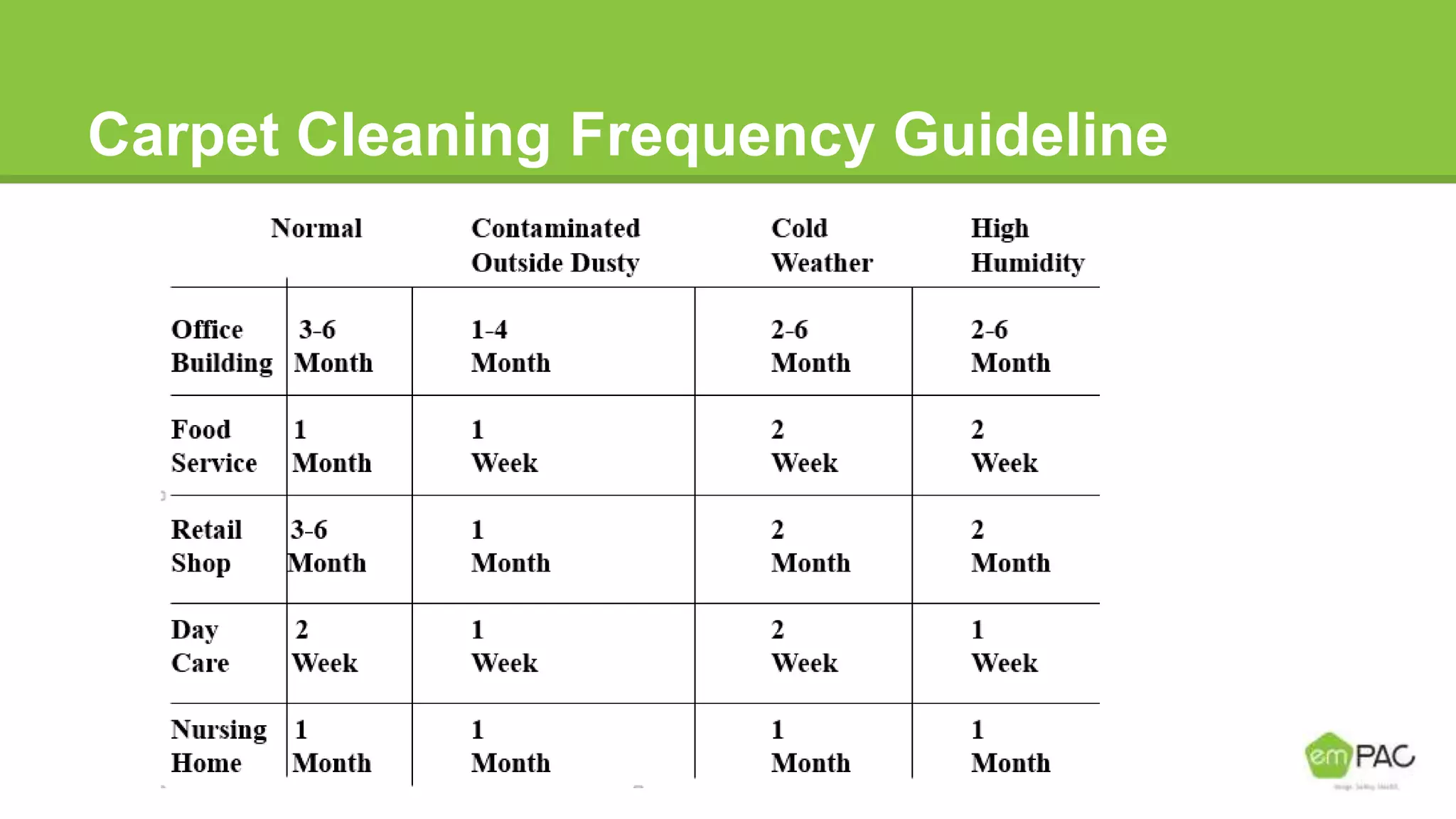
Carpet Cleaning Frequency Guideline
How do we Clean &
Maintain our Facilities?
Restroom Care
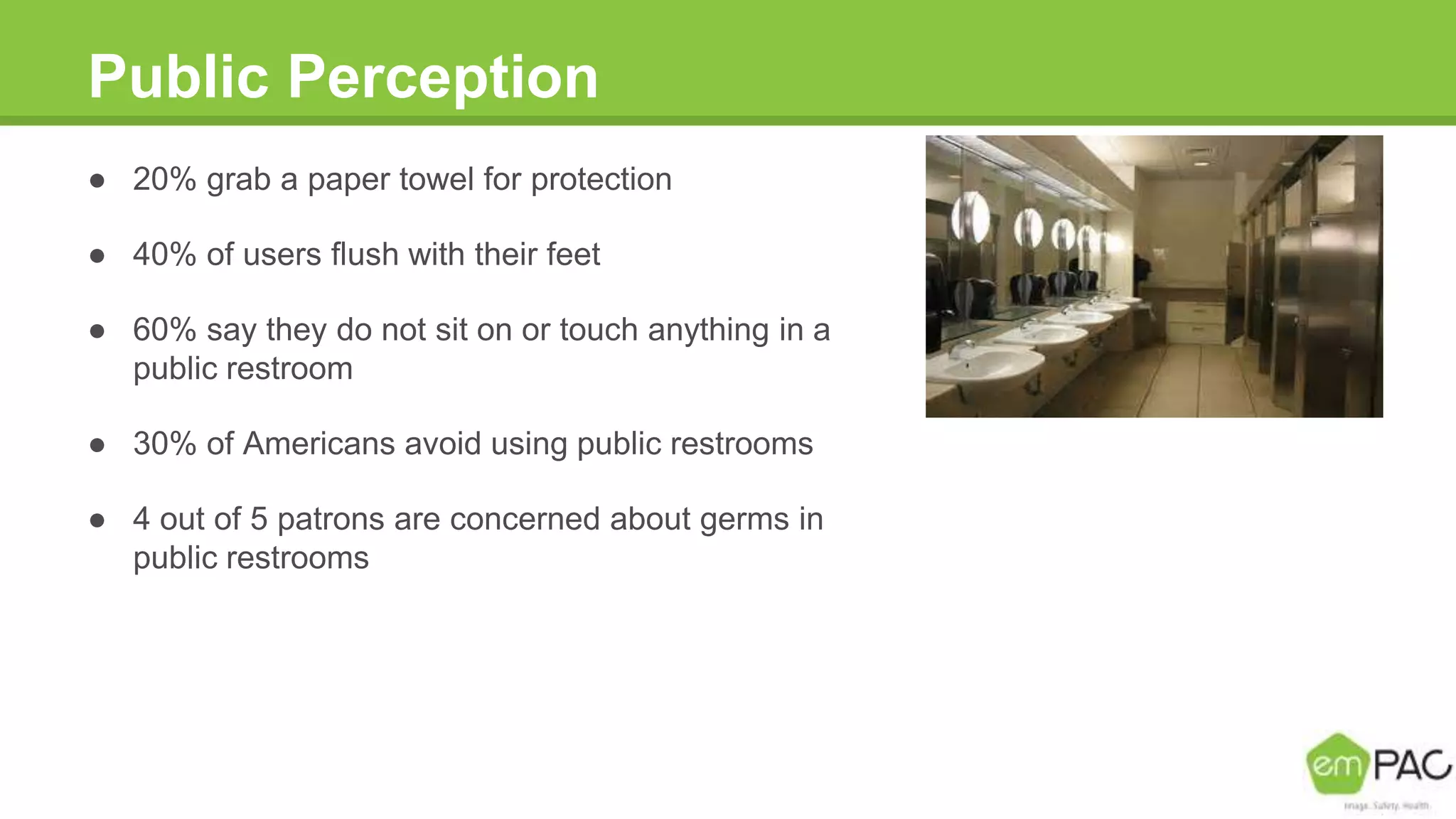
Public Perception
● 20% grab a paper towel for protection
● 40% of users flush with their feet
● 60% say they do not sit on or touch anything in a
public restroom
● 30% of Americans avoid using public restrooms
● 4 out of 5 patrons are concerned about germs in
public restrooms
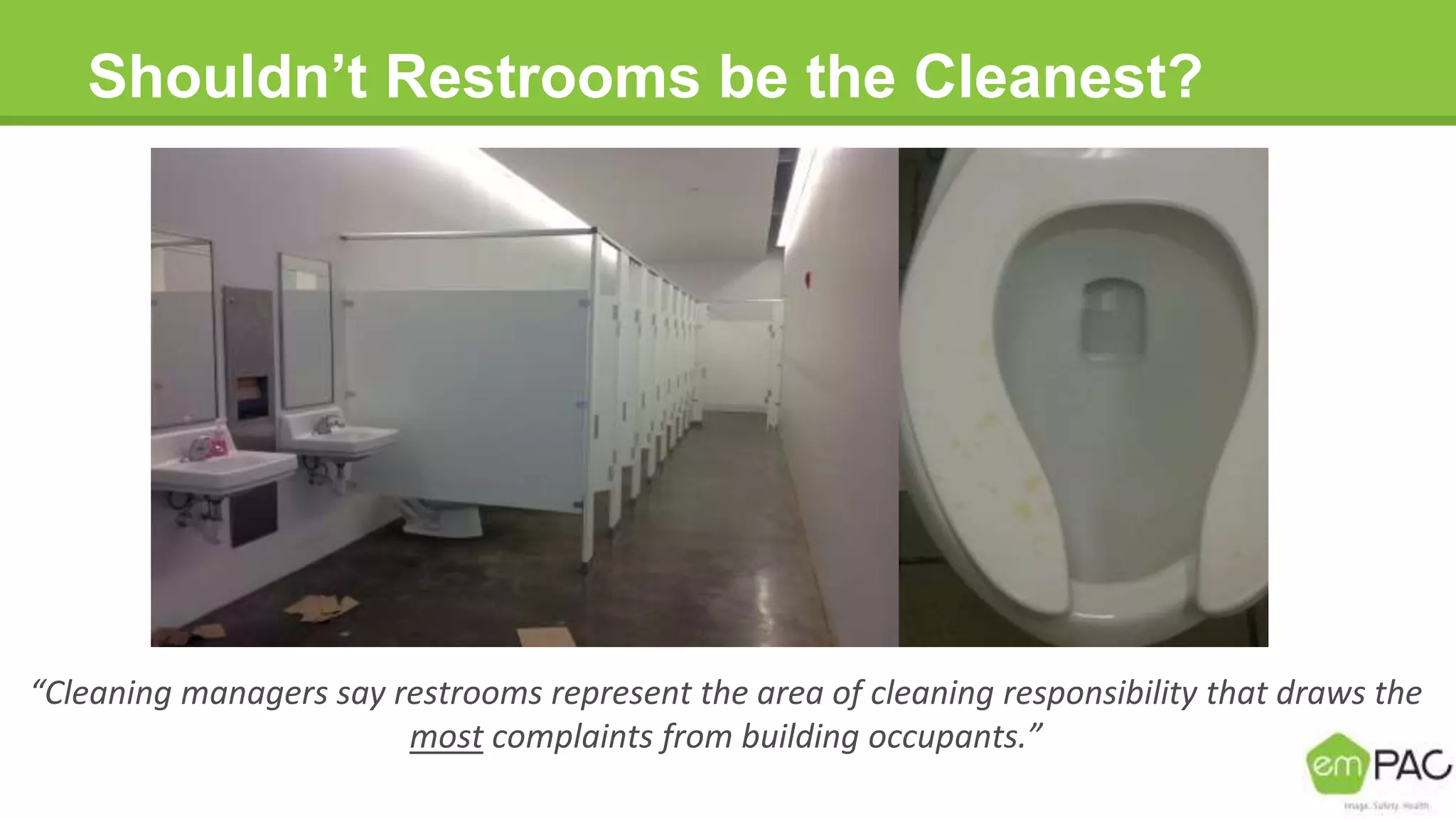
Shouldn’t Restrooms be the Cleanest?
“Cleaning managers say restrooms represent the area of cleaning responsibility that draws the
most complaints from building occupants.”
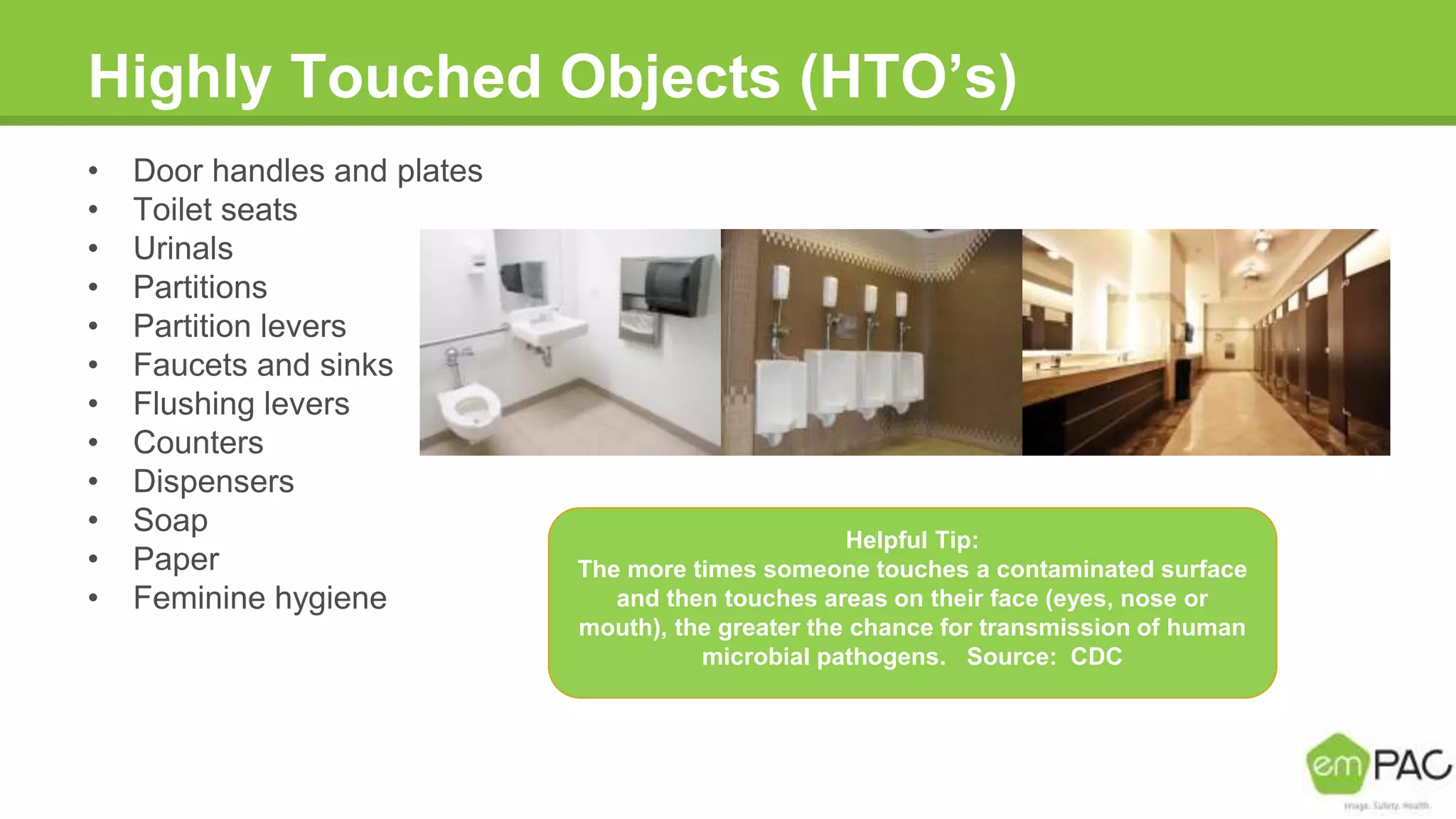
Highly Touched Objects (HTO’s)
• Door handles and plates
• Toilet seats
• Urinals
• Partitions
• Partition levers
• Faucets and sinks
• Flushing levers
• Counters
• Dispensers
• Soap
• Paper
• Feminine hygiene
Helpful Tip:
The more times someone touches a contaminated surface
and then touches areas on their face (eyes, nose or
mouth), the greater the chance for transmission of human
microbial pathogens. Source: CDC
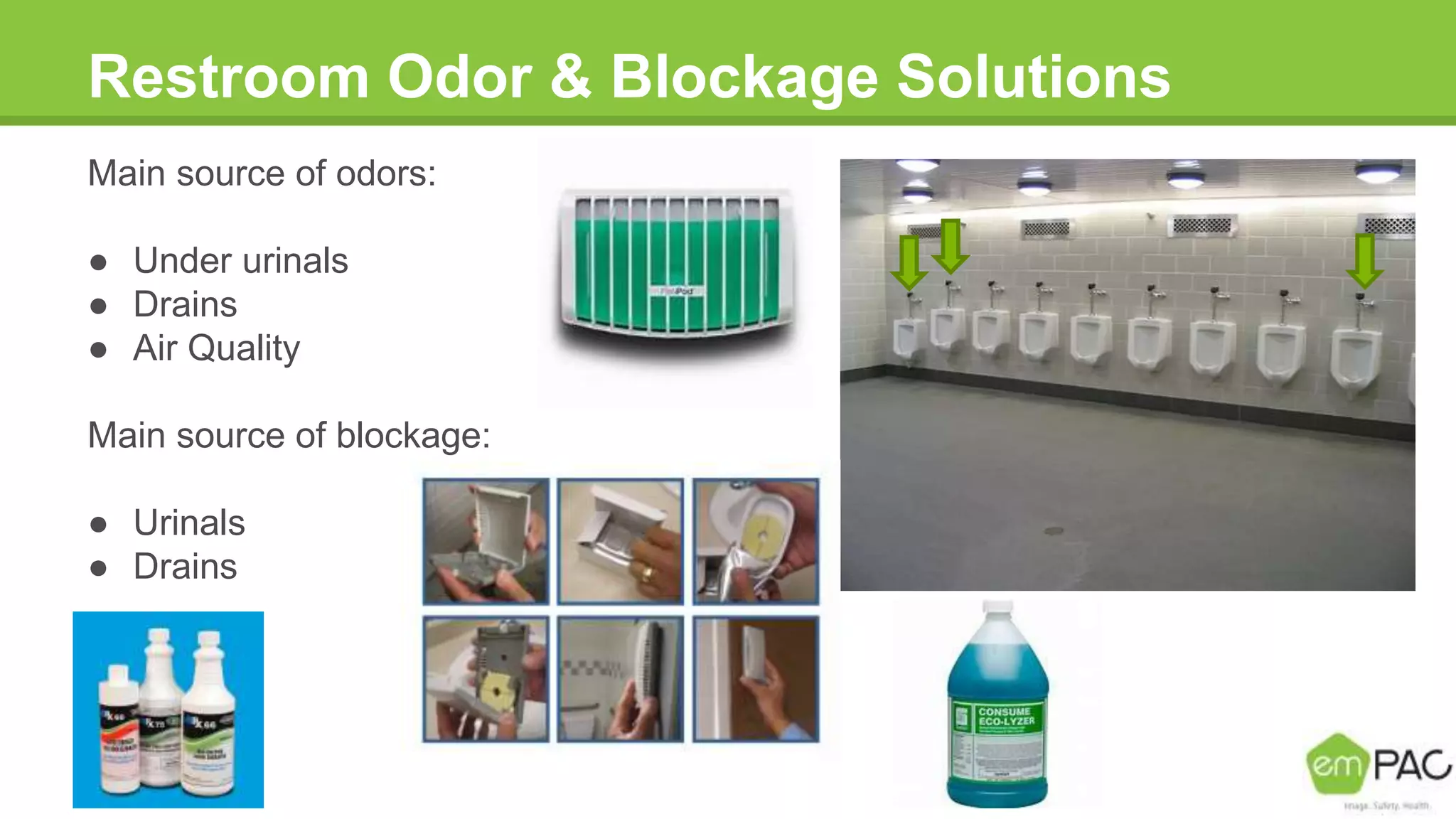
Restroom Odor & Blockage Solutions
Main source of odors:
● Under urinals
● Drains
● Air Quality
Main source of blockage:
● Urinals
● Drains
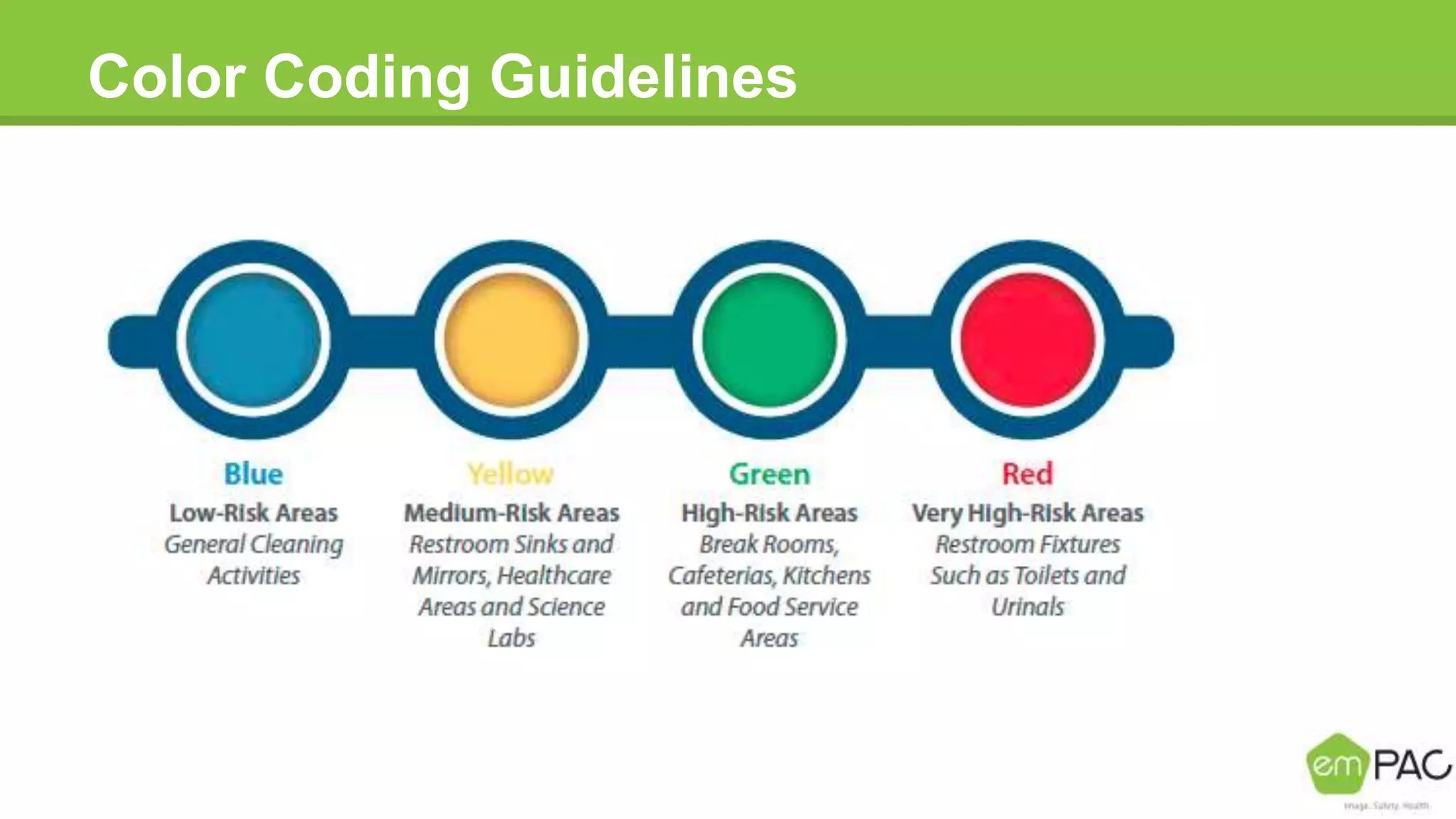
Color Coding Guidelines
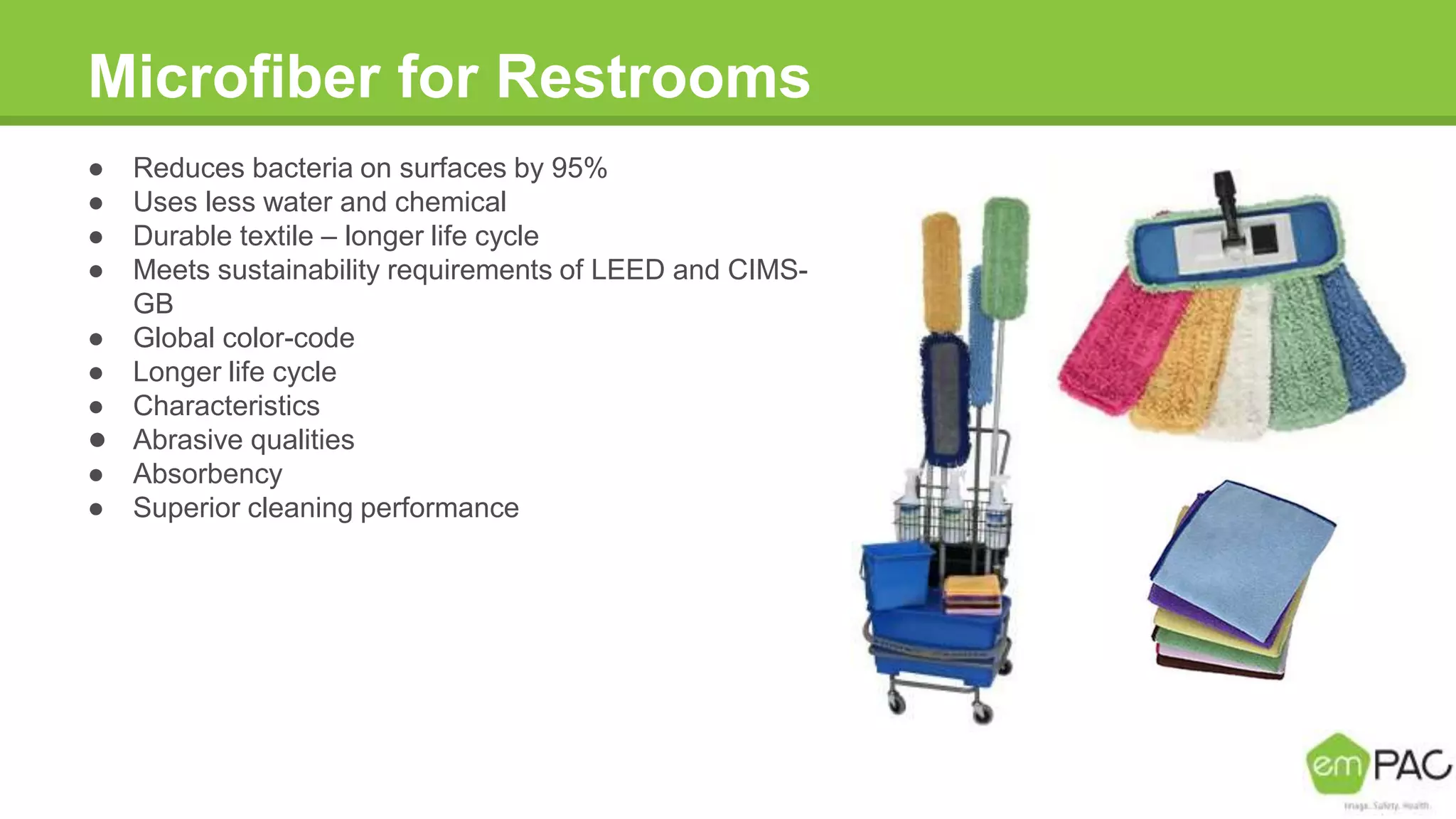
Microfiber for Restrooms
● Reduces bacteria on surfaces by 95%
● Uses less water and chemical
● Durable textile – longer life cycle
● Meets sustainability requirements of LEED and CIMS-
GB
● Global color-code
● Longer life cycle
● Characteristics
● Abrasive qualities
● Absorbency
● Superior cleaning performance
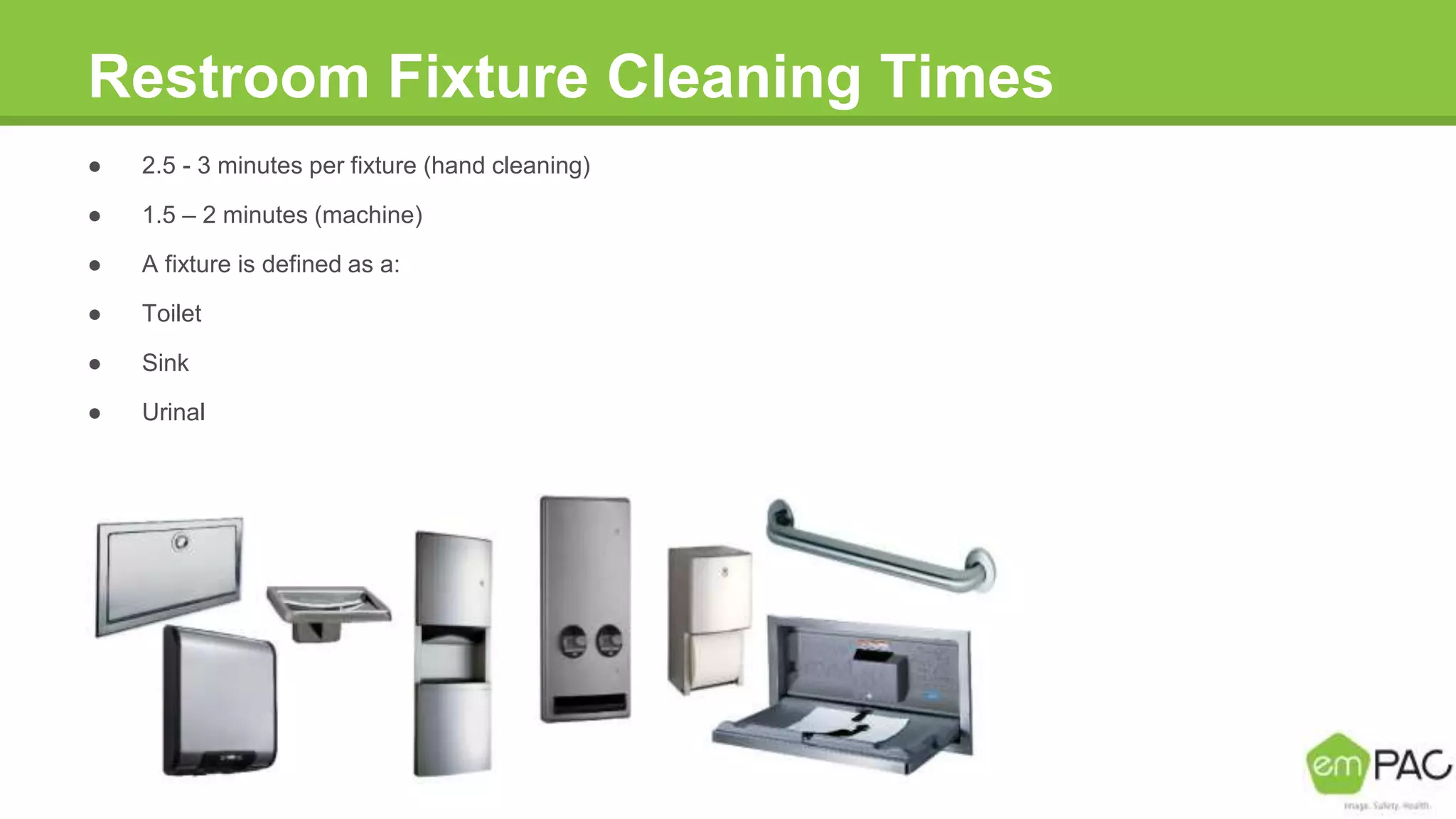
Restroom Fixture Cleaning Times
● 2.5 - 3 minutes per fixture (hand cleaning)
● 1.5 – 2 minutes (machine)
● A fixture is defined as a:
● Toilet
● Sink
● Urinal
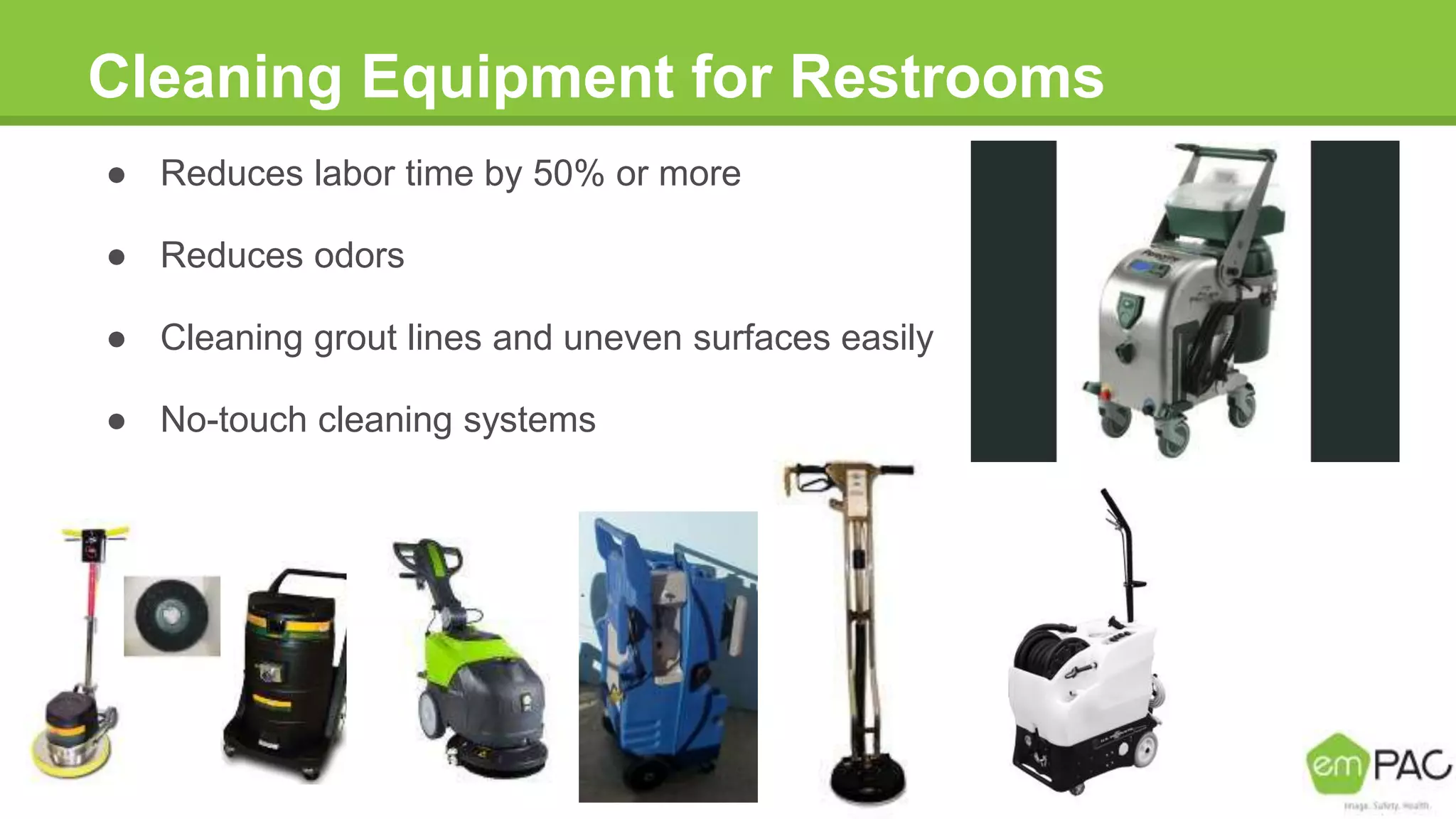
Cleaning Equipment for Restrooms
● Reduces labor time by 50% or more
● Reduces odors
● Cleaning grout lines and uneven surfaces easily
● No-touch cleaning systems
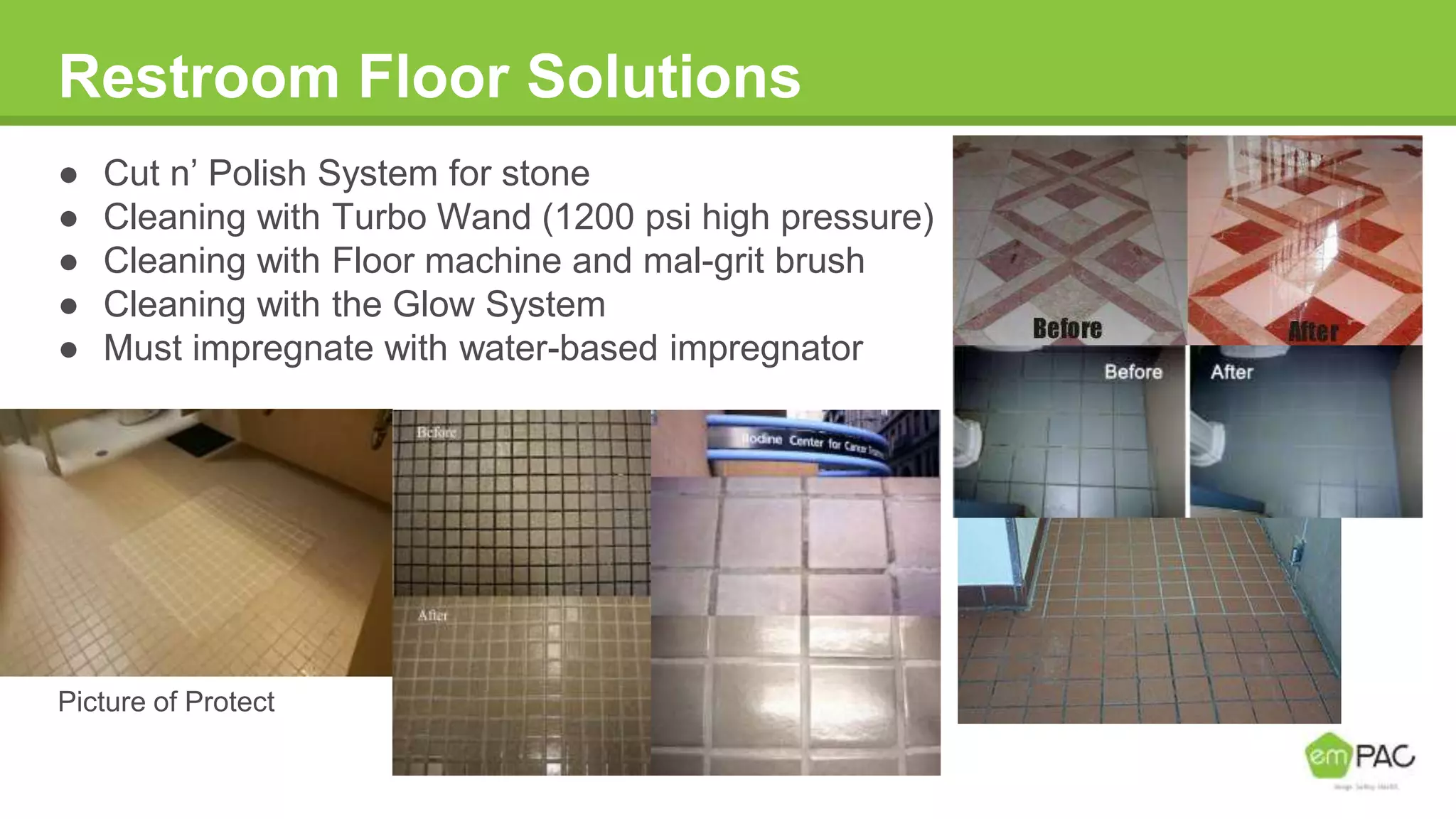
Restroom Floor Solutions
● Cut n’ Polish System for stone
● Cleaning with Turbo Wand (1200 psi high pressure)
● Cleaning with Floor machine and mal-grit brush
● Cleaning with the Glow System
● Must impregnate with water-based impregnator
Picture of Protect
Restroom Cleaning Tips & Takeaways
Restroom cleanliness is ranked at the top of uncleanly/unhealthy areas
Restroom floors (predominantly ceramic with grout) are the biggest contributor to the above ranking
Touchless consumables will help eliminate cross contamination
Color coded flat microfibers will help eliminate cross contamination
You need to start by shocking your floor back to new and impregnating
There are methods/tools to clean on a scheduled basis
What is the best way to deodorize your restrooms? How about enzymes?
Are there products to prevent clogs in my urinals?
Do I use ATP meters or black lights to ensure proper disinfection on high touch areas?
Can a peroxide based cleaner clean everything in my bathroom?
Lets discuss acid bowl cleaners
Your imPACt
It costs $350 for a company to remove the calcium blocks in urinals (that is if they don’t have to
tear into the wall) Why not eliminate that with the pee pod!?
How do we Clean &
Maintain our Facilities?
Infection Control & Disinfecting
MICROBIOLOGY
BACTERIA FUNGIVIRUSES
Disinfection
Consideration for a successful disinfection program
 Types of microorganisms involved pathogenic or nonpathogenic organisms
 Contaminated areas and types of surfaces that need disinfection
 Disinfectant concentrations and economics
 Product stability, performance and storage conditions
 Application method- labor and contact time allowed
 Safety Precautions
 Environmental Impact
Disinfection
Definitions:
Disinfection is 100% kill of the claimed organism.
A sanitizer claim is for 99.99% of the claimed
organism, or reducing the level of bacteria to a safe
and acceptable level.
Sterilization is 100% kill of ALL organisms on a surface.
Disinfection
How Disinfectants Work
Disinfectants destroy the microbial cell membrane through extreme charges
which cause cell lyses.
Some disinfectant chemistry will work in synergy with strong chelating
agents, surfactants and solvents to help weaken the cell structure.
Disinfectants provide harsh environmental conditions that will also denature
proteins.
A surface free of organic soil will allow for better disinfection, as organic soils
can tie up active ingredients.
Disinfection
How Disinfectants Work
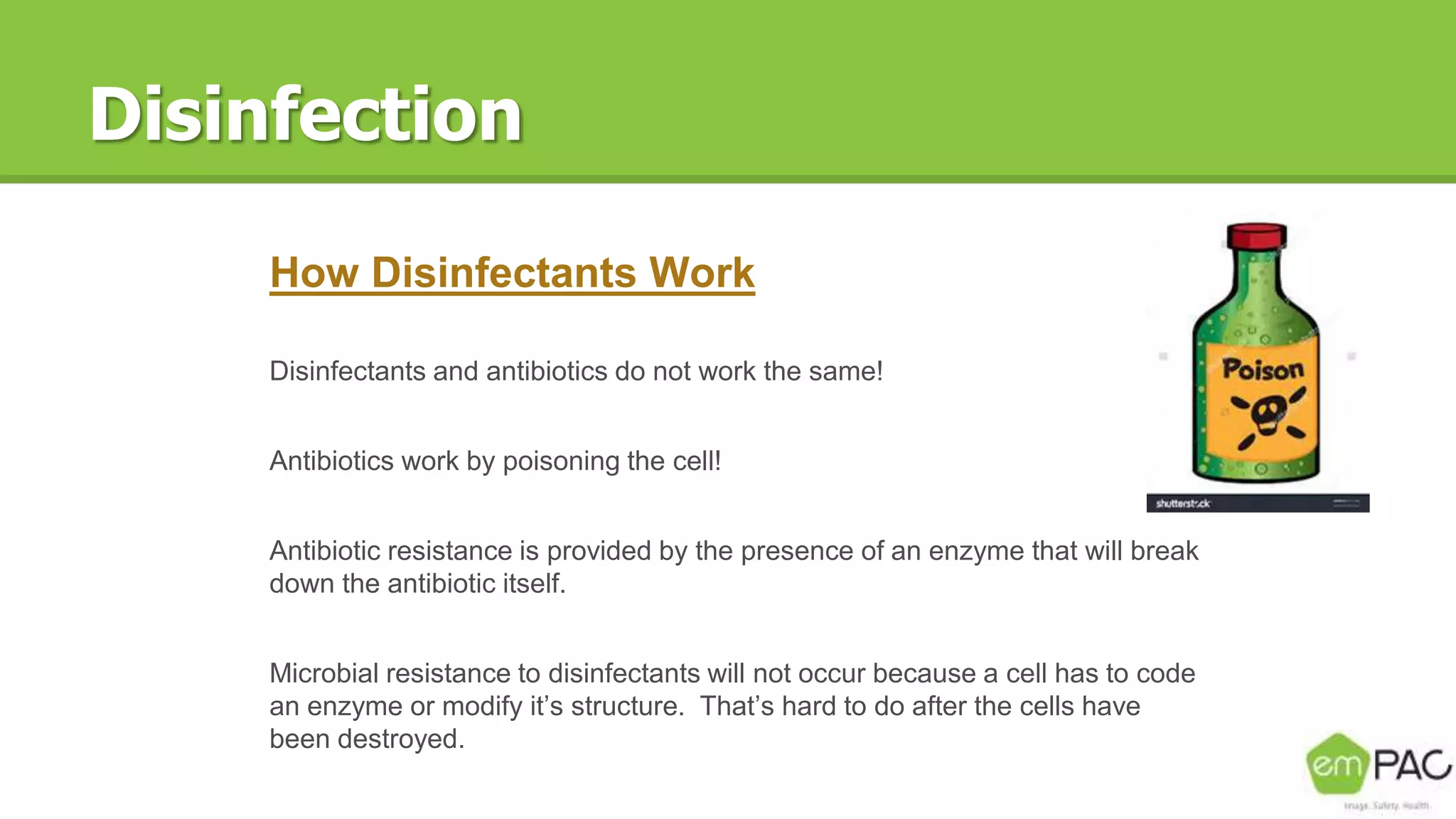
Disinfectants and antibiotics do not work the same!
Antibiotics work by poisoning the cell!
Antibiotic resistance is provided by the presence of an enzyme that will break
down the antibiotic itself.
Microbial resistance to disinfectants will not occur because a cell has to code
an enzyme or modify it’s structure. That’s hard to do after the cells have
been destroyed.
Disinfection
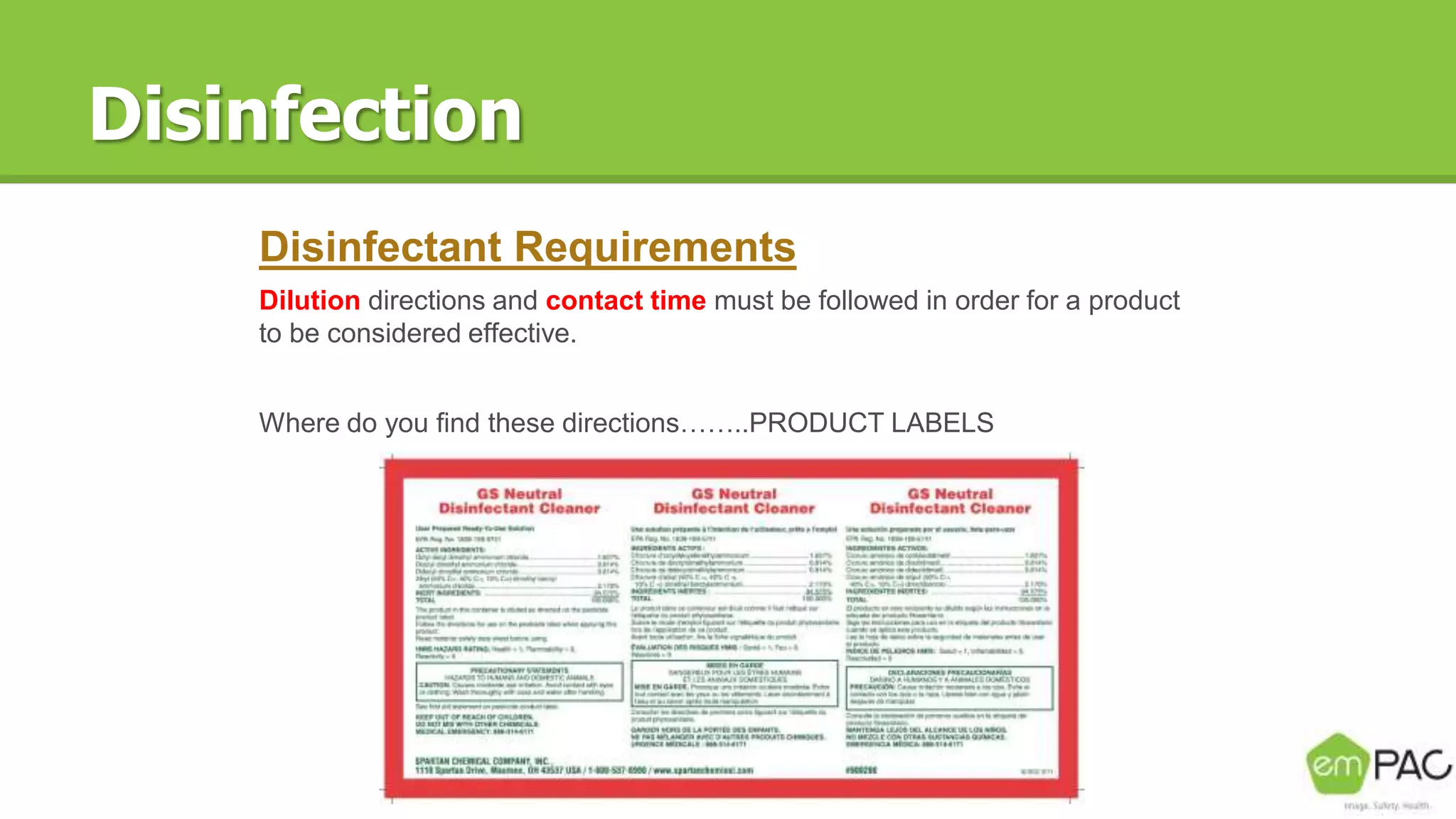
Disinfectant Requirements
A disinfectant is only as good as its label says it is.
Always READ disinfectant labels!
"It is a violation of Federal law to use this product in a manner
inconsistent with its labeling.“
Follow all label instructions!
Disinfection
Disinfectant Requirements
A product can not make a claim against an organism without testing it first
and requires E.P.A. approval of the data.
A “Hospital Grade” Disinfectant requires 2 organisms to be tested.
Pseudomonas aeruginosa and Staphylococcus aureus
A one step disinfectant cleaner is an E.P.A. registered disinfectant that has
been tested in 5% blood serum.
A tuberculocidal claim is only used for an indicator of strength. A TB claim
will qualify the product as a "intermediate level disinfectant“ in the Spaulding
classification of disinfectants.
Disinfection
Disinfectant Requirements
Dilution directions and contact time must be followed in order for a product
to be considered effective.
Where do you find these directions……..PRODUCT LABELS
How do we Clean &
Maintain our Facilities?
Industrial Cleaning Procedures
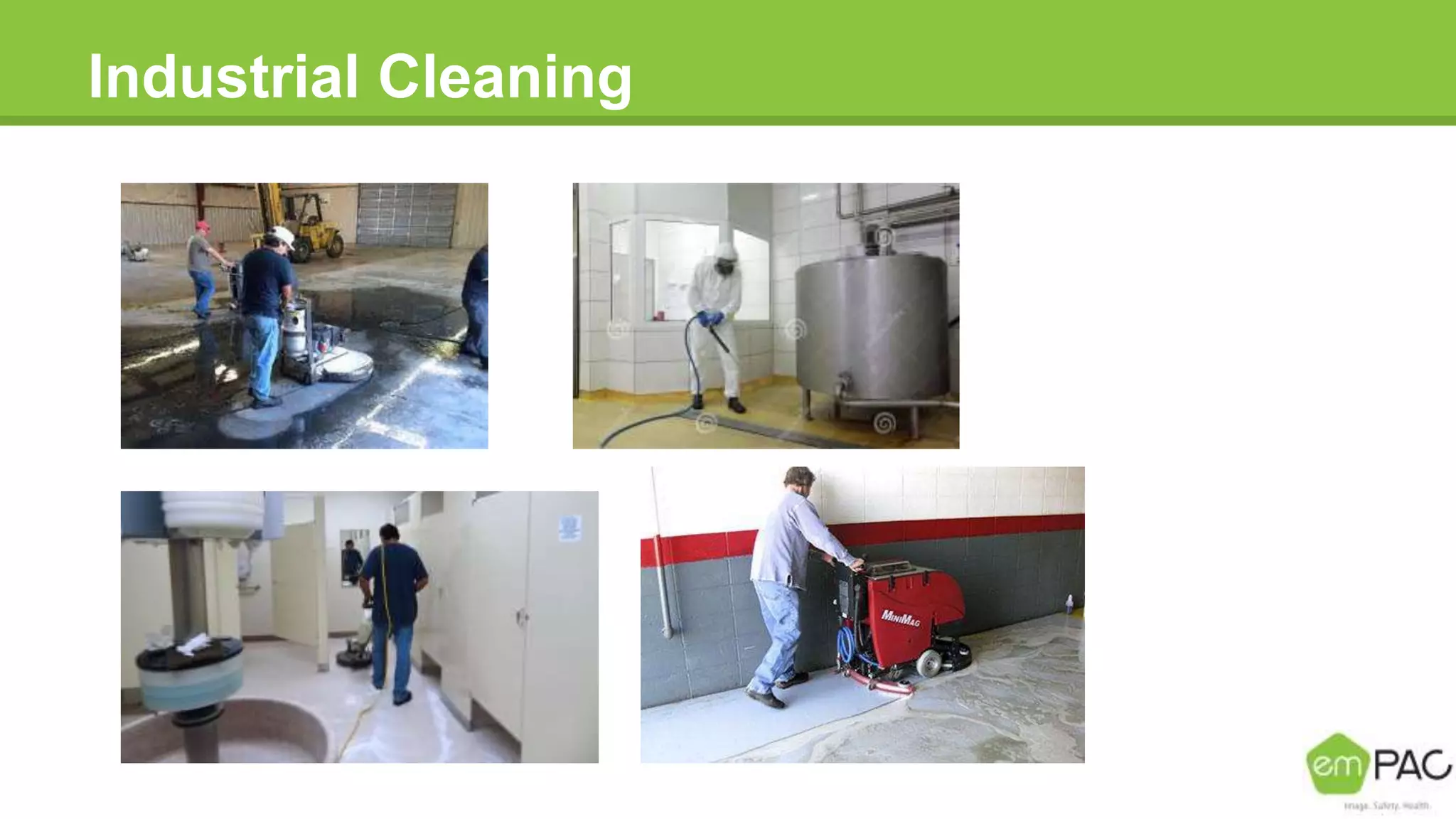
Industrial Cleaning
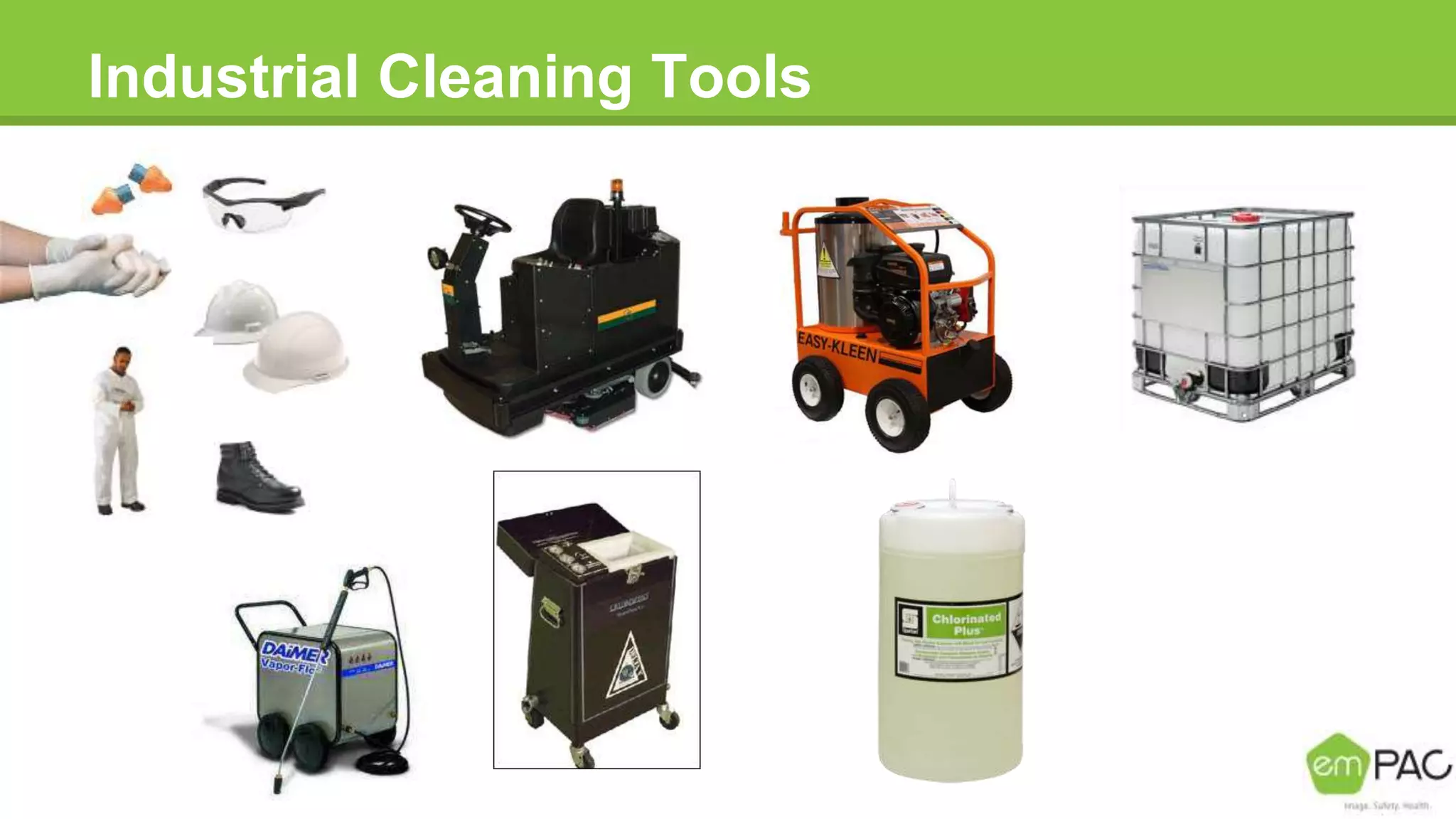
Industrial Cleaning Tools
Industrial Cleaning
The correct PPE is imperative for worker safety
Identify the dirt you are removing
Match the cleaning tools to the size area to maximize your productivity
Start from the furthest part away from water source
Remember chemical cost is insignificant if you have to spend twice the amount of time cleaning.
Make it stronger and clean faster
Your imPACt
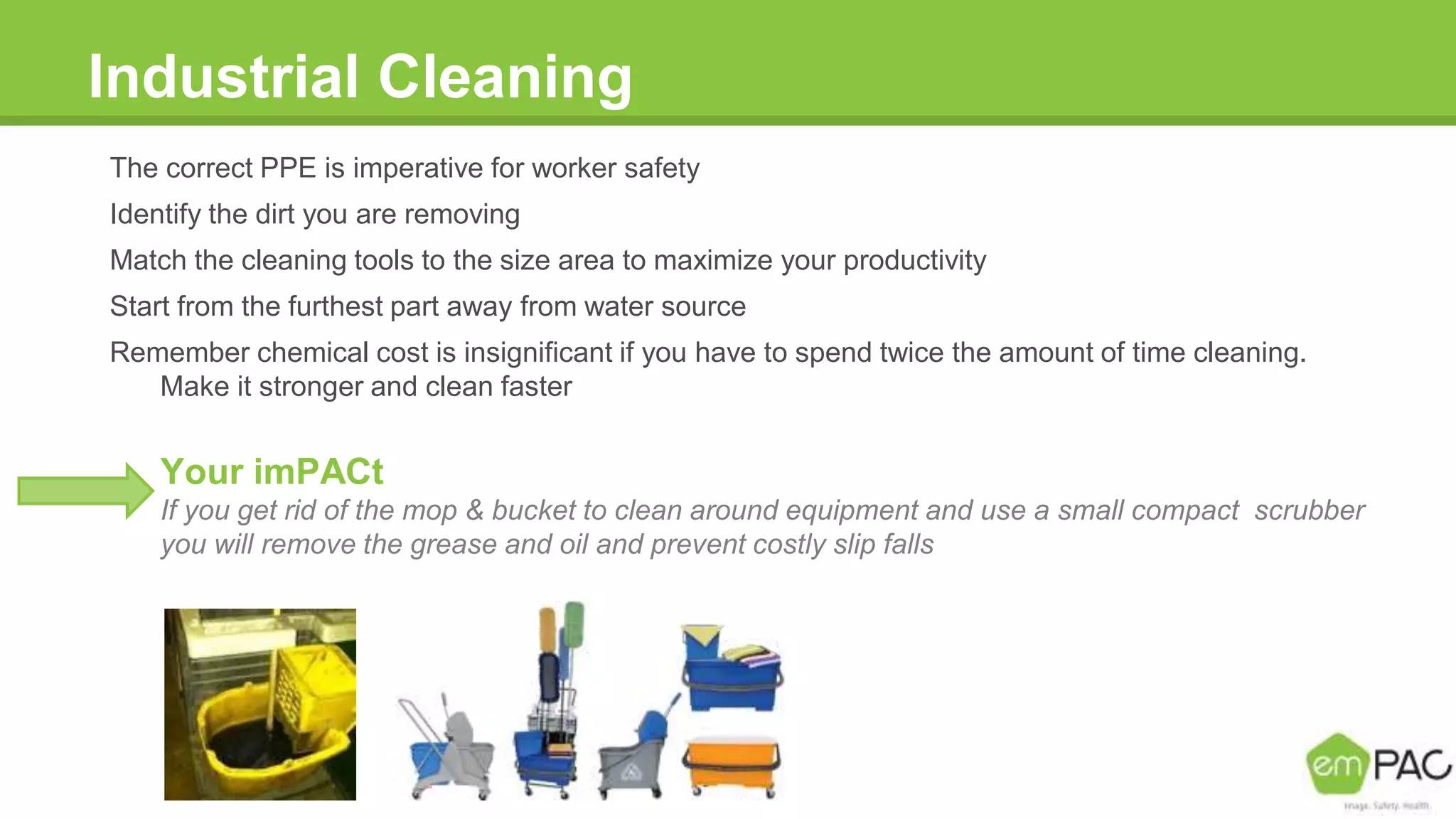
If you get rid of the mop & bucket to clean around equipment and use a small compact scrubber
you will remove the grease and oil and prevent costly slip falls

HowandWhyFM

  • 1.
    The Whys andHow's of Facility Maintenance Evaluate, Match, Process, Analyze, Cleanup
  • 2.
    Meet your Speaker DustyBrown Director of Sales FlexPAC, Inc. dbrown@flexp.com Credentials: 6 years in the Jan/San Industry ISSA Certified Expert – CIMS/CIMS-GB CITS Certified Trainer Certified HAZCOM/GHS Trainer Green Cleaning Specialist – cert. #525
  • 3.
    Why do weClean & Maintain our Facilities? What we will cover: • The Triangle of Triumph • Understanding associated Operational & Maintenance costs • Sustainability of assets • Clean for Health - IAQ & BRI • The Operational & Maintenance Ecosystem
  • 4.
    How do weClean & Maintain our Facilities? What we will cover: • Safety & PPE • Basic Functions of Cleaners • General Hard Floor Care Practices • General Carpet Care Practices • Restroom & Locker Room Care • Infection Control & Proper Disinfecting Procedures
  • 5.
    Why do weClean & Maintain our Facilities? People Processes Product
  • 6.
    Why do weClean & Maintain our Facilities? Direct Costs • Labor = 50% - 60% of M&O Budget • Cleaning chemicals and supplies • Equipment • Miscellaneous • Paper & consumable cost Indirect Costs • Insurance • Deterioration of Assets • Benefits • Training & Time spent Staffing • Workman’s Comp. • Taxes • Turnover • Supply Chain • Risk Department Costing - Direct & Indirect Costs
  • 7.
    Why do weClean & Maintain our Facilities? Maintenance & Operation Budget $14,714,525
  • 8.
    Why do weClean & Maintain our Facilities? Cost Containment Reduce the task frequency Eliminate the task Mechanize the task Improve the process Product innovation
  • 9.
    Why do weClean & Maintain our Facilities? Sustainability of Assets: • Carpet lifespan can be extended by 3 – 5 years • Protecting & maintaining a floor properly will help reduce replacement costs by as much as 63% • Proper restroom & locker room cleaning will reduce costs for replacing partitions, urinals, plumbing, and other fixtures • Occupant and/or Owned office equipment along with other building fixtures are less likely to be damaged or show wear
  • 10.
    Why do weClean & Maintain our Facilities? ~ Clean for Health Indoor Air Quality Technology Activities People Building Materials Furnishings HVAC Finishes Outdoor Air Quality
  • 11.
    Why do weClean & Maintain our Facilities? Indoor Air Contaminants Relative Size
  • 12.
    Indoor Air QualityStats & Conclusions Source: Protecting the Built Environment: Cleaning for Health. Dr. Berry 70% of waking hours are in the work environment 30-40% of buildings are sick Particles are recycled rather than captured Carpet & furniture act as “sinks” Upright Vacuums compound the problem $5,000 -$40,000 to diagnose the problem $5 billion dollars spent on indoor air pollution annually Indoor Air Quality (IAQ) health problems cost $15 billion in medical expenses
  • 13.
    Why do weClean & Maintain our Facilities? EPA Assumptions - Using a New England Study As Basis 0.24 doctor visits per worker/year 64,000,000 white collar workers Average $30 medical visit cost IAQ & BRI COULD BE COSTING THE U.S. $500,000,000
  • 14.
    Why do weClean & Maintain our Facilities? The Operational & Maintenance Ecosystem People Processes Sanitary Surfaces Fixtures & Assets Clean for Health
  • 15.
    How do weClean & Maintain our Facilities? Safety & PPE
  • 16.
  • 17.
    Most Frequent OSHACitations Facilities Maintenance Departments Bloodborne pathogens Hazard communication General requirements (PPE) www.osha.gov/dcsp/products/topics/cleaningindustry/standards.html
  • 18.
    OSHA Fine -$60,000
  • 19.
  • 20.
  • 21.
    Eye Protection Use appropriateeye protection when exposed to potential hazards Dispensing chemicals Splash Handling chemicals Splash Chemical spraying Splash Dusting Airborne debris Pesticide application Spray Grounds maintenance Flying particles Light discomfort Glare Eyewear Must Meet ANSI Std. Z87.1- 2003 Eyewear Must Have Side shields
  • 22.
    Hand Protection Use appropriatehand protection when exposed to potential hazards Skin absorption of harmful substances Punctures, chemical burns Harmful temperature extremes Chemical handling and chemical burns Sharp or abrasive objects
  • 23.
    Hand Protection Gloves HelpProvide Proper Hand Protection Four types of gloves 1. Chemical Resistant/Liquid Resistant 2. General Purpose - Work Gloves 3. Disposables 4. Specialty Make Sure to Select The Proper Chemical Resistant Gloves For The Job
  • 24.
    Hand Protection Glove RemovalProcedure You must follow a safe procedure for glove removal, being careful that no pathogens from the soiled gloves contact your hands: Remove gloves when they become contaminated or damaged, or before leaving the work area. Wash hands thoroughly.
  • 25.
    How do weClean & Maintain our Facilities? Basic Functions of Cleaners
  • 26.
    T.A.C.T. – ControllableFactors in Cleaning 1. Time 2. Agitation 3. Concentration 4. Temperature
  • 27.
    Understanding the PHScale & Cleaning
  • 28.
    How do weClean & Maintain our Facilities? Hard Floor Care
  • 29.
    Cleaning Tools forDust Mopping
  • 30.
    Dust Mopping Tips& Takeaways • The difference between a laundered and disposables dust mops • When using a dust mop keep on the floor at all times using the swivel head • Dust mopping collects all of the fine debris • Any heavy dirt you can collect in front of the mop and scoop up with dust pan • Flop the mop to release grit and contaminates • Do not use on wet floors • Test floor with a light color microfiber run across floor to see if you need to dust mop • Apply mop treatment the night before using if needed • Supplement your dust mop with flag-tipped brushes to get areas the mops will not get • Clean-up (throw disposable away, use a vacuum to clean off the mops, launder the mop by placing it into a mesh bag if needed) Your imPACt Size your dust mops to maximize coverage and reduce labor
  • 31.
    Cleaning Tools forDamp/Wet Mopping
  • 32.
    Damp/Wet Mopping Tips& Takeaways • Difference between damp mopping and wet mopping • Why damp mop? • To extend time before recoating floor • Why wet mop? • To remove soil that can not be removed by damp mopping • Dilute the chemical according to manufacturer's recommendation • Using figure eight pattern • Put a wet floor sign out • Difference between conventional damp mopping and microfiber flat mops • Microfiber mops reduce cross contamination as well as eliminate chemical waste • Clean-up (rinse conventional mops with clean water, hang to dry, rinse buckets and wringers and store face down) Your imPACt By using microfiber flat mops you eliminate going back and forth for clean water and more chemical. The travel time reduces labor.
  • 33.
  • 34.
    Scrubbing Tips &Takeaways • Scrubbing the floor can be done the conventional way by using a floor machine and wet/dry vacuum or by using an automatic scrubber • Dilute the chemical according to manufacturer's recommendation • Put wet floor signs out • Apply chemical to floor with mop and bucket and let chemical sit for 5 minutes • Scrub floor with floor machine and blue or green pad (sized to machine) starting from the farthest point from water source. Pick up with wet/dry vacuum • Using an auto-scrubber you can mix chemical in the tank, dispense chemical from the tank and double scrub (using blue or green pads) the area while picking up dirty water with the same unit • Clean-Up Your imPACt Rightsizing an automatic scrubber instead of all of the mops and buckets needed for a two man operation. One man scrubbing will reduce your labor by 60%
  • 35.
  • 36.
    Floor Stripping Tips& Takeaways • Stripping the floor can be done the conventional way by using a floor machine and wet/dry vacuum or by using an automatic scrubber • Dilute the chemical according to manufacturer's recommendation • Put wet floor signs out • Apply chemical to floor with mop and bucket and let chemical sit for 15 minutes. Put heavy along baseboards (you may need additional gel baseboard stripper, scrappers, and doodlebug) • Strip floor with floor machine using a black pad (sized to machine) starting from the farthest point from water source. Pick up with wet/dry vacuum • Rinse the floor before coating (check the chalk) • Using an auto-scrubber you can have rinse water in the tank only, double scrub (using black pads) the area while picking up and rinsing with the same unit • Option to use an oscillating scrubber with (maroon 3M surface prep pad) and plain water to remove floor finish and recoat • Clean-Up Your imPACt By utilizing the oscillating technology you can eliminate time consuming procedures and reduce cost of stripping and cleaning by up to 60%
  • 37.
    Cleaning Tools forApplying Coatings
  • 38.
    Applying Floor CoatingsTips & Takeaways Why use floor coating Protect the surface of the floor Enhance the image of the floor Increase overall appearance of facility First impression is lasting Four ways to apply floor coatings Using a conventional mop, bucket (can liner), and finish mop Using a tool (applicator) Using a backpack (applicator) Using a walk-behind (applicator) You want to coat small squares at a time so that you eliminate and lap marks You want to apply first coat to wall and then working your way away from wall on the remaining coats until the last coat back to wall Before applying additional coats you must wait 30 minutes or to the floor is completely dry Clean-up (Rinse everything with hot water to clean thoroughly) Your imPACt By utilizing right size applicators you can reduce your time on coating floors. Clean up is fast and easy
  • 39.
    Cleaning Tools forHigh Speed Burnishing
  • 40.
    Spray Buffing/High SpeedBurnishing Why Spray Buff or Burnish? To extend the life of the floor To smooth floor for light reaction Make sure you dust mop or damp mop floor if needed first Spray buffing you use a standard 175 rpm or dual speed floor machine, spray buff chemical (wax n’ water) and a red pad (sized to machine) Burnishing the floor you will use a standard 1500 rpm burnishing machine, floor restorer chemical. and a pink, tan, aqua, or hogs hair pad Clean-up (make sure you soak pads in stripping solution and rinse them good before hang dry, if you have a pressure washer or access to a faucet that has good pressure and hot water you can rinse them) Your imPACt By applying the restorer with your scrubber when you clean the floor (leaves a haze) you can follow up with a cord or battery burnisher to drastically reduce your time
  • 41.
    How do weClean & Maintain our Facilities? Carpet Care
  • 42.
  • 43.
    Carpet Spotting Tips& Takeaways What is a spot? Spot is fresh and has not set yet What is a Stain? Stain is a set in spot The right chemical to remove the source (spotting kit) How important is my FlexPac carpet spotting guide? How important is water/flushing? The key to success moisture/flood removal How do I remove pink stains (wine, fruit drinks, etc.) ? Different methods of spotting Wet extraction with spotting equipment Low moisture with a brush Dry extraction with a vacuum Your imPACt Set up a scheduled spot identification system. Put signs up in food areas to contact extension #101 if you spill something and what it is. This will give you time to remove the spot before it sets thus reducing your labor costs
  • 44.
  • 45.
    Vacuuming Tips &Takeaways Why is vacuuming the #1 line of defense Removal of one pound of dirt = $600.00 Why carpet mills stress vacuuming in their warranties What does a vacuum do? What are the different vacuums on the market? Single motor vacuum Two motor upright vacuum Wide-area vacuum Rider vacuum Back Packs Your imPACt Vacuum selection based on a “team vacuuming” approach will reduce your labor significantly
  • 46.
    Cleaning Tools forLow Moisture Cleaning
  • 47.
    Low Moisture CleaningTips & Takeaways What is carpet encapsulation? Why keep the valleys out for enhanced image How does encapsulation work? What are the benefits of low moisture cleaning? 30 minute turn on carpets Spot and stain removal quickly Very little if no wicking Your imPACt If you incorporate low moisture cleaning in your carpet maintenance schedule you can extend out wet extraction. One push saves you big dollars
  • 48.
    Cleaning Tools forWet/Deep Extraction
  • 49.
    Wet/Deep Extraction Tips& Takeaways What are the different types of wet extraction? Floor Machine & Wet Extraction Self-Contained Extraction Box Extraction Portable Truck Mounts Truck Mounts When should I wet extract carpet? Planning/Scheduling Wet Extraction When should I look at carpet – wicking issues? Your imPACt If you select a method that provides you with one pass results it will cut down your time. Remember that it is costly having to re-do carpet extraction. Make the right choice!
  • 50.
  • 51.
    How do weClean & Maintain our Facilities? Restroom Care
  • 52.
    Public Perception ● 20%grab a paper towel for protection ● 40% of users flush with their feet ● 60% say they do not sit on or touch anything in a public restroom ● 30% of Americans avoid using public restrooms ● 4 out of 5 patrons are concerned about germs in public restrooms
  • 53.
    Shouldn’t Restrooms bethe Cleanest? “Cleaning managers say restrooms represent the area of cleaning responsibility that draws the most complaints from building occupants.”
  • 54.
    Highly Touched Objects(HTO’s) • Door handles and plates • Toilet seats • Urinals • Partitions • Partition levers • Faucets and sinks • Flushing levers • Counters • Dispensers • Soap • Paper • Feminine hygiene Helpful Tip: The more times someone touches a contaminated surface and then touches areas on their face (eyes, nose or mouth), the greater the chance for transmission of human microbial pathogens. Source: CDC
  • 55.
    Restroom Odor &Blockage Solutions Main source of odors: ● Under urinals ● Drains ● Air Quality Main source of blockage: ● Urinals ● Drains
  • 56.
  • 57.
    Microfiber for Restrooms ●Reduces bacteria on surfaces by 95% ● Uses less water and chemical ● Durable textile – longer life cycle ● Meets sustainability requirements of LEED and CIMS- GB ● Global color-code ● Longer life cycle ● Characteristics ● Abrasive qualities ● Absorbency ● Superior cleaning performance
  • 58.
    Restroom Fixture CleaningTimes ● 2.5 - 3 minutes per fixture (hand cleaning) ● 1.5 – 2 minutes (machine) ● A fixture is defined as a: ● Toilet ● Sink ● Urinal
  • 59.
    Cleaning Equipment forRestrooms ● Reduces labor time by 50% or more ● Reduces odors ● Cleaning grout lines and uneven surfaces easily ● No-touch cleaning systems
  • 60.
    Restroom Floor Solutions ●Cut n’ Polish System for stone ● Cleaning with Turbo Wand (1200 psi high pressure) ● Cleaning with Floor machine and mal-grit brush ● Cleaning with the Glow System ● Must impregnate with water-based impregnator Picture of Protect
  • 61.
    Restroom Cleaning Tips& Takeaways Restroom cleanliness is ranked at the top of uncleanly/unhealthy areas Restroom floors (predominantly ceramic with grout) are the biggest contributor to the above ranking Touchless consumables will help eliminate cross contamination Color coded flat microfibers will help eliminate cross contamination You need to start by shocking your floor back to new and impregnating There are methods/tools to clean on a scheduled basis What is the best way to deodorize your restrooms? How about enzymes? Are there products to prevent clogs in my urinals? Do I use ATP meters or black lights to ensure proper disinfection on high touch areas? Can a peroxide based cleaner clean everything in my bathroom? Lets discuss acid bowl cleaners Your imPACt It costs $350 for a company to remove the calcium blocks in urinals (that is if they don’t have to tear into the wall) Why not eliminate that with the pee pod!?
  • 62.
    How do weClean & Maintain our Facilities? Infection Control & Disinfecting
  • 63.
  • 64.
    Disinfection Consideration for asuccessful disinfection program  Types of microorganisms involved pathogenic or nonpathogenic organisms  Contaminated areas and types of surfaces that need disinfection  Disinfectant concentrations and economics  Product stability, performance and storage conditions  Application method- labor and contact time allowed  Safety Precautions  Environmental Impact
  • 65.
    Disinfection Definitions: Disinfection is 100%kill of the claimed organism. A sanitizer claim is for 99.99% of the claimed organism, or reducing the level of bacteria to a safe and acceptable level. Sterilization is 100% kill of ALL organisms on a surface.
  • 66.
    Disinfection How Disinfectants Work Disinfectantsdestroy the microbial cell membrane through extreme charges which cause cell lyses. Some disinfectant chemistry will work in synergy with strong chelating agents, surfactants and solvents to help weaken the cell structure. Disinfectants provide harsh environmental conditions that will also denature proteins. A surface free of organic soil will allow for better disinfection, as organic soils can tie up active ingredients.
  • 67.
    Disinfection How Disinfectants Work Disinfectantsand antibiotics do not work the same! Antibiotics work by poisoning the cell! Antibiotic resistance is provided by the presence of an enzyme that will break down the antibiotic itself. Microbial resistance to disinfectants will not occur because a cell has to code an enzyme or modify it’s structure. That’s hard to do after the cells have been destroyed.
  • 68.
    Disinfection Disinfectant Requirements A disinfectantis only as good as its label says it is. Always READ disinfectant labels! "It is a violation of Federal law to use this product in a manner inconsistent with its labeling.“ Follow all label instructions!
  • 69.
    Disinfection Disinfectant Requirements A productcan not make a claim against an organism without testing it first and requires E.P.A. approval of the data. A “Hospital Grade” Disinfectant requires 2 organisms to be tested. Pseudomonas aeruginosa and Staphylococcus aureus A one step disinfectant cleaner is an E.P.A. registered disinfectant that has been tested in 5% blood serum. A tuberculocidal claim is only used for an indicator of strength. A TB claim will qualify the product as a "intermediate level disinfectant“ in the Spaulding classification of disinfectants.
  • 70.
    Disinfection Disinfectant Requirements Dilution directionsand contact time must be followed in order for a product to be considered effective. Where do you find these directions……..PRODUCT LABELS
  • 71.
    How do weClean & Maintain our Facilities? Industrial Cleaning Procedures
  • 72.
  • 73.
  • 74.
    Industrial Cleaning The correctPPE is imperative for worker safety Identify the dirt you are removing Match the cleaning tools to the size area to maximize your productivity Start from the furthest part away from water source Remember chemical cost is insignificant if you have to spend twice the amount of time cleaning. Make it stronger and clean faster Your imPACt If you get rid of the mop & bucket to clean around equipment and use a small compact scrubber you will remove the grease and oil and prevent costly slip falls