LTC 
Independent Expertise 
C 
Washing Processes 
LTC & DTC 2014 
© LTC&DTC Ltd 2014
LTC 
Wash Process Additives 
EMULSION 
Independent Expertise 
Emulsifiers 
OIL 
WATER 
• An alternative way of improving the release of oily or 
fatty soiling is to use an emulsifier in the wash. This 
is a neutral liquid designed to help solubilise oily fatty 
globules by splitting them and lifting them off the 
fabric without aggressive chemistry.
LTC 
Wash process additives 
Sour (Acid) 
• To neutralise alkalis from the wash process 
Antichlor 
• To neutralise residual hypochlorite bleach 
Fabric Conditioner 
• To make the fabric feel ‘softer’ and reduce static 
Starch 
• Impart a ‘stiffer’ feel to the fabric-can be natural – 
Rice or synthetic - PVA 
Independent Expertise
LTC 
Wash Process Design 
Independent Expertise
LTC 
Bleaches 
Used within the wash or rinse sections depending upon the 
type of bleach used. 
2 Families of Bleach - Oxidizing and Reducing 
Oxidizing bleaches for protein soiling and vegetable dyes 
• Sodium hypochlorite - 60ºC Max – otherwise excess 
Independent Expertise 
fabric damage 
• Hydrogen Peroxide - 65ºC+ 
Reducing used to remove dye (Sodium dithionite/ Sodium 
hydrosulphite)
LTC 
Sinners Circle – 4 principle 
elements 
DDeetteerrggeennccyy MMeecchhaanniiccaall AAccttiioonn 
WATER 
TTiimmee TTeemmppeerraattuurree 
Independent Expertise
LTC 
Ingredients for a good wash….. 
Independent Expertise 
WATER 
• Quality – Clean, colourless, odour and bacteria free 
• Soft (more than 5ºClarke – 72ppm too hard) 
• Hard water contains Calcium and Magnesium Salts. 
• Right amount in the right place at the right time at the 
correct temperature
LTC 
Some problems caused by hard water 
• Destroys some of the detergent 
• Can make loads feel greasy if soap is within the 
formulation 
• Leads to scale build up in the CBTW which prevents 
transfer occurring and can lead to blockages. 
• Leads to a hard skin forming around greasy and oily 
soiling making it harder to remove. 
• Makes fabrics feel hard and harsh. 
• Any water hardness has some effect on washing quality, 
and the higher the hardness the greater the problem. 
Independent Expertise
LTC 
Time 
Different stages of the wash process need different amounts 
of time. Typical examples are 
• Pre-wash: 4-8 minutes to remove loose particulate soiling 
• Main wash: 5-14 minutes to remove ingrained soiling 
• Rinses: 3-5 minutes to dilute chemicals 
• Spin: 3-8 minutes depending upon fabric type. 
Independent Expertise
LTC 
Degree of Loading 
• All washing machines are usually referred to by their 
maximum loading capacity of dry 100% cotton textiles 
(e.g. a 90kg machine). This figure is usually calculated 
using dry 100% cotton sheeting as the standard 
classification. 
• Above this designated weight, mechanical action will be 
reduced by the restricted movement and drop of the 
linen. Overloading will therefore result in poor wash 
quality. 
• Below this target weight (under-loading), increased 
mechanical action will occur which can increase fabric 
damage. Wash costs also increase as the same amount 
of water, chemicals and energy are used for a smaller 
amount of work. 
Independent Expertise
LTC 
Temperature 
• Different types of soiling need different temperatures 
(Oily – high, Protein Low) 
• Fabrics, dyes and soiling behave differently at high and 
Independent Expertise 
low temperature 
• Chemicals activity increases with higher temperature
LTC 
Temperature 
• 38ºC - Protein stains (blood and perspiration) start to set 
above this temperature 
• 40ºC - Optimum temperature for enzyme activity to digest 
protein stains. Some enzymes are designed to work at 
higher temperatures. 
• 60ºC - Maximum temperature for sodium hypochlorite use, 
to avoid fabric damage. 
• 65ºC - Minimum temperature for using Hydrogen Peroxide 
• 80ºC - Normal minimum temperature for heavy mineral oil 
removal, but the latest systems can work at lower 
temperatures. 
Independent Expertise
LTC 
Detergency 
• Each chemical reacts in various ways with both the 
soiling and the fabric 
• Detergency to match the particular stage of the 
Independent Expertise 
process 
• Chemicals are affected by the concentration (amount 
added to the machine) as well as the temperature they 
are used and the time which they have to react
LTC 
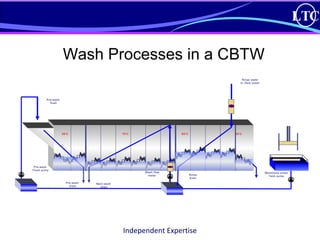
39ºC 75ºC 60ºC 25ºC 
Independent Expertise 
Pre-wash 
drain 
Main-wash 
drain 
Rinse water 
In /flow meter 
Membrane press 
Rinse Tank pump 
drain 
Wash flow 
meter 
Pre-wash 
flush 
Pre-wash 
Flush pump 
Wash Processes in a CBTW
LTC 
Time 
12 stage CBTW - Total cycle time is 30minutes, 
30mins÷ 12 compartments = 2½minutes 
Therefore the process is likely to be set up 
• Pre-wash/Wetting out – Sections 1 & 2 = 2 x 2½mins = 5 
Independent Expertise 
minutes. 
• Main wash stage – sections 3 – 8 = 6 x 2½mins = 15 
minutes. 
• Rinse stage – sections 9-12 = 4 x 2½mins = 10 minutes 
• Total time: 30 mins.
LTC 
Mechanical Action 
• Machine inner basket rotational speed – normally 
pre-set during manufacture 
• Correct reversing (to avoid tangles) 
• Operational speeds - Rocking and Transfer (fabric 
Independent Expertise 
type) 
• Mechanical action from the contraflow of water 
and/or the bath transfer
LTC 
Degree of Loading 
• The principles of over and under loading apply with 
CBTW’s. In CBTWs overloading has an additional 
problem which can cause blockages. 
• With CBTW underloading wash costs also increase as 
the same amount of water, chemicals and energy are 
used for a smaller amount of work. 
Independent Expertise
LTC 
39ºC 75ºC 60ºC 25ºC 
Independent Expertise 
Pre-wash 
drain 
Main-wash 
drain 
Rinse water 
In /flow meter 
Membrane press 
Rinse Tank pump 
drain 
Wash flow 
meter 
Pre-wash 
flush 
Pre-wash 
Flush pump 
Water levels
LTC 
Temperature 
• Within CBTW’s the same rules for temperature apply 
for soiling types and fabrics. 
• There are inbuilt inflexibilities with using CBTW’s as it is 
a continuous process which must be taken into account 
Independent Expertise
LTC 
39ºC 75ºC 60ºC 25ºC 
Independent Expertise 
Pre-wash 
drain 
Main-wash 
drain 
Rinse water 
In /flow meter 
Membrane press 
Rinse Tank pump 
drain 
Wash flow 
meter 
Pre-wash 
flush 
Pre-wash 
Flush pump 
Temperature
LTC 
Detergency 
• The rules on detergency still apply 
• Within CBTW’s there are inbuilt inflexibilities which 
must be taken into account 
• Careful detergency planning and management will 
give you flexibility in soil removal 
Independent Expertise

Washing Process Presentation

  • 1.
    LTC Independent Expertise C Washing Processes LTC & DTC 2014 © LTC&DTC Ltd 2014
  • 2.
    LTC Wash ProcessAdditives EMULSION Independent Expertise Emulsifiers OIL WATER • An alternative way of improving the release of oily or fatty soiling is to use an emulsifier in the wash. This is a neutral liquid designed to help solubilise oily fatty globules by splitting them and lifting them off the fabric without aggressive chemistry.
  • 3.
    LTC Wash processadditives Sour (Acid) • To neutralise alkalis from the wash process Antichlor • To neutralise residual hypochlorite bleach Fabric Conditioner • To make the fabric feel ‘softer’ and reduce static Starch • Impart a ‘stiffer’ feel to the fabric-can be natural – Rice or synthetic - PVA Independent Expertise
  • 4.
    LTC Wash ProcessDesign Independent Expertise
  • 5.
    LTC Bleaches Usedwithin the wash or rinse sections depending upon the type of bleach used. 2 Families of Bleach - Oxidizing and Reducing Oxidizing bleaches for protein soiling and vegetable dyes • Sodium hypochlorite - 60ºC Max – otherwise excess Independent Expertise fabric damage • Hydrogen Peroxide - 65ºC+ Reducing used to remove dye (Sodium dithionite/ Sodium hydrosulphite)
  • 6.
    LTC Sinners Circle– 4 principle elements DDeetteerrggeennccyy MMeecchhaanniiccaall AAccttiioonn WATER TTiimmee TTeemmppeerraattuurree Independent Expertise
  • 7.
    LTC Ingredients fora good wash….. Independent Expertise WATER • Quality – Clean, colourless, odour and bacteria free • Soft (more than 5ºClarke – 72ppm too hard) • Hard water contains Calcium and Magnesium Salts. • Right amount in the right place at the right time at the correct temperature
  • 8.
    LTC Some problemscaused by hard water • Destroys some of the detergent • Can make loads feel greasy if soap is within the formulation • Leads to scale build up in the CBTW which prevents transfer occurring and can lead to blockages. • Leads to a hard skin forming around greasy and oily soiling making it harder to remove. • Makes fabrics feel hard and harsh. • Any water hardness has some effect on washing quality, and the higher the hardness the greater the problem. Independent Expertise
  • 9.
    LTC Time Differentstages of the wash process need different amounts of time. Typical examples are • Pre-wash: 4-8 minutes to remove loose particulate soiling • Main wash: 5-14 minutes to remove ingrained soiling • Rinses: 3-5 minutes to dilute chemicals • Spin: 3-8 minutes depending upon fabric type. Independent Expertise
  • 10.
    LTC Degree ofLoading • All washing machines are usually referred to by their maximum loading capacity of dry 100% cotton textiles (e.g. a 90kg machine). This figure is usually calculated using dry 100% cotton sheeting as the standard classification. • Above this designated weight, mechanical action will be reduced by the restricted movement and drop of the linen. Overloading will therefore result in poor wash quality. • Below this target weight (under-loading), increased mechanical action will occur which can increase fabric damage. Wash costs also increase as the same amount of water, chemicals and energy are used for a smaller amount of work. Independent Expertise
  • 11.
    LTC Temperature •Different types of soiling need different temperatures (Oily – high, Protein Low) • Fabrics, dyes and soiling behave differently at high and Independent Expertise low temperature • Chemicals activity increases with higher temperature
  • 12.
    LTC Temperature •38ºC - Protein stains (blood and perspiration) start to set above this temperature • 40ºC - Optimum temperature for enzyme activity to digest protein stains. Some enzymes are designed to work at higher temperatures. • 60ºC - Maximum temperature for sodium hypochlorite use, to avoid fabric damage. • 65ºC - Minimum temperature for using Hydrogen Peroxide • 80ºC - Normal minimum temperature for heavy mineral oil removal, but the latest systems can work at lower temperatures. Independent Expertise
  • 13.
    LTC Detergency •Each chemical reacts in various ways with both the soiling and the fabric • Detergency to match the particular stage of the Independent Expertise process • Chemicals are affected by the concentration (amount added to the machine) as well as the temperature they are used and the time which they have to react
  • 14.
    LTC 39ºC 75ºC60ºC 25ºC Independent Expertise Pre-wash drain Main-wash drain Rinse water In /flow meter Membrane press Rinse Tank pump drain Wash flow meter Pre-wash flush Pre-wash Flush pump Wash Processes in a CBTW
  • 15.
    LTC Time 12stage CBTW - Total cycle time is 30minutes, 30mins÷ 12 compartments = 2½minutes Therefore the process is likely to be set up • Pre-wash/Wetting out – Sections 1 & 2 = 2 x 2½mins = 5 Independent Expertise minutes. • Main wash stage – sections 3 – 8 = 6 x 2½mins = 15 minutes. • Rinse stage – sections 9-12 = 4 x 2½mins = 10 minutes • Total time: 30 mins.
  • 16.
    LTC Mechanical Action • Machine inner basket rotational speed – normally pre-set during manufacture • Correct reversing (to avoid tangles) • Operational speeds - Rocking and Transfer (fabric Independent Expertise type) • Mechanical action from the contraflow of water and/or the bath transfer
  • 17.
    LTC Degree ofLoading • The principles of over and under loading apply with CBTW’s. In CBTWs overloading has an additional problem which can cause blockages. • With CBTW underloading wash costs also increase as the same amount of water, chemicals and energy are used for a smaller amount of work. Independent Expertise
  • 18.
    LTC 39ºC 75ºC60ºC 25ºC Independent Expertise Pre-wash drain Main-wash drain Rinse water In /flow meter Membrane press Rinse Tank pump drain Wash flow meter Pre-wash flush Pre-wash Flush pump Water levels
  • 19.
    LTC Temperature •Within CBTW’s the same rules for temperature apply for soiling types and fabrics. • There are inbuilt inflexibilities with using CBTW’s as it is a continuous process which must be taken into account Independent Expertise
  • 20.
    LTC 39ºC 75ºC60ºC 25ºC Independent Expertise Pre-wash drain Main-wash drain Rinse water In /flow meter Membrane press Rinse Tank pump drain Wash flow meter Pre-wash flush Pre-wash Flush pump Temperature
  • 21.
    LTC Detergency •The rules on detergency still apply • Within CBTW’s there are inbuilt inflexibilities which must be taken into account • Careful detergency planning and management will give you flexibility in soil removal Independent Expertise