FAUVISM Revision
The “Fauves” The group is not homogeneous and lacks of a defined programme, They share   their opposition to the Art Nouveau decoration and opposition to  the formal consistence of the Symbolism.  Members of this group are : Matisse, Marquet, Dufy, Derain, Braque, and  Vlaminck.
Phylosophy  T hey conceived the art as a vital impulse T hey started depicting some subjects in a critic way. Far from Cezanne’s synthesis there was just one possibility: to solve the dualism between : the feeling –the colour – and the construction –the plastic form, the volume, the space –putting special strength on the colour
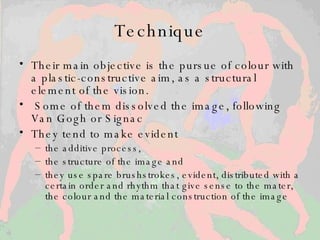
Technique Their main objective is the pursue of colour with a plastic-constructive aim, as a structural element of the vision. Some of them dissolved the image, following Van Gogh or Signac  They  tend to make evident the additive process,  the structure of the image and  they use spare brushstrokes, evident, distributed with a certain order and rhythm that give sense to the mater, the colour and the material construction of the image
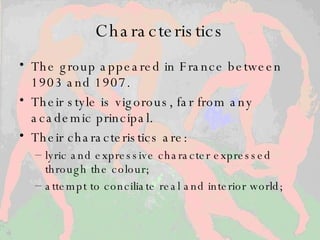
Characteristics The group appeared in France between 1903 and 1907.  Their style is vigorous, far from any academic principal.  Their characteristics are:  lyric and expressive character expressed through the colour;  attempt to conciliate real and interior world;
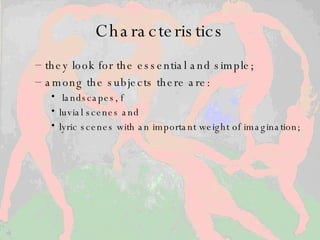
Characteristics they look for the essential and simple;  among the subjects there are : landscapes, f luvial scenes and  lyric scenes with an important weight of imagination;
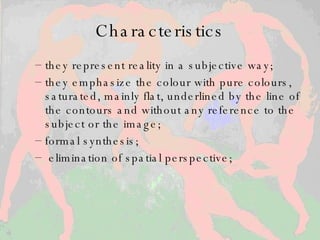
Characteristics they represent reality in a subjective way;  they emphasize the colour with pure colours, saturated, mainly flat, underlined by the line of the contours and without any reference to the subject or the image;  formal synthesis; elimination of spatial perspective;
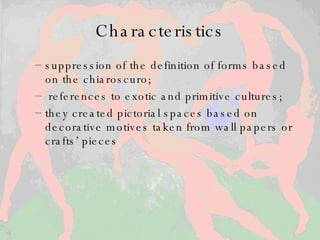
Characteristics suppression of the definition of forms based on the chiaroscuro; references to exotic and primitive cultures;  they created pictorial spaces based on decorative motives taken from wall papers or crafts’ pieces
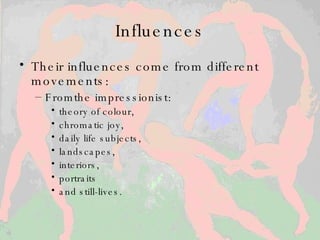
Influences Their influences come from different movements:  From the impressionist : theory of colour,  chromatic joy,  daily life subjects,  landscapes,  interiors,  portraits  and still-lives.
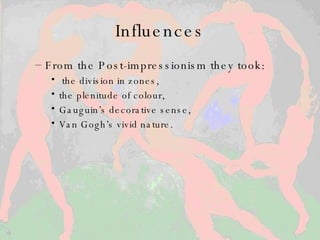
Influences From the Post-impressionism they took : the division in zones,  the plenitude of colour,  Gauguin’s decorative sense,  Van Gogh’s vivid nature.
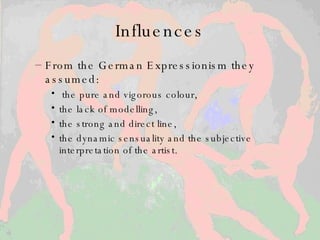
Influences From the German Expressionism they assumed : the pure and vigorous colour,  the lack of modelling,  the strong and direct line,  the dynamic sensuality and the subjective interpretation of the artist.
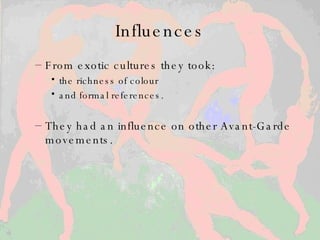
Influences From exotic cultures they took : the richness of colour  and formal references. They had an influence on other Avant-Garde movements.

Fauvism

  • 1.
  • 2.
    The “Fauves” Thegroup is not homogeneous and lacks of a defined programme, They share their opposition to the Art Nouveau decoration and opposition to the formal consistence of the Symbolism. Members of this group are : Matisse, Marquet, Dufy, Derain, Braque, and Vlaminck.
  • 3.
    Phylosophy They conceived the art as a vital impulse T hey started depicting some subjects in a critic way. Far from Cezanne’s synthesis there was just one possibility: to solve the dualism between : the feeling –the colour – and the construction –the plastic form, the volume, the space –putting special strength on the colour
  • 4.
    Technique Their mainobjective is the pursue of colour with a plastic-constructive aim, as a structural element of the vision. Some of them dissolved the image, following Van Gogh or Signac They tend to make evident the additive process, the structure of the image and they use spare brushstrokes, evident, distributed with a certain order and rhythm that give sense to the mater, the colour and the material construction of the image
  • 5.
    Characteristics The groupappeared in France between 1903 and 1907. Their style is vigorous, far from any academic principal. Their characteristics are: lyric and expressive character expressed through the colour; attempt to conciliate real and interior world;
  • 6.
    Characteristics they lookfor the essential and simple; among the subjects there are : landscapes, f luvial scenes and lyric scenes with an important weight of imagination;
  • 7.
    Characteristics they representreality in a subjective way; they emphasize the colour with pure colours, saturated, mainly flat, underlined by the line of the contours and without any reference to the subject or the image; formal synthesis; elimination of spatial perspective;
  • 8.
    Characteristics suppression ofthe definition of forms based on the chiaroscuro; references to exotic and primitive cultures; they created pictorial spaces based on decorative motives taken from wall papers or crafts’ pieces
  • 9.
    Influences Their influencescome from different movements: From the impressionist : theory of colour, chromatic joy, daily life subjects, landscapes, interiors, portraits and still-lives.
  • 10.
    Influences From thePost-impressionism they took : the division in zones, the plenitude of colour, Gauguin’s decorative sense, Van Gogh’s vivid nature.
  • 11.
    Influences From theGerman Expressionism they assumed : the pure and vigorous colour, the lack of modelling, the strong and direct line, the dynamic sensuality and the subjective interpretation of the artist.
  • 12.
    Influences From exoticcultures they took : the richness of colour and formal references. They had an influence on other Avant-Garde movements.