Module 6
Licence Category A, B1, B2 and B3
Materials and Hardware
6.5 Fasteners
Prepared by Mahmoud jadallah
Enabling Objectives
Fasteners
1-Screw Threads
Screw nomenclature
Thread forms, dimensions and tolerances for standard
threads used in aircraft
Measuring screw threads
2-Bolts, studs and screws
Bolt types: specification, identification and marking of
aircraft bolts, international standards
Nuts: self locking, anchor, standard types
Machine screws: aircraft specifications
Studs: types and uses, insertion and removal
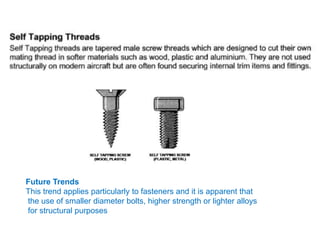
Self tapping screws, dowels
3-Locking devices
Tab and spring washers, locking plates, split pins, pal-nuts, wire
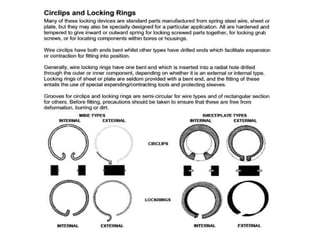
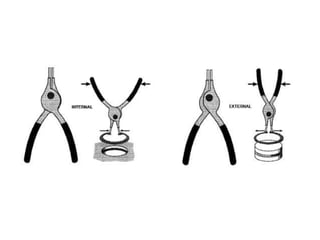
locking, quick release fasteners, keys, circlips, cotter pins
4-Aircraft rivets
types of solid and blind rivets: specifications and
identification, heat treatment
1-Screw Threads
1-Principle
2-Screw Thread Terminology
3-Power Transmission Threads
4-Thread Systems
5-Cutting Screw Threads at the Bench
6-Thread Manufacture
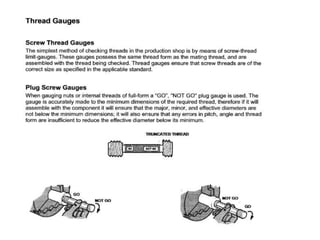
7-Thread Gauges
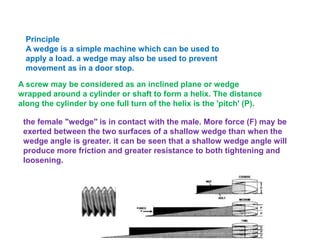
Principle
A wedge is a simple machine which can be used to
apply a load. a wedge may also be used to prevent
movement as in a door stop.
A screw may be considered as an inclined plane or wedge
wrapped around a cylinder or shaft to form a helix. The distance
along the cylinder by one full turn of the helix is the 'pitch' (P).
the female "wedge" is in contact with the male. More force (F) may be
exerted between the two surfaces of a shallow wedge than when the
wedge angle is greater. it can be seen that a shallow wedge angle will
produce more friction and greater resistance to both tightening and
loosening.
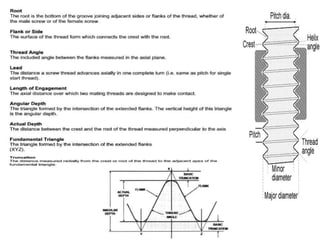
Screw Thread Terminology
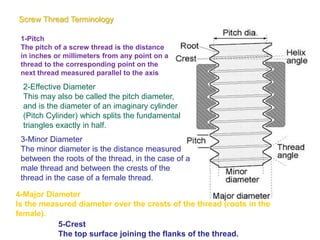
1-Pitch
The pitch of a screw thread is the distance
in inches or millimeters from any point on a
thread to the corresponding point on the
next thread measured parallel to the axis
2-Effective Diameter
This may also be called the pitch diameter,
and is the diameter of an imaginary cylinder
(Pitch Cylinder) which splits the fundamental
triangles exactly in half.
3-Minor Diameter
The minor diameter is the distance measured
between the roots of the thread, in the case of a
male thread and between the crests of the
thread in the case of a female thread.
4-Major Diameter
Is the measured diameter over the crests of the thread (roots in the
female).
5-Crest
The top surface joining the flanks of the thread.
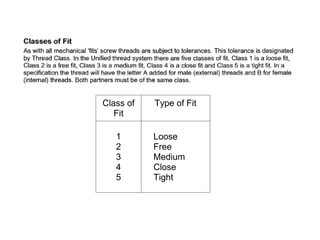
Class of
Fit
Type of Fit
1
2
3
4
5
Loose
Free
Medium
Close
Tight
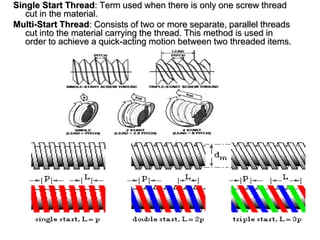
Single Start Thread: Term used when there is only one screw thread
cut in the material.
Multi-Start Thread: Consists of two or more separate, parallel threads
cut into the material carrying the thread. This method is used in
order to achieve a quick-acting motion between two threaded items.
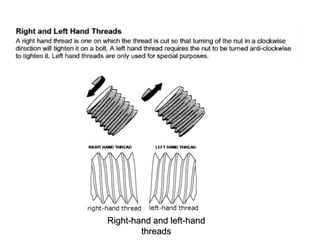
Right-hand and left-hand
threads
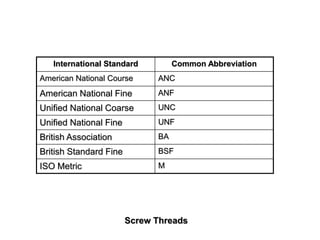
Screw Threads
International Standard Common Abbreviation
American National Course ANC
American National Fine ANF
Unified National Coarse UNC
Unified National Fine UNF
British Association BA
British Standard Fine BSF
ISO Metric M
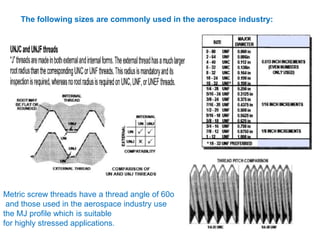
The following sizes are commonly used in the aerospace industry:
Metric screw threads have a thread angle of 60o
and those used in the aerospace industry use
the MJ profile which is suitable
for highly stressed applications.
Future Trends
This trend applies particularly to fasteners and it is apparent that
the use of smaller diameter bolts, higher strength or lighter alloys
for structural purposes
Cutting Screw Threads at the Bench
General
Screw threads of up to about 1 1U' can be successfully produced by hand
methods using taps for internal threads and dies for external threads.
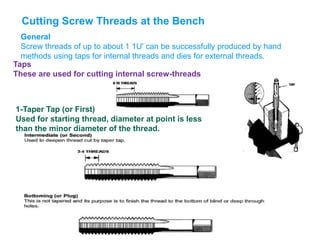
Taps
These are used for cutting internal screw-threads
1-Taper Tap (or First)
Used for starting thread, diameter at point is less
than the minor diameter of the thread.
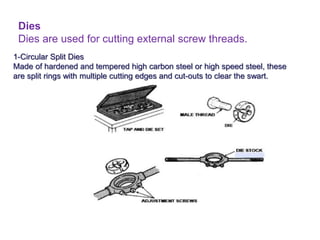
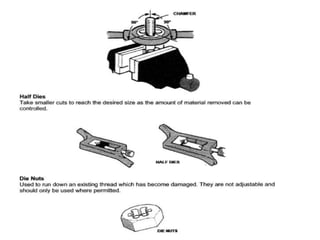
Dies
Dies are used for cutting external screw threads.
1-Circular Split Dies
Made of hardened and tempered high carbon steel or high speed steel, these
are split rings with multiple cutting edges and cut-outs to clear the swart.
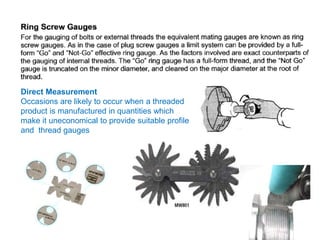
Direct Measurement
Occasions are likely to occur when a threaded
product is manufactured in quantities which
make it uneconomical to provide suitable profile
and thread gauges
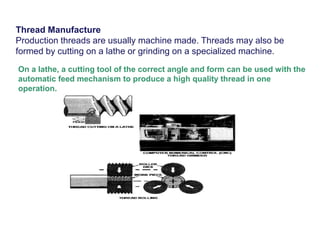
Thread Manufacture
Production threads are usually machine made. Threads may also be
formed by cutting on a lathe or grinding on a specialized machine.
On a lathe, a cutting tool of the correct angle and form can be used with the
automatic feed mechanism to produce a high quality thread in one
operation.
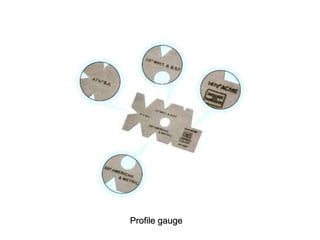
Profile gauge
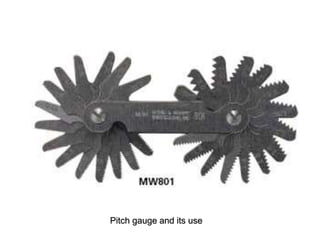
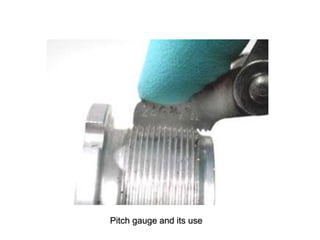
Pitch gauge and its use
Fasteners
2-Bolts, studs and screws
Bolt types: specification, identification and
marking of
aircraft bolts, international standards
Nuts: self locking, anchor, standard types
Machine screws: aircraft specifications
Studs: types and uses, insertion and removal
Self tapping screws, dowels
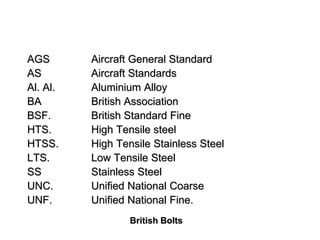
British Bolts
AGS Aircraft General Standard
AS Aircraft Standards
Al. Al. Aluminium Alloy
BA British Association
BSF. British Standard Fine
HTS. High Tensile steel
HTSS. High Tensile Stainless Steel
LTS. Low Tensile Steel
SS Stainless Steel
UNC. Unified National Coarse
UNF. Unified National Fine.
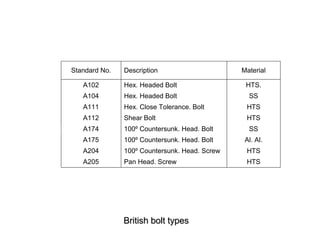
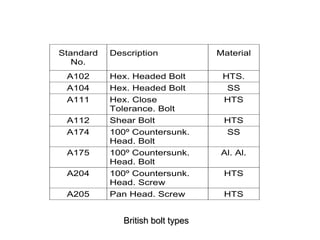
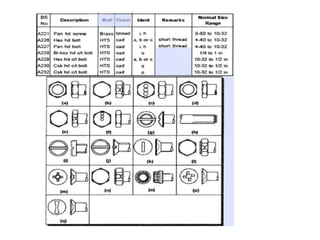
British bolt types
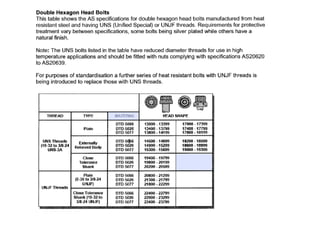
Standard No. Description Material
A102 Hex. Headed Bolt HTS.
A104 Hex. Headed Bolt SS
A111 Hex. Close Tolerance. Bolt HTS
A112 Shear Bolt HTS
A174 100º Countersunk. Head. Bolt SS
A175 100º Countersunk. Head. Bolt Al. Al.
A204 100º Countersunk. Head. Screw HTS
A205 Pan Head. Screw HTS
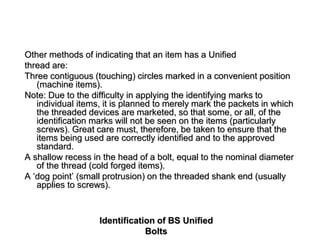
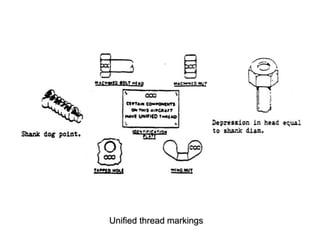
Identification of BS Unified
Bolts
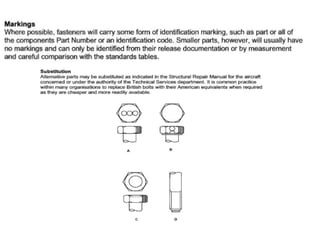
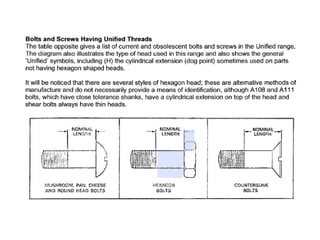
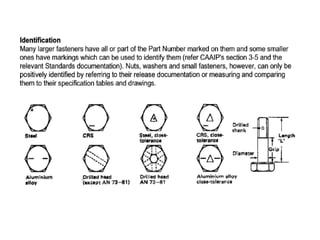
Other methods of indicating that an item has a Unified
thread are:
Three contiguous (touching) circles marked in a convenient position
(machine items).
Note: Due to the difficulty in applying the identifying marks to
individual items, it is planned to merely mark the packets in which
the threaded devices are marketed, so that some, or all, of the
identification marks will not be seen on the items (particularly
screws). Great care must, therefore, be taken to ensure that the
items being used are correctly identified and to the approved
standard.
A shallow recess in the head of a bolt, equal to the nominal diameter
of the thread (cold forged items).
A ‘dog point’ (small protrusion) on the threaded shank end (usually
applies to screws).
British bolt types
Standard
No.
Description Material
A102 Hex. Headed Bolt HTS.
A104 Hex. Headed Bolt SS
A111 Hex. Close
Tolerance. Bolt
HTS
A112 Shear Bolt HTS
A174 100º Countersunk.
Head. Bolt
SS
A175 100º Countersunk.
Head. Bolt
Al. Al.
A204 100º Countersunk.
Head. Screw
HTS
A205 Pan Head. Screw HTS
Unified thread markings
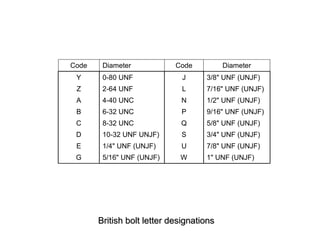
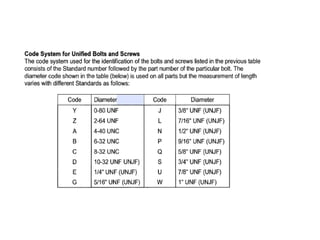
British bolt letter designations
Code Diameter Code Diameter
Y 0-80 UNF J 3/8" UNF (UNJF)
Z 2-64 UNF L 7/16" UNF (UNJF)
A 4-40 UNC N 1/2" UNF (UNJF)
B 6-32 UNC P 9/16" UNF (UNJF)
C 8-32 UNC Q 5/8" UNF (UNJF)
D 10-32 UNF UNJF) S 3/4" UNF (UNJF)
E 1/4" UNF (UNJF) U 7/8" UNF (UNJF)
G 5/16" UNF (UNJF) W 1" UNF (UNJF)
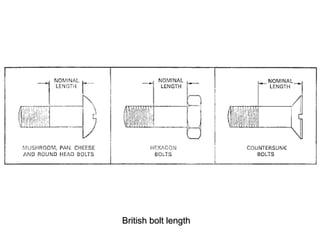
British bolt length
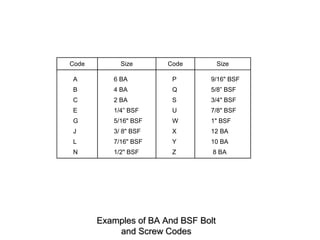
Examples of BA And BSF Bolt
and Screw Codes
Code Size Code Size
A
B
C
E
G
J
L
N
6 BA
4 BA
2 BA
1/4” BSF
5/16" BSF
3/ 8" BSF
7/16" BSF
1/2" BSF
P
Q
S
U
W
X
Y
Z
9/16" BSF
5/8” BSF
3/4" BSF
7/8" BSF
1" BSF
12 BA
10 BA
8 BA
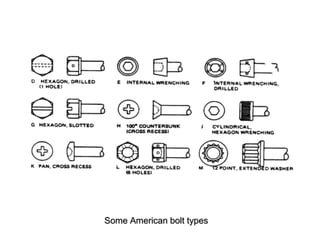
Some American bolt types
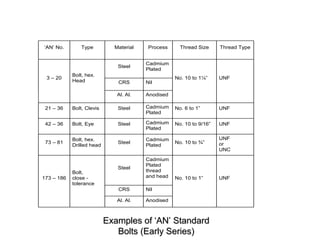
Examples of ‘AN’ Standard
Bolts (Early Series)
‘AN’ No. Type Material Process Thread Size Thread Type
Steel
Cadmium
Plated
CRS Nil
3 – 20
Bolt, hex.
Head
Al. Al. Anodised
No. 10 to 1¼” UNF
21 – 36 Bolt, Clevis Steel Cadmium
Plated
No. 6 to 1” UNF
42 – 36 Bolt, Eye Steel Cadmium
Plated
No. 10 to 9/16” UNF
73 – 81
Bolt, hex.
Drilled head
Steel
Cadmium
Plated
No. 10 to ¾”
UNF
or
UNC
Steel
Cadmium
Plated
thread
and head
CRS Nil
173 – 186
Bolt,
close -
tolerance
Al. Al. Anodised
No. 10 to 1” UNF
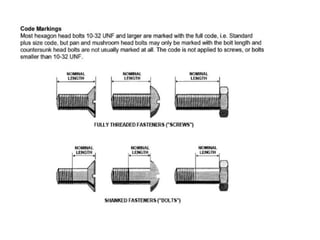
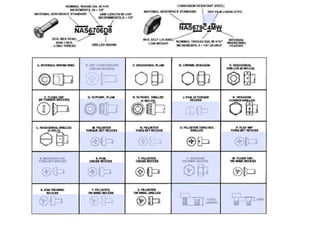
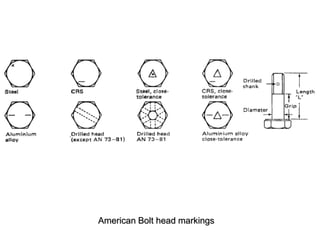
American Bolt head markings
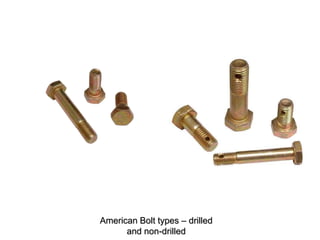
American Bolt types – drilled
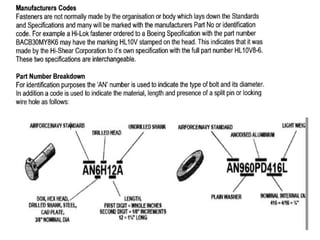
and non-drilled
AN Bolts
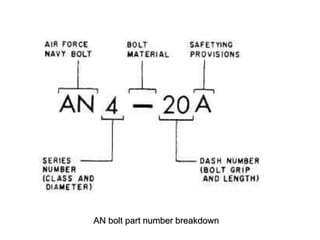
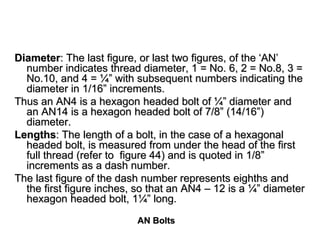
Diameter: The last figure, or last two figures, of the ‘AN’
number indicates thread diameter, 1 = No. 6, 2 = No.8, 3 =
No.10, and 4 = ¼” with subsequent numbers indicating the
diameter in 1/16” increments.
Thus an AN4 is a hexagon headed bolt of ¼” diameter and
an AN14 is a hexagon headed bolt of 7/8” (14/16”)
diameter.
Lengths: The length of a bolt, in the case of a hexagonal
headed bolt, is measured from under the head of the first
full thread (refer to figure 44) and is quoted in 1/8”
increments as a dash number.
The last figure of the dash number represents eighths and
the first figure inches, so that an AN4 – 12 is a ¼” diameter
hexagon headed bolt, 1¼” long.
AN Bolts
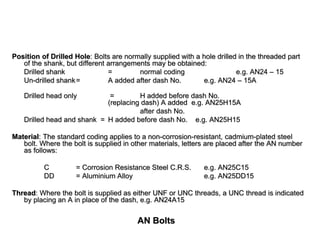
Position of Drilled Hole: Bolts are normally supplied with a hole drilled in the threaded part
of the shank, but different arrangements may be obtained:
Drilled shank = normal coding e.g. AN24 – 15
Un-drilled shank= A added after dash No. e.g. AN24 – 15A
Drilled head only = H added before dash No.
(replacing dash) A added e.g. AN25H15A
after dash No.
Drilled head and shank = H added before dash No. e.g. AN25H15
Material: The standard coding applies to a non-corrosion-resistant, cadmium-plated steel
bolt. Where the bolt is supplied in other materials, letters are placed after the AN number
as follows:
C = Corrosion Resistance Steel C.R.S. e.g. AN25C15
DD = Aluminium Alloy e.g. AN25DD15
Thread: Where the bolt is supplied as either UNF or UNC threads, a UNC thread is indicated
by placing an A in place of the dash, e.g. AN24A15
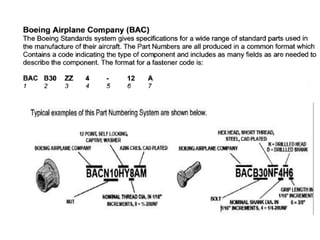
AN bolt part number breakdown
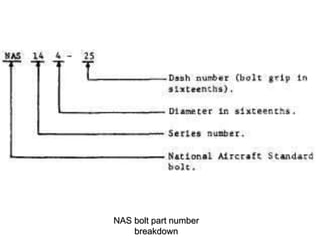
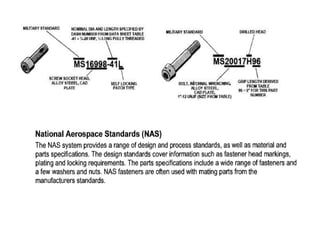
NAS bolt part number
breakdown
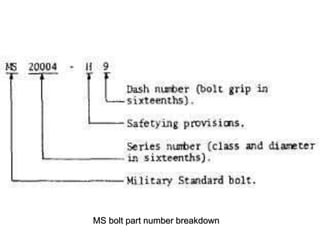
MS bolt part number breakdown
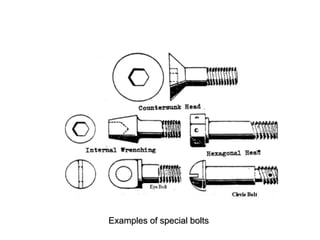
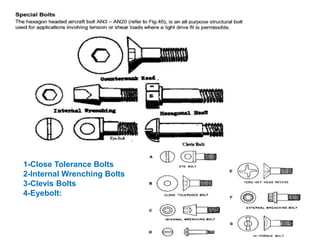
Examples of special bolts
Special Bolts
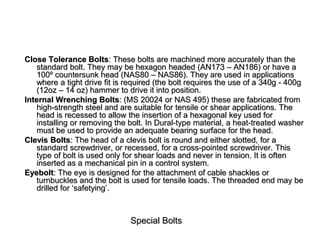
Close Tolerance Bolts: These bolts are machined more accurately than the
standard bolt. They may be hexagon headed (AN173 – AN186) or have a
100º countersunk head (NAS80 – NAS86). They are used in applications
where a tight drive fit is required (the bolt requires the use of a 340g - 400g
(12oz – 14 oz) hammer to drive it into position.
Internal Wrenching Bolts: (MS 20024 or NAS 495) these are fabricated from
high-strength steel and are suitable for tensile or shear applications. The
head is recessed to allow the insertion of a hexagonal key used for
installing or removing the bolt. In Dural-type material, a heat-treated washer
must be used to provide an adequate bearing surface for the head.
Clevis Bolts: The head of a clevis bolt is round and either slotted, for a
standard screwdriver, or recessed, for a cross-pointed screwdriver. This
type of bolt is used only for shear loads and never in tension. It is often
inserted as a mechanical pin in a control system.
Eyebolt: The eye is designed for the attachment of cable shackles or
turnbuckles and the bolt is used for tensile loads. The threaded end may be
drilled for ‘safetying’.
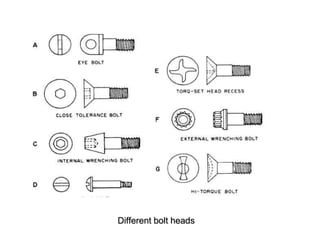
Different bolt heads
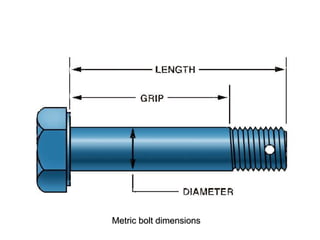
Metric bolt dimensions
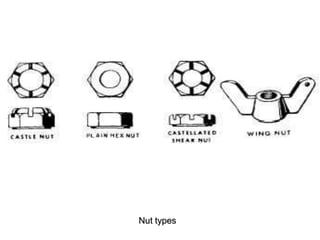
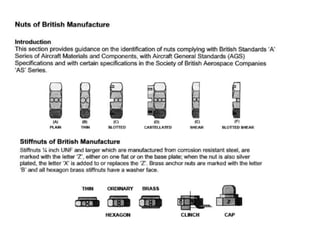
Nut types
Nuts
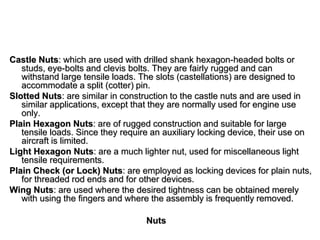
Castle Nuts: which are used with drilled shank hexagon-headed bolts or
studs, eye-bolts and clevis bolts. They are fairly rugged and can
withstand large tensile loads. The slots (castellations) are designed to
accommodate a split (cotter) pin.
Slotted Nuts: are similar in construction to the castle nuts and are used in
similar applications, except that they are normally used for engine use
only.
Plain Hexagon Nuts: are of rugged construction and suitable for large
tensile loads. Since they require an auxiliary locking device, their use on
aircraft is limited.
Light Hexagon Nuts: are a much lighter nut, used for miscellaneous light
tensile requirements.
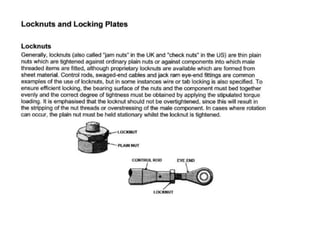
Plain Check (or Lock) Nuts: are employed as locking devices for plain nuts,
for threaded rod ends and for other devices.
Wing Nuts: are used where the desired tightness can be obtained merely
with using the fingers and where the assembly is frequently removed.
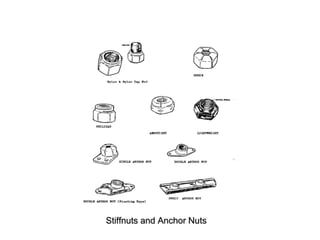
Stiffnuts and Anchor Nuts
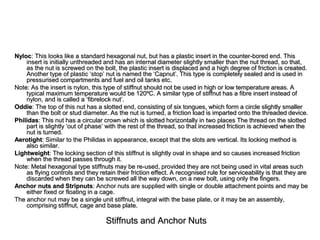
Nyloc: This looks like a standard hexagonal nut, but has a plastic insert in the counter-bored end. This
insert is initially unthreaded and has an internal diameter slightly smaller than the nut thread, so that,
as the nut is screwed on the bolt, the plastic insert is displaced and a high degree of friction is created.
Another type of plastic ‘stop’ nut is named the ‘Capnut’. This type is completely sealed and is used in
pressurised compartments and fuel and oil tanks etc.
Note: As the insert is nylon, this type of stiffnut should not be used in high or low temperature areas. A
typical maximum temperature would be 120ºC. A similar type of stiffnut has a fibre insert instead of
nylon, and is called a ‘fibrelock nut’.
Oddie: The top of this nut has a slotted end, consisting of six tongues, which form a circle slightly smaller
than the bolt or stud diameter. As the nut is turned, a friction load is imparted onto the threaded device.
Philidas: This nut has a circular crown which is slotted horizontally in two places The thread on the slotted
part is slightly ‘out of phase’ with the rest of the thread, so that increased friction is achieved when the
nut is turned.
Aerotight: Similar to the Philidas in appearance, except that the slots are vertical. Its locking method is
also similar.
Lightweight: The locking section of this stiffnut is slightly oval in shape and so causes increased friction
when the thread passes through it.
Note: Metal hexagonal type stiffnuts may be re-used, provided they are not being used in vital areas such
as flying controls and they retain their friction effect. A recognised rule for serviceability is that they are
discarded when they can be screwed all the way down, on a new bolt, using only the fingers.
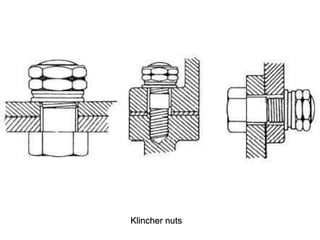
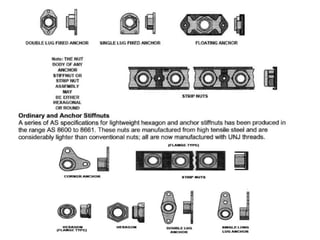
Anchor nuts and Stripnuts: Anchor nuts are supplied with single or double attachment points and may be
either fixed or floating in a cage.
The anchor nut may be a single unit stiffnut, integral with the base plate, or it may be an assembly,
comprising stiffnut, cage and base plate.
Stiffnuts and Anchor Nuts
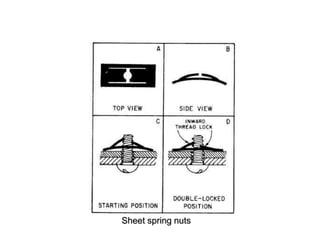
Sheet spring nuts
Klincher nuts
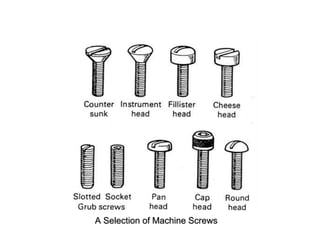
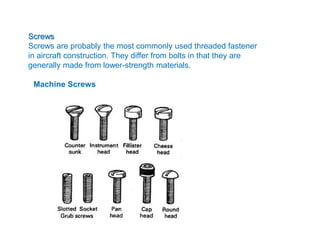
A Selection of Machine Screws
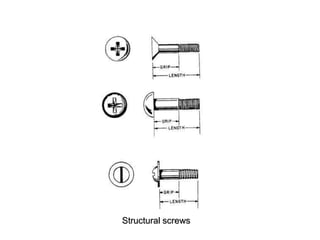
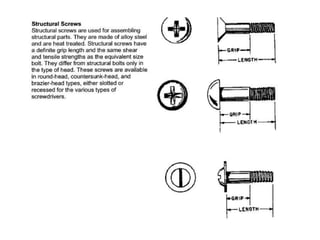
Structural screws
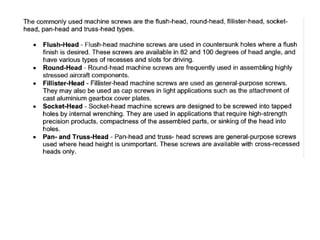
Machine Screws
Flush-Head - Flush-head machine screws are used in countersunk holes
where a flush finish is desired. These screws are available in 82 and
100 degrees of head angle, and have various types of recesses and
slots for driving.
Round-Head - Round-head machine screws are frequently used in
assembling highly stressed aircraft components.
Fillister-Head - Fillister-head machine screws are used as general-
purpose screws. They may also be used as cap screws in light
applications such as the attachment of cast aluminium gearbox cover
plates.
Socket-Head - Socket-head machine screws are designed to be
screwed into tapped holes by internal wrenching. They are used in
applications that require high-strength precision products,
compactness of the assembled parts, or sinking of the head into
holes.
Pan- and Truss-Head - Pan-head and truss- head screws are general-
purpose screws used where head height is unimportant. These
screws are available with cross-recessed heads only.
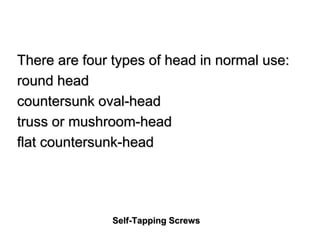
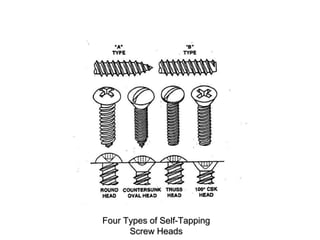
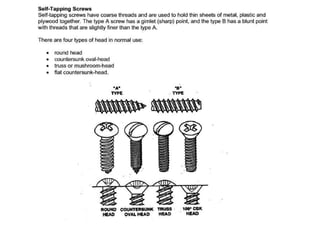
Self-Tapping Screws
There are four types of head in normal use:
round head
countersunk oval-head
truss or mushroom-head
flat countersunk-head
Four Types of Self-Tapping
Screw Heads
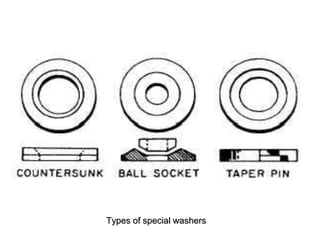
Types of special washers
Studs
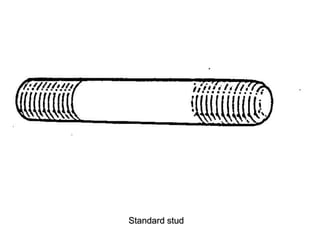
Standard Studs - By far the most widely used stud is the standard
(plain, or parallel) type, in which the diameter of the whole stud,
along its length, is constant. Standard studs are classified by the
thread type, diameter and overall length. The ‘metal’ thread is,
usually, finished very slightly oversize to give a tight fit into the
tapped hole.
Other variants of the standard stud are available for use in
circumstances that require special consideration.
To meet special requirements, the various types of standard studs
may also be supplied with non-standard lengths of plain portion
and ‘metal’ end. A simple method of fitting and removing a stud is
by running two plain nuts down the ‘nut’ end of the stud and
cinching (locking) them together using two spanners. The stud can
then be screwed into or removed from the material. Breaking the
cinch then separating and removing the nuts completes the
operation.
Standard stud
Studs
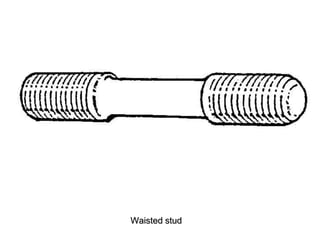
Waisted Studs - Waisted studs are used
where reduction of weight, without the
loss of strength, is of paramount
importance. The diameter of the plain
portion of the stud is reduced to the
minor diameter of the end threads, thus
lightening the stud without impairing its
effective strength.
Waisted stud
Studs
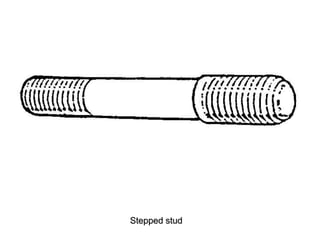
Stepped Studs - This type affords a stronger
anchorage than the standard type, if the ‘metal’ end
of the stud has to be housed in soft metal. The
thread of the ‘metal’ end is one size larger than that
of the ‘nut’ end. For example, a ¼ inch BSF stepped
stud has a plain portion of ¼ inch thread on the ‘nut’
end and a 3/16-inch thread on the ‘metal’ end.
Stepped studs are also used as replacements for
standard studs when the tapped stud-hole has to be
re-drilled and tapped with a larger thread, due to
damage
Stepped stud
Studs
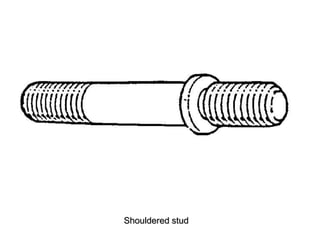
Shouldered Studs - This type is used where
maximum rigidity of assembly is of prime
importance. The stud is machined from oversize
bar and a projecting shoulder is left between the
‘metal’ end of the thread and the normal diameter
plain portion. This shoulder seats firmly on the
surface of the ‘metal’ and gives additional
resistance to sideways stresses. The clearance
hole in the second component, through which the
‘nut’ end and plain portion of the stud passes, must
be machined at the inner end to give clearance to
the stud shoulder
Shouldered stud
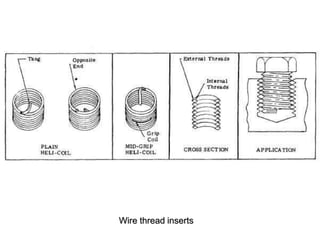
Wire thread inserts
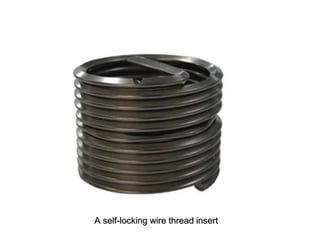
A self-locking wire thread insert
Thin Wall Inserts
Key-Locked Inserts: Key-Iocked inserts are threaded both internally and
externally and, after being screwed into the prepared hole, are (as their
name implies), locked into their holes by tiny wedges or keys. The keys
are then pressed (or hammered) into place between the insert and the
wall of the hole.
Swaged Inserts: Swaged inserts are also threaded internally and externally
and are, again, screwed into the hole before a tool is used to deform
(swage) the insert so that it is locked into the hole.
Ring-Locked Inserts: Ring-Iocked inserts, with internal and external
threads, are screwed into holes which are counter bored, to allow a
special lock-ring to be installed, (after the insert) and yet another special
tool is used to complete the locking action of the lock-ring.
Bonded Inserts: Bonded inserts are, usually, only internally threaded (to
hold the bolt, screw, stud etc) and are secured in the prepared hole by
the use of adhesives.
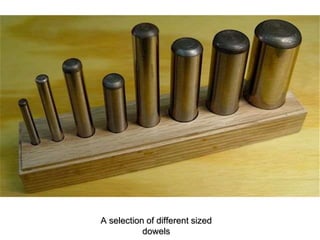
A selection of different sized
dowels
1-Close Tolerance Bolts
2-Internal Wrenching Bolts
3-Clevis Bolts
4-Eyebolt:
Screws
Screws are probably the most commonly used threaded fastener
in aircraft construction. They differ from bolts in that they are
generally made from lower-strength materials.
Machine Screws
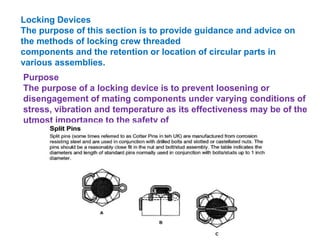
Locking Devices
The purpose of this section is to provide guidance and advice on
the methods of locking crew threaded
components and the retention or location of circular parts in
various assemblies.
Purpose
The purpose of a locking device is to prevent loosening or
disengagement of mating components under varying conditions of
stress, vibration and temperature as its effectiveness may be of the
utmost importance to the safety of
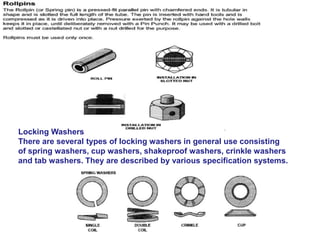
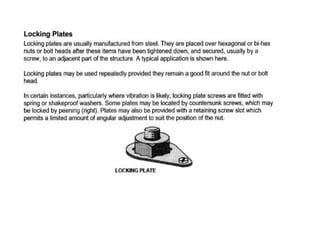
Locking Washers
There are several types of locking washers in general use consisting
of spring washers, cup washers, shakeproof washers, crinkle washers
and tab washers. They are described by various specification systems.
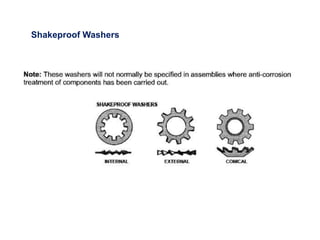
Shakeproof Washers
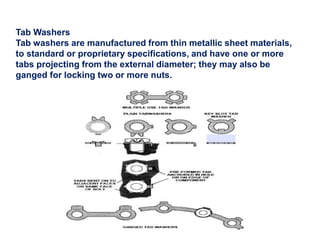
Tab Washers
Tab washers are manufactured from thin metallic sheet materials,
to standard or proprietary specifications, and have one or more
tabs projecting from the external diameter; they may also be
ganged for locking two or more nuts.
Pins
General
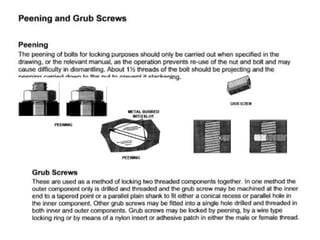
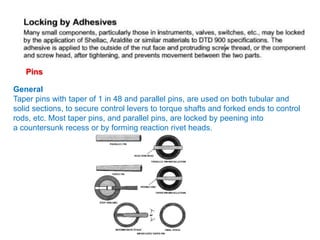
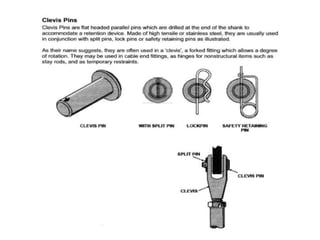
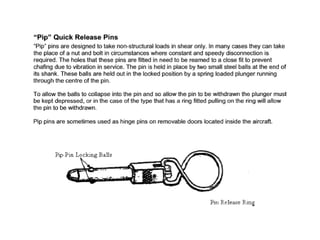
Taper pins with taper of 1 in 48 and parallel pins, are used on both tubular and
solid sections, to secure control levers to torque shafts and forked ends to control
rods, etc. Most taper pins, and parallel pins, are locked by peening into
a countersunk recess or by forming reaction rivet heads.
Quick Release Fasteners
General
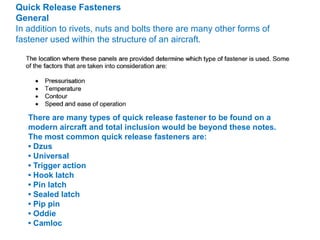
In addition to rivets, nuts and bolts there are many other forms of
fastener used within the structure of an aircraft.
There are many types of quick release fastener to be found on a
modern aircraft and total inclusion would be beyond these notes.
The most common quick release fasteners are:
• Dzus
• Universal
• Trigger action
• Hook latch
• Pin latch
• Sealed latch
• Pip pin
• Oddie
• Camloc
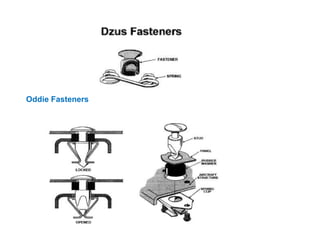
Oddie Fasteners
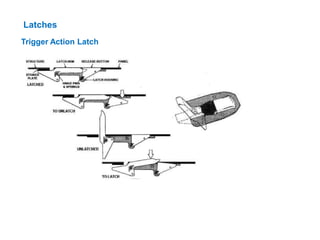
Latches
Trigger Action Latch
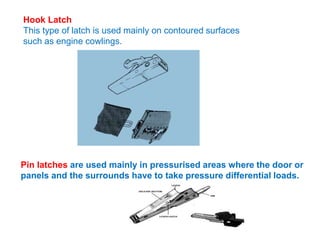
Hook Latch
This type of latch is used mainly on contoured surfaces
such as engine cowlings.
Pin latches are used mainly in pressurised areas where the door or
panels and the surrounds have to take pressure differential loads.
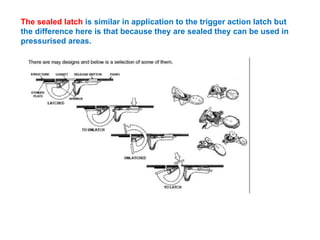
The sealed latch is similar in application to the trigger action latch but
the difference here is that because they are sealed they can be used in
pressurised areas.
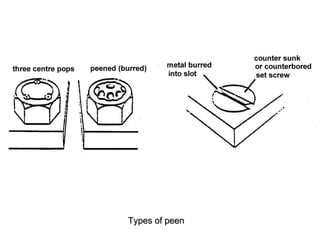
Types of peen
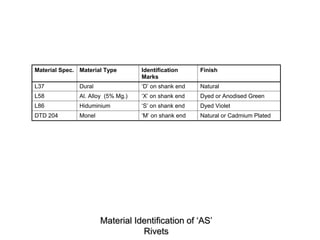
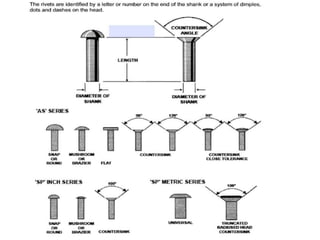
Material Identification of ‘AS’
Rivets
Material Spec. Material Type Identification
Marks
Finish
L37 Dural ‘D’ on shank end Natural
L58 Al. Alloy (5% Mg.) ‘X’ on shank end Dyed or Anodised Green
L86 Hiduminium ‘S’ on shank end Dyed Violet
DTD 204 Monel ‘M’ on shank end Natural or Cadmium Plated
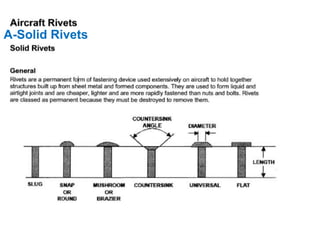
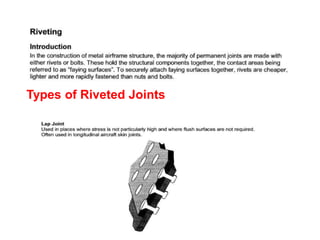
A-Solid Rivets
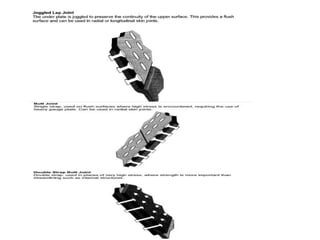
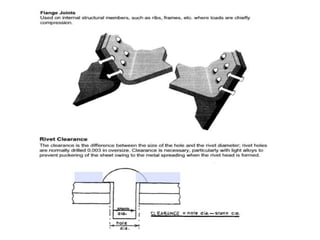
Types of Riveted Joints
See movie
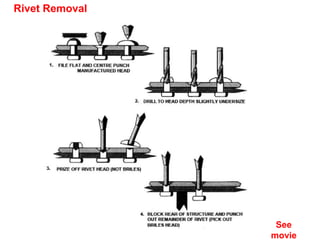
Rivet Removal
See
movie
ANY QUESTIONS?
B-Hollow Rivets
There are many types of hollow rivets used on aircraft and
aircraft equipment.
Hollow rivets are broadly classified into two main groups,
some being closed by pulling a mandrel through the
bore of the rivet and others having to be closed by
hammering, using special punches.
Hollow rivets that have to be closed by hammering are
known as tubular rivets and are not often used in modern
aircraft. It is therefore not considered necessary to include
them in these notes.
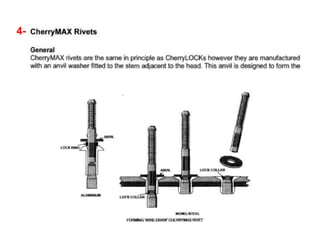
Hollow rivets that are closed by mandrels are
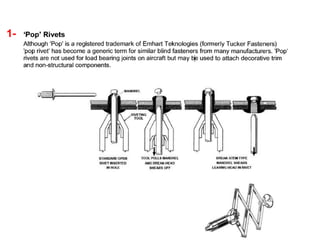
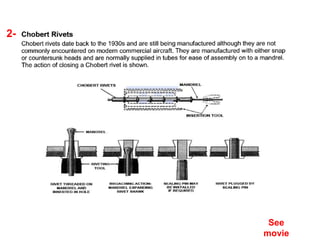
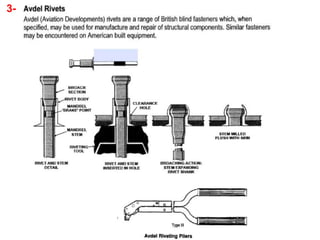
also known as 'blind' rivets.
1-
2-
See
movie
3-
1-
2-
3-
4-
5-
6-
Special types rivet
1- Pin Rivets and Lockbolts
2- Hi-Shear Fasteners
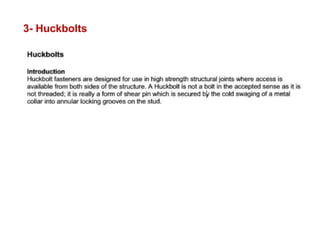
3- Huckbolts
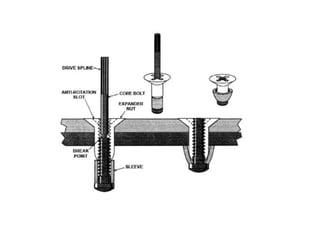
4- Blind Bolts
A-Jo-Bolts
B-Accu-lok
C-Visu-lok
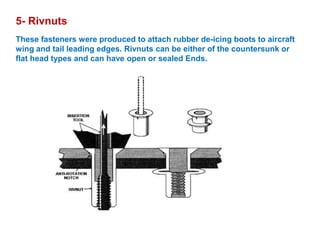
5- Rivnuts
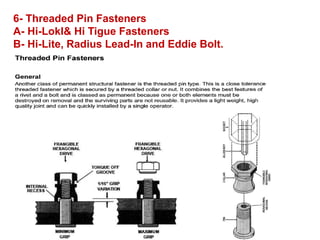
6- Threaded Pin Fasteners
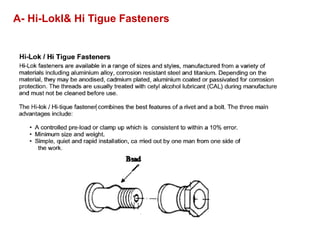
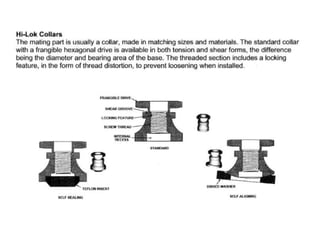
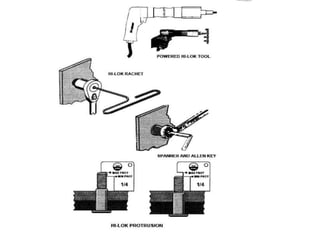
A- Hi-LokI& Hi Tigue Fasteners
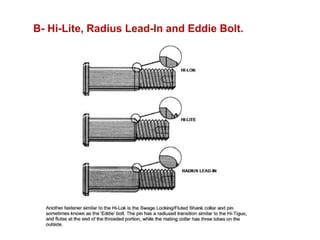
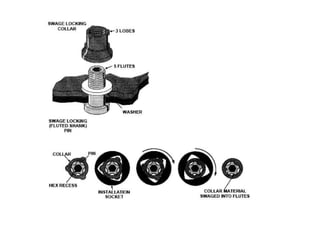
B- Hi-Lite, Radius Lead-In and Eddie Bolt.
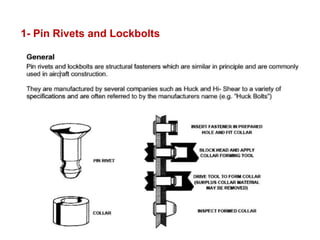
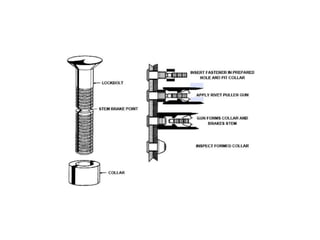
1- Pin Rivets and Lockbolts
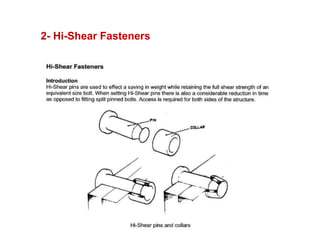
2- Hi-Shear Fasteners
3- Huckbolts
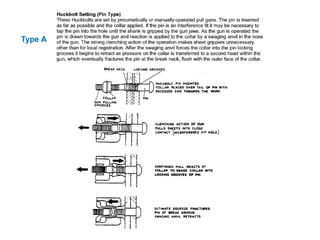
Type A
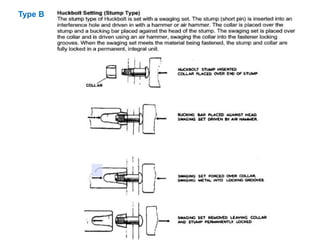
Type B
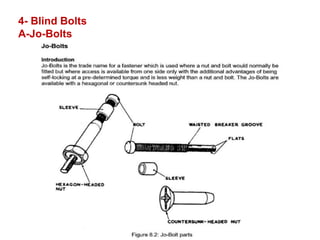
4- Blind Bolts
A-Jo-Bolts
5- Rivnuts
These fasteners were produced to attach rubber de-icing boots to aircraft
wing and tail leading edges. Rivnuts can be either of the countersunk or
flat head types and can have open or sealed Ends.
6- Threaded Pin Fasteners
A- Hi-LokI& Hi Tigue Fasteners
B- Hi-Lite, Radius Lead-In and Eddie Bolt.
A- Hi-LokI& Hi Tigue Fasteners
B- Hi-Lite, Radius Lead-In and Eddie Bolt.
ANY QUESTIONS?

6.5 materials and hardware

  • 1.
    Module 6 Licence CategoryA, B1, B2 and B3 Materials and Hardware 6.5 Fasteners Prepared by Mahmoud jadallah
  • 2.
    Enabling Objectives Fasteners 1-Screw Threads Screwnomenclature Thread forms, dimensions and tolerances for standard threads used in aircraft Measuring screw threads 2-Bolts, studs and screws Bolt types: specification, identification and marking of aircraft bolts, international standards Nuts: self locking, anchor, standard types Machine screws: aircraft specifications Studs: types and uses, insertion and removal Self tapping screws, dowels 3-Locking devices Tab and spring washers, locking plates, split pins, pal-nuts, wire locking, quick release fasteners, keys, circlips, cotter pins 4-Aircraft rivets types of solid and blind rivets: specifications and identification, heat treatment
  • 3.
    1-Screw Threads 1-Principle 2-Screw ThreadTerminology 3-Power Transmission Threads 4-Thread Systems 5-Cutting Screw Threads at the Bench 6-Thread Manufacture 7-Thread Gauges
  • 4.
    Principle A wedge isa simple machine which can be used to apply a load. a wedge may also be used to prevent movement as in a door stop. A screw may be considered as an inclined plane or wedge wrapped around a cylinder or shaft to form a helix. The distance along the cylinder by one full turn of the helix is the 'pitch' (P). the female "wedge" is in contact with the male. More force (F) may be exerted between the two surfaces of a shallow wedge than when the wedge angle is greater. it can be seen that a shallow wedge angle will produce more friction and greater resistance to both tightening and loosening.
  • 5.
    Screw Thread Terminology 1-Pitch Thepitch of a screw thread is the distance in inches or millimeters from any point on a thread to the corresponding point on the next thread measured parallel to the axis 2-Effective Diameter This may also be called the pitch diameter, and is the diameter of an imaginary cylinder (Pitch Cylinder) which splits the fundamental triangles exactly in half. 3-Minor Diameter The minor diameter is the distance measured between the roots of the thread, in the case of a male thread and between the crests of the thread in the case of a female thread. 4-Major Diameter Is the measured diameter over the crests of the thread (roots in the female). 5-Crest The top surface joining the flanks of the thread.
  • 7.
    Class of Fit Type ofFit 1 2 3 4 5 Loose Free Medium Close Tight
  • 8.
    Single Start Thread:Term used when there is only one screw thread cut in the material. Multi-Start Thread: Consists of two or more separate, parallel threads cut into the material carrying the thread. This method is used in order to achieve a quick-acting motion between two threaded items.
  • 9.
  • 12.
    Screw Threads International StandardCommon Abbreviation American National Course ANC American National Fine ANF Unified National Coarse UNC Unified National Fine UNF British Association BA British Standard Fine BSF ISO Metric M
  • 13.
    The following sizesare commonly used in the aerospace industry: Metric screw threads have a thread angle of 60o and those used in the aerospace industry use the MJ profile which is suitable for highly stressed applications.
  • 14.
    Future Trends This trendapplies particularly to fasteners and it is apparent that the use of smaller diameter bolts, higher strength or lighter alloys for structural purposes
  • 15.
    Cutting Screw Threadsat the Bench General Screw threads of up to about 1 1U' can be successfully produced by hand methods using taps for internal threads and dies for external threads. Taps These are used for cutting internal screw-threads 1-Taper Tap (or First) Used for starting thread, diameter at point is less than the minor diameter of the thread.
  • 17.
    Dies Dies are usedfor cutting external screw threads. 1-Circular Split Dies Made of hardened and tempered high carbon steel or high speed steel, these are split rings with multiple cutting edges and cut-outs to clear the swart.
  • 20.
    Direct Measurement Occasions arelikely to occur when a threaded product is manufactured in quantities which make it uneconomical to provide suitable profile and thread gauges
  • 21.
    Thread Manufacture Production threadsare usually machine made. Threads may also be formed by cutting on a lathe or grinding on a specialized machine. On a lathe, a cutting tool of the correct angle and form can be used with the automatic feed mechanism to produce a high quality thread in one operation.
  • 22.
  • 23.
  • 24.
  • 25.
    Fasteners 2-Bolts, studs andscrews Bolt types: specification, identification and marking of aircraft bolts, international standards Nuts: self locking, anchor, standard types Machine screws: aircraft specifications Studs: types and uses, insertion and removal Self tapping screws, dowels
  • 26.
    British Bolts AGS AircraftGeneral Standard AS Aircraft Standards Al. Al. Aluminium Alloy BA British Association BSF. British Standard Fine HTS. High Tensile steel HTSS. High Tensile Stainless Steel LTS. Low Tensile Steel SS Stainless Steel UNC. Unified National Coarse UNF. Unified National Fine.
  • 27.
    British bolt types StandardNo. Description Material A102 Hex. Headed Bolt HTS. A104 Hex. Headed Bolt SS A111 Hex. Close Tolerance. Bolt HTS A112 Shear Bolt HTS A174 100º Countersunk. Head. Bolt SS A175 100º Countersunk. Head. Bolt Al. Al. A204 100º Countersunk. Head. Screw HTS A205 Pan Head. Screw HTS
  • 28.
    Identification of BSUnified Bolts Other methods of indicating that an item has a Unified thread are: Three contiguous (touching) circles marked in a convenient position (machine items). Note: Due to the difficulty in applying the identifying marks to individual items, it is planned to merely mark the packets in which the threaded devices are marketed, so that some, or all, of the identification marks will not be seen on the items (particularly screws). Great care must, therefore, be taken to ensure that the items being used are correctly identified and to the approved standard. A shallow recess in the head of a bolt, equal to the nominal diameter of the thread (cold forged items). A ‘dog point’ (small protrusion) on the threaded shank end (usually applies to screws).
  • 29.
    British bolt types Standard No. DescriptionMaterial A102 Hex. Headed Bolt HTS. A104 Hex. Headed Bolt SS A111 Hex. Close Tolerance. Bolt HTS A112 Shear Bolt HTS A174 100º Countersunk. Head. Bolt SS A175 100º Countersunk. Head. Bolt Al. Al. A204 100º Countersunk. Head. Screw HTS A205 Pan Head. Screw HTS
  • 30.
  • 31.
    British bolt letterdesignations Code Diameter Code Diameter Y 0-80 UNF J 3/8" UNF (UNJF) Z 2-64 UNF L 7/16" UNF (UNJF) A 4-40 UNC N 1/2" UNF (UNJF) B 6-32 UNC P 9/16" UNF (UNJF) C 8-32 UNC Q 5/8" UNF (UNJF) D 10-32 UNF UNJF) S 3/4" UNF (UNJF) E 1/4" UNF (UNJF) U 7/8" UNF (UNJF) G 5/16" UNF (UNJF) W 1" UNF (UNJF)
  • 32.
  • 33.
    Examples of BAAnd BSF Bolt and Screw Codes Code Size Code Size A B C E G J L N 6 BA 4 BA 2 BA 1/4” BSF 5/16" BSF 3/ 8" BSF 7/16" BSF 1/2" BSF P Q S U W X Y Z 9/16" BSF 5/8” BSF 3/4" BSF 7/8" BSF 1" BSF 12 BA 10 BA 8 BA
  • 34.
  • 35.
    Examples of ‘AN’Standard Bolts (Early Series) ‘AN’ No. Type Material Process Thread Size Thread Type Steel Cadmium Plated CRS Nil 3 – 20 Bolt, hex. Head Al. Al. Anodised No. 10 to 1¼” UNF 21 – 36 Bolt, Clevis Steel Cadmium Plated No. 6 to 1” UNF 42 – 36 Bolt, Eye Steel Cadmium Plated No. 10 to 9/16” UNF 73 – 81 Bolt, hex. Drilled head Steel Cadmium Plated No. 10 to ¾” UNF or UNC Steel Cadmium Plated thread and head CRS Nil 173 – 186 Bolt, close - tolerance Al. Al. Anodised No. 10 to 1” UNF
  • 36.
  • 37.
    American Bolt types– drilled and non-drilled
  • 38.
    AN Bolts Diameter: Thelast figure, or last two figures, of the ‘AN’ number indicates thread diameter, 1 = No. 6, 2 = No.8, 3 = No.10, and 4 = ¼” with subsequent numbers indicating the diameter in 1/16” increments. Thus an AN4 is a hexagon headed bolt of ¼” diameter and an AN14 is a hexagon headed bolt of 7/8” (14/16”) diameter. Lengths: The length of a bolt, in the case of a hexagonal headed bolt, is measured from under the head of the first full thread (refer to figure 44) and is quoted in 1/8” increments as a dash number. The last figure of the dash number represents eighths and the first figure inches, so that an AN4 – 12 is a ¼” diameter hexagon headed bolt, 1¼” long.
  • 39.
    AN Bolts Position ofDrilled Hole: Bolts are normally supplied with a hole drilled in the threaded part of the shank, but different arrangements may be obtained: Drilled shank = normal coding e.g. AN24 – 15 Un-drilled shank= A added after dash No. e.g. AN24 – 15A Drilled head only = H added before dash No. (replacing dash) A added e.g. AN25H15A after dash No. Drilled head and shank = H added before dash No. e.g. AN25H15 Material: The standard coding applies to a non-corrosion-resistant, cadmium-plated steel bolt. Where the bolt is supplied in other materials, letters are placed after the AN number as follows: C = Corrosion Resistance Steel C.R.S. e.g. AN25C15 DD = Aluminium Alloy e.g. AN25DD15 Thread: Where the bolt is supplied as either UNF or UNC threads, a UNC thread is indicated by placing an A in place of the dash, e.g. AN24A15
  • 40.
    AN bolt partnumber breakdown
  • 41.
    NAS bolt partnumber breakdown
  • 42.
    MS bolt partnumber breakdown
  • 43.
  • 44.
    Special Bolts Close ToleranceBolts: These bolts are machined more accurately than the standard bolt. They may be hexagon headed (AN173 – AN186) or have a 100º countersunk head (NAS80 – NAS86). They are used in applications where a tight drive fit is required (the bolt requires the use of a 340g - 400g (12oz – 14 oz) hammer to drive it into position. Internal Wrenching Bolts: (MS 20024 or NAS 495) these are fabricated from high-strength steel and are suitable for tensile or shear applications. The head is recessed to allow the insertion of a hexagonal key used for installing or removing the bolt. In Dural-type material, a heat-treated washer must be used to provide an adequate bearing surface for the head. Clevis Bolts: The head of a clevis bolt is round and either slotted, for a standard screwdriver, or recessed, for a cross-pointed screwdriver. This type of bolt is used only for shear loads and never in tension. It is often inserted as a mechanical pin in a control system. Eyebolt: The eye is designed for the attachment of cable shackles or turnbuckles and the bolt is used for tensile loads. The threaded end may be drilled for ‘safetying’.
  • 45.
  • 46.
  • 47.
  • 48.
    Nuts Castle Nuts: whichare used with drilled shank hexagon-headed bolts or studs, eye-bolts and clevis bolts. They are fairly rugged and can withstand large tensile loads. The slots (castellations) are designed to accommodate a split (cotter) pin. Slotted Nuts: are similar in construction to the castle nuts and are used in similar applications, except that they are normally used for engine use only. Plain Hexagon Nuts: are of rugged construction and suitable for large tensile loads. Since they require an auxiliary locking device, their use on aircraft is limited. Light Hexagon Nuts: are a much lighter nut, used for miscellaneous light tensile requirements. Plain Check (or Lock) Nuts: are employed as locking devices for plain nuts, for threaded rod ends and for other devices. Wing Nuts: are used where the desired tightness can be obtained merely with using the fingers and where the assembly is frequently removed.
  • 49.
    Stiffnuts and AnchorNuts Nyloc: This looks like a standard hexagonal nut, but has a plastic insert in the counter-bored end. This insert is initially unthreaded and has an internal diameter slightly smaller than the nut thread, so that, as the nut is screwed on the bolt, the plastic insert is displaced and a high degree of friction is created. Another type of plastic ‘stop’ nut is named the ‘Capnut’. This type is completely sealed and is used in pressurised compartments and fuel and oil tanks etc. Note: As the insert is nylon, this type of stiffnut should not be used in high or low temperature areas. A typical maximum temperature would be 120ºC. A similar type of stiffnut has a fibre insert instead of nylon, and is called a ‘fibrelock nut’. Oddie: The top of this nut has a slotted end, consisting of six tongues, which form a circle slightly smaller than the bolt or stud diameter. As the nut is turned, a friction load is imparted onto the threaded device. Philidas: This nut has a circular crown which is slotted horizontally in two places The thread on the slotted part is slightly ‘out of phase’ with the rest of the thread, so that increased friction is achieved when the nut is turned. Aerotight: Similar to the Philidas in appearance, except that the slots are vertical. Its locking method is also similar. Lightweight: The locking section of this stiffnut is slightly oval in shape and so causes increased friction when the thread passes through it. Note: Metal hexagonal type stiffnuts may be re-used, provided they are not being used in vital areas such as flying controls and they retain their friction effect. A recognised rule for serviceability is that they are discarded when they can be screwed all the way down, on a new bolt, using only the fingers. Anchor nuts and Stripnuts: Anchor nuts are supplied with single or double attachment points and may be either fixed or floating in a cage. The anchor nut may be a single unit stiffnut, integral with the base plate, or it may be an assembly, comprising stiffnut, cage and base plate.
  • 50.
  • 51.
  • 52.
  • 53.
    A Selection ofMachine Screws
  • 54.
  • 55.
    Machine Screws Flush-Head -Flush-head machine screws are used in countersunk holes where a flush finish is desired. These screws are available in 82 and 100 degrees of head angle, and have various types of recesses and slots for driving. Round-Head - Round-head machine screws are frequently used in assembling highly stressed aircraft components. Fillister-Head - Fillister-head machine screws are used as general- purpose screws. They may also be used as cap screws in light applications such as the attachment of cast aluminium gearbox cover plates. Socket-Head - Socket-head machine screws are designed to be screwed into tapped holes by internal wrenching. They are used in applications that require high-strength precision products, compactness of the assembled parts, or sinking of the head into holes. Pan- and Truss-Head - Pan-head and truss- head screws are general- purpose screws used where head height is unimportant. These screws are available with cross-recessed heads only.
  • 56.
    Self-Tapping Screws There arefour types of head in normal use: round head countersunk oval-head truss or mushroom-head flat countersunk-head
  • 57.
    Four Types ofSelf-Tapping Screw Heads
  • 58.
  • 59.
    Studs Standard Studs -By far the most widely used stud is the standard (plain, or parallel) type, in which the diameter of the whole stud, along its length, is constant. Standard studs are classified by the thread type, diameter and overall length. The ‘metal’ thread is, usually, finished very slightly oversize to give a tight fit into the tapped hole. Other variants of the standard stud are available for use in circumstances that require special consideration. To meet special requirements, the various types of standard studs may also be supplied with non-standard lengths of plain portion and ‘metal’ end. A simple method of fitting and removing a stud is by running two plain nuts down the ‘nut’ end of the stud and cinching (locking) them together using two spanners. The stud can then be screwed into or removed from the material. Breaking the cinch then separating and removing the nuts completes the operation.
  • 60.
  • 61.
    Studs Waisted Studs -Waisted studs are used where reduction of weight, without the loss of strength, is of paramount importance. The diameter of the plain portion of the stud is reduced to the minor diameter of the end threads, thus lightening the stud without impairing its effective strength.
  • 62.
  • 63.
    Studs Stepped Studs -This type affords a stronger anchorage than the standard type, if the ‘metal’ end of the stud has to be housed in soft metal. The thread of the ‘metal’ end is one size larger than that of the ‘nut’ end. For example, a ¼ inch BSF stepped stud has a plain portion of ¼ inch thread on the ‘nut’ end and a 3/16-inch thread on the ‘metal’ end. Stepped studs are also used as replacements for standard studs when the tapped stud-hole has to be re-drilled and tapped with a larger thread, due to damage
  • 64.
  • 65.
    Studs Shouldered Studs -This type is used where maximum rigidity of assembly is of prime importance. The stud is machined from oversize bar and a projecting shoulder is left between the ‘metal’ end of the thread and the normal diameter plain portion. This shoulder seats firmly on the surface of the ‘metal’ and gives additional resistance to sideways stresses. The clearance hole in the second component, through which the ‘nut’ end and plain portion of the stud passes, must be machined at the inner end to give clearance to the stud shoulder
  • 66.
  • 67.
  • 68.
    A self-locking wirethread insert
  • 69.
    Thin Wall Inserts Key-LockedInserts: Key-Iocked inserts are threaded both internally and externally and, after being screwed into the prepared hole, are (as their name implies), locked into their holes by tiny wedges or keys. The keys are then pressed (or hammered) into place between the insert and the wall of the hole. Swaged Inserts: Swaged inserts are also threaded internally and externally and are, again, screwed into the hole before a tool is used to deform (swage) the insert so that it is locked into the hole. Ring-Locked Inserts: Ring-Iocked inserts, with internal and external threads, are screwed into holes which are counter bored, to allow a special lock-ring to be installed, (after the insert) and yet another special tool is used to complete the locking action of the lock-ring. Bonded Inserts: Bonded inserts are, usually, only internally threaded (to hold the bolt, screw, stud etc) and are secured in the prepared hole by the use of adhesives.
  • 70.
    A selection ofdifferent sized dowels
  • 86.
    1-Close Tolerance Bolts 2-InternalWrenching Bolts 3-Clevis Bolts 4-Eyebolt:
  • 87.
    Screws Screws are probablythe most commonly used threaded fastener in aircraft construction. They differ from bolts in that they are generally made from lower-strength materials. Machine Screws
  • 91.
    Locking Devices The purposeof this section is to provide guidance and advice on the methods of locking crew threaded components and the retention or location of circular parts in various assemblies. Purpose The purpose of a locking device is to prevent loosening or disengagement of mating components under varying conditions of stress, vibration and temperature as its effectiveness may be of the utmost importance to the safety of
  • 92.
    Locking Washers There areseveral types of locking washers in general use consisting of spring washers, cup washers, shakeproof washers, crinkle washers and tab washers. They are described by various specification systems.
  • 93.
  • 94.
    Tab Washers Tab washersare manufactured from thin metallic sheet materials, to standard or proprietary specifications, and have one or more tabs projecting from the external diameter; they may also be ganged for locking two or more nuts.
  • 104.
    Pins General Taper pins withtaper of 1 in 48 and parallel pins, are used on both tubular and solid sections, to secure control levers to torque shafts and forked ends to control rods, etc. Most taper pins, and parallel pins, are locked by peening into a countersunk recess or by forming reaction rivet heads.
  • 109.
    Quick Release Fasteners General Inaddition to rivets, nuts and bolts there are many other forms of fastener used within the structure of an aircraft. There are many types of quick release fastener to be found on a modern aircraft and total inclusion would be beyond these notes. The most common quick release fasteners are: • Dzus • Universal • Trigger action • Hook latch • Pin latch • Sealed latch • Pip pin • Oddie • Camloc
  • 110.
  • 111.
  • 112.
    Hook Latch This typeof latch is used mainly on contoured surfaces such as engine cowlings. Pin latches are used mainly in pressurised areas where the door or panels and the surrounds have to take pressure differential loads.
  • 113.
    The sealed latchis similar in application to the trigger action latch but the difference here is that because they are sealed they can be used in pressurised areas.
  • 114.
  • 115.
    Material Identification of‘AS’ Rivets Material Spec. Material Type Identification Marks Finish L37 Dural ‘D’ on shank end Natural L58 Al. Alloy (5% Mg.) ‘X’ on shank end Dyed or Anodised Green L86 Hiduminium ‘S’ on shank end Dyed Violet DTD 204 Monel ‘M’ on shank end Natural or Cadmium Plated
  • 116.
  • 124.
  • 144.
  • 147.
  • 148.
  • 149.
    B-Hollow Rivets There aremany types of hollow rivets used on aircraft and aircraft equipment. Hollow rivets are broadly classified into two main groups, some being closed by pulling a mandrel through the bore of the rivet and others having to be closed by hammering, using special punches. Hollow rivets that have to be closed by hammering are known as tubular rivets and are not often used in modern aircraft. It is therefore not considered necessary to include them in these notes. Hollow rivets that are closed by mandrels are also known as 'blind' rivets.
  • 152.
  • 153.
  • 154.
  • 157.
  • 158.
  • 159.
  • 160.
  • 162.
  • 163.
  • 164.
    Special types rivet 1-Pin Rivets and Lockbolts 2- Hi-Shear Fasteners 3- Huckbolts 4- Blind Bolts A-Jo-Bolts B-Accu-lok C-Visu-lok 5- Rivnuts 6- Threaded Pin Fasteners A- Hi-LokI& Hi Tigue Fasteners B- Hi-Lite, Radius Lead-In and Eddie Bolt.
  • 165.
    1- Pin Rivetsand Lockbolts
  • 167.
  • 168.
  • 169.
  • 170.
  • 171.
  • 173.
    5- Rivnuts These fastenerswere produced to attach rubber de-icing boots to aircraft wing and tail leading edges. Rivnuts can be either of the countersunk or flat head types and can have open or sealed Ends.
  • 174.
    6- Threaded PinFasteners A- Hi-LokI& Hi Tigue Fasteners B- Hi-Lite, Radius Lead-In and Eddie Bolt.
  • 175.
    A- Hi-LokI& HiTigue Fasteners
  • 178.
    B- Hi-Lite, RadiusLead-In and Eddie Bolt.
  • 181.