What type is the fastener?
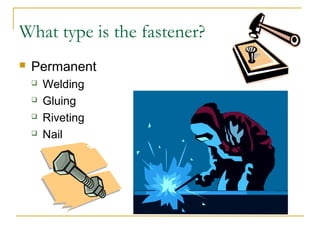
 Permanent
 Welding
 Gluing
 Riveting
 Nail
Is it a temporary Fastener?
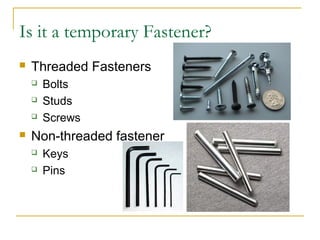
 Threaded Fasteners
 Bolts
 Studs
 Screws
 Non-threaded fastener
 Keys
 Pins
Why do we need Fasteners?
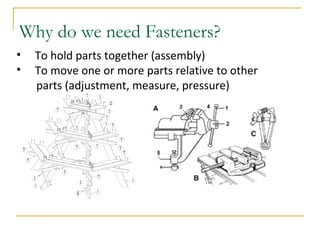
• To hold parts together (assembly)
• To move one or more parts relative to other
parts (adjustment, measure, pressure)
Power and movement
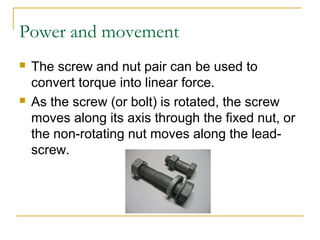
 The screw and nut pair can be used to
convert torque into linear force.
 As the screw (or bolt) is rotated, the screw
moves along its axis through the fixed nut, or
the non-rotating nut moves along the lead-
screw.
Internal & External Fasteners
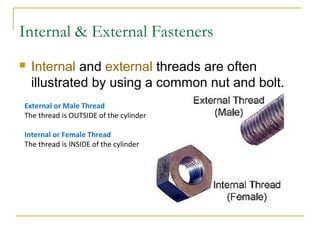
 Internal and external threads are often
illustrated by using a common nut and bolt.
External or Male Thread
The thread is OUTSIDE of the cylinder
Internal or Female Thread
The thread is INSIDE of the cylinder
Right & Left Handed Threads
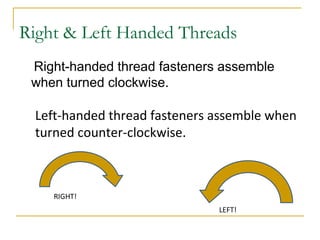
Right-handed thread fasteners assemble
when turned clockwise.
RIGHT!
LEFT!
Left-handed thread fasteners assemble when
turned counter-clockwise.
Clearance Fit
 This means the fasteners assemble without
interference.
Classes of fit
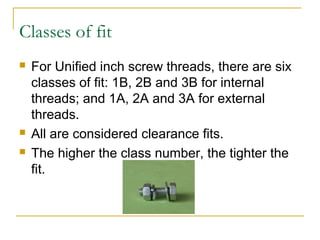
 For Unified inch screw threads, there are six
classes of fit: 1B, 2B and 3B for internal
threads; and 1A, 2A and 3A for external
threads.
 All are considered clearance fits.
 The higher the class number, the tighter the
fit.
A & B
Clearance Fit Continued
 1 is considered an extremely loose tolerance
thread fit. This class is suited for quick and
easy assembly and disassembly. For
mechanical fasteners, this thread fit is rarely
specified.
 You would see it as 1A and 1B for a loose fit
(A for external, B for internal) on drawings.
Clearance Fit Continued
 2 is the optimum thread fit that balances
fastener performance, manufacturing
economics, and convenience.
 Nearly 90% of all the commercial and
industrial fasteners produced in North
America are either 2A or 2B.
Clearance Fit Continued
 3A and 3B Class fits are best suited for very
precise, close tolerance fasteners.
 These fasteners are intended for service
where safety is a critical design
consideration.
 This class 3 has no allowance.
Thread Series
 Three standard thread series in the Unified
screw thread system are used for fasteners:
UNC (coarse), UNF (fine), and 8-UN (8
thread).
 The UNC and UNF are more common.
 Arguments are made for both fine and coarse
thread series. However, with increasing
automated assembly processes, industry is
biased towards the coarse thread series.
UNF – Fine Thread
 Larger stress areas means stronger in
tension situations
 Larger minor diameters develop higher
torsional and transverse shear strengths
 Tap better into thin-wall members or parts
 Smaller helix angle permits closer adjustment
accuracy
UNC – Coarse Thread
 Exhibit a better fatigue resistance
 Less tendency to cross thread
 Assemble and disassembles more quickly
(easier)
 Taps better into brittle materials or parts
 Larger thread allowances allow for thicker
coatings
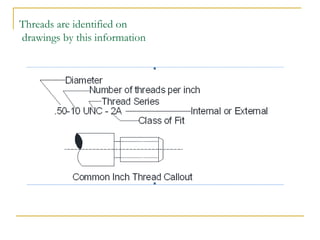
Threads are identified on
drawings by this information
Standards
 You see standards referenced in anything
you read about fasteners. These are
documented agreements regarding the
technical specifications and definitions of
materials, products, processes and services
that meet some agreed upon and established
quality.
 Several different international and regional
organizations work to help establish, check
and affirm specific industry standards.
ANSI
 American National Standard Institute
 Founded in 1918, ANSI serves as administrator and
coordinator for the United States private sectory voluntary
standardization system.
 ANSI promotes the use of US standards internationally,
advocates US policy and technical positions with other
international and regional standards organizations.
 ANSI does not develop the American National Standards:
rather, it facilitates development by working to gain consensus
among the ANSI member associations like ASTM, Society of
Automotive Engineers (SAE), Institute of Electrical and
Electronics Engineers (IEEE), and American Society of
Mechanical Engineers (ASME).
ASTM
 American Society for Testing and Materials
 ASTM is a scientific and technical organization formed
for the “development of standards on characteristics and
performances of materials, products, systems and
services; and the promotion of related knowledge.”
 Through technical committees, ASTM publishes
standardized test methodology, specifications, practices,
guides, classifications, and terminology.
 ASTM standards cover metals, paints, plastics, textiles,
petroleum, construction, environmental products,
medical services, electronics, fasteners, and other areas.
ASME
 American Society of Mechanical Engineers
 Founded in 1880, ASMe works to develop
codes and standards for the engineering
profession, the public, industry and
government.
 Currently, there are over 600 standards
published by ASME on topics such as screw
threads, valves, flow measurement and other
industrial products.
SAE
 Society of Automotive Engineers
 SAE was founded in 1905 and develops and
implements standards and safety specifically
used in designing, building, maintaining, and
operating self-propelled vehicles.
ISO
 International Organization for Standardization
 ISO is a specialized “multinational and multicultural
international organization with some 120-member countries
governed by consensus and spanning the breadth of global
technology.”
 The object of ISO is to promote the development of
standardization and related activities throughout the world.
 ISA brings together the interests of users (including
consumers), producers, governments and the scientific
community to form international standards covering
everything from screw threads to surgical implants.
 More than 800 standards committees and subcommittees
suppot another 2000 plus working groups.
Systems of Standards
 Two systems, the inch-pound (Imperial) and
metric, are used predominately in most
industrial nations.
 Which system are you most familiar with in
your own life?
Systems of Standards
 With the exception of the Untied States and a few other
nations, all countries in the world use the metric system
for their national standards.
 The world is working toward one version of metric,
known as the International System of Units, or SI.
Currently, the US is using both SI and Imperial
standards.
 Most countries that previously used the inch-pound
system, are moving to SI in new standards and limiting
the use of inch-pound products to maintenance parts for
older machinery and equipment.
Systems of Standards
 Many United States industries like the
automotive and agricultural industries have
implemented the metric system into their
operations.
 Another problem has been standardization of
the metric system.
 Although the intent is to fully convert most metric
specifications to an ISO standard, most
industries have been slow to convert from the
metric ANSI standards.
Example of standards
for a metric hex cap screw:
 The German Institute for Standardization would
apply: DIN931 or DIN933 for fully threaded
 The ISO standard would apply: ISO 4014 or ISO
4017 for fully threaded
 The ANSI/ASME standard would apply:
B18.2.3.1M
 This makes it difficult for manufacturers and is
one of the hurdles in moving completely to the
metric system in several countries.
Springs
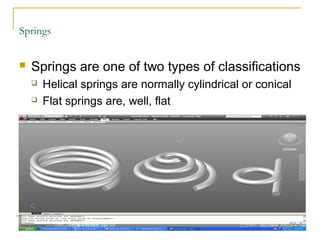
 Springs are one of two types of classifications
 Helical springs are normally cylindrical or conical
 Flat springs are, well, flat
Helical Springs
 Helical springs either push, hold, or turn. The
three types correspond to what they do.
 Compression springs push and offer
resistance to a pushing force
 Extension springs offers resistance to a
pulling force
 Flat springs are not standardized and are
designed for specialty situations. Think of a
spiral flat spring that powers a toy
Important Spring Dimensions
 Free Length is the overall length of a spring in
the unloaded position
 Solid Height is the length of a compression
spring under sufficient load so that all the coils
are touching the next one
 Spring Rate is the change in load per unit
deflection in pounds per inch (lb. /in.) or
Newtons per millimeter (N/mm).
What do You Really
Need to Know about Springs?
 What is the outside diameter?
 What is the inside diameter?
 What is the wire size?
 What is the free length?
 What is the solid length for a compression spring?
 What is the material?
 How many coils are in the spring?
 Is the direction of winding mentioned? If not, assume it is right handed.
 What is the torque data for a torsion spring?
 What is the finish required for the spring?
 Is the spring going to be treated in some way in manufacturing like
heat?
 Any other information needed to manufacture and use this spring in a
design.
Drawing Springs
 Two methods are often used to save
tremendous time in drawing springs.
 After all, the Bill of Materials or Callout contains
all the information required to manufacture the
spring or to place it in a working drawing.
 The first method shows the free length and
outside diameter only.
 Again the critical information is written rather
than drafted.
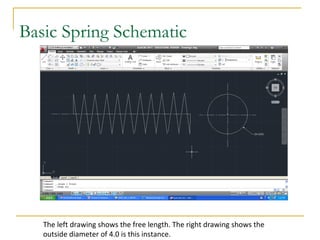
Basic Spring Schematic
The left drawing shows the free length. The right drawing shows the
outside diameter of 4.0 is this instance.
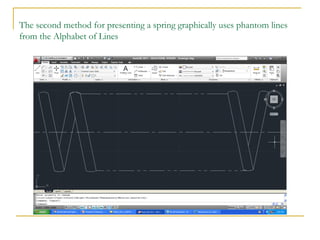
The second method for presenting a spring graphically uses phantom lines
from the Alphabet of Lines
Quick Review
 Two types of thread classes and three types of
fit
 1A, 2A, 3A are all External
 1B, 2B, 3B are all Internal
 1A, 1B is an extremely loose tolerance thread fit
 2A, 2B balances fastener performance,
manufacturing economics, and convenience.
 3A, 3B are best suited for very precise, close
tolerance fasteners
Read a call-out for a thread fastener
 .750-10 UNC-2A
 Nominal Diameter is .750
 Number of threads per inch is 10
 The thread series is UNC
 The class of fit is 2A (external, and the most
common fit)
Springs
 Are usually identified more by the call-out
than taking the time to draw each one
 Are either helical or flat
 Compress, extend or have a specialty
application

Engr ma 4_threads&fasteners_powerpoint

  • 2.
    What type isthe fastener?  Permanent  Welding  Gluing  Riveting  Nail
  • 3.
    Is it atemporary Fastener?  Threaded Fasteners  Bolts  Studs  Screws  Non-threaded fastener  Keys  Pins
  • 4.
    Why do weneed Fasteners? • To hold parts together (assembly) • To move one or more parts relative to other parts (adjustment, measure, pressure)
  • 5.
    Power and movement The screw and nut pair can be used to convert torque into linear force.  As the screw (or bolt) is rotated, the screw moves along its axis through the fixed nut, or the non-rotating nut moves along the lead- screw.
  • 6.
    Internal & ExternalFasteners  Internal and external threads are often illustrated by using a common nut and bolt. External or Male Thread The thread is OUTSIDE of the cylinder Internal or Female Thread The thread is INSIDE of the cylinder
  • 7.
    Right & LeftHanded Threads Right-handed thread fasteners assemble when turned clockwise. RIGHT! LEFT! Left-handed thread fasteners assemble when turned counter-clockwise.
  • 8.
    Clearance Fit  Thismeans the fasteners assemble without interference.
  • 9.
    Classes of fit For Unified inch screw threads, there are six classes of fit: 1B, 2B and 3B for internal threads; and 1A, 2A and 3A for external threads.  All are considered clearance fits.  The higher the class number, the tighter the fit.
  • 10.
  • 11.
    Clearance Fit Continued 1 is considered an extremely loose tolerance thread fit. This class is suited for quick and easy assembly and disassembly. For mechanical fasteners, this thread fit is rarely specified.  You would see it as 1A and 1B for a loose fit (A for external, B for internal) on drawings.
  • 12.
    Clearance Fit Continued 2 is the optimum thread fit that balances fastener performance, manufacturing economics, and convenience.  Nearly 90% of all the commercial and industrial fasteners produced in North America are either 2A or 2B.
  • 13.
    Clearance Fit Continued 3A and 3B Class fits are best suited for very precise, close tolerance fasteners.  These fasteners are intended for service where safety is a critical design consideration.  This class 3 has no allowance.
  • 14.
    Thread Series  Threestandard thread series in the Unified screw thread system are used for fasteners: UNC (coarse), UNF (fine), and 8-UN (8 thread).  The UNC and UNF are more common.  Arguments are made for both fine and coarse thread series. However, with increasing automated assembly processes, industry is biased towards the coarse thread series.
  • 15.
    UNF – FineThread  Larger stress areas means stronger in tension situations  Larger minor diameters develop higher torsional and transverse shear strengths  Tap better into thin-wall members or parts  Smaller helix angle permits closer adjustment accuracy
  • 16.
    UNC – CoarseThread  Exhibit a better fatigue resistance  Less tendency to cross thread  Assemble and disassembles more quickly (easier)  Taps better into brittle materials or parts  Larger thread allowances allow for thicker coatings
  • 17.
    Threads are identifiedon drawings by this information
  • 18.
    Standards  You seestandards referenced in anything you read about fasteners. These are documented agreements regarding the technical specifications and definitions of materials, products, processes and services that meet some agreed upon and established quality.  Several different international and regional organizations work to help establish, check and affirm specific industry standards.
  • 19.
    ANSI  American NationalStandard Institute  Founded in 1918, ANSI serves as administrator and coordinator for the United States private sectory voluntary standardization system.  ANSI promotes the use of US standards internationally, advocates US policy and technical positions with other international and regional standards organizations.  ANSI does not develop the American National Standards: rather, it facilitates development by working to gain consensus among the ANSI member associations like ASTM, Society of Automotive Engineers (SAE), Institute of Electrical and Electronics Engineers (IEEE), and American Society of Mechanical Engineers (ASME).
  • 20.
    ASTM  American Societyfor Testing and Materials  ASTM is a scientific and technical organization formed for the “development of standards on characteristics and performances of materials, products, systems and services; and the promotion of related knowledge.”  Through technical committees, ASTM publishes standardized test methodology, specifications, practices, guides, classifications, and terminology.  ASTM standards cover metals, paints, plastics, textiles, petroleum, construction, environmental products, medical services, electronics, fasteners, and other areas.
  • 21.
    ASME  American Societyof Mechanical Engineers  Founded in 1880, ASMe works to develop codes and standards for the engineering profession, the public, industry and government.  Currently, there are over 600 standards published by ASME on topics such as screw threads, valves, flow measurement and other industrial products.
  • 22.
    SAE  Society ofAutomotive Engineers  SAE was founded in 1905 and develops and implements standards and safety specifically used in designing, building, maintaining, and operating self-propelled vehicles.
  • 23.
    ISO  International Organizationfor Standardization  ISO is a specialized “multinational and multicultural international organization with some 120-member countries governed by consensus and spanning the breadth of global technology.”  The object of ISO is to promote the development of standardization and related activities throughout the world.  ISA brings together the interests of users (including consumers), producers, governments and the scientific community to form international standards covering everything from screw threads to surgical implants.  More than 800 standards committees and subcommittees suppot another 2000 plus working groups.
  • 24.
    Systems of Standards Two systems, the inch-pound (Imperial) and metric, are used predominately in most industrial nations.  Which system are you most familiar with in your own life?
  • 25.
    Systems of Standards With the exception of the Untied States and a few other nations, all countries in the world use the metric system for their national standards.  The world is working toward one version of metric, known as the International System of Units, or SI. Currently, the US is using both SI and Imperial standards.  Most countries that previously used the inch-pound system, are moving to SI in new standards and limiting the use of inch-pound products to maintenance parts for older machinery and equipment.
  • 26.
    Systems of Standards Many United States industries like the automotive and agricultural industries have implemented the metric system into their operations.  Another problem has been standardization of the metric system.  Although the intent is to fully convert most metric specifications to an ISO standard, most industries have been slow to convert from the metric ANSI standards.
  • 27.
    Example of standards fora metric hex cap screw:  The German Institute for Standardization would apply: DIN931 or DIN933 for fully threaded  The ISO standard would apply: ISO 4014 or ISO 4017 for fully threaded  The ANSI/ASME standard would apply: B18.2.3.1M  This makes it difficult for manufacturers and is one of the hurdles in moving completely to the metric system in several countries.
  • 28.
    Springs  Springs areone of two types of classifications  Helical springs are normally cylindrical or conical  Flat springs are, well, flat
  • 29.
    Helical Springs  Helicalsprings either push, hold, or turn. The three types correspond to what they do.  Compression springs push and offer resistance to a pushing force  Extension springs offers resistance to a pulling force  Flat springs are not standardized and are designed for specialty situations. Think of a spiral flat spring that powers a toy
  • 30.
    Important Spring Dimensions Free Length is the overall length of a spring in the unloaded position  Solid Height is the length of a compression spring under sufficient load so that all the coils are touching the next one  Spring Rate is the change in load per unit deflection in pounds per inch (lb. /in.) or Newtons per millimeter (N/mm).
  • 31.
    What do YouReally Need to Know about Springs?  What is the outside diameter?  What is the inside diameter?  What is the wire size?  What is the free length?  What is the solid length for a compression spring?  What is the material?  How many coils are in the spring?  Is the direction of winding mentioned? If not, assume it is right handed.  What is the torque data for a torsion spring?  What is the finish required for the spring?  Is the spring going to be treated in some way in manufacturing like heat?  Any other information needed to manufacture and use this spring in a design.
  • 32.
    Drawing Springs  Twomethods are often used to save tremendous time in drawing springs.  After all, the Bill of Materials or Callout contains all the information required to manufacture the spring or to place it in a working drawing.  The first method shows the free length and outside diameter only.  Again the critical information is written rather than drafted.
  • 33.
    Basic Spring Schematic Theleft drawing shows the free length. The right drawing shows the outside diameter of 4.0 is this instance.
  • 34.
    The second methodfor presenting a spring graphically uses phantom lines from the Alphabet of Lines
  • 35.
    Quick Review  Twotypes of thread classes and three types of fit  1A, 2A, 3A are all External  1B, 2B, 3B are all Internal  1A, 1B is an extremely loose tolerance thread fit  2A, 2B balances fastener performance, manufacturing economics, and convenience.  3A, 3B are best suited for very precise, close tolerance fasteners
  • 36.
    Read a call-outfor a thread fastener  .750-10 UNC-2A  Nominal Diameter is .750  Number of threads per inch is 10  The thread series is UNC  The class of fit is 2A (external, and the most common fit)
  • 37.
    Springs  Are usuallyidentified more by the call-out than taking the time to draw each one  Are either helical or flat  Compress, extend or have a specialty application